
The first time I walked the property off Brockett Road, the homeowner met me on the deck holding a printed estimate from another contractor and a look that said tell me this number is wrong. The pool was a 1994-built Lake Capri rectangle — original Anthony Pools shell, original copper return lines, a Pentair heater that had a sticker on it dated 2008, and a deck pitched the wrong direction from twenty-six years of clay settlement. She had budgeted $25,000 for a “refresh.” She walked out of the project at $42,800, and every dollar of the overage went to the things she didn’t know to ask about.
This is a project story, not a brochure. One pool, one homeowner, one decision chain — every line item, what we kept, what we replaced, and why. If you own a 1990s pool in Clarkston, you are almost certainly looking at the same nine decisions she was. The numbers will not be identical to yours, but the framework will.
Clarkston is a renovation market, not a new-build market. The original 1960s through 1980s housing stock in Lake Capri, Idlewood, and the Brockett Road corridor came with a wave of in-ground pools built between roughly 1975 and 1998. Those pools are now 28 to 50 years old. They were built before NEC §680 was rewritten, before the VGB Act of 2008 mandated split drains, before variable-speed pumps existed as a residential category, and during an era when copper plumbing in chlorinated water was still considered acceptable practice. Walking onto one of these projects is closer to forensic work than design work.
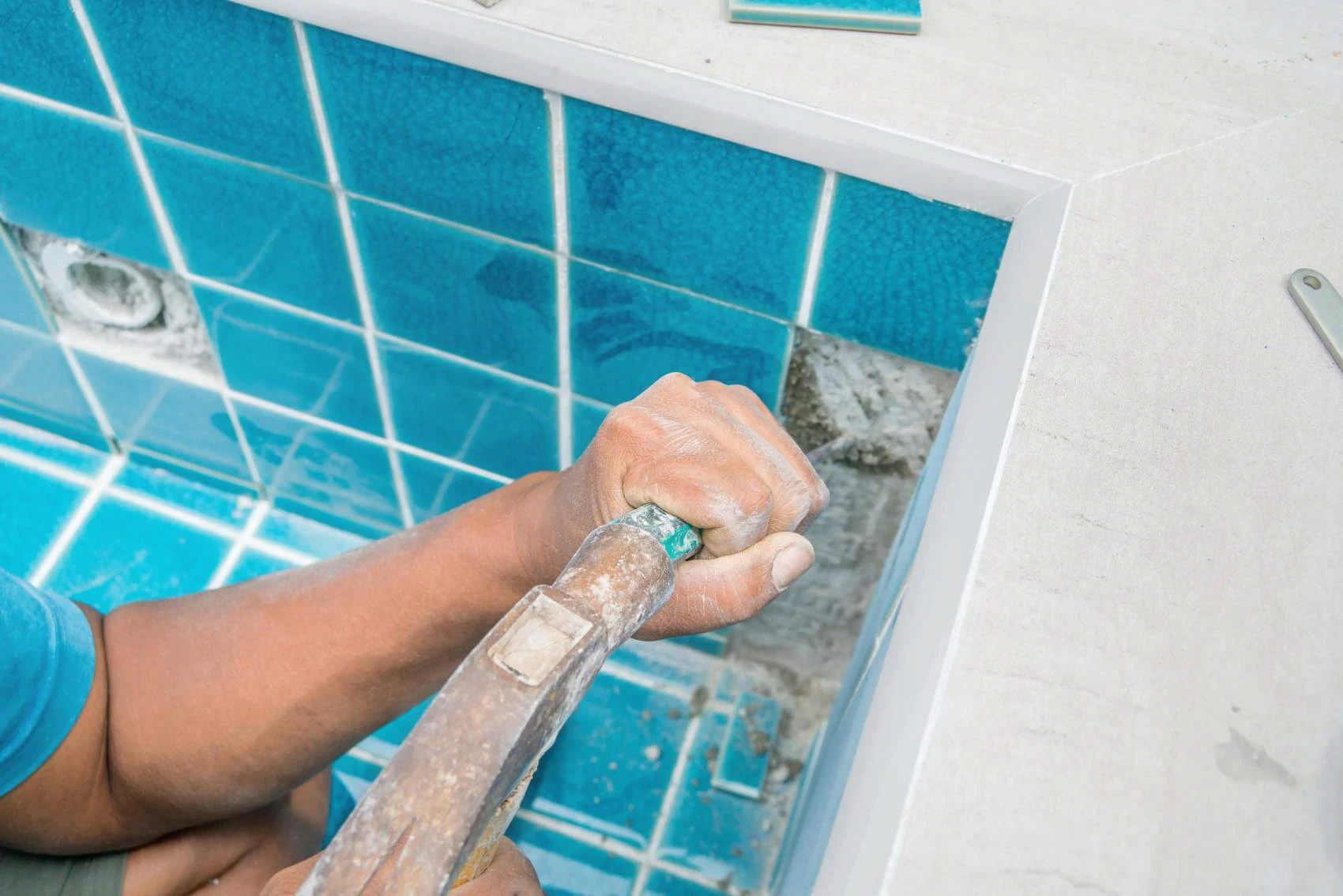
Shell Assessment — Day One on the Deck
Before anyone talks about plaster, pebble, or color palettes, somebody walks the shell. On the Lake Capri pool that meant draining to the floor drains, pressure-washing the interior, and reading the gunite like a survey map. The shell was a 35-year-old Anthony Pools rectangle, 16×32 with a transitional deep end. The gunite itself was sound — surprisingly so. Two hairline cracks in the shallow shelf, one moderate diagonal at the deep-end transition that needed a structural staple-and-patch before any finish work.
The bond beam was the bigger story. The top four inches of the perimeter had a soft band where freeze-thaw water had wicked behind the original waterline tile for years. You could push a screwdriver tip into it. That meant any new waterline tile would need a fresh substrate — we couldn’t just chip and re-set on the existing beam.
The good news on the shell was that the original gunite was 8 inches thick at the floor and 10 inches at the bond beam, which was generous for a 1994 build. Some of the cheaper 1990s pools in the Clarkston market came in at 4 to 6 inches and crack catastrophically by the 30-year mark. This one had structural runway left for another 25 years if we did the rehab right.
What we kept: the shell itself, the basic geometry, and roughly 40% of the bond beam. What we replaced: the upper four inches of bond beam perimeter, both shallow-end cracks (cosmetic), and the deep-end diagonal (structural). Line-item cost: $4,200 for shell prep, crack stitching, and bond beam patch.
What to Keep — The Decisions That Saved Real Money
The instinct on a 1990s renovation is to tear out everything. That instinct is wrong, and following it is how a $25,000 budget becomes a $70,000 budget. On the Lake Capri project we kept four things that another contractor’s estimate would have replaced — and the savings funded the upgrades that actually mattered.
First, the shell. As above. A sound 1994 gunite shell is worth roughly $22,000 to replicate today. Keeping it was not a compromise; it was a structural inheritance.
Second, the basic plumbing trenches. The PVC suction line on the skimmer side was original Schedule 40 from 1994 and tested clean at 25 PSI for 20 minutes — no leaks, no root intrusion. That line stays. The return side was the copper that had to go (we’ll get there), but pulling out a perfectly functional suction line just because the rest of the system was getting touched would have added $1,800 to the bill for zero benefit.
Third, the original main drains — kind of. The drain pots themselves and the trunk line back to the pump were fine. What had to change was the cover and the split-drain configuration, mandated by the VGB Act 2008. We retrofit the existing drain ports with compliant covers and added a second port to create the dual-suction split. That’s $1,400 versus $4,800 for full drain replacement.
Fourth, the steel hopper steps and the rebar bench in the shallow end. Both were structurally sound, both were going to be replastered anyway, and ripping them out would have added a week of demo and pour to a project that already had a five-week timeline.
Plumbing Overhaul — The Copper Comes Out
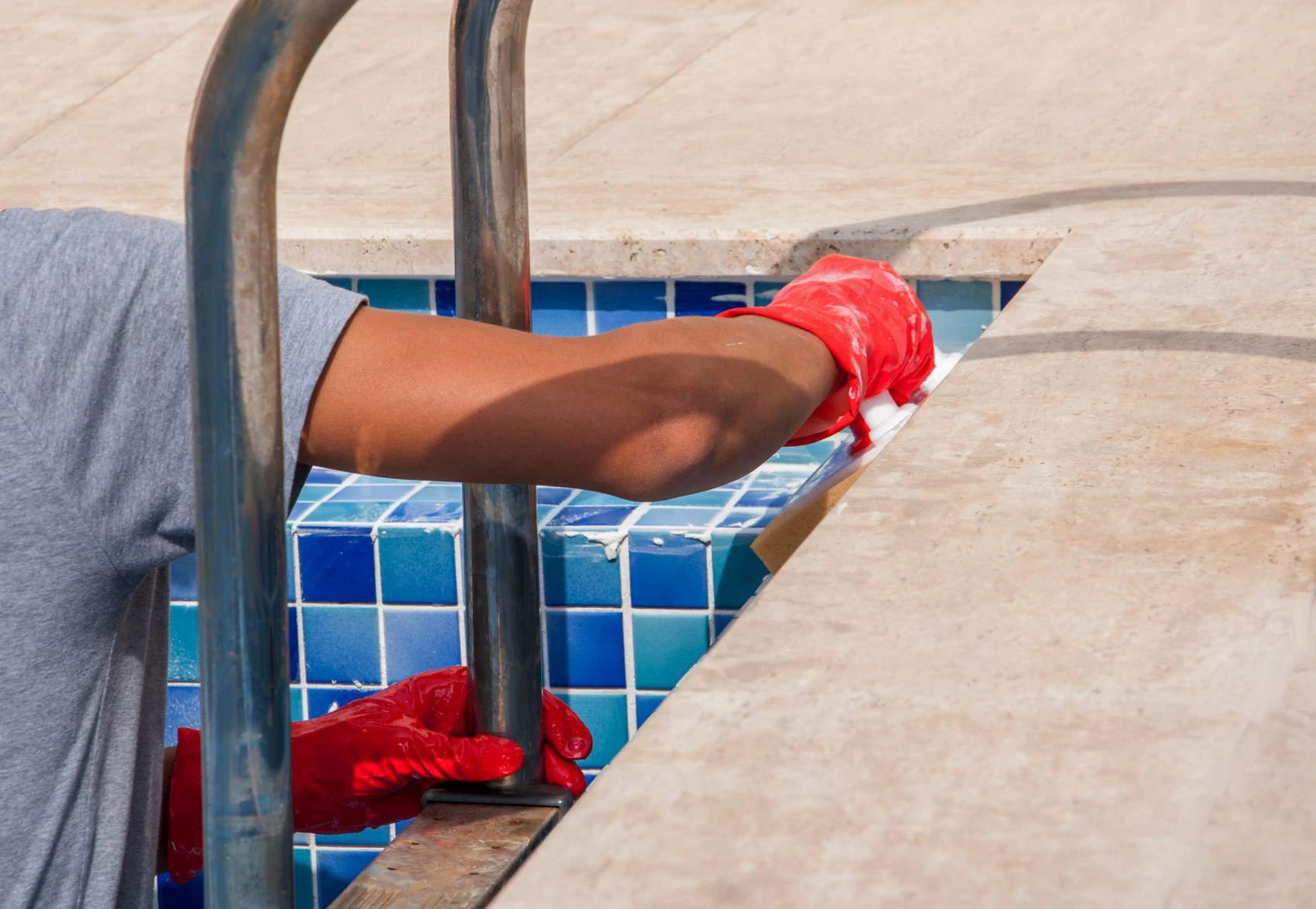
Nothing about a 1990s pool renovation in Clarkston matters more, in my opinion, than what happens to the copper return lines. Many builds from that era used soft-tempered copper for the returns — cheaper than PVC at the time, easier to bend, and considered durable. What they didn’t anticipate was three decades of chlorinated water plus DeKalb County water hardness running through that copper at 30 to 50 gallons per minute, pinhole-corroding the inside walls and dumping copper sulfate into the pool every time the pump ran.
On the Lake Capri project, the original copper returns measured 0.875″ interior diameter when new. By 2024, two of the three return runs were under 0.5″ effective ID from internal scale and corrosion buildup. The third had a slow pinhole that had been quietly losing water for years — the homeowner thought she had an evaporation problem.
All three return runs got pulled and replaced with 2-inch Schedule 40 PVC on the trunk run from the pump, branching to 1.5-inch at the eyeball returns. The new sizing alone increased flow capacity by roughly 40% and dropped the head loss enough that the new variable-speed pump could run at 1,200 RPM for filtration instead of the 2,400 the old single-speed system had needed. That is the difference between a $90 power bill and a $35 power bill per month for the pump alone.
We also pressure-tested every original suction line at 25 PSI for 15 minutes, located one slow leak under the deck that had been masquerading as evaporation since at least 2019, and spot-repaired it with a coupler under an access cut. Plumbing line-item: $5,400.
Equipment Pad — Building a System, Not a Pile
The original equipment pad on the Lake Capri pool was a museum: 1994 Hayward single-speed pump (replaced with another single-speed in 2011), 2015 Pentair cartridge filter, an 18-year-old heater (a 2006 Pentair MasterTemp 250k BTU that had been “working” in the sense that it cycled on, ran for 90 seconds, and shut off on a sail switch fault about half the time), an erosion-style chlorinator bypassed with a floating dispenser since 2017, and a Pentair Intermatic mechanical time clock from the original install.
None of it talked to anything else. None of it was sized for the new plumbing we’d just laid. And none of it was going to support a fresh pebble interior without scaling, staining, or eating the heater exchanger within two seasons.
Here’s the pad we built to replace it, with line-item pricing:
- Pentair IntelliFlo3 VSF variable-speed pump (1.5 HP): $2,400 installed, including new union fittings, flow-rate programming, and 240V hardwire to the panel.
- Pentair Clean & Clear Plus 520 sq ft cartridge filter: $1,300 installed. Cartridge over DE was the homeowner’s call — she didn’t want the DE backwash routine.
- Pentair MasterTemp 400k BTU natural gas heater: $4,600 installed. The original gas line ran 3/4-inch and tested at 7 inches WC — adequate but at the bottom of spec. We left it.
- Jandy AquaPure 1400 salt cell + power center: $1,700 installed. The homeowner had been chasing chlorine tablets for ten years and was ready for salt.
- Pentair IntelliCenter automation controller (8-relay): $2,200 installed, including app pairing and tablet-side configuration.
Equipment pad line-item total: $12,200. That’s roughly 28% of the total renovation budget — and on a 1990s pool, that ratio is usually right. The pad is the system that keeps every other dollar you spend on the project working correctly.
What to demand in your renovation contract: Every piece of equipment must be listed by manufacturer, model, and horsepower or BTU rating. Not “VS pump” — Pentair IntelliFlo3 VSF 1.5 HP. Not “heater” — Pentair MasterTemp 400k BTU, natural gas. Vague equipment lines are how contractors substitute house-brand or off-spec equipment after the contract is signed, and you never find out until the warranty card arrives in the mail.
Plaster vs. Pebble — The Interior Decision
The Lake Capri pool’s original plaster had been resurfaced once before, in 2008, with standard white marcite. By 2024 it was etched, mottled, and stained at the waterline — about what you’d expect from 16 years of DeKalb County water running through it. DeKalb water hardness sits at roughly 110 to 140 ppm calcium carbonate, which is harder than Gwinnett’s typical 80 ppm and meaningfully harder than the Northern Atlanta service area average. Hard water eats standard plaster faster.
The honest comparison on this pool came down to three options:
- Standard white marcite plaster: $6,200 chip-out and replaster. Working lifespan in DeKalb water: 7 to 9 years before the next resurface. Cheapest upfront, most expensive over a 20-year horizon.
- Quartz aggregate plaster (StoneScapes or equivalent): $8,400. Working lifespan: 10 to 14 years. Middle ground on price and durability, slightly more texture to the touch.
- Pebble interior (Pebble Tec Pebble Sheen): $11,200. Working lifespan: 15 to 22 years in DeKalb water if the chemistry is managed correctly. Highest upfront, lowest cost per year over a 20-year hold.
The homeowner picked pebble. Two reasons drove it: she planned to be in the house another 20 years and didn’t want to do this again at year 8, and the new salt cell + automation pad meant water chemistry would actually be managed correctly rather than chased reactively. Standard plaster behind a properly run salt system can hit 12 years; standard plaster behind a chlorine-floater-and-hope-for-the-best system rarely makes 8.
Interior finish line-item: $11,200.
Coping & Deck — The Two Most Visible Changes
The original coping on the Lake Capri pool was 1994 cantilever concrete — a poured deck that flowed over the bond beam in a smooth, lipped edge. It had two problems. First, it was cracked in four places where the deck had settled and pulled the cantilever down with it. Second, it was forming the original deck and the original coping as one monolithic piece, which meant any deck repair required coping repair and vice versa.
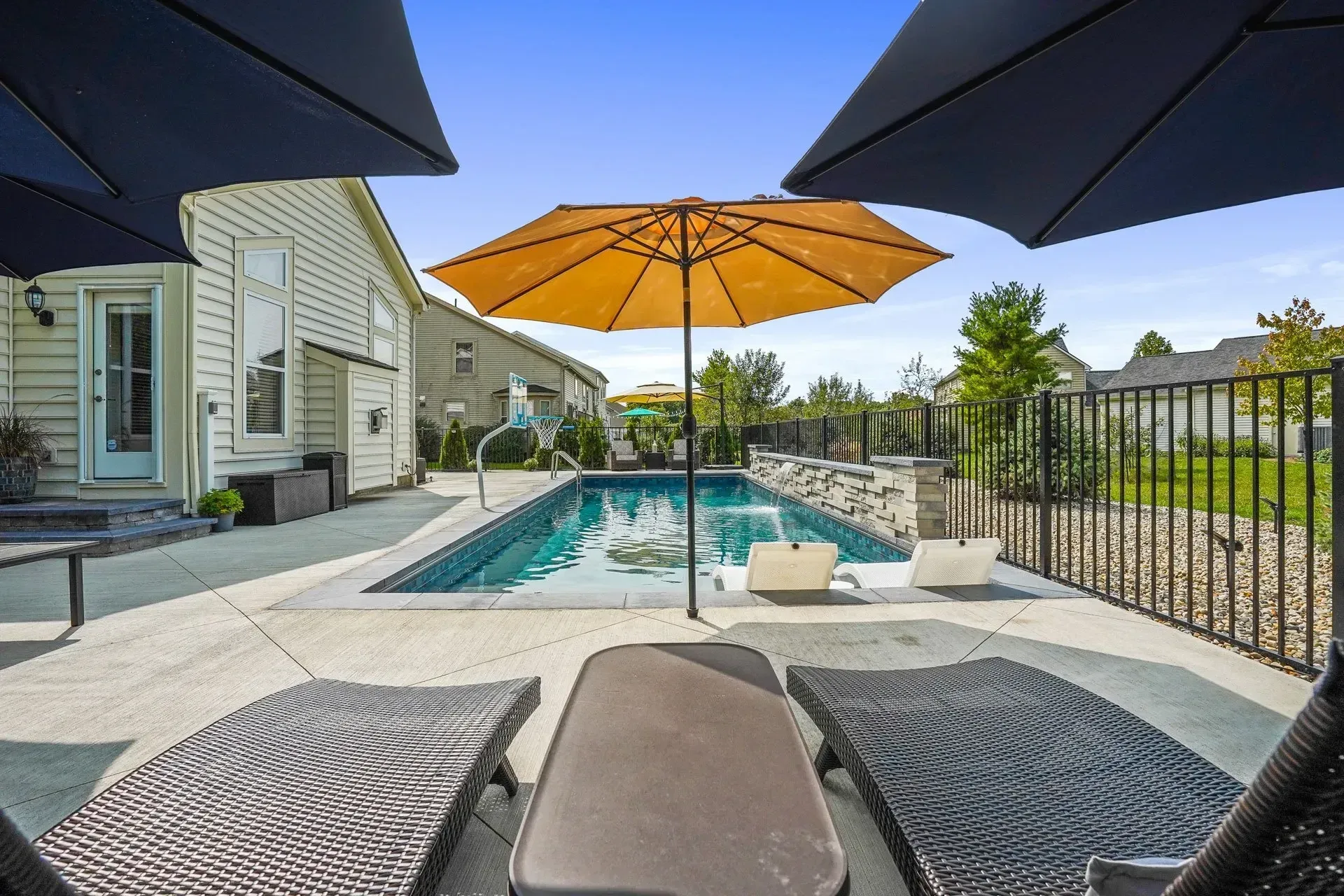
We changed the strategy entirely: removed the cantilever, demoed the original deck back six feet from the pool edge on three sides (full demo on the long side, partial on the short sides), and installed separate travertine coping with a structural mortar bed on top of the rebuilt bond beam. New deck went down as 4-inch reinforced concrete with a broom finish, sloped at 1/4 inch per foot away from the pool, with a linear drain at the far edge of the entertaining side to catch runoff before it could ever migrate back toward the coping.
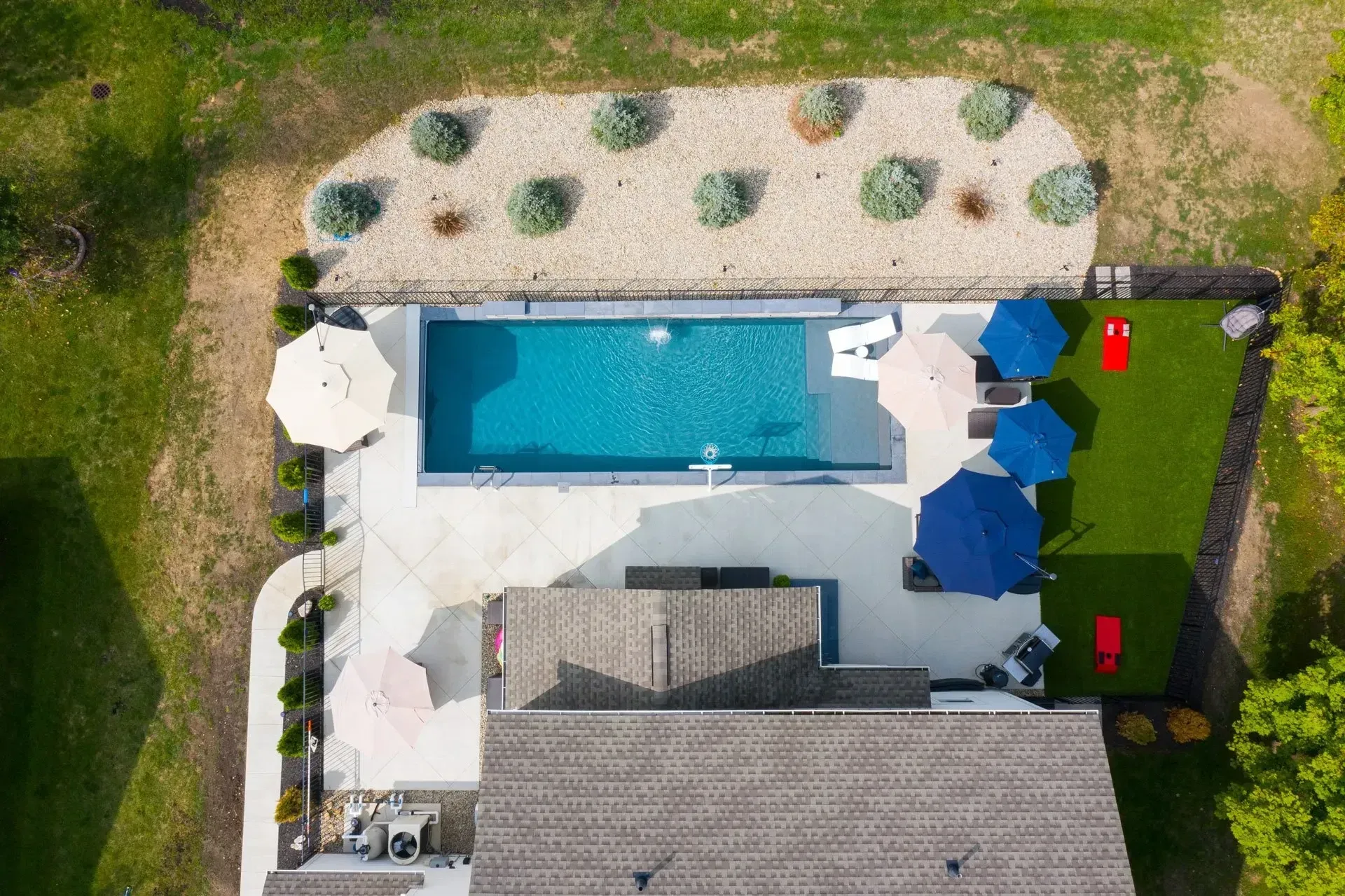
The travertine choice was practical: Clarkston summer afternoons hit 90+ degrees, and the homeowner had small grandkids who’d be on the deck barefoot. Travertine reads roughly 15 to 20°F cooler than the broom-finish concrete it bordered. The aesthetic upgrade was the bonus; the foot-temperature decision was the driver.
Coping + deck line-item: $8,900. That breaks down as $2,400 for the travertine coping (35 linear feet, ivory unfilled), $5,800 for deck demo and repour with linear drain, and $700 for new mastic and expansion joint work between the deck and the bond beam.
Lighting — Pulling the Old Niches Was the Hardest Decision
The 1994 Anthony Pools build came with two 500-watt incandescent niches — original technology that drew 1,000 watts combined and produced a yellow-tinted pool of light that didn’t really illuminate the water so much as remind you that the lights were on. Worse, both niches were wired through the original junction box that predated NEC §680‘s current bonding requirements. The cord assemblies were brittle, the gaskets had failed, and one niche had been taking on water for at least two summers.
The hardest decision in this section wasn’t whether to relight — it was whether to keep the existing niche shells and just swap LED retrofits inside them. Retrofit costs are roughly $400 per niche; full housing replacement runs $1,400 per niche because you’re cutting through the shell and tying into the bond ring on each one.
We pulled the housings. The original niche shells were corroded at the conduit entry, and any retrofit would have inherited that corrosion plus the pre-NEC bonding. Two new Pentair IntelliBrite 5G LED color-changing niches went in with new bond connections to the rebar grid, new GFCI breaker at the panel, and tested-grounded conduit runs back to the pad. The whole system now draws 90 watts combined instead of 1,000, and the controller dims, color-shifts, and runs scheduled scenes through the IntelliCenter automation.
Lighting line-item: $2,800. Plus $400 in electrical work for the GFCI breaker upgrade and panel-side conduit run.
Automation & Code Compliance — The Quiet Upgrades That Matter Most
Two upgrades on this project will never show up in a real estate listing photo, and they’re the two that matter most for the long-term safety and operating cost of the pool.
First, the equipotential bonding loop. Pre-1995 pools in Clarkston frequently fail current NEC §680 inspection because the bonding wire (#8 AWG bare copper) buried in the original deck has corroded at the lugs and at the rebar tie-ins. On the Lake Capri pool, we pulled a galvanic voltage reading between the water and the pool ladder of 0.41 volts before renovation — above the 0.3V threshold where stray voltage becomes a real concern. The bond ring was reconnected to the rebar grid in three places during the bond beam patch, new lugs installed at every metal element within 5 feet of the water (ladder, handrail, light niches, pump, heater, salt cell), and the post-renovation reading came in at 0.04V. That’s a quiet number that hides a real safety upgrade.
Second, the VGB Act 2008 split-drain retrofit. The original single main drain was a 12-inch flat cover — pre-VGB, technically illegal to operate a pool with under current federal law, and a documented entrapment hazard for any small swimmer. We added a second drain port at a code-compliant spacing, installed dual VGB-listed anti-entrapment covers, and rebalanced the suction split through the pump manifold so a single blocked cover can never produce enough suction to entrap.
The pricing reality nobody quotes upfront: Bonding inspection and corrective work on a pre-1995 Clarkston pool runs $1,800 to $4,600 depending on how much copper has to come out of the deck. VGB drain retrofit on an existing single-drain layout runs $1,400 to $2,200. Together that’s $3,200 to $6,800 — and on most renovation estimates from contractors who don’t specialize in 1990s rehabs, this work simply doesn’t appear. Not because they’re hiding it. Because they’re not looking for it. Ask explicitly about bonding test readings and VGB compliance before signing any renovation contract.
Automation, bonding, and VGB line-item: $4,300.
The Numbers — Line by Line, $42,800 Total
Here is the project, line by line, the way it actually got billed:
- Shell prep, crack stitching, bond beam patch — $4,200
- Plumbing overhaul (copper return removal, new 2″ Schedule 40 PVC, pressure testing, leak repair) — $5,400
- Equipment pad (IntelliFlo3 VSF pump, Clean & Clear Plus filter, MasterTemp 400k heater, Jandy AquaPure salt cell, IntelliCenter automation) — $12,200
- Pebble interior finish (Pebble Tec Pebble Sheen, full chip-out, new waterline tile) — $11,200
- Coping & deck (travertine coping, partial deck demo/repour, linear drain) — $8,900
- Lighting (two Pentair IntelliBrite 5G LED housings, GFCI breaker upgrade, new conduit) — $3,200
- Automation, bonding, and VGB compliance (NEC §680 bond loop rework, dual drain retrofit, automation final commissioning) — $4,300
- DeKalb County permit + inspection fees — $420
- Contingency (used on a deeper-than-expected deck cut on the long side) — $2,180
Total: $42,800.
The homeowner came in expecting $25,000 because that was the resurface-plus-light-cosmetics number she’d been quoted by two other contractors. Neither of those quotes included plumbing replacement. Neither included bonding rework or VGB compliance. Neither included equipment pad replacement. One of them included a heater “evaluation” that would have charged a separate visit fee to determine that the 2006 unit needed replacing — a determination anyone with eyes on the equipment for ten minutes could have made.
The honest range for a comprehensive 1990s pool modernization in Clarkston lands between $32,000 and $58,000. The variables are deck size, equipment selection (gas heater vs. heat pump adds $2,000 to $3,500 of swing), interior finish choice, and how much of the original plumbing comes out. The Lake Capri project sat in the middle of that range — average size, mid-tier finishes, full plumbing replacement, premium equipment. A smaller pool with a tighter scope can land at $32,000. A larger pool with a full deck rebuild and a heat pump add lands at $55,000 or more.
DeKalb County’s permit turnaround for residential pool renovation runs 3 to 4 weeks — slower than Gwinnett’s 10 to 14 days, faster than Fulton unincorporated. Plan your project timeline accordingly: from contract signature to first swim on a project like this is typically 9 to 12 weeks, with permit time accounting for roughly a third of that calendar.
If you own a 1990s pool in Lake Capri, Idlewood, the Brockett Road corridor, or anywhere else in DeKalb County where the original Anthony or Sylvan or Gunite Pools shells are now pushing 30+ years, you are not necessarily looking at a tear-out. The shell is almost always the asset. The plumbing, the pad, the bonding, the drains, the deck — those carry the failures. Replace what’s failed. Keep what’s worked. Pay the contractor who tells you which is which.
Pool renovations across 20+ cities within 30 miles of Winder, GA
We evaluate every 1990s Clarkston pool the same way: shell, plumbing, pad, bonding, drains, deck — line by line, in writing, before a single dollar of scope gets committed.