
Eighty percent of the outdoor kitchens quoted in DeKalb County are the same kitchen: an L-shaped 14-foot run with five appliances, a granite top, and a stacked-stone veneer base. It looks impressive on the contract, photographs beautifully the day it’s finished, and then sits unused from mid-October to mid-March while the homeowner cooks indoors like they always did. The question isn’t what fits — the question is what earns its footprint year after year.
Most outdoor-kitchen sales pitches start with a template: main grill, side burner, refrigerator, storage drawers, plus a power burner or ice chest. The base is a CMU shell wrapped in dry-stack veneer. Everything bolted in place, no flexibility. Lifetime cost — including gas, water, electrical, footing, drainage, and finish — runs $24,000 to $58,000.
The problem isn’t the price. The problem is that most of those kitchens get used about twelve to twenty cook sessions per year. That’s cost-per-session north of $1,400. By comparison, a $1,800 freestanding pellet grill on a covered patio with a small prep counter gets used forty to sixty times a year. Something in the math is broken.
Clarkston has variables that make the standard template even less appropriate. DeKalb County logs 8 to 14 freeze events per year — enough to crack ceramic ice makers and split copper water lines, but not enough to justify a fully winterized appliance suite. Annual rainfall sits around 52 inches, and the tree canopy on older Lake Capri and Idlewood lots keeps most backyards damp longer than the open lots up in Forsyth. Lot sizes are tighter — a 1965-vintage Lake Capri parcel gives you maybe 18 to 30 feet of usable patio width, not 50. The kitchen has to earn every square foot.
What follows is the eight-question diagnostic we walk every Clarkston client through before drawing a kitchen plan.
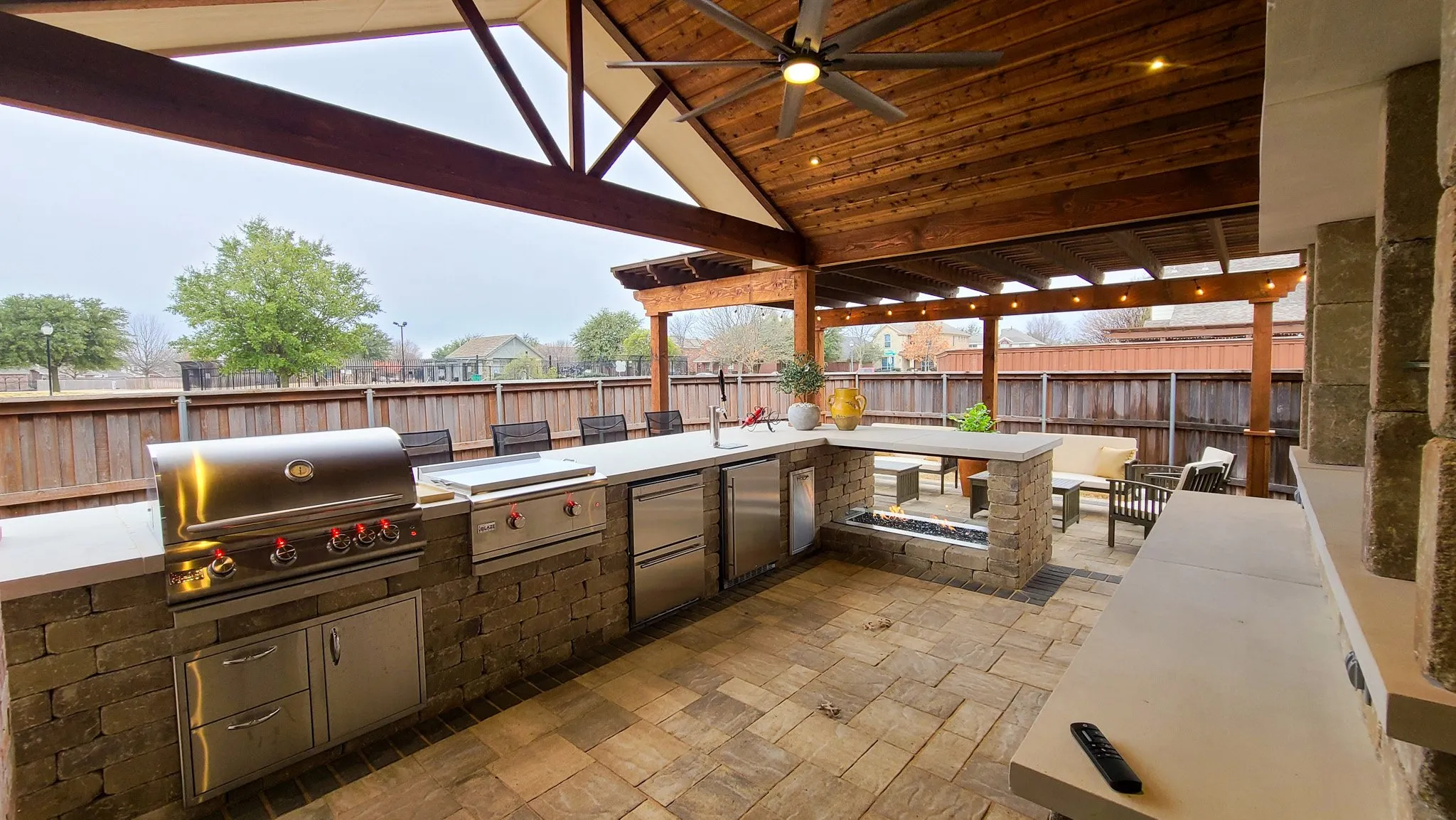
Do I really need a built-in grill, or will a top-tier freestanding do?
This is the first question and it kills more bad projects than any other. The honest answer for most Clarkston homeowners is that a top-tier freestanding cart will outperform a mid-tier built-in for less than half the installed cost, and you’ll never know the difference except on the contract.
A Lynx 36″ Smart Grill built-in lists around $7,400 before the cabinet, gas line, and granite cutout. By the time it’s installed in a CMU surround with stone veneer, you’re at $14,500 to $17,000 for the grill zone alone. A Weber Genesis SX-435 freestanding lands at $1,799 and gives you the same 75,000 BTU main burner capacity, the same primary grilling area, and the advantage that you can roll it out from under the eave to clean it without dismantling stonework. The built-in wins on three things: aesthetics, the perception of permanence, and the ability to leave a heavy stainless lid open in the wind without it slamming.
Built-in only earns its premium when three things are true: the kitchen is the household’s primary cooking appliance (60+ uses/year), the backyard is a primary entertaining space (8+ events/year), and the homeowner stays at least seven years. One of three and you’re buying a built-in because you saw it on Instagram.
The honest brand stack at three price tiers: Entry built-in — Coyote C-Series 36″ at roughly $2,800 for the grill head, full kitchen install $18,000 to $24,000. Mid-tier — Twin Eagles 30″ at $5,600 grill head, full kitchen $28,000 to $36,000. Premium — Kalamazoo Hybrid Fire at $19,500 grill head (runs gas, charcoal, and wood), full kitchen $58,000 to $84,000. The Kalamazoo is the only built-in we sell without flinching because it does something a freestanding genuinely cannot.
How big should the prep counter actually be?
The standard quote shows you a 14-foot run. Half of that is appliance face. The remaining usable counter is closer to 60 to 72 linear inches, broken into two awkward segments on either side of the grill cutout. That’s not enough prep space to plate four entrees, and there’s nowhere to set a tray of raw protein down without it touching the granite that just held cilantro.
The number that works in Clarkston-sized backyards is 36 inches of continuous, uninterrupted prep counter on one side of the grill, minimum. Forty-eight is better. This is the single most-skipped spec because every additional 12 inches of counter is another $180 to $240 in stone, another foot of base, and one more square foot the design has to justify. It is also the single most-loved feature once it’s built — every client who pushed back on it during design has thanked us for it after the first summer.
The reason 36 inches matters is geometry, not opinion. A standard half-sheet tray is 18 by 13. You need room for two trays side by side (raw on the left, cooked on the right) plus enough margin to set down a glass, a phone, and a pair of tongs without anything crowding the heat zone within 18 inches of the grill body. If you can’t lay all of that out without stacking, you’ll cook indoors.
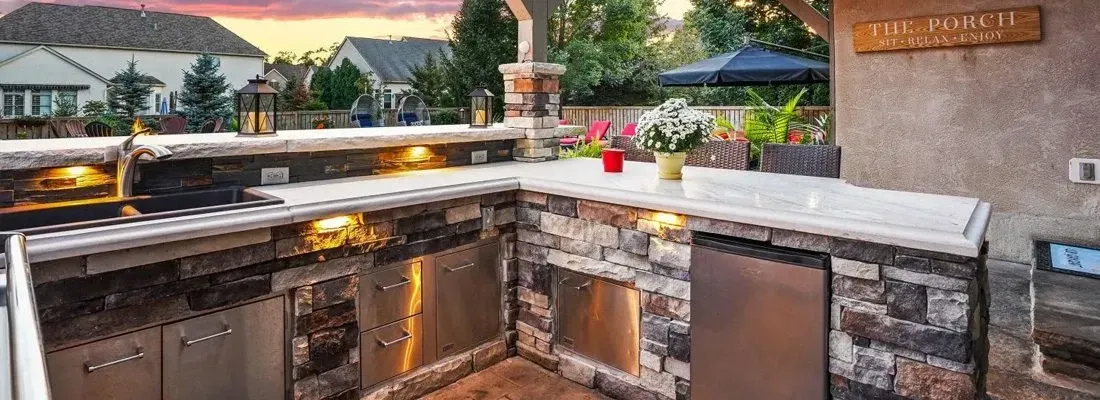
Is a side burner worth $800?
A built-in side burner adds roughly $800 to $1,200 to the appliance line, another $200 to $300 in cabinet cutout and gas-line run, and a permanent footprint of about 14 by 22 inches that you can’t repurpose later. The 12,000 BTU output is enough to boil a small pot or sweat onions. It is not enough to do a serious sear in a cast-iron pan against any wind at all, which means it gets used three or four times a year for corn on the cob and then it sits.
Side burners earn their footprint in exactly one scenario: low-country boils, crab steams, or fish fries where you need a sustained outdoor flame for an hour-plus and you don’t want the smell inside. If your household runs three or more of those events a year, install the side burner — and install the 18,000 BTU power burner upgrade instead of the standard 12,000 unit, because the standard unit will not maintain a rolling boil in a 24-quart pot with the lid off. If you cook a low-country boil twice ever, buy a propane bayou burner for $89 and store it in the garage. It will outperform the built-in and it will not occupy 308 square inches of granite.
The honest version of this question is whether you’re buying the side burner or whether the contractor is selling it because it pads the appliance line. Ask.
Smoker, pellet grill, or pizza oven — which earns its keep?
This is where outdoor-kitchen decisions get personal, and it’s also where most homeowners spend money on the appliance they thought they’d love instead of the one they actually use.
The honest breakdown, after building these kitchens for two decades across DeKalb, Gwinnett, and Rockdale:
Pellet grills — Traeger Timberline ($2,799) or Weber SmokeFire EX6 ($1,499) — are the highest-use auxiliary cooker in our client base. They run set-and-forget, the temperature holds within 15 degrees, and they’re forgiving enough that a Tuesday-night chicken at 375°F is no harder than turning on the oven. Forty-plus cook sessions a year is normal. Build them in or leave them on a cart on a paver pad nearby — the cart version is functionally equivalent.
Smokers — the Big Green Egg XL ($1,449 plus $300 in accessories) — get used hard for two summers and then less. The all-day brisket cook is a special-occasion event, not a Wednesday-night dinner. Owners who already smoke meat as a hobby will love it. Owners who think they’ll start are buying a beautiful ceramic vessel that will live under a cover for three years.
Pizza ovens — the wood-fired masonry kind, $4,800 to $14,000 installed — are the most photographed and least used of the three. The fire-up cycle is 45 minutes minimum, the wood is messy, the cleanup takes another 30 minutes, and most homeowners hit the wall after the fifth pizza night. The gas-fired countertop alternatives like the Ooni Karu 16 ($799) deliver 90% of the result with 10% of the friction. If your kids love pizza nights, buy the Ooni. If you genuinely love the ritual of wood fire, build the masonry oven — but go in knowing you’re buying a beautiful piece of theater.
Refrigerator: full-size, drawer, or kegerator?
Outdoor refrigeration is where the largest hidden cost lives. A standard built-in outdoor-rated refrigerator like the U-Line UORE124 runs $1,899 to $2,400 for the unit, plus a dedicated 20-amp circuit, plus the cutout, plus the long-term reality that the compressor runs harder outdoors and the unit dies five to seven years sooner than the indoor equivalent. Lifecycle cost over fifteen years is closer to $5,000 than $2,000.
What we recommend in Clarkston nine times out of ten is one of two configurations. Option A is an outdoor-rated refrigerator drawer unit sized to hold a case of canned drinks and condiments. Drawer units use less energy, are more accessible than a vertical door swing in a tight kitchen footprint, and stay sealed better in the high humidity Clarkston summers throw at them. Option B is a kegerator in place of a beverage fridge entirely. If your household drinks beer or kombucha, a built-in kegerator at $1,299 will deliver more cold beverage per dollar than any refrigerator ever will, and the maintenance is honestly easier — change the keg every few weeks, sanitize the line annually.
What we almost never recommend is the full-height outdoor fridge unless the kitchen is genuinely the household’s primary entertaining hub. The vertical real estate is better spent on storage drawers, a trash pull-out, and a tall pantry cabinet for grilling tools, plates, and dry goods.
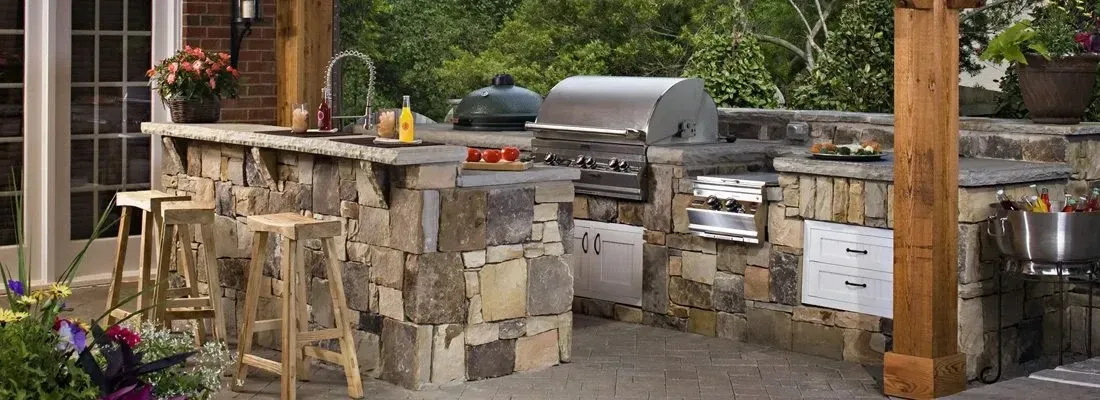
What’s the real cost of running gas + water + electric to the kitchen?
This is the line item that surprises homeowners more than any other, and it’s the one most contractors quote vaguely so they don’t lose the deal on sticker shock. The honest number for a kitchen 25 to 60 feet from the house in Clarkston is $3,200 to $7,800 for utilities alone, before a single appliance or stone is on site.
Gas is the largest single cost. A built-in kitchen with a main grill, side burner, and one auxiliary appliance needs a 200 cubic foot per hour demand calculation at minimum. That demand exceeds what a typical 1/2″ CSST branch off the house manifold can deliver at distance. Most Clarkston kitchens require a fresh 3/4″ CSST run from the meter, tied into a code-compliant manifold near the kitchen, pressure-tested at 50 psi for at least 15 minutes per IFGC §406.4. That’s $1,400 to $3,200 in materials and licensed gas-fitter labor, plus DeKalb County’s rough and final gas inspection sequence which adds 7 to 14 calendar days to the build.
Water requires a dedicated 1/2″ PEX or copper feed from the closest interior fixture, with a freeze-protection consideration — either a frost-free hose bib spec or a shutoff valve accessible from inside the house for winter drain-down. Electric for the kitchen needs a dedicated 20-amp GFCI-protected circuit minimum, two circuits if you’re running both a refrigerator and a pizza oven or pellet grill, with weather-rated boxes and bubble covers throughout.
Outlet spec that has to go in the contract: Per NEC §680.22(A)(4), any 125-volt receptacle within 20 feet of the inside wall of a pool must be GFCI-protected, and any receptacle on the kitchen serving the pool deck must be in a weather-resistant, in-use (“bubble”) cover rated for damp/wet location. Per NEC §210.8(B), all outdoor outlets must be GFCI regardless of pool proximity. We install 20-amp WR/TR GFCI receptacles in dual-flap bubble covers on every Clarkston outdoor kitchen — non-negotiable, written into the contract, photographed at rough-in for the inspector.
Add up the three utilities and the inspection delay, and you can see why a $24,000 outdoor kitchen turns into a $31,000 outdoor kitchen by the time it’s actually functional. Anyone quoting you “I’ll just tap off the existing line” without a demand calculation is selling you a kitchen that will starve the main grill the first time you fire two burners and the side burner together.
Stone, stucco, or framed base — which lasts longest in Clarkston?
The base of an outdoor kitchen is the part nobody thinks about until it fails — and the failure mode is rarely dramatic. It’s a hairline at year five that turns into a quarter-inch separation at year nine. The veneer pops loose along one corner. The granite top develops a small unsupported overhang. The whole thing starts looking tired.
There are three base systems used in the metro Atlanta market. CMU (concrete masonry unit) with stone or brick veneer is the heaviest, most stable, most expensive, and most repairable when something goes wrong. It costs $180 to $260 per linear foot for the shell alone before veneer, and another $42 to $78 per square foot for stone veneer installed. It’s the right call when the kitchen is integrated with a pool-deck retaining wall or a permanent pergola — the structural mass pulls double duty.
Steel-framed kitchens — galvanized or stainless tube frames with cementboard skinning and stucco or thin-stone veneer — install in a fraction of the time, cost 30 to 45% less, and weigh roughly an eighth of what a CMU base weighs. The catch is repair. When stucco cracks at year seven, fixing it requires opening a skin panel, which means cutting through cementboard and the veneer simultaneously. CMU cracks can be patched in place; steel-framed cracks usually require panel replacement.
Stucco-over-CMU is a hybrid we use frequently in Clarkston when the architectural style of the home is more Mediterranean or modern than the stacked-stone Atlanta default. A skim coat of acrylic-modified stucco over a CMU shell gives a cleaner aesthetic, ages better than dry-stack stone in shaded humid yards (less moss and lichen on a smooth painted surface than on irregular stone face), and costs about 15% less than full stone veneer. The downside is that stucco shows hairline movement more readily than veneer hides it.
In Clarkston the deciding factor is shade and humidity. A kitchen under heavy tree canopy — common in older Lake Capri and Idlewood lots — stays damp longer after every rain. Stacked-stone veneer in deep shade grows biological staining within three years; smooth stucco or large-format porcelain handles that environment better. The 52 inches of annual rainfall plus tree canopy makes covered structures more valuable here than in the sunnier lots up in Forsyth — budget the pergola or gable extension as part of the kitchen, not an afterthought.
What I’d skip if I were starting over.
If we could redo every Clarkston outdoor kitchen we’ve built since 2014, here is what would change. The list is short on purpose. Every item on it represents money that’s been spent and then not used.
The side burner — eight of ten clients have told us they use it less than four times a year. The two who use it heavily love it. The other eight wish they had the counter space back.
The dedicated outdoor ice maker — runs $1,800 to $2,400, needs a water line, freezes hard in DeKalb’s 8 to 14 annual freeze events unless you remember to drain it every fall, and produces ice that’s no better than what comes out of the indoor freezer. Skip.
The full-height outdoor refrigerator when the kitchen is more than 25 feet from the house — every step you take to grab a drink is a step you could take back inside. A small drawer fridge near the grill plus a beverage cooler on the patio outperforms a full-height fridge for half the lifecycle cost.
The under-counter trash with the soft-close pull-out in stainless — beautiful, expensive, and almost always replaced within two years by a $40 plastic kitchen-trash can the homeowner can pull out and hose off. Build the cavity but skip the premium stainless insert until you know which one of your clients actually wants it.
What we wish more clients had spent money on instead: a covered roof structure over the kitchen and a portion of the dining patio (the 52-inch annual rainfall and DeKalb tree canopy makes this the single best ROI item in a Clarkston outdoor kitchen), better lighting on the prep counter (under-cabinet LED strips, dimmable, $280 installed — used every single night), and one more electrical circuit than the contractor quoted, terminated in a flush-mount weatherproof box on the kitchen exterior wall, so that the inevitable future addition (heater, fan, blender, sound system) doesn’t require running new conduit through finished stonework.
Here is the line-item budget we’d build instead of the standard $36,000 five-appliance template, for a Clarkston household that cooks outdoors three to four nights a week from April through October:
- Built-in grill — Twin Eagles 30″ with sear zone and rotisserie: $5,600 head + $1,800 install/cutout = $7,400
- 36″ continuous prep counter in honed quartzite, single slab no seam: $2,400
- Drawer-style refrigerator (U-Line single-drawer 24″): $1,899 + $600 install/circuit = $2,499
- Pellet grill on adjacent paver pad — Traeger Timberline, freestanding so it can be replaced or relocated: $2,799
- Three soft-close storage drawers + tall pantry cabinet: $2,800
- CMU base + stucco-over-CMU finish in a creamy off-white to match the home: $5,200
- Gas line — 3/4″ CSST run + manifold + 50 psi inspection: $2,800
- Electric — two dedicated 20-amp GFCI circuits with WR/TR bubble covers: $1,400
- Under-cabinet dimmable LED strips + two overhead pendants: $980
- Covered cedar pergola with translucent polycarbonate roof panels, 12 x 16: $7,200
Total: roughly $36,479 — same as the default template, completely different lifetime cost-per-use. No side burner. No full-height fridge. No ice maker. No pizza oven (the $799 Ooni lives in the pantry cabinet and comes out for pizza nights). A roof over the cook. Real prep space. Two circuits for the future. This is a kitchen a Clarkston family will use 80 to 110 nights a year, not 14.
Outdoor kitchen design and construction across 20+ cities within 30 miles of Winder, GA
We build outdoor kitchens that get used — sized to the household, spec’d to the climate, and engineered to pass DeKalb’s gas and electrical inspections without a punch list. Free design consultation, transparent line-item pricing, and no five-appliance defaults unless that’s actually what you need.