
It is the first week of February. A Clarkston homeowner off Brockett Road has just signed a $78,400 hardscape contract — 1,180 sq ft of Belgard Mega-Arbel pool deck, a 38-linear-foot Techo-Bloc Mini-Creta seat wall, a Pavestone fire-bowl pad, and a regraded equipment alley feeding the existing pool. The Memorial Day goal is on the table. The pool needs to be open and the deck walkable by May 23. From contract signature to that target date is sixteen weeks on paper, but only six of those are build weeks. The other ten are calendar, weather, permit, and supply chain. Here is exactly how a build like that lands on time in DeKalb County — week by week, what’s on site, and where the schedule actually goes sideways.
Hardscape sells fast and builds slow. The contract takes an afternoon. The build takes six full weeks of weekday production once a backhoe is on the lawn. Everything in between — engineering, permit, material lead time, sub scheduling — is the silent calendar that decides whether the deck is poured by Memorial Day or by July 4. We’ve built enough projects in Clarkston to know which weeks slip and which weeks hold, and the difference is almost never the crew. It’s the calendar in front of the crew.
What follows is the exact gantt we run on a typical Clarkston full-build. Week 0 is the permit and prep window — DeKalb’s planning office is the long pole, and we’ll cover why in a minute. Weeks 1 through 6 are production. Week 7 is punchlist and handover. Eight weeks of clock time, six weeks of boots-on-the-grass build time, and a built-in rain-day buffer that almost always gets spent.
Week 0 — Permit, Engineering, and the DeKalb County Long Pole
Week 0 is the most misunderstood week in the whole timeline. The homeowner has signed and wants to see a Bobcat in the yard tomorrow. We can’t put one there. Before any digging happens, we need a sealed site plan, a wall-engineering letter for any wall over 30 inches, a permit application package, and the DeKalb County review clock to run.
Here’s the math that drives the entire calendar. DeKalb County permit turnaround for residential hardscape and pool decks runs 3 to 4 weeks, start to finish. That is dramatically slower than Gwinnett’s 10 to 14 business days, which is what most Atlanta-metro contractors quote off the top of their head. If your contractor is telling you “we’ll be digging in two weeks” on a Clarkston project, they have not actually pulled a DeKalb permit recently.
The DeKalb permit reality: Plans go to DeKalb County Planning & Sustainability at 178 Sams St., Decatur. Initial review runs 14 to 18 business days. First-round redlines come back almost every time — typically a wall-height detail, an erosion-control silt-fence note, or a setback callout. We rebuild, resubmit, and the second review runs another 5 to 8 business days. Total: 3 to 4 weeks of calendar before the first shovel goes in. Plan for it. Don’t fight it.
While the permit is in review, three things happen in parallel and they have to. We finalize the structural engineering for any seat wall, retaining wall, or fire feature footing. We place the paver order with Belgard, Techo-Bloc, and Pavestone — lead times in spring run 9 to 18 business days depending on color and finish, and Belgard’s Mega-Arbel in the popular Bristol Beige colorway has been a 14-day lead since late February the last three years running. And we lock the dig date with the sub-base subcontractor and the concrete pump truck operator.
The homeowner doesn’t see much during Week 0. There is no equipment on site, no crew, no visible movement. What’s happening is paperwork, phone calls, and a project manager keeping four parallel tracks from drifting. The biggest derail at this stage is a homeowner change request — adding a fire bowl, moving a wall location, changing paver color — because every change resets the engineering and the permit clock. After Week 0 starts, every change is a 5- to 10-business-day delay minimum.
Week 1 — Mobilization, Layout, and Excavation
The permit clears. The placard goes in the front window. Day one of Week 1 is mobilization — the dumpster lands curbside, the porta-john gets dropped, silt fence goes up along the rear property line, and the tree-protection fencing wraps the two oaks the homeowner wants saved. By lunchtime on Monday, the layout is painted onto the lawn in orange marking paint — every paver edge, every wall footing, every utility crossing.
By Tuesday morning, a Bobcat E32 mini-excavator is on site and the topsoil strip starts. We pull the top 6 to 8 inches of organic soil and stockpile it for later regrading. Then the rough excavation begins — for a 1,180 sq ft deck like our Brockett Road project, that’s roughly 38 cubic yards of soil moving out. Most goes to a haul-off pile, some stays for backfill behind the seat wall.
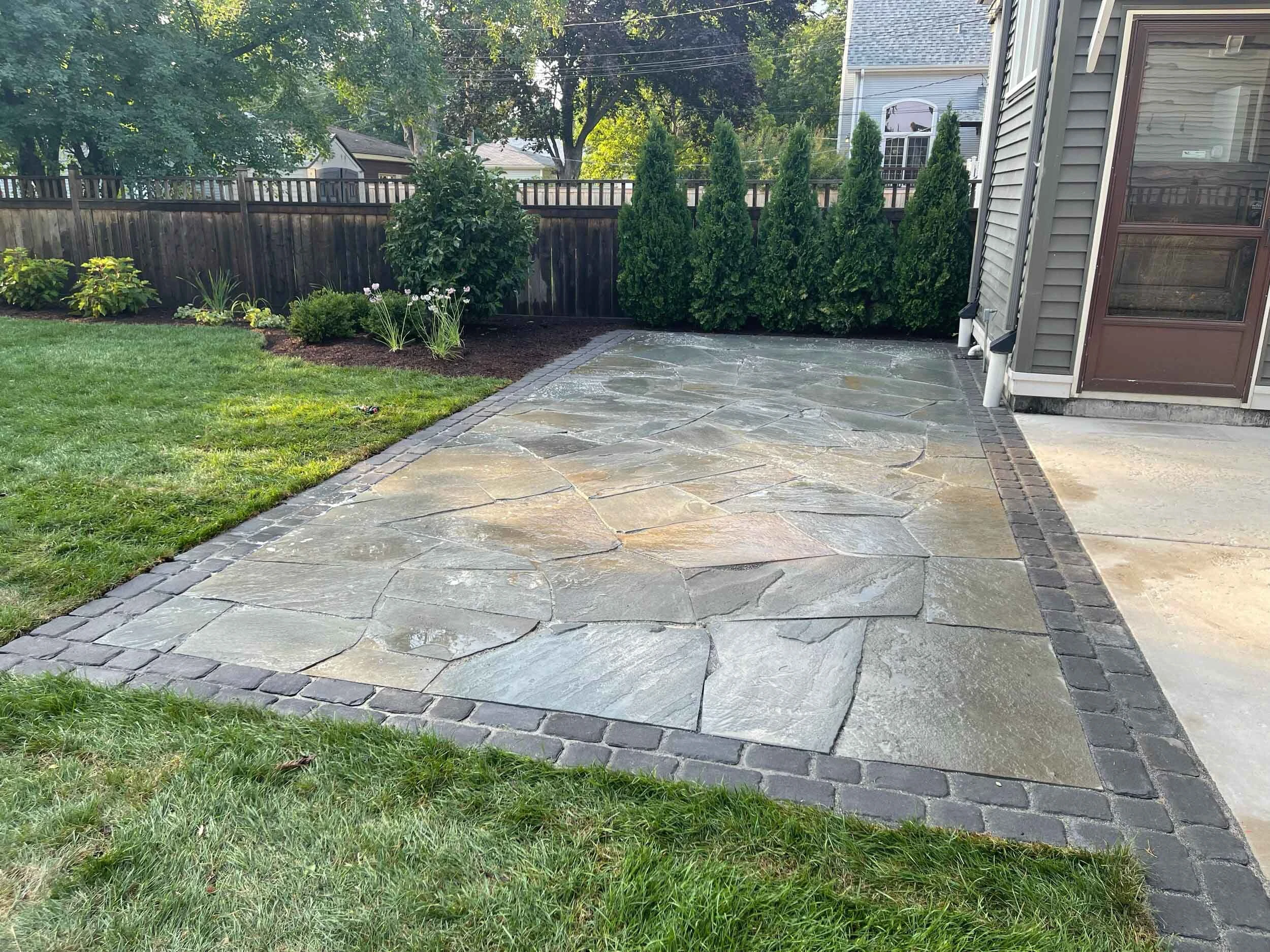
Here is where Clarkston-specific subsoil shows up. Lots within roughly a mile of the Stone Mountain pluton edge — and Brockett Road, Idlewood, and the Hambrick neighborhoods all qualify — hit decomposed granite at 4 to 8 ft of excavation depth. For a pool deck excavation, that usually doesn’t matter; we’re rarely going below 18 inches. But for the seat-wall footing, which on this build is 24 inches deep, and for the fire-bowl pad footing at 30 inches, we may hit weathered granite saprolite. That adds 0.5 to 1 day to the dig and occasionally requires a hydraulic breaker attachment instead of a smooth bucket.
Crew on site this week: three Primetime hardscape technicians plus a site foreman. No subs yet. The homeowner sees real, visible movement — the lawn is gone, the shape of the project is now drawn into the ground, and the dumpster fills up. This is the week the project finally feels real to them. It’s also the week most homeowners get nervous about the scale of disruption. That’s normal.
What can derail Week 1: an unmarked utility line. Always call 811 a minimum of 72 hours before the dig. Unmarked private irrigation lines, low-voltage landscape lighting wires, and abandoned-but-still-live 1980s subdivision sprinkler systems are the three most common surprises on Clarkston lots. A nicked irrigation line is a half-day delay. A clipped Georgia Power service drop is a different week entirely.
Week 2 — Sub-Base, Drainage, and Wall Footings
Week 2 is the week most contractors skip steps and most pool decks start their slow march toward failure four years later. We do not skip. The sub-base goes in over four working days, in measured 2-inch lifts, with a plate compactor passing each lift before the next one drops.
For the Brockett Road deck, that means 8 inches of compacted GAB #57 open-graded stone beneath the entire paver area, with a non-woven geotextile separator between the Cecil-series clay subgrade and the stone. The geotextile is non-negotiable on Clarkston clay — without it, clay migrates up into the stone voids over time and the base loses its drainage function within five to seven years. The deck still looks fine, but the freeze-thaw cycles start lifting individual pavers a quarter-inch per winter.
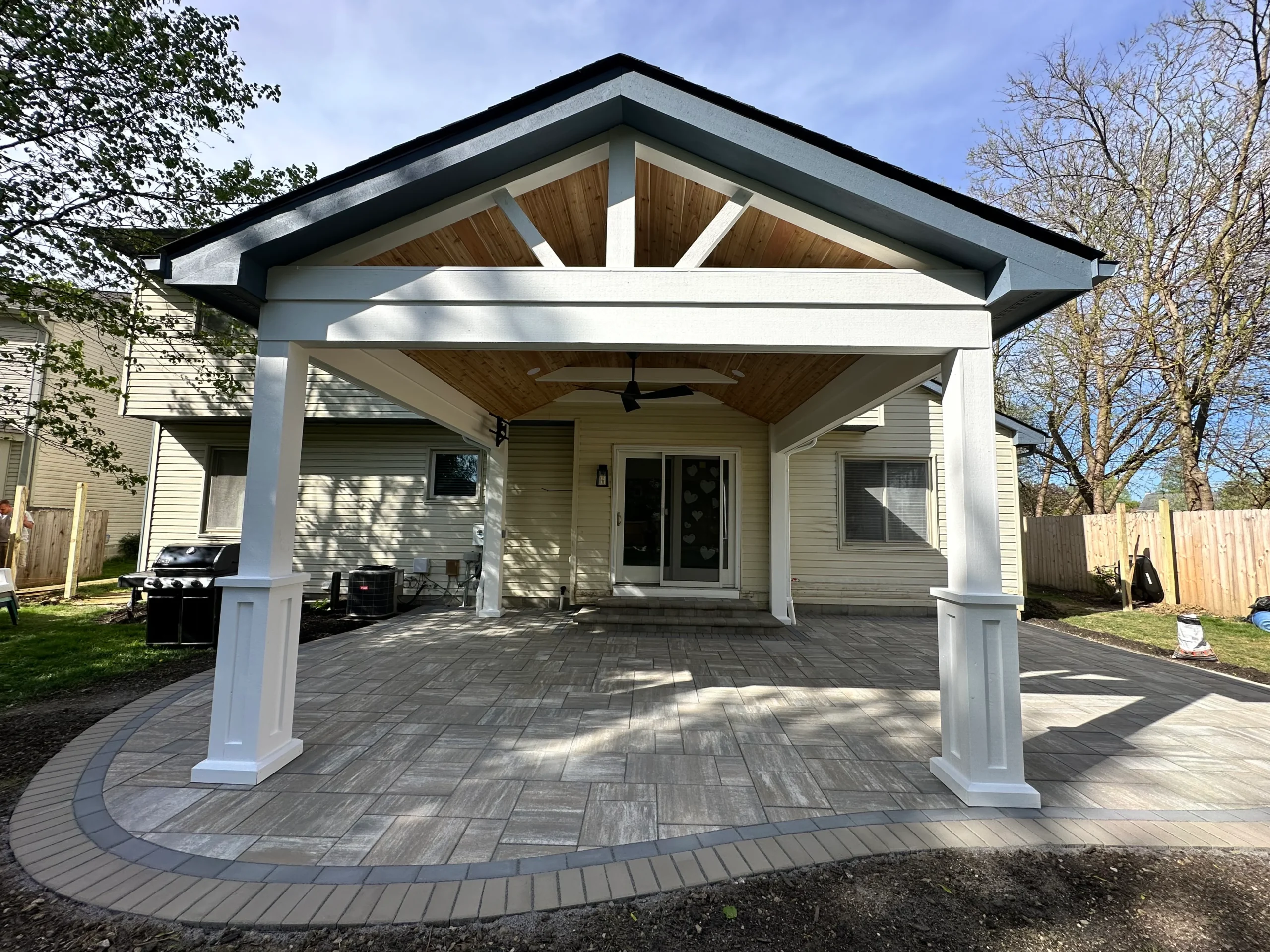
Drainage trenching happens in parallel with the sub-base work. A 4-inch perforated drain pipe wrapped in filter sock runs along the upslope edge of the deck, daylight-discharging to the back property line. Clarkston averages 52 inches of rain per year, with most of that concentrated in spring thunderstorms and tropical-system bands in late summer. A pool deck that doesn’t have a real drainage plan is a pool deck that pushes water toward the house foundation by year three.
Wall footings get formed and poured this week. For the 38-foot Techo-Bloc Mini-Creta seat wall, we pour a 24-inch-wide by 12-inch-deep continuous footing with two runs of #4 rebar. The fire-bowl pad footing — a 5-foot-square reinforced slab — goes in on the same pour day to share the concrete truck minimum.
Crew this week: four hardscape technicians plus a concrete sub for the footing pour. The homeowner sees the project’s geometry crystallize — the deck is no longer just a hole, it has shape, edges, and the first vertical lines from the wall forms. This is also when the dust starts. Clarkston yards with mature tree canopy hold humidity, which keeps dust down, but the bordering neighbor relationship gets its first real test this week. We door-knock both neighbors before mobilization for exactly this reason.
Week 3 — Paver Delivery, Edge Restraint, and Field Installation Begins
The pallets arrive Monday morning of Week 3. For the Brockett Road build, that’s 14 pallets of Belgard Mega-Arbel in Bristol Beige, two pallets of Techo-Bloc Mini-Creta wall block in Champlain Grey, and one pallet of Pavestone bullnose pieces for the wall caps. The delivery truck stages on the front driveway; the crew runs them to the rear yard with a powered buggy.
Before any pavers go down, the bedding layer goes in — 1 inch of clean, washed concrete sand (ASTM C33) screeded to a perfectly flat plane across the compacted sub-base. The screed runs against PVC screed pipes that get pulled out as the bedding gets struck. Two technicians screed, two technicians follow with paver placement.
Rain-delay protocol: We build 5 to 7 rain days into every 6-week Clarkston hardscape schedule. A wet sub-base cannot be compacted. Wet sand bedding cannot be screeded flat — it pumps. Sand-set pavers cannot be installed in active rain because the joint sand washes before it locks. If the radar shows more than 40% chance of measurable rain between 7 a.m. and 4 p.m., the day is called by 6 a.m. and the crew is redirected to indoor prep (cuts, layout review, material staging). Pretending to build through rain is how a 6-week project becomes a 9-week project with failures baked into it.
Field installation moves at roughly 110 to 140 sq ft per crew-day on a Mega-Arbel pattern that requires cuts at every curve. By Friday of Week 3, about 60% of the deck is laid. The homeowner walks out Friday evening to see actual stone in place for the first time. This is usually the moment a homeowner stops worrying.
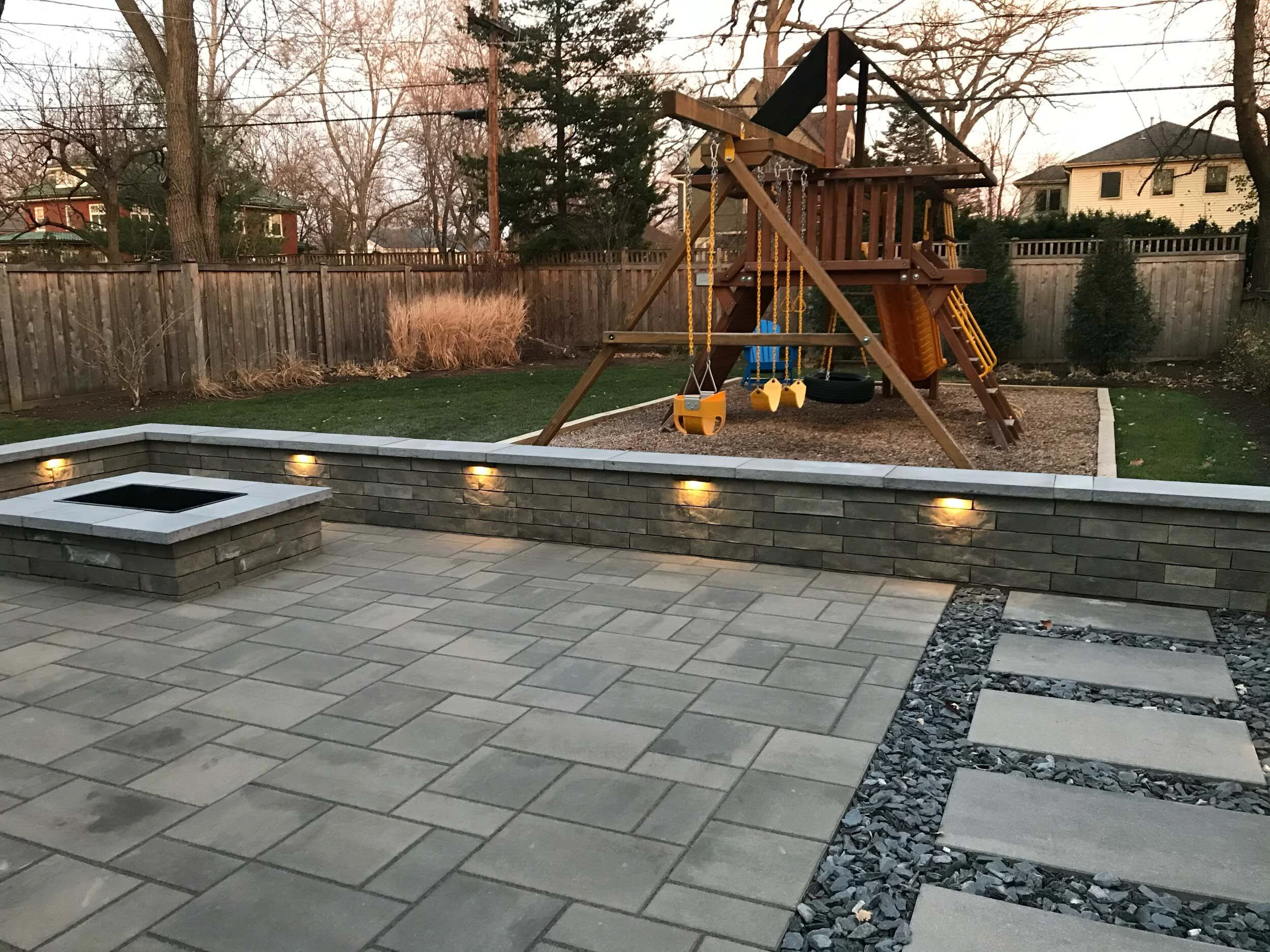
What can derail Week 3: a wrong-color pallet, a short order, or a damaged shipment. Belgard, Techo-Bloc, and Pavestone all run quality inspection at the yard, but pallets do show up cracked occasionally — usually 1 or 2 pieces per pallet, which is normal waste. If a full pallet is damaged or wrong-color, we file the warranty claim same-day and the replacement is on site within 5 to 8 business days. That’s a hard delay we can’t compress.
Week 4 — Field Completion, Cuts, Wall Build, and Coping
Week 4 is the heaviest production week of the project. The remaining 40% of the paver field goes down Monday and Tuesday. Wednesday is dedicated to cuts — every curved edge, every penetration around the equipment alley, every transition where the deck meets existing concrete or the pool coping. We run a 14-inch wet saw with a continuous-rim diamond blade and a foreman whose entire week is just cut quality. A bad cut on a $78,400 deck is what the homeowner notices three years from now when nothing else has aged.
The Techo-Bloc Mini-Creta seat wall starts going up Wednesday afternoon and runs through Friday. Block-by-block, course-by-course, with the polymer adhesive bead between every horizontal joint. The wall ties to the footing with stainless-steel pins on 16-inch centers. The bullnose caps from Pavestone get set last, with an extra 3/8-inch overhang past the wall face for the rain-shed detail. We finish the wall with the cap line dead-level across all 38 feet — checked with both a 6-foot bubble and a rotary laser at the start and end of each course.
Crew this week: five hardscape technicians, one cut-station foreman, plus an apprentice running material to each station. No subs. This is the week the project visibly becomes a built backyard. The fire-bowl pad gets its travertine veneer Thursday. Pool coping — if it’s part of the scope, which it is on this project — gets reset over a thinset bed with a clean expansion joint between coping and deck.
Week 5 — Joint Sand, Sealer Prep, Hardscape Lighting Rough-In
By Monday of Week 5, the entire paver field is set, cut, and walked. Now we lock it. Polymeric joint sand — we use Techni-Seal RG+ on most Clarkston projects, but the spec varies by joint width — gets swept into every joint, vibrated in with a plate compactor wearing a urethane mat, and then activated with a fine water mist. Activation has to happen the same day the sand goes in; if it sits in the joints overnight without activation, morning dew or unexpected rain ruins the bond.
The electrician arrives Tuesday for hardscape lighting rough-in. For the Brockett Road build, that’s six low-voltage Kichler hardscape lights mounted under the seat-wall cap line, plus two LED pathway fixtures along the deck-to-grass transition. Conduit runs were sleeved into the sub-base during Week 2, so the electrician is pulling wire through pre-set sleeves rather than trenching. That detail alone saves a full day of schedule.
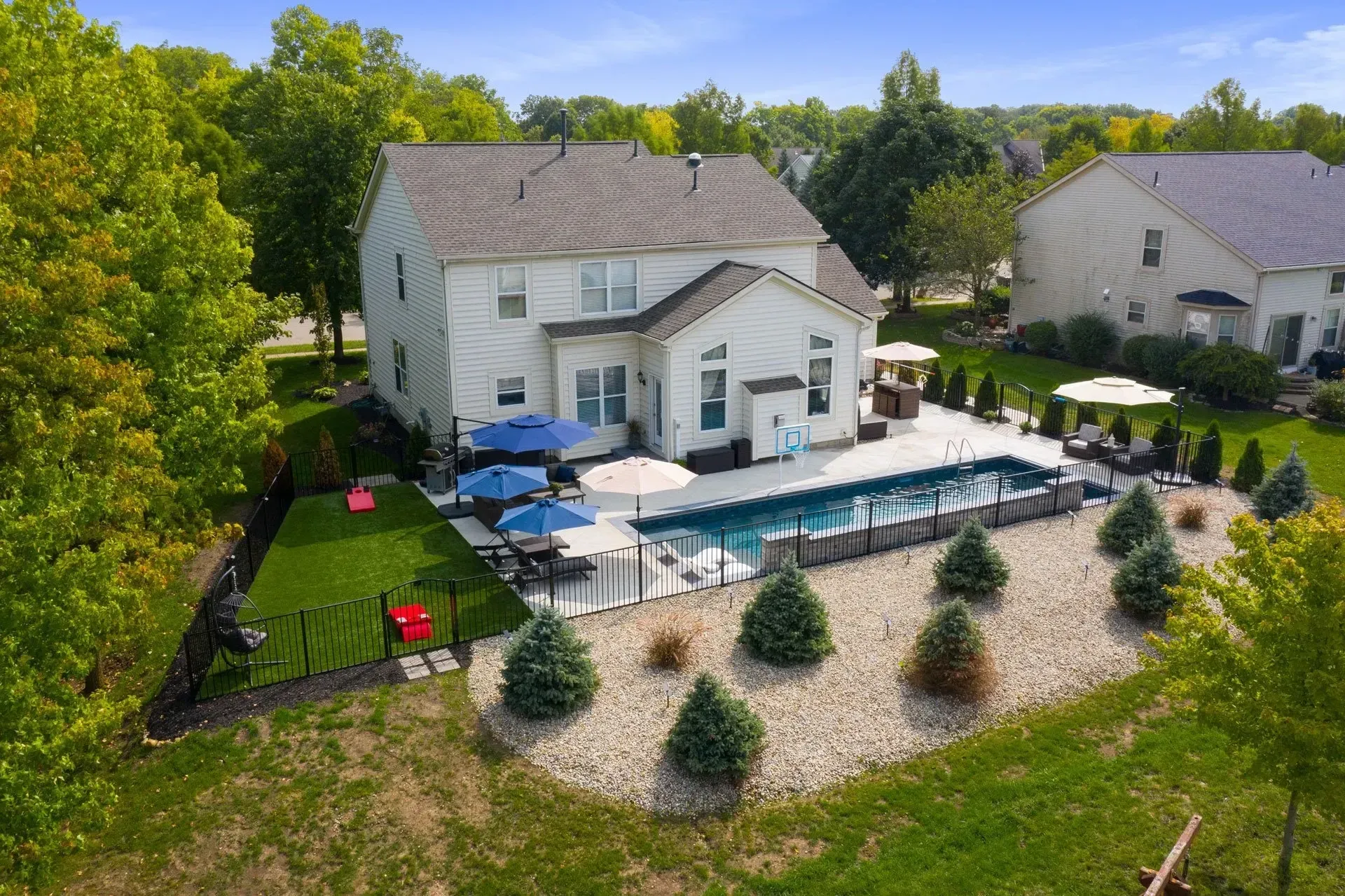
The plumber comes Wednesday for the fire-bowl gas line — a 3/4-inch CSST run from the home’s existing gas manifold, sleeved through the deck base, terminating at a key valve at the fire-bowl pad per NFPA 54. Gas pressure test happens same day. The fire bowl itself isn’t set yet — it’ll land next week.
Crew this week: three hardscape technicians, the licensed electrician (subcontractor), and the gas plumber (subcontractor). The homeowner sees the project move from “construction site” to “almost-finished backyard.” Lawn furniture starts showing up in their imagination. This is also when warranty paperwork and final-walk scheduling start coming up in homeowner emails.
Week 6 — Sealer, Final Grade, Sod, and Fire-Feature Set
Week 6 is the finishing week. Monday is final grade — the topsoil stockpile from Week 1 comes back out, gets feathered into the deck edges, and the disturbed lawn perimeter gets prepped for sod or seed. The crew foreman walks the entire perimeter with a stringline to verify a 2% slope away from the deck across every linear foot, which is the engineering minimum to keep water moving toward the property’s existing drainage rather than back toward the house or the seat wall footing.
Sod goes down Tuesday — 410 sq ft of Bermuda on the Brockett Road perimeter, edge-tucked against the deck. We use sod rather than seed on every Clarkston project that finishes between March and June, because seed in spring competes with crabgrass germination and looks terrible by July. Sod gives the homeowner a finished yard from day one.
Sealer goes on Wednesday — but only if the pavers have had a minimum of 48 hours of dry weather since joint-sand activation. The standard spec is a water-based, breathable acrylic sealer applied in two coats with a low-pressure sprayer. Sealer is the most weather-sensitive single step in the project; if Wednesday rains, sealer slides to Thursday or Friday, and the schedule pressure becomes real.
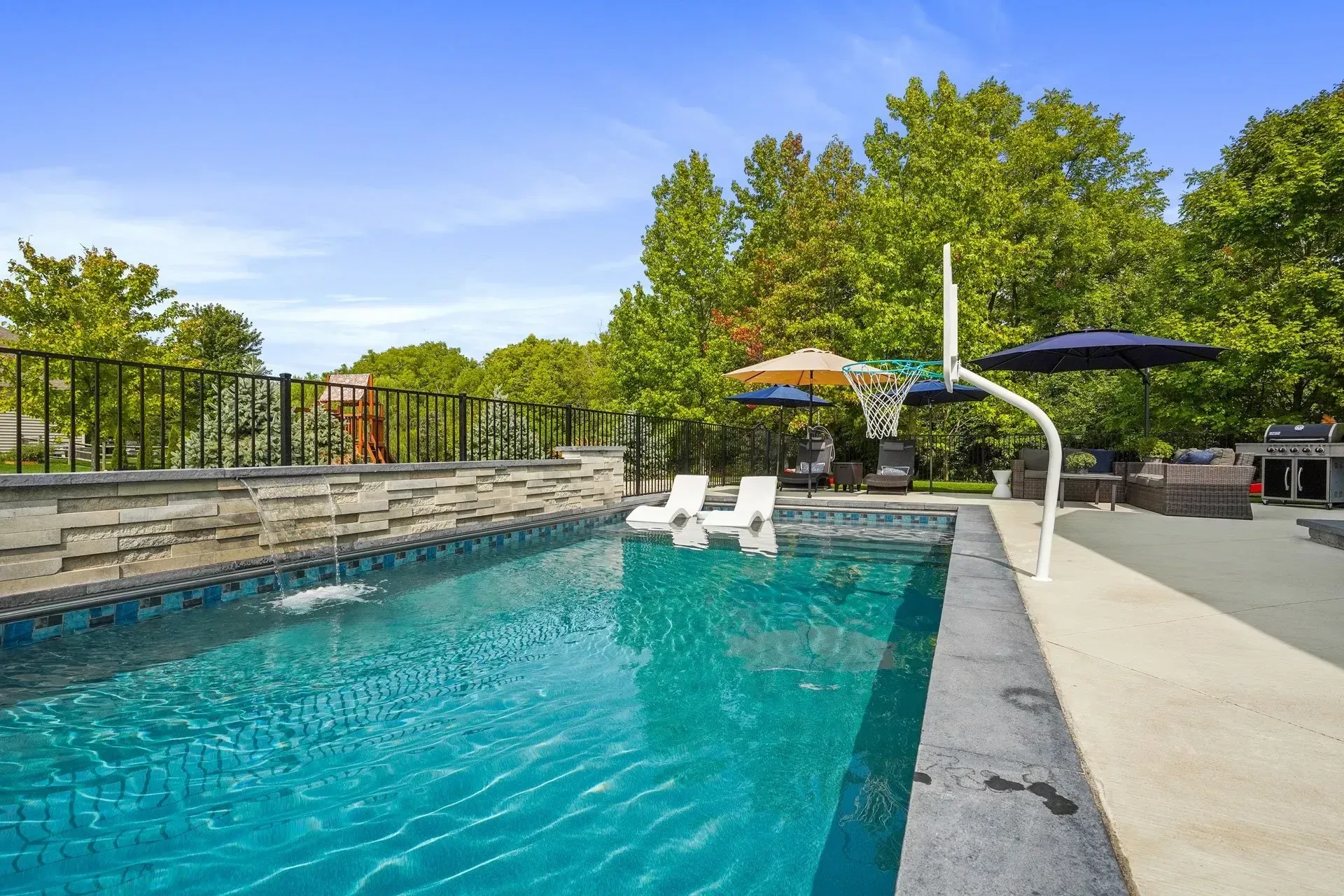
The Pavestone gas fire bowl gets set Thursday. Bonding lug attached, gas line connected, leak test, ignition test, flame-height adjustment. The licensed gas plumber issues the final paperwork. By Friday afternoon of Week 6, the crew is sweeping up the deck, pulling silt fence, and rolling the porta-john and dumpster back to the curb.
Crew this week: three hardscape technicians, a sod installer, and the gas plumber for the fire-feature set. The homeowner is now within a week of a finished project. The Memorial Day deadline, set sixteen weeks ago in February, is suddenly two weeks away.
Week 7 — Punchlist, Walk-Through, and Handover
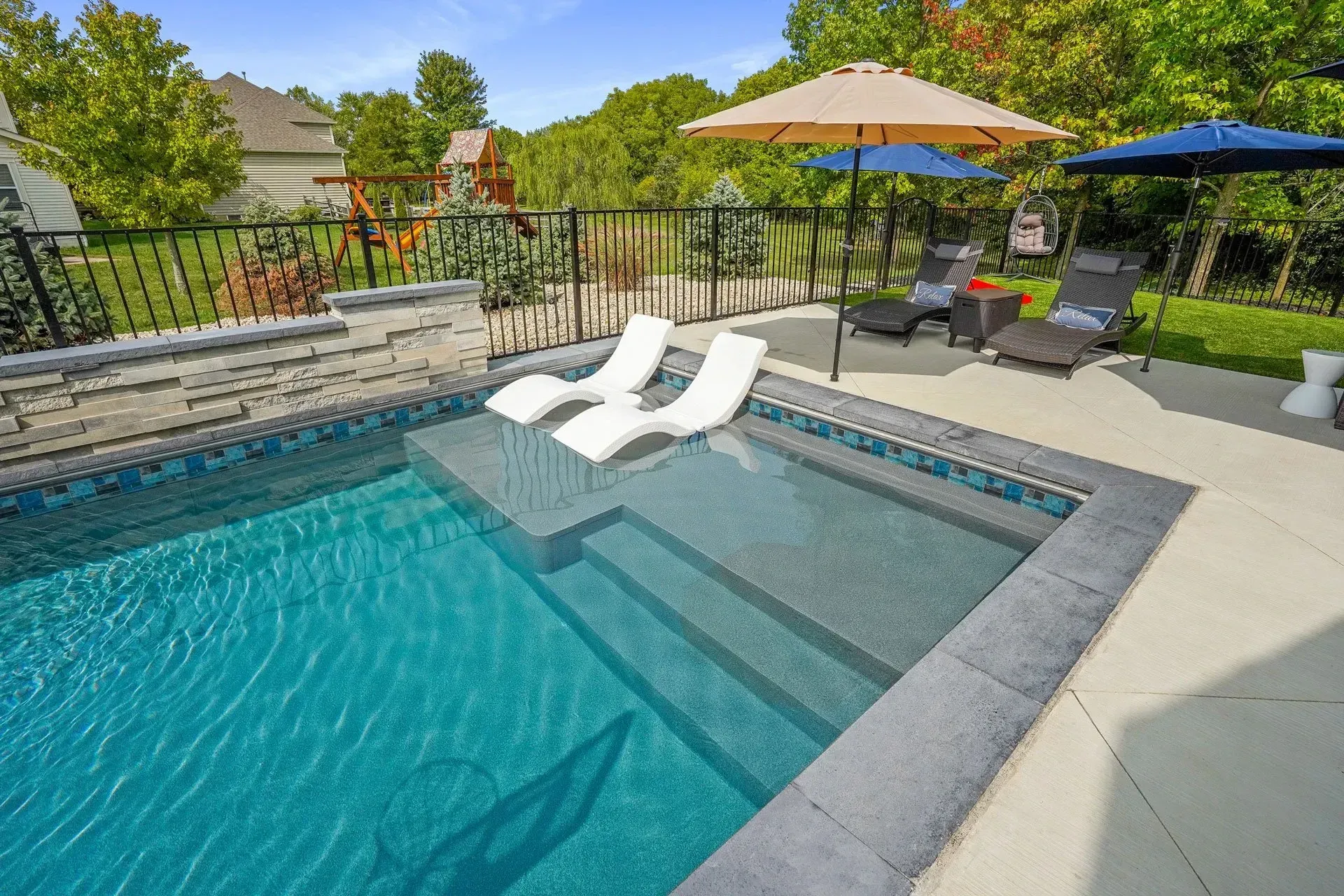
Week 7 isn’t a build week — it’s a quality week. Monday and Tuesday are punchlist days. The foreman and project manager walk the entire build with a fresh eye, mark every imperfection, and the crew comes back Wednesday and Thursday for fix-and-finish. Common punchlist items on a Clarkston build: a low corner on the seat-wall cap, a paver that didn’t seat fully and needs to be lifted and reset, a sealer streak that needs a second-coat touch-up, joint sand that settled in one or two seams and needs a top-off.
The homeowner walk-through happens Friday morning. We bring a printed binder: warranty documentation, manufacturer warranty cards for Belgard, Techo-Bloc, and Pavestone, the maintenance schedule (sealer reapply every 3 to 5 years, joint-sand top-off every 18 to 24 months for the first 6 years), the gas-fire-bowl ignition procedure, and the final lien waivers from every subcontractor.
The homeowner signs the completion certificate, which triggers the final draw and starts the warranty clock — typically 2 years on workmanship, lifetime on the Techo-Bloc and Belgard manufacturer warranties. The dumpster gets hauled off. The truck pulls out for the last time.
At the end of Week 7, you are seven weeks past permit clearance, eight to ten weeks past contract signature depending on how the DeKalb review ran, and on a February-start schedule, you are walking into Memorial Day weekend with the pool open, the deck cured, and the fire bowl lit. That is exactly how the gantt is supposed to land. When it doesn’t, it’s almost always a Week-0 calendar miss — not a construction-week miss.
If you’re considering a hardscape build for next summer in Clarkston: start contract conversations in November or December for a Memorial Day completion. Sign by mid-February. Anything past March 1 puts the target into a coin-flip with the DeKalb permit calendar and the spring-supplier surge.
Hardscape builds across 20+ cities within 30 miles of Winder, GA
Six weeks of build time. Three weeks of DeKalb permit review. Five rain days budgeted in. We build the calendar before we build the deck — and we hand you a date you can plan a Memorial Day cookout around.