
Two summers ago we walked a Clarkston backyard off Idlewood Circle with a homeowner who had already paid one pool builder a $9,400 design deposit and was wondering why the permit application kept getting kicked back. We measured the yard with a laser level and put the tape on a story pole: a 4-foot, 3-inch drop over the 19 feet between the rear foundation and the fence line. That’s the grade at which a standard gunite pool design stops being a pool project and starts being a civil engineering project — and it’s the reason the DeKalb County reviewer wasn’t going to stamp his plans.
The homeowner thought he had a pool problem. He had a slope problem. And once we walked him through what was actually going on underneath the turf — the Cecil-series clay, the weathered granite shelf at about 7 feet, the way surface water was already pooling against his foundation every spring — it became obvious that the first builder hadn’t looked at any of it. The plan he’d been sold was a flat-lot plan dropped onto a hillside with no retention, no engineered backfill, no underdrain, and no structural upgrade to the shell.
We’ve now built or corrected roughly thirty custom pools in Clarkston and the immediate Stone Mountain corridor. About a third of them were in-ground rebuilds where another contractor had already put a pool in the wrong way and walked off when the warranty phone calls started. The pattern is consistent enough to teach from: when a Clarkston pool fails early, slope is almost always the reason — and slope fails in four specific, predictable ways that every homeowner in this part of DeKalb County should understand before signing anything.
This post is that teaching. The four failure modes we see on sloped lots, what each one looks like two to six years in, and what the engineering response costs when you build correctly the first time. Every photo here is a real Primetime build, and every number is pulled from a current project file.
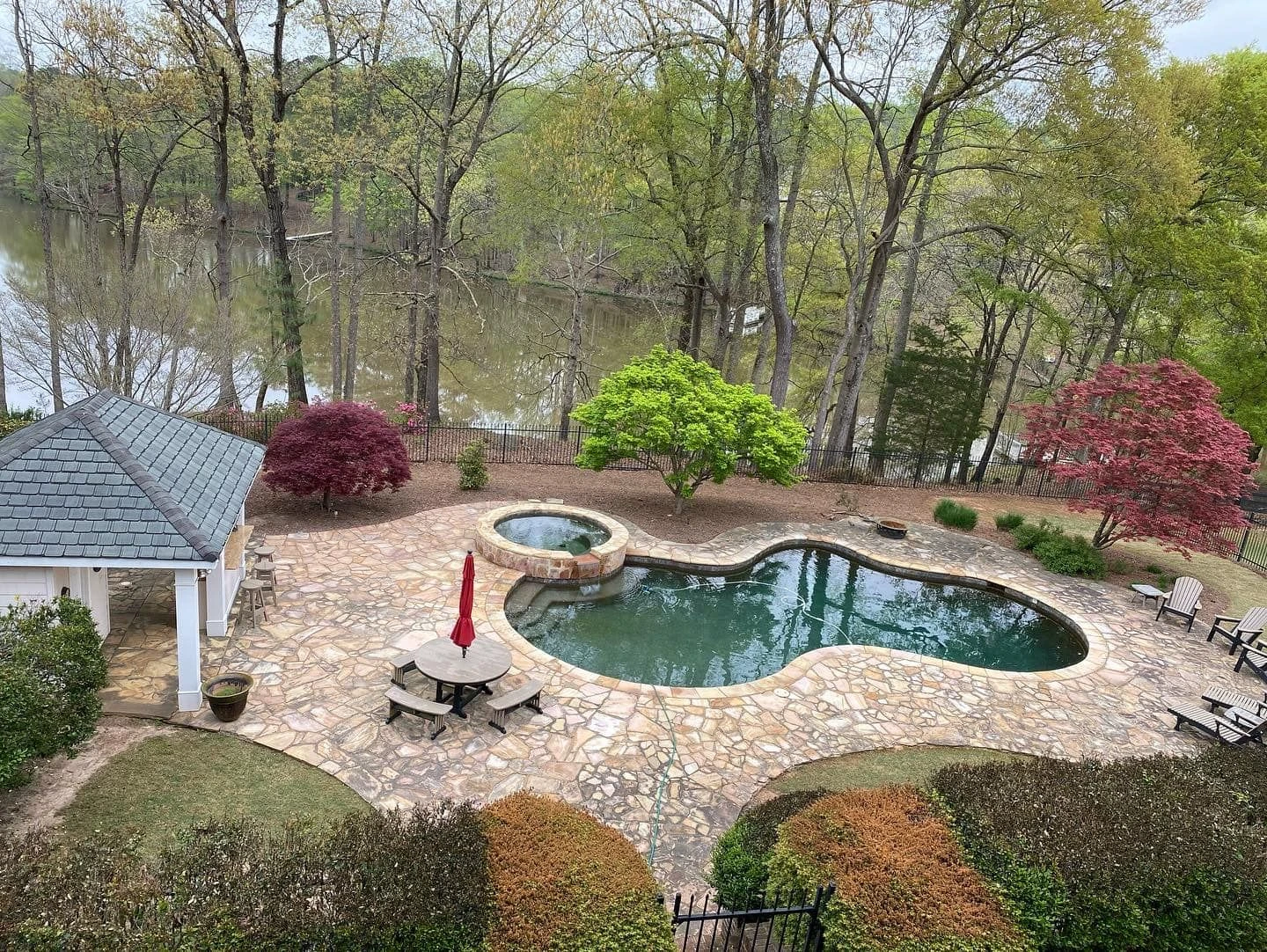
Failure Mode 1: Hydrostatic Pressure and Water Migration Into the Shell
A pool on a sloped lot is a concrete bathtub sitting halfway up a hill. Gravity is moving water downhill through the soil around it every single day. When it rains, that movement accelerates. When the Piedmont clay behind the shell saturates and can’t drain, the water has to go somewhere — and the path of least resistance is the pool itself.
The specific mechanism is hydrostatic pressure. Groundwater collects on the uphill side of the shell, sits against the gunite wall, and pushes inward with a force that scales with the column height of water behind it. In Clarkston’s Cecil clay, which has a permeability coefficient roughly two orders of magnitude lower than sandy loam, that water doesn’t drain laterally the way it would in coastal Georgia. It stacks up. A pool shell that was perfectly watertight on day one starts weeping along cold joints by year four. By year seven you can see the mineral staining on the interior finish where groundwater has been slowly migrating through the shell for months.
The way this fails visibly is almost always the same: a horizontal stain line on the pool’s interior about 18 to 24 inches below the waterline on the uphill side, a white efflorescence bloom on the exterior of the raised wall where a spillover wall is involved, and — in the worst cases — the plaster finish delaminating in sheets roughly the size of a dinner plate. That delamination isn’t the plaster’s fault. It’s water coming the wrong direction through the substrate.
The engineered fix on a slope build is a drainage system that exists specifically to make sure hydrostatic pressure never builds in the first place. A perforated 4-inch PVC underdrain wrapped in filter fabric, installed in a gravel trench on the uphill side of the shell, graded to daylight or to an existing storm structure. A secondary drain plane along the back of any raised bond beam. And, in the heaviest-clay lots, a geocomposite drainage sheet adhered to the exterior of the shell before backfill. Done right, groundwater never touches the wall — it’s intercepted, channeled, and routed off the property before it can pressurize anything.
Failure Mode 2: Differential Settlement Under the Gunite Shell
The second failure mode is the one that actually cracks pools in half, and it happens because the ground a sloped pool sits on is not homogeneous.
Here’s the physics. A pool on a level lot sits on native soil that has roughly the same bearing capacity from corner to corner. A pool on a sloped lot often spans the cut-and-fill line — which means half of the shell is resting on undisturbed native soil and the other half is resting on compacted fill that was placed to build up the downhill side. Those two substrates have radically different compression behavior. Native Cecil clay at proper moisture content carries somewhere around 2,500 to 3,500 pounds per square foot. Poorly compacted fill in the same soil type can carry less than 1,200 psf. Under the weight of a full pool — water, shell, and deck — the fill side settles and the native side doesn’t. The shell tries to bridge the difference, and because concrete is extremely good in compression but mediocre in tension, it cracks along the line where the differential is occurring.
The crack usually telegraphs first at the beam line (where the coping meets the shell) and then propagates down the wall. By the time you see it at the waterline, there is almost always a corresponding crack at the floor of the deep end, where the tension forces were highest. This is not patchable in any meaningful sense. A structural crack in a gunite shell from differential settlement will reopen no matter how many times you chase it with hydraulic cement.
What we write into every slope-build contract: “Shell to be constructed on native undisturbed soil or on engineered structural fill compacted to 95% Modified Proctor in maximum 8-inch lifts, verified by independent density testing at a minimum of one test per 400 square feet of shell footprint.” If your contractor’s contract doesn’t include a density-test requirement with a specified third-party lab, they are not planning to verify compaction — they are planning to hope.
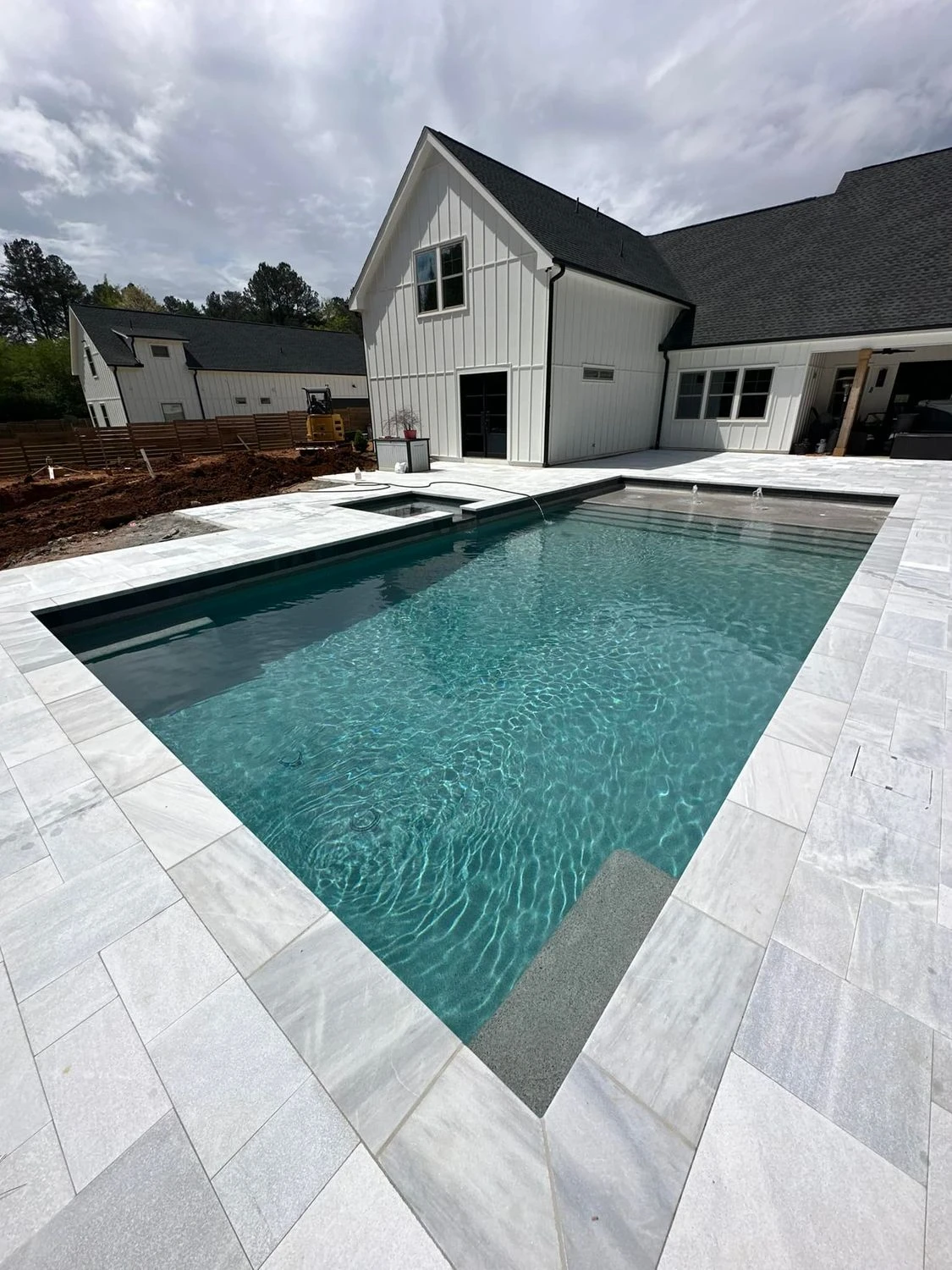
Failure Mode 3: Coping Heave and Deck Separation on the Downhill Side
The third failure mode is the one homeowners notice first because it’s the most visible. The coping stones lift off the bond beam on the downhill side. The deck pulls away from the coping and a gap opens up that you can drop a pencil into. The mastic joint that was supposed to absorb seasonal movement fails, water enters that gap, and the cycle accelerates from there.
This is a downhill-specific problem. The uphill side of a sloped pool is retained — the soil behind it is held in place by the shell itself acting as a retaining wall. The downhill side is exposed. It has nothing holding the soil in place except its own angle of repose, and Piedmont clay’s angle of repose drops from roughly 30 degrees when dry to under 15 degrees when saturated. So every wet season, the downhill soil is wanting to creep away from the pool. The deck, which is tied to the coping by friction and a mastic joint, gets pulled along with it. The coping, which is typically mortared to the bond beam with a half-inch of modified thinset, doesn’t have the shear capacity to resist that pull indefinitely.
On a sloped Clarkston lot, the coping and deck aren’t two separate systems that happen to meet at the pool edge. They’re a single continuous structure, and if you don’t engineer them that way, the hill will eventually separate them for you.
The corrected approach is mechanical, not adhesive. We anchor the coping into the bond beam with stainless #3 dowels set in epoxy every 18 inches on the downhill half of the pool. The deck is poured with integrated rebar that threads through the coping line and ties directly into the shell’s bond beam — so the deck and the shell move together as one body, or not at all. The mastic joint is still there, but it’s a weather seal, not a structural element. On the steepest Clarkston lots we’ve also built a secondary reinforced-concrete grade beam behind the downhill coping to resist soil creep directly, effectively turning the deck edge into a miniature retaining wall.
Failure Mode 4: Retained Soil Behind the Shell — The Silent Killer
The fourth failure mode is the one that doesn’t show itself until year eight or ten, and it’s the one that ends pools. On a sloped lot, the uphill wall of the pool is functioning as a retaining wall whether it was engineered for that load or not. Most standard pool shells weren’t engineered for it. They were engineered to hold water in, not to hold dirt out.
The load profile behind an uphill pool wall is called active earth pressure, and on a lot with 4 feet of retained soil in saturated Piedmont clay, it runs approximately 450 to 600 pounds per linear foot at the base of the wall. A standard 8-inch gunite wall with a #3 rebar grid at 16 inches on center — which is the default spec most volume pool builders quote — is designed for water pressure on the inside face. It is not designed for 550 plf of lateral soil pressure pushing the opposite direction. In the short term it holds, because the water inside the pool is pushing outward and partially counteracting the soil pressure. In the long term, during any period when the pool is drained for service and the hill behind it is saturated, the wall is completely exposed to the full lateral load with no counterforce. That’s when uphill walls bow inward. We’ve seen it in two Clarkston rebuilds — a visible inward curvature of three-quarters of an inch or more measured at mid-height.
The structural answer is to design the uphill wall as a retaining wall from the start. That means a thicker shell section — typically 10 to 12 inches instead of 8 — with a denser rebar grid, specifically #4 rebar on a 12-inch on-center grid in both directions, with hooked tie-ins at the bond beam and footing. It means shotcrete placed at a minimum of 40 psi at the nozzle, not hand-packed gunite from a crew that’s tired. It means a dedicated footing that’s widened toward the uphill side to resist overturning. And it means a drained gravel zone behind the wall with a discharge path, so the wall is never loaded by saturated soil in the first place.
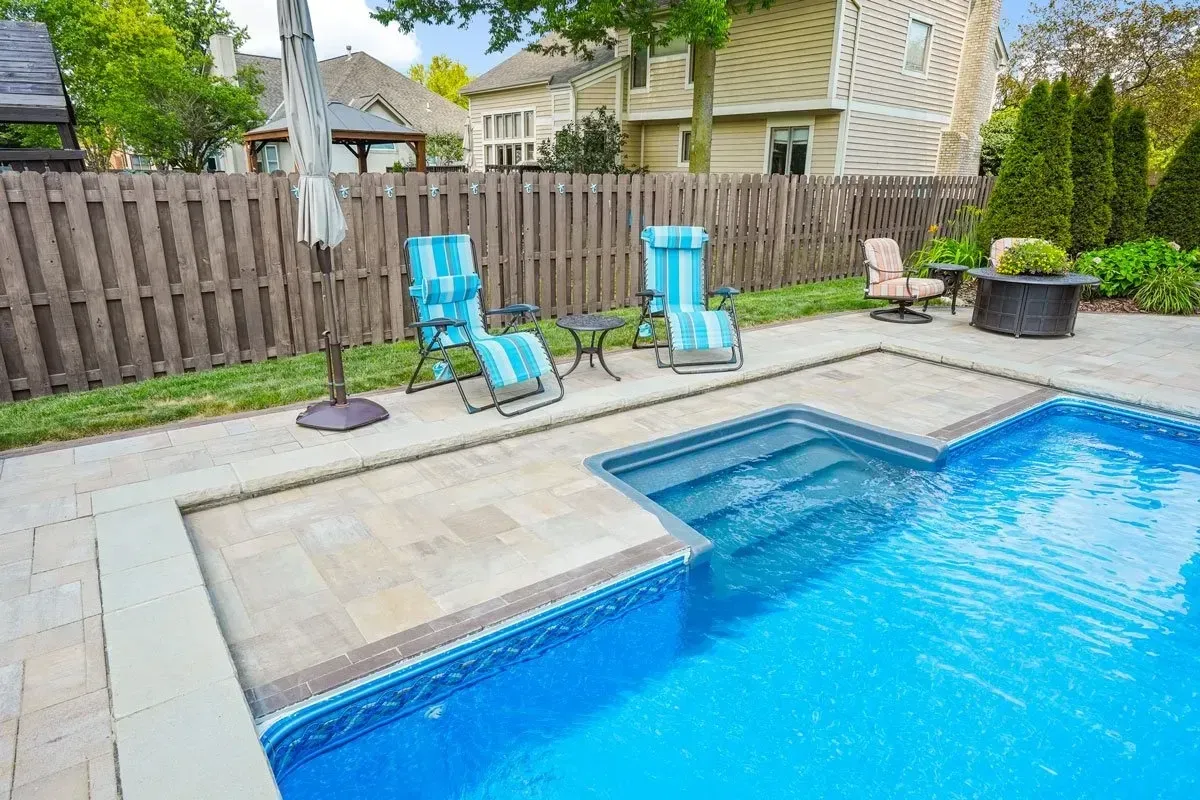
What the Geotechnical Workup Actually Looks Like — and What It Costs
Most Clarkston homeowners don’t realize a real slope-build quote includes a geotechnical study. It’s not optional in the engineering sense, and on any lot with meaningful grade change it’s not optional in the DeKalb County permit sense either. If you’re getting bids without a line item for soils work, you’re getting bids for a pool that hasn’t been designed yet.
Here’s what a proper workup involves. A licensed geotechnical firm comes out with a drill rig and takes soil borings — usually two to four of them, spaced across the proposed pool footprint, drilled to a depth of 15 to 20 feet or to refusal on the weathered granite bedrock, whichever comes first. Split-spoon samples get taken at 2.5-foot intervals and sent to a lab for moisture content, Atterberg limits, and shear strength testing. The engineer writes up a report that specifies allowable bearing pressure, groundwater depth at the time of boring, recommended foundation type, and recommended backfill compaction criteria. That report is what the structural engineer then uses to design the shell.
What the geotechnical and structural engineering workup runs in Clarkston: $4,200 to $7,800 for the full package — two to four borings, lab work, geotechnical report, structural engineer review, and stamped shell drawings sized to the specific site conditions. On lots with more than 5 feet of elevation change across the pool footprint, expect the upper end of that range plus a possible additional $1,800 to $3,400 for a wall-design supplement and deck-level grading plan.
Volume builders skip this because it’s a cost line the homeowner sees clearly and often doesn’t understand is load-bearing (in the literal sense). What they don’t tell you is that skipping it is what makes the warranty call possible in year five.
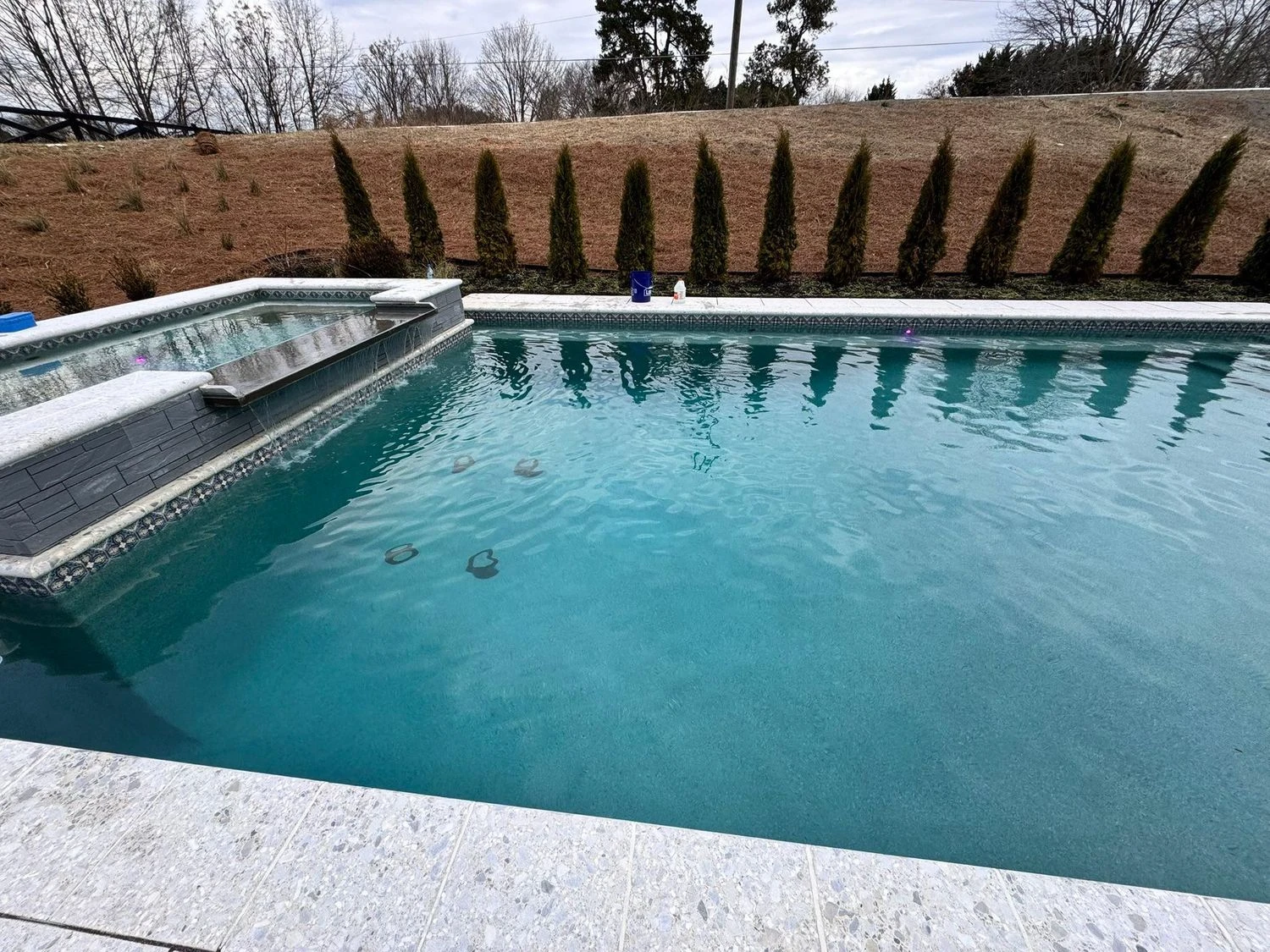
The Compaction and Rebar Protocol for Slope Builds
If the geotechnical workup is the diagnosis, the compaction and rebar protocol is the prescription. This is the specific construction procedure we follow on any Clarkston pool with more than roughly 30 inches of grade change across the footprint, and it’s the section of the contract we’d push back on if a client tried to value-engineer it out.
For the sub-grade, we excavate to the shell’s design depth plus a minimum of 8 inches. That extra 8 inches gets replaced with #57 crushed stone, compacted in two 4-inch lifts, each lift vibrated with a 4,000-pound-force plate compactor in perpendicular passes. Third-party density testing confirms a minimum of 95% Modified Proctor before any rebar goes in. If the geotechnical report flagged a fill area within the footprint — which happens on maybe 60% of Clarkston lots — the fill zone gets over-excavated and replaced with engineered structural fill compacted the same way, in 8-inch lifts, with a density test every lift.
The rebar grid is where slope builds really differentiate from flat-lot builds. On a standard flat-lot pool we’ll run #3 rebar at 16 inches on center. On any slope build in Clarkston we step up to #4 rebar at 12 inches on center in both directions, with a second curtain on the uphill retaining wall and double-mat in the bond beam where the deck ties in. Every intersection is wire-tied, not just laid across. Corners get L-bent rebar, not straight bar with hook-and-pray reliance on the shotcrete to carry the corner load.
Shotcrete placement is the moment the shell becomes a shell, and it’s the moment where experience matters most. A crew that’s been shooting gunite on flat-lot residential pools for years can still botch a slope shell if they don’t adjust the nozzle pressure and the crew position. Our spec calls for shotcrete placed at a minimum of 40 psi at the nozzle with the nozzleman positioned perpendicular to the rebar face, placing in lifts that don’t exceed 8 inches of buildup between rebound-cleaning passes. Rebound material — the stuff that bounces off the forms during placement — is removed and discarded, never reincorporated, because it has a radically different water-cement ratio than the design mix.
What This Means If You’re Getting Bids in Clarkston
A pool quote in Clarkston should tell you, in writing, what kind of lot the builder thinks they’re quoting. If the contract doesn’t reference slope, doesn’t reference a geotechnical study, doesn’t specify the rebar grid and compaction criteria, and doesn’t include a drainage plan — then what you’re holding is a flat-lot quote applied to a sloped-lot project. That’s the configuration that produces every single one of the four failure modes in this post.
When comparing Primetime’s number against a lower bid on the same property, the question isn’t “why are they more expensive.” The question is “what are they quoting that the other guy isn’t.” On a 4-foot drop over 18 feet — which is the threshold where we treat a lot as an engineering-required slope build — the delta between a properly engineered pool and a volume-builder pool is typically 14% to 22% of total project cost. On a $135,000 build that’s somewhere between $19,000 and $30,000. It is also, not coincidentally, almost exactly what it costs to tear out and rebuild a failed shell in year eight — minus the landscape damage, minus the 14 weeks of demolition and reconstruction, and minus the argument with your insurance carrier about whether the original builder’s warranty claim is still valid.
There’s a specific question we recommend every Clarkston homeowner ask every builder they interview, and it’s this: “At what point on my lot’s grade do your standard specifications change, and what do they change to?” A qualified builder will answer that question with a number. An unqualified builder will tell you their standard spec works on any lot. Only one of those answers is honest on a hillside in DeKalb County Piedmont clay.
Pool permits in Clarkston route through the DeKalb County Department of Planning and Sustainability, and for structural pools on slope the reviewer will want a stamped structural set and — in most cases — the geotechnical report attached to the application. Permits on marginal slope lots without that documentation get kicked back, and we’ve seen projects sit in review for six to eight weeks because a builder tried to submit flat-lot drawings. Plan for the engineering up front. It’s faster, not slower, than shortcutting it.
Custom pool construction across 20+ cities within 30 miles of Winder, GA
Every Primetime pool build on a sloped Clarkston lot gets the same geotechnical workup, 95% Modified Proctor compaction protocol, #4 rebar grid at 12″ on-center, and engineered underdrain detailed above. Written into the contract, verified by third-party testing, stamped by a licensed structural engineer.