
Should your Clarkston fire feature burn gas or wood? Wrong question to start with. The better questions are these: can your lot legally hold an open wood fire, can your gas service carry another 65,000 to 90,000 BTU load, and how many nights a month will you actually strike a match? Answer those three honestly and the fuel picks itself.
We get asked this on nearly every backyard consult east of I-285. A homeowner in Idlewood or off Brockett Road likes the crackle of real logs and the push-button ease of gas, and wants to know which is “better.” Neither. They solve different problems, and they come with different paperwork, different setbacks, and different habits attached.
So this post runs as a set of straight questions and side-by-side answers. What does the gas permit path look like in DeKalb County? How much yard does a wood fire actually need? Where does the smoke go on a 1960s ranch lot with a creek corridor behind it? What does each one cost to build and to run? And what do our own clients report a year after we hand over the keys?
What Is the Permit Path for a Gas Fire Feature in DeKalb County?
Start with jurisdiction, because it trips people up. Clarkston is its own city, but on the residential backyard jobs we run here, the trade permits route through DeKalb County Planning & Sustainability at 178 Sams St. in Decatur. DeKalb’s review queue runs about three to four weeks on a typical residential submission, compared with the ten to fourteen days we’re used to in Gwinnett. Want a gas fire by early October? File by late summer.
A gas fire pit is not a plug-and-play appliance. It is a new branch of fuel piping, and the piping is what gets permitted and inspected. Georgia adopts the International Fuel Gas Code with state amendments, and the sequence on a Clarkston job looks like this:
- Load check at the meter. We add up every gas appliance in the house — furnace, water heater, range, dryer, any existing grill line — and add the fire pit burner. On a 1960s split-level with the original meter, a large burner can push the total past what the meter set was sized for.
- Pipe sizing. Pipe size is driven by total load and the length of the run. A 60-foot run to the back of a Lake Capri lot usually needs larger pipe than a 20-foot run off the back wall.
- Georgia 811 locate. State law requires the locate request at least three business days before digging.
- Trench and rough inspection. The fuel gas code calls for underground piping at a minimum of 12 inches below grade, with a reduced depth allowed only for individual lines feeding outdoor appliances. Plastic gas pipe needs a tracer wire so it can be found later. The inspector sees the trench open.
- Pressure test. The piping is tested under pressure and has to hold before anything gets buried or connected.
- Burner set, final inspection, and a lighting walkthrough with the homeowner.
If the added load exceeds what the meter can deliver, Atlanta Gas Light — the pipeline utility behind every natural gas account in this part of Georgia, no matter which marketer sends your bill — has to swap the meter. That swap has its own lead time and is a common reason a gas project slips a month. We check the meter plate on the first visit for exactly this reason.
Propane is not a permit shortcut: A hidden 20-lb tank inside a fire table enclosure avoids a buried line, but you trade it for tank swaps every six to eight burn hours on a mid-size burner, and a buried 100- or 250-gallon tank brings its own setback and installation rules. On a Clarkston lot that already has natural gas at the house, a hard line almost always wins.
One more gas detail people skip: the burner itself should be listed to ANSI Z21.97, the standard for outdoor decorative gas appliances. A listed burner system — from brands like Warming Trends, HPC Fire, or American Fireglass — comes with an installation manual that spells out clearances, ventilation openings in the enclosure, and the correct fire media. Inspectors read those manuals.
How Much Yard Does a Wood-Burning Fire Pit Actually Need?
Here is the number that decides many Clarkston wood-burning conversations before they start. Under the International Fire Code, a recreational fire has to sit at least 25 feet from any structure or combustible material. A listed portable outdoor fireplace — a manufactured steel unit with a screen — gets a reduced 15-foot distance. A built-in stone pit with open logs is treated as a recreational fire.
Twenty-five feet sounds modest until you draw it. Picture a typical 1960s–1970s Clarkston lot: roughly 80 to 100 feet wide with a rear yard of 70 to 120 feet before the tree line. Draw a 25-foot circle around the pit; nothing combustible can land inside it. That circle excludes:
- Your house, including a wood deck, vinyl siding, or the soffits of a covered porch.
- Any wood privacy fence — yours or the neighbor’s — along the side or rear property line.
- A storage shed, a wood pergola, or a playset.
- Overhanging limbs and heavy leaf litter, which on a canopied lot near a creek tributary can be most of the perimeter.
On a 90-foot-wide lot with a wood fence on both sides, a 25-foot radius means the pit has to sit within a strip about 40 feet wide down the middle of the yard, well out from the back wall of the house. That is doable on the deeper lots in Toney Valley or along the Sycamore Drive corridor. On a shallow infill lot, it often isn’t doable at all — not legally, and not safely.
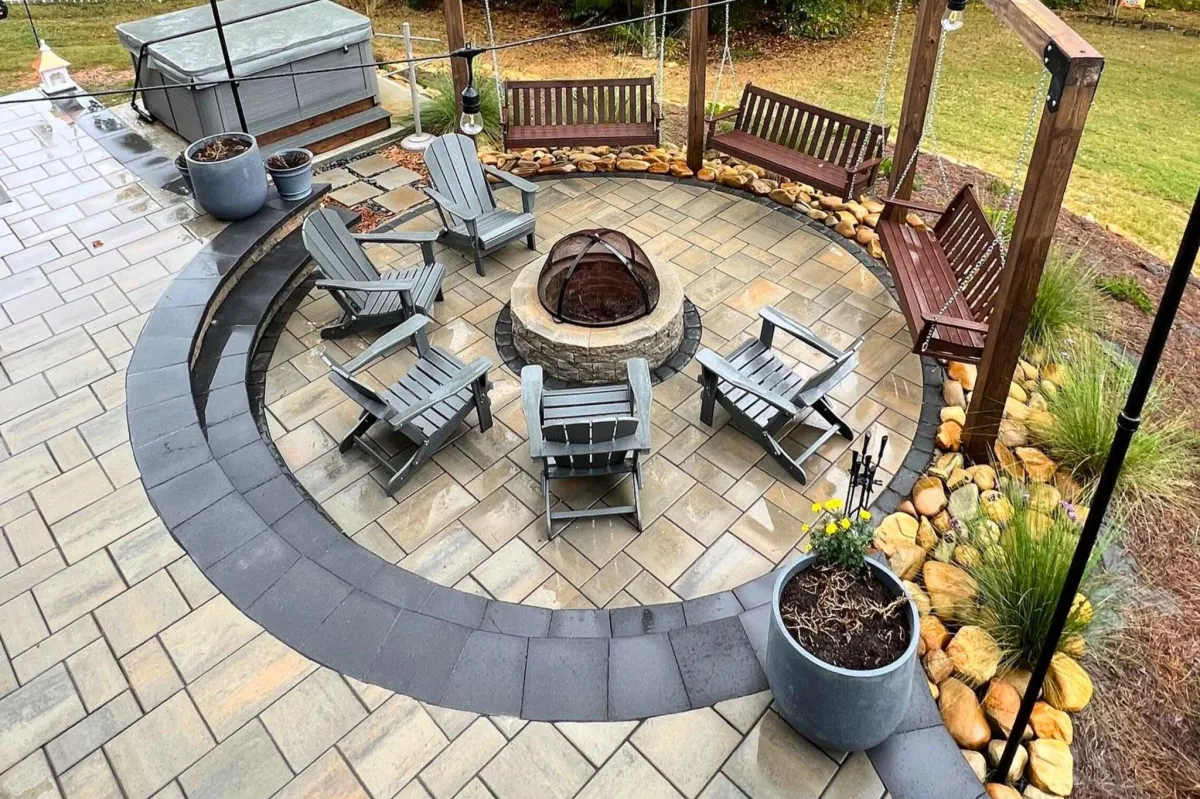
Local fire officials can enforce these distances, and DeKalb County Fire Rescue can order a fire put out if it creates a hazard or a smoke nuisance. The code also expects someone to attend the fire until it’s out and to keep an extinguishing method within reach — a charged garden hose counts, and we plumb a hose bib close to every wood pit we build for that reason.
Gas plays by different rules. Because a listed gas appliance has no flying embers and no smoldering coals, its clearances come from the manufacturer’s listing, not the 25-foot recreational-fire distance. Those listed clearances are typically a few feet to the sides and several feet overhead. That’s why a gas pit can sit near a fence or under a designed roof where a log fire never could.
Where Does the Smoke Go on a Canopied Clarkston Lot?
Clearance keeps a wood fire legal. It doesn’t keep it neighborly, and in Clarkston smoke deserves extra attention for three reasons.
First, the air sits still. Clarkston sits around 1,036 feet of elevation, lower than the north-metro suburbs, and plenty of backyards back up to tree-canopied creek corridors along Pole Bridge Creek or the South Fork of Peachtree Creek. On cool fall evenings, air settles into those low spots, and wood smoke settles with it — pooling along the ground and drifting downhill — often straight across the rear property line toward the next house.
Second, the houses are close and the windows are open. October and April are the best months for a backyard fire in Georgia, and they’re also the months people turn off the HVAC and open the bedroom windows. A ranch house 30 feet from your side line will smell your fire long before you notice any haze.
Third, the neighborhood is dense. Clarkston packs about 13,800 people into a small footprint, and neighbors here keep every kind of schedule. A log fire that burns until midnight three nights a week will get noticed.
If you still want wood — and many people do, for good reasons — design for the smoke:
- Burn seasoned hardwood only. Oak and hickory split and stacked at least six months burn cleaner and hotter. Green wood and yard scraps create the thick, lingering smoke.
- Watch the evening breeze. Site the pit so the usual fall breeze carries smoke across your own lawn, not into a neighbor’s patio.
- Size the pit modestly. A 36- to 42-inch interior diameter holds a fire big enough for six people without turning into a bonfire.
Gas vs. Wood Side by Side: Cost, Code, and Upkeep
The figures below reflect what we see on Clarkston and east-DeKalb projects for a built-in, stone- or block-faced fire pit on an existing or new paver patio. Your numbers will move with finish materials, burner size, and — for gas — how far the pit sits from the meter.
The gap narrows in two situations. If a gas stub already exists near the house — say, an old grill line — piping cost drops sharply. And if a wood pit needs a long run of new patio just to reach a legal spot 25 feet out from the house and fences, the extra square footage of pavers can erase the savings.
Freeze exposure matters for both. Clarkston sees roughly 8 to 14 freeze events a winter — enough to stress any masonry that holds water. A gas pit filled with lava rock or glass needs drain holes at the base so rainwater doesn’t sit around the burner pan and freeze. A wood pit needs its firebrick liner set in refractory mortar, not standard mortar, because heat cycling on top of freeze-thaw cycling breaks ordinary joints apart within a few seasons.
How Often Do Clarkston Homeowners Actually Light Them?
This is the section we wish every client read before choosing. We follow up with homeowners after a project is finished, and one question we always ask is how often the fire feature gets used. It’s informal — phone calls, not a lab study — but the pattern across our DeKalb and Gwinnett fire projects is consistent.
Read that table again and notice the real story. Gas fire features get lit more often, for shorter sessions, with less planning. Wood fires get lit less often, for longer sessions, as a planned event. If you picture a half-hour unwind on a Tuesday, a wood fire won’t get lit that Tuesday — the setup, the wait for coals, and the cleanup turn it into a project.
The flip side is just as true. Several of our wood-burning clients told us plainly that the ritual is the point. If that’s you, don’t let anyone talk you into gas just because it’s convenient.
Where Each Fuel Fits: Pergolas, Fence Lines, and Open Lawns
Once you know your lot and habits, placement usually settles it.
Under a pergola or pavilion roof
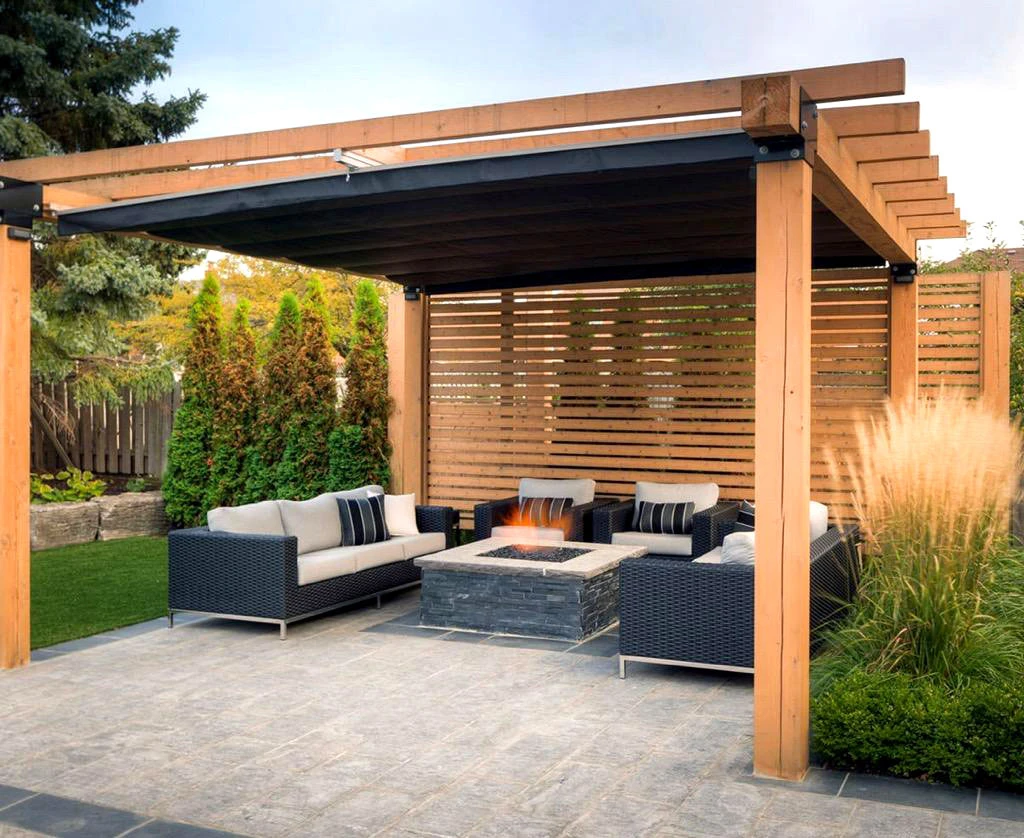
Gas only. A wood fire under any roof structure is a non-starter — sparks, heat, and creosote-laden smoke all rise into the framing. A listed gas fire table under a pavilion is a different story, as long as the overhead clearance in the manufacturer’s manual is met and the space is open enough on the sides to ventilate.
Tight to a fence line or close to the house
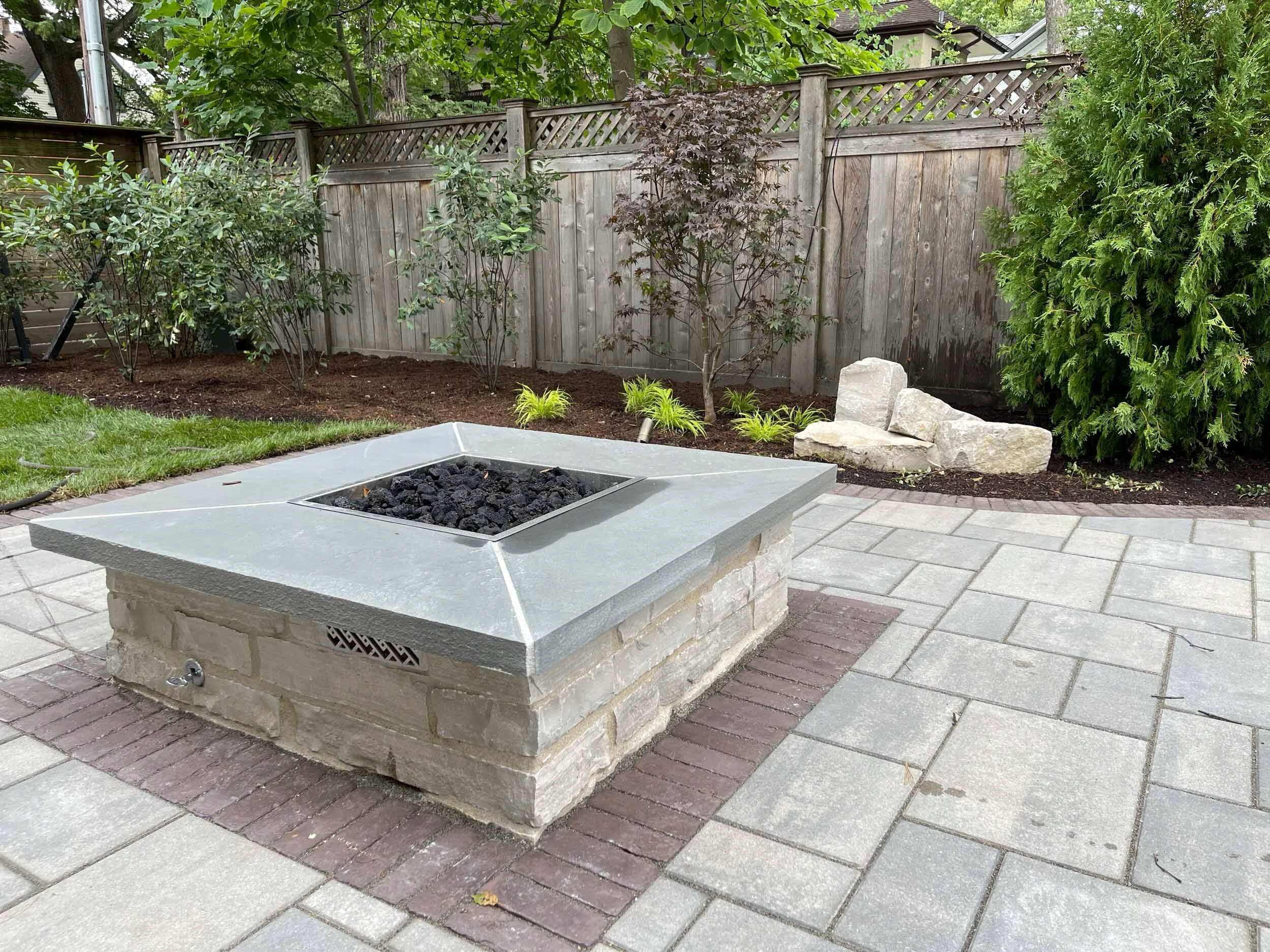
Gas, almost every time. Plenty of Clarkston lots from the 1960s and 1970s have wood privacy fences, and homeowners often want the fire area tucked into a back corner for privacy. That corner puts the pit within a few feet of combustible fencing — fine for a listed gas appliance installed to its clearances, and flatly off-limits for a wood fire. The square gas pit near the top of this post shows that setup.
An open lawn or a lower terrace away from the house
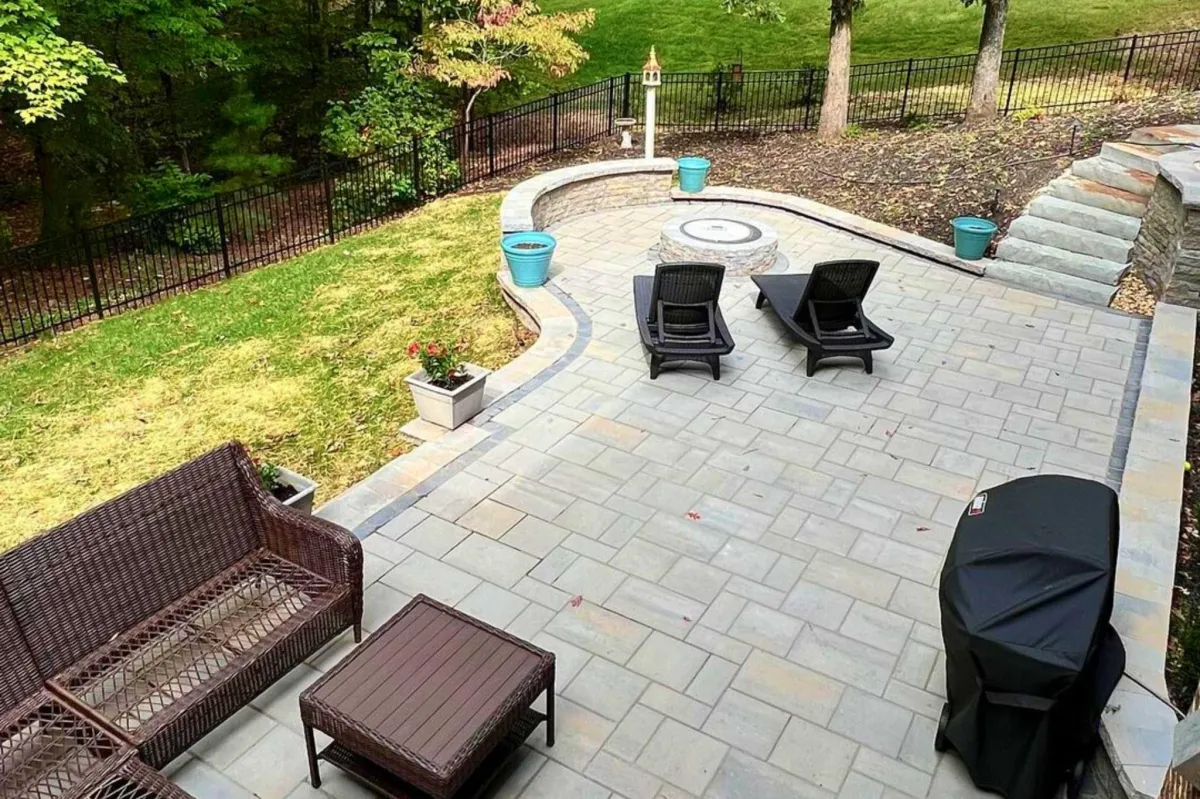
This is where wood earns its spot. Deeper lots in Lake Capri, Hambrick, and parts of the Stone Mountain–Lithia Springs corridor often have a second, lower level of yard, thanks to the 4- to 10-foot grade changes common on older Piedmont lots east of I-285. A lower terrace set well out from the house and fences can hold the full 25-foot circle, and the grade change helps separate the smoke from the living spaces above.
There’s a catch. Running a gas line down to a lower terrace means trenching through red clay and, on lots nearer the Stone Mountain pluton, sometimes hitting decomposed granite in deeper cuts. A long trench adds real cost. So the same terrace that makes wood legal also makes gas more expensive. That’s why we see more wood pits on the deep lots and more gas features on the shallow ones.
Choosing by Habit: A Decision Grid for Your Clarkston Backyard
Pull it together. Answer each line honestly and count which column wins.
If the columns come out close, there’s a middle path we build fairly often: a round stone shell sized and vented for a gas burner, with a capped gas stub run during the patio build. You burn wood for a few seasons if the lot allows it. If habits shift — a new baby, a new neighbor, less patience for ash — you add the burner later without cutting up the patio. The extra cost is mostly a run of pipe and a sleeve through the wall, far cheaper than trenching through a finished patio.
If you’re weighing this for your own yard, start with a tape measure and a look at your gas meter plate. Then take the Tuesday-night test: is your fire a quick half hour or a whole evening? Your answer is your fuel.
Fire pits and fireplaces across 20+ cities from our home base in Winder, GA
We measure the clearances, check the gas meter, and ask about your habits before we sketch a single fire feature, so the one we build is legal, safe, and gets lit often.