
The homeowners called us with a brief most Clarkston backyards can’t actually accommodate — a full integration of pool, patio, and outdoor kitchen on a 0.31-acre lot with a 6-foot grade fall from the back door to the rear fence. The challenge wasn’t budget. It was geometry. Every cubic foot of pool, patio, gas line, and roof had to be located on the first sketch — because a backyard this size punishes anything moved twice.
This is the case study of a $148,600 build we finished off Brockett Road in 2025 — a property in one of the older Clarkston subdivisions where the original 1972 ranch had a flat concrete patio, a pressure-treated deck added in the 90s, and a backyard that sloped four to six feet from the rear sliding door down to a privacy fence forty feet away. The owners had been quoted for a pool by two other companies. Both quotes had treated the pool as a standalone object. Neither bid addressed the patio surface integration, neither priced the outdoor kitchen, and neither one of them had walked the grade with a transit before quoting the depth.
The reason that matters: on a Clarkston lot this size, a pool placed without thinking through the kitchen, the patio surface, and the gas, water, and electrical runs becomes the only thing in the backyard. The patio gets squeezed into whatever’s left. The kitchen gets pushed against the house — usually right where the gas meter is — and the homeowner ends up with a beautiful pool they don’t actually live around. What follows is the full sequence: brief, constraints, master plan, pool placement, patio surface, kitchen package, and final numbers — plus what we’d repeat and what we’d change.
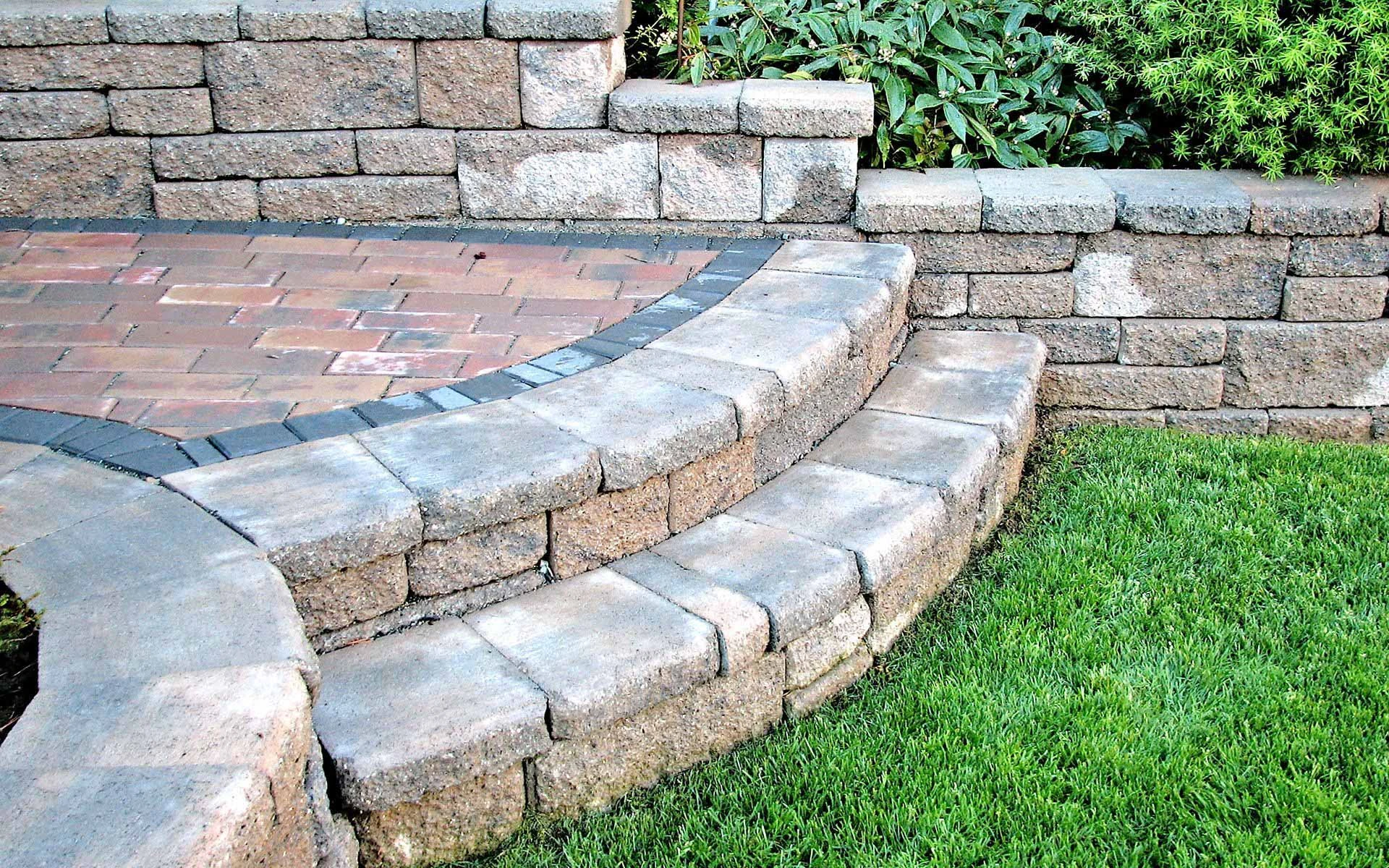
The Backyard — Lot Constraints and What We Inherited
The lot was a typical older-Clarkston parcel: 0.31-acre lot, 36-foot rear setback from the back of the house to the fence at the closest point, with an actual usable width of about 58 feet between the side setbacks. DeKalb County’s residential pool setback rules required a minimum of 10 feet from the rear property line, 10 feet from any side property line, and 8 feet from the principal structure for the pool wall itself — which on this lot left a buildable window roughly 38 feet by 38 feet for everything we wanted to put in the backyard.
Inside that window we had to fit a 14-by-30 pool, a dining-and-lounge patio of at least 600 square feet, an outdoor kitchen island with roof, a path from the house, and the equipment pad. We also had to handle the grade. The transit shot showed a 6.2-foot drop from the back door threshold to the lowest fence corner. Most of that fall happened across the first 22 feet — meaning the pool itself was going to sit either in a cut, on a fill, or split between a partial cut and a low retaining wall.
Below grade we hit something less common in the rest of metro Atlanta: decomposed granite at 4 to 8 feet on the eastern half of the lot, consistent with the Stone Mountain pluton five miles east. That changed two things. First, it constrained how deep we could go without rock removal premiums. Second, it actually helped us — competent decomposed-granite shelves are excellent bearing material for a gunite shell and the kitchen footings, far better than Cecil clay alone.
DeKalb County residential pool setback rule we built to: 10 feet from rear and side property lines, 8 feet from principal structure (closer than that requires structural review of foundation proximity), and a permit-required 48-inch barrier around the pool perimeter per DeKalb adopted IRC §AG105. Permits routed through DeKalb Planning & Sustainability at 178 Sams St., Decatur — not through the City of Clarkston. Average review time on this project: 22 calendar days from submittal to issuance.
The Brief — Must-Haves, Nice-to-Haves, and the Budget Range
The clients gave us five must-haves on the first site visit, written on the legal pad we used that afternoon: pool with shallow sun-shelf, dining table that seats eight, outdoor kitchen with grill + smoker + bar seating, covered roof over the kitchen, and a continuous patio surface that didn’t change material between zones. Two nice-to-haves — a pizza oven and a gas fire bowl — got cut in the value-engineering pass.
Budget framing came next. The first bidder had told them a pool of this size “would be around $80,000,” with patio and kitchen added later for $20,000-$30,000. That math has been wrong on every Clarkston job we’ve ever quoted. Pool + patio + outdoor kitchen with roof, done right, almost never lands under $120,000 in this market. We told them so on visit one and asked for a real ceiling before we drew anything. The ceiling came back at $155,000. Final delivered build: $148,600 — $86k pool, $34k patio, $28.6k outdoor kitchen + roof, leaving about $6,400 of headroom kept in reserve for trim, planting, and final lighting.
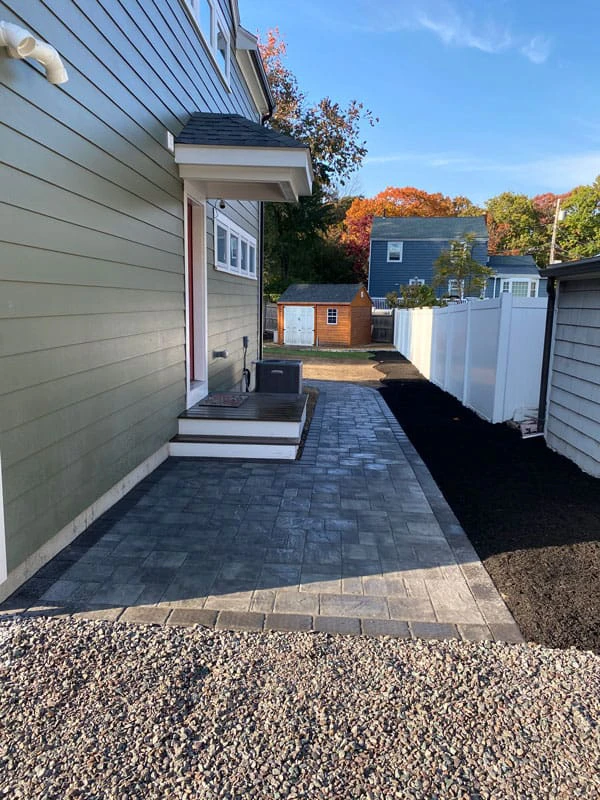
Master Plan and the Two Sight Lines That Drove Everything
The first hour of design on any integrated build is spent standing at the back door, then standing where the dining table will go, then standing where the cook will stand at the grill. Three positions. Two sight lines. Get those right and the rest of the plan almost draws itself.
Sight line one ran from the kitchen island through the dining patio across the pool to the privacy fence at the rear. We wanted that line clear — no roof column, no kitchen wall, no equipment, nothing in it — so that the cook could see every kid in the pool without leaning over the bar. That single requirement determined the pool’s long-axis orientation (parallel to the house, not perpendicular) and the location of the kitchen island (offset 8 feet from the back door, not directly out of it).
Sight line two ran from the back-door threshold straight out the slider. In a backyard this small, the temptation is to make the pool the anchor — but a pool seen end-on from inside looks like a rectangle of water with no depth. We oriented the pool so the long edge faced the slider and put a floating bench with a tall planter behind it at the far end. From the kitchen sink inside the house, that’s now the visual: water across the foreground, bench and planter as focal point, fence and trees beyond. The pool reads as a room, not an object.
Those sight lines also dictated circulation. The path from the back door doesn’t go straight to the kitchen — it turns 90 degrees right at a wide step landing, then continues. The pool becomes the first thing you see; the kitchen is revealed only when you turn into it. A small trick that makes a 0.31-acre backyard feel almost twice as deep.
The master plan also locked equipment pad, gas meter run, electrical sub-panel, and irrigation manifold — all four sharing a single 6-foot service corridor along the right side of the house. We drew the corridor on sheet one before we drew the pool. The easiest way to ruin an integrated backyard is to design the pretty parts first and then try to find a place for the ugly ones.
Pool Placement, Setbacks, and the Excavation Decision
With sight lines fixed, the pool location was almost forced. A 14-by-30 rectangle with a 7-foot tanning shelf ended up 11 feet off the rear fence, 12 feet off the right side, and 19 feet off the back of the house, long axis parallel to the house.
The grade decision was harder. With a 6.2-foot drop across the buildable area, we had three options: full cut (pool sunk into existing grade), full fill (raise the whole backyard and retain against the back fence), or a split — partial cut on the house side, partial fill on the fence side, with a low seat wall doing the retaining. We went with the split. Full cut would have created a sunken pit. Full fill would have required a 6-foot retaining wall along the rear, structurally fine but visually heavy and triggering an additional DeKalb County wall permit at $185 for any retaining structure over 4 feet. The split used an 18-inch seat wall integral to the rear coping, doubling as bench seating around a fire-bowl spot we left rough-plumbed for future install.
Excavation hit the granite shelf at 6 feet on the deep end as predicted — trim work with a hydraulic breaker rather than rock blasting. We budgeted a $1,400 rock allowance; actual was $1,180.
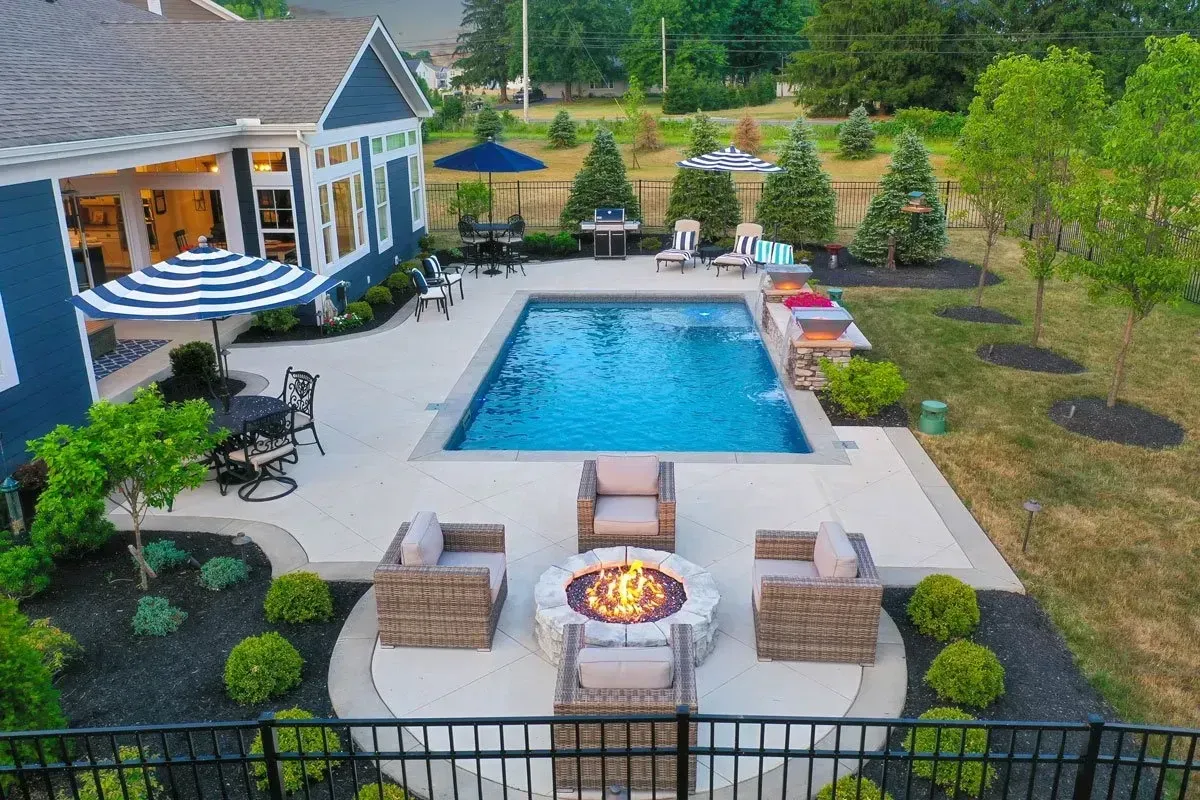
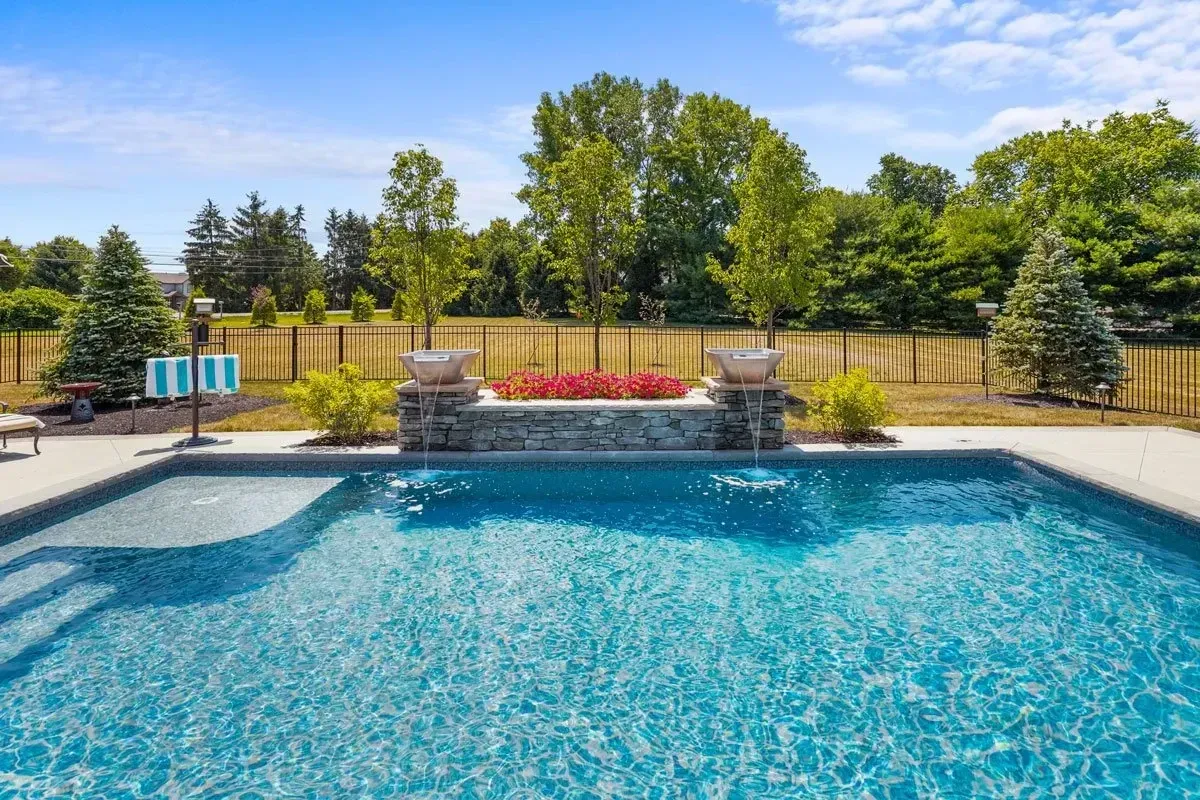
Pool finish was a Pebble Tec Sand Quartz in a warm tan that read sand-bottom in sunlight and turned a deeper amber under the LED color program at night. The owners had originally asked for white plaster. We talked them out of it. Clarkston’s water hardness runs in the 110 to 140 ppm CaCO₃ range coming out of the DeKalb County tap, which is meaningfully harder than the Gwinnett system. Hard water plus white plaster equals visible scaling at the waterline inside 18 months, and stain etching on the sun shelf where everyone’s drinks sweat in summer. The aggregate finish hides both.
Total pool line item: $86,000. That included excavation, gunite shell, plumbing, equipment (Pentair IntelliFlo3 VSF pump, Pentair MasterTemp 400k BTU heater, Pentair Clean & Clear Plus 320 filter), Pebble Tec interior, six color LED lights, automation, and bonding to NEC §680.
The Connecting Patio Surface — One Material, Three Zones
One must-have was a continuous patio surface that didn’t change material between zones. On a small backyard, switching materials between cooking area, dining area, and pool deck makes the space read as three small rooms instead of one. We use one paver across the whole footprint whenever we can, with subtle border shifts to delineate zones.
The surface we specced was Belgard Mega-Lafitt in Bavarian Blend — a 3-piece random paver in a charcoal-and-warm-gray colorway that reads as natural stone from twelve feet away at meaningfully less than flagstone cost. We laid the field at 90 degrees against the house wall to push visual length, with a soldier-course border in the same paver marking transitions at the kitchen threshold, pool deck, and dining area.
Base build determines whether an integrated patio is still flat in fifteen years or heaving in three. Clarkston’s Cecil-series clay has meaningful shrink-swell behavior. Base spec: 8-inch compacted GAB (Georgia Aggregate Base, 57 stone over crusher run) in 2-inch lifts, non-woven geotextile separator beneath, 1 inch of ASTM C33 bedding sand screeded on top. Joints swept with polymeric sand and activated with a fine mist, not a hose blast.
Total patio surface: 1,420 square feet across three zones, plus 220 square feet of pool coping in matching Belgard travertine-finish bullnose. Material plus install: $34,000 — roughly $24 per square foot. We’ve seen identical specs quoted at $38 per foot elsewhere in DeKalb. The difference is usually whether base depth gets written into the contract.
Base depth contract language we use: “8-inch compacted Georgia Aggregate Base, installed in 2-inch lifts with plate compaction between each lift, over a non-woven 6-oz geotextile separator. 1-inch ASTM C33 concrete sand bedding screeded to grade. Polymeric sand swept and activated per manufacturer specification. Final surface tolerance ±1/8 inch over any 10-foot run.”
Written, not verbal. If a contractor won’t put the lift sequence into the contract, the lift sequence isn’t happening on the jobsite.
The Outdoor Kitchen Build — Layout, Appliances, and the Gas Run
The kitchen footprint was an L-shape: a 9-foot run with grill and sink, and a 6-foot return wing with bar seating for four. The L put the cook at the corner — facing the pool through the sight line we’d locked — rather than against a wall with their back to the action.
Appliance package: Lynx 36″ grill (L36ASR) as primary cook surface, Coyote 28″ pellet smoker in the return wing, 24″ undercounter beverage center. The clients had asked early about a Kalamazoo Hybrid Fire as centerpiece — best built-in grill made in America, worth the money — but at $9,200 it pushed the kitchen total past budget. The Lynx at roughly $4,900 is still a 30-year piece of equipment. The Kalamazoo was the only real budget concession in the build.
The expensive un-glamorous part was the gas run. The existing meter sat on the right side of the house, 64 feet from the kitchen, sharing a trench with the patio, equipment pad, and irrigation manifold. We ran 3/4″ CSST (corrugated stainless steel tubing) sized for combined load: grill (50,000 BTU/hr) + smoker (12,000 BTU/hr) + pool heater (400,000 BTU/hr). Combined load determines line size, not just the appliance you’re worried about.
Gas-line contract spec we write for every kitchen build: “3/4” CSST trunk line from meter to manifold, sized per IFGC Table 402.4 for combined connected load. Pressure-tested at 50 psi for 15 minutes, witnessed by DeKalb County inspector before backfill. Trench depth 18-inch minimum, with yellow caution tape laid 6 inches above line.” If the contractor doesn’t write the pressure-test value into the contract, they’re not pressure-testing.
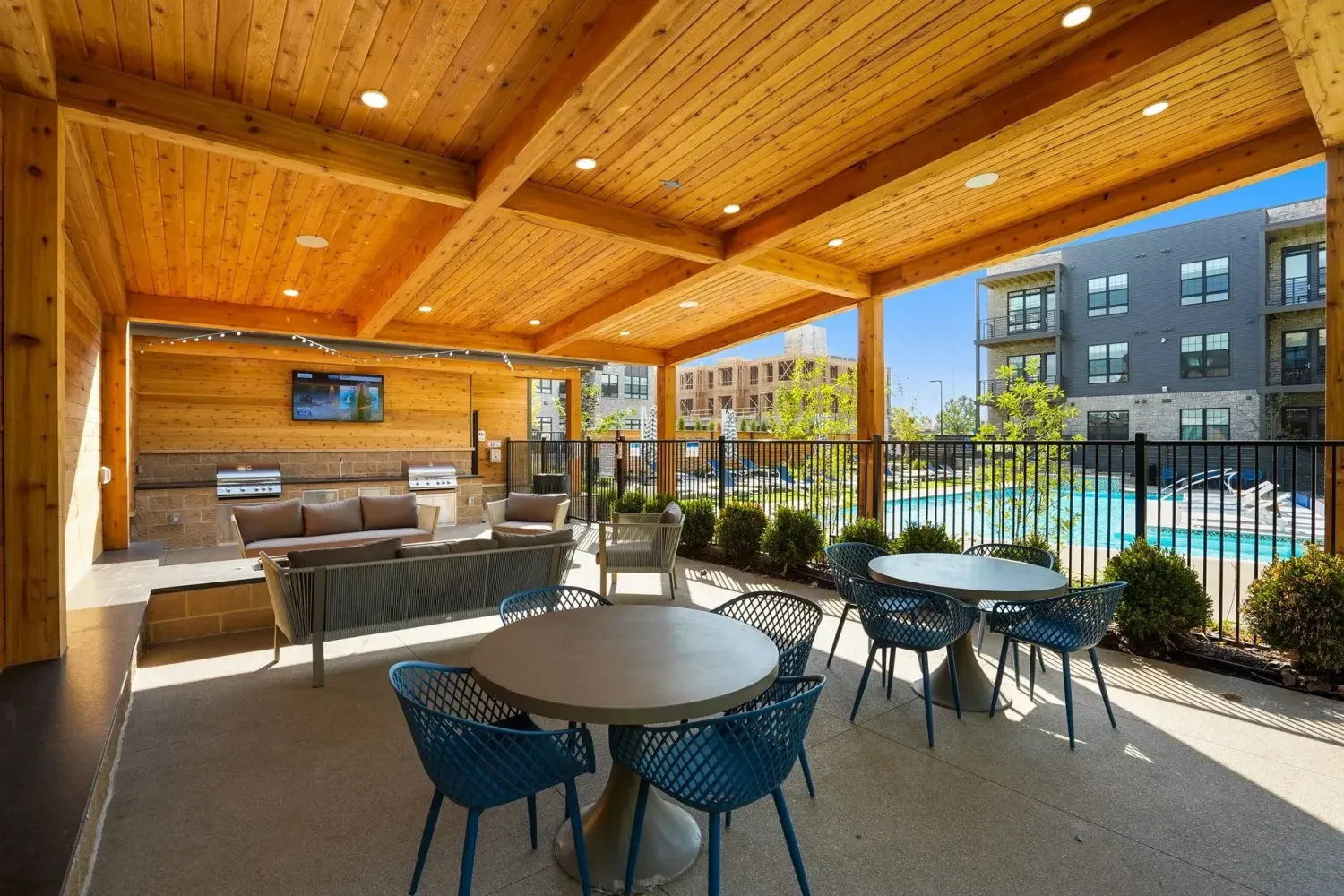
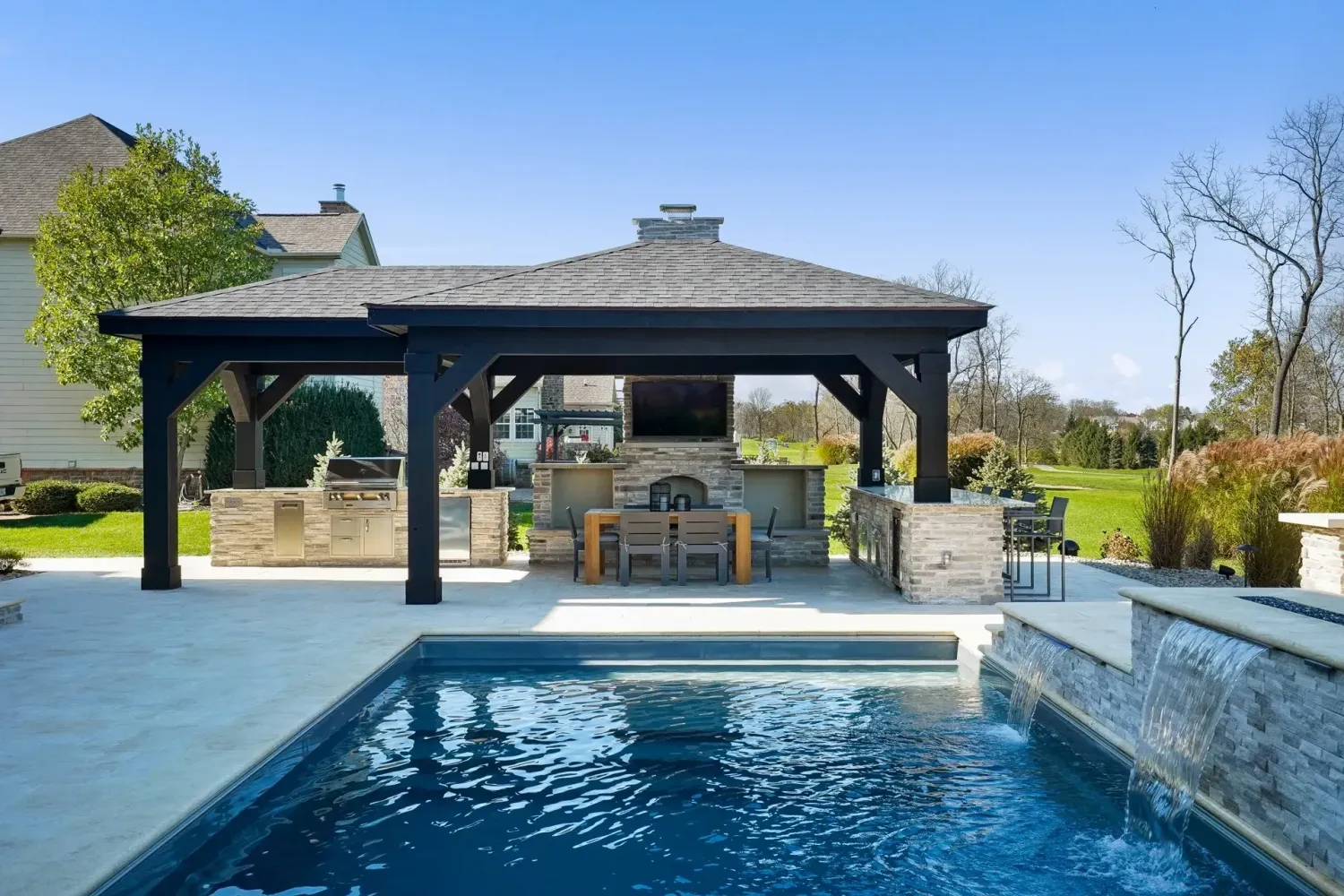
The roof was a 12-by-14 standing-seam metal pavilion, post-supported on two outer corners and tied into the house ledger on the inboard side, slope matching the existing gable at 6:12. We added a damp-rated ceiling fan, four recessed downlights on a dimmer, and a 240V outlet for a future infrared heater on a separate circuit so the kitchen could shoulder-season into October and back into March.
Kitchen + roof line item: $28,600 — roughly $11,400 cabinetry, stone counters (leathered honed granite), and trim; $9,800 appliances; $4,200 gas, plumbing, electrical; $3,200 roof structure.
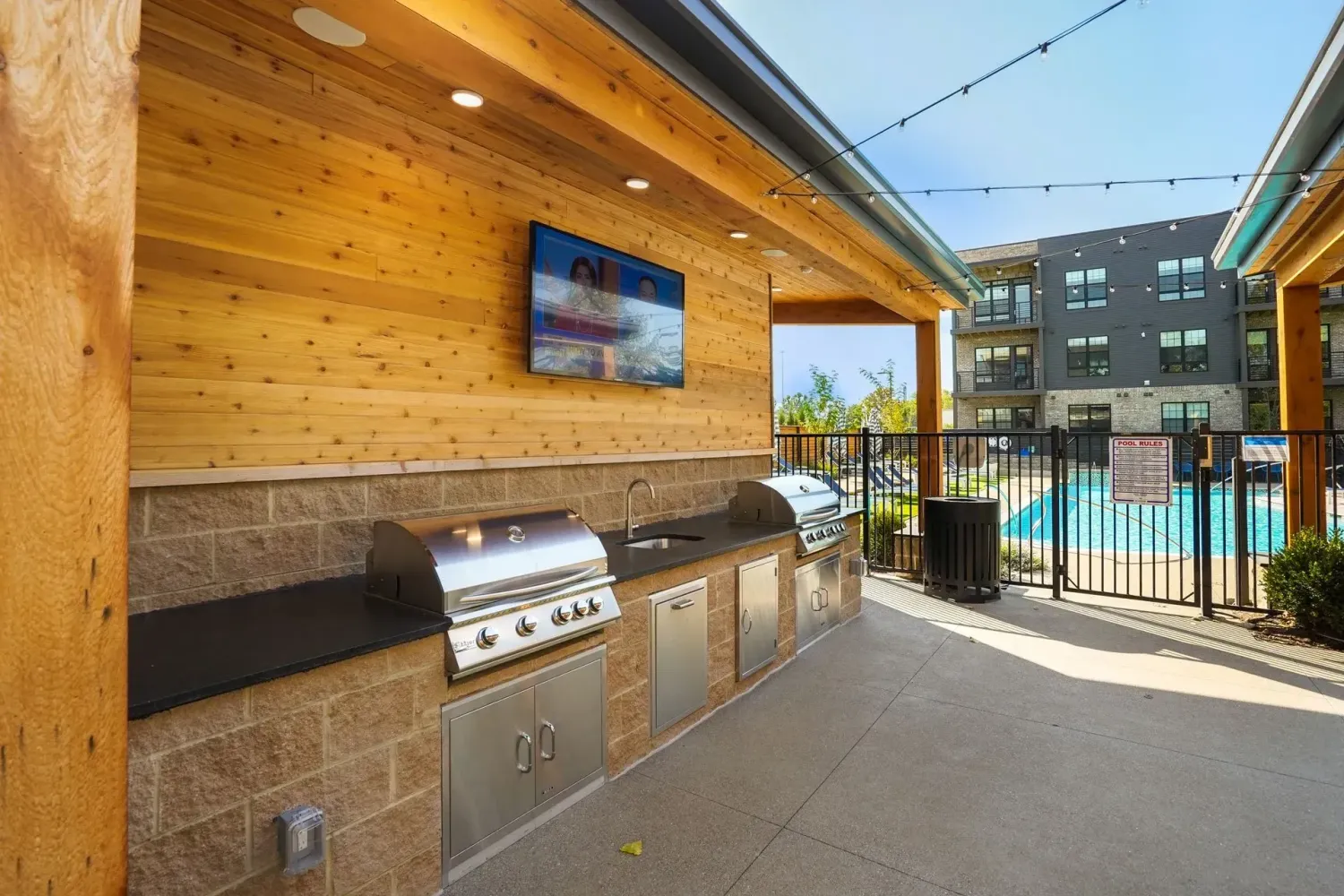
Lighting, Water, and Material Carry-Through
The integration only works if the lighting reads as one system, the water reads as continuous, and the materials carry from zone to zone without a visible seam. Three small categories of decision determine whether a backyard like this looks designed or assembled.
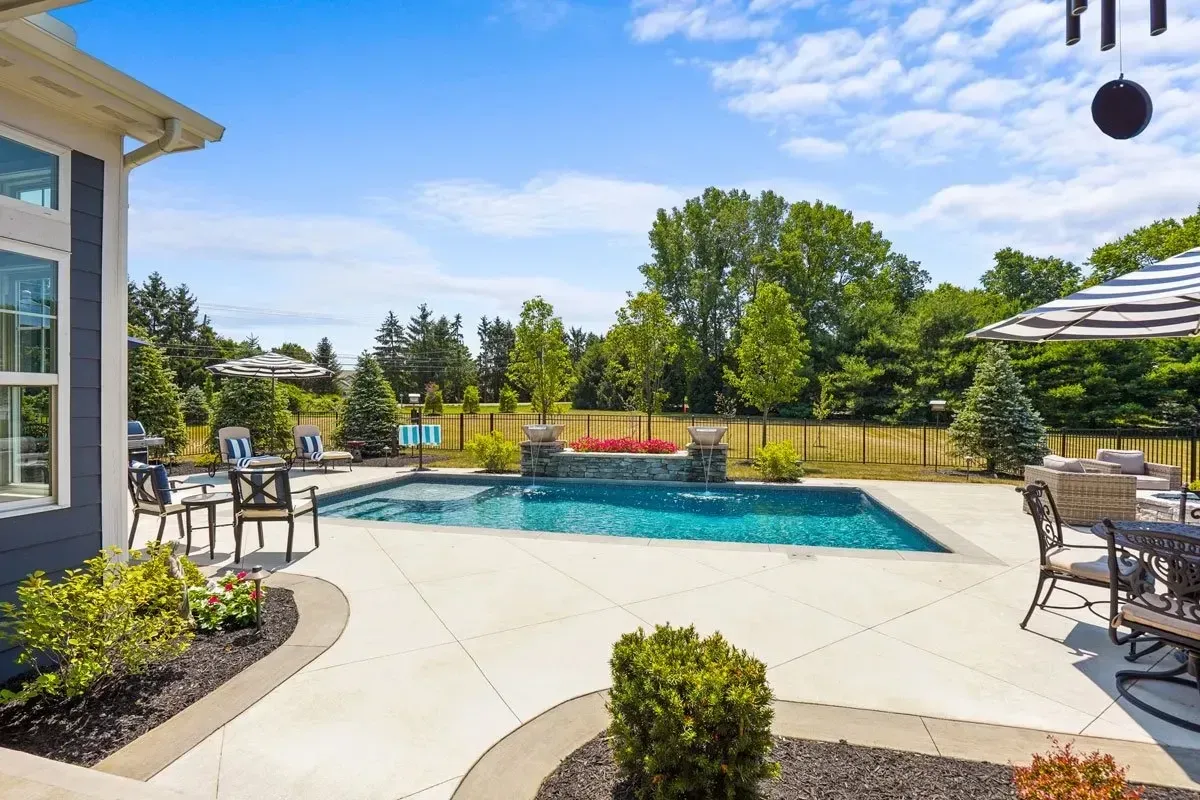
Lighting was layered in four levels. Functional: four recessed downlights in the kitchen roof, dimmed. Architectural: low-voltage FX Luminaire path lights along the soldier course at kitchen and pool-deck transitions, 30-degree downward beam at 2700K so the patio reads warm at night. Pool: six Pentair color LEDs on a single automation circuit, defaulting to soft amber that complements the Pebble Tec rather than the cyan most pools default to. Accent: two uplights at the rear planter and one on the privacy fence beyond, extending visual depth by another fifteen feet.
Water continuity was a smaller call but meaningful. We did not add a spillover spa, a fountain, or a sheer descent. The clients had asked about all three. We talked them out of all three. On a backyard this small, water features fragment the visual rather than unifying it, and moving water reads as nervous rather than calming when you’re sitting eight feet from the source. We left rough plumbing for a future gas fire bowl on the rear seat wall — drama without noise.
Material carry-through was the third lever. Same Belgard paver from kitchen floor through dining patio across pool deck. Same leathered granite as the kitchen counter caps the rear seat wall. Same matte-black standing-seam shows up as the trim band on the kitchen island and as the gutter against the house. Five repetitions across three zones. Without them the backyard reads as three projects glued together. With them, it reads as one room.
Total delivered cost: $148,600. Pool $86,000. Patio surfaces $34,000. Outdoor kitchen + roof $28,600. That figure includes everything from permit fees to the final lighting commissioning. It does not include the landscape softscaping (planting beds, sod, irrigation extension) which the owners contracted separately for about $9,800 with a different vendor.
Timeline ran 11 weeks from contract signature to substantial completion. Permits issued in 22 calendar days. Excavation, gunite, and shell cure ran weeks 3-5. Plumbing rough-in, equipment-pad framing, and kitchen footings happened in parallel across weeks 4-5 to consolidate trenching. Paver base build was week 6, paver install and coping week 7, kitchen cabinetry and appliances weeks 8-9, roof week 9, pool plaster and start-up week 10, final lighting and punch-list week 11.
DeKalb water hardness mattered on start-up day. Fill came in at 132 ppm hardness with a pH of 8.1 — both numbers that would have driven calcium scaling on white plaster inside thirty days. We pre-balanced with a sequestrant, dropped pH to 7.4 with muriatic acid, and ran the filter continuously for 72 hours. On Pebble Tec those numbers are forgiving. On white plaster they’d have shown up as a chalky waterline ring within a month.
Final Numbers, Timeline, and What We’d Repeat
What we’d repeat, in order of impact: locking the two sight lines on day one before anything else got drawn; consolidating the equipment-and-utility corridor on a single sheet before the pool went on plan; specifying one paver across all three zones; writing base-depth lift sequence and gas-line pressure-test value into the contract; talking the clients out of three water features toward one future fire bowl; selecting Pebble Tec over white plaster for Clarkston’s water chemistry.
What we’d do differently: run a second 240V circuit to the kitchen roof at rough-in for the future infrared heater, with conductors pre-pulled rather than a stubbed chase; spend another $400 on heavier ledger flashing where the roof ties to the house; ask the clients earlier whether they ever cook for more than eight, because 600 square feet of dining is right at the lower limit for hosting twelve — another 80 square feet would have cost about $1,900 more.
Small notes in a build we’d otherwise duplicate. The bigger lesson, and the one we use to vet every Clarkston integration brief: a backyard this size doesn’t reward heroics. It rewards a master plan that locates everything correctly on the first pass. Pool, patio, kitchen, gas, water, electric, drainage, and sight lines all on the same sheet before anyone breaks ground. The clients who get this right live outside three seasons a year. The ones who don’t end up with a backyard that’s beautiful for one photograph and crowded for the next ten years.
Integrated pool, patio, and outdoor kitchen builds across 20+ cities within 30 miles of Winder, GA
If you’re planning a build that has to fit pool, patio, and kitchen on one Clarkston lot, the master plan is the part most contractors skip. We won’t break ground on an integrated backyard until pool, patio, kitchen, gas, water, electric, and sight lines are all on the same sheet.