
“Is saltwater actually easier to own than chlorine, or is that just a sales pitch the pool industry recycles every spring?”
That is a real question a homeowner off Montreal Road sent us last month, right before signing a build contract. The honest answer is that saltwater is not easier — it is different. It shifts your costs from chemicals to equipment, your headaches from weekly dosing to cell maintenance, and your pool’s chemistry behavior from twitchy to slow-drifting but predictable. After 14 years of building both systems inside the I-285 ring, we can tell you exactly where each one wins and where each one quietly costs you money you did not budget for.
Before we go criterion by criterion, one myth has to go. A saltwater pool is still a chlorine pool. The salt cell on the equipment pad electrolyzes dissolved sodium chloride and produces hypochlorous acid — the exact same active sanitizer a chlorine tab dissolves into. The chemistry in the water is functionally identical. What differs is how that chlorine gets generated, and what that generation method does to everything it touches over the next fifteen summers.
This post walks through six criteria every Clarkston homeowner should weigh — startup cost, annual chemistry cost, equipment lifespan, swimmer experience, chemistry maintenance load, and resale value. Direct side-by-side first, then the three places the decision actually gets interesting.
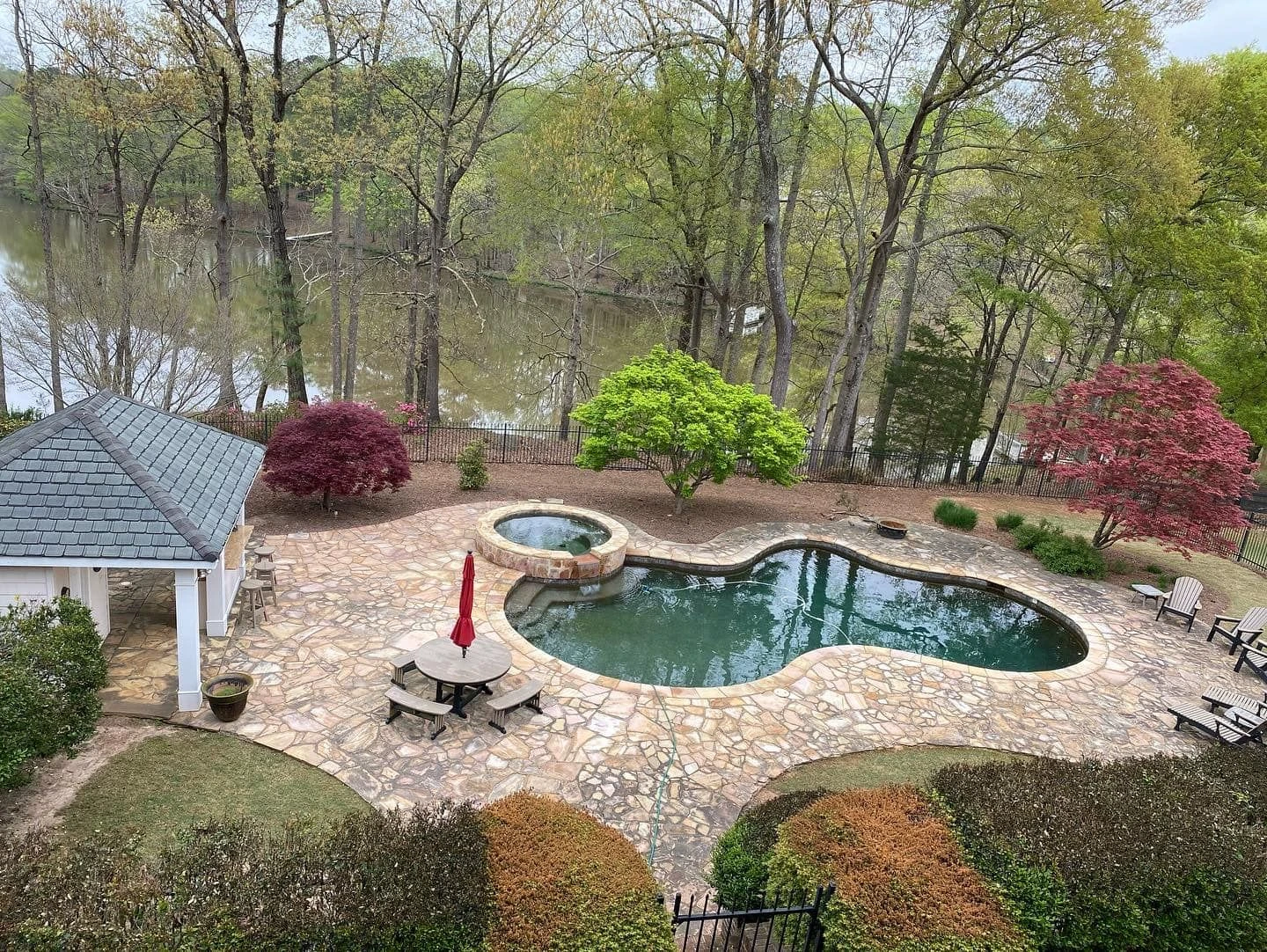
The Short Answer (Then the Honest One)
For most Clarkston homeowners who plan to own the pool more than seven years, saltwater is the better long-term choice — but only if you build it with the right materials up front. For homeowners planning to sell inside five years, or building the smallest pool they can justify, a well-managed chlorine pool is the smarter financial decision.
The honest answer takes longer, because the variables that swing the math aren’t the ones the industry usually talks about. It isn’t chemical cost. It’s the stainless-steel grade on your ladder rail, the alloy in your light housing, the distance from your heat pump’s aluminum condenser fins to the pool surface, and whether your saltwater cell is sized for the gallonage you actually have.
One thing worth saying up front: the DeKalb County Watershed Management fill water in Clarkston runs roughly 3 to 5 grains per gallon of hardness — moderately soft to moderately hard depending on which reservoir is feeding your neighborhood. That’s low enough that calcium hardness in both pool types drifts downward over time and needs supplementation.
Six Criteria, Side by Side — What Actually Separates Them
Here is the comparison we walk every client through when they are weighing systems. Numbers reflect installed pricing in the Metro Atlanta market as of our current build quarter, for an average 14′×28′ inground pool holding roughly 16,000 to 19,000 gallons.
That table is the decision in one view. What follows is the part that matters more: where the table lies to you by oversimplifying.
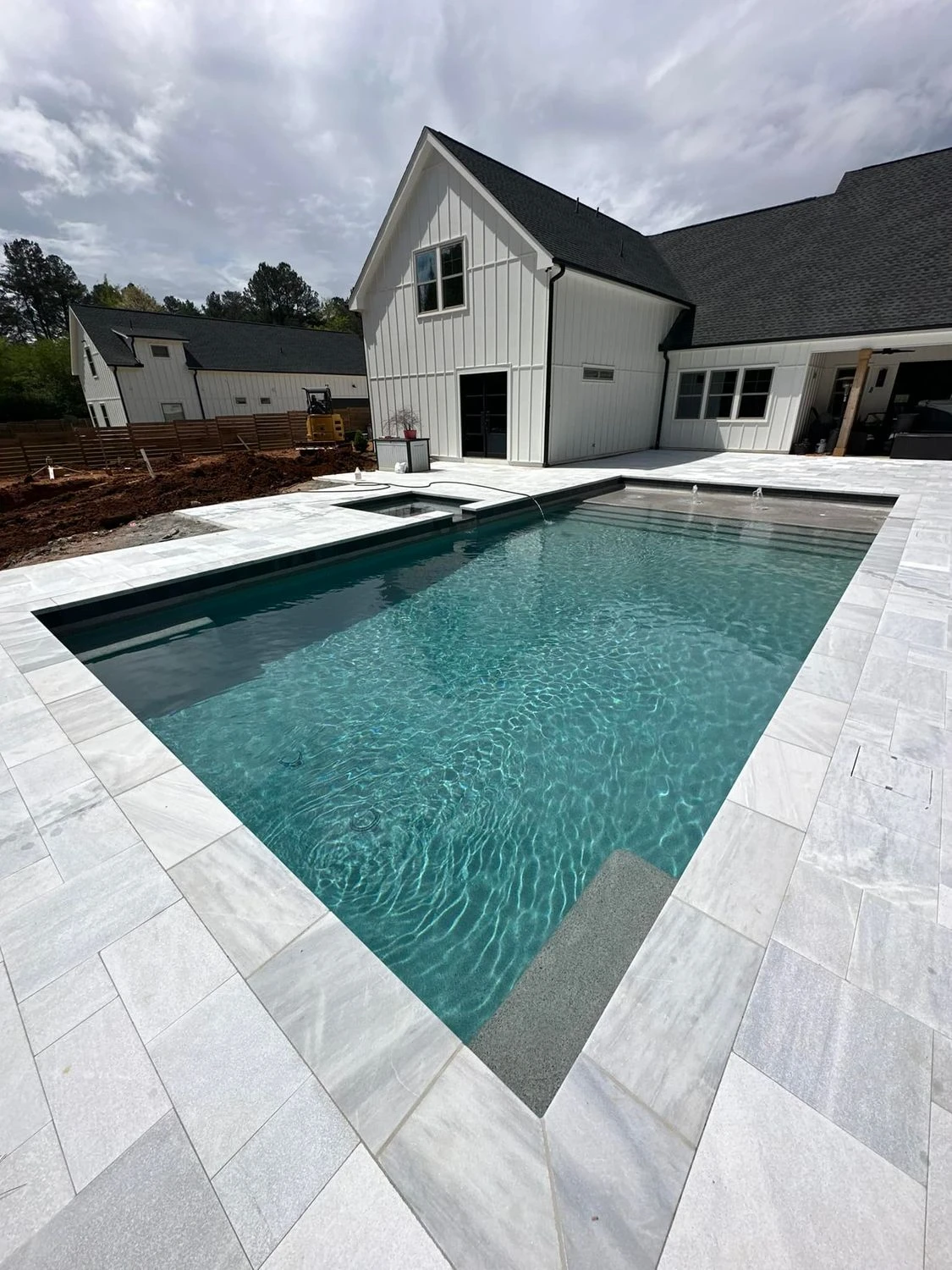
The Equipment Lifespan Story Salt Retailers Skip
Criterion 3 on the table — equipment lifespan — is where the industry conversation gets lazy. Salt-generator retailers tend to say “the cell lasts 5 to 7 years, same as any other equipment.” What they don’t tell you is that the salt inside the water is also eating at every metal component it touches, every second the pool is full, for the entire life of the pool.
Here is what 14 years of Metro Atlanta service calls have taught us about what actually ages faster on a saltwater pool versus a chlorine one:
- Stainless steel ladders, handrails, and anchor sockets. If they are 304 stainless steel (the common grade in budget builds), saltwater will pit them visibly in 4 to 6 years. 316 stainless is required for saltwater applications — it contains 2 to 3% molybdenum that dramatically improves chloride resistance. The cost difference at install is about $140 per rail. The cost difference at year 5, when you are replacing corroded 304, is roughly $900 including labor.
- Pool light housings and trim rings. Cheap aluminum or poorly-plated trim rings oxidize on saltwater pools within 3 years. We specify bronze or 316 SS niche hardware on every saltwater build we touch. Non-negotiable.
- Heat pump condenser fins. Aluminum fin stock on an air-source pool heat pump, mounted within 8 feet of a saltwater pool edge, can degrade 40% faster than the same unit next to a chlorine pool, because of salt-laden deck spray. The fix is positioning (move the unit further back) and semiannual fin-wash with a potable-water rinse.
- Natural stone coping and travertine decks. Saltwater is acidic enough when it splashes onto unsealed limestone, marble, or travertine to etch the surface over time. The protection is an annual silane or siloxane sealer — about $200 to $320 in materials for a 600-square-foot deck, applied once a year. Skip it, and the coping surface becomes chalky and rough within 4 summers.
- Concrete pool shell rebar. Only matters if the concrete cover over the steel is undersized. We pour 3-inch cover on every saltwater shell we build — industry minimum is 2 inches, which is fine for a chlorine pool and marginal for a saltwater one.
None of these items are deal-breakers. Every one of them is solvable at the spec sheet, before the first shovel hits dirt. The problem is when a contractor builds the pool as if it is a chlorine pool and then tells the client to “just switch to salt” at the end — because now the client owns 15 years of corrosion waiting to happen, and it starts around year 4.
The question to ask before you sign: “Is the ladder, handrail, light niche hardware, and anchor socket specified at 316 stainless steel, and is the natural stone coping receiving an annual salt-rated silane sealer?” If your contractor can’t answer that cleanly in writing, you are about to own a saltwater pool built to chlorine-pool standards.
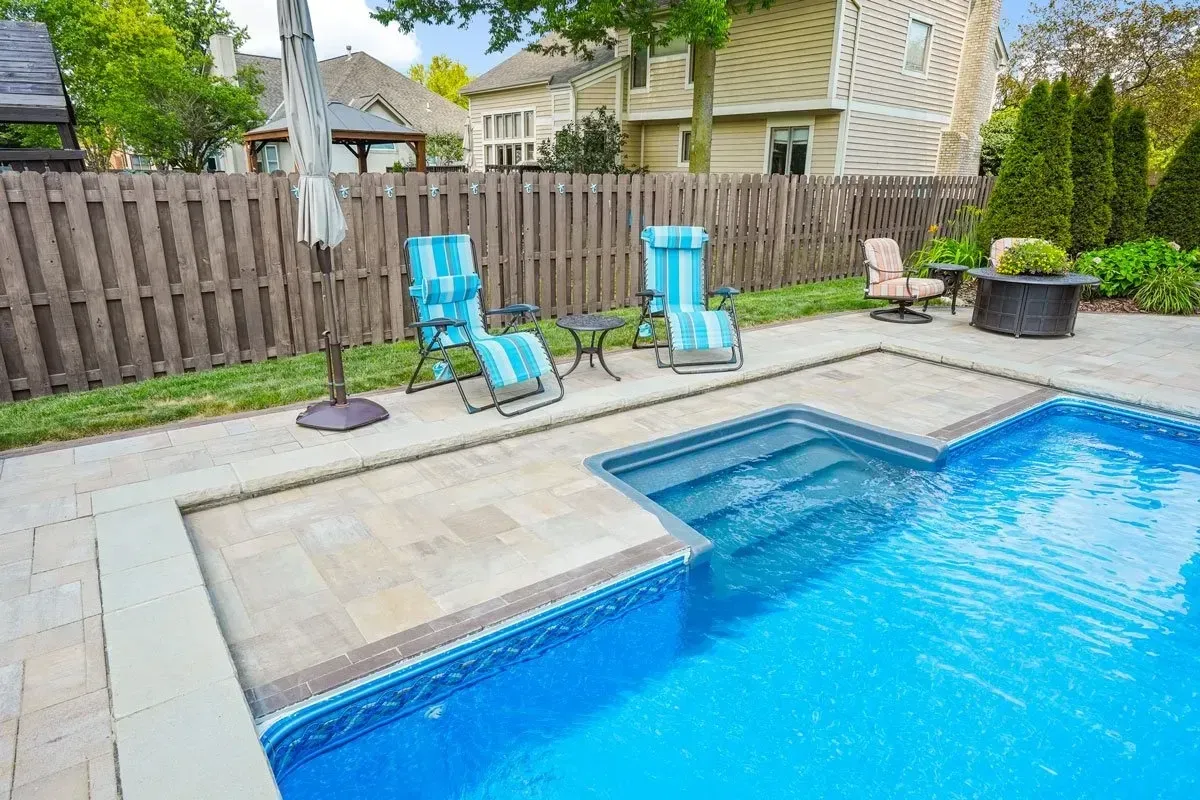
Swimmer Experience and Water Chemistry — Where Salt Genuinely Wins
This is the category where the saltwater industry tells the truth, and where we tell clients to listen. A properly-tuned salt system at 3,000 to 3,500 ppm produces chlorine so smoothly and steadily that the water genuinely does feel different to swim in. Not because there is less chlorine in it — there isn’t — but because the concentration holds tight to a narrow band instead of swinging up and down between dosing events.
In a tab-fed chlorine pool, free chlorine peaks the day you shock and then declines over five to seven days as swimmers, UV, and bather load consume it. On a hot Clarkston July afternoon with high humidity driving evaporation and three cannonballing kids in the pool, free chlorine can burn off in hours. That’s when you get the locker-room smell — that’s not “too much chlorine,” that’s chloramines, which form when free chlorine binds to sweat, sunscreen, and urine. Chloramines irritate eyes; free chlorine itself is odorless.
A saltwater generator produces fresh chlorine continuously whenever the pump runs, at a concentration that never spikes after shock and never drops low enough to let chloramines accumulate. That’s the actual experiential difference. It’s real, it’s measurable, and it’s the reason people who have owned both consistently describe saltwater as “softer.”
There is a trade-off worth understanding. Saltwater generators cause pH to drift upward more predictably than a tab-fed system does — electrolysis off-gasses hydrogen at the cell, pulling pH up over time. In peak Clarkston summer, with humidity high and evaporation pulling half an inch of water out daily, we see pH drift from 7.4 to 8.0+ in 10 to 14 days on untreated saltwater pools. The correction: muriatic acid or dry acid (sodium bisulfate) every week or two, dosed to hold pH at 7.4 and total alkalinity in the 80-to-120 ppm range. Most clients put it on a calendar and forget about it.
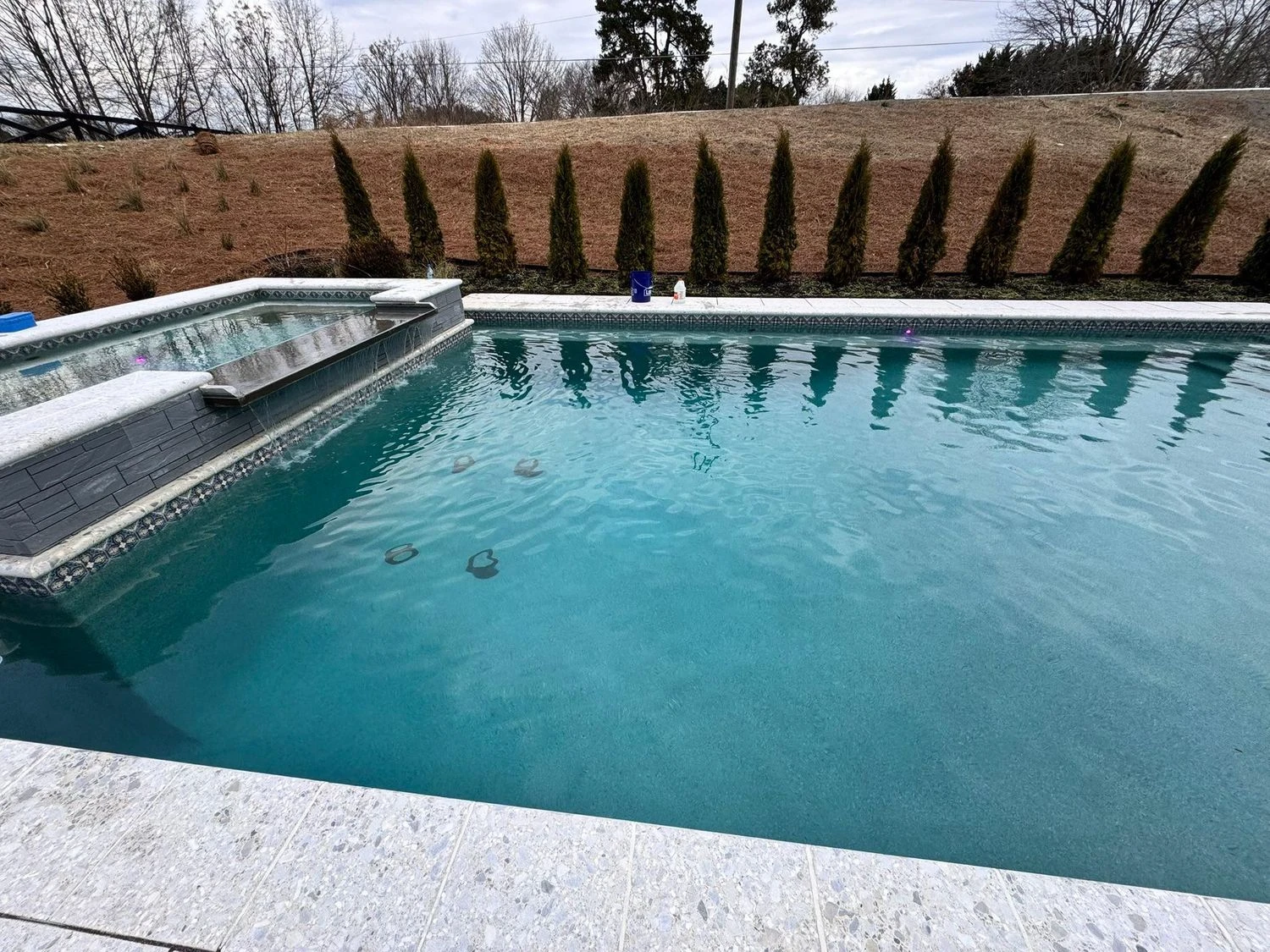
Resale, Recovery Cost, and the UV-Ozone Wildcard
Criterion 6 — resale impact — needs more nuance than a table row gives it. In Metro Atlanta’s upper-middle market right now, saltwater is essentially the price of admission for a modern pool. Buyers touring a $650K home with a pool expect saltwater. They will note its absence in their offer conversation with their agent, even if they don’t raise it on the tour. That is worth roughly $3,000 to $6,000 of negotiating leverage against the seller, which is not far off from what a retrofit would cost.
Below about $500K, the expectation tapers off quickly. A clean, well-maintained chlorine pool in a $420K listing is not a deduction — the buyer is price-sensitive enough that the sanitation method is a footnote, not a line item. This matters for Clarkston specifically because the housing stock here has real diversity. A 1960s ranch seven miles east of downtown Atlanta being sold at $380K is a different buyer than a new-construction four-bedroom at $725K, and they weigh pool systems differently.
Now the wildcard. There’s a third category worth naming, even though it isn’t on the table: UV-ozone hybrid sanitation. Units like the Del Ozone MDV and Paramount Ultra UV use ultraviolet light plus ozone injection to kill waterborne pathogens before the water returns to the pool. They run $2,400 to $3,800 installed and work alongside either a salt cell or a low-dose chlorine tab system. They don’t replace chlorine — a residual is still required — but they let you hold that residual at 0.5 to 1.0 ppm instead of the 1.5 to 3.0 ppm a chlorine-only system needs.
For families with infants, swimmers with sensitive skin, or lap swimmers, a UV-ozone system stacked with a salt generator is the premium spec. Total upcharge over a baseline chlorine pool runs $4,500 to $6,000. Not for everyone. For the subset it’s right for, it’s the best pool chemistry experience money currently buys.
Conversion math if you already own a chlorine pool: Converting an existing Clarkston chlorine pool to saltwater costs $2,200 to $3,000 installed, assuming the existing electrical can support a generator and no corrosion-sensitive components need swapping first. If you have 304 stainless rails or a cheap light trim, budget another $600 to $1,100 for upgrades. Budget a full day for installation plus a week of chemistry balancing.
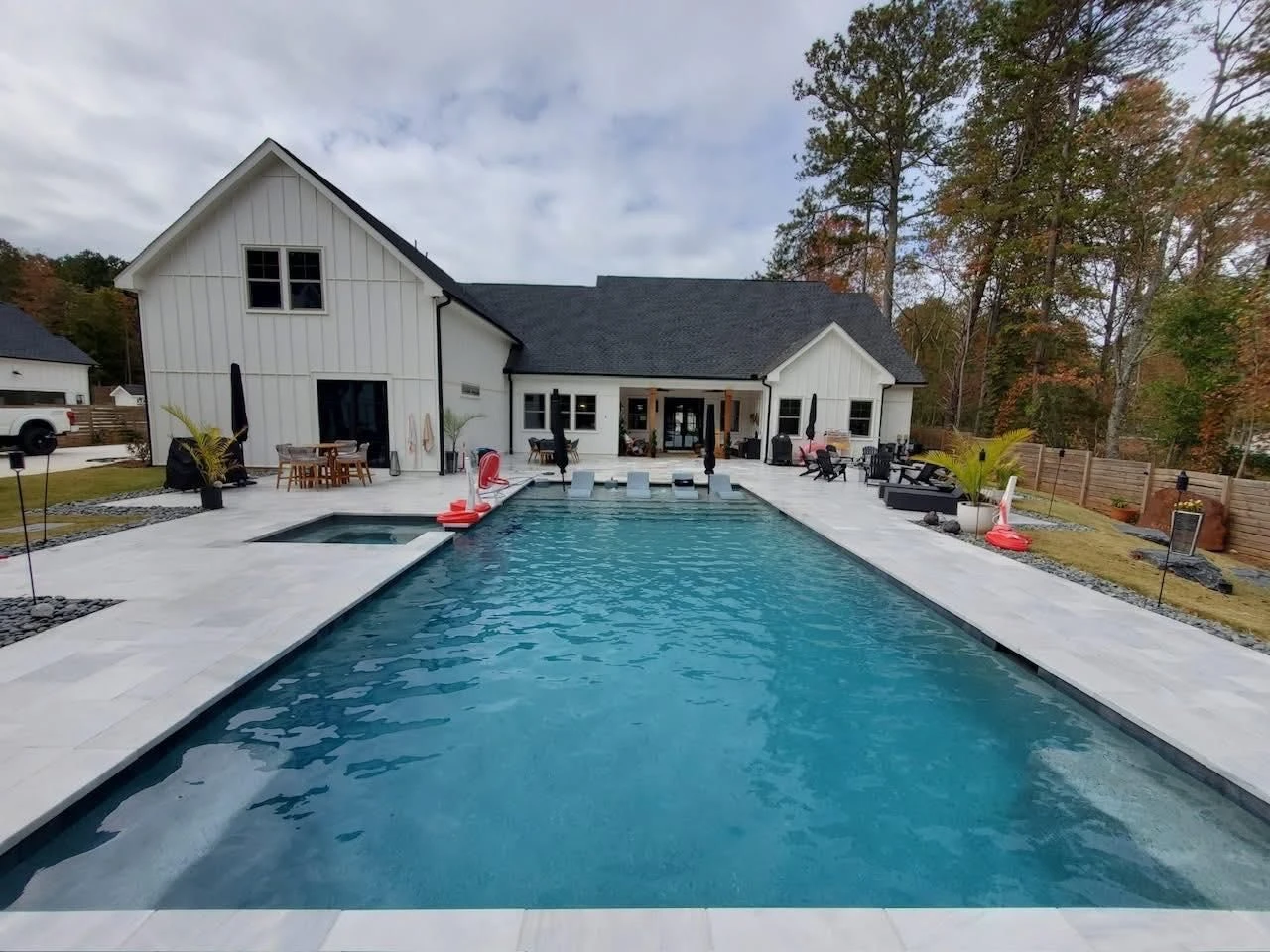
What We Actually Recommend in Clarkston
After walking a few hundred DeKalb County clients through this decision, here is the short version of how we steer people — organized by the situation they’re actually in, not by what is theoretically optimal.
New build, plan to stay 7+ years, budget above $75K
Build saltwater. Specify 316 stainless throughout. Pour 3-inch concrete cover on the rebar. Add a UV-ozone hybrid if any household member has sensitive skin or if you swim laps. This is the configuration that ages most gracefully through Clarkston’s long humid-hot season and is also the configuration with the strongest resale position five or ten years from now.
New build, budget under $65K, single-decade horizon
Build traditional chlorine. Spend the saved $2,000 on better coping, better waterline tile, or a bigger tanning ledge — things you see every time you walk outside. A well-maintained chlorine pool is a great pool. The chemistry is not dramatically harder. The rumor that chlorine pools are “harsh” is about pools that are poorly maintained, not about the sanitation method.
Existing chlorine pool, considering conversion
If your pool is less than 8 years old and you plan to own it for at least 6 more, convert to saltwater. The payback on ongoing chemical cost savings plus the resale bump makes the math work inside 4 years. If your pool is 12+ years old, fix the things that need fixing (replace the liner or re-plaster, swap the pump if it’s the original) before adding a salt generator — otherwise you’re putting a new system on a tired body.
House is going on the market within 18 months
Don’t convert. Spend the $2,500 on a deep pool renovation, fresh coping sealer, a light-bulb color upgrade to an LED niche, and a professional chemistry tune-up the week before photos. Those are the things that show in listing photos and open houses. An invisible salt cell on the equipment pad is a footnote on the disclosure, not a decision-maker.
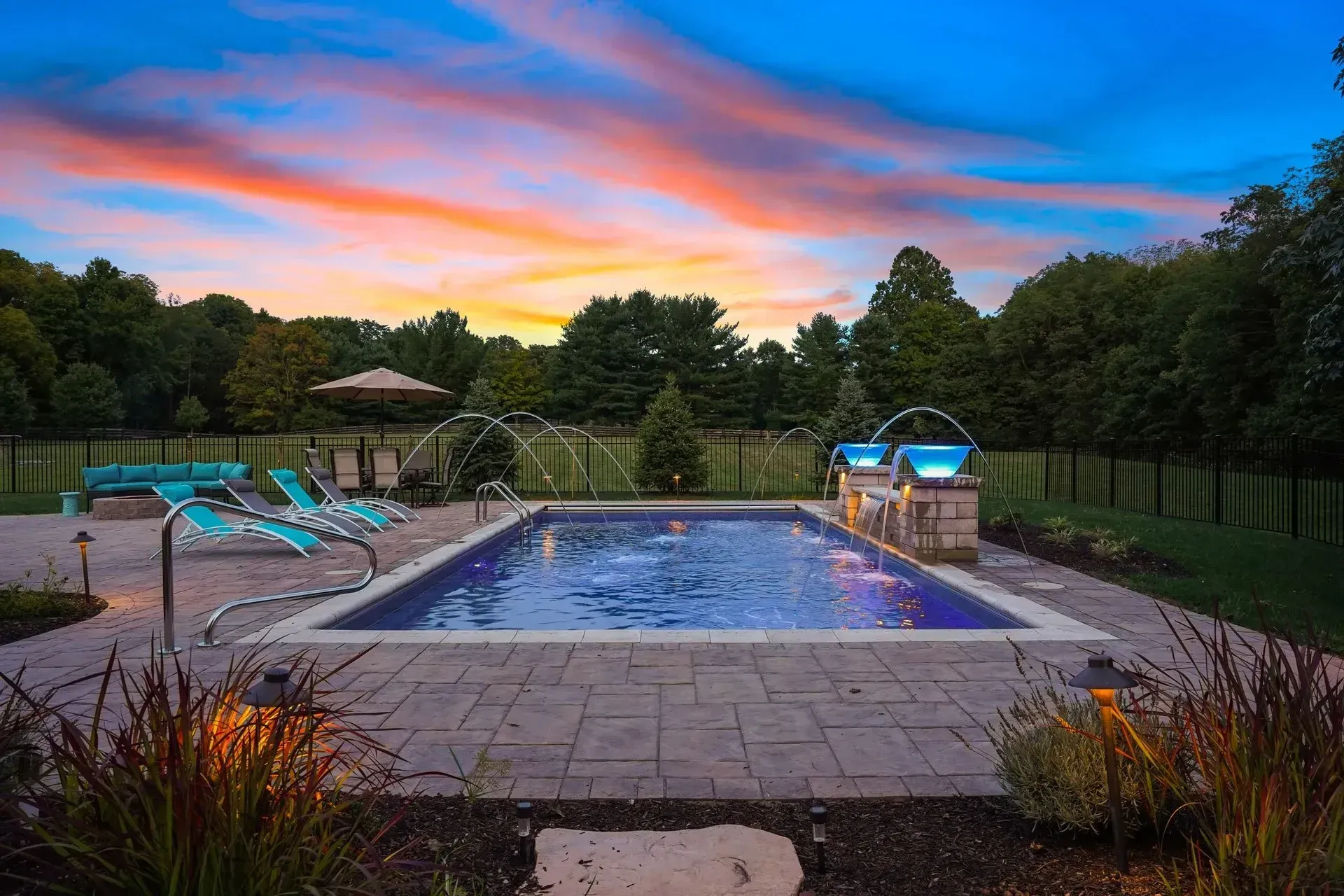
A saltwater pool is not a different kind of pool. It is a different kind of spec sheet. Build the spec sheet right and both systems last decades. Build either one to the wrong standard and you are on a short clock.
One reality check: neither system is “maintenance-free.” A saltwater pool still needs weekly chemistry checks, monthly cell visual inspections for calcium buildup, quarterly stabilizer checks, and an annual cell cleaning with muriatic acid at 10:1 dilution. Less frequent than a chlorine pool. Not zero.
Both systems, built correctly, produce pools that are safe and structurally sound for twenty-plus years. The wrong spec in either one produces a pool that looks great on day one and ages poorly by year six. The decision that matters isn’t which sanitation method — it’s which contractor you hand the spec sheet to.
Saltwater and chlorine pools built across 20+ cities within 30 miles of Winder, GA
Primetime Pools GA designs and constructs custom inground pools, saltwater conversions, and full backyard transformations throughout these communities — every one built to the corrosion-resistant spec described in this post.