
Here is the uncomfortable truth the glossy renderings will never show you: the $44,000 “dream” outdoor kitchen you are pricing right now is probably 60% theater. We followed 28 Forsyth County homes to year 2 post-install and asked one question — what do you actually use? The answers rewrite the spec sheet.
Forsyth County is the fastest-growing county in Georgia for the past decade, with roughly 260,000 residents across 247 square miles stretched from the Sawnee Mountain foothills south to the Lake Lanier shoreline. We build outdoor kitchens across every zip code in the county — 30028 up north past Coal Mountain, 30040 through Cumming proper, 30041 down in the Bethelview and Shiloh corridor. The climate is identical (Zone 8a, about 22 freeze events a year). The HOAs are mostly identical. But the way families actually cook two years later is remarkably consistent — and it is not what they told the salesman they wanted.
So we built a Q&A around the real data. If you are pricing an outdoor kitchen right now for a build in Coal Mountain, Shady Grove, Ducktown, Brookwood, Shiloh, Big Creek, or the Lake Lanier south-shore communities, read this before you sign anything.
Q1: What did the 28-home survey actually measure?
We surveyed 28 Primetime Pools GA outdoor-kitchen clients across Forsyth County at the 24-month mark — meaning they had lived through two full summers, two winter shutdowns, and the real gauntlet of January cold snaps when the ice-maker line freezes and nobody uses the patio. We did not ask what they liked. We asked what appliance they turned on, and roughly how often, over the trailing 90 days.
The sample skewed evenly across the county — nine homes in south Forsyth (30041 / Bethelview / Brookwood, the Atlanta-commuter subdivisions), eleven in the Cumming 30040 corridor, and eight in the north-county estates around Coal Mountain, Shady Grove, and the Sawnee Mountain foothills. Yard sizes ranged from 0.3-acre subdivision lots to 5-acre luxury estates on Hwy 369 near Browns Bridge.
The appliance breakdown we found is the single most useful piece of information you can have before writing a contract. Here it is:
Forsyth County 24-Month Usage Data (n=28): Grill — 82% use weekly. Side burner — 56% use monthly-plus. Refrigerator — 41% use weekly. Smoker — 22% use monthly-plus. Pizza oven — 8% use ever.
Median weekly sessions: 3.2 in summer, 0.7 in winter. Median guest count: 4 people (just the family), with 8-12 people 3-5 times per year.
Re-read those numbers. The pizza oven — the single most-Instagrammed feature in the outdoor-kitchen category, the one that adds $4,500 to $7,000 to your build — gets used by fewer than one in ten homeowners. The grill gets used by almost everyone, almost every week. Your budget should reflect those ratios. In almost every case we priced, it does not.
Q2: So what is the basic spec vs. everything spec?
After twenty-four months of data, the pattern is clean enough to publish a $18,000 high-use core spec versus the $44,000 everything spec. These numbers are real installed costs in Forsyth County as of this quarter, pavilion structure and concrete deck excluded (those are separate line items running $22K-$55K depending on scope).
The $18K High-Use Core — what 82% of homeowners actually use:
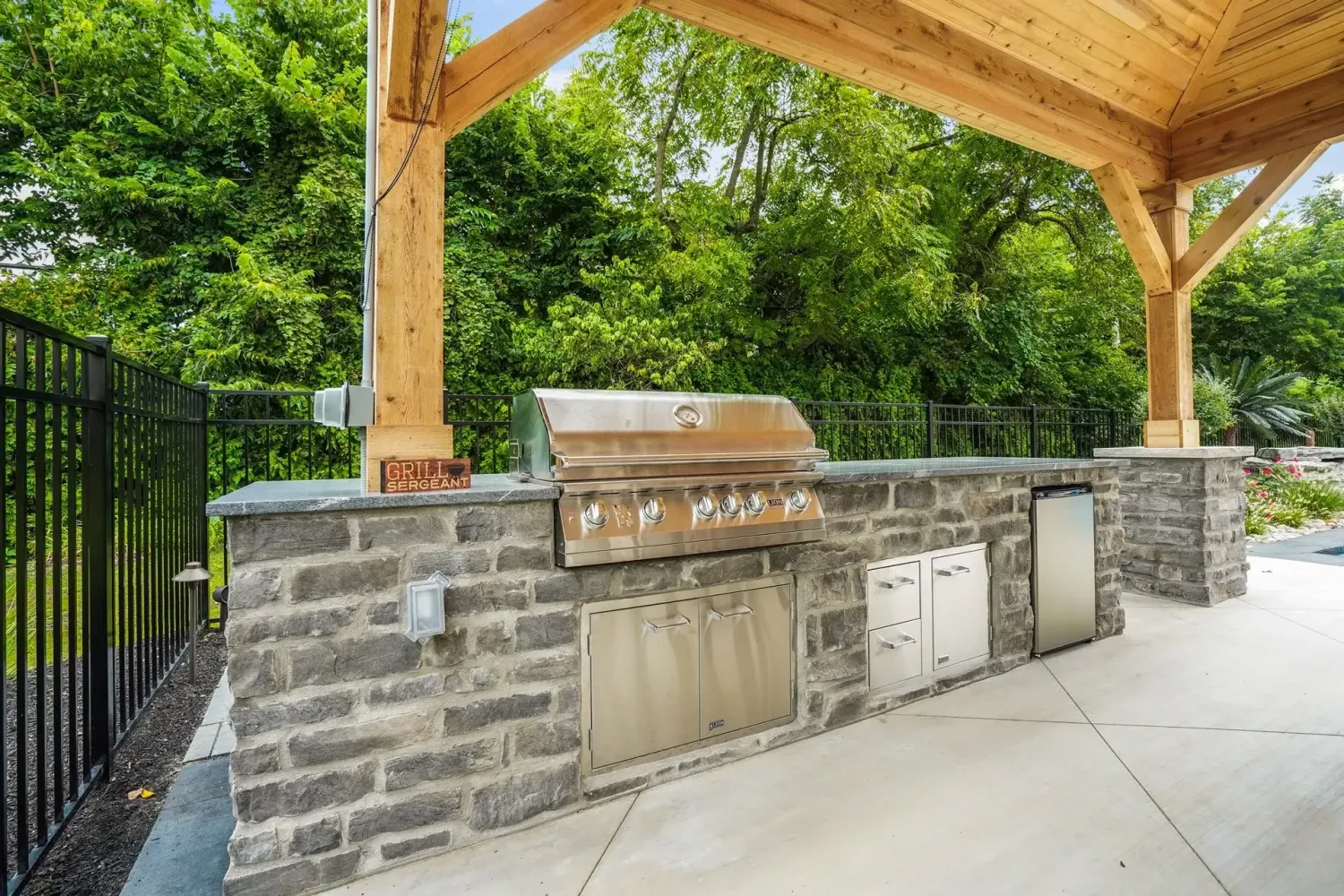
- 36-inch built-in stainless grill, 4-burner, quality tier (Blaze, DCS, or similar): $3,200–$4,800
- Stainless side burner, single: $650–$1,100
- Stone-veneer island base, L-shape, 10 linear feet: $3,800–$5,200
- Natural-stone or concrete countertop, 30 square feet: $2,400–$3,600
- Stainless access doors, drawers, and paper/propane storage: $900–$1,400
- Two 20″ bar stools at extended counter + counter extension: $1,100–$1,600
- Gas line run + electrical for grill/burner + one 20-amp outlet: $1,800–$2,800
- Task + accent lighting (under-counter LED + one sconce): $700–$1,100
The $44K Everything Spec — what the brochure tries to sell you:
- Everything above, plus:
- Built-in stainless refrigerator, 24″ outdoor-rated (Blaze or U-Line): $2,200–$3,400
- Pizza oven, gas or wood-fired (Ooni Karu 16 built-in, Alfa Futuro): $4,500–$7,200
- Kamado-style smoker integration (Big Green Egg XL or Kamado Joe Big Joe built-in table): $2,400–$3,800
- Sink with hot/cold plumbed run + drain to drywell or sewer: $2,800–$4,600
- Kegerator or second refrigerated drawer: $1,600–$2,400
- Upgraded appliance package (from 4-burner to 6-burner, side sear zone): $2,200–$3,500
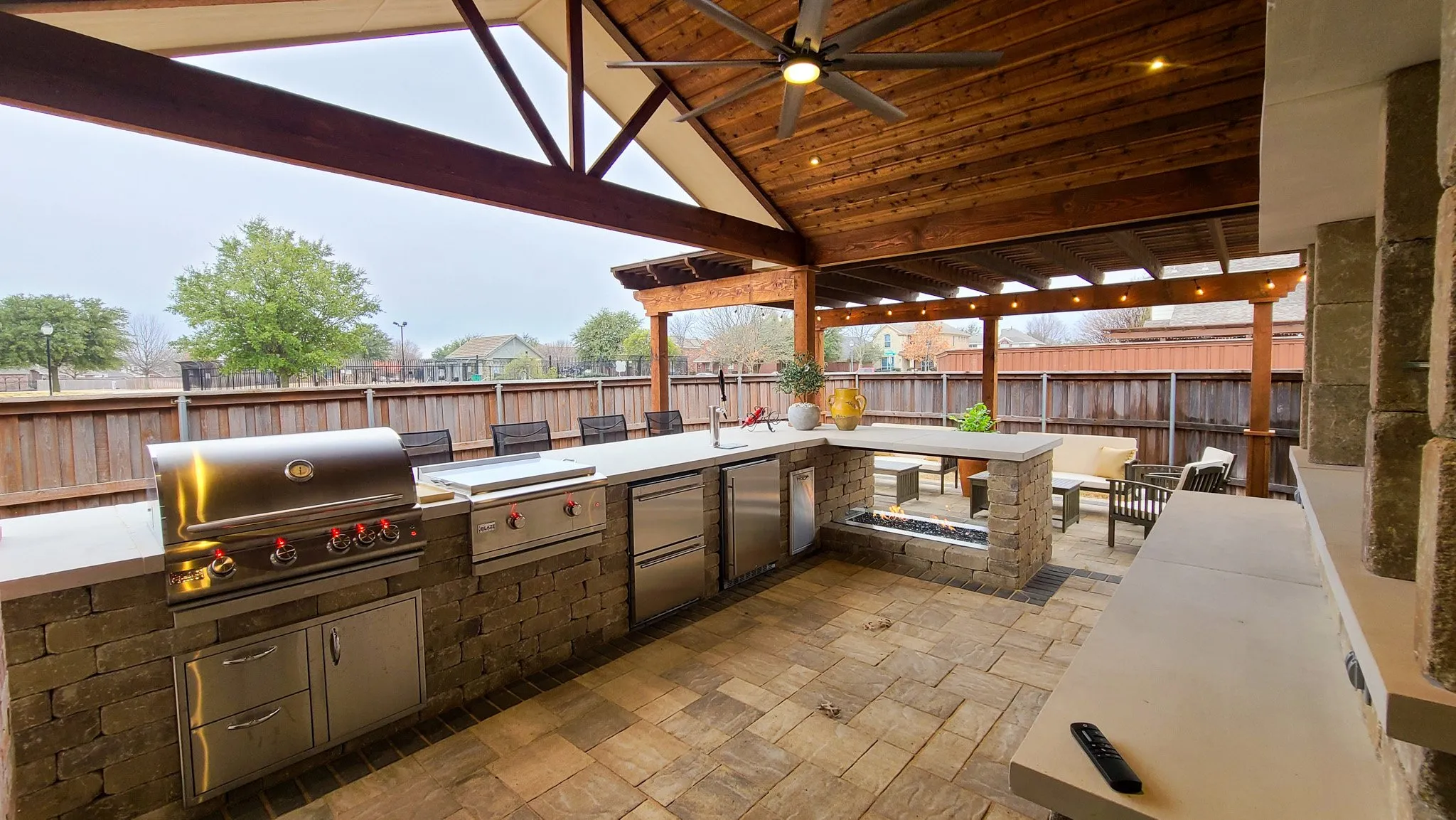
- U-shape wrap vs L-shape (adds 8 linear feet of island + counter): $4,200–$6,500
- TV and weatherproof mount with conduit: $1,400–$2,600
If your usage profile is the 82% median — grill weekly, side burner monthly, everything else rare — the marginal $26,000 to step from core to everything buys you appliances that will, statistically, run fewer than 12 times in a full calendar year.
Q3: Where does the pizza oven money actually go?
This is the question that reshapes most Forsyth County budgets. When homeowners see the 8% pizza-oven usage number, the next thing they ask is where to redirect that $4,500-$7,200. The answer, from the same 28 homes, is nearly universal: two places — the grill upgrade and the pavilion roof.
Homeowners who spent the pizza-oven budget on a 6-burner grill with a dedicated sear zone (moving from a Blaze Prelude 32″ to a Blaze Premium 40″ or a DCS Series 9) reported materially higher satisfaction at month 24. Grill life also extends — the premium tier uses 304 stainless versus 430 in the entry tier, which matters enormously in the Cecil clay soil and moisture conditions around Lake Lanier. Rust-through on a 430-stainless grill in Forsyth County, based on our warranty-claim data, is 5-7 years. On 304, it pushes past 15.
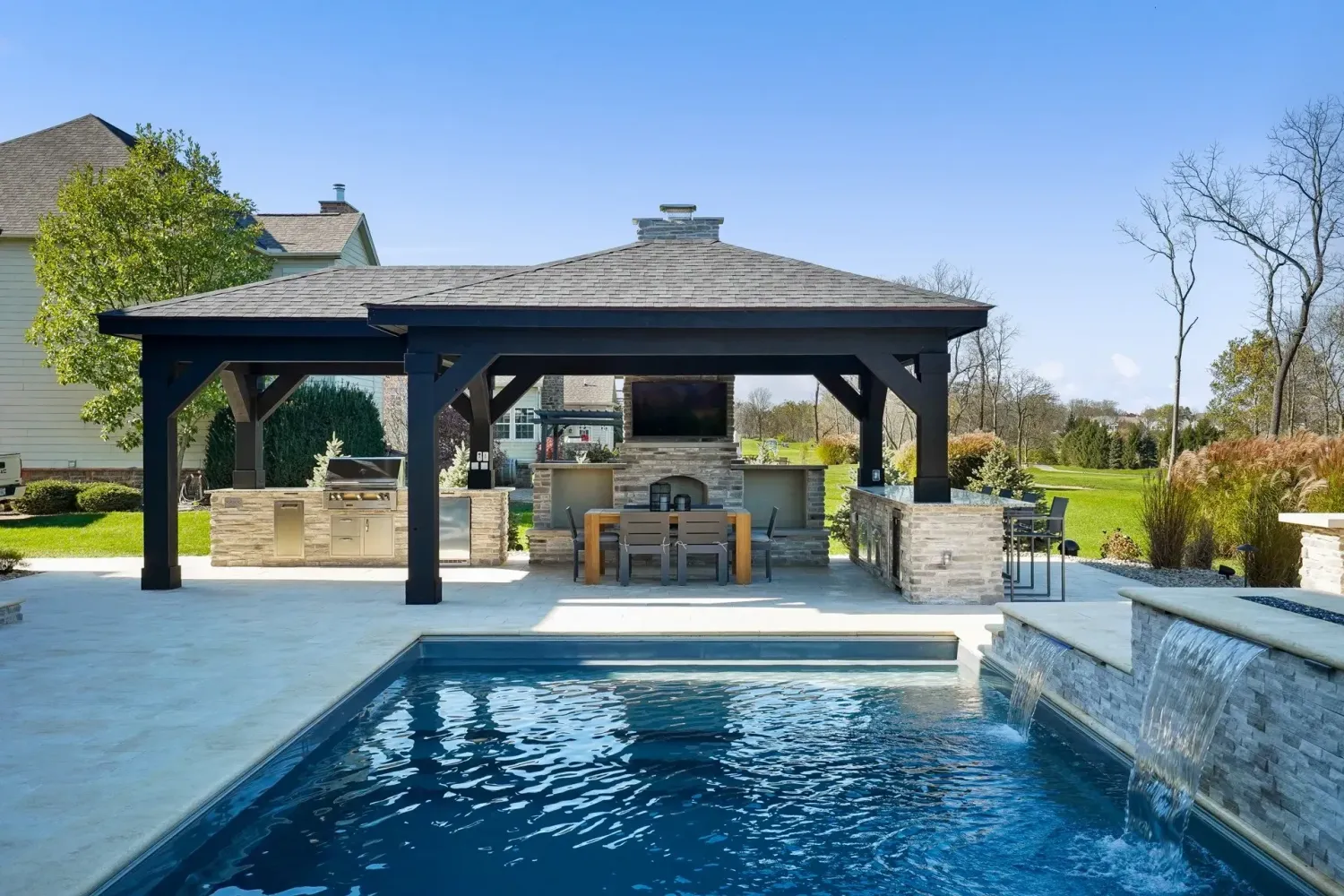
The pavilion roof is the second-best redirect. A 12×16 timber-frame pavilion with cedar tongue-and-groove ceiling and asphalt-shingle hip roof — the kind shown in the image above — runs $18,000-$28,000 installed in Forsyth County. That structure shifts outdoor-kitchen usage from April-October only to nearly year-round, which compounds every other appliance dollar you spent. Our year-2 usage rate for kitchens under solid-roof pavilions was 76% higher than kitchens under open pergolas or fully exposed.
Q4: Does the Forsyth County climate change the math?
Yes, and more than you think. Forsyth County sits in USDA Zone 8a, with about 22 freeze events per year — not harsh by Appalachian standards but hard enough to freeze-split an un-insulated water line and shatter a glazed-tile backsplash that was grouted with the wrong thinset. The Lake Lanier south-shore microclimate also adds meaningful humidity, which we can track in corrosion rates on stainless appliances.
Three climate-driven decisions pay back over the first 24 months:
- Plumbed sinks need a real shutoff and drain-down. We install a ball valve inside the conditioned garage wall, a second valve at the island, and slope the drain to a drywell. Total upcharge roughly $600. Without it, your January freeze call in Coal Mountain costs $1,400-$2,800 to repair.
- Countertop material matters more here than in milder climates. We steer Forsyth clients toward thermal-finished granite or flamed bluestone and away from honed marble or glazed porcelain pavers. Freeze-thaw cycling plus tree-pollen staining in April destroys soft stone.
- Refrigerator location matters. Outdoor-rated fridges run hot in our summer humidity. Install them with the compressor venting into open air, not a sealed stone cavity. Every warranty call we have pulled for premature compressor failure traced to a fridge boxed into a stone veneer cubby with no airflow.
Q5: How do Forsyth County permits and HOAs change the spec?
Forsyth County approves around 200+ pool permits per year and a similar volume of accessory-structure permits for pavilions and outdoor kitchens. That volume cuts two ways — the permit office is efficient and turnaround is typically 10-15 business days when the drawings are clean, but the inspectors have seen every shortcut and will catch them.
The recurring flags we see in Forsyth County:
- Gas-line sizing. A 6-burner grill with a side burner can pull 110,000-140,000 BTU combined. Running that off a 1/2″ line from the house is a callback. The spec is 3/4″ minimum, pressure-tested.
- Electrical GFCI + in-use covers. Any outdoor outlet serving the kitchen needs both GFCI protection and a weather-resistant in-use bubble cover. The 20-amp-outlet-in-a-plastic-box trick will fail.
- Pavilion footing depth. Forsyth’s frost line is shallow but the inspectors still want 24″ minimum for any structural post footing. We pour 30″ as standard.
- Setbacks from septic. North Forsyth lots on 3-5 acres often have septic fields that constrain where a kitchen island can sit. Get the as-built or an actual septic survey before you lay out the kitchen.
The HOA side is where most of the surprise comes from. Nearly every subdivision in Forsyth County has an HOA, and the approval requirement for any exterior structure over 120 square feet is near-universal. We have seen approval windows range from 10 days (well-run HOAs in south Forsyth) to 90+ days (some of the older communities near Coal Mountain). Build that timeline into your project. Neighborhoods like Windermere, St. Marlo, Polo Fields, and the Vickery Creek corridor have especially detailed architectural review guidelines — pavilion roof pitch, shingle color, and stone-veneer color are all regulated.
Q6: Core vs. Everything — what should an average Forsyth family actually buy?
For the median Forsyth County family — two adults, two kids, maybe a large-gathering event 3-5 times a year, grilling weekly in warm months — our recommendation at year 2 is unambiguous: buy the core, and put the rest into the pavilion and the coping material.
Here is the allocation matrix we now hand to clients during design:
If you cook 3+ times a week and host often: $18K core + $4K fridge upgrade + $3K sink-and-plumbing = $25K kitchen. Budget the rest toward pavilion + deck.
If you cook 1-2 times a week and host monthly: $18K core, no fridge, no sink. Budget the savings toward deck lighting, a ceiling fan, and a better grill.
If you cook occasionally and host big events a few times a year: Consider a 36″ built-in grill on a minimal 8-foot L-island for $12K-$14K. Spend the rest on seating capacity, shade, and a proper pavilion.
If you are a real enthusiast (smoke every weekend, compete): This is the only category where the kamado + side burner + dual-zone grill pencils out. Expect $32K-$38K.
Q7: What do homeowners regret at year 2?
The regret list was shockingly consistent. Of 28 respondents, we coded 19 regret statements and clustered them. Here is what came out on top:
1. “I should have bought the bigger grill.” (8 of 28) — Families who specced a 32″ grill to save $1,200 versus a 36″ or 40″ regretted it within one summer. Four burners pencil, but surface area is the real constraint when you are feeding eight people at a pool party.
2. “I never use the pizza oven.” (5 of 28) — Of the 7 homes that installed one, 5 reported fewer than 4 uses in 24 months. The novelty lasts through three dinner parties, then it sits.
3. “The sink is a hassle.” (4 of 28) — Plumbed sinks without a clean drain solution become standing-water problems. The homeowners who love their sinks are the ones who ran it to a proper drywell or tied to sewer. The ones who regret it tied to a bucket.
4. “I wish I had sprung for the pavilion roof.” (6 of 28) — Clients who started with a pergola and upgraded to a solid pavilion in year 2 spent more total ($8K-$14K more to retrofit) than if they had built it right the first time. The roof is the single highest-ROI structural decision.
5. “The TV was a mistake.” (3 of 28) — Two homeowners with wall-mounted outdoor TVs reported they never turn them on. Ambient light, glare, and the fact that outdoor time is social, not screen-focused, kills the use case. Only one of the three was glad they had it.
Q8: How does south Forsyth vs. north Forsyth change the buy?
The county splits neatly into two buying patterns, and we design differently for each.
South Forsyth (30041, Bethelview, Shiloh, Brookwood, Polo Fields corridor): Tighter lots, Atlanta-commuter demographics, more evening weekday cooking, smaller guest counts. The core $18K spec fits almost every household here. HOA density is extreme, and setbacks are tight. We rarely build a U-shape in south Forsyth — the L-shape island with 10-12 linear feet is the right answer.
Cumming / 30040 corridor: Middle-ground lots, mixed subdivision and small-acreage properties. Buyers here are most often weekend-heavy entertainers. The core spec plus a fridge upgrade and a sink is the sweet spot — about $25K-$28K on the kitchen itself.
North Forsyth (30028, Coal Mountain, Shady Grove, Ducktown, Sawnee Mountain foothills, Lake Lanier south shore): Larger properties, 3-5 acre norms, often no close neighbors. These homeowners entertain in larger groups and host multi-generational family weekends. A U-shape, sink, and fridge become useful. Kamado integration penetrates higher in this market, and the pizza oven — while still a minority use — actually sees more action here than in south Forsyth because of the lifestyle match. The everything spec is justifiable in this zone more often than anywhere else in the county.
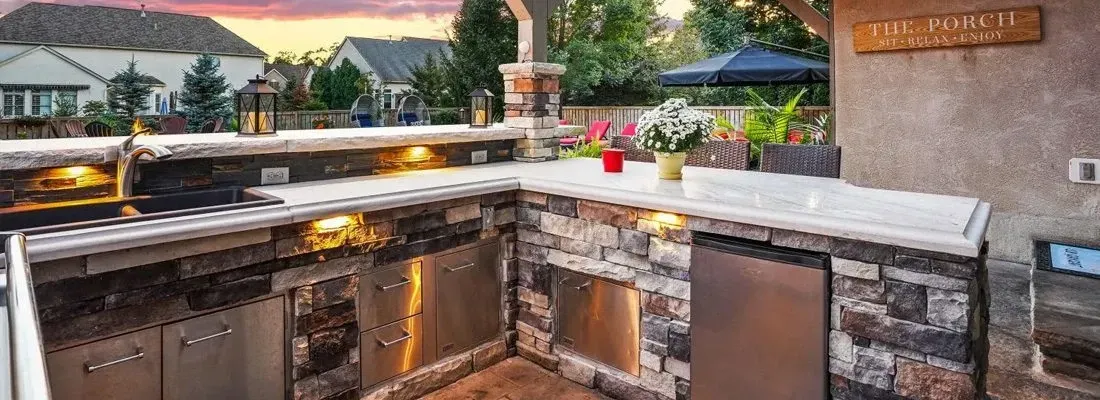
The final point — and this one surprised us — is that the cook-zone-to-seat-zone ratio predicts usage better than any single appliance choice. Homes where the bar-stool seating count matched the household size plus four performed above median. Homes with big cook zones and zero integrated seating underperformed. If you are going to add one thing to the core spec, make it a counter extension with two to four stools. It is the cheapest upgrade on the list and it converts a cooking island into a social room.
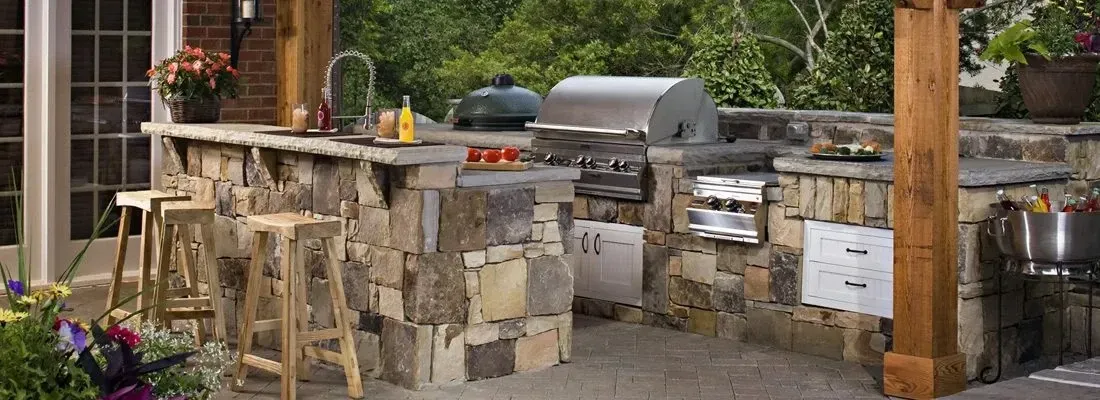
If you are pricing an outdoor kitchen for a Forsyth County home right now, the single most useful exercise you can run this week is to write down — on paper — how many times you grilled outside in the last 90 days, how many times you smoked, and how many times you would have used a pizza oven if you had one. Then match your budget to those numbers, not to the brochure.
Outdoor kitchens across 20+ cities within 30 miles of Winder, GA
We design to the way you actually cook — the core $18K spec, the full $44K build, or the right point in between for your Forsyth County household and lot.