
Call us in June, when a Hamilton Mill homeowner has just spent a Saturday sanding down the south-facing posts of an eight-year-old cedar pergola and found punky, spongy wood two inches below the surface where the trim meets the footing. That pergola cost her $9,400 new. The rebuild quote, if she wants cedar again, is another $10,000 and a promise she’ll re-stain it every two years for the rest of her time in that house. This is the conversation we’re having a dozen times a summer in Dacula, and it’s the reason we’re writing this.
The question sounds simple — wood or aluminum? — but it is really three questions stacked on top of each other. How much are you willing to spend up front. How much ongoing maintenance are you willing to do (or pay to have done). And how long do you intend to live with the result. A cedar pergola and a louvered aluminum pergola are both legitimate purchases for a Gwinnett County backyard. They are not the same product, they do not age the same way, and they are not priced the same for reasons that only become obvious after the first decade. We build both, and we’ve refinished a lot of the first and almost none of the second.
Dacula’s climate is the quiet variable. USDA Zone 8a, about twenty freeze events a year, summer highs in the mid-90s with humidity that keeps wood damp for hours after a storm passes. Carpenter bees emerge around mid-April and start boring perfectly round 1/2-inch holes into any softwood they can find. The material you choose has to survive all of that for the length of time you plan to own the house.
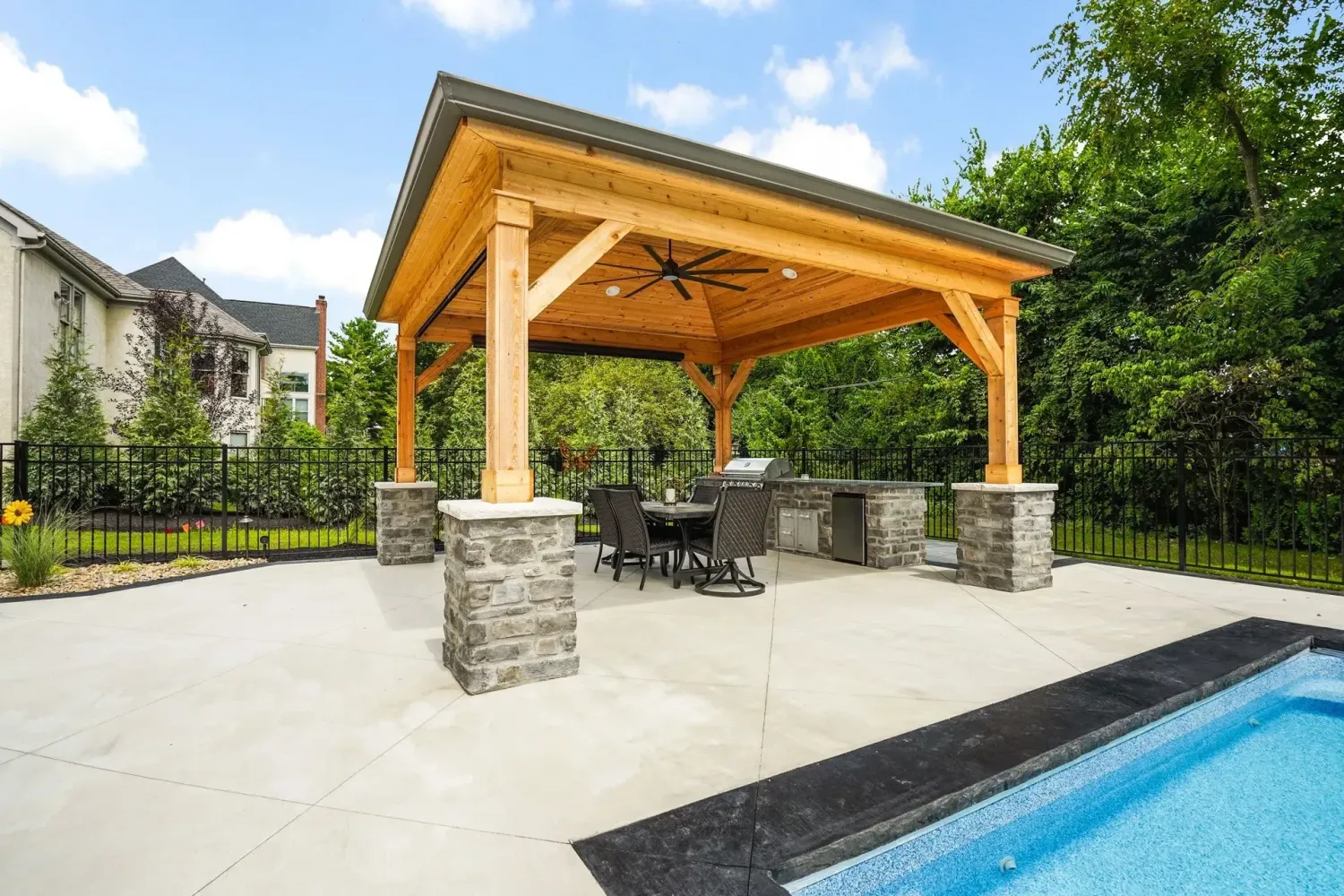
The Upfront Cost Gap — And Why It’s Real
For a freestanding 12×14 pergola (large enough to shade a dining table plus a small lounge area, which is the most common size we build in Dacula), here’s where 2026 pricing actually lands in Gwinnett County — materials plus labor, permit-ready, installed on concrete footings to frost depth:
Cedar (Western Red or Alaskan Yellow)
$6,200 – $11,400
Range driven by post dimension (6×6 vs. 8×8), rafter depth, whether you want drop-rafter ends or straight cuts, and the finish (clear sealer vs. semi-transparent stain vs. solid-body stain).
Pressure-Treated Pine, Painted
$4,800 – $8,200
The budget-friendly path. PT pine is structural and the framework will hold, but the painted finish is what makes or breaks the long-term look.
Powder-Coated Louvered (StruXure, Azenco, Trex Pergola)
$18,000 – $32,000
Motorized louvers, integrated LED and fan-ready beam, sealed gutter system on the perimeter, bonded grounding to the house electrical panel per NEC. The low end is a base frame with manual louvers; the high end is a fully integrated outdoor room.
Fixed-blade or open-top aluminum comes in lower — $11,000 to $17,000 for a 12×14 — but we install far fewer of these because the gap to louvered isn’t enough to offset the functional loss.
The gap is real and it does not lie — aluminum is roughly two-to-three times the upfront outlay of cedar at comparable sizes. The honest question is what that difference buys you, and the answer is a zero-refinish lifespan plus a set of mechanical features (motorized louvers, integrated lighting, rain sensors) that simply do not exist in the wood category.
Why powder-coated aluminum costs what it does: the material itself is the smaller part. You’re paying for extruded 6063-T5 aluminum sections (not sheet), a 7-step pretreatment and powder-coat process rated for coastal exposure, precision-engineered louver mechanics with sealed bearings, and in most cases a 20-year structural warranty plus a 10-year finish warranty. The engineering is the cost center, not the metal.
Lifespan in Dacula Humidity — The 20-Year Window
This is where the cedar-versus-aluminum conversation stops being theoretical. Wood pergolas in Northeast Atlanta live or die based on how the bottom 18 inches of every post are handled, and on how religiously the owner maintains the finish. We have seen both ends of that spectrum on the same street in Ivey Chase.
Cedar with disciplined maintenance — meaning a stain refresh every two to three years, posts on elevated standoff brackets (not in direct ground contact, and not wrapped in mulch), and prompt attention to any caulked joinery — will give you 20 to 25 years of structural service. The wood above grade, protected by finish and airflow, is not the failure point. Ground contact is the failure point.
Cedar left alone — the pattern we see most often when a homeowner inherits an older pergola from a previous owner or simply runs out of weekends — fails at 12 to 15 years. The failure is almost always the same: the base of the posts wicks moisture, the finish chalks and loses its sheen, mildew lives in the grain, and the sapwood layer below the finish begins to rot. By the time the homeowner notices the sponginess we described in the opening, the post is structurally compromised and needs replacement.
Pressure-treated pine with a painted finish has a different failure curve. The structural PT core lasts longer against rot than cedar sapwood does, because it’s pre-impregnated with copper-based preservatives. But the paint layer on a PT pine pergola cracks, peels, and requires recoating every 3 to 5 years in Dacula’s humidity — and that recoat is more labor-intensive than a cedar stain refresh because you have to scrape and prime before you repaint. Ground contact on PT pine also becomes a liability at 8 to 12 years; the preservative protection runs out, and you get rot at the base even though the rest of the post looks fine.
Powder-coated aluminum is a different category entirely. We have installed units that are now approaching year 12 of service in Hamilton Mill and Sycamore Ridge with no finish refresh, no refastening, no rot. Manufacturer lifespan claims of 40+ years are not marketing puff — they are grounded in the metallurgy and the coating chemistry. An aluminum pergola that’s properly bonded, properly anchored, and not physically damaged should outlive the roof on the house it shades.
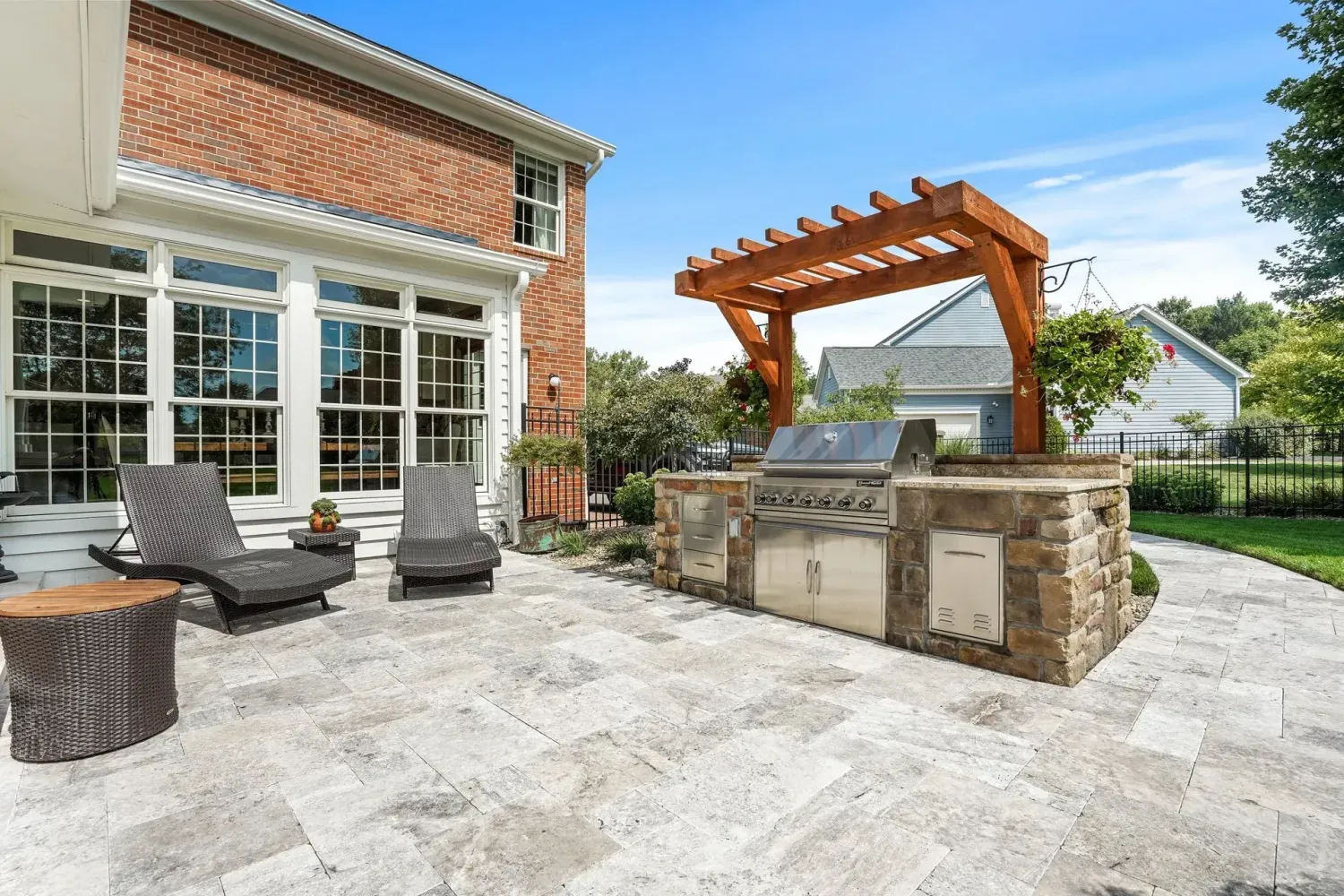
The Maintenance Schedule, Plus the Bees
Ask ten homeowners how much maintenance their wood pergola takes and you will get ten different answers, because most people do not log the hours. Here is what we see across dozens of projects.
Cedar — Year-by-Year Reality
Every 2 to 3 years: full stain refresh. For a 12×14 pergola, plan on $400 to $800 if you hire it out. DIY is $120 in materials and a solid weekend of prep, sanding, and application — most of it working overhead.
Every spring: carpenter bee patrol. You’ll see sawdust piles on the patio starting around mid-April. Fill the 1/2-inch holes with wood filler, drill in a dowel, touch up the stain. Ignoring this is how you get hollow rafters by year 8. Carpenter bees in Dacula appear between April 15 and May 10; they bore a straight 1/2-inch hole, then turn 90 degrees to excavate a gallery 6 to 10 inches along the grain. One bee is cosmetic. Five generations nesting in the same rafter is structural.
Every 5 years or so: check and re-caulk exposed joinery — the mortise-and-tenon joints where rafters meet beams, the tops of posts where the beam sits. Moisture in these joints starts rot on the inside, out of sight.
Every 10 to 12 years: expect to address at least one post base, depending on how the original detailing handled ground contact. Elevated standoff bracket above the footing, and this almost never becomes an issue. Post set directly into the concrete, and this is where the structural repair conversation starts.
Pressure-Treated Pine — Year-by-Year Reality
Every 3 to 5 years: full repaint. Budget $600 to $1,200 professionally. The repaint is more work than a cedar stain because peeling paint has to be scraped and primed first. Shortcut this and you embed the failing layer under the new coat.
Every spring: same bee patrol. Painted PT is marginally less attractive to carpenter bees but still gets hit, especially on raw cuts the painter missed.
Around year 8 to 12: ground contact shows. The painted surface looks fine from across the yard, but the bottom 12 inches of one or more posts is soft. Subterranean termites occasionally move into PT post bases in Dacula once the preservative runs out — we’ve pulled damaged post bases twice in the last three years.
Aluminum — Year-by-Year Reality
None of the above. A twice-yearly pressure-washer rinse to clear pollen off the louvers, and a once-a-year walk-around to check that the motorized mechanism is dry and unobstructed. No refinish, no sanding, no caulking, no bee holes. We charge $180 for the annual inspection, mostly because nobody wants to stand on a ladder to look at their louver motor housing.
20-year total cost of ownership, 12×14 pergola, Dacula install:
Cedar: $8,500 build + ~9 stain refreshes @ $600 = $13,900 (plus your time if DIY)
PT Pine painted: $6,500 build + ~5 repaints @ $900 + 1 post repair @ $1,400 = $12,400
Aluminum louvered: $22,000 build + 20 annual rinses @ $0 (if DIY) = $22,000
Aluminum is still more over 20 years — but the gap narrows, and the weekend-labor line item on the wood options is not in the math.
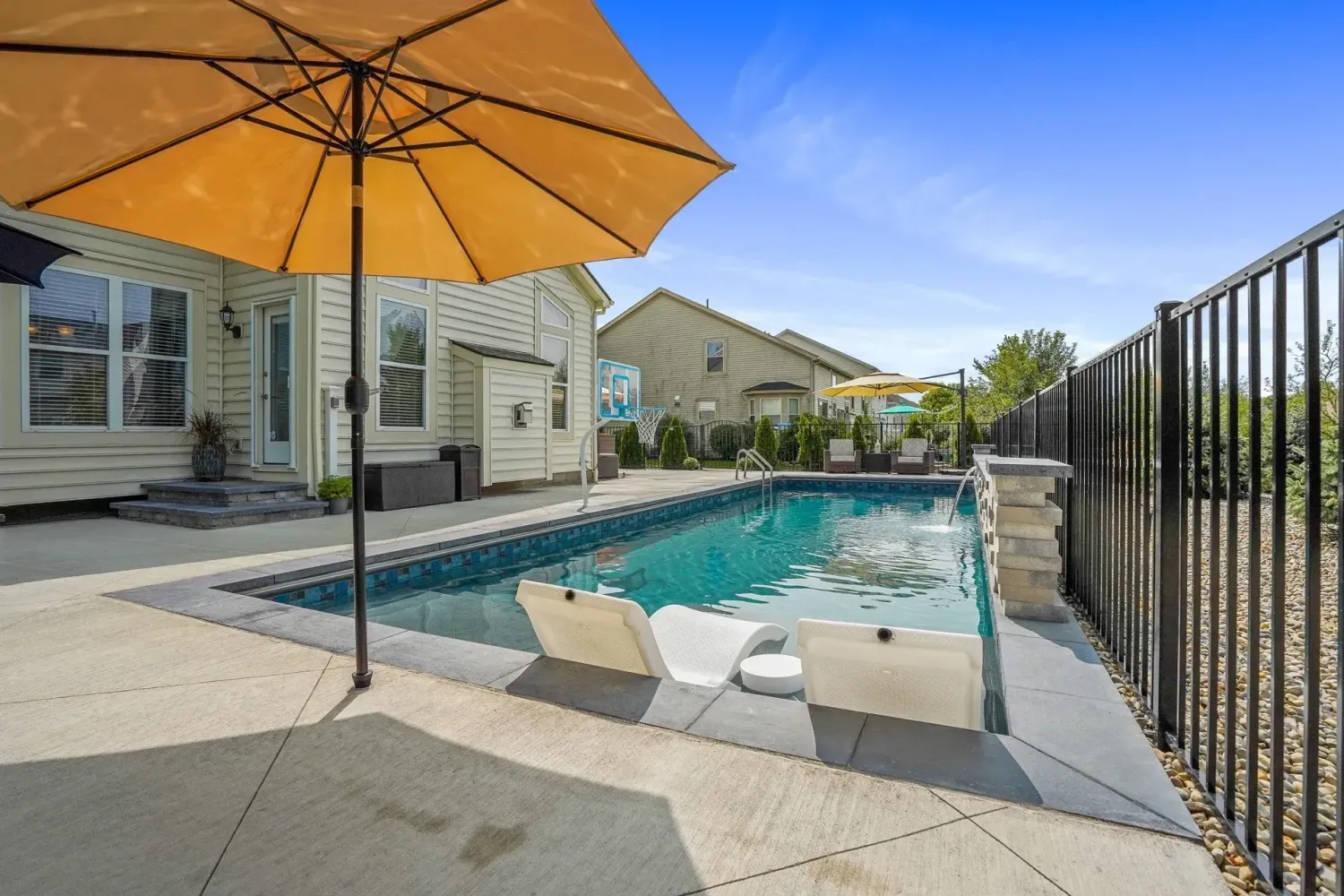
The Engineering Details That Change By Material
Once you choose your material, the engineering of the structure itself diverges in ways that are not obvious from a catalog photo. If you are comparing quotes from different builders, these are the line items to scrutinize.
Thermal Expansion in Aluminum
Aluminum moves. The thermal expansion coefficient works out to roughly 1/4 inch per 100°F of temperature swing per 10 feet of run. In Dacula, a south-facing aluminum beam can go from 45°F at 6am on a February morning to 140°F surface temperature at 2pm on a July afternoon — a 95-degree delta. On a 20-foot beam, that’s just under half an inch of length change. Engineered aluminum pergolas handle this with slip joints at defined points, and with fastener holes that are slotted rather than round. A shop that doesn’t understand this detail will end up with a pergola that pops rivets or warps in the first summer. We specify the slip-joint locations on every aluminum install.
Grounding and Lightning
This is the item most homeowners never hear about. NEC Article 250 requires that metal structures of significant mass attached to or near a house be bonded to the building’s grounding electrode system. For an aluminum pergola, particularly one with an electrical circuit for lighting or a fan, Gwinnett County’s inspectors are looking for a #6 AWG copper bonding conductor running from a lug on the pergola frame to the nearest qualified ground point — usually the service entrance ground rod or the equipotential grid if the pergola is near a pool. This is a $200 to $400 line item on our aluminum quotes and it is not optional. We have never failed a pergola inspection in Gwinnett, and the grounding detail is the single most common reason other builders’ projects get red-tagged on the first visit.
Post Footings — Different Math for Different Materials
Both wood and aluminum pergolas need concrete footings to frost depth, which in the Piedmont is typically 12 inches minimum per Gwinnett County code but in practice we pour to 18 to 24 inches for lateral wind capacity. The diameter of the footing and the anchor hardware differs:
- Cedar 6×6 posts: 14-inch diameter footing, 24 inches deep. Elevated standoff bracket (Simpson ABA66 or equivalent) bolted to a threaded J-bolt in the wet concrete. The standoff is what keeps the post base off the concrete and out of standing water.
- Aluminum extruded posts: 16 to 20 inch diameter footing depending on span, 24 to 30 inches deep. Anchor detail per engineering, typically 4 to 6 anchor bolts epoxied into a cured footing with base plate and leveling shims. Plumb tolerance is much tighter than wood — you do not have the option to trim the post to fit later.
Span Capacity
A 6×6 cedar post tops out around a 14-foot unsupported beam span before you’re into deflection territory that will sag within a few years. An engineered aluminum beam of comparable depth can span 20 feet or more. If you want a pergola that covers a 16×20 outdoor room with no intermediate posts, aluminum is the only path — cedar will need a mid-beam post that breaks the open feel.
Gwinnett County permit note: Any pergola over 120 square feet or attached to the house requires a building permit from the Gwinnett Dept. of Planning & Development (446 W. Crogan St., Lawrenceville). Freestanding pergolas under 120 sqft are typically exempt but still subject to HOA rules in neighborhoods like Hamilton Mill and Providence Club. We pull every permit on pergolas we build — the inspection gives the homeowner a paper trail at resale and catches detailing errors before they’re buried.
When We Recommend Wood, When We Recommend Aluminum
Here is the honest version of the conversation we have at the quote appointment, condensed into the cases where each material genuinely wins.
The warmth and cost arguments matter most
- Your budget for the project is under $12,000 and you want the 12×14 size — wood is the only option at that price point.
- The backyard aesthetic is traditional, craftsman, or rustic — the grain, tone, and drop-rafter details of cedar read as handcrafted in a way aluminum does not.
- You plan to move within 10 years — the maintenance runway hasn’t fully compounded, and wood’s lower entry cost makes sense.
- You enjoy the maintenance rhythm, or you have a trusted painter/deck refinisher who will handle it for you at a price you’re comfortable with.
- You want mortise-and-tenon joinery, decorative rafter cuts, or carved details — custom woodwork remains a craft advantage.
Lifespan, features, and hands-off use matter most
- You intend to stay in the house 15+ years and want the full payback window on the higher upfront outlay.
- You want motorized louvers, integrated lighting, heaters, fans, or rain sensors — these are native to aluminum systems and retrofittable only with difficulty to wood.
- The span you need is longer than 14 feet without intermediate posts.
- You are building adjacent to a pool and want a clean, modern look that complements hardscape rather than competing with it.
- You genuinely do not want to think about maintenance — not even the annual stain inspection — and are willing to pay once for that outcome.
- The pergola is exposed to full sun and intense weather, where wood’s finish degradation accelerates.
Both answers are defensible. We have clients in Chandler Ridge who chose cedar, refinish it every other summer, and love it. We have clients in Hamilton Mill who chose louvered aluminum, have not touched it in six years, and love it. The material that’s wrong for a given backyard is the one that doesn’t match the owner’s tolerance for ongoing work against their tolerance for upfront cost.
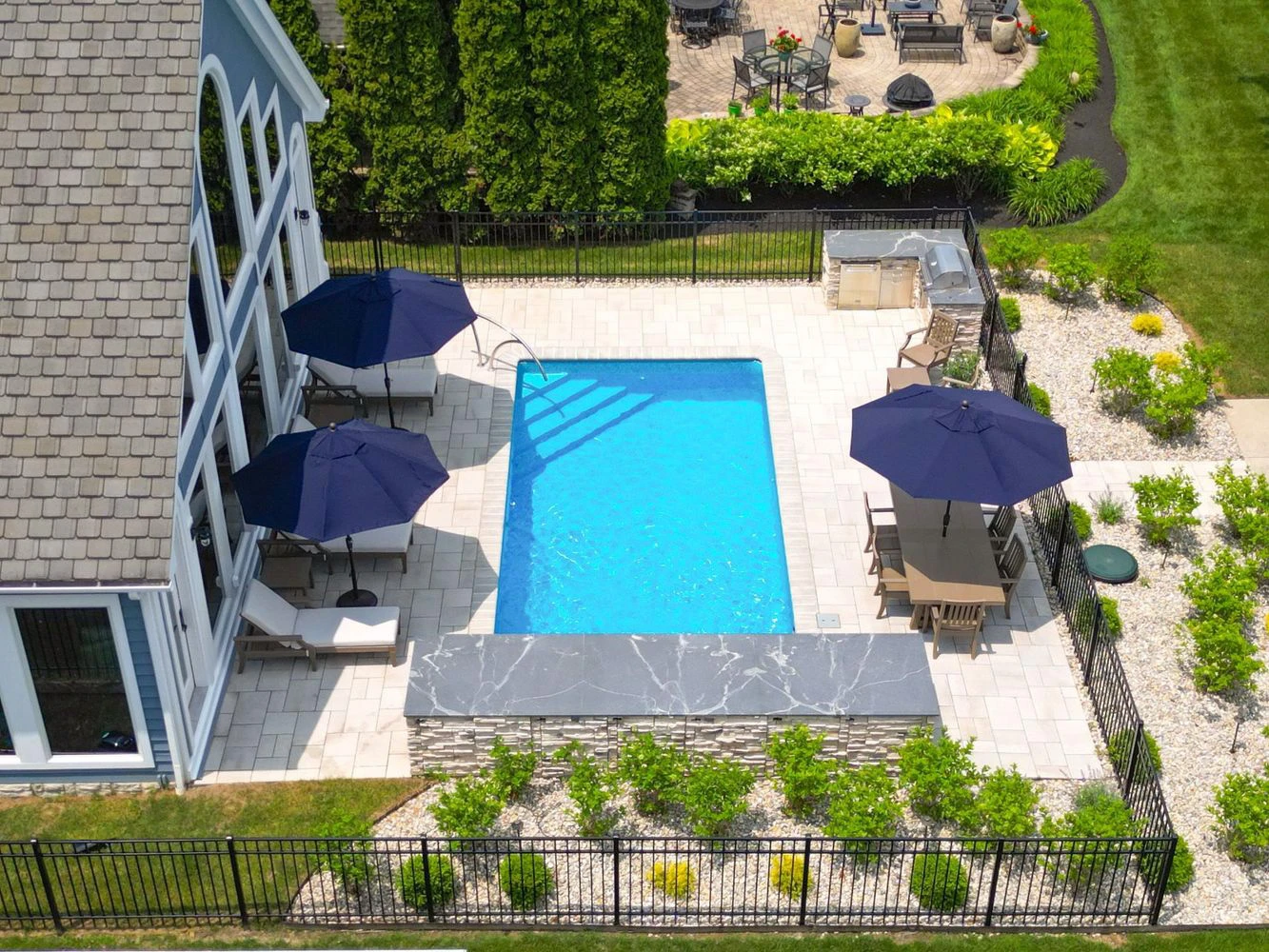
What to Ask Any Pergola Contractor Before You Sign
Whether you’re leaning wood or aluminum, the way to separate a serious Dacula builder from a weekend deck crew is to ask for the details that do not appear on the marketing brochure.
- Footing depth and diameter, specified against the Piedmont frost line? A real answer references 12-inch minimum by county code and at least 18 to 24 inches actual depth.
- How does the post meet the footing? For wood: “elevated standoff bracket, post not in direct contact with concrete.” For aluminum: anchor bolt pattern, base plate detail, leveling shims.
- Species of cedar, or grade of PT pine? Western Red Cedar #2 Better is the standard. PT pine should be .40 retention for above-ground, .60 for ground contact.
- For aluminum: is the bonding conductor in the price, and what gauge? #6 AWG copper minimum, and it should be a line item in the proposal.
- Finish warranty? On aluminum, 10 years is the floor for quality powder-coat. On cedar, finish warranties are rarely meaningful beyond 1 to 2 years.
- Permit pulled through Gwinnett County? Any builder who offers to “save you the permit fee” is telling you the project won’t pass inspection.
- HOA approval in Hamilton Mill, Providence Club, Ivey Chase? A local builder knows the ARB material rules, including whether aluminum is permitted in your specific subdivision.
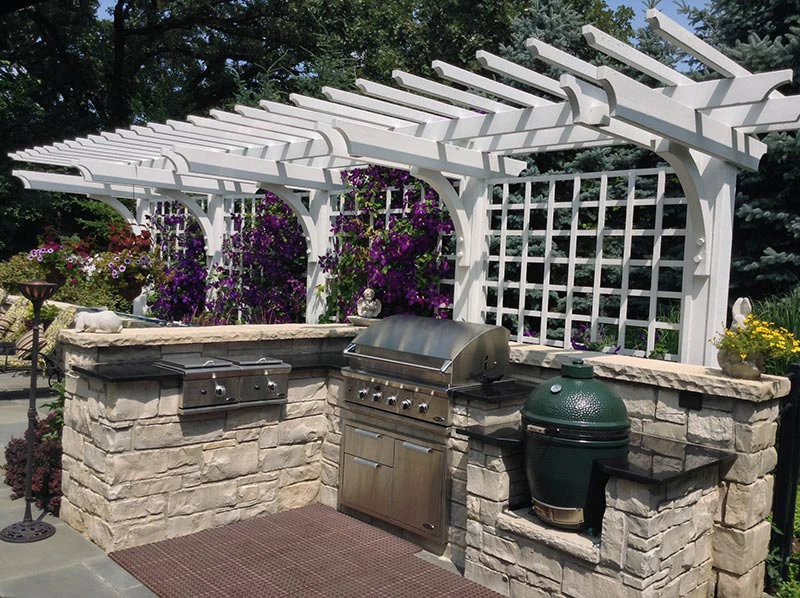
The right pergola for a Dacula backyard is the one where upfront cost, ongoing maintenance, and expected lifespan align with how you actually live in the house. We’ve been asked “which is better?” a few thousand times, and the answer is always the same — better at what, for whom, on what timeline? Once those three answers are clear, the material almost picks itself.
Pergola design and construction across 20+ cities within 30 miles of Winder, GA
Whether the right answer for your backyard is cedar, pressure-treated pine, or powder-coated aluminum, we’ll walk the site, pull the permit, and build it to stand up to Dacula’s climate for the next two decades.