
The homeowners had lived with the same 18-by-36 rectangle since closing on the house in 2004. Twenty-one summers, two pump rebuilds, one liner patch kit that was supposed to last the season and made it eleven months. By the time they called us, the deck was cracked from Forsyth County’s freeze-thaw cycles, the plaster had worn through to aggregate in the deep end, and their oldest had just asked — politely — if the pool could please look less like it was built during the Bush administration. That is the call we get three or four times a month from Windermere.
Windermere — a 900-home master-planned community off Post Road in 30040 — saw its first wave of pools go in between 2003 and 2006. Two decades later those pools are hitting the same wall at once: plaster cycling out, cantilevered concrete coping spiderwebbed from Piedmont clay movement, and a taste cycle that has moved entirely away from the raised-brick-coping, white-plaster, diving-board aesthetic.
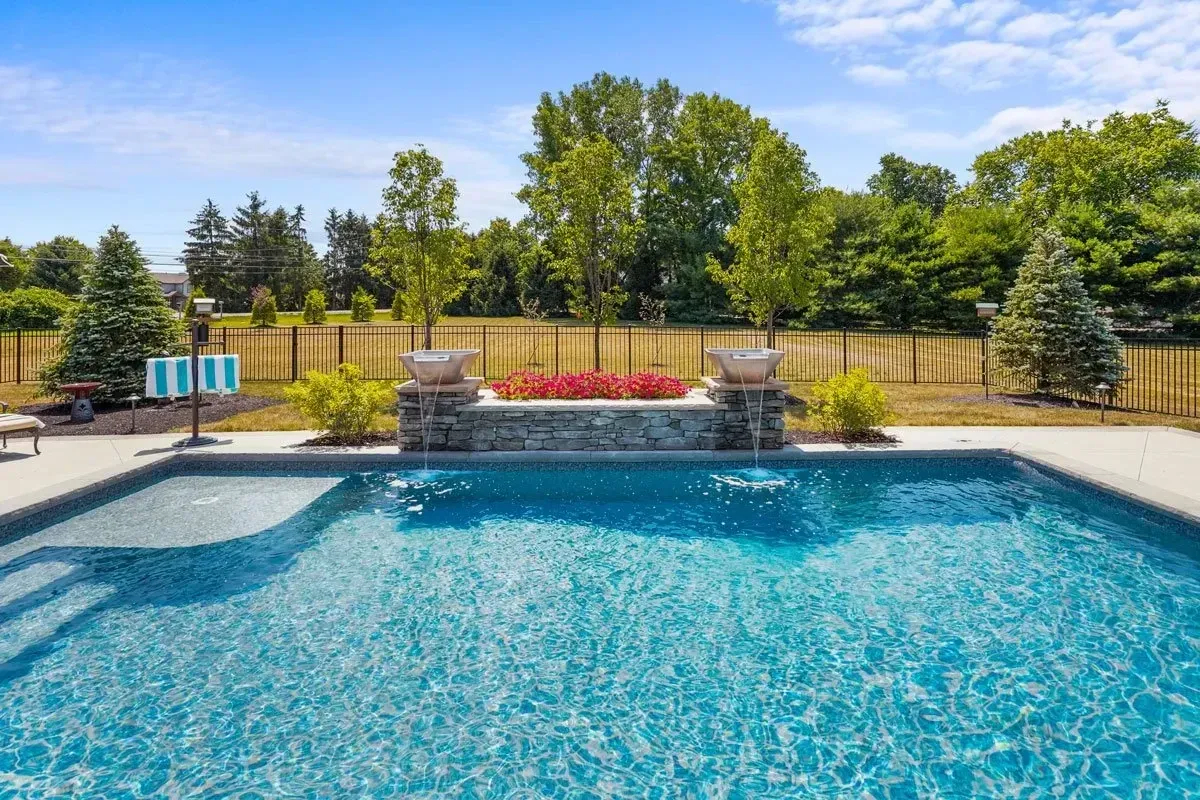
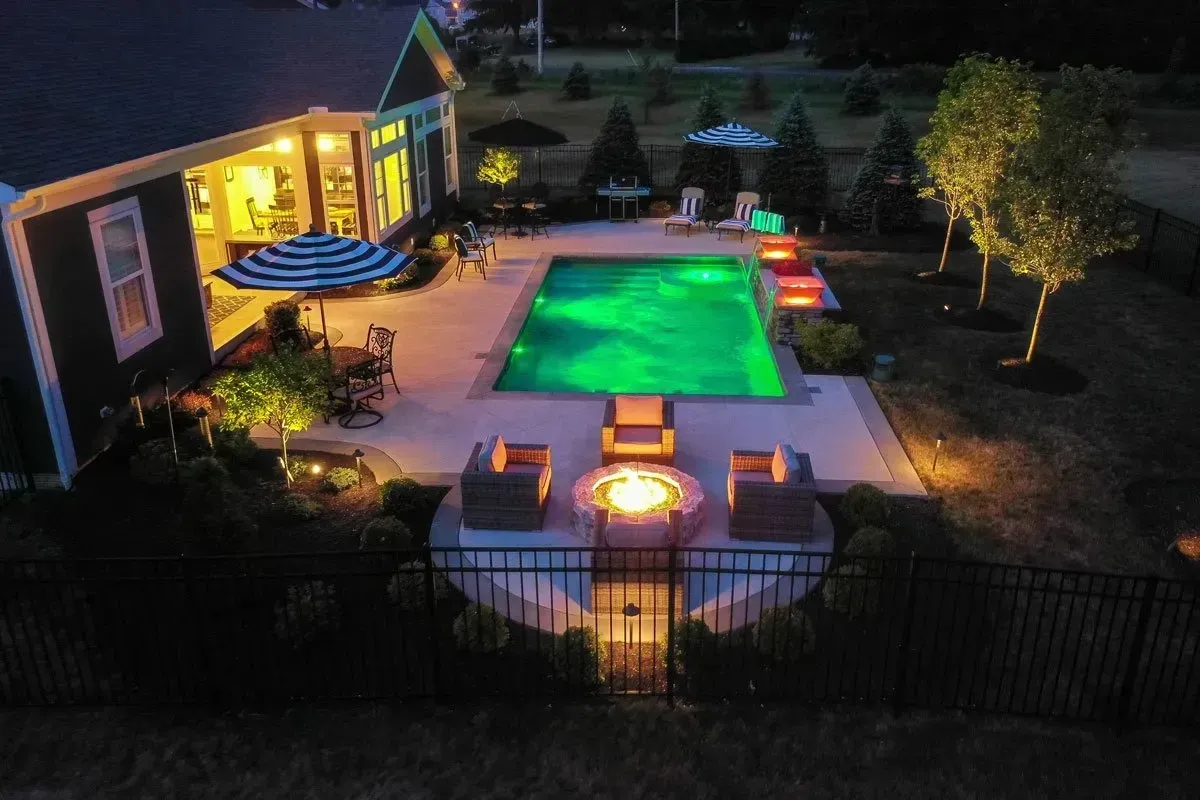
This post walks through what it actually costs to convert a 2003-era Windermere rectangle into what we call a modern resort build — raised spa with spillovers, sun shelf with bubblers, LED color-changing, fire bowl trim, travertine deck. Budget range, start to finish, with permits and equipment swap: $78,000 on the floor, $128,000 on the ceiling. Three in four Windermere projects we quote land in the $94,000 to $112,000 band.
Why the 2003 Windermere Rectangle Is the Easiest Shell in Forsyth County to Remodel
The 2003-era Windermere shells are, by and large, sound. Builders that phase used gunite over a rebar cage that by 2003 had caught up with post-Andrew code — 8-inch wall, 12-inch floor, proper bond beam. We core-sample before we quote, and in the last nineteen Windermere rectangles we have scoped, we recommended full shell replacement on zero. That is the starting point of every budget below. If the shell is sound, you are remodeling. If it is failing, you are building a new pool with a demolition credit, and the numbers roughly double.
What fails is the stuff that was supposed to fail — the wear items. Plaster is a ten-to-twelve-year surface in this climate. By our count, a majority of Windermere rectangles have been replastered once already, around 2014 to 2016, which means they are about due again. Coping — specifically the poured-concrete cantilevered coping that was standard in 2003 — is the first thing homeowners say needs to go, partly because it is cracked, partly because it looks dated the second you stand a raised spa next to it.
Mechanical is a different story. The original pump on a 2003 build was almost certainly a Hayward Super II single-speed, which the Georgia variable-speed mandate retired years ago. Nine of ten Windermere pools we quote are already on their second or third pump. Heaters are a coin flip. Original filters were usually DE, and they have either been replaced with cartridge units or are on their last season.
Starting-point shell assumption: If you live in Windermere and your pool went in between 2003 and 2006, odds are about 95% your shell is sound and this is a remodel, not a rebuild. That matters because remodel permits through the Forsyth County Dept. of Planning & Community Development at 110 E. Main Street run two to three weeks of turnaround — a new-build permit adds four to six weeks minimum.
The Anatomy of a Resort Conversion — What “Modern Resort Build” Actually Means Here
Resort-style gets thrown around until it stops meaning anything. Here is what we mean on a Windermere remodel. The conversion has five architectural moves; the budget you pick determines how many you get.
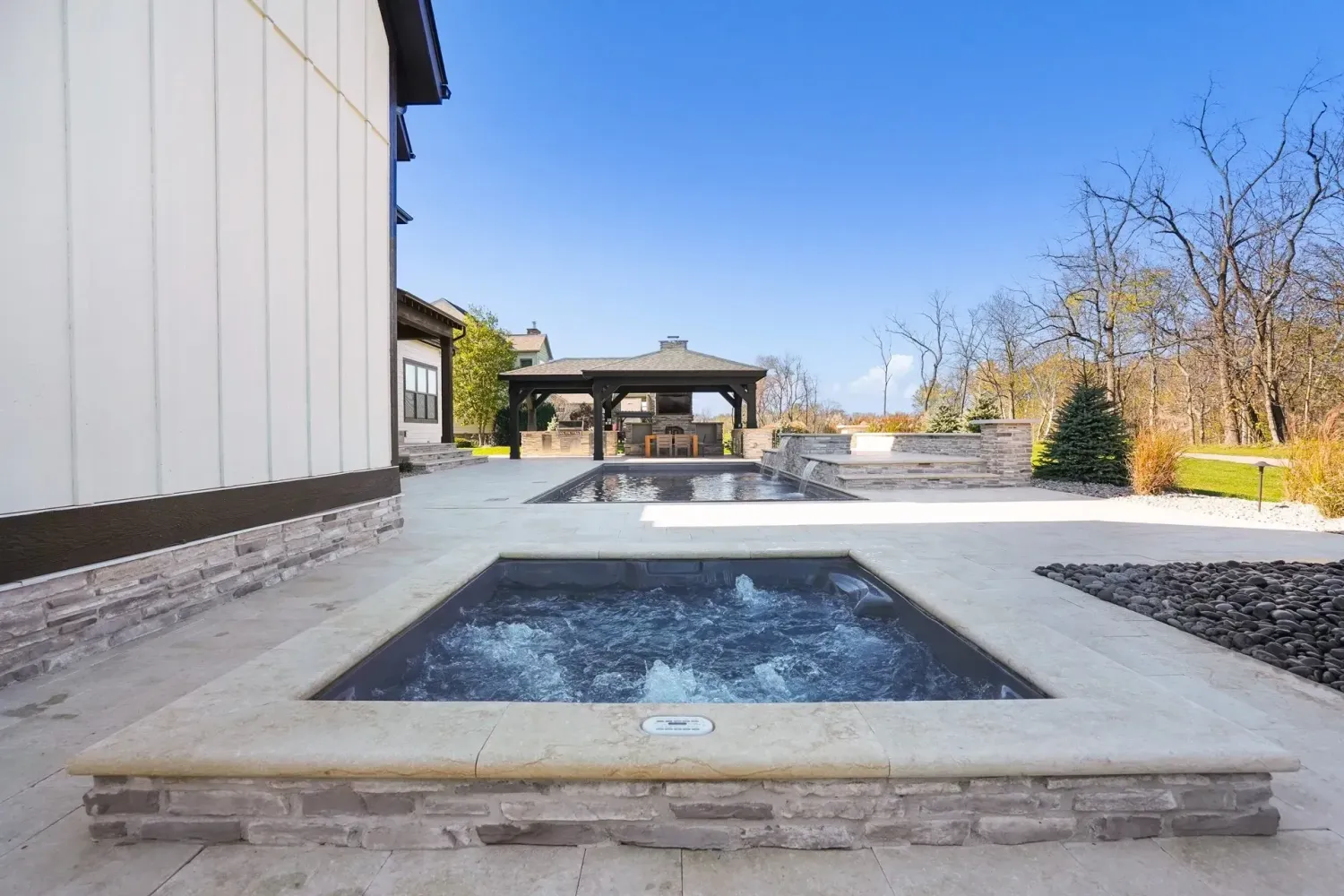
Move one: the raised spa with spillover. The spa sits 18 to 22 inches above the pool waterline, usually on the deep-end short side. Water flows down through scuppers — three on the face, typically cast-bronze Bobe scuppers in a brushed satin finish, 6-inch outlet. The spa is its own hydraulic loop off a dedicated pump. Cost to add: $18,000 to $26,000, depending on tile spec and plumbing route.
Move two: the sun shelf. A new tanning ledge poured into the shallow end, 8 to 10 feet long by 6 feet wide, with 9 inches of water over it. Two bubblers punch through the surface off a dedicated line. Single highest-ROI feature for families with kids and for resale. Cost to retrofit: $11,000 to $16,000.
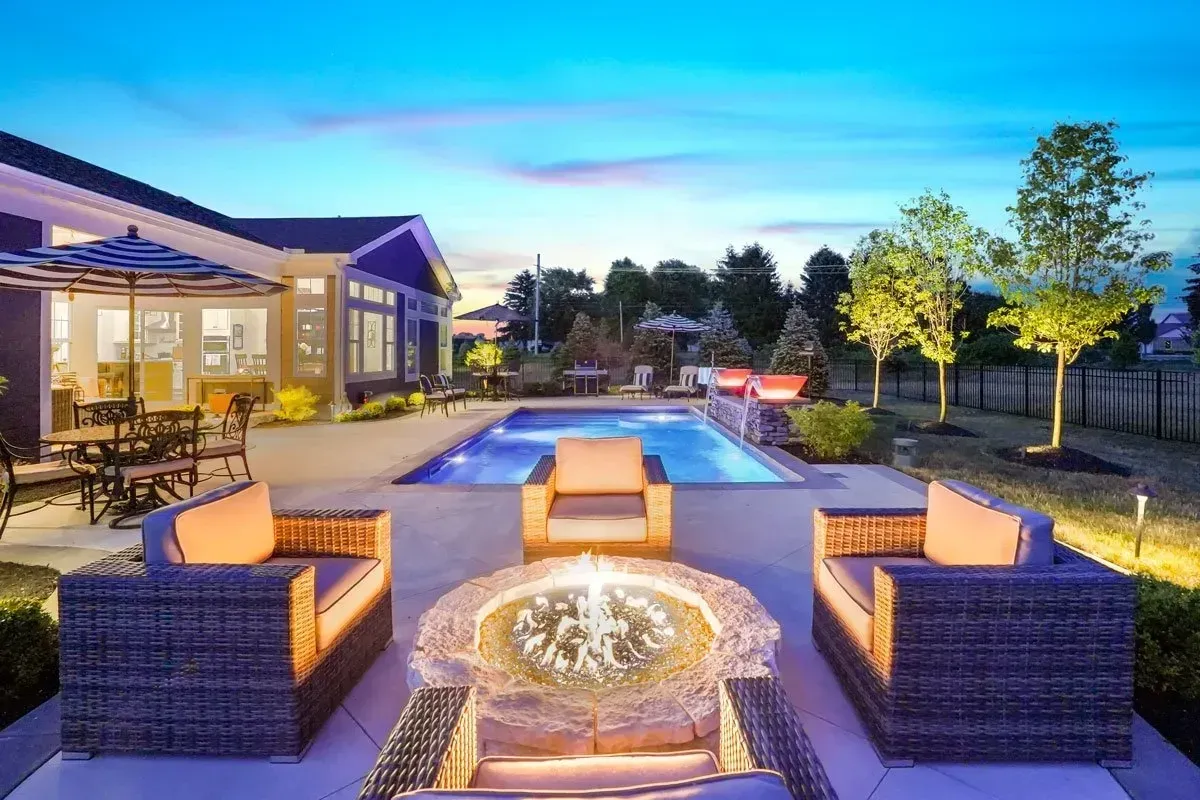
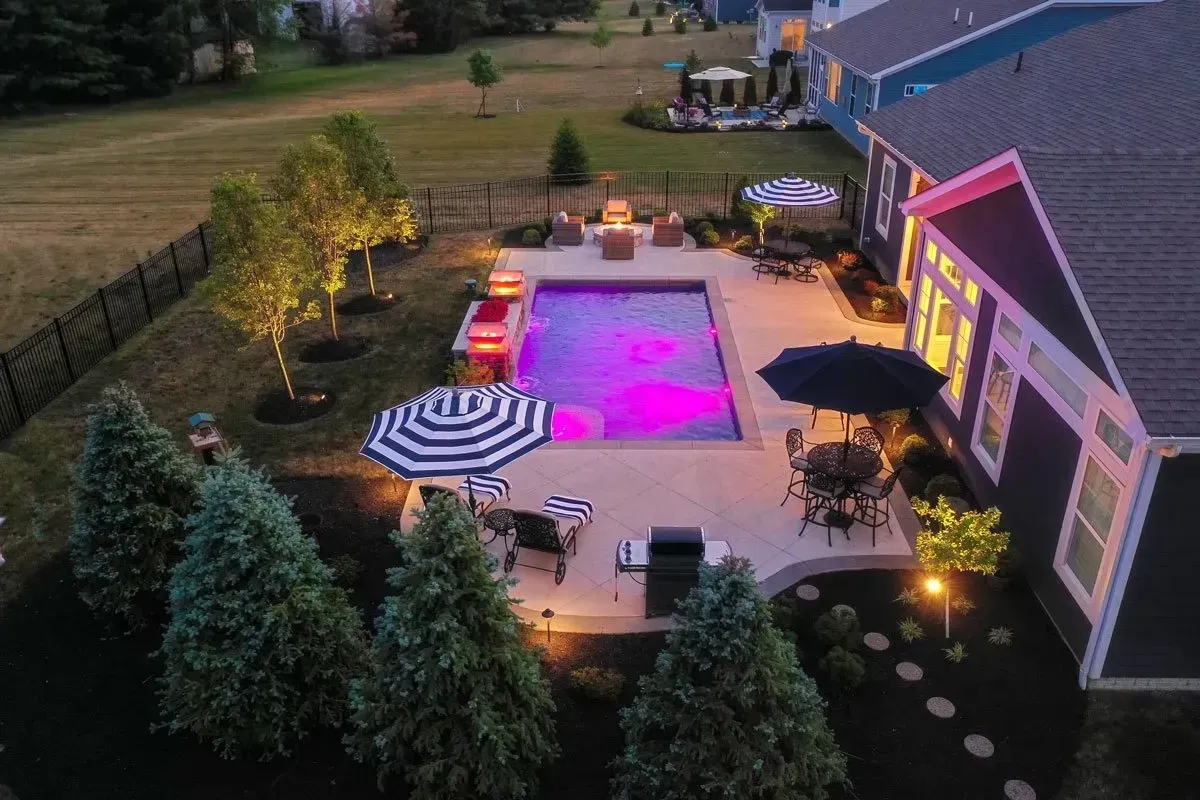
Move three: lighting. Original 2003 pools were almost all on 120V incandescent niche lights — 300 watts, burned out by year eight. Resort-build lighting is Pentair IntelliBrite 5G color-changing LED, typically two in the pool and one in the spa. Figure $3,400 to $4,200 for three fixtures plus the transformer upgrade. NEC §680 job — the niche bonding matters, and Sawnee EMC will flag any inspection where the bonding grid is incomplete.
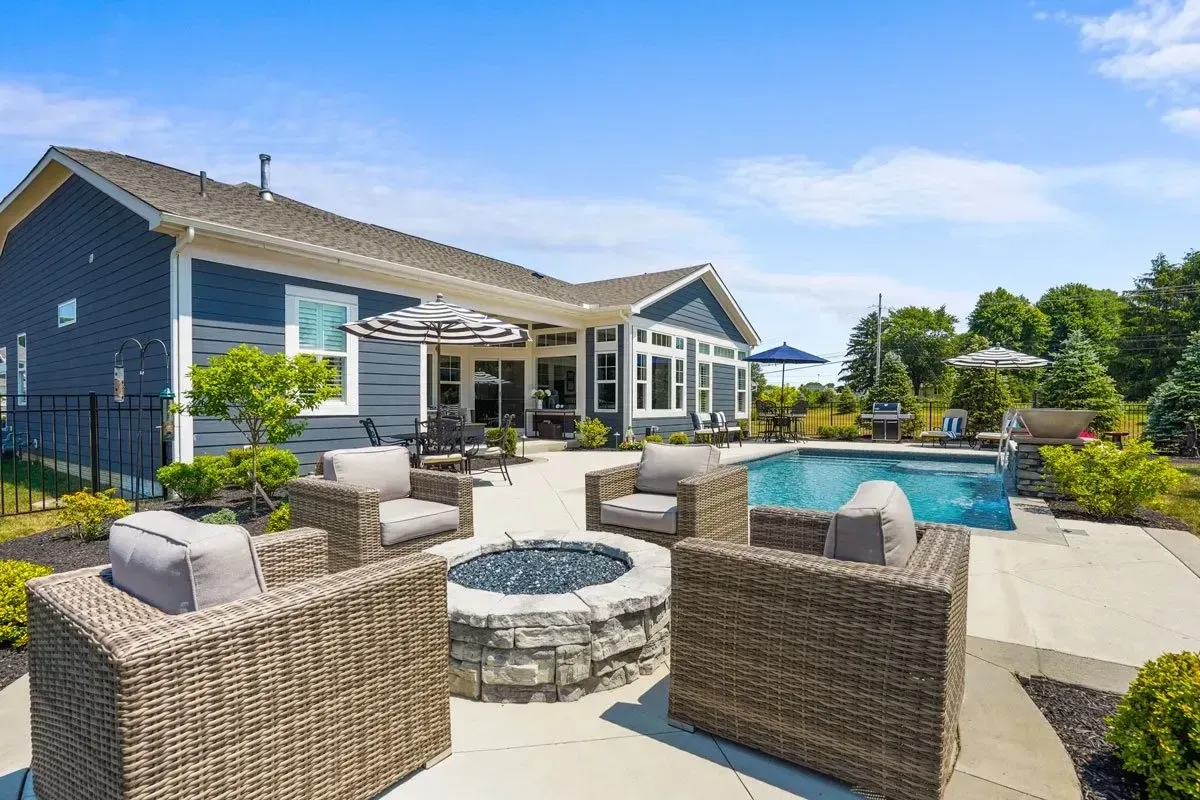
Move four: fire bowl trim. Two natural-gas fire bowls on deck pedestals flanking the pool, piped off a 3/4-inch line from the house meter, cast concrete in a sand finish, 31 inches in diameter. Figure $5,800 to $9,000 installed for a pair.
Move five: the deck. Cantilevered concrete coping and broom-finish deck reads as 2003; travertine coping with a travertine or porcelain deck reads as modern. Travertine in French pattern, unfilled, tumbled edge — that is the spec we write on about 70% of Windermere remodels.
Value Engineering — Keep the Shell, Kill the Deck, and Other Budget Math
Where is the money going? About 55% of a resort-conversion budget is the deck and coping. The pool itself — replaster, new tile, lights, pump — is closer to 25%. The raised spa is about 15%. Fire bowls, bubblers, automation share the remaining 5%. That proportion is surprising to most homeowners and is the single most useful fact to carry into the planning conversation.
The biggest value-engineering decision is how much deck you tear out. Three paths, in order of cost:
Path A — Partial replacement. Keep the existing broom-finish concrete on three sides; tear out and replace only on the spa side, extending to a travertine patio where the spa sits. The new travertine frames the spa, which is where the eye goes anyway. Saves $14,000 to $22,000 vs. full replacement. Trade-off: a visible seam where old meets new.
Path B — Full tear-out, replace with travertine. The existing 900 to 1,200 square feet of deck comes out, we pour a new 4-inch concrete substrate with fiber mesh, and we set 1.25-inch travertine in French pattern on a full mortar bed. Standard resort-conversion spec. Budget: $28,000 to $46,000 for the deck alone, including coping, edge bands, and step treads.
Path C — Overlay. A 1-inch porcelain paver over the existing concrete deck after surface prep, setting bed, and edge restraint. Faster, cheaper — $18,000 to $28,000 — but only worthwhile when the existing deck is genuinely sound, which in Windermere is about one pool in six. More often the slab is cracked enough that an overlay transfers cracks up into the new surface within two seasons.
The second value-engineering call is equipment pad relocation. Original Windermere pools put the pad on the pool side of the house — easy plumbing, but visible from every window and twenty years later obsolete. We relocate the pad roughly half the time, into a screened enclosure off the garage. Relocation adds $6,500 to $9,500 — new trench, longer plumbing runs, potentially a second sub-panel tied into Sawnee EMC’s 240V service. Worth it if your existing pad is visible from the primary deck sitting area.
The deck-tear-out rule of thumb: If the existing slab has more than three visible cracks longer than 18 inches, or any crack wider than 1/8 inch, do not overlay. Pull it and start over. The saved money on the overlay gets swallowed by the reflective crack repair call you will make in year three.
Permits, HOA Review, and the Forsyth County Timeline
Windermere falls under a mandatory HOA architectural review board. Raised spa, fire bowls, or deck expansion all require ARB approval before a permit package is filed. The Windermere ARB meets twice monthly; submit-to-approval averages 14 to 21 days across the last twenty projects we have run in the neighborhood.
Once ARB is stamped, we file with Forsyth County Dept. of Planning & Community Development at 110 E. Main Street. Remodel permits for pool work run two to three weeks in Forsyth — faster than Gwinnett, meaningfully faster than Fulton. Permit fee for this scope typically runs $340 to $620.
Timeline from signed contract to swim-ready: 11 to 16 weeks on a standard Windermere remodel, 18 to 22 weeks on a top-end build with deck tear-out and equipment relocation. We do not start construction until permits are in hand. Anyone who offers to start sooner is either cutting corners or not pulling permits — and both catch up to you at the closing table when you try to sell the house.
What the Numbers Actually Are — Three Real Windermere Budgets
Abstract ranges are fine for scoping — not for decisions. Three real Windermere remodels we have completed in the last eighteen months, with actual scope and actual numbers.
Project 1 — “Floor” Resort Conversion
2003 rectangle, 18×36, shell sound. Scope: replaster in white quartz, new 6×6 Lightstreams glass tile waterline, one Pentair IntelliBrite LED, modest 6×8 raised spa with two scuppers, partial deck tear-out on spa side only (about 380 sq ft of travertine), Pentair IntelliFlo3 pump, new cartridge filter. No fire bowls. No sun shelf. Total: $81,400. 12 weeks.
Project 2 — “Mid” Resort Conversion
2004 rectangle, 20×40, shell sound. Scope: pebble tec replaster (mini-pebble graphite), glass mosaic tile waterline, full 8×10 raised spa with three Bobe scuppers, 9-foot sun shelf with two bubblers, three Pentair IntelliBrite LEDs, variable-speed pump, new Pentair MasterTemp 400 gas heater, full deck tear-out to silver travertine French pattern (1,050 sq ft), basic IntelliCenter automation. Total: $104,800. 15 weeks.
Project 3 — “Top” Resort Conversion
2005 rectangle, 20×40, shell sound. Scope: glass bead finish replaster, 2×2 glass tile on all four sides plus full-tile spillover wall, 10×12 raised spa with three Bobe bronze scuppers, 10-foot sun shelf, four IntelliBrite LEDs, pair of 31-inch cast-concrete gas fire bowls, dual variable-speed pumps, full IntelliCenter automation with deck-side remote, walnut travertine French pattern deck (1,260 sq ft), equipment pad relocated behind garage. Total: $127,200. 19 weeks.
Equipment Pad and the Lake Lanier Factor — Where Cumming Builds Diverge From Everyone Else’s
The equipment pad is where remodels either end up clean or end up a patchwork of adaptor fittings, mismatched diameters, and wire runs that make the next contractor wince. On a 2003 Windermere pool, the pad has almost always been patched two or three times — someone swapped the pump in 2011 with a 1.5-inch adapter on a 2-inch line, someone else added a salt cell in 2018 that backflows under low flow.
Our rule: if we are in, we redo the pad. Single manifold, dedicated loops for pool, spa, bubblers, and water features. All 2-inch Schedule 40 PVC on pressure side, 2.5-inch on suction. Union fittings before and after every piece of equipment so the next service call does not require cutting pipe.
Pump spec: Pentair IntelliFlo3 VSF on the main loop, second IntelliFlo3 on the spa loop if the spa warrants it, smaller Pentair SuperFlo VS on the water feature loop. Pad gets a Pentair MasterTemp 400 heater, IntelliChlor salt cell if homeowner is going salt, and a properly-sized cartridge filter (Pentair Clean & Clear Plus 520). Total rebuild without relocation runs $9,500 to $14,000. The IntelliFlo3 alone saves roughly $420 to $680 per year in electricity over the 2003 single-speed, paying for itself in about four years.
The Lake Lanier Factor — Why Cumming Pool Chemistry Is Different
Cumming sits inside the humidity halo of Lake Lanier. Humidity averages 8 to 12 percentage points higher than Dacula, and evaporation runs about 15% higher in peak summer — make-up water demand is higher, chemistry dilutes faster, and the salt cell or chlorine feed has to work harder to hold free chlorine.
On a resort conversion, this shows up in two places. First: automation. We specify Pentair IntelliCenter with the remote chemistry sensor package, which logs ORP and pH in fifteen-minute intervals. In Cumming it will catch the evening-wind-off-Lanier shift that sinks free chlorine overnight. Second: salt cell sizing. We oversize one step. A pool that would take an IntelliChlor IC40 elsewhere gets an IC60 in Windermere.
Electrical loads on a resort conversion — two variable-speed pumps, salt cell, heater electronics, LED transformer, automation hub, fire-bowl igniters — exceed the 2003 sub-panel’s spec. Sawnee EMC will flag this on inspection. We pull a new 60- or 100-amp sub-panel from the main house service to the pad, typically $1,800 to $3,200. Any contractor who does not include it is either eating the cost or leaving it for the next guy.
Resale Impact — What the Appraisal and MLS Comps Actually Show
Homeowners almost always ask: “Will we get the money back?” In Windermere the answer is more favorable than the national pool-remodel stat. We pulled every Windermere closing from the last 30 months where the listing included documented pool work of this scope — 23 comps. Median lift attributable to the pool-deck package: $38,000 to $62,000 on a base home value of $750K to $1.05M. On a $105,000 project, that is 36% to 59% direct recovery, plus 18 to 27 fewer days on market versus comparable listings with original pools.
You do not remodel your backyard as a financial investment, but recovery runs high in Windermere for three reasons: buyers relocating from higher cost-of-living metros pay a premium for turnkey outdoor living; the lots are generous enough that the backyard is a primary value driver; and the comps now show a real gap between original-pool and remodeled-pool homes that did not exist five years ago.
Other Cumming subdivisions show similar but not identical patterns. St. Marlo trends higher — 45% to 65% — on higher base values. Polo Fields runs similar to Windermere. Hampton Park trends lower, 28% to 45%, in a more value-sensitive price band. A Cumming pool remodel in a premium subdivision recovers a meaningfully higher share than the national average suggests.
The comp rule: If you are planning to sell within three years, the resort conversion pays a higher recovery percentage than any interior kitchen or bath remodel in the same budget band for Windermere homes in the $800K+ range. If you are planning to stay ten-plus years, the financial-recovery conversation is the wrong frame — you are buying your backyard back.
What You Live Through — The Build and the Details That Matter
The 15-Week Reality of the Build
The 15-week mid-budget build breaks down as: weeks 1-3 ARB submittal and permits; 3-5 demo; 5-7 structural (spa and sun shelf bond beams, new plumbing trenched, electrical pulled); 7-9 finishes (tile, plaster, lights); 9-12 decking; 12-14 equipment pad and systems; 14-15 fill, chemistry, startup, final inspection.
Practically, your backyard is a dust zone for three weeks of demo, a mud zone for two weeks of trench work, and a staging zone for most of the middle. The dogs cannot go out the back door for roughly 10 of the 15 weeks. The driveway has a 30-yard dumpster for weeks 3-5 and a second for weeks 9-11.
Windermere families typically plan the build for late September through early February so they have the backyard back by Memorial Day. That window lets permits settle, concrete and tile work proceed in workable weather, and final fill land in the April warm-up when chemistry stabilizes fastest.
The Details That Separate a Good Remodel From a Great One
Two projects with identical scope sheets can finish looking entirely different. The gap is in the details.
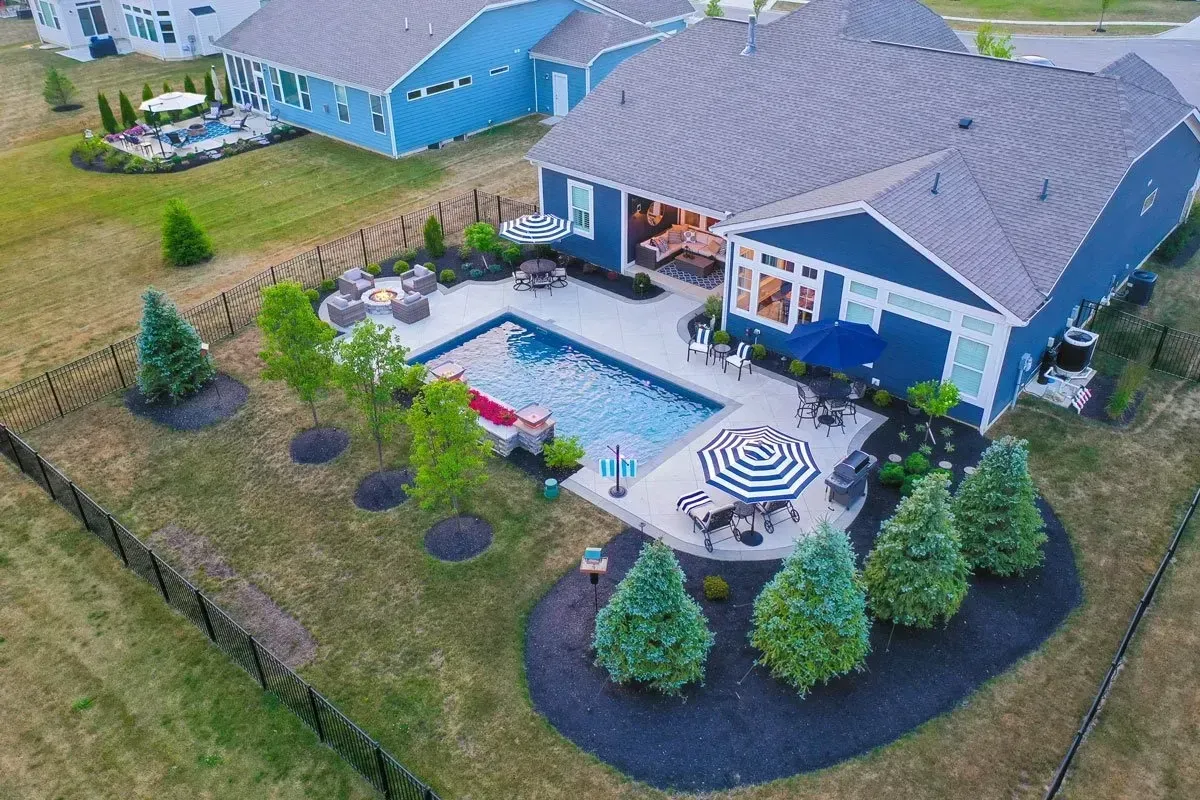
Coping-to-deck seam. The travertine coping has to sit flush with the deck. If the coping is 1-1/4 inch thick and the deck is set on a 3/8-inch mortar bed, the substrate has to drop 7/8 of an inch at the edge to bring surfaces level. Amateur builds miss this and leave a lip that stubs every toe.
Spa-wall tile wrap. On a three-scupper spa, the face tile should wrap the corners onto the spa side walls for six inches, not end at the corner. Corner terminations read cheap; wrapped terminations read resort.
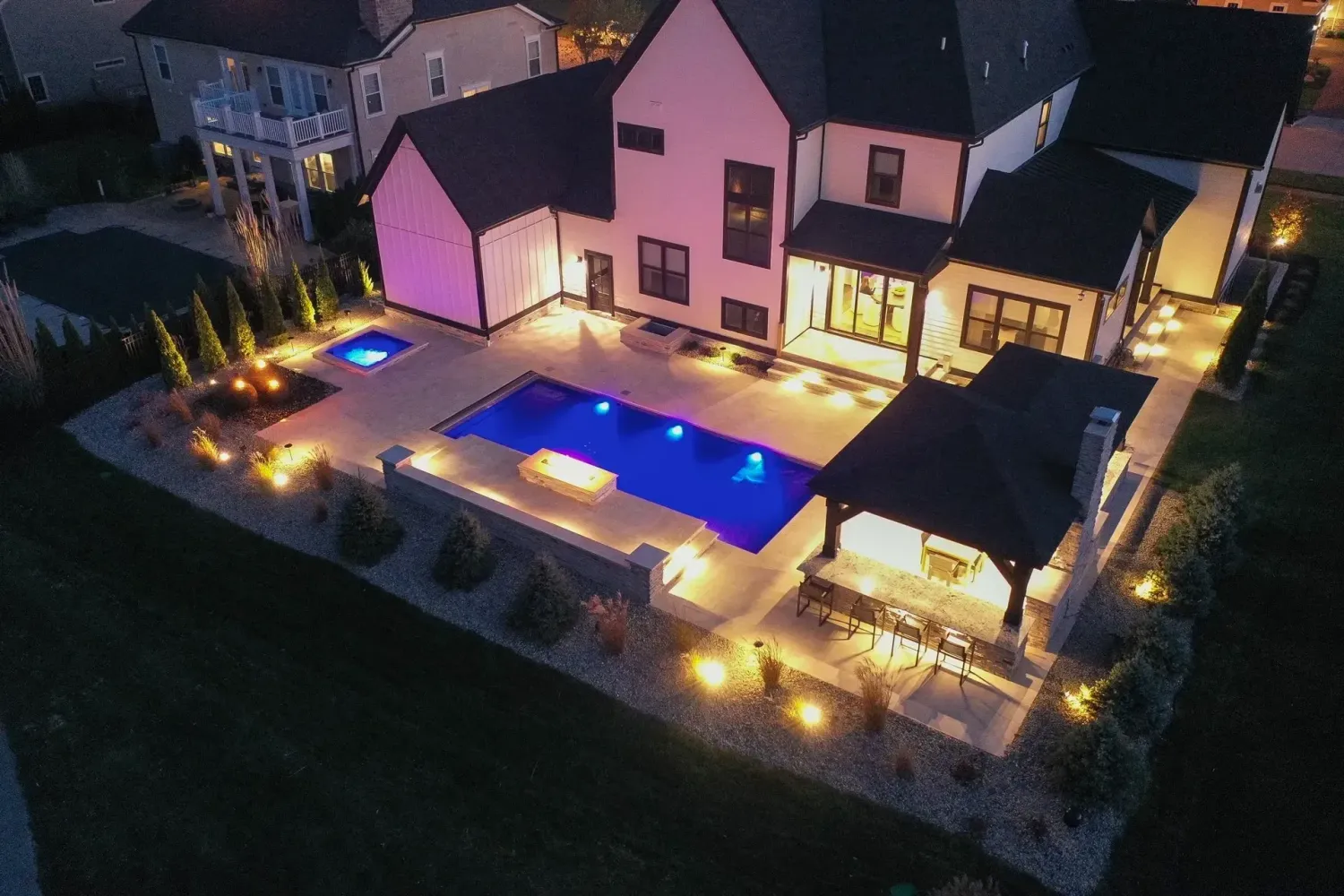
LED color calibration. IntelliBrite fixtures default to a preset palette that reads amusement-park. We hand-tune to 2700K warm white for evening swim, 4000K cool white for late-evening ambient, plus three custom presets. Default-preset pools look juvenile; tuned pools look expensive.
Bubbler sync. Twin bubblers should pulse on the same duty cycle at the same height and volume — which requires balancing valves on the bubbler feed. A 45-minute valve-balancing session during startup fixes this forever.
Deck drain spec. Slot drains with stainless grates run the full length of the deck edge, moving the same water as channel drains but reading as architectural detail. Upcharge $1,800 to $3,400. Worth it.
When a Resort Conversion Is Not the Right Call
Not every Windermere rectangle should become a resort conversion. Three scenarios where we steer homeowners away.
First: you are selling inside 18 months. Recovery numbers are calibrated to 24-to-36-month listings. Faster turns penalize project-heavy remodels. If you are selling in 2026, a $22,000 refresh — replaster, new tile, new lights, minor deck repair — recovers a higher percentage than a $105,000 conversion.
Second: your shell is failing. If core samples show bond-beam failure, significant rebar corrosion, or hydrostatic damage, you are looking at a new-build with a demolition credit — $145,000 to $210,000, and the recovery percentages are different.
Third: your lot is wrong for the scope. Some Windermere lots — the cul-de-sac phases backing up to South Forsyth tributary drainage — have 5-to-8-foot grade drops in the pool footprint. A raised spa working against that grade can push totals $20,000 to $35,000 above the ranges above. On those lots we recommend a grotto or negative-edge catch basin that works with the grade instead of against it.
For every other scenario in Windermere, the resort conversion math works. Shells are sound, lots are workable, HOA is predictable, the county permit office is efficient, and the resale comps support the project.
Pool Remodeling across 20+ cities within 30 miles of Winder, GA
From Windermere resort conversions to Vickery shell rebuilds, we work the full Forsyth County arc — planning, permitting, and building pools that still read as new in year fifteen.