
Four water features dominate Suwanee luxury pool design, and they are not interchangeable. A $2,800 scupper bowl and a $44,000 grotto cave move the same liquid through the same plumbing, but they create completely different rooms.
Walk the back elevation of any finished build in Laurel Springs or The River Club at Suwanee and you will see some version of the same decision tree: how loud, how visible, how much masonry, how much you actually swim around the feature. This post is the decision tree in written form — every column compared on flow rate, price installed, acoustic behavior, and what it does to the rest of the build.
Below: scuppers versus sheer descents versus rain curtains versus grottos, on the specs that actually matter in Gwinnett County, for the Suwanee housing stock that tends to ask for them.
At-a-glance price range: Scupper bowls $2,800–$4,400 each installed, 15–25 GPM. Sheer descent weirs $4,400–$6,200 each at 35–50 GPM. Rain curtain (24-ft linear) $8,400–$12,800 total. Grotto cave $24,000–$44,000 turn-key. Signature combo (3-bowl + 2-descent) runs $16,000–$28,000.
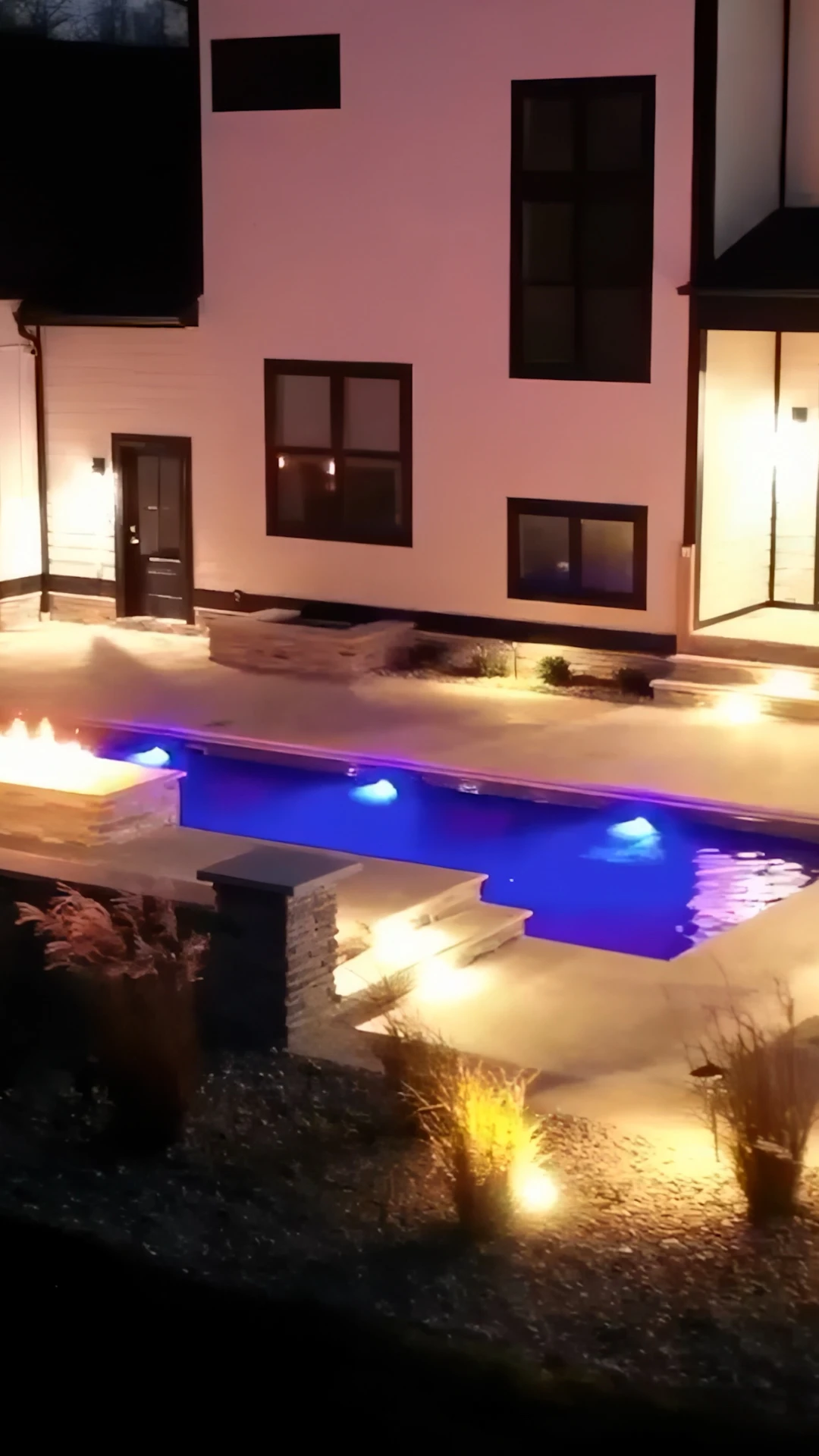
Scupper bowls: the $2,800 starter that still reads luxury
A scupper is a bowl, pier, or niche that receives water from a dedicated return line and spills it forward into the pool. The shape is the aesthetic — bronze, cast-stone, ceramic, stainless, sculpted concrete — and the flow rate is the performance. In Suwanee the cast-stone Oldcastle-style bowl at roughly 18 inches across is the default choice because it pairs with the stacked-stone pier elevations that dominate Laurel Springs and Bear’s Best Atlanta.
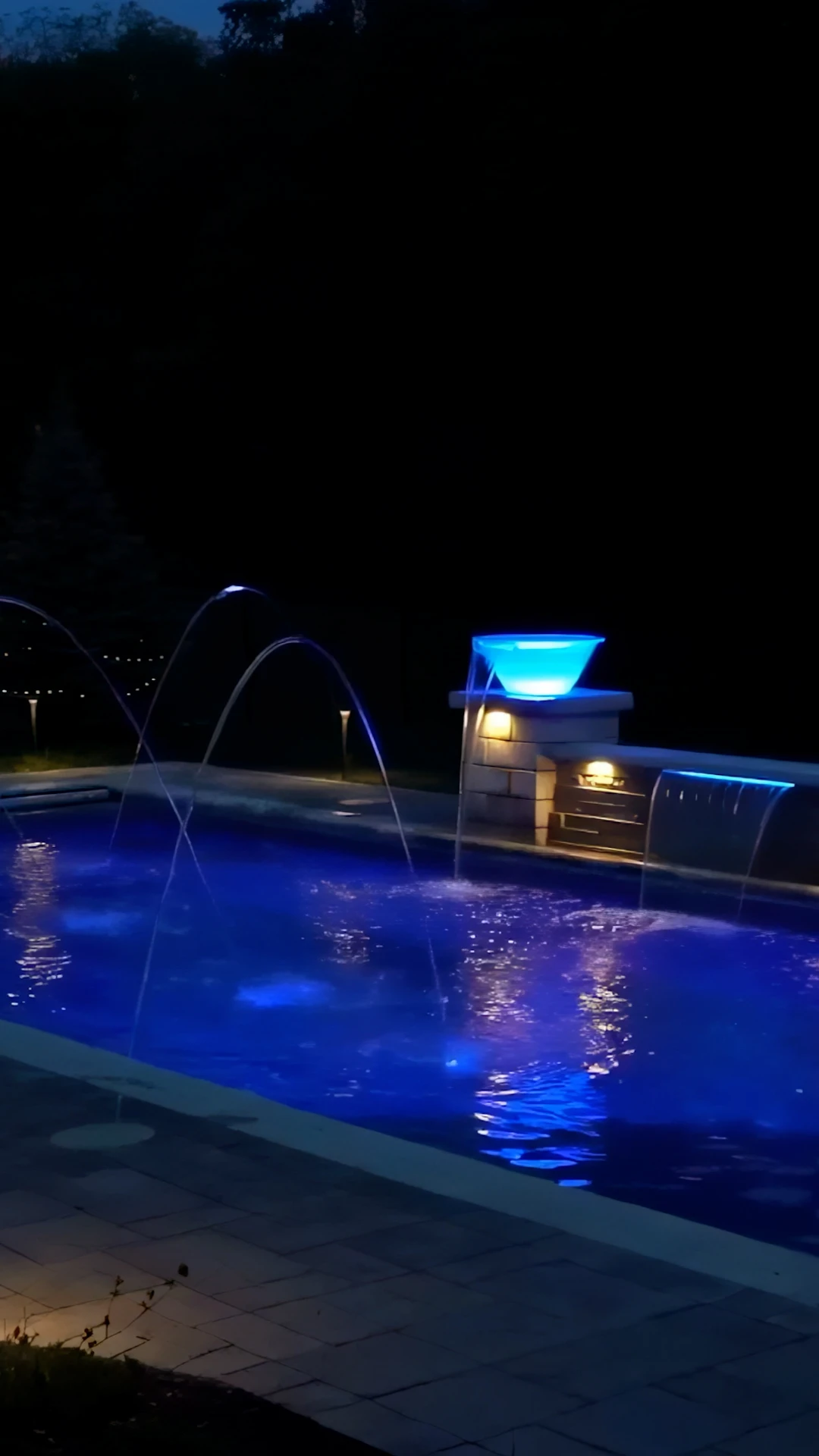
Each bowl wants 15–25 gallons per minute to produce an arcing laminar spill. At 15 GPM the stream is polite, almost quiet; at 25 GPM it throws eight to ten inches of clear arc and makes a soft drumming sound on the pool surface. A three-bowl symmetric pier array is the most common Suwanee installation — pier, bowl, pier, bowl, pier, bowl — and total cost sits at $8,400–$13,200 installed including the dedicated 3/4 HP booster pump most builders spec for clean simultaneous flow.
The advantage: scuppers are reconfigurable. If the homeowner decides in year three that they want the bowls louder, a plumber swaps the eyeball fitting for a higher-flow nozzle and moves the variable-speed pump up 400 RPM. The plumbing trench does not get re-opened. Scuppers are also the feature most likely to survive an HOA architectural review — the 3-to-4 week Laurel Springs HOA turnaround typically approves traditional cast-stone bowls on first pass because they read as historic garden element rather than contemporary water sculpture.
Sheer descent weirs: the architectural line
A sheer descent is a 6-inch stainless steel linear weir set into the top of a raised bond-beam wall. Water is fed behind the weir through a pressurized manifold and exits as a clean sheet — not an arc, not a splash, a translucent curtain about a quarter-inch thick. The visual is contemporary architectural; the sound is bigger than a scupper but cleaner.
Installed costs in Suwanee run $4,400–$6,200 each for the standard 24-inch blade, with 36-inch and 48-inch blades escalating roughly linearly. Flow is 35–50 GPM per foot of weir length, which means the plumbing side of the equation is very different from scuppers — a pair of 36-inch descents can demand 120 GPM from the booster, and that drives a different pump selection. Pentair IntelliFlo3 VSF variable-speed units are the go-to for this load in Gwinnett County builds because they hold flow precisely at the low end for ambient evenings and push to full at full-party volume.
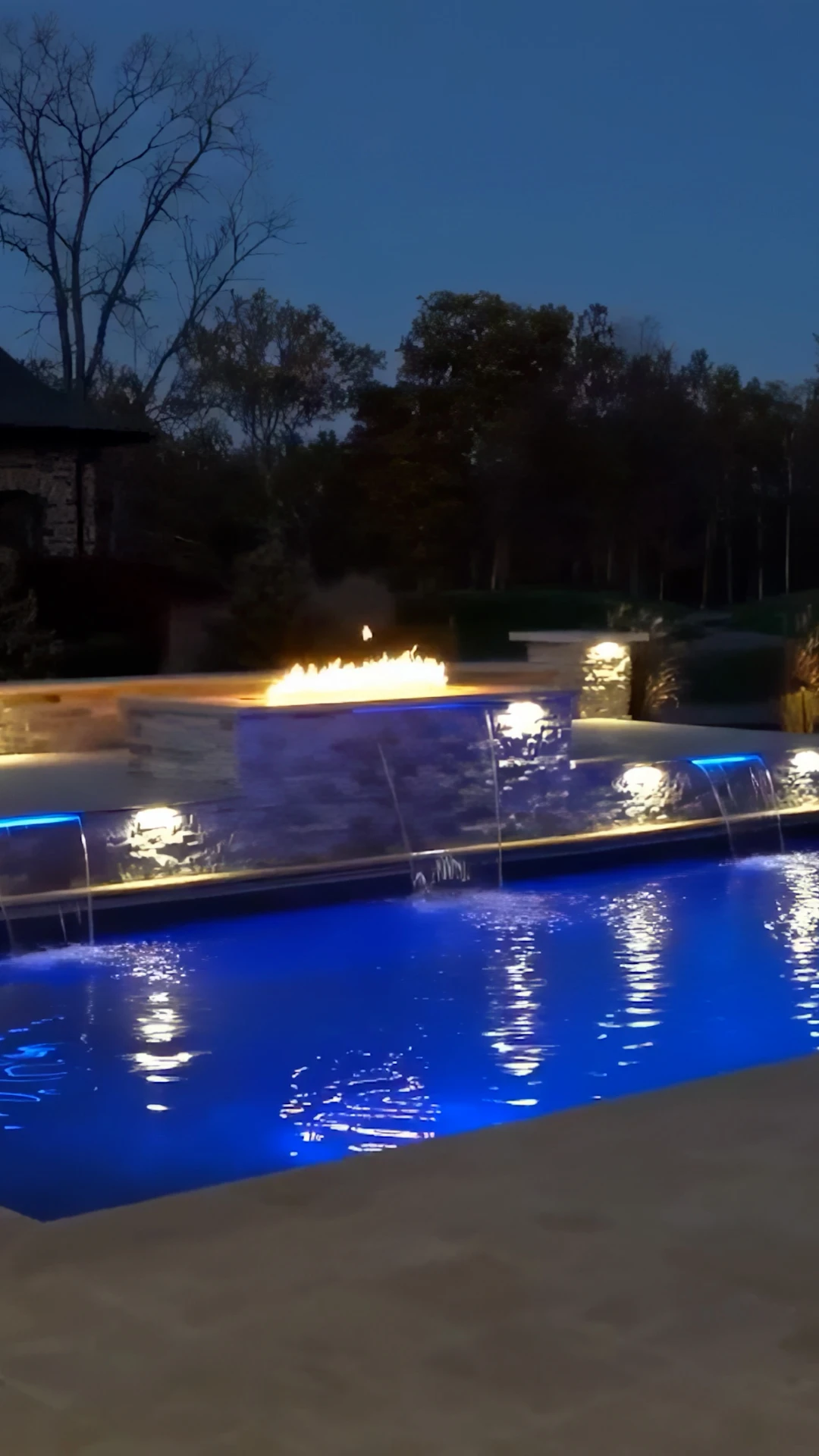
Sheer descents demand more wall than scuppers. You cannot retrofit them into an existing flat coping — they require a raised bond-beam wall a minimum 10 inches tall behind the weir face, typically clad in stacked ledgestone or cream travertine to match the pool coping. That structural wall is an extra $180–$240 per linear foot on top of the weir itself, and it changes the entire back elevation of the build. In a Settles Bridge lot with a tight setback from the Chattahoochee flood zone, that wall may also change your grading plan.
Rain curtains: theater, not ambiance
A rain curtain is a 24-foot linear array of closely-spaced laminar jet nozzles — sometimes 40 to 60 individual orifices — suspended from an overhead beam or integrated pergola header, dropping vertical streams into the pool below. Total installed cost for a Suwanee build: $8,400–$12,800, driven mostly by the overhead structure that has to carry the manifold plus the laminar nozzles themselves (Fiberstars or Pentair branded units run $180–$260 apiece in quantity).
The rain curtain is the loudest water feature in this category. At full flow a 24-foot curtain registers in the mid-60s decibel range at 10 feet — roughly the volume of normal conversation, which means it will dominate the acoustic room it sits in. This is a feature for events and for photography, not for a quiet dinner. Homeowners at Village Grove and Highgrove who install rain curtains almost always install a separate valve so they can turn the whole array off for everyday use and fire it up for parties.
The other consideration is evaporation. A 24-foot curtain at full flow evaporates roughly 1.5 inches of pool water per week during a Suwanee summer (90–94°F, ~52 inches annual rainfall, Zone 8a climate) beyond normal pool evaporation. That makes the autofill system a non-negotiable spec, and it also compounds chlorine stabilizer demand — the chemistry side of a rain curtain is not free.
Grotto caves: the $44,000 question
A grotto is a stacked-stone covered chamber built into the back of the pool — typically 7 to 9 feet wide at the entrance, 5 to 6 feet deep, 6 to 7 feet of headroom inside — with water spilling off the front entrance lip as either a sheer descent or a rock weir. Suwanee installed costs: $24,000 to $44,000 turn-key. A grotto is not a water feature in the way the other three are — it is a room that happens to have water running off the front.
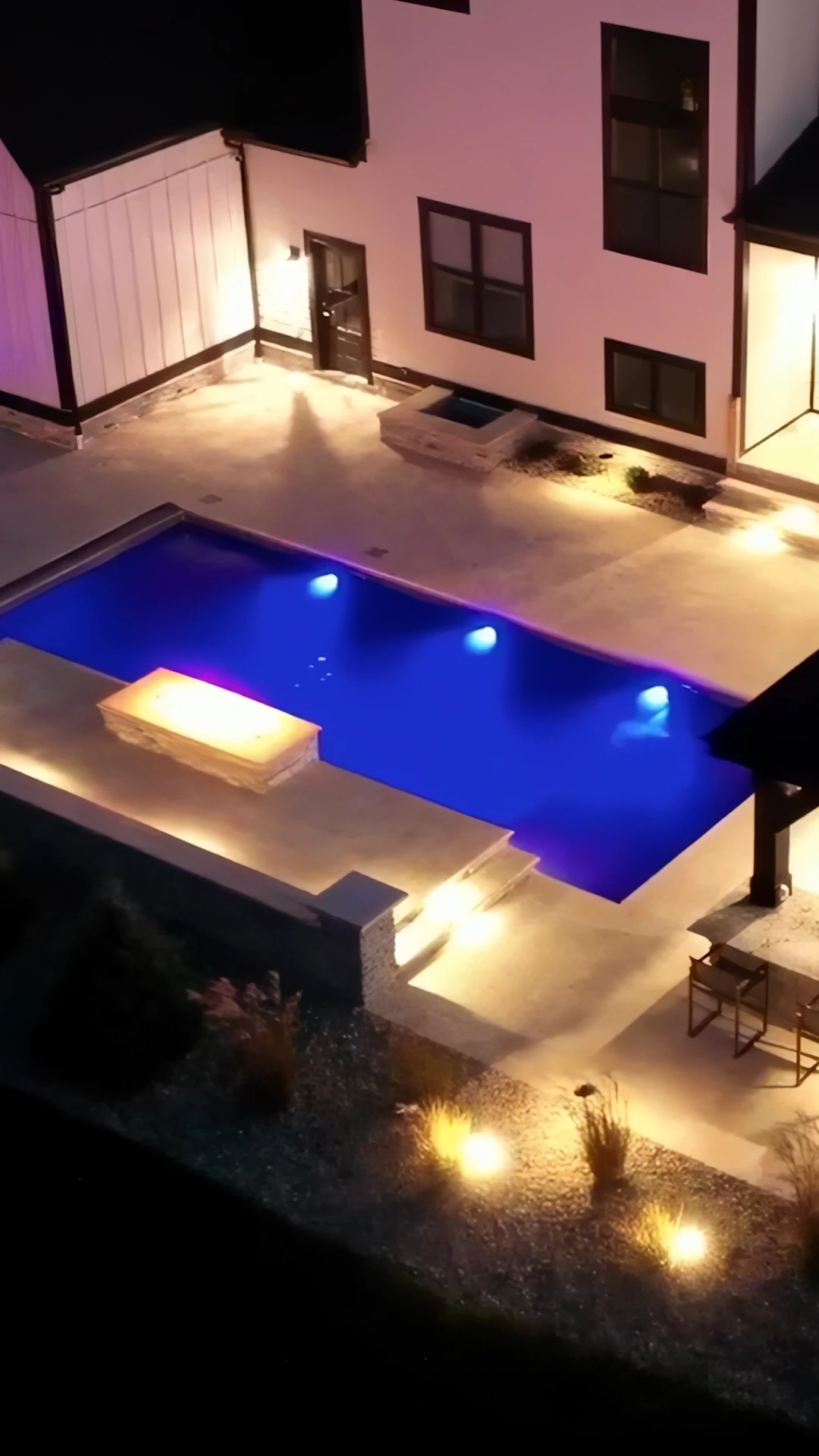
The structural side is serious. A grotto requires its own reinforced concrete shell, typically #5 rebar on 8-inch centers wrapped in a sprayed gunite envelope a minimum 8 inches thick, then faced in Tennessee fieldstone or regional granite. Underwater access through a submerged entrance is standard — the swimmer ducks under a 30-inch waterline transom and surfaces inside a quiet dry chamber. Lighting is interior LED on its own 12V transformer circuit so electrical permit inspection passes cleanly through Gwinnett Dept. of Planning & Development at 446 W. Crogan St.
Grottos add six to eight weeks to a build timeline because the gunite crew has to return for a second structural shoot after the main pool shell cures. They also restrict the pool’s skimmer placement — you cannot run skimmer circulation across the grotto entrance cleanly, so plumbing design has to pull the far-wall returns harder. A grotto on the standard 1/4 to 1 acre Suwanee lot is not a small decision; a grotto on a 1+ acre Laurel Springs estate lot is routine.
Grotto permitting note: Any covered pool chamber in Gwinnett County requires a separate structural review beyond the standard pool permit. Expect 3 additional weeks at plan review on top of normal pool turnaround, and a structural engineer’s stamped drawings showing the chamber shell calculations.
The signature Laurel Springs combo: 3 scuppers + 2 sheer descents
The most-requested Suwanee water feature configuration for the last four build seasons has been a 3-bowl scupper array paired with 2 linear sheer descents flanking a raised back wall. Total installed cost $16,000 to $28,000 depending on bowl selection, weir length, and wall cladding. The reason it works is acoustic layering: the scuppers supply mid-frequency arcing drum, the descents supply the low-frequency sheet, and the two together mask HVAC condenser noise, neighbor conversation, and Peachtree Industrial Blvd traffic from the rear setback.
On a Settles Bridge or Laurel Springs lot, the combo also hits a privacy-acoustic sweet spot. Measured at the seating area 14 feet from the back wall, the combined feature produces 8 to 12 dB of ambient masking — enough to functionally erase the kind of HOA-neighbor voice carry that open-lot Gwinnett backyards suffer from. That is a spec worth more than most homeowners realize when they are shopping features on price alone.
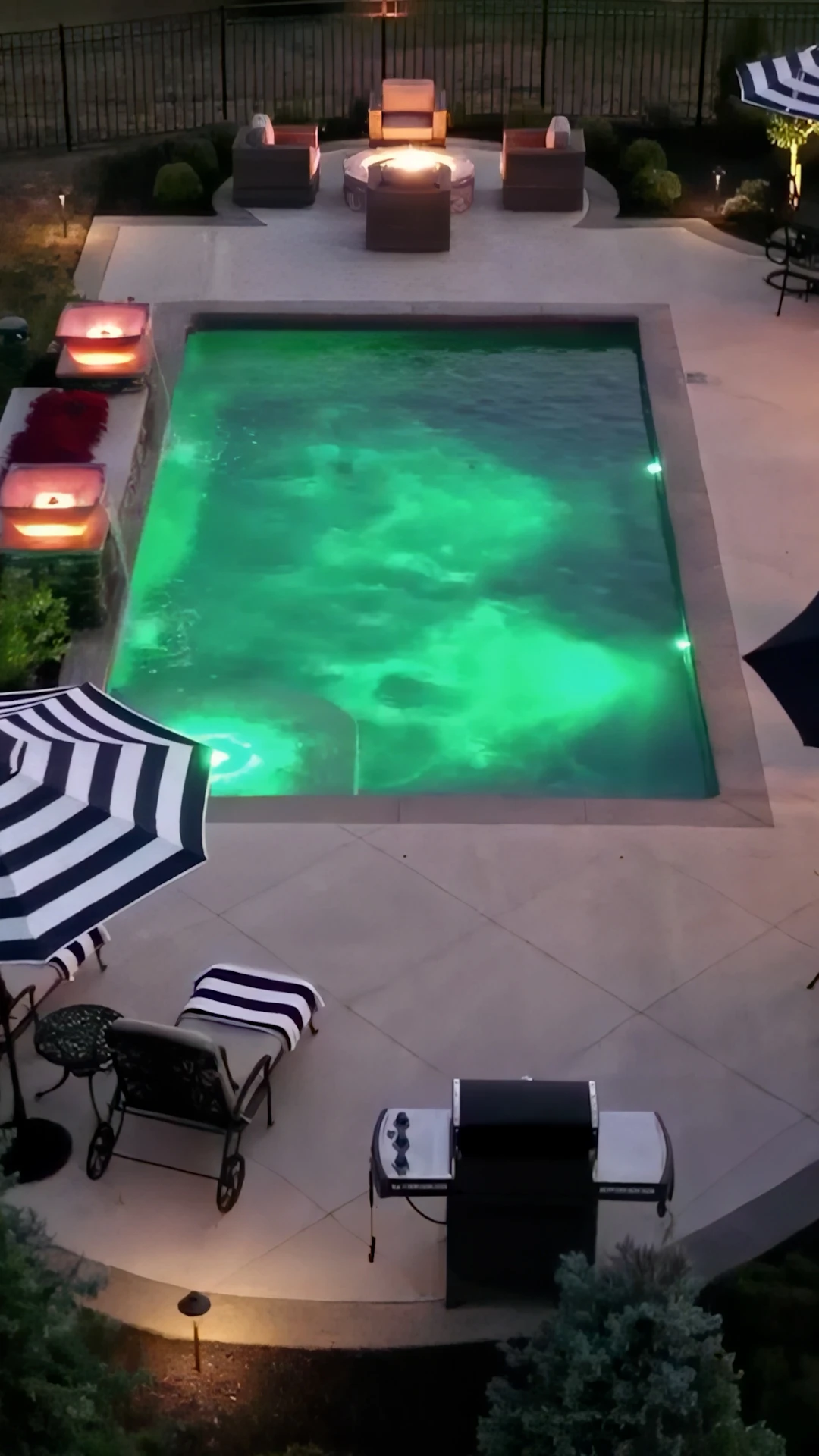
The plumbing side of the combo is a two-loop system. Loop one runs the scuppers at 15–20 GPM per bowl off a dedicated 3/4 HP booster; loop two runs the sheer descents at 40 GPM per foot off a second booster or a high-end VSF primary. Trying to feed both off a single pump is the mistake first-time installers make — the head pressure curves do not overlap, and you end up with descents that pulse and scuppers that dribble. Two pumps, two schedules, clean flow.
How Suwanee site conditions change the spec
Suwanee sits on Cecil series Piedmont clay — the same heavy red subsoil as Dacula and most of north Gwinnett — but lots closer to the Chattahoochee River on Settles Bridge and in River Club pick up sandy loam deposits that drain noticeably better. That matters for water feature foundations. A sheer descent wall set into clay needs a 42-inch deep footing with grade-beam reinforcement to resist frost heave across the 20 freeze events Suwanee averages per year; the same wall on riverfront sandy loam can sometimes go in on a shallower piered foundation.
Flood zone designation is the second site-specific call. Some Settles Bridge properties sit in FEMA Zone AE, where the base flood elevation limits how deep you can excavate for sub-grade pool equipment — and that limit can rule out a recirculating grotto pump vault that would normally sit below deck grade. On those lots we mount pumps and filters in an above-ground equipment pad screened behind fencing.
Elevation at Suwanee runs around 1,063 feet, which is high enough above the river to avoid most fog deposit on equipment — a real variable in Chattahoochee river fog country where copper fittings left exposed develop verdigris in 18 months. Above-grade equipment pads on 30024 lots want powder-coated galvanized enclosures, not raw steel frames.
Utility-side: Jackson EMC, not Georgia Power, delivers electric service to most of Suwanee. A water-feature-heavy pool with two booster pumps, a primary VSF, color-changing LED, and a grotto lighting circuit typically requires a 50-amp 240V subpanel at the equipment pad — and Jackson EMC’s service upgrade timeline runs 10–14 business days after the signed electrical permit, which is longer than Georgia Power’s typical turnaround. Bake that into the build schedule.
Decks, surrounds, and how the feature changes the hardscape budget
Every water feature in this post lives inside a hardscape envelope — and the hardscape cost scales with the feature. A scupper pier wall drags $180–$240 per linear foot of stacked-stone cladding into the budget. A sheer descent wall pulls the same cladding plus roughly $280 per linear foot of raised bond-beam structural work. A rain curtain requires an overhead pergola, beam, or steel header that adds $4,000–$12,000 to the hardscape line. A grotto adds its own structural envelope.
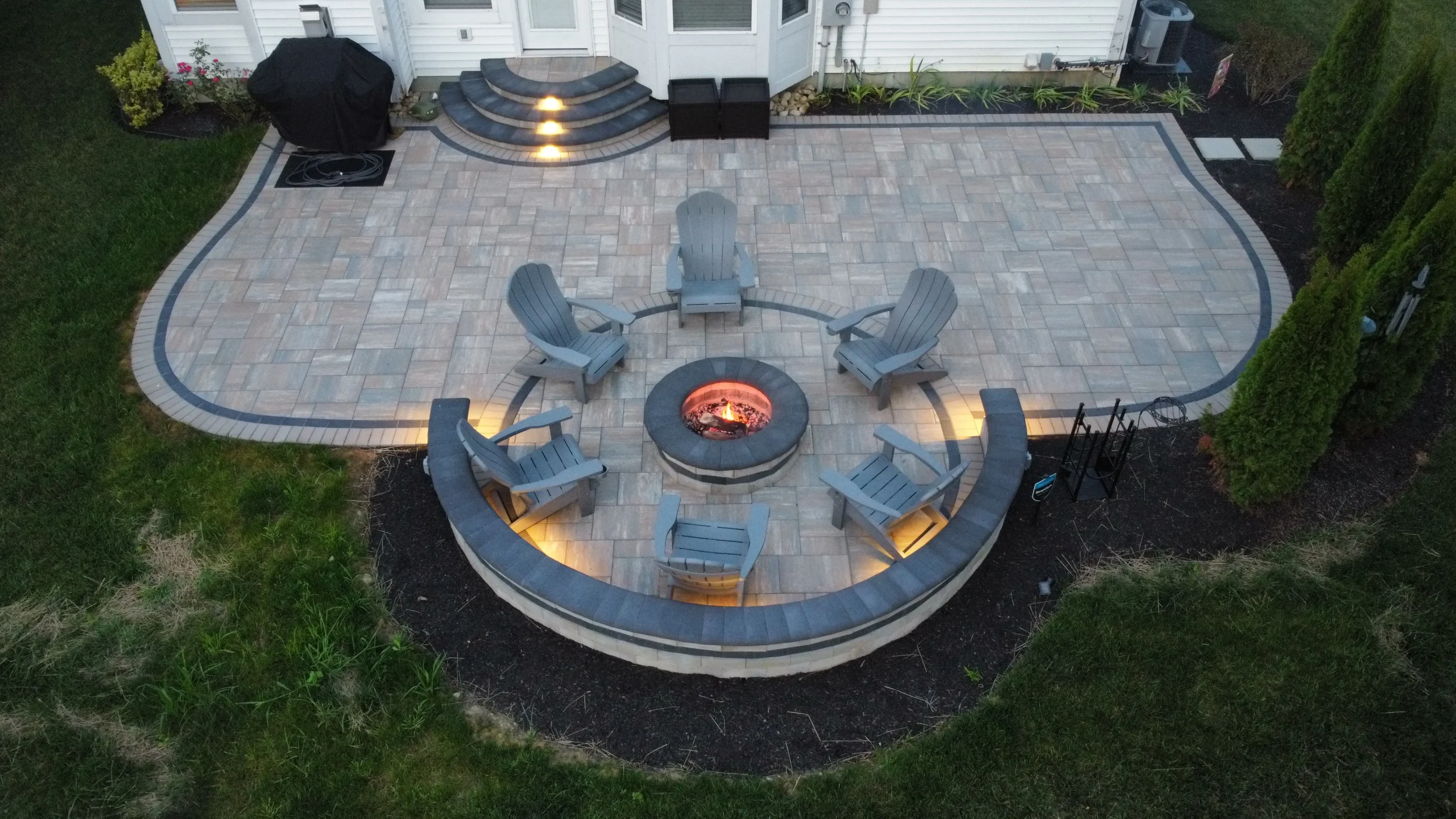
The deck material around the feature also matters. Cream travertine pavers at roughly $14 per square foot installed are the go-to around sheer descents because they read architectural, handle the constant splash without degrading, and hold thermal mass low enough for barefoot comfort at the 92°F peak summer decks. Flagstone with a brick soldier border — a classic Suwanee-and-north-Gwinnett tradition — works around scupper installations but is generally wrong around sheer descents because the irregular joints catch mineral scale from the higher flow rate and look bad inside 18 months.
Coping is a separate decision with water features. A scupper pier typically gets a cast-concrete cantilever coping that runs unbroken across the feature. A sheer descent wall needs a travertine or bluestone cap behind the weir to seat the stainless blade flat — and that cap has to be installed before the weir is plumbed, not after. Nearly every callback on sheer descent installations traces back to a weir retrofit onto an existing cap; they never run perfectly flat, and they drip.
The final hardscape variable is drainage. A rain curtain dropping 40 GPM of aerated water creates splash pattern 3 to 5 feet out from the drop line. That splash zone needs a slot drain or channel drain at the deck perimeter or the hardscape will mineral-stain in white calcium rings within a season. Channel drains run $85–$140 per linear foot installed and they are rarely budgeted for in a base-bid water feature scope.
For a Suwanee homeowner trying to pick from these four features on first build, the matrix is simple once price and sound get reconciled against the visual goal:
- Traditional two-story home, classical landscape, entertaining budget under $15,000: three scupper bowls on a symmetric pier array. Quiet, reconfigurable, low HOA friction.
- Modern home, contemporary architecture, feature budget $12,000–$25,000: two linear sheer descents off a raised back wall. Clean line, quieter than a rain curtain, serious architectural statement.
- Party house, rear-yard entertaining focus, budget $10,000–$15,000 and an existing pergola: 24-foot rain curtain with event valve. Loud and dramatic on demand, off for evening wine.
- Estate build, Laurel Springs or River Club scale, feature budget $25,000+: grotto cave plus either the signature 3-bowl/2-descent combo or both. This is where the full water-feature vocabulary gets used in one build.
The decision is not which feature is best. It is which feature is best for this elevation, this budget, this acoustic target, and this HOA process. A rain curtain at a Woodbury cottage is wrong; a rain curtain at a Bear’s Best Atlanta estate with a poolside pavilion is iconic. A grotto in a 1/4-acre starter lot swallows the yard; a grotto in a 2-acre River Club lot reads subtle. Start with the site and the sound, then back into the feature.
Everything above assumes the rest of the pool is engineered correctly — circulation turnover under 6 hours, variable-speed pumps on separate loops, 240V clean service, and structural footings matched to Cecil clay. Any water feature bolted onto an undersized plumbing plant will underperform no matter how much the bowl or weir cost. Plumb first, pick the feature second.
Custom pool water features across 20+ cities within 30 miles of Winder, GA
From three-bowl scupper arrays in Settles Bridge to grotto builds in Laurel Springs, Primetime Pools GA engineers the plumbing, acoustics, and hardscape envelope as one integrated system.