
The homeowner had already bought the stone. A palette of Tennessee fieldstone was sitting on her driveway in Walton Woods, and a Pinterest screenshot of a 6 ft wide by 10 ft tall chimney was taped to her kitchen island. What she didn’t have was a permit — and Cobb County wasn’t going to stamp the plan until three specific boxes got checked.
This is the story of that build. Not a generic overview of outdoor fireplaces. A courtyard fireplace on a sloped half-acre lot off Lower Roswell Road, the exact NFPA 211 compliance conversation we had with the plans examiner at 1150 Powder Springs St., and the line items that moved a $19,200 quote to a final invoice of $23,850. If you are planning the same project in East Cobb, this is the walk-through nobody gives you until you’ve paid a deposit.
The Marietta outdoor fireplace market behaves differently than the rest of Metro Atlanta. Cobb County Community Development enforces the 2018 International Residential Code with Georgia amendments, and the plans examiners have seen enough smoke-stained soffits and cracked refractory panels to know exactly where amateur masons cut corners. Clearances aren’t suggestions here. Chimney caps aren’t cosmetic. Every dimension on the drawing has to be defended.
Why Walton Woods Courtyards Push Fireplaces Tall
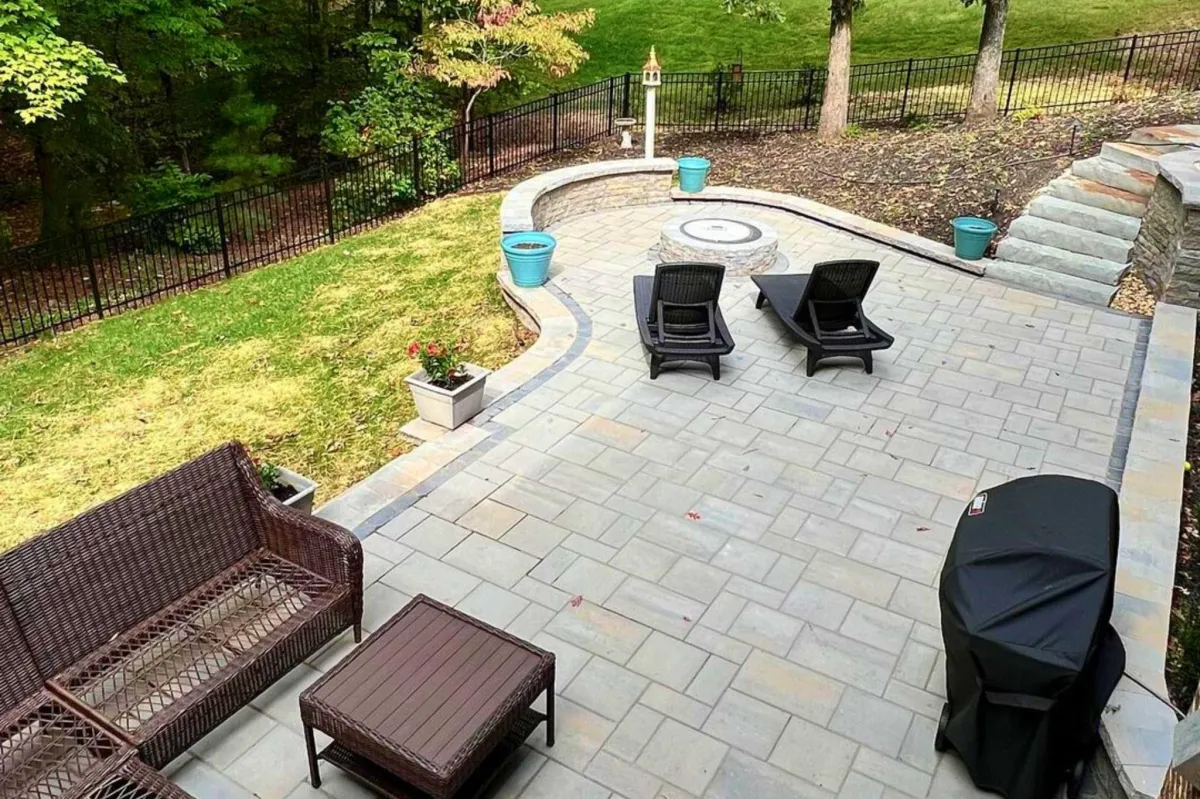
Walton Woods sits just east of Johnson Ferry Road in the 30068 zip code, a 1990s-era luxury subdivision with lots averaging 0.6 acres and homes in the 4,500 to 6,800 sq ft range. The backyards share a specific geometry: a paved rear courtyard flanked by two-story house wings that form a U-shape, with the open side pointing downhill toward a wooded rear buffer. It’s a beautiful shape for a fireplace. It’s also a code problem.
NFPA 211 Section 10.4 and the IRC R1003.9 companion rule require any masonry chimney to extend at least 2 ft higher than any portion of the building within 10 ft, and at minimum 3 ft above the highest point where it passes through the roof. In a courtyard, the “any portion of the building” isn’t the fireplace’s own back wall — it’s the adjacent two-story wing. Miss this by 8 inches and the Cobb inspector will fail the final.
The Walton Woods home had a 22 ft eave height on the west wing, 14 ft from the planned fireplace centerline. The fireplace wall itself was going to sit 8 ft off the house. Running the math: the chimney couldn’t stop at the originally-drawn 8 ft. It needed to climb past the 22 ft eave plus 2 ft, and then meet the 3 ft rule at the roof plane it intersected. That’s where the 10 ft chimney came from — not aesthetics, not Pinterest. Geometry plus code.
Wind patterns off Kennesaw Mountain’s 1,808 ft ridgeline also feed into this calculation. East Cobb sits in the mountain’s lee on prevailing westerlies, which creates downdraft rotors across taller rooflines during winter frontal passages. A chimney that barely clears the code minimum will smoke back into the courtyard every time a November cold front rolls through. We size chimneys in Marietta about 12 to 18 inches taller than the absolute code floor for this reason.
Walton Woods chimney height math: 22 ft west-wing eave + 2 ft clearance + 14 inches downdraft buffer = 25 ft 2 in from finished patio surface. With a 15 ft 2 in fireplace wall footing and hearth stack, the chimney itself works out to roughly 10 ft of exposed flue above the firebox shelf.
The Three Things the Cobb Inspector Checks First
Cobb County Community Development, headquartered at 1150 Powder Springs St., Marietta, runs a two-phase inspection process for outdoor masonry fireplaces: a footing/foundation inspection before the first block course goes down, and a rough masonry inspection before any veneer goes on. The plans examiner and the field inspector are different people. Both of them check the same three things.
One — refractory brick certification. The firebox has to be built from refractory brick meeting ASTM C-1261, not standard clay brick and not face brick. We invoice the brand and lot number on the submittal because Cobb asks for it. On the Walton Woods job, we specified Whitacre Greer 9×4.5×2.5 firebrick at 2,700°F rating, set in high-heat refractory mortar (Rutland 211 or equivalent). The inspector literally pulls out a sample brick from the stack and checks the manufacturer’s stamp. Cheap clay brick will not pass, even if the courses look perfect.
Two — flue liner dimensions and material. The IRC requires a listed clay tile flue liner or stainless-steel liner sized by firebox opening. For a 40 in wide by 30 in tall firebox opening (standard residential), the flue cross-section must be at least 1/10th of the firebox opening area. That math lands at 120 sq in minimum, which in a round liner is a 13 in diameter stainless or an 13×13 clay tile. We use Supaflu cast-in-place or ICC Excel Class A where a stack is being retrofit. On the Walton Woods build, we ran 13×13 clay tile straight up, pinned at every 36 in with stainless-steel spacers.
Three — chimney cap and spark arrestor. Cobb requires a listed cap per IRC R1003.9.2 with a spark arrestor screen of 19 gauge galvanized wire, openings no larger than 1/2 in and no smaller than 3/8 in. Custom copper caps are fine — we specify Improvement Direct 24 gauge copper or pre-fabricated Olde World Distributors mesh inserts — but the spec sheet has to be on the submittal. “Decorative stone cap” without a listed arrestor will be flagged at final.
The Permit Timeline From First Drawing to Final Inspection
Homeowners assume a fireplace permit is a one-week formality. In Marietta, it isn’t. The realistic window is 18 to 28 days from submittal to permit-in-hand, and we budget another 10 to 14 construction days on top of that for framing, footing, masonry, veneer, and final inspection.
The Cobb Community Development online portal accepts electronic plans, but the review queue runs 8 to 12 business days during normal load. We’ve seen it stretch to 16 days in April and October — the peak outdoor-construction seasons. Expect at least one plan-review comment: usually something about a missing detail on footing depth, a rebar schedule, or a mechanical connection between the firebox and the chimney stack. Responding to that comment resets the clock by another 3 to 5 business days.
The footing inspection is scheduled same-day or next-day after the online request. We pour a 36 in deep by 48 in wide reinforced footing (4 #5 bars each way, bottom and top) for any chimney over 7 ft. The frost line in Marietta’s 1,118 ft elevation is officially 6 inches, but Cobb code requires 12 inches minimum for structural footings — we go deeper because the Piedmont clay shrinks and swells with seasonal moisture and an 8,000 lb chimney doesn’t forgive differential settlement.
The rough masonry inspection happens before veneer goes on. The inspector wants to see: firebox refractory complete, flue liner stacked and pinned, smoke chamber parged, damper installed and functioning, chimney framing complete with all through-roof flashing in place if the chimney passes through any structure. We schedule this inspection 48 hours in advance because same-day availability after 2 p.m. is rare.
Typical Marietta outdoor fireplace permit timeline:
Day 1: Submit plans via online portal · Day 8-12: Plan review comment returns · Day 14-18: Permit issued · Day 19-22: Footing pour + inspection · Day 23-28: Block core, firebox, flue · Day 29-31: Rough masonry inspection · Day 32-38: Veneer + cap · Day 40: Final inspection
What $16,400 Buys vs. What $24,800 Buys
Marietta outdoor fireplace pricing breaks into three tiers, and Walton Woods lands near the top of the middle band. Here’s how the money actually moves.
Entry tier — $16,400 to $18,900. This is a 4 ft wide by 7 ft tall prefab-insert fireplace on a simple slab extension. Isokern Magnum 28 modular firebox, minimal stone veneer (usually Cultured Stone or Eldorado manufactured veneer), single-flue chimney, standard galvanized cap. This pricing assumes no courtyard geometry complications and a chimney under 8 ft — which means it meets code on a single-story lot, not a two-story home wing. Most Marietta lots don’t qualify at this tier.
Mid tier — $19,200 to $22,400. Custom-built firebox with ASTM C-1261 brick, 8-10 ft chimney, real stone veneer (Tennessee fieldstone, Pennsylvania bluestone, or Chattahoochee river rock), listed copper or stainless cap, and dedicated footing engineering for chimneys over 7 ft. This is the range for most Burnt Hickory, Indian Hills, and Walton Woods homes. The Walton Woods project opened at $19,200.
Top tier — $24,800 to $36,000+. Full custom masonry with raised hearth, gas log starter line, integrated wood storage boxes, stone mantle carved on-site, copper flashing details, and sometimes a matching pizza-oven stack. Atlanta Country Club and Marietta Country Club jobs routinely land here. Chimney heights of 12 to 14 ft are common because of steeper rooflines on those lots.
The Walton Woods build crossed from $19,200 to $23,850 through four line items: upgrade from manufactured veneer to Tennessee fieldstone ($2,100), add gas log starter with dedicated 1/2 in CSST line from the meter ($1,450), upgrade cap from galvanized to 24 oz copper ($640), and upgrade chimney height from 8 ft to 10 ft to clear the west-wing eave ($460). None of these were upsells in the slimy sense. Three of them were code-driven.
The East Cobb Soil and Utility Details Nobody Mentions
Two details specific to East Cobb change how we price and build Marietta fireplaces: soil conditions and the utility service mix.
Soil. The Piedmont red clay on most of Cobb County (Cecil series, if you want the USDA soil map term) shrinks and swells with moisture cycles. A fireplace foundation that doesn’t key into stable subgrade will telegraph hairline cracks up through the veneer within 18 months. We core-sample every Walton Woods-style job before pricing. On this build we hit decomposed granite at 42 inches — ideal bearing — and poured the footing keyed 4 inches into it. On a neighboring Indian Hills job the previous spring, we hit granite bedrock at 28 inches and had to pneumatic-chip a bearing shelf, which adds $800 to $1,400 depending on the depth spread.
East Cobb pockets along the Chattahoochee River corridor and Sope Creek drainage have better-draining sandy-loam inclusions, which actually helps footing stability but reduces lateral bearing strength. We up-size the footing width 6 inches on those lots and add 2 additional #5 bars in the top mat.
Utilities. Marietta has a split electrical service map that catches homeowners off guard. Cobb EMC serves most of the unincorporated East Cobb zone (30067, 30068, parts of 30062). Marietta Power (a city-owned utility) serves incorporated Marietta (30060, 30064, parts of 30066). If your fireplace includes landscape lighting, an outlet for a rotisserie attachment, or an integrated fan-assisted flue draft system, the pre-wiring runs off different service points with different inspection departments. The Walton Woods address sits inside Cobb EMC’s territory, so our electrical sub coordinated with Cobb EMC’s inspector for the 20A GFCI outlet tap on the fireplace’s east flank.
Gas service is simpler — Atlanta Gas Light handles the whole metro — but the CSST line from the meter to the firebox has to be sized by BTU load. A gas log starter pulls roughly 15,000 BTU/hr. A full gas-burning system runs 45,000 to 75,000 BTU/hr. The Walton Woods build used a starter-only configuration with a 1/2 in CSST run of 38 ft from the side-yard meter, which meets the pressure-drop tables in NFPA 54.
Clearances, Combustibles, and the Things That Fail Final Inspection
The failure patterns on Marietta outdoor fireplace finals are predictable. We’ve sat in enough post-fail meetings at 1150 Powder Springs St. to know the top five.
Failure one — combustible clearance violations. IRC R1001.11 requires 6 inches between the firebox opening and any combustible trim (wood mantles, pergola posts, cedar shake siding). Builders miss this on the mantle detail constantly — installing a reclaimed oak beam 4 inches off the opening because “it looks right.” It doesn’t pass. On the Walton Woods job we framed the mantle corbel 8 inches clear with a stainless spacer detail and got a clean check.
Failure two — hearth extension math. The hearth must extend at least 16 inches forward of the firebox opening if the opening is less than 6 sq ft, and 20 inches if 6 sq ft or more. It must also extend 8 inches past each side of the opening. Walton Woods had a 40×30 opening (8.3 sq ft), which triggered the 20-inch rule. We ran 22 inches to give margin.
Failure three — uncertified damper. The damper has to be listed and sealed closed with a gasket when not in use. Shop-fabricated throat dampers without a UL listing get flagged. We specify Lyemance top-sealing dampers on every Cobb job because they double as animal guards and pass inspection every time.
Failure four — smoke chamber slope. The smoke chamber walls must slope inward at 45 degrees or less, and must be parged smooth with refractory mortar. Ugly trowel work inside the smoke chamber sends you back to the plans examiner. We parge with Heat Stop II and let the inspector stick a mirror up to confirm smooth finish.
Failure five — missing chimney flashing at through-roof penetrations. On courtyard fireplaces that tuck close to a rear roofline, the chimney sometimes passes through an overhang. This triggers IRC R905 flashing requirements with step flashing, cricket if over 30 inches wide, and counter-flashing. Walton Woods sat 8 ft off the house, so we avoided this entirely — but a Brookstone job earlier in the season needed a 48 in wide cricket because the chimney clipped the rear gable overhang.
Quick clearance reference for Marietta outdoor masonry fireplaces:
Firebox opening to combustible trim: 6 in minimum · Hearth forward extension: 16-20 in per opening area · Hearth side extension: 8 in past opening · Chimney above any roof within 10 ft: 2 ft minimum · Chimney above penetration roof plane: 3 ft minimum · Spark arrestor mesh: 3/8 to 1/2 in openings · Damper: UL listed, gasketed
The Walton Woods Final — What Actually Got Built
The finished Walton Woods courtyard fireplace is 6 ft wide at the firebox shoulders, 10 ft tall at the cap, set 8 ft off the west wing of the house and oriented 22 degrees east of due north to minimize backdraft during dominant westerly winter winds. The veneer is Tennessee fieldstone in a random-range pattern, mortared with Type S dyed to match the existing home veneer. The firebox is Whitacre Greer C-1261 refractory brick, the flue is 13×13 clay tile, the cap is 24 oz copper with an Olde World stainless mesh arrestor. The hearth is Pennsylvania bluestone, 22 inches deep.
Final invoice was $23,850. The permit cleared on day 17, footing poured day 21, rough masonry passed day 32, final signed off day 41. The homeowner hosted her first outdoor dinner on the courtyard on the 44th day — a late-October Friday when the thermometer dropped to 46 degrees at sunset and the fire drew cleanly without a single puff of smoke rolling back into the courtyard.
That clean draw isn’t luck. It’s the 14 inches of extra chimney height we added for the Kennesaw Mountain lee-wind pattern. The properly-sized 13×13 flue for an 8.3 sq ft firebox opening. The 45-degree smoke chamber parged with Heat Stop II. The gasket-sealed Lyemance damper. These aren’t aesthetic decisions. They’re the difference between a fireplace that works every night for the next 30 years and a fireplace that becomes a smoke-stained regret by the second winter.
Planning Your Own Cobb County Outdoor Fireplace
If you are in Indian Hills, Burnt Hickory, Atlanta Country Club, Brookstone, Chestnut Hill, Seven Oaks, Sope Creek, Willeo Creek, or anywhere else in the 30060-30068 zip code band, the Walton Woods template is worth studying even if your yard geometry is different. Three things carry over to every Marietta build.
One: Get the chimney height right on paper before you break ground. The 2 ft / 10 ft rule plus downdraft buffer is the single most-violated spec in this county. Measure your tallest nearby roofline — then add the buffer. A chimney that has to be extended after the fact costs two to three times what it costs to build tall from the start.
Two: Spec every material by brand and ASTM/UL listing before submittal. Vague plans get returned for comment. Plans that list Whitacre Greer refractory, Supaflu or clay tile flue, Lyemance damper, and a listed cap get approved on first pass. This alone saves 5 to 8 days of the permit timeline.
Three: Price the soil investigation into the project. A core sample or two test pits costs $400 to $800. Finding bedrock at 28 inches when you expected decomposed granite at 60 inches mid-excavation costs $1,200 to $2,200 in added pneumatic work plus schedule slip. Know what’s under your courtyard before the mason shows up.
Cobb County isn’t the hardest permit jurisdiction in Metro Atlanta, but it’s the most specific. The inspectors know this product category cold, and they don’t negotiate. The upside: a fireplace that clears Cobb’s final has already passed every code that matters, and a chimney designed for East Cobb’s Kennesaw Mountain lee-wind pattern will draw cleanly in any Piedmont county you move to next.
Outdoor fireplace design and permitting across 20+ cities within 30 miles of Winder, GA
From Walton Woods chimney math to Atlanta Country Club custom hearths, we design and build every Marietta outdoor fireplace to clear Cobb’s inspection the first time — ASTM refractory, listed caps, and the chimney height Kennesaw Mountain actually demands.