
A homeowner in Indian Hills called after three different contractors quoted his outdoor kitchen base. One said $42 per square foot for cultured veneer. Another said $128 per square foot for natural granite ashlar. The third split the difference and left him more confused than before — because none of them explained which material his actual house, his actual lot, and his actual HOA would accept for the next forty years.
That is the problem with outdoor kitchen base construction in Marietta. The photo-driven search results show every kitchen looking roughly the same — stacked stone, slab counter, stainless grill, done. But the base material underneath those counters is where a $24,000 project becomes a $54,000 project, where a resale-neutral upgrade becomes a resale-negative one, and where Cobb County HOA review letters show up eighteen months after the pour.
This post is the decision framework. Which base material Marietta homeowners should choose, when cultured stone veneer is the right call, when natural granite ashlar is the only thing that will survive your neighborhood’s design covenants, and the specific dollar, durability, and appearance tradeoffs that separate the two. The Cobb County permit office doesn’t care which one you pick. Your HOA architectural review committee almost certainly does.
Why This Decision Drives Half the Kitchen Budget in Marietta
An outdoor kitchen in Marietta runs in three parts. The appliances — grill, side burner, refrigerator, drawers — typically come to $8,000 to $18,000 depending on whether the homeowner picks a Weber Summit S-460, a Lynx 42-inch built-in, or the Kalamazoo Hybrid Fire Grill that Atlanta Country Club homeowners seem to gravitate toward. The countertop — slab granite, leathered soapstone, or thick porcelain — runs $62 to $140 per square foot installed. And the base — the structure that holds up the grill, wraps the appliance bay, and presents the face of the kitchen to the pool deck — runs the widest spread of any line item.
That base number is where the entire project’s visual identity lives. A cultured stone veneer base on a $42 to $58 per square foot face will deliver a clean, finished, contemporary look that photographs well and holds up for 40 years in Cobb County’s climate. A natural granite ashlar base at $88 to $128 per square foot face will deliver a weight, depth, and shadow-line quality that reads as estate-grade even from the upper deck of a two-story East Cobb traditional.
Both materials work. Both are appropriate somewhere in Marietta. The question is where, and the honest answer is that your neighborhood decides more of this than your budget does. The homeowner who called from Indian Hills eventually went with cultured veneer because his HOA’s design standards specifically referenced it. The Atlanta Country Club homeowner we wrapped up last September specced natural granite ashlar because the neighborhood’s architectural covenants require natural materials on any structure visible from a primary elevation.
Base cost share of total kitchen budget: On a typical Marietta outdoor kitchen running $32,000 to $68,000 installed, the base alone accounts for 22% to 41% of total cost depending on material choice. Appliances are a narrower band (18-28%). Countertop is usually 14-22%. Plumbing, gas, and Cobb EMC 240V electrical run 10-18%.
The Comparison Grid — Cultured Veneer vs Natural Granite Ashlar
This is the side-by-side most homeowners wish they had before the first quote came in. Costs reflect current 2026 Marietta install pricing for the kitchen base only — appliances, countertop, plumbing, gas, and electrical are separate line items. Expect roughly 7-9% year-over-year material inflation on natural stone and about 3-4% on cultured.
Where Cultured Veneer Is the Right Choice in Marietta
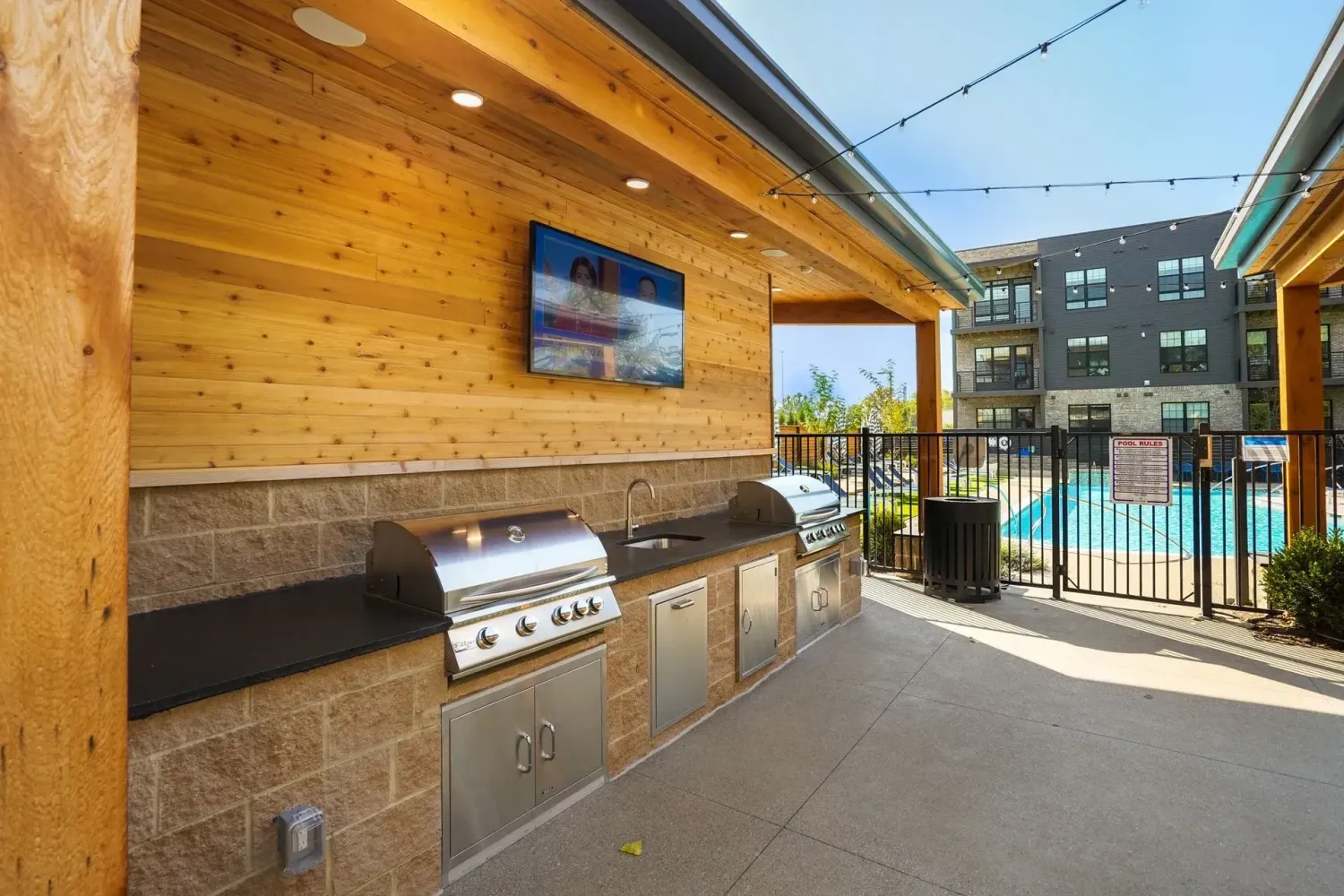
The best cultured veneer outcomes we build in Cobb County share a profile. The home sits in a 1990s to 2010s subdivision with contemporary transitional or craftsman-style architecture. The HOA’s design standards mention “manufactured stone” or “cast stone veneer” in the approved materials list. The homeowner is targeting a kitchen that complements the pool deck without dominating it, and the house itself has stucco, hardie, or brick elevations rather than full natural-stone facades.
In that profile, cultured veneer delivers a specific set of wins. The lighter weight means the footing doesn’t have to be engineered for the kind of load a natural stone wall requires — which matters because Marietta’s Cecil-series red clay shrinks and swells more than the Atlanta-standard Piedmont average. A 42-pound-per-square-foot natural stone base on an un-engineered pad will telegraph that movement in the mortar joints within about eighteen seasons. A 10-pound-per-square-foot cultured veneer is forgiving of the same subgrade movement.
The second win is color stability and repairability. Boral and Eldorado both still stock color matches for lines they introduced in 2008. Natural stone doesn’t work that way — match a quarry-cut Tennessee fieldstone ten years after the original run and you’ll see a color seam from twelve feet away. The third win is appliance clearance. Cultured veneer can be built thinner on the face, which means the CMU core can be sized tighter to the grill cutout without stealing valuable bar-overhang counter depth.
Subdivisions Where We Spec Cultured By Default
Indian Hills, Brookstone, Chestnut Hill, Seven Oaks, Walton Woods, most Burnt Hickory corridor subdivisions, and the newer Sope Creek infill developments. In each of these, cultured veneer is the HOA norm, the architectural transition is clean, and the cost delta against natural stone would not be recoverable at resale.
Where Natural Granite Ashlar Is Non-Negotiable
Then there are the Marietta neighborhoods where natural granite is the only answer that will clear the architectural review committee on the first pass. Atlanta Country Club is the clearest case — the community’s design covenants reference “natural materials matching primary residence” on any exterior structural element visible from a primary elevation. Same for select sections of Marietta Country Club, the estate sections of Indian Hills backing onto the golf course, and a handful of the Willeo Creek and Sope Creek custom-home properties on lots above two acres.
On those properties, the cost math also inverts. On a $1.6M to $3.2M home, spending $28,000 on a granite ashlar base instead of $11,000 on cultured veneer isn’t an upgrade — it’s baseline compliance with the neighborhood’s architectural center of gravity. The resale appraisal picks up nearly the full delta. And the kitchen reads as a deliberate extension of the house rather than a retrofitted feature that happened to land on the back patio.
Natural granite ashlar also behaves differently at the scale of a large kitchen. A U-shape or L-shape kitchen over about 14 linear feet starts to reveal cultured veneer’s visual repeat — the molds used in manufacturing only have so many unique stone faces, and the eye picks up the pattern at distance. Natural stone has no repeat. Every stone is individually shaped. On a 22-foot kitchen wrapping a Kalamazoo grill, a Lynx Professional side burner, and a 72-inch refrigerator drawer tower, natural stone is what keeps the wall from reading as mass-produced.
How to Read Your HOA Covenant Before You Quote
Pull the architectural standards document — most Marietta HOAs have a 40-80 page CC&R supplement that lives behind the first-page declaration. Search for the terms “veneer,” “manufactured stone,” “cultured stone,” “cast stone,” and “natural stone.” If your covenant explicitly approves manufactured or cultured stone, you’re cleared for veneer. If it specifies “natural materials matching primary residence,” you’re not. The Cobb County Community Development permit office at 1150 Powder Springs Street will issue a permit either way — the HOA is where the actual enforcement happens, usually 4-12 months after install, via a compliance letter.
The Build Details That Matter More Than the Material Choice
One of the quiet truths of outdoor kitchen construction is that the base material is only as durable as the structure behind it. We have repaired cultured veneer bases built on bare sand-fill that delaminated in year three, and we have repaired natural granite ashlar that popped mortar joints in year six because the installing contractor didn’t pin the stone to the CMU core properly. The material is never the whole story.
On any outdoor kitchen base in Marietta, the core structure should be 8-inch reinforced CMU block, filled with grout at every cell containing vertical rebar, set on a footing sized for the base’s actual weight. For cultured veneer, that footing can be a continuous 12-inch-wide by 8-inch-deep reinforced strip. For natural granite ashlar, we spec a 24-inch-wide by 12-inch-deep footing with #4 rebar mat and a minimum 24-inch frost depth given Marietta’s 22 freeze events per year.
The scratch coat behind cultured veneer must be metal-lathed, with a minimum 3/4-inch thickness, screened flat before the mortar bed goes on. Skip the lath and the veneer will shear off in five years. On natural stone, the mortar joints need weepholes every 32 inches at grade so any water that migrates behind the wall has a path out. Without weepholes, freeze cycles will blow the mortar joints from the inside out.
The appliance cutouts also dictate a different build. A Kalamazoo Hybrid Fire Grill needs 6 inches of clearance on each side to combustible material — which both cultured and natural stone qualify as non-combustible, but the CMU core behind them must not be continuous across the cutout. We cut the top three courses of block where the grill lands and frame the opening with steel angle, then wrap the interior with mineral wool insulation rated to 2000°F.
The base spec language to put in your contract: “8-inch grouted CMU core, continuous vertical #4 rebar at 32 inches on center, footing sized for dead load plus appliance point load, minimum 24-inch frost depth, metal lath scratch coat on veneer applications, weepholes every 32 inches on mortared natural stone.” Without this language, you are at the mercy of whatever the installing crew decides to do the morning of the pour.
Cobb EMC 240V Service and Why It Affects the Base Plan
One Marietta-specific wrinkle. Outdoor kitchens with electric refrigeration, ice makers, or rotisserie motors need a dedicated 240V circuit, and Marietta homes served by Cobb EMC pull that circuit from a different panel configuration than Georgia Power homes. The electrical run typically enters the kitchen base at the appliance-bay side, not the grill side, which means the CMU core has to include a conduit sweep from grade level up to the appliance box. Missing that sweep at the base-build stage means a surface-mount conduit scar across the finished veneer later. Cobb EMC’s standard service drop to residential pools and kitchens is different from the Marietta Power equivalent for city residents — confirm which utility serves the lot before laying out the base.
What We Actually Recommend, Marietta Lot by Marietta Lot
After fifteen years of building outdoor kitchens across Cobb County, the recommendation pattern has gotten clearer. We tell Indian Hills homeowners to spec cultured veneer unless they are inside the estate-section covenants, in which case we price both and let them see the delta. We tell Atlanta Country Club homeowners to spec natural granite ashlar and build the footing to carry it. We tell Brookstone, Chestnut Hill, and Seven Oaks homeowners that cultured will photograph beautifully, age 40 years, and hold its resale weight — no need to reach for natural unless they specifically want that look.
For the Willeo Creek and Sope Creek custom-home corridor, it depends on the house. A modern transitional with stucco and hardie — cultured. A brick traditional with a full stone water-table — natural. A contemporary with corten steel accents and flat roof — honestly, consider concrete or porcelain slab rather than either veneer or natural.
And for the older Burnt Hickory and East Cobb ranch homes from the 1960s-1980s that are getting backyard pool and kitchen installs now, cultured veneer gives the best return. The house itself has modest material elevations, the kitchen is usually under 14 linear feet, the mature oak and poplar canopy shades the kitchen most of the day — which means even the natural-stone color cues get lost in green light anyway. Cultured reads cleaner in that lighting and costs half as much.
The Decision Tree in Three Questions
Ask three questions and the answer usually writes itself. First, does the house have any natural stone on a primary elevation? If yes, lean natural. If no, lean cultured. Second, does the HOA covenant language mention “natural materials” or “matching primary residence”? If yes, natural. If no and cultured is listed as approved, cultured. Third, is the kitchen run longer than 16 linear feet? If yes, the visual repeat of cultured veneer starts to show and natural is worth the upcharge. If no, cultured performs at every metric that matters on a reasonable-sized kitchen.
Budget Reality Checks for Both Paths
A typical 10-linear-foot L-shape outdoor kitchen with cultured veneer base, 3cm leathered soapstone counter, 36-inch built-in grill, side burner, two drawer stacks, and a 24-inch refrigerator runs $34,000 to $46,000 installed in Marietta, gas and electrical included, without pavilion or pergola overhead cover. The same kitchen with natural granite ashlar base and a slab-granite or thick-porcelain counter runs $48,000 to $68,000. Add a freestanding timber-frame pavilion over the kitchen and add another $24,000 to $42,000.
The Cobb EMC or Marietta Power 240V service drop, gas line extension from the house meter, and permit fees add $2,200 to $4,800 depending on lot distance from the panel and meter. Cobb County Community Development permit fees for the kitchen alone run $140 to $280, issued through the same office at 1150 Powder Springs that handles pool permits. If the kitchen is tied into a pool permit, they can be combined on one application and one inspection cycle.
One final budget note Marietta homeowners rarely see coming. If the kitchen sits on a lot with mountainside exposure toward Kennesaw Mountain, wind loads on any pavilion or pergola built over the kitchen jump about 12-18% above flat-lot equivalents. The base material choice doesn’t change — the structural connection between the pavilion posts and the kitchen base does. On exposed Burnt Hickory and Kennesaw-adjacent lots, we core-drill and epoxy-anchor the pavilion posts directly into the CMU core of the kitchen base rather than into the deck slab. That hardware adds roughly $800 to $1,400 to the total package but removes the single most common warranty call on Marietta outdoor kitchens — pavilion uplift pulling the roof off in a summer thunderstorm.
And for the resale question most Marietta homeowners don’t ask out loud — on a five-year hold, the natural granite ashlar base is the clear winner on any home priced above $1.2M at listing. On a ten-plus-year hold, cultured veneer closes most of the gap because both materials will be in good shape and the appraiser is looking at condition more than pedigree. Under three years, neither upgrade recovers fully — which is the honest answer nobody wants to hear and the answer we give every homeowner who asks whether to build the kitchen at all versus selling the house next spring.
Outdoor kitchen design and construction across 20+ cities within 30 miles of Winder, GA
The veneer vs. granite decision is a tiny fraction of the overall kitchen design — but it is the decision that most determines how the finished kitchen reads in your Marietta backyard for the next four decades. We build both, and we tell homeowners straight which one fits their house and their neighborhood.