
Your Dawsonville pool deck sits at 1,270 feet of elevation and absorbs roughly 30 freeze events every year. That’s the single fact that kills more travertine decks in Dawson County than anything a salesman will ever admit in the showroom.
We get the call every March. A homeowner in Foxcreek or Riverbend bought a travertine deck in 2019 because a different contractor sold them on “Mediterranean luxury” and the cooler foot-feel in August. Six summers and roughly 180 freeze-thaw cycles later, the joints are gapping a quarter-inch, polymeric sand is blowing out in every windy front, and one corner near the spa overflow is starting to lift where moisture got under a pitted stone and froze.
The homeowner isn’t crazy. Travertine is a beautiful material. It is cooler underfoot. And in Buckhead, Alpharetta, or most of Dacula at 950 feet, it holds up fine. But Dawsonville is not Buckhead. The city sits on the North-Georgia foothills on the USDA Zone 7b/8a border, and the engineering math behind pool decks changes the minute you cross into real cold country.
This post is not a generic rundown of deck materials. It’s one comparison, one climate, one final recommendation — Techo-Bloc Industria in driftwood-gray at $22–$28 per installed square foot — with the numbers that got us there.
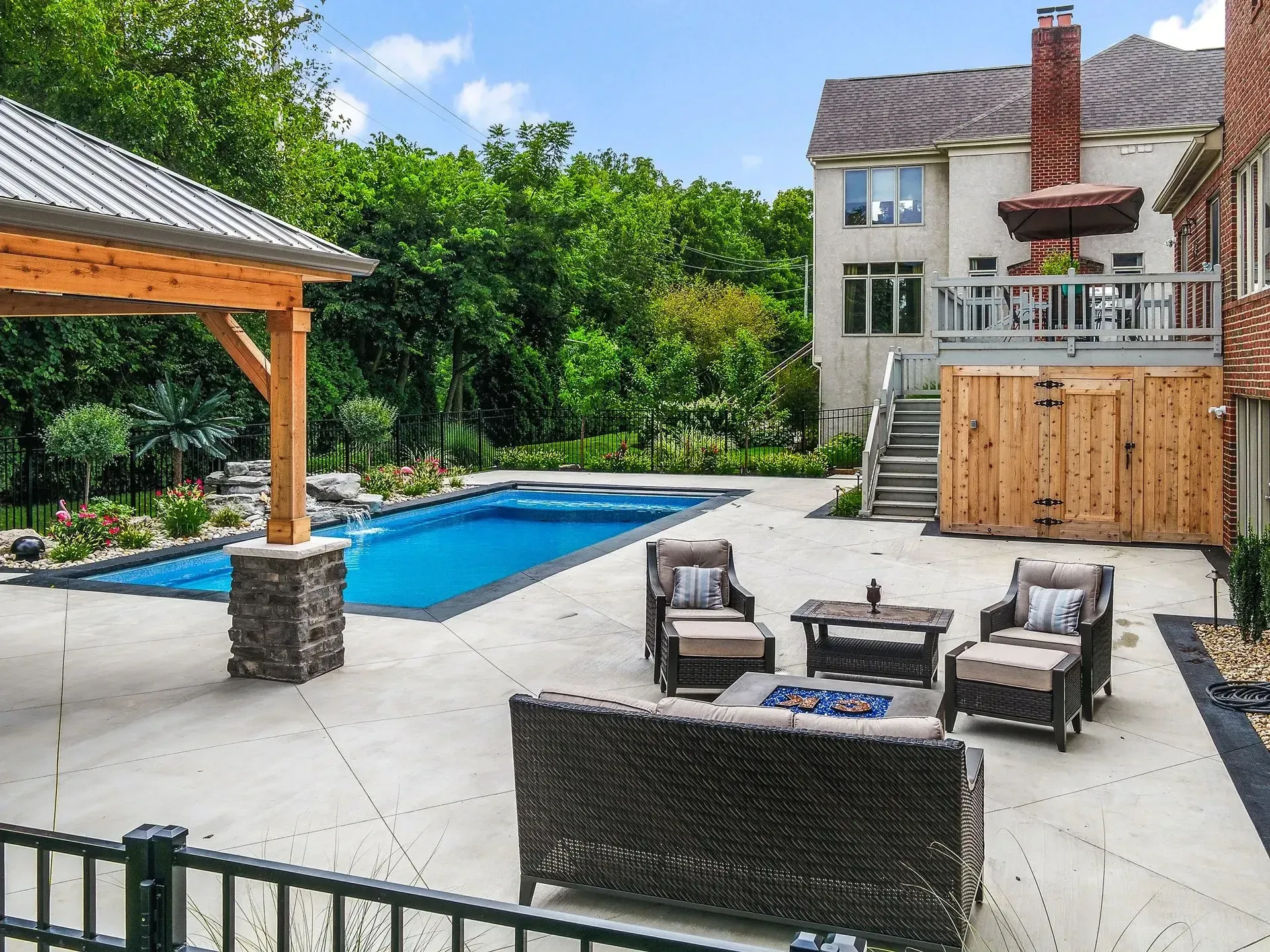
The 30-Freeze Reality — Why Elevation Actually Changes the Spec
Dawsonville gets roughly 30 nights per year where air temperature drops below 32°F. Dacula, sitting at 950 feet, gets about 20. That ten-event delta doesn’t sound like much until you translate it into deck material failure.
Freeze-thaw damage isn’t about air temperature. It’s about water that has already soaked into a porous surface, expanded 9% as it turned to ice, and pushed outward on whatever pore structure is holding it. Do that ten extra times every winter for the 25-year expected life of a deck and you’re asking the material for 250 additional expansion cycles that the Atlanta Piedmont never sees.
Travertine’s native porosity is around 6–10% by volume. Techo-Bloc’s Industria paver, a high-density architectural concrete unit, runs closer to 4.5%. That gap — less than half a percentage point feels trivial on paper — is the entire ballgame when you multiply it by 750 freeze cycles over the deck’s life.
At Amicalola Falls, fifteen minutes north of town, rangers will tell you the freeze line tracks a full USDA zone colder than downtown Cumming. Dawsonville sits on the warmer edge of that pattern but still feels it. Any deck material you spec for a Dawson County home needs to be rated for the harsher end of its published range, not the middle.
There’s a second wrinkle most homeowners never hear. Elevation also changes how fast a surface dries after a freezing rain event. At 1,270 feet, the ambient dew point on a clear winter morning runs several degrees lower than it does down in Lawrenceville. Lower dew point means faster surface evaporation — but only from the top skin of the stone. The water that has already wicked 3 to 5 millimeters into travertine overnight doesn’t evaporate out on the morning of the freeze. It freezes in place. That’s why a deck in Chestatee at 1,300 feet will pit faster than the exact same deck installed in a 900-foot neighborhood fifteen miles south, even though both technically fall inside “North Georgia.”
The freeze-cycle math: 30 freeze events per year × 25-year deck life = 750 total freeze-thaw cycles. Travertine is rated for roughly 500 cycles before visible pitting begins. Techo-Bloc Industria is rated past 1,000.
Thermal Expansion — The Number Nobody Puts on the Sample Board
Travertine and architectural concrete pavers expand and contract at different rates when temperature swings. For Dawsonville — where we can see a 45-degree diurnal swing on a clear March day — that difference shows up in the joints before it shows up anywhere else.
Travertine’s coefficient of thermal expansion runs around 0.08 inches per 100 linear feet per 10°F. Techo-Bloc’s published figure for their architectural concrete line is closer to 0.05. On a 40-foot-long pool deck running east-west, a 50-degree temperature swing will open travertine joints about 1.5 times wider than Industria joints — every single day the sun comes up.
What does that actually do? It pumps the polymeric sand in the joint. Up, down, up, down. Every thermal cycle is a miniature bellows that loosens sand grains at the top of the joint until a windy thunderstorm — and Dawsonville gets plenty of mountain-pattern thunderstorms, roughly 55 inches of rainfall a year — carries them into the skimmer basket.
The practical result: a travertine deck in Foxcreek or Mountain Laurel needs polymeric sand touch-up every 3–4 years. The same deck built in Techo-Bloc Industria holds its joint sand 6–8 years. Over the 25-year life of the deck, that’s the difference between six re-sanding service calls and three.
Re-sanding sounds minor until you’ve scheduled it. It’s a full Saturday job — blow out the joints, sweep fresh polymeric sand into the gaps, soak and set, keep the dog off the deck overnight. A service call from a qualified hardscape crew runs $1.20 to $1.80 per square foot depending on deck geometry and access. On a typical 650-square-foot Dawsonville pool deck, that’s roughly $900 every time. Three extra occurrences over 25 years pencils out to about $2,700 in avoidable labor you hand to a contractor because the original material spec didn’t match the climate.
A lot of homeowners will tell us they don’t mind maintenance. Fair. But the real issue isn’t the maintenance cost. It’s the two or three years between when the joint sand actually fails and when a homeowner gets around to calling someone. During that window, grit and pool chemistry migrate down through the open joint, contaminate the bedding layer, and accelerate the long-term settling of individual units. Skipped re-sanding doesn’t just look bad — it shortens the structural life of the deck by several years.
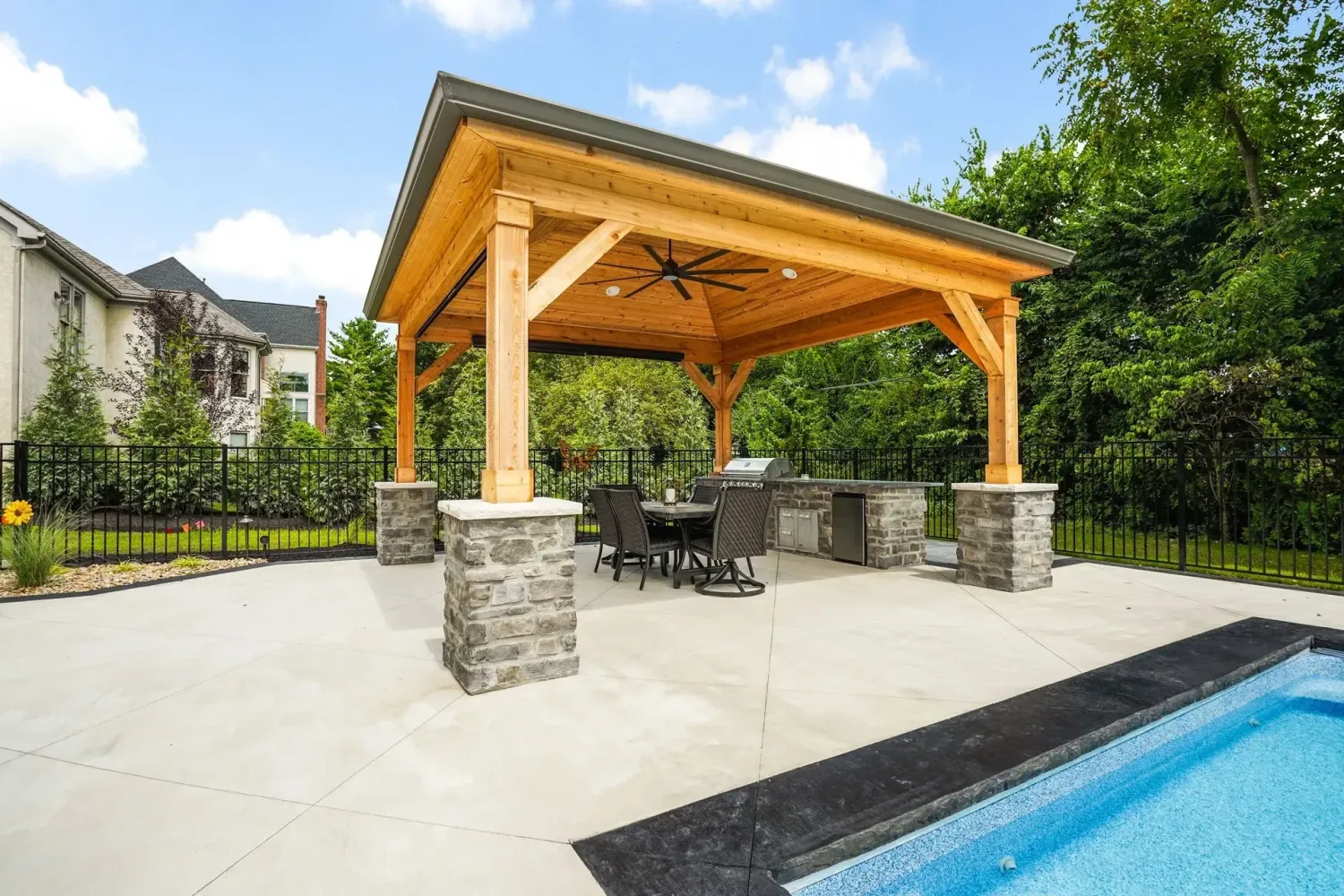
Cool Feet in July, Wet Stone in January
The honest argument for travertine is summer comfort. On an August afternoon when Dawsonville is sitting at 92°F in direct sun, a travertine deck will measure about 8°F cooler at the surface than a standard charcoal concrete paver. Barefoot, that’s a real difference. Kids notice it. Dogs notice it.
But the physical mechanism that makes travertine cooler in July is the same mechanism that destroys it in January. Travertine is cooler because it’s more porous and absorbs more moisture, which then evaporates and carries heat away. The same porosity that wicks water out of the stone in summer wicks water into the stone in winter, where it sits until the next freeze event.
Techo-Bloc’s Industria series was engineered specifically around this trade. The surface texture is ground finer, the aggregate is denser, and recent driftwood-gray and bone-white colorways reflect enough summer sun that the measured surface temperature gap versus travertine has narrowed to about 3–4°F — not the 8°F gap you’d see against an older charcoal paver.
Put simply: the case for travertine gets a lot weaker when your winter cost is six extra re-sanding visits and a higher risk of joint-edge spalling, and the summer benefit is only a few degrees on a paver finish designed to stay pale.
What the Stone Looks Like After 180 Freeze-Thaw Cycles
We pulled a six-year-old travertine deck in a Chestatee home last spring and logged the failure modes before we hauled it to the fill site. It’s a useful catalog for any homeowner weighing this decision with a sample tile in their hand.
- Edge spalling — the top 1/16″ of the stone along joint edges had pitted off in roughly 22% of the units. All the pitting concentrated on the north-facing corner, which gets the least afternoon sun to dry the surface before nighttime freezes.
- Rust-halo staining — three stones nearest the spa overflow had small iron-oxide halos where freeze cycles opened micro-fractures and let pool-chemistry iron oxidize inside the stone.
- Joint opening — measured average joint gap was 9 mm, versus the original 3 mm install spec. That’s almost three times the design gap and well past where polymeric sand can hold.
- Unit rocking — seven stones out of 340 had lifted enough to rock under foot pressure. All seven sat directly above the pool’s plumbing trench, where backfill had settled differently than the rest of the subgrade.
The same house, rebuilt in Techo-Bloc Industria driftwood-gray on a properly graded compacted base, will not show any of those failure modes at the six-year mark. It will show some efflorescence in the first winter, which washes off, and essentially nothing else.
Worth calling out the failure mode almost no sample board ever explains — iron-oxide halos. Travertine is a natural stone with trace iron inclusions that sit inert until water carrying dissolved chlorine, salt, or metals finds a freeze-opened micro-fracture. Once the water is inside, chemistry runs its course over a couple of summers. The resulting rust halo is structural, not surface. You cannot sand or chemically scrub it out. Salt-chlorinated pools in Dawsonville see this faster than gas-chlorinated ones because the dissolved sodium accelerates iron mobilization.
None of this is a knock on travertine as a material. In climates the stone was quarried for — Tuscany, central Turkey, the Sea of Galilee basin — freeze events per year sit in the low single digits. The stone was not engineered, quarried, or tested for 750 freeze-thaw cycles over a 25-year service life. Dawsonville simply asks more of the stone than the stone is built for.
The Rock Blast Surprise — How Dawsonville Dirt Changes the Bid
This is the part of the Dawsonville conversation that has nothing to do with travertine or pavers and everything to do with what’s under your yard.
Most of the Primetime service area sits on Cecil clay, the classic orange-red Piedmont subsoil that excavates cleanly with a tracked mini-excavator. Dawsonville does not. At 1,270 feet of elevation the subsoil is stony residuum — a weathered blend of saprolite and fractured granite, remnants of the Appalachian foothills. Thinner topsoil. Bigger rocks. And occasionally, somewhere between three and six feet down, solid rock.
We plan every Dawson County pool bid with a rock blast contingency of $8 to $14 per cubic yard above the standard dig rate. Sometimes we don’t touch it. On a recent Etowah River Club project we burned through $6,400 in supplemental blasting to reach depth on the deep end. That’s not a deck cost — but it flows into the deck decision because homeowners who just absorbed a rock-blast line item are rightfully careful about any material choice with a higher lifetime maintenance cost.
Beyond the blast risk, the stony residuum drains better than Dacula clay. That is genuinely good news. A well-graded subbase in Dawson County will hold compaction longer than the same subbase in Gwinnett because the percolation is higher. Paver systems love that. Travertine, unfortunately, doesn’t convert drainage-friendly subsoil into immunity from surface freeze damage — the water in the stone is the problem, not the water in the yard.
The slope picture in Dawsonville deserves its own paragraph. Most residential lots along Hwy 53, Hwy 9, and the Dawson Forest Road corridor hold 8 to 14 percent grade before any terracing. That’s real slope — enough that we regularly spec stepped retaining courses inside the deck footprint itself. Retaining plus deck is where Industria’s modular geometry pulls ahead of travertine a second time. Techo-Bloc publishes coordinated wall and deck color palettes, so a 24-inch retaining bench in a matching driftwood-gray finish reads as one piece with the deck. Matching travertine wall units exist but are typically 2–3 times the price and often have to be cut to coordinate color block to block.
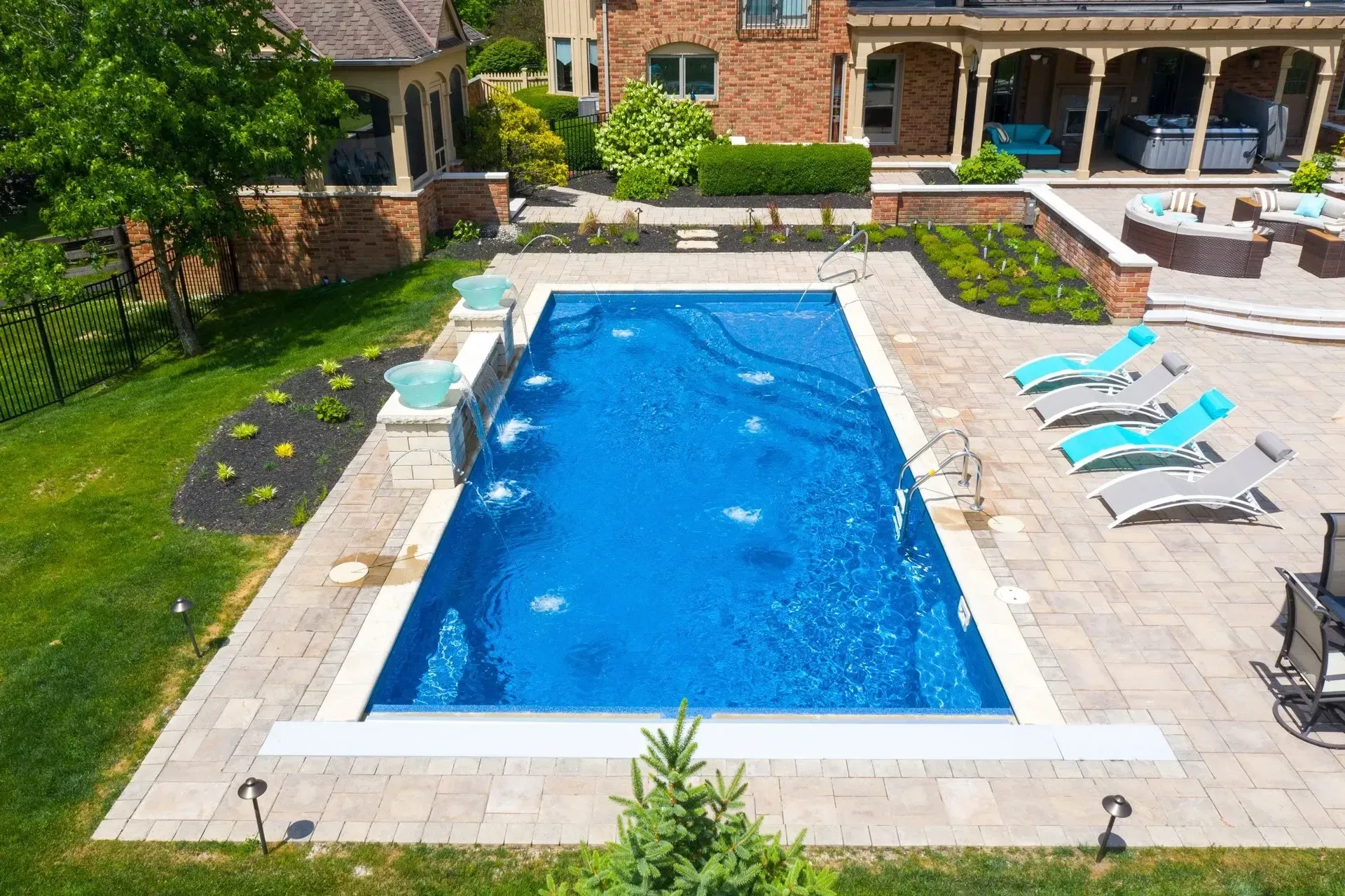
Permits, Power, and Practical Install Realities in Dawson County
Even after you’ve made the material call, Dawsonville adds a few logistical wrinkles that any homeowner deserves to hear before the truck arrives.
Permits pull through the Dawson County Department of Planning & Development at 25 Justice Way. Turnaround is typically faster than Gwinnett — 5 to 9 business days on a standard pool-plus-deck permit — but inspectors will enforce setback and grading specs strictly on the steeper lots, which in Dawsonville is most of them. If your deck is cutting into a slope and requires retaining, expect a separate structural review.
Power service to the pool equipment pad is usually on Amicalola EMC, not Georgia Power. That matters because EMC service drops around Dawsonville are frequently overhead rather than underground, and the pad location has to work with whatever the existing drop geometry is. We’ve redesigned deck layouts twice in the past two years to avoid a run conflict with an EMC anchor easement.
Equipment trucking is easier than most homeowners expect. GA-400 dumps directly onto Highway 53 or Highway 9 and most Dawsonville subdivisions sit within ten minutes of a four-lane interchange, so delivery of Techo-Bloc pallets is straightforward. The real driveway problem in Dawson County is grade — a tracked forklift can walk a pallet up most driveways, but anything steeper than 12% requires a skid-steer shuttle, which adds a half-day of labor.
Neighborhood approvals in some Dawsonville communities — Etowah River Club and Big Canoe especially — require architectural committee sign-off on deck material and color before a permit application is even filed. Bring the sample to the meeting. The committees we’ve worked with almost always approve Industria driftwood-gray on sight because it reads as natural stone from five feet away.
Typical Dawsonville pool-deck budget range: Techo-Bloc Industria installed at $22–$28 per square foot, including compacted base, polymeric sand, and edge restraint. Travertine comparable spec runs $24–$32 per square foot before accounting for a maintenance-cost delta of roughly $1,800–$2,400 per decade in re-sanding and joint work.
Our Recommendation for Dawson County — and Where Travertine Still Earns It
For a pool deck at Dawsonville elevation, facing 30 freeze events and 55 inches of annual rainfall on stony residuum subsoil, our call is Techo-Bloc Industria in driftwood-gray, installed on a 6-inch compacted crushed-stone base with polymeric sand joints, edge restraint, and a perimeter french drain. That spec will land between $22 and $28 per installed square foot depending on deck geometry and coping selection.
Travertine isn’t never the right answer. If you’re building a small plunge pool on a covered lanai where the deck never sees freezing rain, or you’re in the valley floor near the Etowah where winter minimums stay higher, or the design language of the home absolutely demands a natural stone edge — we’ll spec travertine and engineer the joint system to compensate. But those are the edge cases, not the rule.
For the standard Foxcreek, Mountain Laurel, Kensington Ridge, or Riverbend build at 1,100+ feet of elevation, Industria wins on durability, joint maintenance, thermal comfort within 3–4°F of travertine, and total 25-year ownership cost. The sample looks like stone. The performance looks like engineering.
That’s the whole thesis. Pool decks don’t fail in the showroom. They fail in February, at 1,270 feet, on the 748th freeze cycle. Spec the deck for that day.
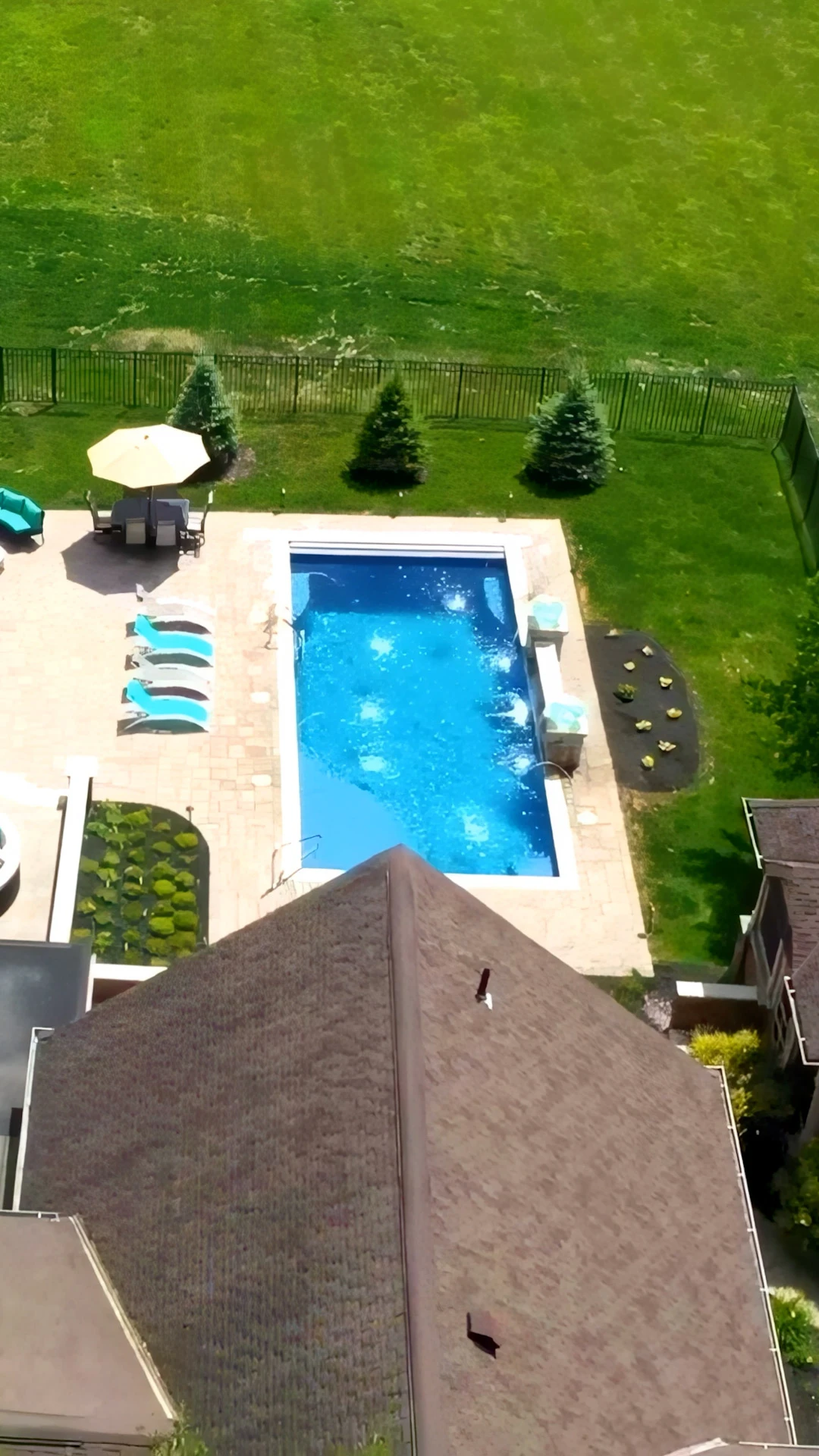
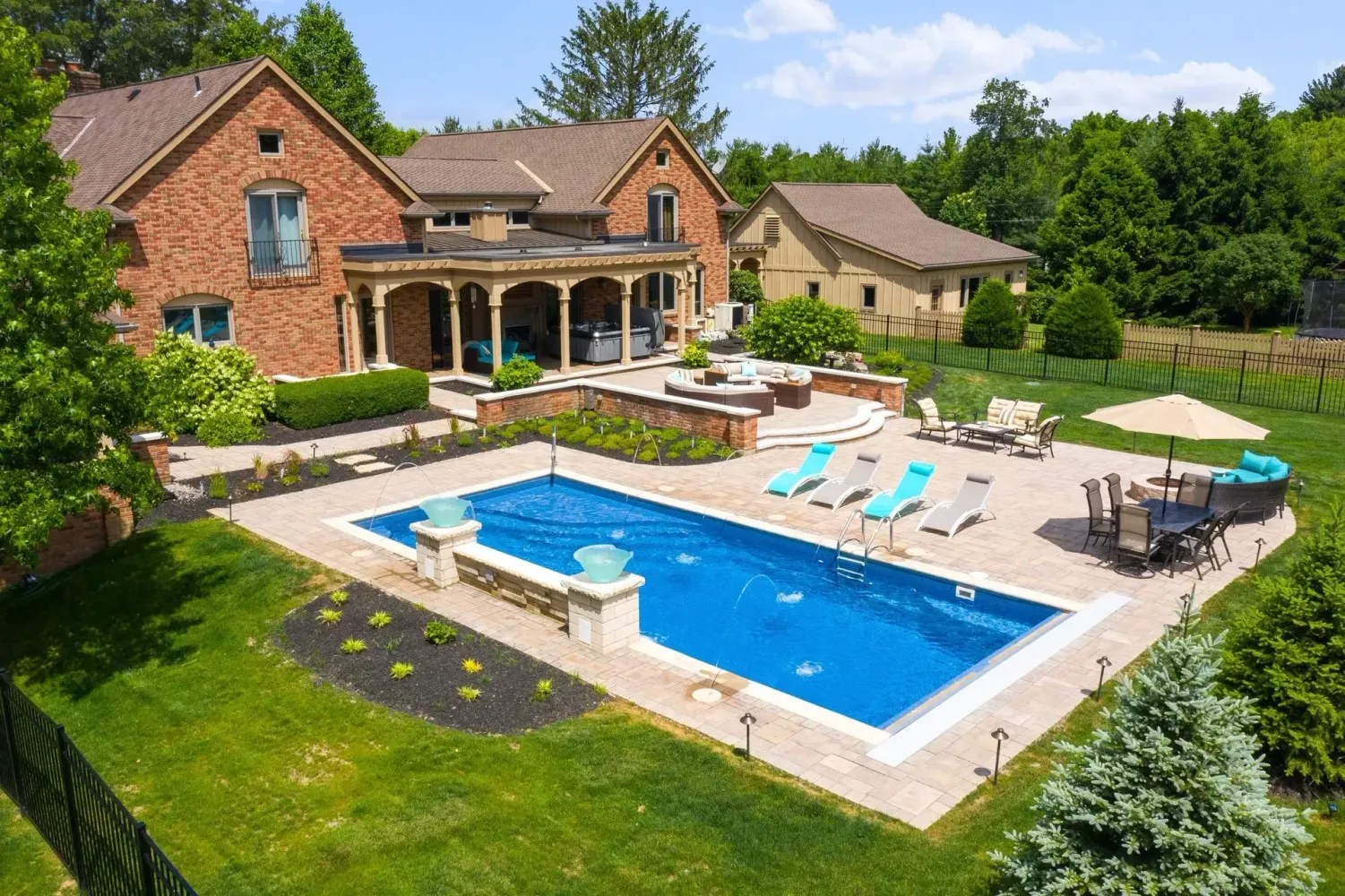
Pool decks engineered for Dawsonville cold across 20+ cities within 30 miles of Winder, GA
From Foxcreek to Etowah River Club, we spec deck materials around the freeze-cycle math of your actual address — not a generic Atlanta climate assumption.