
Here is the part of travertine ownership nobody mentions at the showroom. In Cumming, because of Lake Lanier sitting twelve minutes from almost any backyard in Forsyth County, your deck pulls roughly 40% more moisture into its pore structure than the same stone installed thirty miles south in Atlanta proper. Sealing once a year is the wrong calendar. It is a spring-and-fall ritual, or it is a stone that hazes, spalls, and blooms efflorescence by year four.
A travertine pool deck is one of the most beautiful surfaces you can put around water in Georgia. It is also one of the most regionally sensitive. The stone is limestone that was deposited by mineral-rich springs over hundreds of thousands of years, which means its internal structure is a honeycomb of microscopic voids. Those voids are what give it that matte, cool-underfoot character that pavers and concrete cannot imitate. They are also exactly what the humidity off Lake Lanier fills, freezes, and works against every winter.
This post is not a general primer on travertine. It is a specific argument about one material in one place. If you live in Vickery, St. Marlo, Lake Windward, Hampton Park, Polo Fields, Windermere, or any of the newer tracts out toward Sadie Farms or Mashburn Plantation, the deck around your pool is doing something different than a deck in East Cobb or Johns Creek. The climate around the lake, the red clay below it, and the freeze cycles we get at 1,275 feet of elevation all push travertine toward a faster failure curve unless the maintenance schedule respects that.
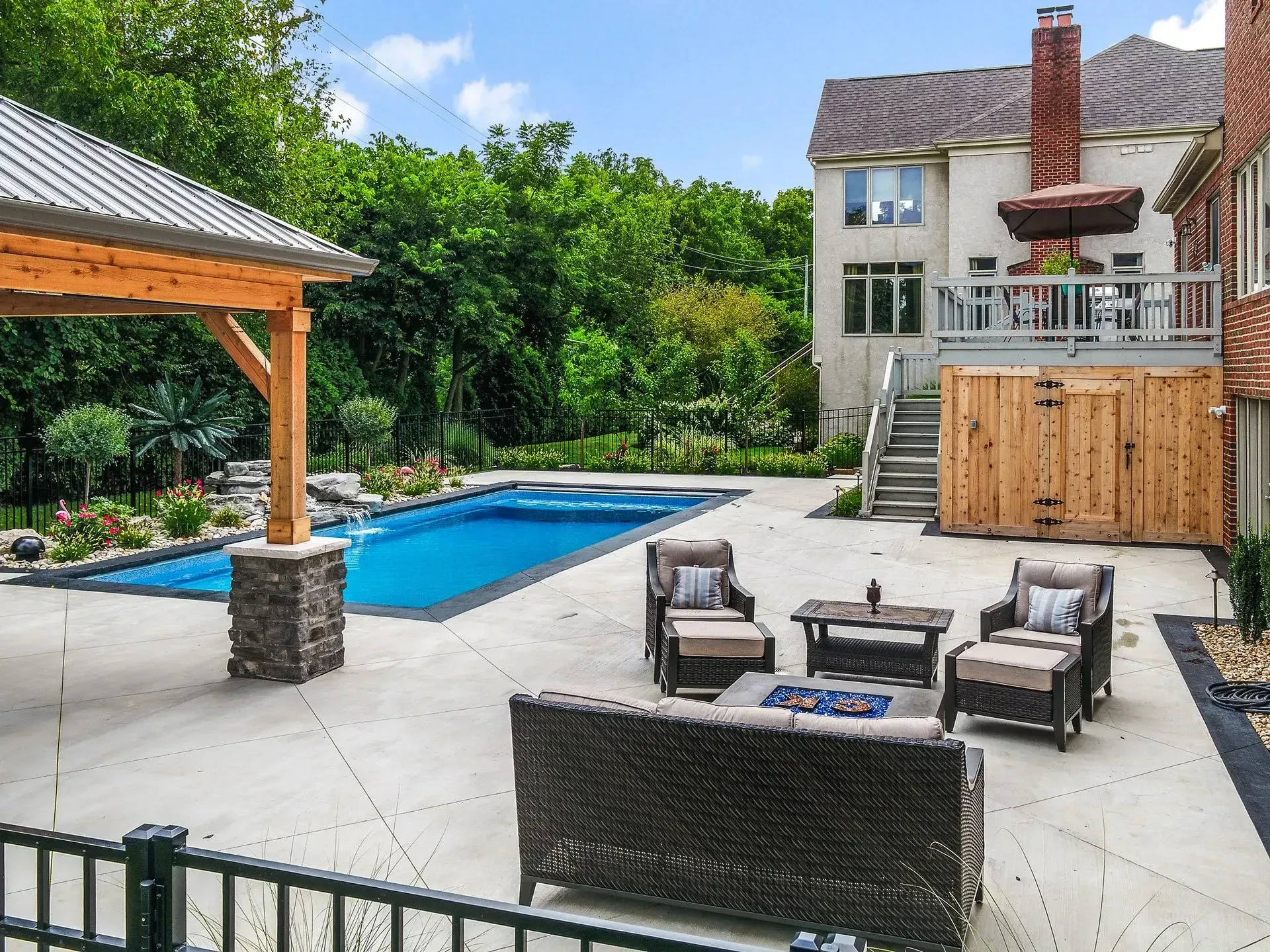
Why Lake Lanier Changes the Humidity Math
Every large body of water creates its own localized humidity dome. Lake Lanier is 38,000 acres, runs from the Buford Dam up past the 400 corridor, and puts roughly 690 miles of shoreline inside easy driving distance of every Cumming subdivision. The closer a property sits to the lake, the higher the average summer dewpoint runs — often five to eight degrees above the reading at the Atlanta airport on the same afternoon.
That matters because travertine absorbs moisture by capillary action through its surface pores. Stone does not wait for rain; it pulls whatever water vapor is in the air toward whatever cooler mass sits underneath it. A slab of travertine over a compacted base, chilled overnight to 72 degrees, with ambient humidity at 88%, will have measurable moisture uptake by morning. Multiply that across 52 inches of annual rainfall, 22 freeze events a year, and a growing season that runs April through October, and the stone is essentially in a permanent wet-dry oscillation.
Atlanta metro averages roughly 70% relative humidity across the summer. The lakeside corridor along 400 — especially north of Exit 14 toward Lake Lanier Islands — runs closer to 78% across those same months. The stone does not care about the number. It cares about how much water it is holding when the first hard freeze arrives in November. That is the number that dictates whether your deck cracks at the joint or stays tight for thirty years.
There is a second Lanier effect that rarely gets discussed — the wind-driven misting that rolls off the lake on summer evenings. When the water surface is warmer than the inland air, a light haze of micro-droplets drifts over the nearest two to four miles of shoreline every night between June and September. Properties in Three Chimneys, Haw Creek, and the eastern edge of Vickery catch this haze directly. Those droplets settle on every horizontal surface, including your pool deck. Over a full summer, the cumulative deposition is equivalent to an extra four to six inches of rainfall contact time — all of it unseen, all of it pulling into the stone through the night when evaporation is lowest.
The Spring-and-Fall Ritual — What Failure Looks Like and How to Prevent It
We get called to evaluate a lot of travertine decks in the 30040 and 30041 zip codes that were installed by builders who treated sealing as optional, or who recommended a single annual reseal and left it at that. The failure pattern is consistent enough to write down. Year one and two, the stone looks stunning. Year three, isolated white blooms appear in grout joints and along the coping seam. Year four, those blooms widen into a cloudy haze across one or two pavers, usually in the lowest-elevation corner where water collects. Year five, the edge of a travertine piece near the skimmer lifts slightly, the chiseled face dusts to the touch, and a pinhole forms where a pore has fully failed. This is not a material defect — it is a maintenance calendar mismatch.
The white blooms are efflorescence — mineral salts that were dissolved inside the stone, carried to the surface by moisture, and crystallized when the water evaporated. Topical sealers accelerate this, because they form a film on the surface that traps the moisture trying to leave. Penetrating sealers prevent it by lining the interior pore walls with a hydrophobic coating while still allowing vapor to move through. That difference is the single most important spec decision on any travertine deck built within fifteen miles of Lake Lanier.
The sealer spec we write into every Cumming contract: Aqua Mix Sealer’s Choice Gold penetrating sealer, minimum two coats, applied with a lamb’s-wool applicator at 70°F to 85°F surface temperature, 24-hour dry between coats, first seal done after the deck has cured for a full 14 days. Never a topical acrylic. Never a “wet look” finish.
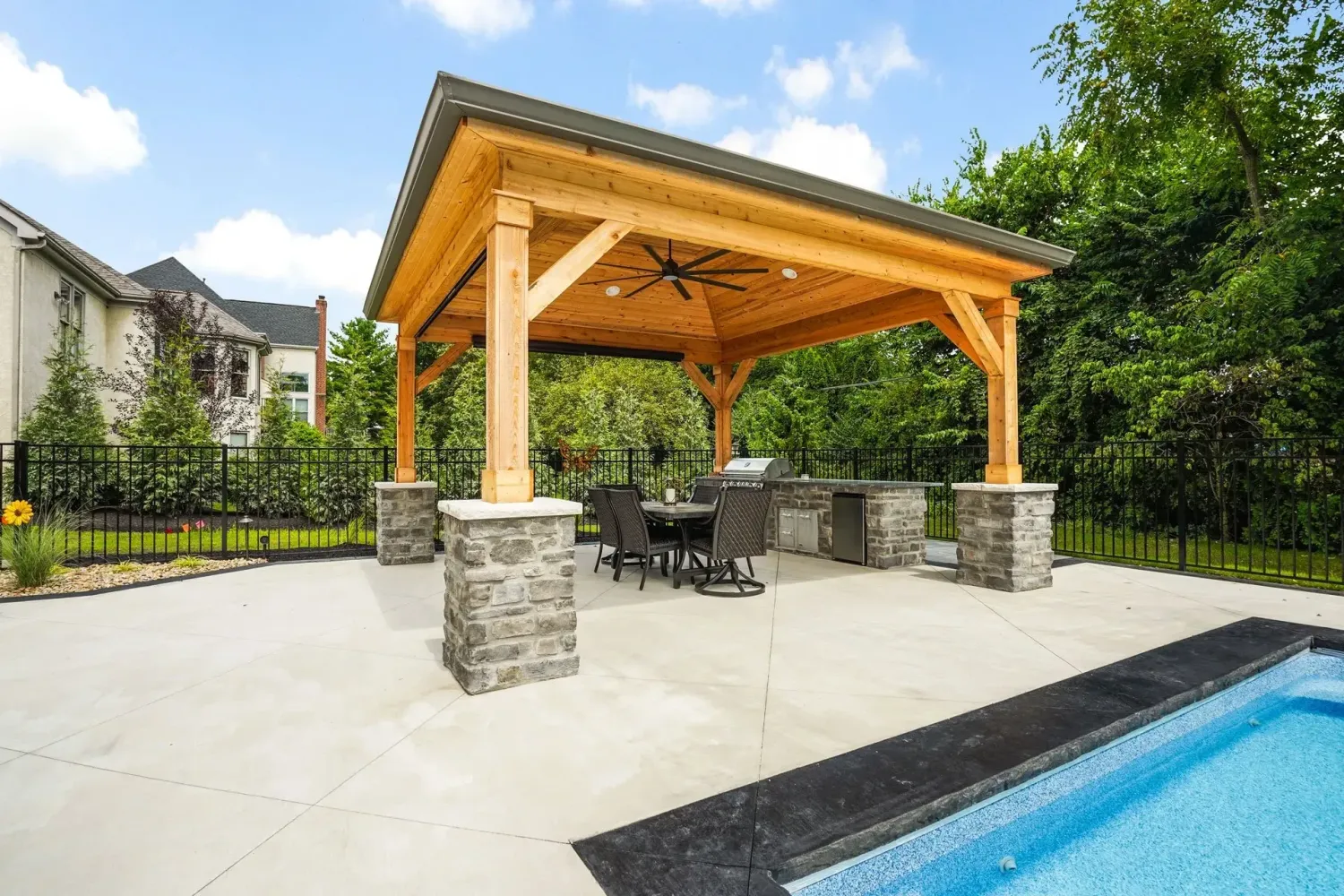
A bi-annual schedule is not a gimmick. It tracks two distinct stressors that hit the stone at different points in the calendar year. Spring sealing prepares the deck for the summer-long humidity load and the chlorine-water splashback that comes with 90-plus-degree afternoons. Fall sealing prepares it for the freeze-thaw cycles that run from late November through early March in Forsyth County.
The spring seal happens in late March or the first two weeks of April, before the pool opens and before sustained daytime highs push above 80°F. The deck is cleaned with a neutral-pH stone cleaner, power-rinsed at no more than 1,800 PSI with a 25-degree fan tip, allowed to dry for a full 48 hours, then sealed with a fresh coat of penetrating sealer on the stone and a matched joint sealer in the grout lines. Total job time on a 700-square-foot deck runs four to six hours with two technicians.
The fall seal happens in mid-October, after the last week of lake swim season but before the first hard freeze. Same cleaning protocol. Same sealer spec. The difference is that we are pushing the sealer into stone that has baked through a humid Georgia summer and needs its hydrophobic layer rebuilt before it faces overnight lows in the mid-20s. Skip this one, and the freeze-thaw cycle does exactly what it does to concrete — it expands whatever water got into the pores, pops a micro-fracture, and widens that fracture every subsequent freeze until the stone delaminates.
Between those two service dates, the deck needs almost nothing. A garden-hose rinse after a heavy pollen week in April. A soft-bristle sweep and a neutral-pH mop after pool parties. No pressure washing between scheduled seals, ever — a homeowner with a rental-grade 3,000 PSI pressure washer can undo a fresh seal coat in ten minutes. If something spills on the deck — sunscreen, red wine, hot-dog grease from a grill drip — blot it, rinse it, and leave it. The penetrating sealer is doing its job as long as nothing mechanical strips it off.
Chiseled vs Honed — A Finish Decision That Becomes a Maintenance Decision
Travertine comes in two primary surface finishes for pool-deck use. The choice is usually made on aesthetics at the showroom. It should be made on maintenance math, especially in Cumming.
Chiseled edge travertine has a broken, tumbled perimeter on each piece — irregular, hand-hewn, old-world. The face can be honed smooth, filled, and brushed, or it can be left unfilled. Chiseled-edge pieces trap slightly more moisture at the joint because the bevel creates micro-pools where rainwater sits before evaporating. They are the finish we recommend most often for Cumming builds because the rustic look matches the stone-and-timber language of the newer luxury tracts — St. Marlo, Polo Fields, and the Vickery cottage-style homes — but they do require a tighter sealing schedule.
Honed travertine is machine-cut on all six faces to a flat, matte surface. Cleaner line. More contemporary. Lower moisture retention at the joint because there is no bevel to pool water. Easier to seal because the surface is uniform. The trade is visual — it reads as a more modern, Belgard-style deck, which fits some of the newer Three Chimneys builds but feels wrong against a brick-and-cedar traditional house.
There is also a third variable — filled versus unfilled. Travertine’s natural voids can be left open for a rustic, pitted face, or filled at the factory with a color-matched epoxy resin. Unfilled travertine looks older and more authentic, but those open voids are direct highways for moisture. In Cumming, we spec filled travertine almost universally for the deck field, with unfilled pieces limited to vertical applications like wall caps or pillar veneer where they are not absorbing ground moisture. A filled, honed 6cm French Pattern — the Ivory, Walnut, or Noce color families from suppliers like MSI Surfaces or Stone Tile Depot — is the safest mechanical-and-visual combination for a lakeside Cumming property.
Finish recommendation for lakeside humidity: If your property sits within five miles of Lake Lanier, we recommend honed travertine in 6cm French Pattern over chiseled edge. The flatter surface sheds water faster and holds the sealer layer more consistently through the summer humidity swing. If you prefer the chiseled look, be prepared for the full bi-annual sealing schedule without exception.
The Cost of Doing This Right — And the Cost of Not
Homeowners want numbers, so here they are. A bi-annual penetrating-sealer maintenance plan on a typical 650 to 900 square foot Cumming pool deck runs $180 to $280 per visit, or roughly $360 to $560 per year. Spread across ten years, that is $3,600 to $5,600 in ongoing maintenance.
Every ten years, the deck also needs a full deep-clean and reseal — acid-neutral deep cleaning, efflorescence removal, grout-joint restoration, and a fresh base coat of sealer applied the same way as the original installation spec. That job runs $3,400 to $5,800 depending on deck size and condition. Budget for it every decade, and the deck looks the same at year 25 as it did at year 3.
Now the other side of the math. A travertine deck that was not sealed on a bi-annual cadence typically needs remediation at year 7 to 9. Remediation is not a reseal — it is stone replacement on the worst-affected pieces, joint rebuild on the full perimeter, and a full strip-and-reseal on everything else. That job runs $9,000 to $18,000 on the same-size deck, depending on how many stones have delaminated. You paid to save $3,000 across a decade and spent $12,000 fixing it.
This is the single clearest argument for treating the sealing calendar as non-negotiable. It is also why we hand every client a one-page maintenance schedule at deck handoff that lists the spring and fall dates, the sealer product name and SKU, and the technician contact. The goal is to make the calendar easier to keep than to ignore.
Homeowners in Cumming’s newer subdivisions — the ones drawing Atlanta-metro relocation buyers coming up 400 from Buckhead, Brookhaven, and Dunwoody — often arrive with an expectation shaped by their last property, which was probably a townhome or a smaller lot without a pool. The reality of owning a 1,500-square-foot outdoor living space with travertine, coping, waterline tile, and equipment is that it carries a recurring service cost similar to an HVAC system. Budget it like one. A deck that gets $500 a year in professional attention performs like a deck that cost twice as much and got none.
Base, Grade, and Drainage — What Sits Under the Stone in Forsyth County
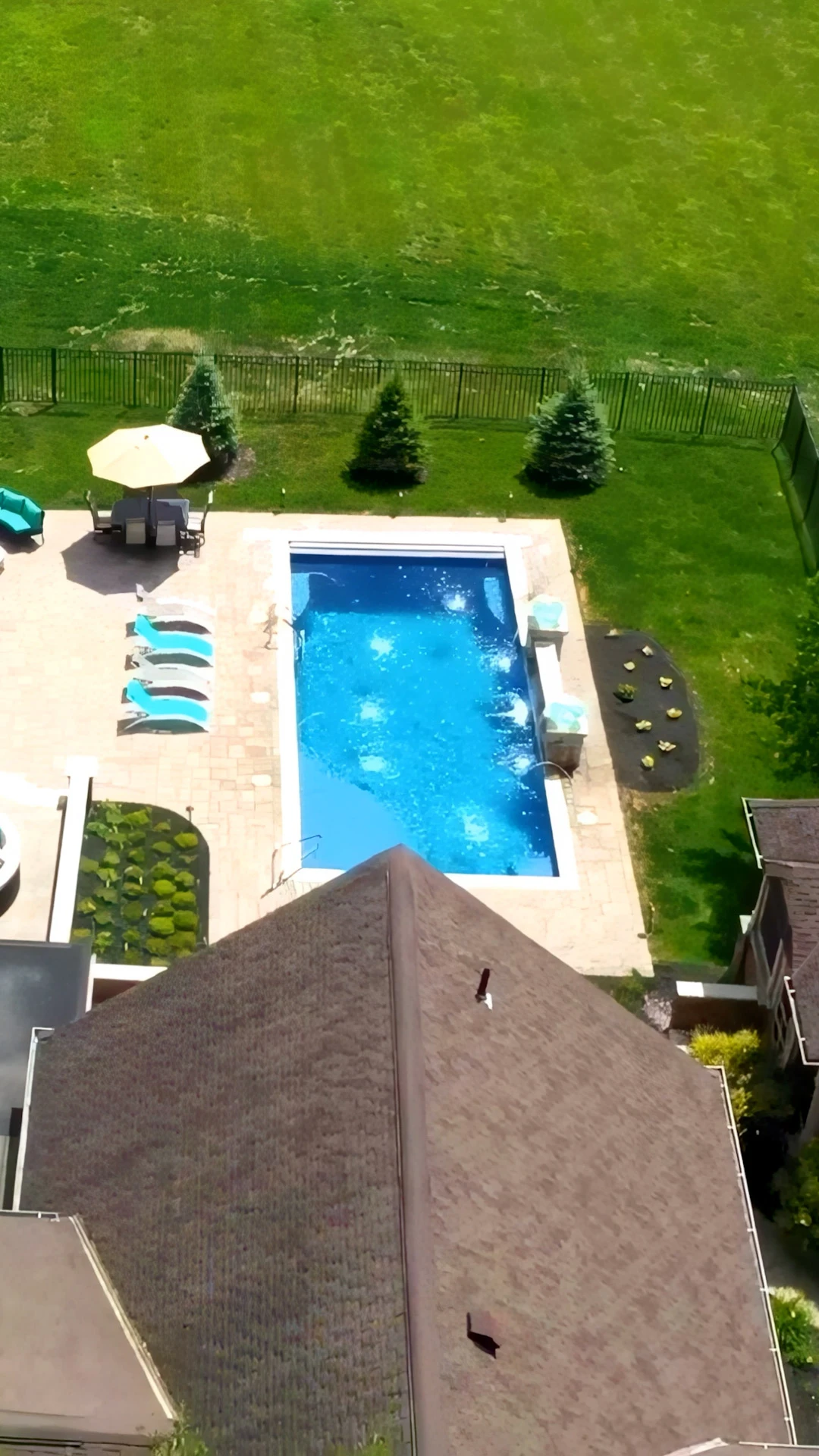
The sealer conversation is only half the story. The base the travertine sits on is the other half, and in Cumming, the base has its own failure patterns that no amount of top-side sealing will fix.
Cumming sits on Cecil-series Piedmont clay, hard-packed and high-density, especially in the older grid near Big Creek and Cumming City Center. In the newer tracts along Bethelview Road and Post Road, pockets of Appling sandy loam mix in — drains better but heaves slightly more in a freeze. Either way, travertine laid directly over clay will telegraph every ground movement within three years. The specification we write is an 8-inch compacted open-graded base in 2-inch lifts with a non-woven geotextile separator over the subgrade, a bituminous setting bed under the stone, and polymeric sand at the joints. That is the foundation that makes the bi-annual sealing calendar meaningful in the first place.
Permit-wise, a new pool and deck job in Cumming goes through the Forsyth County Department of Planning & Community Development at 110 East Main Street, downtown. Electrical for the pool equipment falls under NEC §680 and requires the bonding grid that Sawnee EMC will want to see during inspection. If your property is inside an HOA — St. Marlo, Polo Fields, Hampton Park, Windermere — plan for a 2 to 3 week architectural review board turnaround on the pool and deck plans before the county permit is pulled. That turnaround is the single most common timeline surprise we see on Cumming projects, which is why we advise every client to submit the HOA package the same week the contract signs.
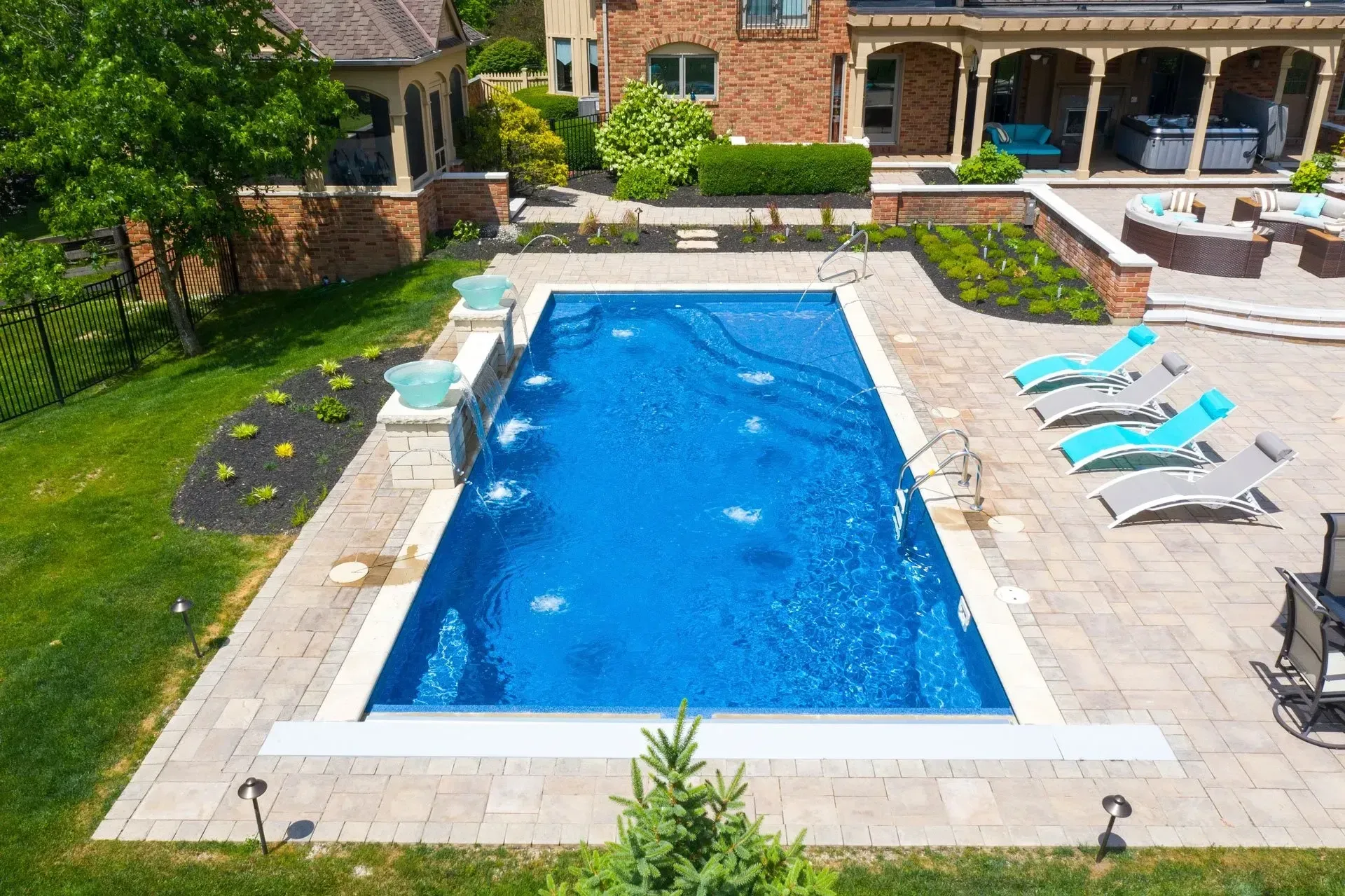
Almost every lot we build on in Cumming has a 3 to 8 foot grade drop somewhere on the property, usually toward a South Forsyth drainage tributary or a cul-de-sac swale. That slope is what gives the region its character, but it is also what makes the deck edge on the downhill side the most failure-prone zone of the entire installation. The deck on the uphill side stays dry — rain sheds off it in under 30 seconds. The downhill edge catches every drop from the house, the decorative beds, and the upslope half of the deck itself. In summer, that corner sees 3 to 5 times the moisture load of the rest of the surface. In winter, it sees the longest freeze-thaw dwell times because the shaded pockets near the downhill perimeter thaw last each morning.
The engineering fix is a channel drain at the downhill deck edge, piped to daylight or to the existing yard drainage. Every Cumming build we do includes this as a standard-spec item, not an upgrade. The sealing calendar stays the same, but the moisture load on the most-stressed section of the deck drops by half. At year ten, the difference between a deck with a properly graded channel drain and a deck without is visible from across the yard. Worth noting too — the frost line in Forsyth County is shallow, roughly 5 to 8 inches, but the stone above it still experiences thermal shock on every cold-morning sunrise after a frost night. A dark coping edge can climb from 28°F at dawn to 78°F within four hours on a clear winter day. That 50-degree swing, repeated across 22 freeze events per year, is the real stressor. Sealer does not stop it — it just makes sure that when the stone expands and contracts, it does so without absorbing any net water.
What to Ask a Builder Before You Sign the Deck Contract
If you are shopping a Cumming pool-deck build right now, the questions below will separate a builder who understands the region from a builder pricing a job off a template. None of these are gotchas. They are the questions that sound like a homeowner who has read one article and done a little homework, which is exactly what a good builder wants to work with.
- What sealer product do you spec, and is it penetrating or topical? The right answer names a penetrating sealer by brand and SKU — Aqua Mix Sealer’s Choice Gold, Miracle 511 Impregnator, or equivalent — and explains why a topical “wet look” finish will cause efflorescence in our humidity.
- How many coats of sealer on day-one installation? Minimum two. Anything less is a cost cut.
- What is the cure time before the first seal is applied? 14 days from final grout. If a builder says “same day” or “next week,” the sealer will fail to penetrate properly.
- Do you include a written bi-annual maintenance schedule? A reputable Cumming builder hands you a calendar, not a shrug.
- What is your base spec? 8-inch open-graded base, 2-inch lifts, geotextile separator, bituminous setting bed. If the base is “4 inches of crusher run and polymeric sand,” walk away.
- Is channel drainage included on sloped lots? Every downhill-edge build needs it. It should not be an upgrade line item.
A builder who answers those six questions cleanly has built enough travertine decks within the Forsyth County humidity band to know what fails and what does not. A builder who hedges on any of them is pricing a job they have not engineered.
One last practical note — keep the paperwork. Receipts for every sealer reapplication, the product data sheets, photos of the deck after each service. If you ever sell the house, a documented bi-annual maintenance history is a material value driver for any buyer who has done their homework on travertine. It separates a stone deck that has been cared for from a stone deck that has simply survived, and at the price point of a custom pool in Hampton Park or Windermere, that documentation has earned back its filing-cabinet space ten times over. Travertine is a thirty-year surface when it is respected. The two dates on the calendar are what earn it that lifespan.
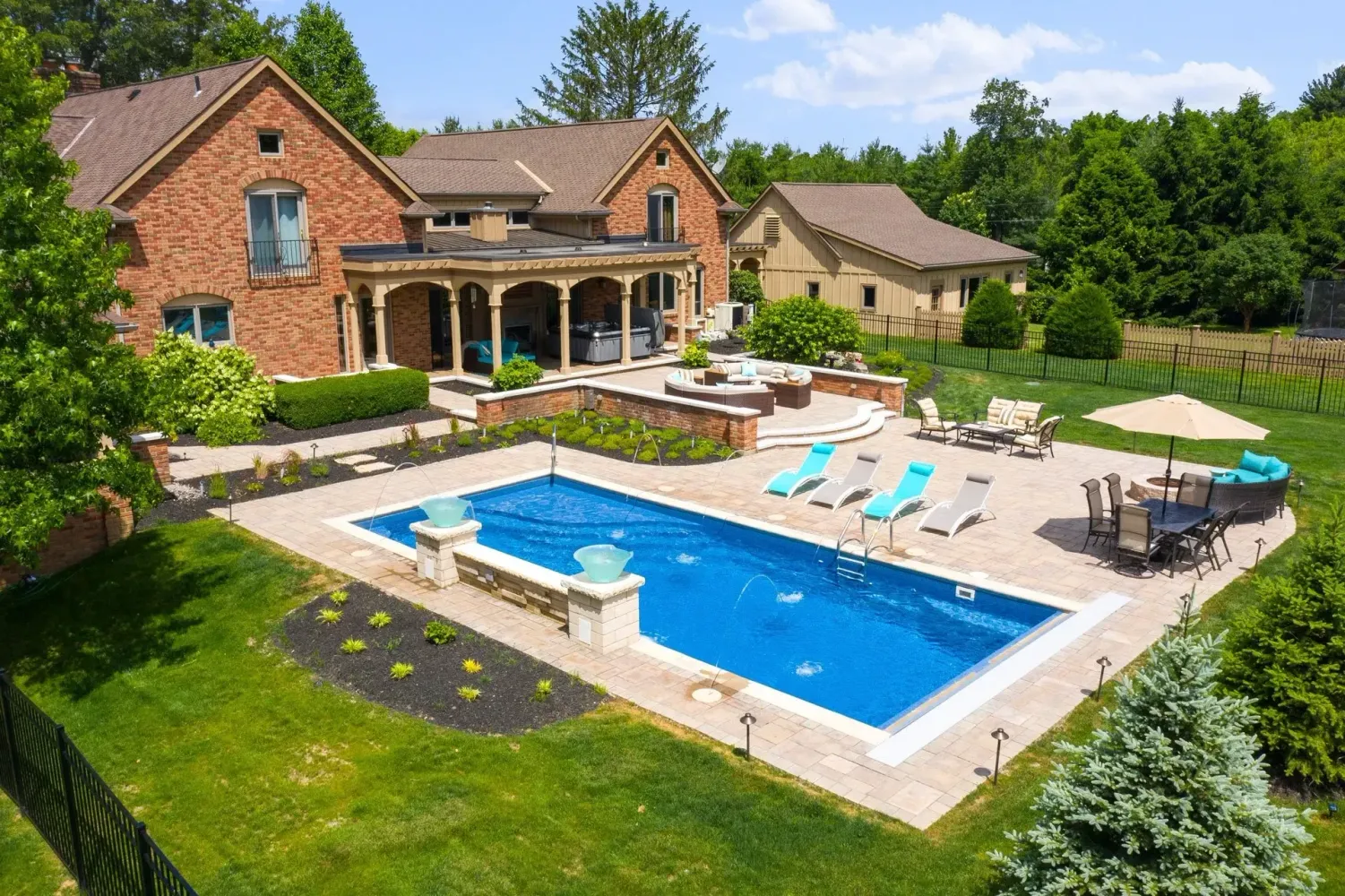
Travertine pool decks engineered for Cumming humidity — across 20+ cities within 30 miles of Winder, GA
From the Lake Lanier corridor through the Forsyth County tracts to the rest of Northeast Atlanta, we build pool decks with a sealing calendar that matches the climate, not a generic national spec sheet.