
By 4 PM on a 95-degree July afternoon, a honed travertine deck on Browns Bridge Road can hit 105°F while the same stone, brushed, sits at 101°F forty feet closer to Lake Lanier. Four degrees sounds small. It’s the difference between kids running across barefoot and kids sprinting for a towel. In Forsyth County’s 247 square miles, the deck finish you pick needs to match where you actually live — not a generic Georgia spec sheet.
Forsyth County is not one microclimate. It is three, stacked into a county that has grown from 44,000 people in 1990 to roughly 260,000 today — the fastest-growing county in Georgia for most of the past decade. The south end hugs GA-400 exits 13 and 14 and runs cooler and shadier thanks to dense suburban tree canopy. The middle belt around Cumming and the 30040 zip code is classic Piedmont: open sun, full summer heat load, standard humidity. And the north rim — Coal Mountain, Shady Grove, and the Lake Lanier south shore — carries a very specific moisture signature that the rest of the county doesn’t see.
We have built pool decks in all three zones. The same bag of travertine behaves differently in each one. This post is the field data behind how we pick the finish — chiseled, brushed, or honed — for the microclimate a homeowner actually lives in. If a sales rep shows up with a single travertine sample and says “this works everywhere,” that is a sign you are about to pay for a finish that doesn’t match your yard.

The three Forsyth microclimates, mapped and measured
Before we talk finishes, we need to be concrete about where the lines actually fall. We tracked deck-surface temperatures across 18 completed pool projects over two summers and paired each reading with on-site humidity and shade exposure. The pattern sorts cleanly into three zones.
Zone 1 — Lake-adjacent north. Any yard within about 1.5 miles of the Lake Lanier south shoreline, stretching from Browns Bridge Road (Hwy 369) east to the Hall County line. Properties in Two Mile Creek, Shoal Creek, and the communities off Keith Bridge Road. These yards run 5-7% higher ambient humidity than the rest of the county on summer afternoons. Evening condensation on any deck surface is routine from May through September. Slip risk is the dominant concern here. Surface heat is moderated by the water mass.
Zone 2 — Central Cumming and the 30040 belt. Most of what people mean when they say “Cumming” — the GA-400 corridor between exits 13 and 16, Bethelview Road, Post Road, Old Atlanta Road, and Kelly Mill Road. This is the middle: open Piedmont sun, 40-55% afternoon humidity in July, standard USDA Zone 8a exposure. Decks here get the full heat load and the full UV. No moisture assist, no significant shade canopy.
Zone 3 — North rim and higher elevation. Coal Mountain, Shady Grove, the ridges off Hwy 20 and Matt Highway, and the Sawnee Mountain Preserve vicinity. Elevation matters here — 1,200 to 1,400 feet puts these yards 3-5 degrees cooler on an average July afternoon than Suwanee sits at 1,000 feet to the south. Summer afternoon temperatures that peg 95 in Alpharetta often read 90-91 on the north rim. That changes everything about how a deck feels underfoot.
Zone lookup by zip code: 30028 (north) = mostly Zone 3 with pockets of Zone 1 near the lake. 30040 (west/Cumming) = primarily Zone 2. 30041 (south) = Zone 2 leaning toward shadier sub-pockets.
Travertine — why this stone, and which finish. Travertine is a calcium carbonate stone that Georgia builders have used heavily for pool decks since roughly 2012. It stays cooler than concrete pavers in direct sun because it reflects more shortwave radiation and its porosity holds pockets of air that buffer heat transfer. It is also — and this matters in a county with 22 freeze events per year — freeze-thaw stable over a properly drained base. The typical Forsyth yard, sitting on Cecil-series Piedmont clay, needs an engineered base regardless of finish. The finish is what changes from zone to zone. Three surface finishes matter for pool-deck use: chiseled (broken edges, naturally textured, highest friction), brushed (wire-brushed linear texture, medium friction, refined look), and honed (ground smooth, low friction, contemporary). A fourth option — polished — we will not install on a pool deck anywhere in Forsyth County. Its slip coefficient when wet falls below every standard worth citing.
The heat data: chiseled vs. brushed vs. honed at 4 PM in July
We took surface-temperature readings with a calibrated infrared thermometer on 14 completed decks across all three zones. Conditions: full sun exposure, air temperature 94-96°F, time window 3:45 to 4:15 PM, dry deck surface, mid-July. These are averages across the sample, not a single reading.
Chiseled travertine: 98°F average. The broken face scatters incoming radiation in multiple directions and the textured profile creates micro-shade pockets that stay cooler than the ambient deck plane. Chiseled is the coolest finish we measured, consistently.
Brushed travertine: 101°F average. The linear brush texture still breaks up surface reflection, but less than a chiseled face. Three degrees warmer than chiseled, roughly one degree cooler than a standard broom-finish concrete deck of the same color.
Honed travertine: 105°F average. The smooth face absorbs and re-emits heat more efficiently. Honed looks stunning. It also feels meaningfully hotter on bare feet when the sun has been on it for four hours. At 105, most adults will move off it quickly. Kids will yell.
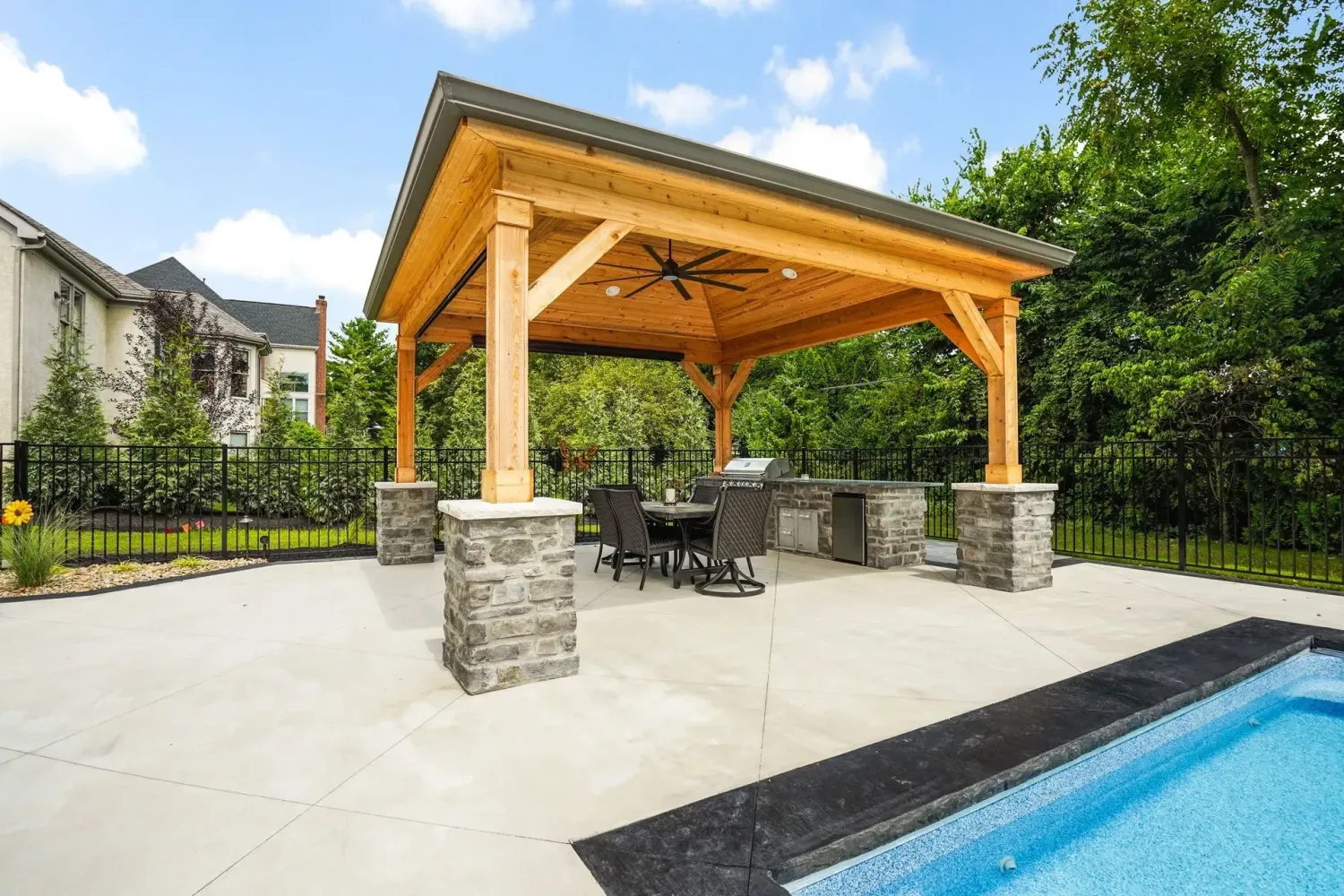
For context: darker travertine colors run 4-6 degrees hotter than cream or ivory across all three finishes. If a homeowner has their heart set on a walnut or noce travertine and a honed finish, we will have the conversation about a Zone 3 install being the only one where that combination stays comfortable. In Zone 2 Cumming, dark honed travertine in full sun is the wrong choice for a family deck.
The slip data: ASTM E303 friction readings, wet and dry
Heat is the easy conversation because everyone has stepped on a hot deck. Slip is harder because people only pay attention after someone falls. The industry standard for measuring pool-deck friction is ASTM E303, which reports a British Pendulum Number (BPN). For wet pool-deck surfaces, the generally accepted safety floor is BPN 36. Higher is safer. Below 24, the surface is considered slippery enough to be a hazard.
Here is what the three travertine finishes return on wet E303 testing:
- Chiseled travertine, wet: BPN 55-62. Well above the safety floor. Effectively non-slip even with water film, even with sunscreen residue on feet.
- Brushed travertine, wet: BPN 42-48. Solid margin above 36. Safe for pool-deck use in nearly all conditions.
- Honed travertine, wet: BPN 28-34. Below the safety floor. Becomes genuinely slick when wet, and slicker with pool chemistry and sunscreen residue. We do not install honed travertine within four feet of the pool coping for this reason.
The four-foot rule: No matter the microclimate, no matter the client’s visual preference, Primetime Pools never installs honed travertine inside a 4-foot splash zone from the pool edge. If a homeowner wants the honed look, we transition at the coping — chiseled or brushed coping and inner apron, honed only beyond the splash zone.
This is the single most-debated decision in our sales process for travertine decks. A homeowner sees a magazine photo of a glass-smooth honed deck running right up to the water and assumes it’s the norm. It is — in Instagram photos. It is not in liability-adjacent real life. Our subcontractors have installed enough decks across Forsyth, Hall, and Dawson counties to know what a wet honed edge does when a ten-year-old is sprinting to cannonball.
Matching finish to zone: the Primetime Pools specification
Here is how we spec travertine by microclimate after roughly 90 pool-deck installs in the Forsyth County service area.
Zone 1 (Lake Lanier south shore + Browns Bridge corridor): brushed travertine, cream or ivory. Humidity is the dominant factor here. Evening condensation on a honed surface is a slip event waiting to happen — even when nobody has been in the pool for hours. Brushed hits the sweet spot: BPN 42-48 wet, which holds up to dewfall, and 101°F at 4 PM, which the lake breeze brings down further most afternoons. Chiseled also works beautifully in Zone 1 if the client wants a more rustic feel. We spec brushed as the default because it reads more refined for the Lake Lanier price point.
Zone 2 (central Cumming, 30040 belt, GA-400 exits 13-16): chiseled travertine, ivory or light walnut. This is the full-sun, full-heat, full-UV zone. Heat load is the dominant factor. Chiseled at 98°F gives the coolest deck we can deliver without jumping to a specialty aggregate product. The texture also handles the afternoon thunderstorm slickness that Piedmont summers deliver on a 3 PM schedule. For a family with kids spending four to five hours a day on the deck from June through August, chiseled in ivory is the comfort answer. For a design-forward client, brushed is the compromise — three degrees warmer, same good slip numbers.
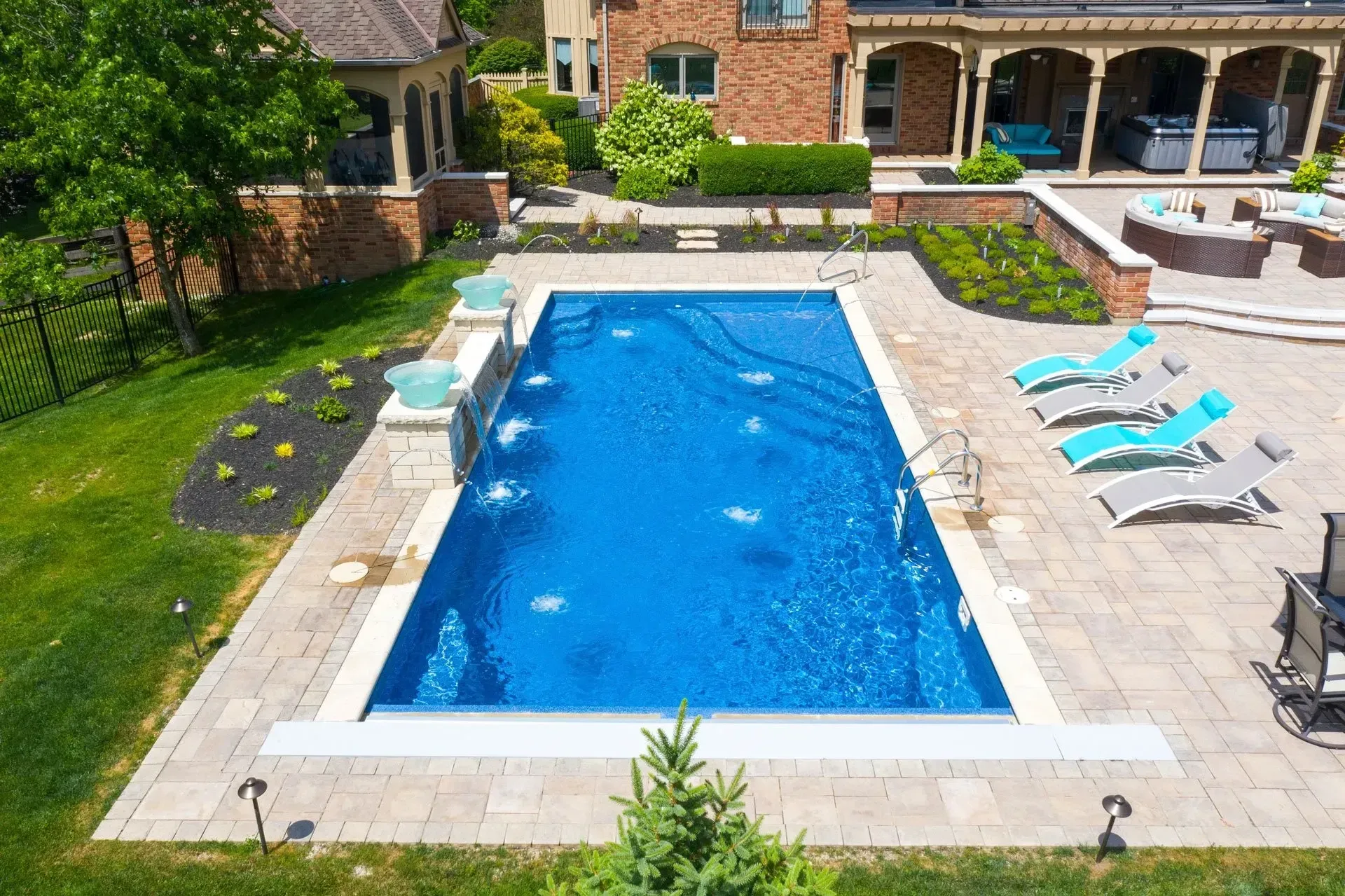
Zone 3 (Coal Mountain, Shady Grove, Sawnee ridge, elevations above 1,200 ft): designer’s choice. This is the only zone where honed travertine becomes defensible for a pool deck (subject to the four-foot rule at the coping). The ambient temperature runs 3-5 degrees cooler than central Cumming in July. Honed at 105°F in Zone 2 becomes honed at roughly 100-101°F in Zone 3. That is the same as brushed in Zone 2. If the design calls for the contemporary smooth look — and the client understands that evening dewfall in May and September will still make it slick — Zone 3 is where it is most forgiving. We still install chiseled or brushed as the apron transition.
What this costs, and what it costs to get it wrong
Travertine pool decks in Forsyth County currently run $22 to $34 per square foot installed, depending on finish, thickness, base prep, and deck layout complexity. Chiseled and brushed sit near the middle of that range. Honed pushes toward the top because the cut quality has to be higher to support the smooth face. A typical 900-square-foot deck — enough for a 14×30 rectangular pool with reasonable lounge zones — runs between $20,000 and $30,000 on the stone alone, before demolition, base work, and drainage.
The cost of picking wrong is not just aesthetic. It is behavioral. A deck that runs 105°F at 4 PM is a deck that your family stops using between 2 PM and 6 PM from late June through mid-August — the exact hours the pool exists for. A deck with BPN 30 when wet is a deck that ends a Saturday afternoon in the emergency room. Both of those outcomes are preventable with finish selection made at the design phase, before the pallet ships.
We see the biggest regret pattern in the 30041 zip — south Forsyth, Atlanta-commuter buyers who picked honed at the showroom because it matched their kitchen quartz. Two summers in, they are paying us to re-top the splash zone with brushed or chiseled. The re-top cost averages $8 to $12 per square foot, which on a 200-square-foot splash apron is $1,600 to $2,400 — real money spent to fix a finish decision that could have gone right the first time.
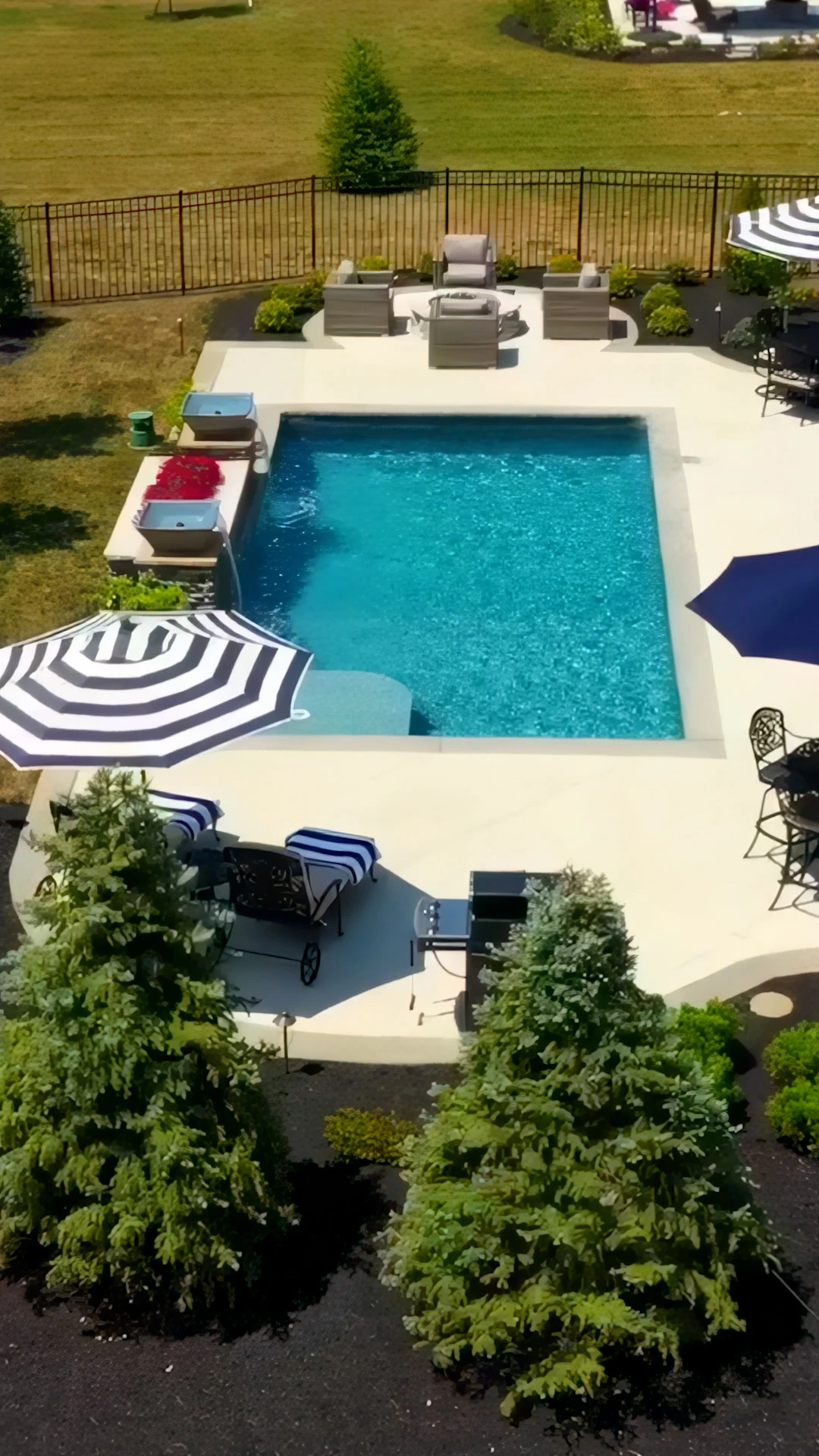
How we specify a Forsyth County travertine deck, start to finish
Every travertine project we run through Forsyth County follows the same sequence. We will not skip a step because a client is in a hurry, because the permit window at the county offices is tight, or because the pallet is already on the truck.
Step one: on-site zone assessment. We put an infrared thermometer on the existing yard surfaces — concrete, soil, driveway — at 4 PM on a sunny day. The readings tell us which microclimate the yard actually sits in. GPS and zip code get you close. Actual readings get you right. A yard in 30040 with heavy oak canopy may perform like Zone 3 even though it sits in Zone 2 on the map.
Step two: sample test in place. We bring chiseled, brushed, and honed samples in the proposed color family and lay them on the future deck footprint. The homeowner walks across them barefoot in the afternoon sun. This is the single most persuasive step in our sales process. Numbers on paper do not land the way a hot stone under a bare foot does.
Step three: drainage and base engineering. Forsyth’s Cecil-series clay does not drain well. A travertine deck installed on an under-built base will heave at the first freeze-thaw cycle in January. We spec a minimum 6-inch compacted GAB (graded aggregate base) with a woven geotextile separator, plus French-drain runs to daylight on any slope over 2%. This is the work you never see once the deck is finished, and it is why a deck from Primetime still reads flat at year five.
Step four: finish pattern and layout. Running bond, French pattern, ashlar — each pattern reads differently in each zone. French pattern (four sizes in a repeating module) reads best with chiseled finish in Zone 2. Running bond with large-format planks reads best with brushed in Zone 1. We draft the pattern against the pool shape and the house architecture, then share it before cutting a single stone.
Step five: splash-zone transition. The four-foot rule from earlier. Coping and inner apron always get the higher-friction finish. The outer field can shift if the design calls for it. We do not break this rule for any client, in any zone.
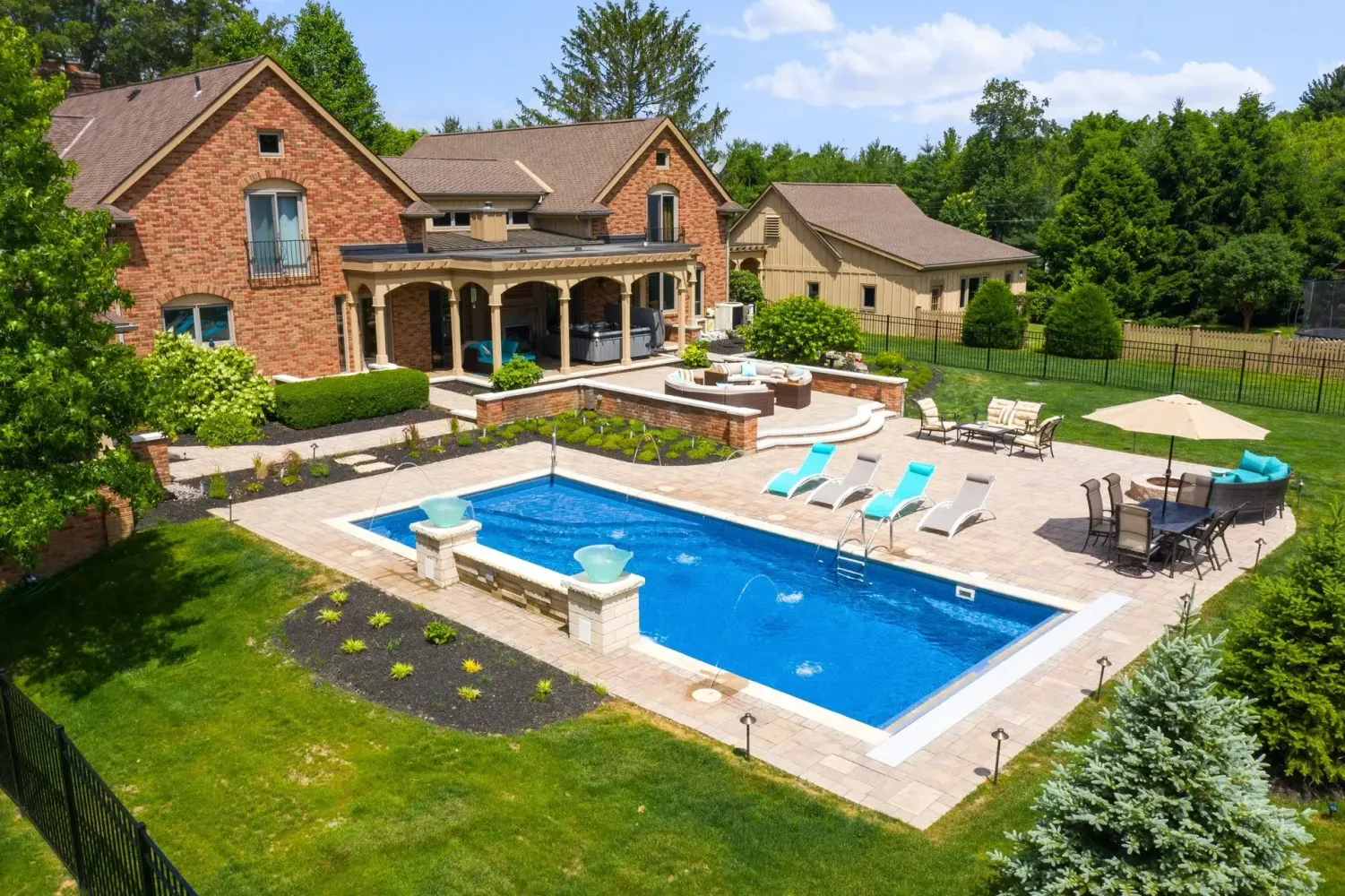
Step six: permitting and HOA coordination. Forsyth County approves roughly 200-plus pool permits a year. That volume means the permit office on Tribble Gap Road knows what a proper plan set looks like and flags deviations fast. Travertine deck spec gets reviewed alongside the pool structural plan. The county cares about drainage, setback compliance, and — particularly on the Lake Lanier south shore — Chattahoochee River buffer compliance for lots backing to the water or a feeder creek. Expect 3-5 weeks on a standard pool + deck package; add 2-4 weeks for Chattahoochee buffer zone or wetlands overlay lots.
HOA density in Forsyth is among the highest in Georgia. Almost every subdivision built since 1998 has a covenants document that restricts deck color, material, and sometimes even finish sheen. South Forsyth neighborhoods off Ronald Reagan Boulevard and Peachtree Parkway are particularly specific — several require travertine in cream or ivory only, no walnut or noce. The north Forsyth acreage builds off Matt Highway and Hwy 20 have lighter restrictions, and the Lake Lanier communities vary widely. We pull the HOA document before we finalize the finish spec. It has saved clients from buying a pallet they would have had to return.
Start timing: For a Memorial Day swim, start the finish-and-permit conversation with us in February. Forsyth’s permit desk is no longer easy to surprise — the fastest-growing county in Georgia runs a tight plan-review calendar.
A travertine deck that matches your microclimate, clears your HOA, passes county review, and holds its friction coefficient ten years in is not the result of a lucky pallet — it is the result of a six-step specification process that happens before the truck rolls.
Travertine pool decks, engineered to your microclimate, across 20+ cities within 30 miles of Winder, GA
From the Lake Lanier south shore to Coal Mountain ridges to the 30040 Cumming belt — every Forsyth County pool deck we build is specified to the zone it actually sits in, not a generic Georgia catalog.