
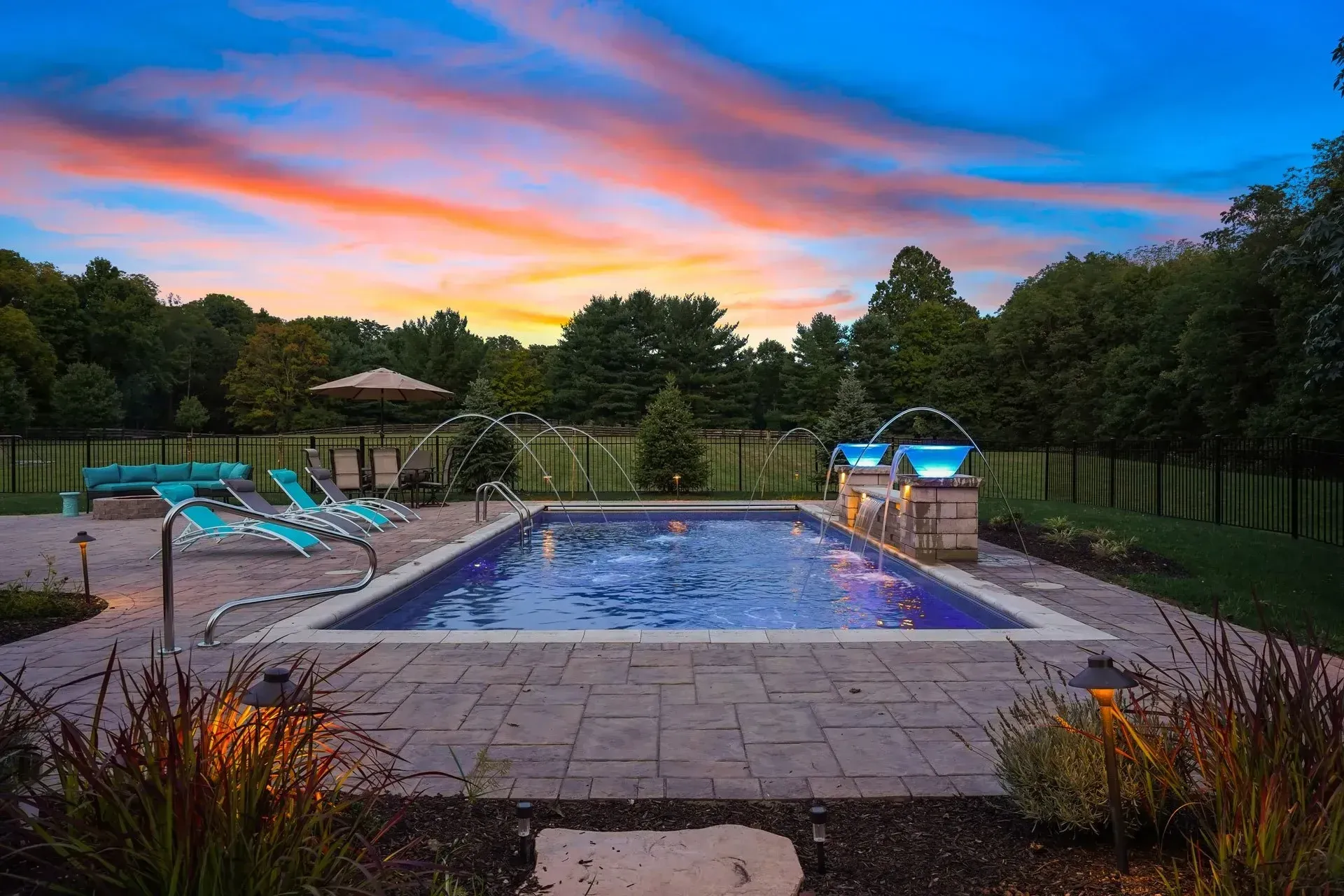
A 2,380-square-foot deck in Cogburn Estates. Cream-tan travertine. French pattern. The owners had walked three other builders’ finished jobs before us, and every one of them had looked smaller than the photos promised. This one doesn’t.
The client had 1.4 acres, a rear elevation that dropped nine feet from the house slab to the pool shelf, and a specific request: they wanted the deck to feel like the pool terraces at the boutique hotels in Positano they’d visited on honeymoon. Not a “pool and patio.” A stone terrace. Continuous. Hand-cut. Weighty. The kind of surface that reads the same whether you’re standing on it with bare feet or looking down from the second-story guest suite.
We ended up installing premium travertine, 1-1/4-inch thick, tumbled edge, laid in the French pattern across 2,380 sqft. Final cost landed inside the range we’d quoted: $68,400 installed. The owners sent a photograph of the finished deck to the three other builders who had quoted them. One of the builders called us the following week to ask how we were pricing the cut work. That’s the job this post is about.
This is not a travertine primer. There are a hundred of those online, and most of them read like brochure copy. This is a material-by-material breakdown of what actually goes into a Milton estate-scale travertine deck when you run the French pattern at 1,600 to 2,800 sqft — the stone itself, the setting bed, the jointing, the edge treatment, the sealer program, and the reason the French pattern reads richer than running-bond once you pass about 1,200 sqft of continuous surface.
Why Milton estates end up on travertine in the first place
Milton incorporated as a separate city in 2006, carved out of the northernmost tip of Fulton County. That matters because permits for pool decks here route through Milton Community Development at 2006 Heritage Walk, not through Fulton. Turnaround runs 10 to 14 business days for a standard pool-and-deck plan — faster than unincorporated Fulton, but the preservation review on anything inside The Manor, Cogburn Estates, or the Crabapple overlay is stricter. Submittals routinely come back with markup on stone choice, color range, and how the deck transitions to native topography.
Milton’s AG-1 zoning (one- to three-plus-acre minimums across large swaths of the city) produces lots that don’t behave like suburban lots. Grade changes of six to fourteen feet across the footprint of a pool-plus-deck are normal. The deck has to span that drop elegantly or it breaks the whole composition. Travertine at 1-1/4-inch handles the step-downs, the raised coping transitions, and the pavilion-to-deck joins that come with estate-scale programs. Concrete pavers can do the work, but they don’t read the same at scale and the tonal variation flattens on camera.
The second reason: sun exposure. Milton’s rolling topography and tree-light estate clearings produce decks that sit in open sun from about 10 a.m. onward. Travertine’s surface temperature runs roughly 20 to 30 degrees cooler than dark concrete paver alternatives on an afternoon when the air is 91 degrees. On a deck the size we’re describing here, that’s the difference between bare feet and flip-flops.
The French pattern — what it actually is, and why scale matters
The French pattern (also called Versailles pattern, Roman opus, or “ashlar” in some catalogs) is a repeating four-tile module. Four different tile sizes interlock to form a unit that repeats across the field. The standard module for 16-inch travertine uses four sizes — 8×8, 8×16, 16×16, and 16×24 — arranged so that no two identical tiles touch and no continuous joint runs more than about 24 inches in any direction.
On a small deck — say, 800 sqft — the pattern reads as “mixed-size stone.” You see it but it doesn’t do much work for the eye. Past about 1,200 sqft, the pattern starts to matter. The broken joints and variable module size prevent the surface from reading as a grid, which is the failure mode that makes a large travertine deck look like a big tile floor. By the time you’re at 2,000 sqft — the size of a typical Milton estate deck — the French pattern is the difference between a terrace and a patio.
Running-bond (standard brick-offset layout) is faster to install, cheaper in material (less cut waste), and fine for decks under about 1,000 sqft. Past that, running-bond reads monotonous and the long continuous joint lines telegraph any settlement. French pattern masks minor movement because the eye never locks onto a single joint line.
Material premium: French pattern requires 8–10% more travertine than running-bond on the same deck footprint because of the cut-waste generated by the smaller modules and the edge trimming. On a 2,000 sqft deck at $14–$22/sqft material, that’s roughly $2,500–$4,000 in additional stone cost. It shows up in the installed quote.
The stone itself — specifying premium travertine for Milton
Not all travertine is the same stone. The catalog term covers a range of quality grades, density classes, and finish treatments. For Milton estate work we spec the following and we won’t deviate:
- Grade: Premium (first select). No filler plugs on the face. Natural vein variation accepted; cavity face rejected.
- Thickness: 1-1/4 inch (standard thin pavers are 1/2 to 5/8 inch — too thin for the loading patterns on a deck that sees furniture, grills, and point loads from pavilion posts).
- Color: Cream-tan blend. We pull from the quarries that produce a consistent warm field with minimal gray banding. Walnut and noce run too dark in Milton’s sun; ivory runs too cold against the red-tan native soil.
- Edge: Tumbled on all four edges. Chiseled edge reads too rustic at scale; sawn edge reads too modern against the estate architecture Milton builds to.
- Module: 16-inch French pattern set (four sizes per crate, pre-sorted).
Installed pricing on that spec runs $28 to $42 per square foot across Milton projects. The spread depends on subgrade condition, pattern complexity at the perimeter, raised-wall coping work, and how many step transitions the deck carries. A straightforward 2,000 sqft flat deck lands around $56,000 to $64,000. A 2,000 sqft deck with a raised spa bond beam, a pavilion post-base integration, two step-downs, and a creek-side edge ramp lands $76,000 to $84,000.

The setting bed — where most travertine decks fail
Milton sits on Cecil clay over weathered granite. Topsoil is thicker in creek bottoms (Cooper Sandy Creek, Chicken Creek, Lake Creek drainages) and thinner on the ridgelines where most estate houses sit. During pool excavation on Hopewell Rd and Freemanville Rd properties, we routinely hit saprolite shelves — partly decomposed granite that behaves like a dense sand. Saprolite is stable in place but doesn’t drain well, and it moves differently than the Cecil clay above it.
This is where travertine decks fail. A travertine paver will last fifty years. A bad setting bed won’t last five. The failure mode is always the same: the bed settles unevenly, the joints open, water gets in, the sand washes out, and individual pavers rock. Once that starts, the whole field unravels.
The setting bed we run on Milton estates is:
- Subgrade: Compacted to 95% standard Proctor density. On saprolite we over-excavate six inches and replace with crushed stone.
- Base: 6 inches of compacted #57 crushed stone, compacted in two lifts.
- Bedding course: 1 inch of coarse bedding sand (ASTM C-33 washed concrete sand — not mason sand), screeded flat.
- Paver set: Travertine laid directly on the bedding course, tapped to plane with a rubber mallet, not vibrated (vibration damages the tumbled edges).
- Joint fill: Polymeric sand, specifically Gator Maxx G2 in a color that matches the cream-tan field. Installed dry, swept into joints, activated with a fine mist over three passes.
The joint-fill step is where most contractors cut corners. Cheaper polymeric sands fail the first time the deck sees freeze-thaw, which in Milton means the first winter. USDA Zone 8a gives us ~22 freeze events per year. Gator Maxx G2 holds through freeze-thaw and through the mid-summer downpours we get in the ~53 inches of annual rainfall that falls on Milton in a typical year.
Edge conditions, coping, and the transitions that read expensive
On a Milton estate deck, the perimeter does as much work as the field. The client sees the pool coping every time they walk to the water, the step-downs every time they move between terrace levels, and the raised-wall returns every time they sit at the pavilion. These are the zones that separate a well-built travertine deck from a rich one.
Coping: we run matching travertine coping, bullnosed, 12 inches wide, mitered at corners. The bullnose is cut in a separate setup from the field pavers — same stone, different edge profile. Mitered corners take about forty minutes per corner and they are worth every minute. A field-butted corner with caulk looks like a field-butted corner with caulk. A mitered corner reads as one continuous piece of stone wrapping the corner.
Step-downs: Milton’s grade changes mean most decks carry at least one step, and often two or three, between the house slab and the pool shelf. We build each step face in matching travertine, same tumbled edge, with a consistent 6-1/2-inch riser and a 14-inch tread. Code allows a 7-3/4-inch riser but 6-1/2 reads more relaxed and is what the estate clients actually want walking out of the kitchen toward the pool.
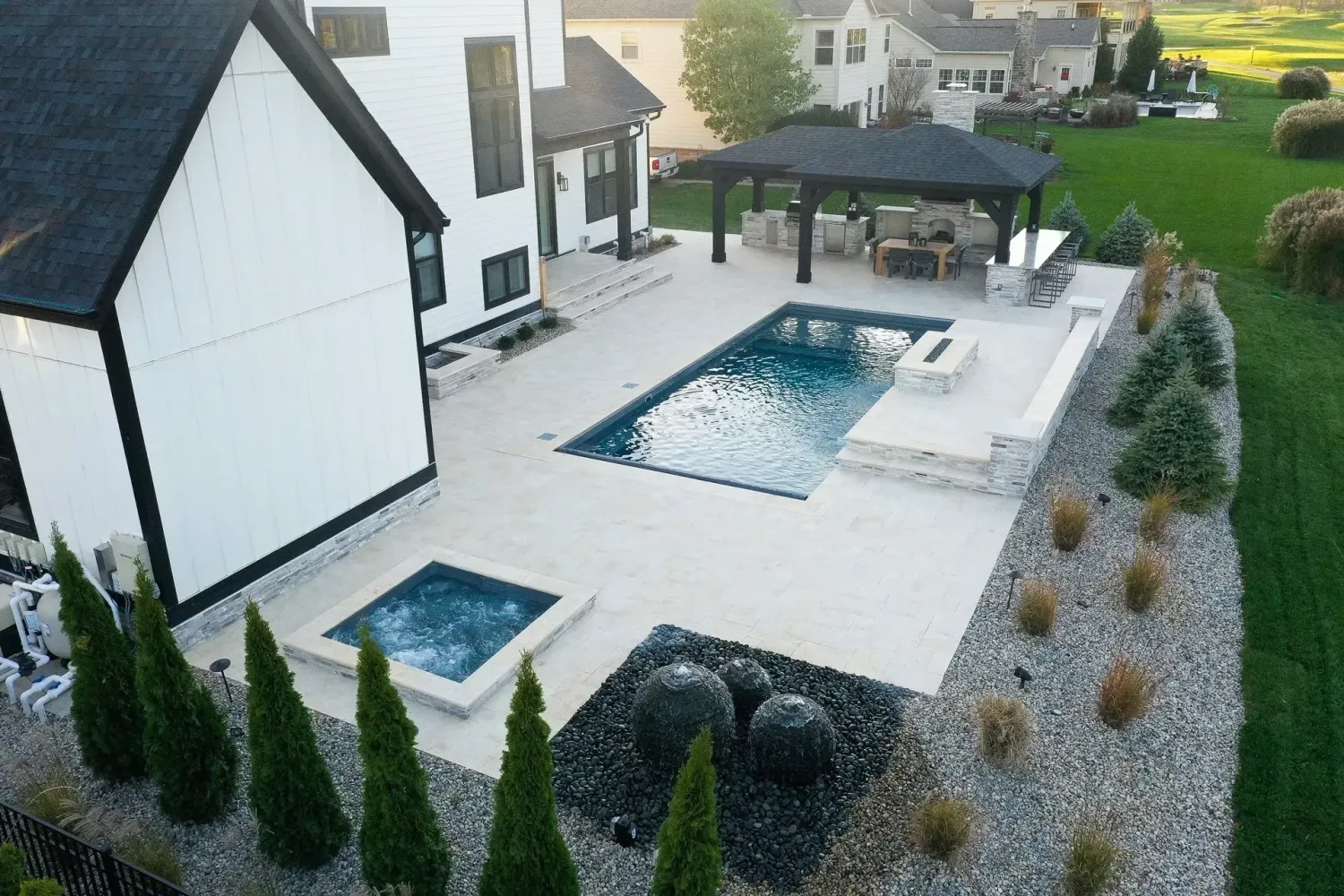
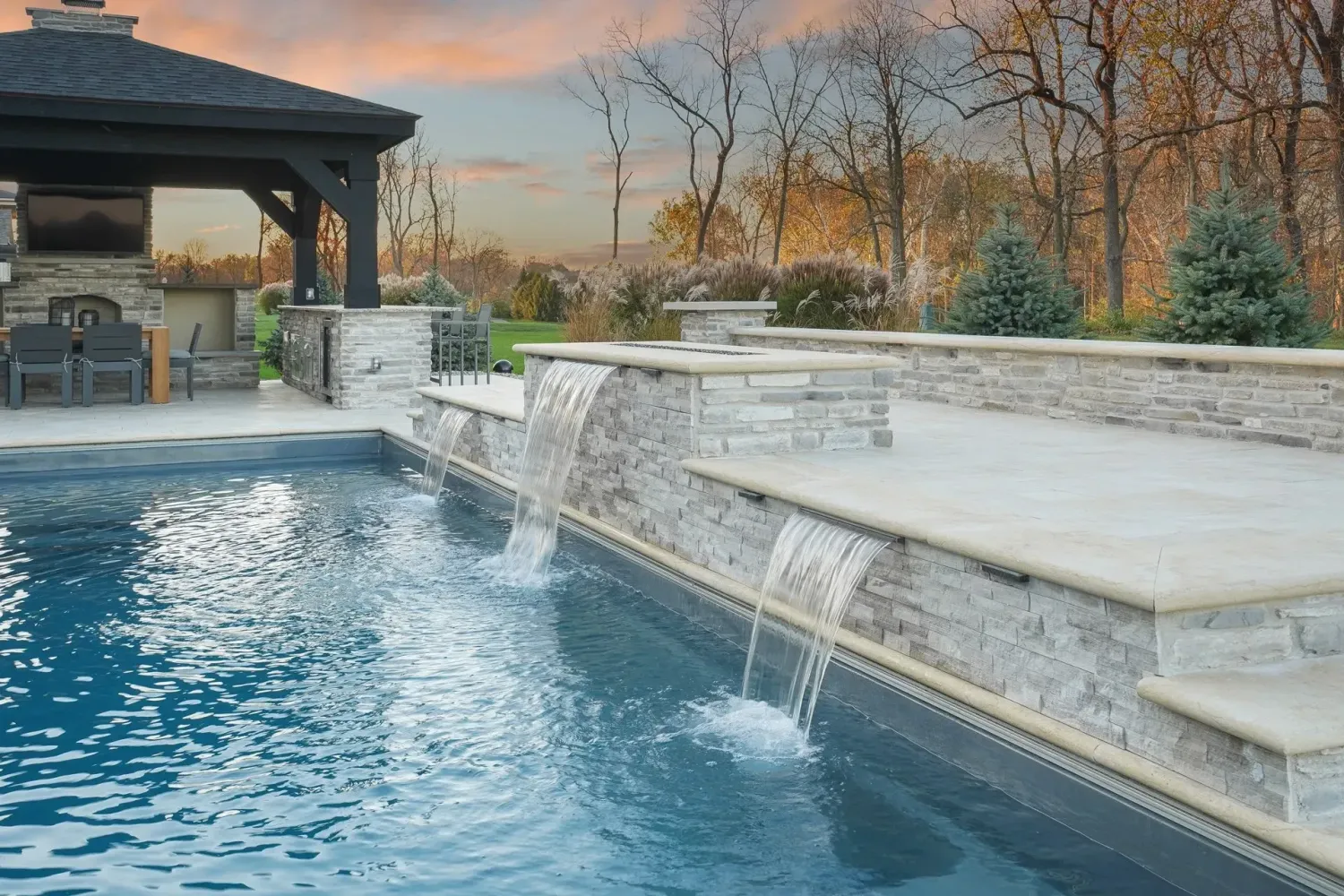
Raised walls: where the deck meets a raised spa bond beam or a pavilion post-base, we wrap the vertical face in matching travertine veneer cut from the same color lot as the field pavers. The veneer is set on a mortar bed over a concrete wall, joints sealed with a matching color-match sanded grout.
Sealing, maintenance, and the stain problem nobody warns you about
Travertine is a calcium carbonate stone. It’s beautiful, it’s cool underfoot, and it stains. Red wine, BBQ sauce, the tannin-heavy leaf drop from the oak canopies in Crooked Creek and Atlanta National, and the iron-bearing runoff from red-clay garden beds all leave marks on unsealed travertine. The solution isn’t avoidance — it’s the right sealer and the right reapplication schedule.
We seal every Milton travertine deck with two coats of Miracle 511 penetrating sealer before handover. 511 is a solvent-based impregnating sealer — it does not form a topical film, so the stone still reads matte and natural to the eye and hand. It blocks water-based and oil-based stains for roughly 24 months in full-sun Milton conditions.
The reapplication schedule we give clients:
- Year 2: Single reapplication coat, one-day job for a 2,000 sqft deck. Runs about $1,800–$2,400 as a service call.
- Years 3–4: Inspection only; spot-reseal high-traffic zones (around the grill, around the steps out of the pool).
- Year 5: Full two-coat reseal. Budget $3,500–$4,800.
Efflorescence — the white mineral haze that sometimes shows up in the first six months after install — is normal on new travertine and it clears with a single treatment of 511 Efflorescence Remover during the first seasonal service call. It is not a defect. It’s calcium salts migrating up through the setting bed and out through the joints. Experienced installers plan for it; inexperienced ones panic and warranty-out stone that’s behaving exactly as it should.
The Manor Golf Club review note: The Manor’s architectural review committee approves French pattern travertine without submittal friction — it’s on the pre-approved material list. Running-bond concrete pavers typically draw a comment and occasionally a revision request. If your Milton lot is inside The Manor, travertine saves you 2–3 weeks of review ping-pong.
Pulling it together: what a real Milton estate deck quote looks like
Here’s the line-item breakdown on a representative Milton project — a 2,000 sqft French pattern travertine deck with a raised spa bond beam, two step-downs, and a 240 sqft pavilion post-base integration. This is a real scope we’ve built, not a textbook example.
- Demolition and haul-off of existing 1,400 sqft concrete deck: $6,200
- Excavation, subgrade prep, base and bedding course (2,000 sqft): $11,800
- Premium travertine material — French pattern, 1-1/4-inch, tumbled cream-tan (2,000 sqft + 10% waste): $34,400
- Bullnose coping, mitered corners (92 linear feet): $6,700
- Veneer on raised spa bond beam and pavilion post bases (58 sqft): $3,900
- Step treads and risers, matching travertine (two step transitions): $5,100
- Installation labor, French pattern layout and setting: $14,200
- Polymeric sand, Gator Maxx G2, color-matched: $1,400
- Miracle 511 two-coat seal, full deck: $2,800
- Subtotal: $86,500
- Milton permit, inspections, and stormwater compliance: included
That scope lands at $86,500 installed, turnkey, with a two-year warranty on the setting bed and a five-year warranty on the stone itself against manufacturing defect. The full job runs roughly 4 to 5 weeks from demo to final seal, assuming weather cooperates and the Milton permit clears on standard timing.
A comparable concrete paver install on the same footprint and scope would run $44,000–$52,000. The travertine premium is real. It buys you stone that reads the same in year fifteen as it reads the week it was installed, a surface temperature that makes summer afternoons usable without outdoor rugs, and a pattern that carries the scale estate houses in Cogburn Estates, Crooked Creek, and The Manor are built to match.
We built our first travertine-at-scale deck in Milton in a project off Birmingham Hwy in 2019. Since then we’ve run the same spec across builds in Bethany Creek, Hopewell Plantation, The Manor, White Columns, and King Estates. The spec hasn’t changed because it keeps working. The stone gets better with age. The clients call us back for fire pits and pavilions and outdoor kitchens on the same decks three and four years later. That’s the test.
Travertine pool decks across 20+ cities within 30 miles of Winder, GA
French pattern travertine at estate scale is a specialty — the stone spec, the setting bed, and the edge work have to line up across 2,000+ sqft for the deck to read right. We run this spec across Milton and the surrounding Metro Atlanta markets.