
Q: “Our ARB in Windward just rejected our paver submittal. What do they actually approve?” A: They approve a short list — Techo-Bloc Blu 60, Blu Grande, and Industria, in three specific greys, laid in running bond with a matched polymeric joint. Everything outside that list gets a rewrite.
That exchange happens in our Alpharetta inbox about twice a month. A homeowner submits a pool-deck design package they pulled from a Pinterest board. The ARB sends back a two-line rejection with no guidance. The homeowner calls us, frustrated, asking what changed. Nothing changed. The rules have been the same for years. They just aren’t written down in the places most people look.
So here is what Windward, Hutchinson Farm, Country Club of the South, and the rest of the North Fulton architectural review boards actually approve for Techo-Bloc pool decks — down to the color numbers, the pattern submittals, the joint sand color, and the perimeter cut width that will flunk your final inspection. If you build in Alpharetta, 30004, 30005, 30009, or 30022, read this before you order pavers.
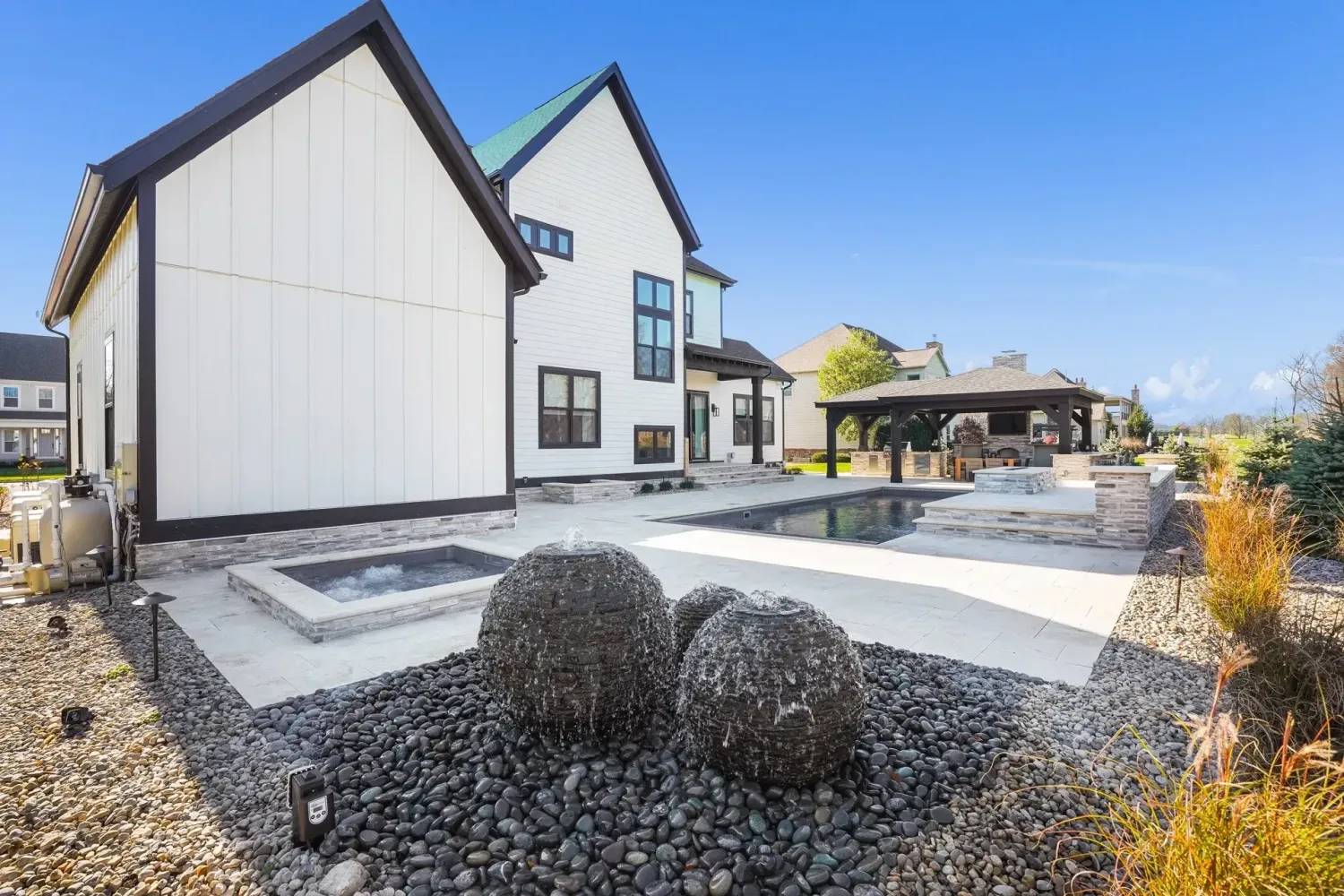
Why Alpharetta ARBs Are Stricter Than the County
Alpharetta is not Fulton County unincorporated. The city runs its own Community Development office at 2 Park Plaza, which means in-city permits move through a dedicated desk with its own inspectors, its own turn times, and — critically — its own expectation that your pool deck matches the architectural language of the subdivision you built it in.
That second part is where the HOAs come in. Alpharetta’s zoning ordinance does not specify paver brands or colors. Your ARB does. And because the city accepts that private covenants are enforceable against the deed, a rejection from the Windward ARB sticks even if the city has already issued your building permit. Plenty of homeowners have paid for pavers, paid for installation, and then paid a second time to tear out and replace because the ARB review happened in the wrong sequence.
The HOAs in the Country Club of the South price band ($1.8M–$3.5M homes) treat pool-deck material selection the same way they treat roof color and driveway material. It is a visual-continuity decision, not an owner-preference decision. The paver has to read as part of the house from 200 feet away. That is why the approved list is short.
There’s a second reason the older Alpharetta subdivisions run tight reviews: the housing stock itself. Windward was platted in the late 1980s and early 1990s, when the architectural vocabulary was Georgian-revival and transitional-traditional. Hutchinson Farm followed the same language. The pool decks of that era were stamped concrete in beige or terracotta, which have aged badly — cracked, faded, stained. When a homeowner removes one of those concrete decks and replaces it with pavers, the ARB’s priority is that the new deck reads as a considered upgrade to the original architecture, not a departure from it. A cool-grey, smooth-face Techo-Bloc slab in a running-bond field hits that target. A warm-tone tumbled cobble in a herringbone fan does not.
The Three Techo-Bloc Products That Get Approved
Across Windward, Hutchinson Farm, White Columns, Country Club of the South, Haynes Manor, and Cambridge Parks, we have not seen a submittal rejection on any of these three Techo-Bloc products when paired with an approved color and pattern:
- Techo-Bloc Blu 60 — the 60mm thickness variant of the Blu slab series. Smooth-face, rectangular format, four face sizes that allow random-ashlar or running-bond layouts. Our default recommendation for pool coping transitions and wide deck fields.
- Techo-Bloc Blu Grande — oversized slab (24″×36″ typical) with a lightly textured smooth face. Reads as modern-traditional. Country Club of the South ARBs favor this one because the scale matches the architecture of the estate homes.
- Techo-Bloc Industria — a linear, quarried-limestone look with a chiseled edge. Approved when the home is more transitional or European-traditional. Not approved in subdivisions with strict Georgian-revival language (Haynes Manor is the edge case — it approves Industria only in Champlain Grey).
Products that routinely get rejected: Borealis (too rustic for North Fulton), Valet (too contemporary), any tumbled-edge cobble in a warm tone. If your contractor proposes Techo-Bloc Mista in a Sandlewood or Chestnut palette, stop and ask to see an ARB-approved job they have already built in your subdivision. We have not seen one.
A note on coping transitions: whichever slab you pick for the deck field, the coping piece directly against the pool water needs to come from the same product line. Mixing a Blu Grande deck with a non-Techo-Bloc bullnose coping creates a visible seam color difference that the ARBs will flag on a site walk even after approval. Techo-Bloc makes a matched coping profile for each of the three approved products, and the additional cost (roughly $6–$9 per linear foot of pool perimeter vs. a generic coping) is the cheapest aesthetic insurance on the build. On a typical Alpharetta freeform pool of 68 linear feet of coping, the upgrade runs $400 to $600. That is a line item worth approving without argument.
Windward + Hutchinson Farm approved palette: Greyed Nickel, Champlain Grey, and Shale Grey. Nothing else passes on first submittal. If your designer shows you Onyx Black or Chestnut Brown, you are about to enter a revision cycle that adds two to three weeks to your build calendar.
Patterns: What Passes, What Requires Extra Submittals, What Gets Killed
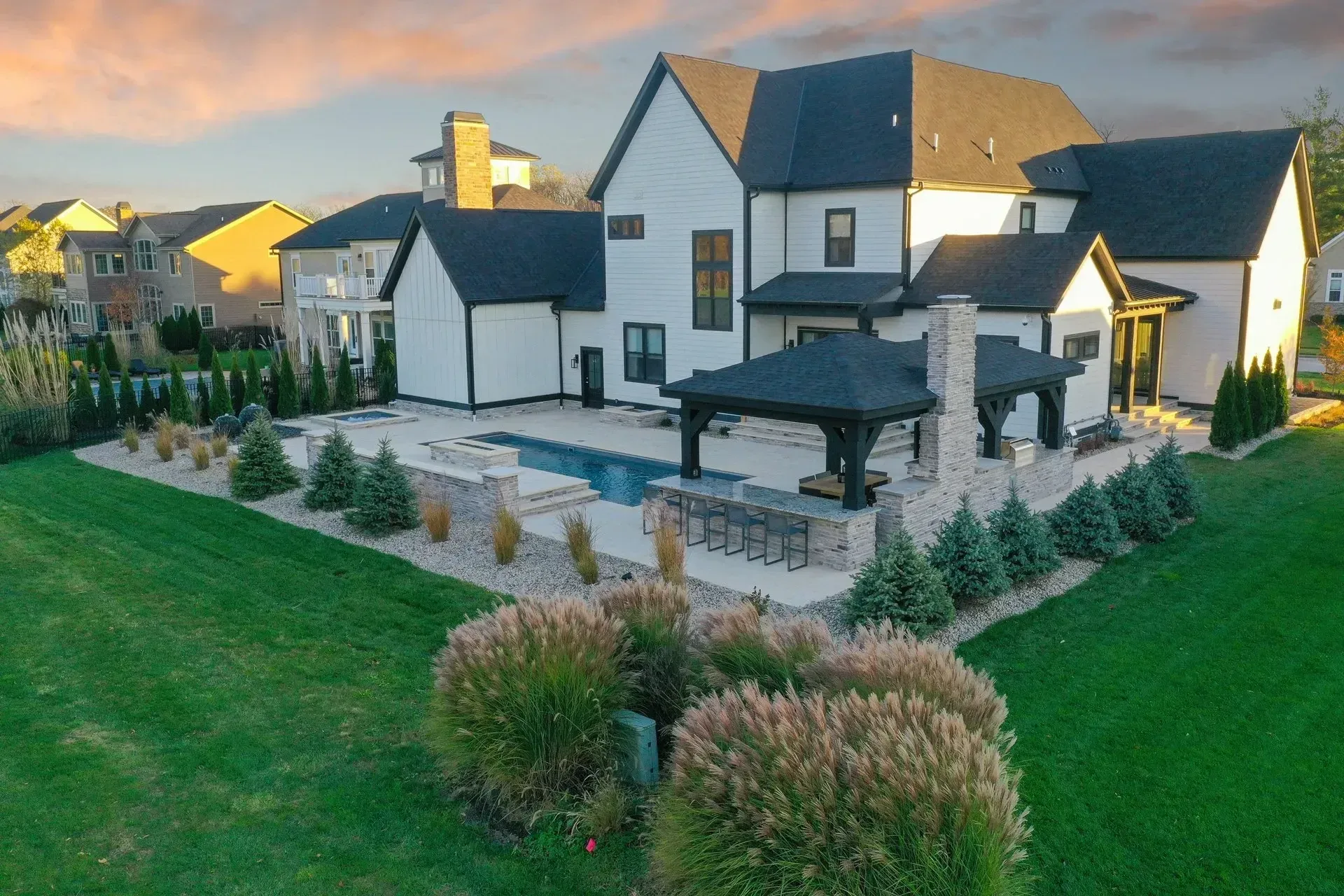
The pattern question is the second place most Alpharetta pool-deck submittals die. The ARBs do not review patterns the same way they review colors. Color is binary — approved or not. Pattern is tiered. Here is the tier system as we have experienced it across the last 40+ Alpharetta projects:
The practical takeaway: if you want no friction and a 3–4 week ARB review to finish on time, submit running bond. If your architect has spec’d herringbone, budget the extra review cycle into your build calendar — which for Alpharetta pool builds generally means pushing the excavation start by two weeks so the crews don’t sit idle while you wait.
One pattern detail that gets overlooked on Windward and Hutchinson Farm submittals: the ARBs also review the orientation of your running bond, not just the pattern itself. On a rectangular deck, running bond oriented parallel to the long axis of the pool reads cleaner than running bond running perpendicular to the water’s edge. Windward’s ARB has rejected decks on the orientation question alone — even with an approved paver in an approved color. If you are submitting a rectangular pool deck, draw the paver run parallel to the longest coping edge. That detail alone has eliminated a second review cycle for two of our last five Windward projects.
The Sample-Board Rule at Country Club of the South
Country Club of the South runs a stricter process than every other Alpharetta HOA we work in. Before your paver order is placed, the CCOTS ARB requires a physical sample board — an 18″×18″ mounted board showing the actual paver, the joint sand color, the coping transition piece, and a color callout noting the Techo-Bloc SKU. This board is reviewed at the monthly ARB meeting, not between meetings.
That means two things. First, the ARB submittal calendar drives your paver order date, not the other way around. If the next CCOTS meeting is in 18 days, your paver order is delayed 18 days minimum. Second, if your sample board is rejected, you wait until the following month — another 30 days. A pool build that misses one CCOTS meeting can easily slide six weeks.
We have learned to pre-stage three sample boards for every CCOTS client: the primary choice, a fallback in a neighboring Techo-Bloc grey, and a third in a slightly different pattern. All three go to the meeting. The ARB picks one. That way nobody leaves empty-handed and the order date holds.
The 2-Inch Cut Rule Nobody Writes Down
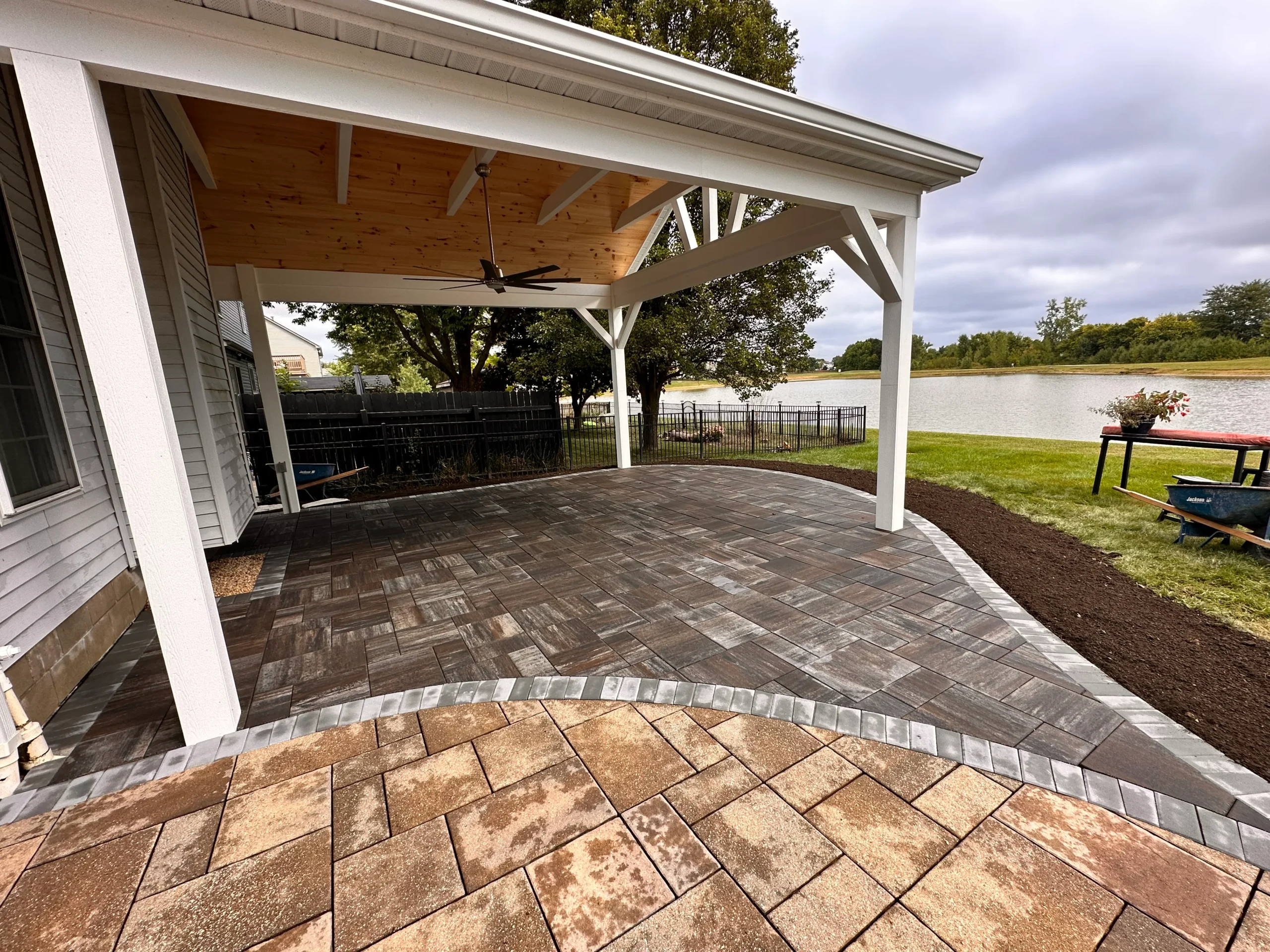
This is the install-quality threshold that separates ARB-approved work from the rework call. Every major Alpharetta HOA we work in will flag — either on final inspection or on the first neighbor complaint — any visible paver cut at the deck perimeter that is less than 2 inches in width. Thin slivers along the coping, along a patio step, along a house wall, will fail.
The rule is not printed in the Windward covenants. It is not in the Hutchinson Farm design guidelines. But every ARB inspector walks the finished deck and eyeballs the perimeter. Sliver cuts read as amateur work. They also fail over time — a 1-inch cut of Blu 60 set into polymeric sand will spall within two or three freeze cycles at Alpharetta’s ~20 freeze events per year in USDA Zone 8a.
The fix is called a pattern reset. Before the crew lays the first paver, a layout stringer is run around the deck perimeter. Wherever a planned cut would fall below 2 inches, the pattern is offset by one paver width so the sliver falls on the opposite side of the cut line — where it becomes a 4-inch or 6-inch cut instead. This decision has to happen at the layout stage, not mid-install. On a 900-sq-ft pool deck, a pattern reset adds roughly $400–$700 in labor if caught early. If it gets missed and the deck is laid, the rework runs $3,800–$6,200 because the perimeter three courses have to come up.
The reason this rule shows up in Alpharetta specifically — and not in every market — comes back to the neighborhoods. Windward, White Columns, and Country Club of the South attract relocation buyers from the tech corridor (Microsoft, CDW, the corporate HQs that seeded the Northpoint submarket) who are used to reviewing construction deliverables the same way they review code. They notice the sliver cut. They photograph it. They email the ARB chair. The ARB chair enforces the standard even when the covenants don’t list it. A crew that has built in Alpharetta for more than a few years knows this instinctively; a crew parachuting in from a lower-scrutiny market does not.
How to spot this on your contractor’s proposal: Ask if the proposal includes “perimeter pattern reset to maintain minimum 2-inch cuts.” If the answer is “we’ll see how it lays out,” the crew doesn’t do pattern resets — they do sliver cuts and hope the ARB doesn’t notice. Walk away. Every Primetime Pools GA Alpharetta deck is laid off a perimeter stringer before the first paver drops.
Joint Sand: The Detail That Fails Your Submittal After Everyone Approves the Paver
Polymeric sand color is the last thing most Alpharetta homeowners think about. It is also the second-most-common reason an ARB chairman sends a follow-up note three days after approval saying, “We need to see the joint sand color spec.”
The approved-by-default spec across Windward, Hutchinson Farm, Haynes Manor, and Cambridge Parks is Gator Maxx G2 in Slate Grey. It matches the three approved paver colors without calling attention to itself, it holds up to the Piedmont clay’s shrink-swell behavior (the base moves; the joint has to move with it), and it resists the ant colonies that find every other polymeric sand in North Fulton.
If your contractor proposes Gator Maxx in Beige, Ivory, or Sandlewood, you are heading toward a rejection. These colors read against the approved paver palette. The ARBs call them out specifically. Same for any non-polymeric jointing — standard mason’s sand or bagged silica will wash out in the first heavy Alpharetta summer rainfall (the city averages ~51 inches of annual rainfall, with July thunderstorms that drop 1–2 inches in under an hour).
On Cecil-series red clay — the dominant Alpharetta soil — the polymeric sand is doing more than cosmetic work. The clay’s shrink-swell cycle drives joint movement of 1/8″ to 1/4″ seasonally. A polymeric that can’t flex will crack, water will reach the base, and the base will wash. That is how a five-year-old deck starts to look like a ten-year-old deck. Gator Maxx G2 handles this; generic polymerics do not.
There is one install-day detail that separates a joint that lasts 15 years from one that fails in 3: the crew has to activate the polymeric with a light water mist, not a hose. Almost every failure we see on deck rework calls comes back to polymeric over-saturation from day one — the installer hits the joints with full hose pressure, washes out the activator, and the polymeric sets without the binding chemistry. A proper install uses a fogger attachment, two passes, 90 seconds apart. If you can, be home on install day and watch that step. It takes 20 minutes and it determines how the deck holds up through Alpharetta’s 8a winter freeze-thaw.

The Base Beneath the Paver — What the ARB Doesn’t See
The ARB doesn’t review your base. The city inspector does, and in our experience only halfway. What holds up a Techo-Bloc deck for 25–30 years in Alpharetta has almost nothing to do with the paver and almost everything to do with what is underneath it.
The Cecil-series Piedmont soil that dominates North Fulton has moderately-high shrink-swell behavior. In a dry August it contracts. After a wet February it swells. A paver base set directly on compacted clay will ride that movement, and within year 4 or 5, joints open, pavers tilt, and the deck reads tired. Polymeric sand can only bridge so much.
The Primetime Alpharetta base spec, which we write into every contract:
- Excavation to 12 inches below finished grade across the full deck footprint — not just the perimeter
- A non-woven geotextile fabric separator layer over the subgrade (Mirafi 140N or equivalent — this is the single cheapest insurance you can buy at about $0.28 per square foot)
- 8 inches of open-graded #57 stone, compacted in two 4-inch lifts with a 5,000-lb plate compactor (GEO-certified)
- 1-inch bedding course of #89 stone, screeded — never sand bedding on clay subgrades
- Paver + polymeric joint above
A pool deck built this way will outlast the pool shell. Across the last 15 years of pool decks we have built along the GA-400 corridor (exits 9, 10, 11, 12), we have zero base-failure callbacks on decks built to this spec. The ones that do fail — and we’ve rebuilt several — were laid on compacted sand or 4-inch crushed-run bases because the original builder quoted low to win the job.
Budget reality: an Alpharetta Techo-Bloc pool deck built to this spec, using Blu 60 or Blu Grande in one of the three approved greys, Gator Maxx G2 joints, and proper base depth, runs $28 to $42 per square foot installed, depending on cut complexity and coping. A 900-square-foot pool deck lands roughly $25,000–$37,000. Decks quoted below $22/sf in Alpharetta are almost always cutting base depth, skipping the geotextile, or using a lesser polymeric.
For homeowners who want a reference point: the pool decks we have built in Windward and Hutchinson Farm over the last five years have averaged 1,050 square feet around the pool shell, plus another 250–400 square feet of connecting patio back toward the house. Total paver footprint on a typical North Fulton pool build lands near 1,400 square feet, which puts the all-in deck line item at roughly $39,000 to $58,000 once you factor coping upcharges, step treads, and the drainage channel at the back of the deck. That is a meaningful number, and it is also one of the few places on the project where cutting the budget by 15% cuts the service life of the deck by half.
Electric-service coordination note: Alpharetta pool projects on Georgia Power’s service drop run a different inspection calendar than the northern pocket served by Sawnee EMC. If your home sits along the Alpharetta / Milton border near Windward Parkway or Hembree Road, check the meter before planning your schedule — the wrong utility-service assumption can add 5–8 business days.
Custom Pool Decks across 20+ cities within 30 miles of Winder, GA
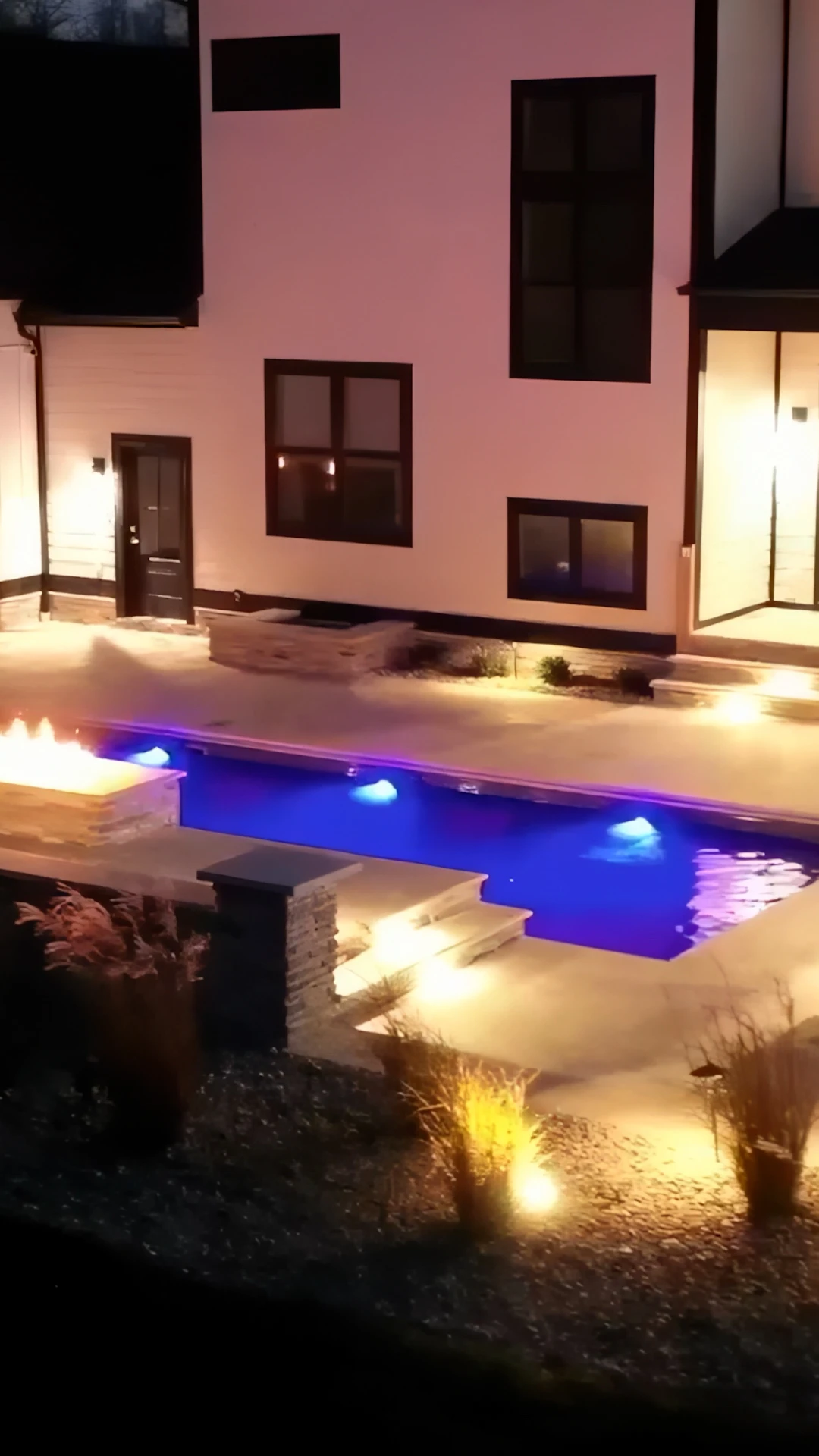
From Country Club of the South ARB submittals in Alpharetta to estate-lot pool decks in Milton and Johns Creek — we build Techo-Bloc pool decks that pass every architectural review board in North Fulton on the first submittal.