
Which paver brands and colors will Atlanta National and Crooked Creek actually approve without a six-week back-and-forth? The short answer: Techo-Bloc Blu 60, Blu Grande, and Belgard Dimensions — in palette-appropriate colors tied to the clubhouse stone.
If you are building a pool deck behind an estate home in Milton, the architectural review committee is going to ask three questions before they look at anything else. What brand is the paver. What color is the paver. What pattern is it laid in. Get those three specifications aligned with the HOA palette on day one and your submittal clears in 10 to 14 business days. Get them wrong, and you are resubmitting through the next monthly board cycle.
This post is not a general overview of pool deck paver selection. It is a Milton-specific field guide based on what the two most active HOAs in the city — Atlanta National at TPC and Crooked Creek — will approve without a formal variance request. If your home sits in either community, or in The Manor, White Columns, Cogburn Estates, or Bethany Creek, the palette rules below will save you weeks.
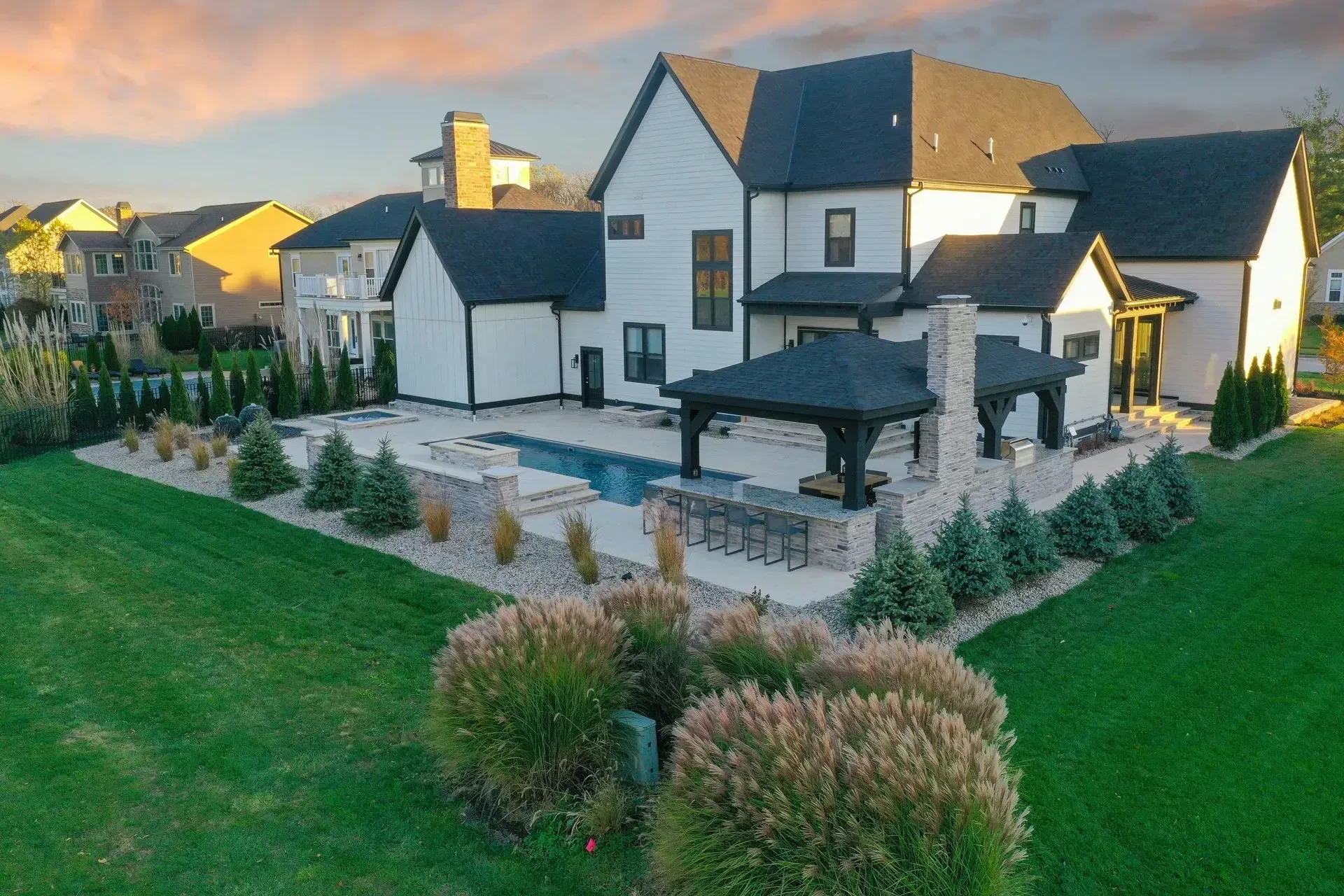
Why Milton HOAs Tie Paver Color to Clubhouse Stone
Atlanta National and Crooked Creek were both master-planned around golf course architecture. The clubhouses, cart barns, monument walls, and gatehouses were designed with a specific natural stone palette — warm grey, sand, and charcoal blends that read as Appalachian fieldstone at a distance. When a homeowner drops a brand-new pool deck in a loud red-brown or stark black paver, it breaks the visual continuity the community was designed to protect.
That is why both HOAs restrict backyard hardscape colors to the clubhouse palette. At Atlanta National, the approved poolside paver colors are Greyed Nickel, Sandlewood, and Champlain Grey. At Crooked Creek, the palette runs slightly warmer: Sandlewood, Shale Grey, and Greyed Nickel are all cleared, while Onyx Black and pure whites are not. If the house in question backs up to a fairway or sits within sightline of the clubhouse, color compliance tightens further — expect the committee to request a physical sample placed on the jobsite for 48 hours before final signoff.
The City of Milton itself does not regulate paver color. Milton Community Development at 2006 Heritage Walk reviews pool permits for structural compliance — pool fencing, setbacks, creek-buffer distances, drainage. The color question lives entirely inside the HOA architectural review process. That is a two-track approval system, and missing either track stops the project cold.
Atlanta National approved poolside pavers: Techo-Bloc Blu 60, Blu Grande, Travertina Raw — colors limited to Greyed Nickel, Sandlewood, Champlain Grey. Belgard Dimensions 3-piece in Victorian or Bella — same color family.
Techo-Bloc vs Belgard: Which Line Fits Which Milton Subdivision
Techo-Bloc and Belgard are the two paver manufacturers with sufficient product depth, color range, and installer network in North Fulton to carry a Milton HOA submittal cleanly. Both make dimensional pavers in the 24×24 and 24×36 sizes that Atlanta National’s review board treats as default-approved. The difference is in texture and pattern flexibility.
Techo-Bloc Blu 60 is a smoother, more architectural surface — cleaner edges, tighter joints, reads as contemporary-traditional. It fits the newer sections of Crooked Creek and the custom homes along Freemanville Road. Blu Grande is the oversized (24×36) version, specified for estate pool decks over 1,200 square feet where the larger format keeps the visual scale proportional to the house.
Belgard Dimensions runs a hair more rustic — a subtly textured face and a three-piece system (6×9, 9×9, 9×12) that interlocks into random-ashlar patterns. This line fits Atlanta National’s TPC traditional architecture and the Appalachian-stone aesthetic of older homes in Hopewell Plantation and Greystone. Belgard’s Victorian colorway is the closest direct match to Crooked Creek clubhouse stone.
Travertine — real travertine, not a travertine-look porcelain — is a separate category. Both HOAs permit it in Silver, Walnut, and Ivory finishes, but it carries a sealing maintenance schedule that pavers do not. For estate pool decks in The Manor Golf Club, travertine is frequently the chosen material because the Paul Tesori-designed course and clubhouse palette leans toward that warmer cream-silver range. The Manor also adds a structural review step on top of the architectural review — expect 4 to 5 weeks through their committee even when the material is pre-approved.
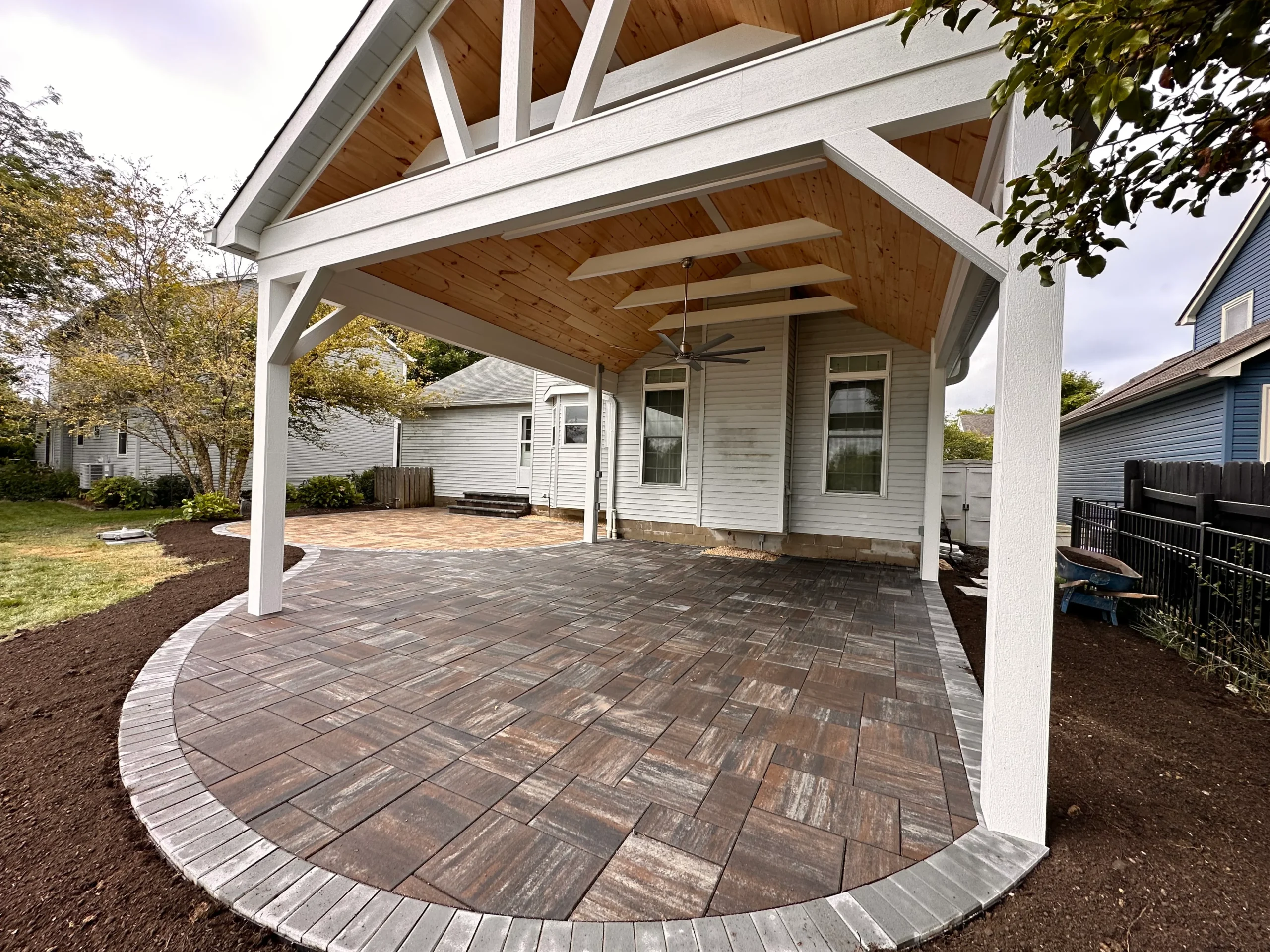
Pattern Rules: Running Bond vs Herringbone vs Random Ashlar
Pattern is where most Milton submittals get kicked back for revision. The rule at both Atlanta National and Crooked Creek is straightforward: running bond is pre-approved, herringbone requires formal board approval, and random ashlar is reserved for estate lots above three acres with specific architectural justification. This ordering is not aesthetic preference — it is about visual noise against the golf course backdrop.
Running bond is the default. It reads as quiet. The paver lines follow the pool edge and run parallel to the house. Atlanta National approves this pattern in any of the three palette colors without a submittal meeting — it moves through staff-level review only. Expect 10 business days from application to approval letter.
Herringbone is where the submittal requires the full architectural review committee. Herringbone reads as busier and more formal — it was historically associated with European driveway hardscape, not poolside leisure space. The committee will approve it, but they want to see a scaled drawing with the pattern orientation clearly marked, a material sample board, and photographs of the home’s existing exterior for palette context. This adds three to four weeks to the timeline.
Random ashlar — the multi-size three-piece pattern in Belgard Dimensions — is the most restricted. Both HOAs require the lot to be at least three acres with the pool deck more than 75 feet from any neighbor’s property line. The rationale: random ashlar has the most visual weight, and at smaller lot sizes it overwhelms the adjacent sightlines. If you are in the estate sections of The Manor or the deeper lots along Hopewell Road, this is available. On a compact 1-acre Crooked Creek lot, it is not.
Real Installed Pricing on a 1,400 sqft Milton Paver Deck
A 1,400 square foot paver pool deck is the median Milton project. That number comes from the typical estate pool footprint (20×40 with diving-end radius) plus a usable deck border running 6 to 8 feet wide on three sides and 10 to 14 feet on the primary sun-lounger side. On tighter Crooked Creek lots you might come in at 1,100 sqft. On Manor or Cogburn estate lots you are often at 2,000 sqft or above. The 1,400 number is a clean Milton benchmark.
Installed pricing for that footprint, fully done to HOA spec, runs $40,000 to $56,000. Here is what drives the spread across that range.
- Paver cost per sqft: Techo-Bloc Blu 60 runs $5.50 to $7.00 per sqft delivered. Blu Grande runs $7.00 to $9.00. Belgard Dimensions is comparable — $5.75 to $8.50 depending on color and pattern mix. Travertine (real, not porcelain) runs $9.00 to $14.00.
- Base prep: Milton sits on Cecil clay over weathered granite. Expect 6 inches of compacted GAB stone base plus 1 inch of bedding sand. On sloped lots — and most Milton estate lots have a 6 to 14 foot drop across the building envelope — add 15 to 25 percent for excavation, grade correction, and retaining.
- Edge restraint and joint polymer: Non-negotiable on any deck that borders a saltwater pool. Polymeric sand with wetting stabilizer adds $1.25 to $1.75 per sqft. Concrete edge restraint on the pool coping side adds roughly $35 to $50 per linear foot.
- Pattern labor: Running bond is baseline. Herringbone adds 10 to 15 percent to labor. Random ashlar adds 20 to 30 percent because of the cut work and the brain-cycles required to keep the random pattern from repeating visually.
- Site access: Many Milton estates sit on long driveways with gates, circular drives, or equestrian buffers. If the paver delivery truck cannot get within 80 feet of the pad, add wheelbarrow labor at 3 to 5 dollars per sqft.
Service life on this spec is 25 to 30 years before any major relay, provided the base is built correctly and the polymeric joints are refreshed once at roughly year 12. Compare that to broom-finish concrete at the same footprint — $28,000 to $38,000 installed, 12 to 18 year service life before visible cracking on Milton’s clay-over-granite substrate.
Milton 1,400 sqft paver deck pricing (HOA-compliant, Techo-Bloc or Belgard): $40,000 to $56,000 installed. Includes 6″ GAB base, polymeric joints, concrete edge restraint, and pool coping integration.

The Two-Track Approval Timeline: City of Milton Plus HOA
Any pool deck in Milton has to clear two separate reviews running in parallel. These are independent — a green light from one does not speed up the other, and a red flag from either one stops the work.
Track one — City of Milton Community Development. This is the structural and code review. When Milton incorporated as a separate city from Fulton County in 2006, it took over permit authority from the county. That means permits go through the city office at 2006 Heritage Walk rather than the Fulton County permit counter downtown. The turnaround is faster — 10 to 14 business days for a straightforward pool and deck — but preservation review is stricter. The city checks creek-buffer setbacks (25 to 75 feet from any named tributary including Cooper Sandy Creek, Chicken Creek, and Lake Creek), equestrian preservation zoning compliance (AG-1 zoning imposes a 1 to 3 acre minimum lot size depending on the section), pool fence code, and drainage discharge.
Track two — HOA architectural review. This is the aesthetic and community-standards review. Atlanta National and Crooked Creek both run monthly committee cycles. Crooked Creek meets on the second Thursday of each month; Atlanta National meets on the third Tuesday. Submittals received less than 10 days before the meeting roll to the next cycle. The Manor Golf Club runs a separate structural review subcommittee that adds one to two weeks on top of the standard aesthetic review.
The trap: if your material submittal to the HOA clashes with the palette rules, the HOA will not issue an approval letter, and Milton Community Development will not issue a final certificate of completion without that letter on file. We have seen projects sit unusable for six weeks post-construction because the polymeric sand color was a shade too dark and the homeowner had to swap out the joint material across the entire 1,400 sqft deck.
The fix is sequencing. On every Milton paver deck project, we open both tracks on the same day — city permit application and HOA submittal packet sent in parallel, with identical drawings, material specs, and color samples. That way the reviews run side by side and both clear within the same three-week window.
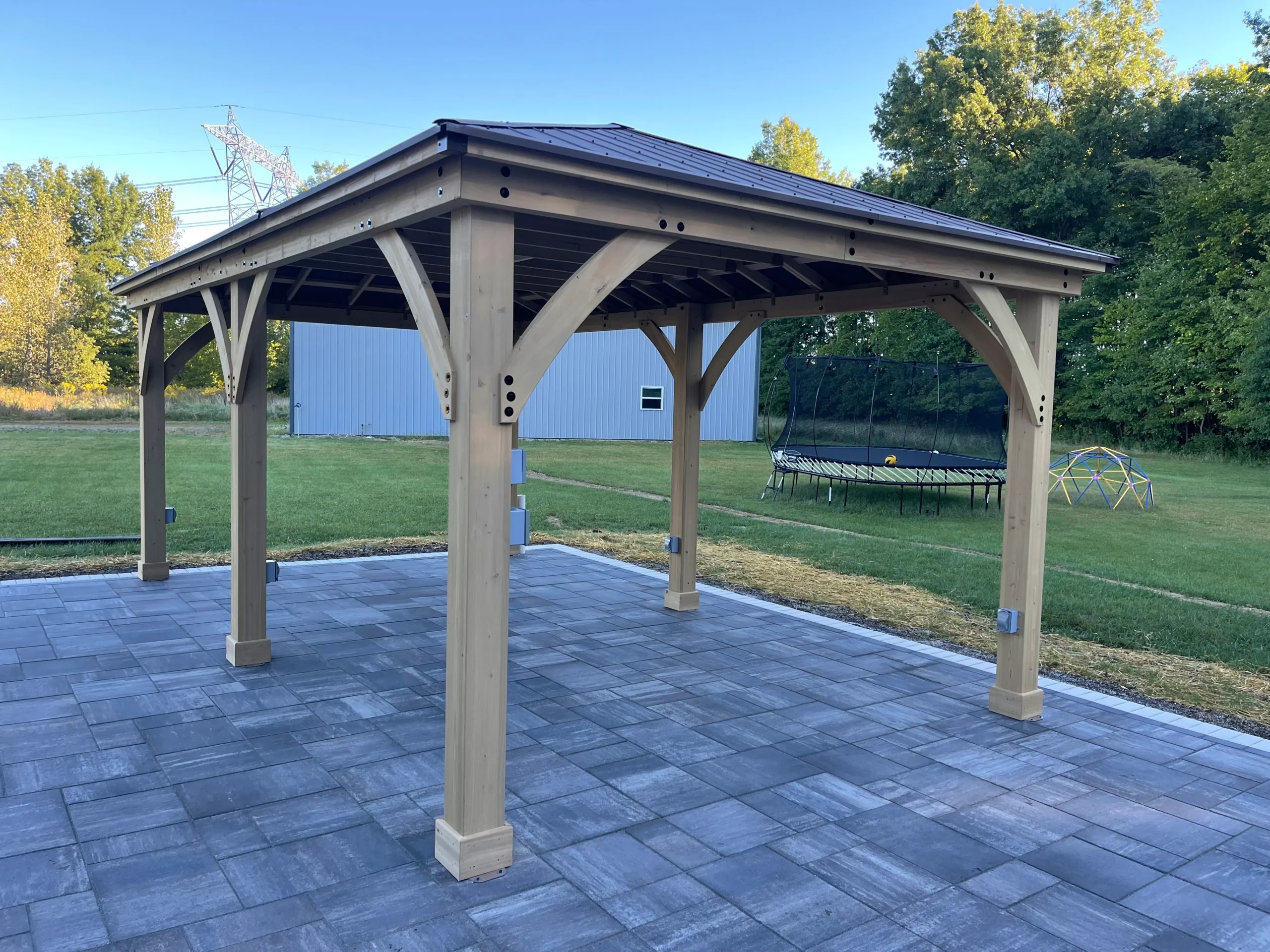
Signature Specs on a Milton HOA-Compliant Deck Build
The last category worth naming is the set of build-quality specs that separate a 25-year deck from one that starts failing at year 8. These are not aesthetic — they are mechanical — but they also do not show up in the HOA submittal packet, so homeowners who focus only on color and pattern often miss them.
Sub-base depth on Cecil clay. Milton’s soil is Cecil clay over weathered granite saprolite. Clay moves with moisture cycles. A 4-inch base will work for a patio that is walked on; it will fail under a pool deck that carries lounger loads, foot traffic, and occasional wheeled equipment. We spec a minimum 6-inch compacted GAB base, with 8 inches on the sections closest to the pool coping. On lots where excavation encounters a saprolite shelf (common on ridgeline parcels off Hopewell Road and Freemanville), the saprolite acts like rock and the base goes down only to the shelf — no over-excavation needed.
Drainage geometry. Milton averages 53 inches of rainfall per year. A paver deck that slopes toward the house is a failure waiting to happen. Minimum slope is 1/4 inch per foot running away from all structures, with a dedicated drainage channel on the upslope side if the pool pad cuts into a hillside — which it almost always does on Milton’s rolling topography. On estate lots with 10-plus foot grade changes across the building envelope, a French drain or channel drain behind the deck is standard spec, not an upgrade.
Creek-buffer compliance. If the pool pad sits within 75 feet of Cooper Sandy Creek, Chicken Creek, Lake Creek, or any named tributary, Milton Community Development will require a state stream buffer variance along with the standard permit. That adds 4 to 6 weeks and involves the Georgia EPD. We check creek setbacks against the county GIS before site planning begins, because rerouting a pool 20 feet away from a tributary is trivial at the design stage and impossible at the build stage.
Freeze-thaw joint tolerance. Milton sits in USDA Zone 8a and sees roughly 22 freeze events per year. That is enough to matter for polymeric sand selection but not enough to require a full freeze-thaw paver rating. We spec high-polymer joint sand with a hardening agent rated for 50-plus freeze cycles, which is well above the Milton climate envelope but gives the homeowner a buffer if they travel and leave the pool covered through January. The alternative — standard sand — washes out after 3 to 5 years and requires a full re-sweep, which becomes an HOA submittal question if a color touch-up is involved.
Coping integration. The transition from pool coping to deck paver is the detail that kills more Milton pool decks than any other failure mode. The coping stone sits on the bond beam of the pool structure. The deck pavers sit on the GAB base. Those two substrates move independently. We run a flexible polymeric joint between coping and deck, never a rigid mortar joint, and we spec the first row of deck pavers cut rather than full — so the visual line follows the pool’s geometry, not the paver’s factory dimensions.
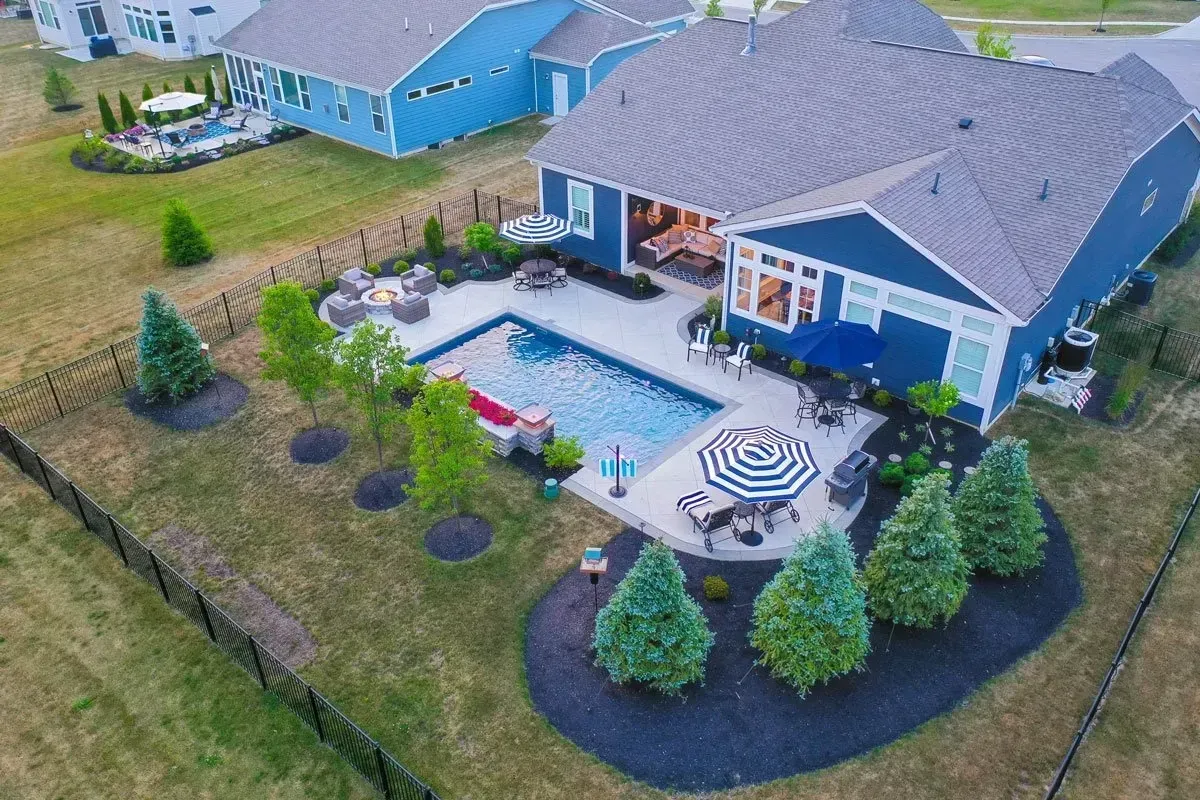
HOA-compliant Techo-Bloc and Belgard pool decks across 20+ cities within 30 miles of Winder, GA
From Milton estate lots backing up to the TPC fairway to Crooked Creek subdivision pools, we run the city permit and HOA architectural submittal in parallel so the deck clears in a single three-week window.