
She handed me a laptop open to a Notion page. Bullet one: “morning lap swim, 25-minute window before 8 a.m. standup.” Bullet two: “midday cold plunge, 4-minute cycle, return to Slack by 12:35.” Bullet three: “Thursday patio, ten people, no kids.” The house was a 2019 build off Windward Parkway, the moving truck was still in the driveway, and her husband had just accepted a staff engineer role in the Microsoft Atlanta hub. She wanted swim-ready by Memorial Day. It was the first Tuesday of December.
That conversation, or some version of it, has happened in fourteen Alpharetta backyards since 2021. The relocation wave out of Redmond, Chicago, the Bay Area, and Austin into the Avalon-Haynes-Windward corridor has shifted the custom pool brief in ways most pool builders are still learning to read. The buyers are not Atlanta natives. They are not bringing kids who want a diving board. They are bringing a lifestyle pattern — morning laps, midday reset, evening entertaining, all scheduled around a 10 a.m. and 2 p.m. meeting block — and they want a backyard that keeps the rhythm without disrupting the workday.
This post is the brief we’ve built for that buyer. The geometry, the equipment list, the budget bands, the permit-path sequencing, the HOA choreography. Not a generic custom pool overview. The actual pool-for-a-tech-worker-who-just-moved-to-Alpharetta blueprint, priced and scheduled against the hard deadline every one of these families shares: the first warm weekend of May.
The Relocation Pattern: Why This Buyer Is Different
Atlanta-native buyers usually walk into a pool consultation with memories. Their parents had a pool. Their cousins had a pool. They want the freeform kidney shape with the tanning ledge and a slide because that’s what summer looked like when they were twelve. The pool is emotional infrastructure.
The relocation buyer walks in with a calendar. Microsoft’s Atlanta hub anchors the north end of the corridor near Windward, CDW operates out of North Point, HPE has pulled staff into the same geography, and Chick-fil-A corporate on Buffington Road pulls a steady stream of product and engineering transplants into the 30004 and 30005 zips. These are hybrid workers. Two or three days in the office, two or three days home. The home days run 7 a.m. to 7 p.m. with meetings stacked tight. The pool has to fit inside a workday.
When we sit down for the first consult, the questions we ask are not “how many kids” and “do you entertain.” They are: when is your first meeting, when is your last, what does your lunch block look like, and how many evenings a week do you host. The answers drive the geometry more than any site-planning software does.
Geometry: The 30×10 Lap Lane, Cold Plunge, and Work Ledge
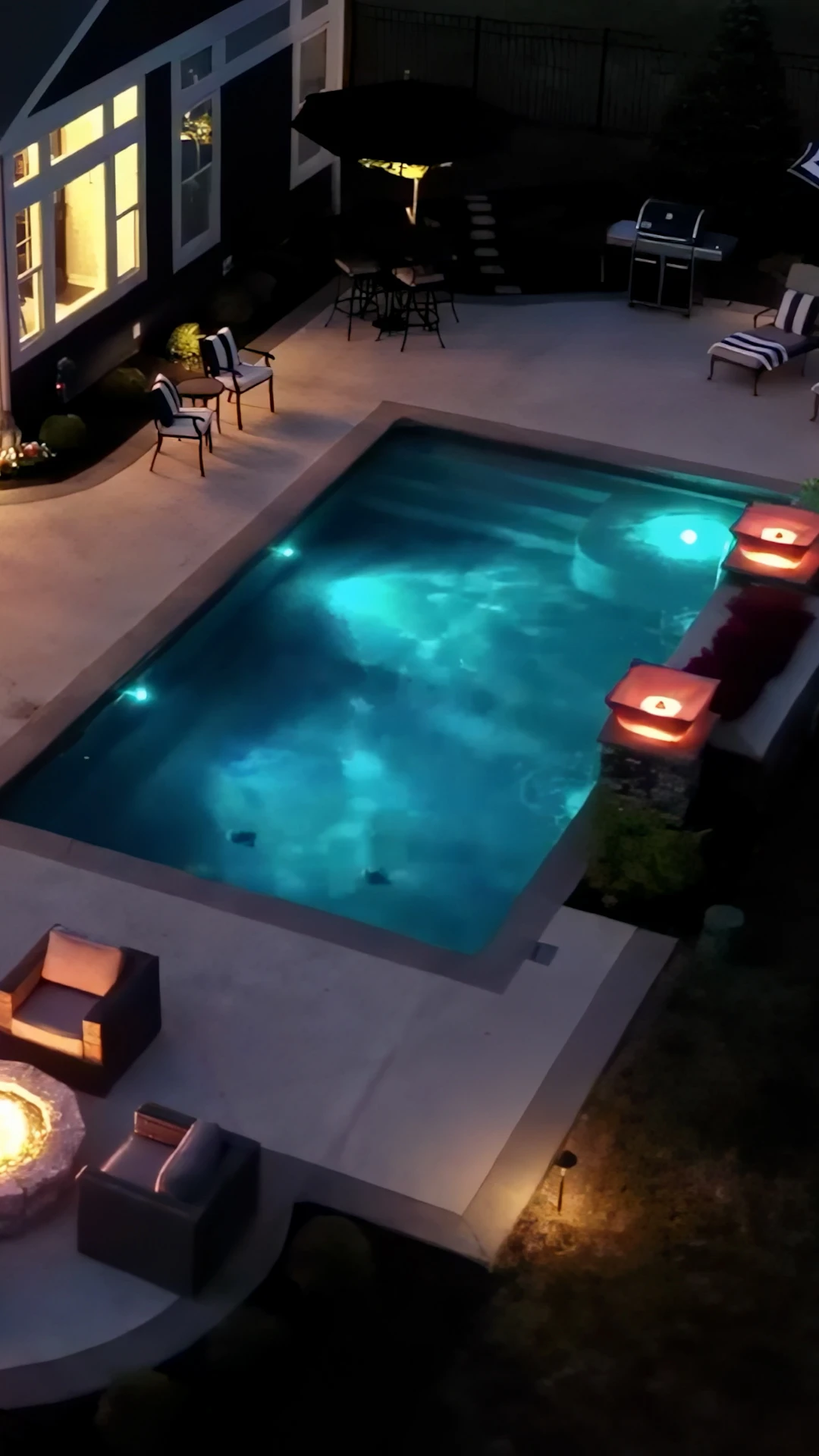
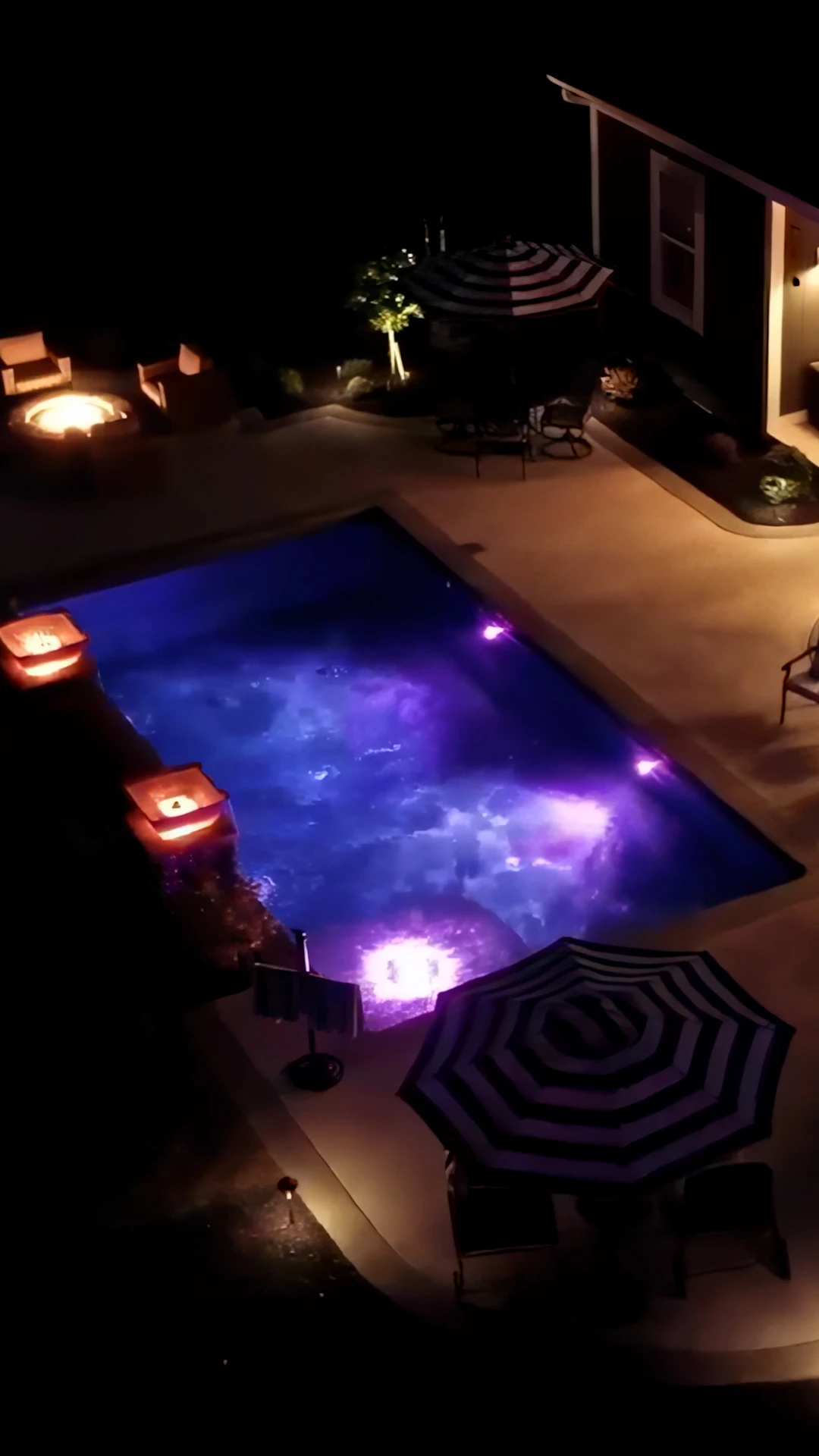
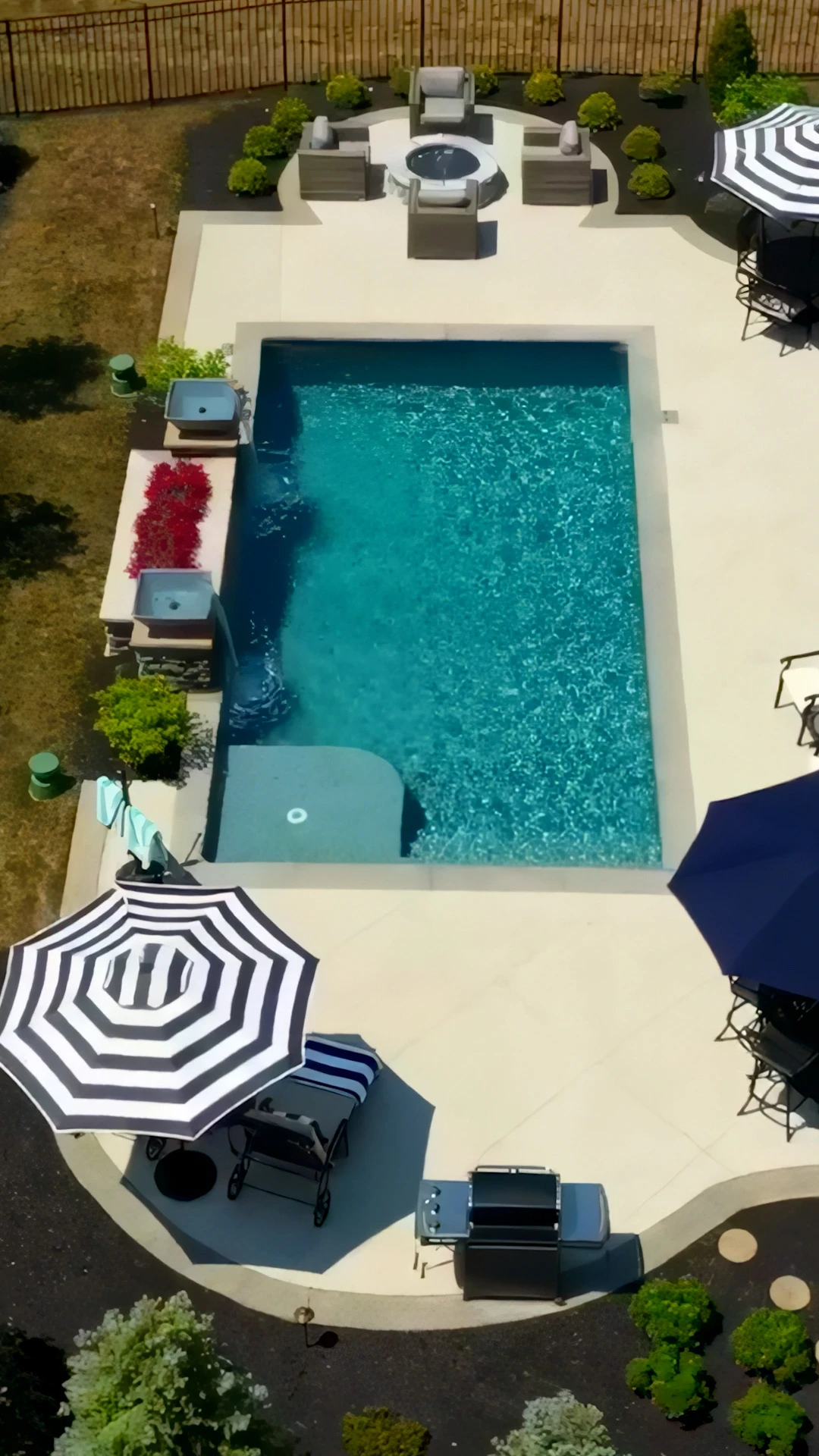
The shape that has emerged as the default — after enough of these briefs that we stopped treating each one as custom — is a 30-foot by 10-foot lap lane with a square spa tucked into one corner, a separate cold plunge tank, and a shallow shelf wide enough to hold a laptop at sitting height.
The 30-foot length is the smallest dimension that returns a usable freestyle stroke count. A competitive swimmer wants 25 yards; a workday swimmer will take 30 feet and bank the time savings. Width at 10 feet allows one swimmer plus a tether point for the second adult if both spouses swim. Depth tapers from 3’6″ at the shallow end to 5’0″ at the deep — shallow enough that the shelf end reads as a walk-in, deep enough that the stroke doesn’t scrape bottom on the turn.
The spa is almost always 7’x7′ square, perimeter overflow, matched to the pool coping material so it reads as part of the architecture rather than a bolt-on. Six to eight jets, not twenty. The relocation buyer uses the spa for a 10-minute decompress, not a full hydrotherapy session, and too many jets turn the surface chaotic.
The cold plunge spec: separate 4’x4’x4′ concrete vessel, dedicated 1 HP chiller unit, target 50–54°F, hold window 3–5 minutes. Routed on its own equipment pad so the main pool pump schedule isn’t bent around plunge temperature.
The shelf — we’ve been calling it the work ledge — is the detail that signals this was built for the laptop-and-pool lifestyle. Ten inches of water over a bench wide enough to seat two adults, a waterproof outlet 18 inches behind the coping on the house side, and a shade sail mount above it rated to cover a MacBook screen at 1 p.m. in July. It’s not ostentatious. Most visitors would read it as a standard tanning ledge. The owner knows it’s where Thursday’s 2 p.m. call happens.
Budget Bands: What $185K to $245K Actually Buys
The honest number on this brief, installed in Alpharetta, runs $185,000 to $245,000 depending on finish selections, hardscape scope, and whether the cold plunge is structural or drop-in. Under $185K and something gets cut — usually the plunge or the integrated spa falls to a standalone unit. Over $245K and you’re layering in custom water features, pavilion construction, or a pool house that’s really a separate project.
Here’s how the budget typically distributes on a representative Country Club of the South or Haynes Manor build:
- Shell, steel, shotcrete, plumbing, deep electrical: $95,000–$115,000
- Interior finish (pebble or polished quartz aggregate): $14,000–$22,000
- Coping, tile, perimeter band: $11,000–$18,000
- Equipment pad — pump, heater, salt chlorinator, automation: $16,000–$24,000
- Cold plunge — structural, separate chiller, insulation: $22,000–$32,000
- Surround deck (travertine or large-format porcelain, 600–900 sq ft): $18,000–$34,000
- Permit, survey, grading, erosion control: $6,000–$9,000
- Shade structure, work-ledge electrical, landscape finish: $8,000–$14,000
Equipment brand doesn’t vary much — the pad is almost always a Pentair IntelliFlo3 VSF pump, Pentair MasterTemp 400 heater, salt chlorination (never tablet), and Pentair IntelliCenter automation so the owner can trigger heat from a Slack break. The cold plunge pad runs a separate loop with a Penguin Cold Plunge 1 HP chiller or equivalent, insulated from ground heat transfer by closed-cell foam under the shell.
The Alpharetta Permit Path: City Hall Beats the County
One of the quiet advantages of building in Alpharetta city limits versus unincorporated Fulton is the permit desk. City of Alpharetta Community Development runs permits out of 2 Park Plaza, and the residential pool review cycle is consistently faster than Fulton County’s unincorporated queue — typically 2–3 weeks from complete submittal to approved permit versus 4–6 weeks through the county.
The submittal packet for a pool in the city limits wants site plan with setbacks (10′ side, 10′ rear minimum from property line for in-ground pool structure, plus separate fence-enclosure compliance), engineered shell drawings, electrical one-line, equipment layout, and grading plan. If the lot slopes more than 4 feet across the pool footprint — common along the ridge-and-valley topography of Windward and Country Club of the South — a retaining wall detail stamped by a Georgia PE gets added.
Fence compliance under Alpharetta code mirrors the Georgia state pool barrier standard: minimum 4-foot barrier, self-closing self-latching gate, no horizontal members on the outside face that give a toehold. Most HOAs layer stricter fencing review on top of this — more on that in a moment.
Permit reality, tech-corridor pace: For a December contract and a Memorial Day swim deadline, the permit packet must be in at 2 Park Plaza no later than the second week of January. That leaves 12–14 weeks for excavation, shell, plumbing, gunite cure, finish, and startup. Lose a week to HOA review and the window collapses.
HOA Architectural Review: Windward, CCOS, Cambridge Parks
The architectural review committees (ARBs) in the older Alpharetta subdivisions run hard. Not obstructionist — most of them have a board that understands pools are part of the community’s value — but detail-oriented. Windward’s ARB runs a 3-week review cycle. Country Club of the South runs 3–4 weeks. Newer HOAs like those around Cambridge Parks and the Avalon townhome communities sometimes cycle in 10 days, sometimes stretch to a month depending on the board’s quarterly calendar.
What they want to see: site plan showing pool and deck footprint, elevation sketch of any structure over 24 inches above grade (pavilion, shade sail posts, pool-house), equipment pad location and screening plan, finish material samples or at minimum manufacturer-grade photos, and — the detail that trips up outside builders — fence type and color matched to community standards. Windward, for example, has a preference for black aluminum 4-foot fencing that disappears against the wood-line rather than the white vinyl that would read loud against brick façades.
The sequencing move that keeps the Memorial Day deadline intact is parallel submission. The HOA packet and the city permit packet go in the same week. Not HOA first, then wait for approval, then submit to the city — parallel, with the understanding that final excavation doesn’t start until both are returned. This saves 2–3 weeks on the critical path.
Soil, Slope, and the Georgia Power / Sawnee EMC Split
Alpharetta’s ground is Piedmont Cecil-series clay with pockets of Appling sandy loam where older farm conversions occurred — Hutchinson Farm, parts of Rucker Road corridor, sections of Ashebrooke. The clay is moderately shrink-swell, which matters for two engineering decisions: the shell’s perimeter drain depth and the deck’s base prep.
On the shell, we run a perimeter drain 8 inches below the deepest shell elevation, wrapped in filter fabric, daylighted to a pop-up or storm structure, so hydrostatic pressure from clay saturation doesn’t push against the shotcrete during a wet March. On the deck, the base under travertine or porcelain gets 8 inches of compacted crushed stone over geogrid on clay sections, versus 6 inches on the sandy-loam pockets. Skip the geogrid and the deck settles unevenly against the coping within two winters.
The utility split is a detail that surprises out-of-state builders. Georgia Power serves most of Alpharetta proper. Sawnee EMC picks up along the northern boundary toward Milton and a sliver of north Alpharetta. They run different inspection calendars and different service-drop procedures. A pool equipment pad that needs a 100-amp sub-panel upgrade on a Georgia Power lot gets a 10–15 business day turn; on Sawnee EMC, it’s scheduled through a different coordinator and can run 3 weeks. On a Memorial Day deadline, you confirm the utility before you sign the contract, not after.
Equipment Pad, Automation, and the Work-From-Home Control Loop
The equipment pad for this brief is sized for quiet more than anything else. The relocation buyer takes calls on the patio. A loud pump 12 feet from the French doors ends the pool’s utility in the first month.
The default pad layout: Pentair IntelliFlo3 VSF variable-speed pump running 30–50% of peak RPM on filtration schedule (whisper-quiet, under 45 dB at 10 feet), Pentair MasterTemp 400 MBTU natural-gas heater for shoulder-season swim extension, salt chlorination via IntelliChlor IC40, and IntelliCenter automation with the full app integration. Cold plunge equipment on its own pad, insulated enclosure, separate breaker.
The automation piece is where the WFH brief lives or dies. The owner’s phone controls three things with one tap each: heater on/off for the spa (45-minute preheat from 85°F to 102°F), cold-plunge cycle confirmation (is the plunge at 52°F right now, or still dropping), and evening scene trigger (lights up, spa temp hold, pool-jet fountain on) for entertainment mode. Set right, it runs in the background of a workday without any manual touch.
Sound envelope spec: Pump pad positioned 18 feet minimum from the nearest exterior wall of the home office. Heater vent stack oriented away from outdoor patio. Result: pool operation stays under 42 dB at the patio — below typical HVAC condenser noise.
The December-to-Memorial-Day Construction Calendar
The relocation buyer’s deadline is the first warm weekend of May. Working backward from that anchor, the calendar looks like this:
Week 1 of December: Design consult, site walk, preliminary layout. Most relocation buyers close on the house in October or November and reach out within 30 days of move-in.
Weeks 2–4 of December: Survey, soil, engineered drawings, HOA packet, city permit packet. Paperwork season. The builder who tries to start excavation here in a normal winter on Alpharetta clay will lose a week to frost-dusted mud.
Weeks 1–3 of January: HOA review and city review running in parallel. Contract signed once both packets are in. Deposit holds the February slot.
Weeks 4 of January – Week 2 of February: Excavation, steel, plumbing rough-in, electrical rough-in, inspection.
Weeks 3–4 of February: Shotcrete shell. Cure window of 28 days begins.
March: Tile, coping, deck base prep, deck installation. Equipment pad set. Cold plunge shell tied in. Gas and electrical final connections.
Weeks 1–2 of April: Interior finish (pebble or polished quartz aggregate), fill, startup, chemistry balancing, automation programming, fence and gate install for pool-barrier code compliance.
Weeks 3–4 of April: Final walkthrough, owner training on automation app, landscape and privacy plantings. Heater tuned. Cold plunge chiller calibrated.
Memorial Day weekend: First swim. Neighbors over Saturday evening. The husband’s team drops in on the following Thursday.
That’s 22 weeks from the first handshake to the first swim. The only way it holds is if every permit, HOA letter, and utility approval moves in parallel rather than in series. On the builds where we’ve missed the deadline, it’s always been because one step waited for another that didn’t need to wait.
The Avalon-Adjacent Townhome Variant
Not every relocation buyer lands on a half-acre lot. A growing share — especially the single-professional and DINK cohorts — buy the luxury townhome stock near Avalon and the downtown Alpharetta historic district. These lots run 30 to 50 feet of rear yard width, often with a shared fence line and an HOA that is stricter, not looser, than the larger-subdivision boards.
The brief compresses. The lap lane becomes a 22-foot plunge-swim with a Badu Jet Swim or equivalent current generator to return the stroke mileage. The spa becomes integrated with the pool rather than a separate structure. The cold plunge, if it fits, becomes a 3’x5′ drop-in tank. Equipment pad pushes to a side-yard enclosure under 32 inches of sound shielding. Budget lands in the $135,000 to $175,000 band.
The townhome HOAs near Avalon tend to want elevation drawings that respect the brick façade palette — no white coping against a red-brick wall, no aggressive LED strip lighting visible from the shared alley. Coping matched to brick mortar color reads cleanest, and the ARB signs off fastest on packets that show that the builder understood the palette before drawing the pool.
What the Brief Actually Delivers
A pool that fits inside a workday. Morning laps before the 8 a.m. call, done and dried by 8:15. Midday cold plunge between a 10 a.m. and a 2 p.m. meeting, four-minute cycle, back at the desk by 12:40. Spa preheat triggered from the phone at 5:45, guests over at 7, dinner on the patio by 8. Twelve months a year with shoulder-season heat, a summer envelope that extends 4–5 weeks past the typical pool season.
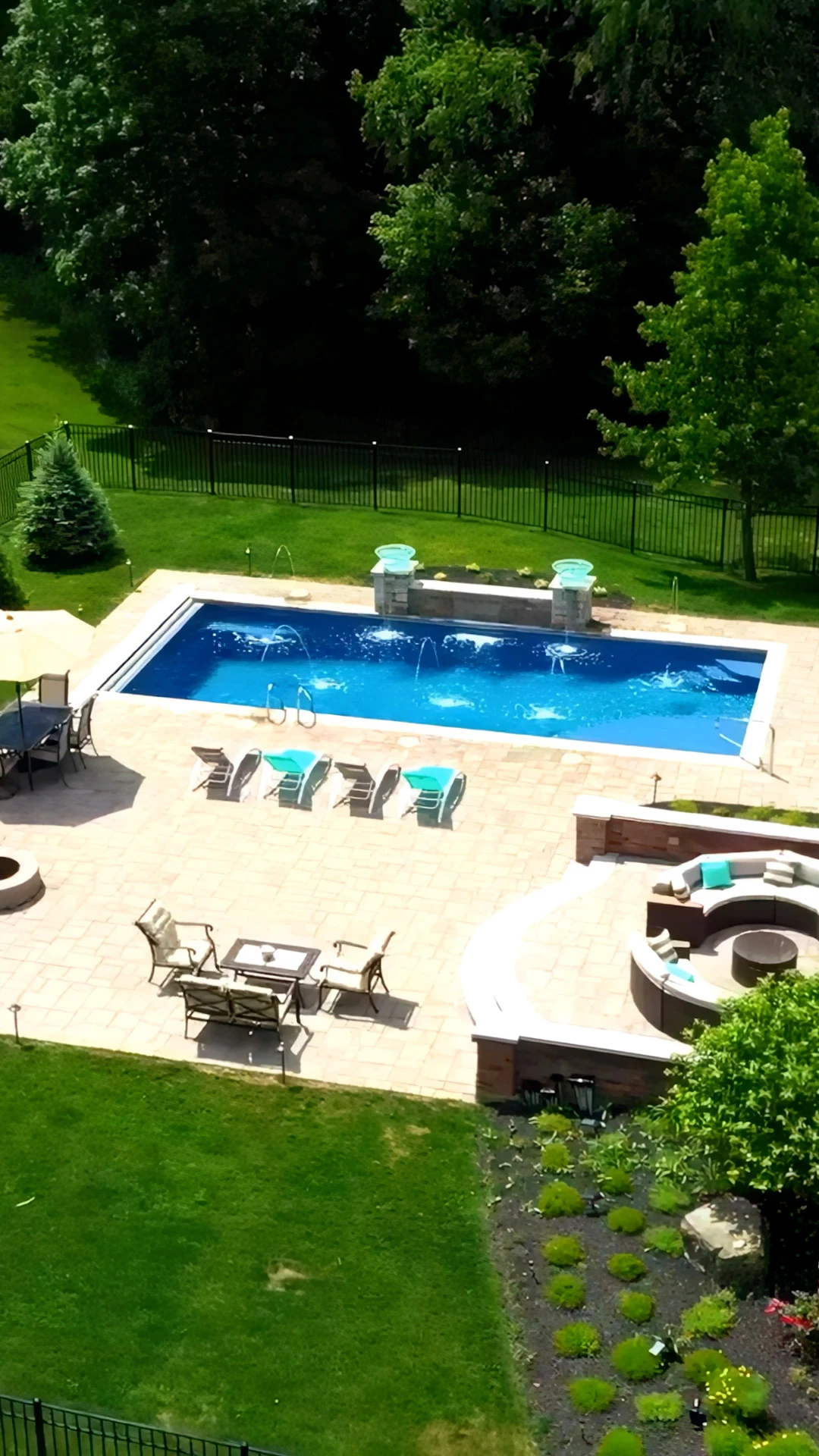
The geometry is not especially innovative. The 30×10 lap lane exists in a hundred communities. What’s different is the fit — the way the pool mirrors a hybrid worker’s actual daily structure rather than a generic vacation-house dream. We’ve built fourteen of them now, and the retention number is the one we pay attention to. Not one of those owners has asked to rebuild, resurface, or rework the geometry. They wanted a pool that fit their week. They got one.
If you’re the Microsoft or CDW or HPE staff engineer who just closed on the Windward or Country Club of the South house, and your partner has already drawn the Notion page with the three bullets, the calendar works. Start the first week of December. Sign the contract before Christmas. Memorial Day is 22 weeks out, and 22 weeks is what this build takes when every step moves on time.
Custom Pool Construction across 20+ cities within 30 miles of Winder, GA
From Windward lap-pool briefs to Country Club of the South entertainer builds, we design the pool around your workweek and deliver the permit-HOA-utility sequencing that keeps Memorial Day intact.