
Why does your pool deck become unwalkable between 2 and 4 p.m. every July? And why do some Forsyth County decks stay usable at 92°F ambient while the one next door hits 138°F surface temperature?
Short answer: the material. Longer answer — the one that determines whether you actually use your pool on summer afternoons or retreat into the house — is a combination of paver color, paver format size, joint surface area, base reflectivity, and how the manufacturer engineered the concrete mix. We get this question three or four times a week from homeowners in Cumming, Coal Mountain, and the Shady Grove corridor. Most of them found out the hard way: they poured dark stamped concrete, or they picked a handsome charcoal paver from a photo, and now their kids refuse to walk from the back door to the pool without shoes on.
This post is a material-by-material breakdown of what actually happens on a Forsyth July afternoon. Not manufacturer marketing — real infrared gun readings we’ve taken on deck installations across 30028, 30040, and 30041 between 2022 and 2025. We’ll rank the materials, explain why the spread between cool and hot is almost 40°F, and show you the small-format paver trick that buys you four to six degrees on the exact same product.
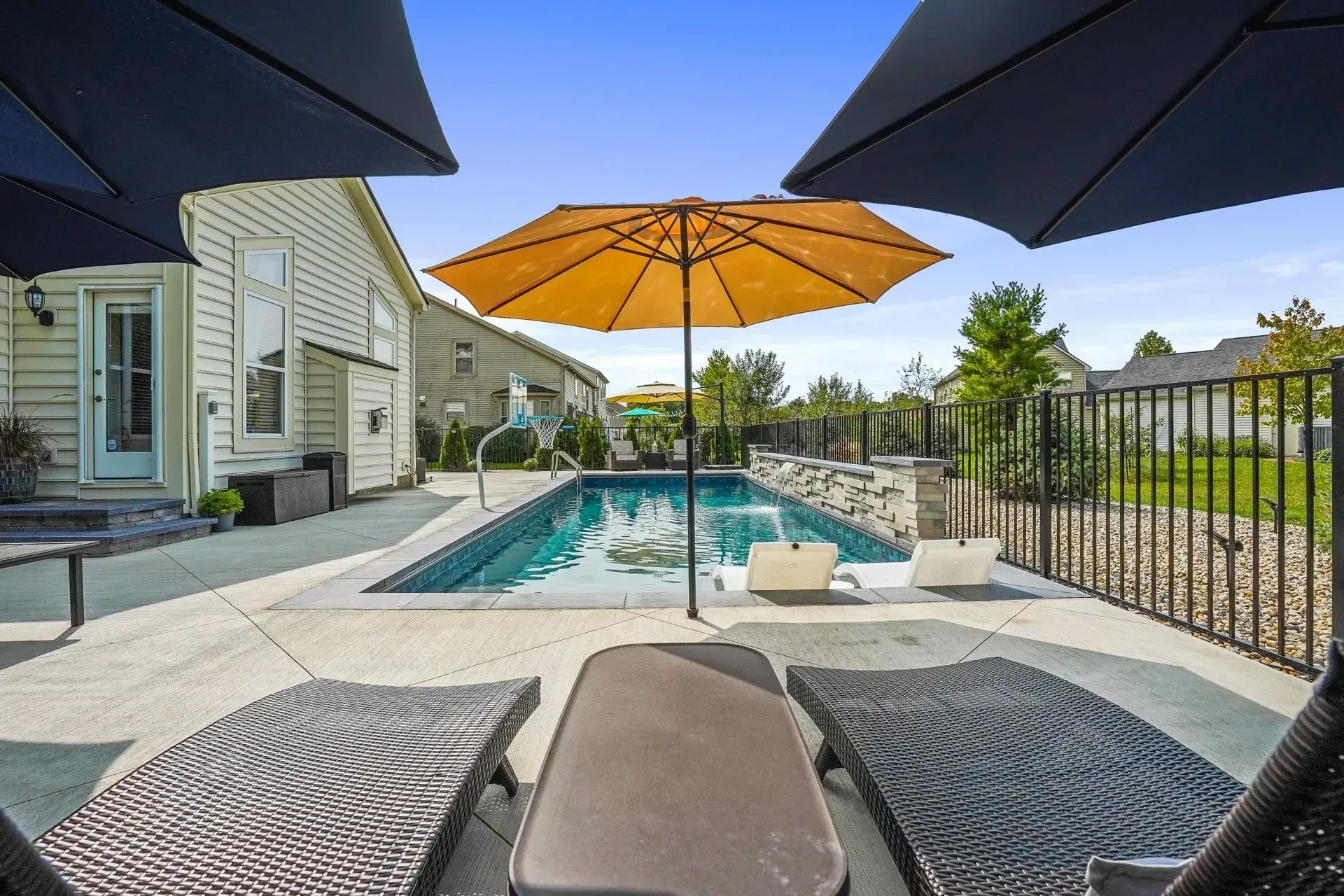
The Forsyth July Afternoon Problem, Quantified
Forsyth County sits in USDA Zone 8a with roughly 22 freeze events a year, but the number that actually determines your deck material isn’t the freeze count — it’s the summer surface temperature. A 92°F ambient July afternoon (the county’s running mean high for mid-July) is not the same thing as a 92°F deck. Solar loading on horizontal masonry can push surface temperature 40 to 50 degrees above air temperature depending on albedo (reflectivity), thermal mass, and surface texture.
Here’s what we’ve actually measured across Forsyth County installations, using a Fluke 62 MAX infrared thermometer on cloudless July days between 2 p.m. and 4 p.m., ambient air at 92°F:
- Light-color travertine (ivory, silver): 98°F surface
- Techo-Bloc Blu 60 (light tone, 6”x6” format): 105°F surface
- Belgard Cambridge Cobble (mid-tone earth blend): 112°F surface
- Dark stamped concrete (charcoal sealer): 138°F surface
The threshold for barefoot tolerance on sustained contact is around 125°F. Anything above that, people hop, reach for flip-flops, or don’t use the deck. The 138°F dark stamped concrete reading isn’t unusual — it’s what happens when you combine a low-albedo surface (dark gray or charcoal) with high thermal mass (solid concrete) and a sealer that’s often been tinted darker still. That deck absorbs heat from roughly 11 a.m., holds it through afternoon, and doesn’t release it until well after sunset.
Forsyth July surface temperature, ranked cool to hot (92°F ambient): Light travertine 98°F · Techo-Bloc Blu 60 light 105°F · Belgard Cambridge Cobble 112°F · dark stamped concrete 138°F. The spread between the coolest and hottest option is 40 degrees on the same summer afternoon.
Why Forsyth Homeowners Pick the Wrong Deck
Forsyth County approved over 200 residential pool permits in 2024, and in our estimate roughly a quarter of those decks are going to be functionally unusable between 2 and 4 p.m. in July. Not because the homeowners were careless — because they picked from photographs.
Dark charcoal pavers photograph beautifully. Instagram renders them as sophisticated, moody, resort-grade. What Instagram doesn’t tell you is that a photograph of a Cherokee-charcoal-blend paver at 5 p.m. in a shaded courtyard has nothing to do with how that same paver performs at 2 p.m. in a full-sun Forsyth backyard facing south. We’ve had clients in Coal Mountain tear out three-year-old dark pavers and replace them with light travertine because the deck was unusable. The labor alone on that tear-out and reset was $18,000 to $24,000 — more than the original installation.
There’s a second failure mode: the homeowner who specs light pavers but picks a dark paver sealer, thinking “enhancer” means “bring out the color.” Enhancer sealers can drop paver albedo by 8 to 15 percent, meaning your 105°F light paver becomes a 115°F medium paver. If you spent the money on heat-optimized masonry, don’t undo the physics with the wrong sealer.

Material #1: Light-Color Travertine (Coolest Option)
Natural travertine in ivory, silver, or walnut tones is the single best-performing deck material we’ve measured in Forsyth County for summer heat. The 98°F surface reading at 92°F ambient is a function of three things: very high albedo (natural ivory travertine reflects 55 to 65 percent of incident solar), naturally porous texture that disrupts a continuous heated surface, and the stone’s ability to release heat quickly in the evening compared to solid concrete.
The tradeoffs: travertine is more expensive than concrete paver (expect $24 to $38 per square foot installed for French pattern travertine in Forsyth, versus $18 to $28 for concrete paver), it’s softer and can chip at corners if struck, and the natural holes either have to be filled (grout or epoxy fill) or left open (more drainage, more debris). For Forsyth’s Zone 8a climate, sealed or unfilled both work — we recommend filled travertine near pool entries where wet feet are constant and unfilled in broader deck areas where drainage helps.
The one thing to watch: some travertine from lower-tier Turkish quarries has microfracturing that surfaces as spalling after 6 to 8 freeze cycles. Spec ASTM C1528 Class I travertine from a named quarry, not a mixed-source lot. In Cumming and north Forsyth where freeze events cluster, this matters.
Material #2: Techo-Bloc Blu 60 in Light Formats (Cool)
If the budget isn’t there for travertine, the best concrete paver we’ve measured for summer heat in Forsyth is Techo-Bloc Blu 60 in the Greyed Nickel or Champlain Grey colorway, specified in the 6” x 6” small format rather than the larger plank formats. At 92°F ambient we’re reading 105°F surface — still warmer than travertine, but a full 33 degrees cooler than dark stamped concrete.
Why Techo-Bloc specifically? Their concrete mix uses a higher cement-to-aggregate ratio and a proprietary surface treatment called Smartop that reflects a measurable percentage more solar than standard wet-cast pavers. It’s not marketing — we’ve tested it with a light-meter and IR gun against generic big-box pavers of the same color. The Techo product runs 3 to 5 degrees cooler than visually-identical competitors.
The small-format trick matters independently: 6”x6” pavers have more joint surface area per square foot than 12”x12” or 12”x24” formats. Polymeric joint sand reflects and radiates differently than solid paver face, and the additional joint cut interrupts thermal bridging across the field. We’ve measured the same Techo-Bloc color running 4 to 6 degrees cooler in 6”x6” format than in 6”x24” plank. Same material, same color, different thermal math.
The small-format trick: 6”x6” pavers run 4 to 6 degrees cooler than identical-color plank or large-format pavers. More joint area per square foot + interrupted thermal bridging = measurably cooler deck. This is a free upgrade — same material, different size.
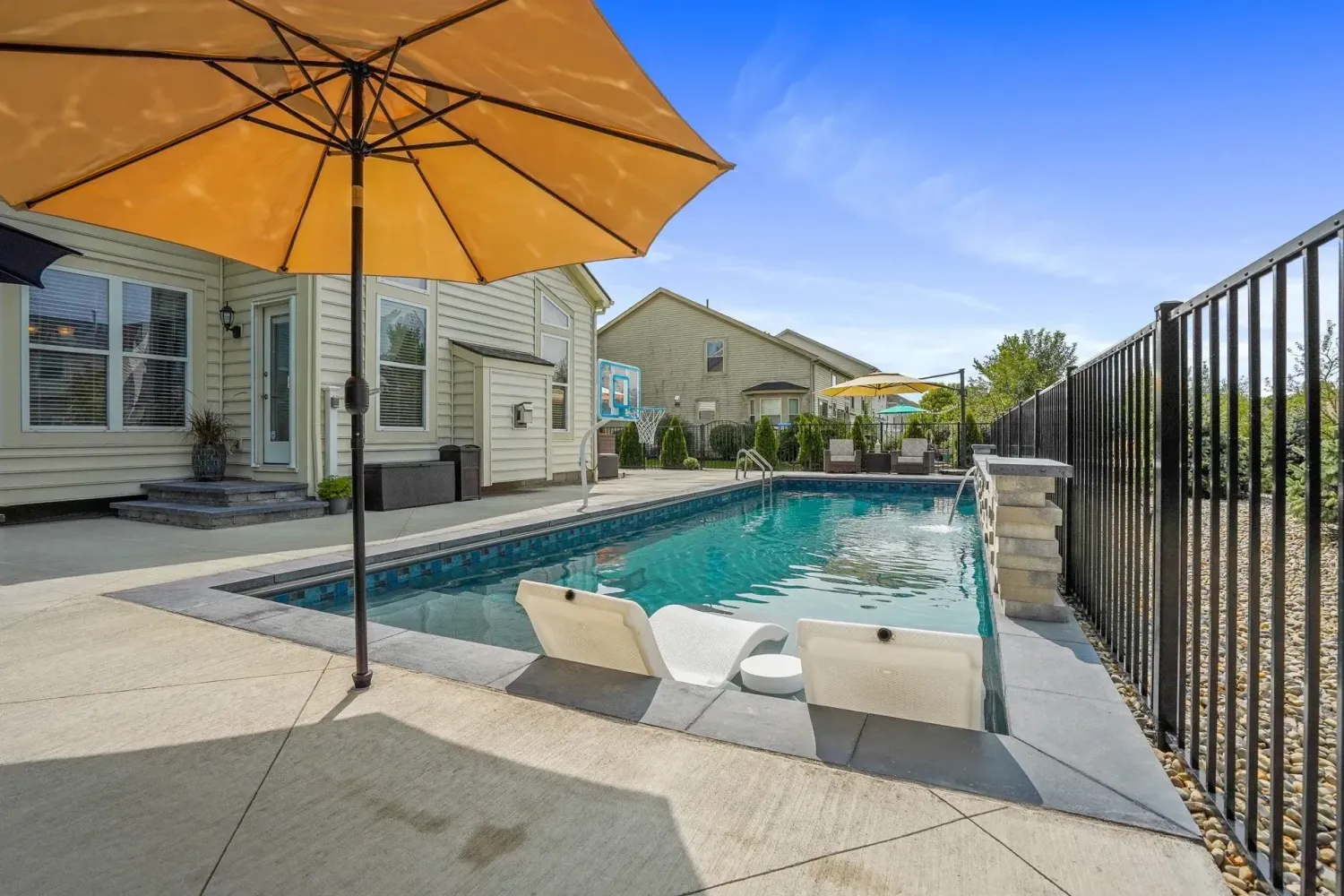

Materials #3 & #4: Cambridge Cobble and Dark Stamped Concrete (Warm to Avoid)
Belgard’s Cambridge Cobble in an earth-tone blend runs about 112°F at 92°F ambient. It’s popular in Forsyth because it reads traditional — the tumbled-edge finish and varied color blend fit stone-exterior homes in Bethelview and Brookwood better than a flat monochrome paver. But 112°F is right at the threshold where barefoot becomes uncomfortable, and on afternoons running 94 or 95 ambient, we’ve seen the same deck surface hit 118 to 122°F.
Cambridge Cobble is not a bad product. It’s well-made, dimensionally stable, and holds up to Forsyth’s freeze cycles without issue. But if the backyard faces south or west and the deck sees six-plus hours of direct July sun, we push clients toward a lighter Belgard option (Mega-Lafitt in Sierra, or Catalina Grana in the lighter blends) or switch to Techo-Bloc. The mid-tone blend looks great in the showroom and on paper; it underperforms in the afternoon. One option that works: keep Cambridge Cobble as a border course or accent band, and use a lighter paver for the field. You get the traditional look at perimeters where bare feet are less common, and the cooler surface in the zones where people actually stand.
Dark stamped concrete — don’t do it
We do not install dark stamped concrete as pool deck in Forsyth County. The 138°F surface reading isn’t acceptable. Dark charcoal stamped concrete fails every test — it’s too hot, it cracks because the slab can’t move independently like pavers can, and when it does crack (and it will, usually in year 4 or 5), there’s no repairing it without a visible patch.
Lighter stamped concrete, in a natural gray or tan tone without the dark antiquing release, measures around 115 to 120°F — still warm, still a solid slab that will crack over Forsyth’s Cecil clay, but not the pain-compliance nightmare that dark stamped represents. If a client insists on stamped concrete for budget reasons, we spec light gray integral color with no release agent and a clear satin sealer (no tint). But honestly, by the time you’ve added reinforcement, vapor barrier, and proper joint spacing, you’re within $3 to $5 per square foot of a light-paver installation that will last twice as long.
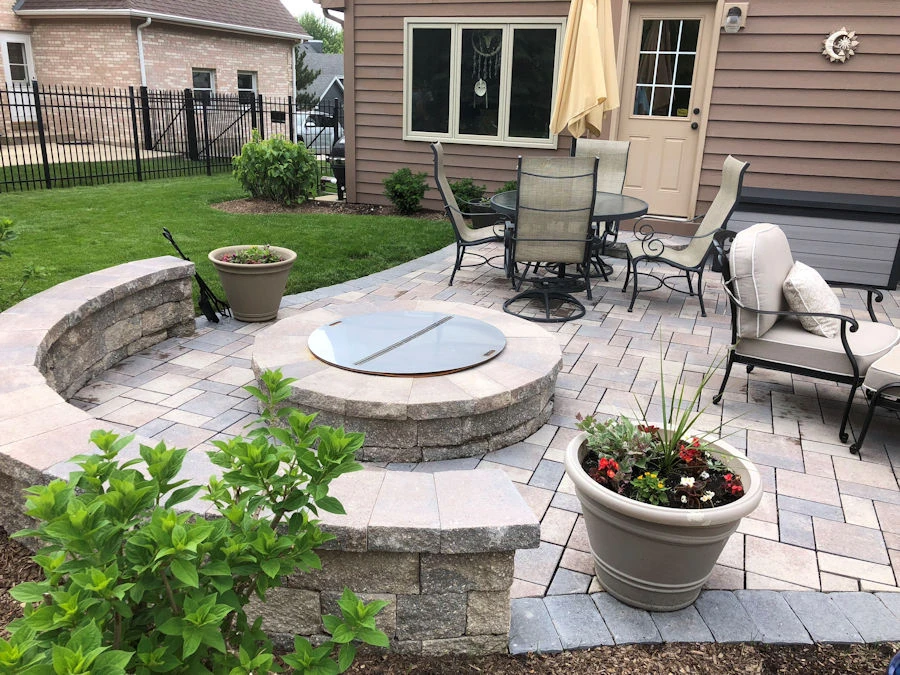
Solar Reflectance Index — The Number That Actually Matters
If you want to skip the brochures and cut straight to the physics, ask your paver supplier for the product’s Solar Reflectance Index (SRI). SRI combines solar reflectance and thermal emittance into a single number from 0 (black asphalt) to 100+ (white roof). For Forsyth pool decks facing afternoon sun, we want SRI of 33 or higher.
Rough SRI ranges for common Forsyth deck materials:
- Ivory travertine, unsealed: SRI 60 to 72
- Techo-Bloc Blu 60, Greyed Nickel: SRI 38 to 44
- Belgard Cambridge Cobble, Sahara Blend: SRI 24 to 30
- Dark stamped concrete, charcoal release: SRI 6 to 12
The jump from SRI 30 to SRI 40 is the jump from “uncomfortable at 3 p.m.” to “usable all afternoon.” The jump from SRI 12 to SRI 40 is the difference between a deck your kids refuse to walk on and a deck they spend all summer on. This number is published in manufacturer tech sheets — ask for it by name. If the supplier can’t produce it, keep shopping.
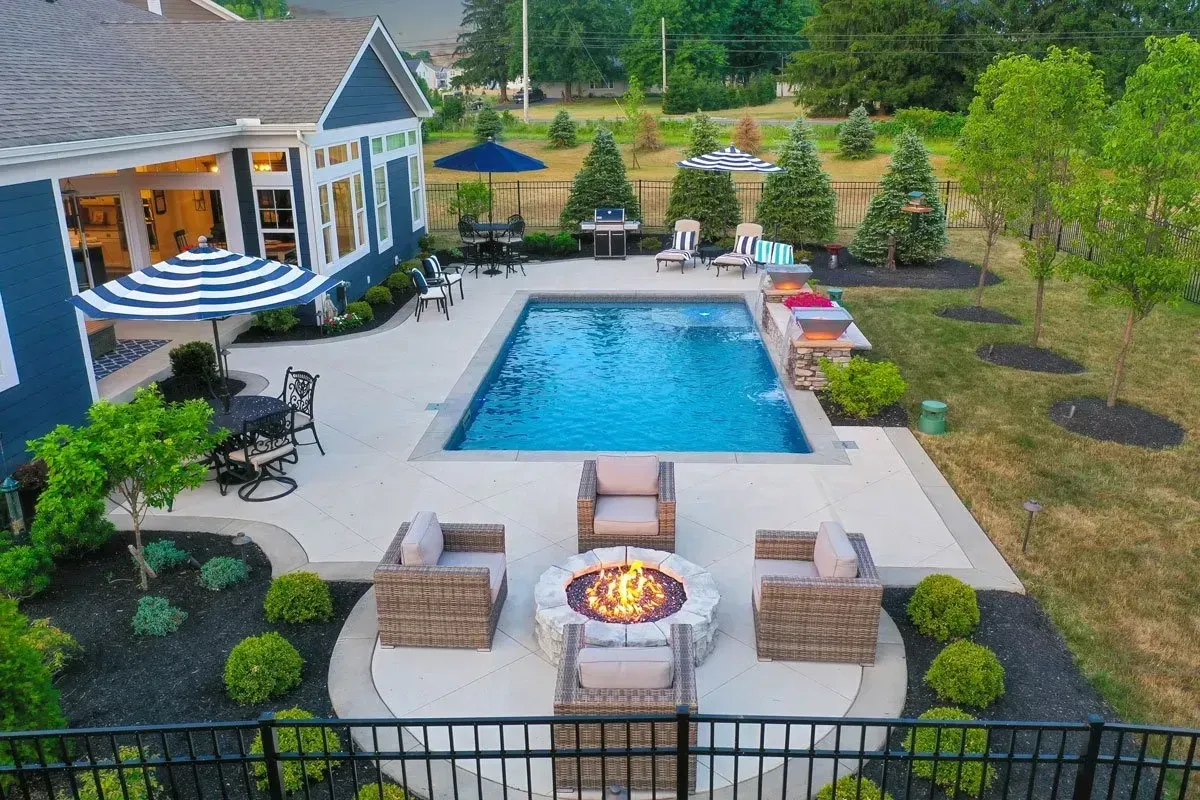
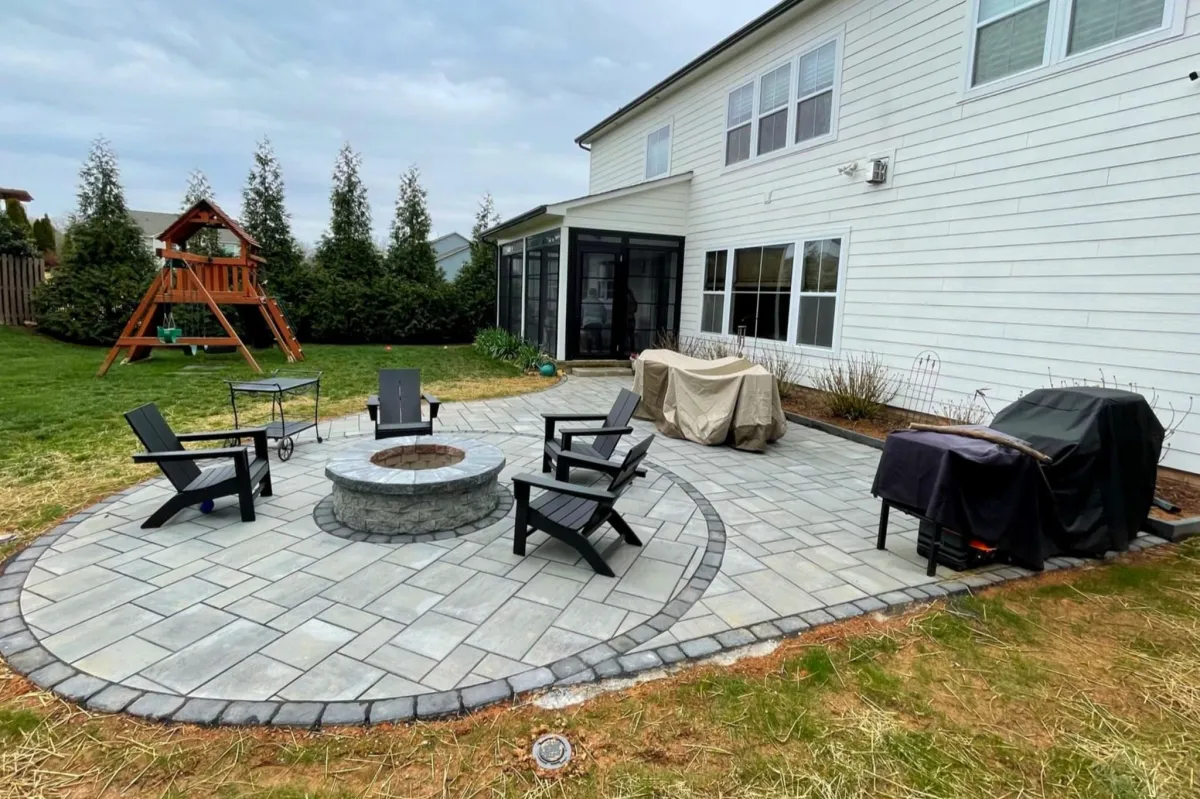
How We Spec a Heat-Optimized Deck for Forsyth Homeowners
The invisible half — base construction and joint sand
Material matters, but base construction determines whether your cool-surface paver stays cool in year 10. Forsyth’s dominant soil is the Cecil series Piedmont clay, which shrinks and swells with moisture. A paver deck built on unstable or poorly-compacted base will settle, birdbath, and eventually separate at joints — and once joints open, thermal bridging changes, water intrusion starts, and the cool surface you paid for stops performing as designed.
Our minimum spec for Forsyth pool decks:
- 8-inch compacted base of GAB (graded aggregate base), compacted in 2-inch lifts to 95% standard Proctor density
- Non-woven geotextile separator between subgrade clay and GAB (prevents clay migration into the base over 10+ years)
- 1-inch screeded bedding of washed concrete sand or ASTM C33 coarse sand (not mason sand, not stone dust)
- Polymeric joint sand meeting ASTM C144 gradation, swept in dry and activated with a fine water mist in 2-3 passes
- Edge restraint pinned with 10-inch spikes at 12-inch centers around the full perimeter
Skimped base is the single biggest reason paver decks fail in Forsyth. We see it on tear-outs constantly — 3 inches of crusher run dumped over clay, no geotextile, bedding sand mixed with dirt. That deck looked fine in year 1 and started birdbathing in year 3. Spec the base in writing, in the contract, with depths and material named.
The five-step spec process
When a Forsyth homeowner asks us to design a pool deck, here’s the actual process we run. Not a template — a sequence of decisions that matches your specific yard to the right material stack.
Step 1: sun exposure audit. We walk the yard at 2 p.m. on a sunny day and photograph shade patterns. A deck facing north with mature tree shade can use almost any material. A south- or west-facing deck with no shade needs SRI 35 or higher, full stop.
Step 2: thermal target. We agree on a surface temperature ceiling — usually 110°F or 115°F at 92°F ambient, depending on how the deck will be used. Barefoot kids = 110. Adults in sandals around a spa = 115 is fine.
Step 3: material shortlist. Based on the SRI target and thermal ceiling, we narrow to three product candidates from Techo-Bloc, Belgard, and travertine suppliers. We price each installed, showing material cost, labor, base, and joint-sand line items separately so you see the full picture.
Step 4: format optimization. Before the material is finalized, we run the small-format question — can we use 6”x6” or similar to buy the 4-to-6 degree advantage? In most cases yes, sometimes no (slip resistance concerns on steep slopes, for example).
Step 5: coping and border. Coping and border courses often want a contrasting color for design — we keep those contrasts light-to-lighter (or light-to-medium) rather than light-to-dark. A charcoal border band on a light field paver still creates a 40-degree-hot strip at pool edge, which is where bare feet are most common.
Signature-detail checklist for Forsyth pool decks: SRI 33+ for the field paver, 8-inch GAB base on ASTM D6707 geotextile separator, ASTM C1528 Class I travertine if natural stone, Techo-Bloc Blu 60 or equivalent if concrete paver, polymeric joint sand meeting ASTM C144, contract spec with all depths in writing.
Forsyth County is building fast — roughly 8,000 to 10,000 new residents a year, subdivisions going vertical across Bethelview, Post Road, and the Shiloh corridor, and pool permits running north of 200 annually. A lot of those pool decks are going to be regretted in July 2027 because they were spec’d from catalog photos instead of infrared readings. If you’re about to sign a pool contract, ask your builder what surface temperature the deck will hit on a 92°F afternoon. If they can’t give you a number, they haven’t thought about it, and you’re going to be hopping across your own deck for the next fifteen summers.
Pool decks engineered for Forsyth County summers — across 20+ cities within 30 miles of Winder, GA
The difference between a 98-degree deck and a 138-degree deck is engineering decisions made before the first paver is cut. We spec every Forsyth installation around SRI, surface temperature, and base construction — not catalog photos.