
Your outdoor kitchen base is the part nobody photographs and everybody lives with. In Cumming’s humid, 22-freeze-event climate on Forsyth County’s Piedmont clay, the wrong substructure cracks by year four, leans by year seven, and costs more to rip out than it did to build. The decision between stucco, stone veneer, and frame-and-finish is the single biggest long-term call you’ll make on the project.
Here is the problem we see across Vickery, St. Marlo, Hampton Park, and Polo Fields: homeowners get three bids, the numbers look wildly different, and the salespeople all say “this is the best option.” One crew quotes a stucco-finish base at $42 a face foot. Another quotes a full natural stone veneer at $78. A third offers a pressure-treated frame with Hardie cladding at $36. They are not quoting the same kitchen. They are quoting three different 20-year maintenance futures. This post is the full decision matrix we walk Cumming clients through before a single block gets laid.
We are going to talk dollars per face foot, service life, freeze-thaw behavior on Piedmont red clay, aesthetic match to the subdivision you live in, and — critically — what the Forsyth County Department of Planning & Community Development at 110 E. Main St. will and will not require on the permit set. By the end you should be able to walk into your contractor meeting and say “I want option B for reasons one, two, and three,” instead of nodding along and signing a proposal you don’t fully understand.
Why Your Base Material Choice Matters More in Cumming Than It Does in South Georgia
Forsyth County sits in USDA Zone 8a at roughly 1,275 feet of elevation, with Sawnee Mountain pulling air currents across the county and Lake Lanier kicking humidity levels up two to four points above what folks in, say, Macon or Valdosta experience. Our annual freeze events average around 22 — individually minor, collectively brutal on any base material that traps moisture. Water gets behind a hairline crack, temperature drops to 28°F overnight, ice expands roughly 9%, and the crack becomes a fissure. Repeat 22 times a year for ten years and you have a ruined finish.
Add the soil. Cecil series Piedmont clay — the dominant soil across Cumming — is high-density, highly expansive, and notoriously unforgiving of poorly compacted footings. It holds water in spring, shrinks hard in July, and moves a cabinet base that wasn’t set on a proper concrete pad by half an inch in either direction over a season. Many of the backyards we grade in Hampton Park and Lake Windward also carry a 3-to-8-foot grade drop toward South Forsyth drainage tributaries, meaning water management under and behind the kitchen base is not optional.
None of this is theoretical. We have been called to tear out four-year-old stucco-finished kitchens in Three Chimneys where the homeowner was promised a premium build, only to find 2×4 framing and un-flashed wall ties rotting in the cavity. We have also restored 18-year-old natural stone veneer kitchens in Polo Fields that needed nothing but a regrout and a new countertop. The material itself is not the whole story — but it is most of it.
Cumming climate reality check: ~22 freeze-thaw cycles per year, ~52 inches of annual rainfall, and Lake Lanier-driven summer humidity averaging 68-74%. Your base needs to shed water, breathe, and move with the house — not against it.
The Three Base Systems, Priced and Compared
Every outdoor kitchen base we build in Forsyth County lands in one of three buckets: stucco-finished CMU, full stone veneer over CMU, or framed cabinet with a cladding finish. Below is the real pricing on a representative 12-foot L-shape kitchen with roughly 48 face feet of base surface — the most common Cumming configuration.
Option A: Stucco-Finished Block Base — $38 to $58 Per Face Foot
Stucco is the default-looking kitchen base in production-builder subdivisions. It is built as a CMU (concrete masonry unit) block shell on a poured footing, wrapped with metal lath and wire ties, scratch-coated, brown-coated, then given a finish coat and color. Done well, in the right stucco system, it looks clean and reads as a modern or transitional Mediterranean aesthetic — which is why you see it everywhere in newer Cumming subdivisions built from 2015 onward.
Typical Cumming pricing: a 12-foot L-shape kitchen with roughly 48 face feet of base surface will run somewhere between $1,800 and $2,800 in stucco face cost alone, not including the block, the footing, or the countertop. Total base-only cost: $38-$58 per face square foot depending on whether you are using a traditional three-coat hard-coat stucco system or a synthetic EIFS-style finish. The hard-coat system is what we specify here — EIFS has a long list of failure modes in wet climates that disqualify it for outdoor kitchens in our market.
Service life: 10 to 18 years before a significant cosmetic refurbishment is required. Hairline cracks start appearing at year three to five. Actual water intrusion failures typically hit at year seven to ten. A full re-stucco (strip, re-lath, re-coat) at that point runs $2,200 to $3,400 on the same kitchen. Repaint-only refreshes run $600 to $900 and buy you another three to four years.
Where stucco wins in Cumming: tight aesthetic matches to stucco or hard-coat homes in places like Vickery, modernist builds in Windermere, or any subdivision where the HOA architectural review board will reject a stone veneer base as “out of character.” Stucco is also the lightest of the three options, which matters if you are building on a second-story deck or over a below-grade garage — both of which we see regularly in the Mashburn Plantation area.
Where stucco loses: freeze-thaw durability. Those 22 annual freeze cycles chew at every hairline that opens up around grill cutouts, plumbing penetrations, and the inside corners where two planes meet. We have walked stucco kitchens at year six in Haw Creek that had eight visible cracks, each one a water pathway. If your installer skips the elastomeric sealant coat on year-one penetrations, plan on a ten-year service life, full stop.
Option B: Full Stone Veneer Base — $58 to $88 Per Face Foot
Stone veneer is the premium answer — and the one that matches what most higher-end Cumming subdivisions were built to. The system: CMU block shell on the same poured footing, wrapped with weather-resistive barrier and galvanized lath, scratch-coated, then a 1-to-2-inch-thick adhered manufactured stone veneer (Cultured Stone, Eldorado, Boral Versetta, or similar) or full-bed natural stone with mortar joints. The veneer itself can run from $18 per square foot (manufactured ledgestone) to $34 per square foot (true full-bed fieldstone, hand-selected).
Typical Cumming pricing: that same 48-face-foot L-shape kitchen runs $2,800 to $4,200 in veneer alone, plus another $600-$900 for the block/lath/mortar substructure. Total base-only cost: $58-$88 per face square foot. Within that spread, manufactured ledgestone in buff/gold tones sits near the bottom, hand-laid natural fieldstone with real full-bed thickness sits at the top. For reference, the base shown in most Hampton Park and St. Marlo kitchens we have built in the last three years lands at $72-$78.
Service life: 35 to 45 years on manufactured stone, 50+ years on natural stone when correctly flashed. We are regularly asked to retile or recountertop 20-year-old stone veneer kitchens whose base looks identical to the day it was installed. No repaint cycles. No re-stucco cycles. One pressure-wash and re-seal every 8-10 years keeps the mortar crisp and the stone saturated in color.
The Hamilton Mill / Polo Fields aesthetic match: If your home is brick, brick-and-stone, or cream-stucco-and-stone, a manufactured ledgestone veneer in a buff/gold mixed blend ties the outdoor kitchen to the architecture without any color negotiation. This is the single most-specified base finish in our Forsyth County builds.
Where stone veneer wins: freeze-thaw resilience, resale value on homes above $800,000, HOA approval speed (the architectural review boards at St. Marlo, Vickery, and Polo Fields typically approve a stone-veneer outdoor kitchen plan in the 2-to-3-week minimum review window without revisions), and 40-year durability that actually pencils out when you amortize the upfront cost. The per-year cost of a stone base over 40 years is $2.20 per face foot. The per-year cost of stucco over 15 years, with one re-stucco at year 10, is $4.80 per face foot. Stone wins on lifetime dollars.
Where stone veneer loses: weight and cost at the project-start line. A full-bed natural stone base adds 85-110 pounds per face foot to the structural load. If your kitchen is sitting on a concrete pad at grade, this is a non-issue. If it is on a second-story deck or a cantilevered terrace — common in the walkout-basement homes along Bethelview Road and the Haw Creek tributaries — you may need structural reinforcement that adds $1,400-$2,200 to the foundation scope. We always pull the structural drawings before quoting stone on elevated builds.
Option C: Frame-and-Finish — $32 to $48 Per Face Foot
This is the option that looks like a bargain on paper and splits cleanly into “done right” and “done wrong” more than either of the others. A frame-and-finish base is built as a steel or pressure-treated 2×4 framed cabinet, sheathed with cement backer board (Durock, Hardiebacker, or PermaBase), then clad with the finish of your choice — manufactured stone veneer strips, tile, Hardie panel, or a thin stucco-look acrylic finish. Underneath the cladding, the structure is a framed box, not a CMU-block shell.
Typical Cumming pricing: a 48-face-foot L-shape cabinet built this way runs $1,500 to $2,300 in total base-only cost — materials and labor. That includes a galvanized steel frame kit (Trueform, RTA, or local fabrication), cement backer board, and a manufactured thin veneer or Hardie cladding. Per face foot: $32-$48. That’s the lowest entry price of any of the three options.
Service life: 12 to 18 years if the frame is galvanized steel and the cladding is stone veneer. 7 to 10 years if the frame is pressure-treated wood and the cladding is a stucco-look acrylic finish. The failure mode is almost always water behind the cladding: moisture gets in at a grill cutout or a plumbing penetration, soaks into the cement backer, swells the fasteners, and blows off a section of the cladding. Repairs are straightforward but visible — you can usually see where a panel has been replaced because it will not weather-match for several years.
Where frame-and-finish wins: budget-tight builds, rental or second-home installations where the 15-year life matches the ownership horizon, and DIY-adjacent projects where the homeowner is doing some of the assembly. The steel-frame RTA kit approach is also the fastest install on site — a galvanized steel cabinet kit can be stood up in an afternoon by two installers, versus three to five days for a CMU-block-and-stucco base or five to eight days for a full natural stone veneer.
Where frame-and-finish loses: long-term thermal performance around the grill and any appliance that throws real heat. The cabinet walls of a framed cabinet are thinner than a block-and-veneer base, and without deliberate heat isolation at the grill bay, you will see fastener heads telegraphing through the cladding at year three to five. We specify a minimum of 2 inches of mineral-wool fire-rated insulation behind the grill bay on every framed cabinet we install, a spec that adds $180-$260 to the build and is not always caught by other contractors.
Year-Ten Maintenance: The Real Cost Nobody Quotes
Here is the table we actually walk Cumming homeowners through before the contract is signed. Same 48-face-foot L-shape kitchen, 30-year ownership horizon, current 2026 Cumming-market pricing:
Stucco base — 30-year total cost of ownership
- Year 0 install: $2,400
- Year 3 hairline crack repair + elastomeric seal: $220
- Year 7 repaint: $750
- Year 12 full re-stucco: $2,900
- Year 18 repaint: $820
- Year 24 full re-stucco: $3,300
- 30-year total: ~$10,390
Stone veneer base — 30-year total cost of ownership
- Year 0 install: $3,600
- Year 8 pressure wash + reseal: $340
- Year 16 pressure wash + reseal + spot regrout: $520
- Year 24 pressure wash + reseal: $380
- 30-year total: ~$4,840
Frame-and-finish base — 30-year total cost of ownership
- Year 0 install: $1,950
- Year 5 cladding repair around grill cutout: $340
- Year 12 cladding panel replacement: $780
- Year 16 full base replacement (steel frame rust-through or cladding failure): $3,200
- Year 24 cladding refresh: $680
- 30-year total: ~$6,950
The stone veneer option — the one that looks most expensive on the bid sheet — is the cheapest over 30 years by a wide margin. The stucco option, typically sold as the “best value” middle tier, is actually the most expensive over that horizon because you are paying for two full re-stucco cycles. The frame-and-finish option lands in the middle, with the caveat that it gets replaced once inside the 30-year window.
One caveat worth naming: these numbers assume your kitchen is properly flashed and drained at year zero. The number one failure accelerator on every Cumming outdoor kitchen we inspect — regardless of base material — is missed or sloppy flashing at the grill cutout, the countertop-to-backsplash seam, and the footing-to-slab transition. A $140 roll of butyl flashing and an extra two hours of labor at the build adds four to six years of service life on any of the three systems. If a contractor tells you flashing is optional, walk away.
A second caveat: the Lake Lanier moisture effect is real and measurable. Pool evaporation rates across Forsyth County run 0.3-0.5 inches per day in peak summer — higher than counties south of I-285 by a consistent 8-12%. That same humidity accelerates mortar carbonation and cement-backer wicking. If your backyard has a line-of-sight to the lake or sits inside the first three miles of shoreline in neighborhoods like Lake Windward, derate your stucco service life by roughly two years and add an extra reseal cycle to your stone veneer base at year six.
The Forsyth County Permit, HOA, and Sawnee EMC Realities
Before you choose the base, you need to understand what the county and the HOA will require on the drawings. Outdoor kitchens with natural gas plumbing, 240V circuits, or attached pergolas/pavilions typically need a permit pulled through the Forsyth County Dept. of Planning & Community Development at 110 E. Main St. in downtown Cumming. Simple freestanding propane-only grill cabinets on an existing paver patio often do not require a permit, but you should confirm on every project — the county website lists the current threshold and it shifts occasionally.
If your kitchen includes a built-in refrigerator, dedicated outlet circuits, or lighting, you are pulling a 240V or dedicated 120V run from the house panel. Sawnee EMC — the utility for nearly all of Forsyth County — requires a permit-approved electrical inspection before they energize any new outdoor circuit. Build that two-week inspection window into your project schedule. It is the single most common reason a Cumming outdoor kitchen project runs three weeks late.
HOAs are the other gate. The architectural review boards at St. Marlo, Polo Fields, Hampton Park, and Lake Windward each have their own material and color standards. St. Marlo, as of last fall, requires all outdoor kitchen finishes to match the primary facade material of the home — no mixing stone on a brick house unless the brick already has stone accents. Polo Fields permits stone veneer, stucco, or Hardie cladding but disallows any visible metal frame. These rules tilt the base-material choice before you even walk to the lumberyard. Always pull the current architectural guidelines before quoting the client.
Sawnee EMC 240V note: Outdoor kitchen refrigerators and some pizza-oven electrics pull a 240V line. Sawnee EMC’s inspection queue runs 10-14 business days. If you want the kitchen running by Memorial Day, your permit needs to be filed no later than late March.
The Decision Matrix: How to Pick in Under Five Minutes
Use this to short-circuit the analysis paralysis:
- Home value above $900,000 and you are staying 10+ years? Stone veneer. The math is not close.
- Home value $500k-$900k, modern or Mediterranean architecture, you like a clean smooth finish? Hard-coat stucco over CMU block, with a year-one elastomeric seal on every penetration. Plan on a repaint at year seven and a re-stucco around year twelve.
- Budget-constrained or ownership horizon under 10 years? Galvanized steel frame with manufactured thin stone veneer cladding and a mineral-wool-insulated grill bay. Accept that you will refresh the cladding once.
- Second-story deck or above-basement installation? Frame-and-finish is the only viable option without structural reinforcement. Use steel, not pressure-treated wood, and spec every cladding fastener to stainless.
- HOA requires match to brick or brick-and-stone facade? Stone veneer in a buff/gold mixed blend with a dark polished granite counter is the safest path through the architectural review board — almost always approved on the first submission.
- You want the fastest install and can pick up the tab at year fifteen? Frame-and-finish. Two-day cabinet build, veneer cladding in another two days, countertop on day six.
None of this replaces a site walk. What grade is your backyard actually on? How close is the kitchen to the tree line? Which direction does the prevailing afternoon rain blow in from? Is there a grill bay needed, and if so, what BTU is the grill rated at? These details shift the spec. But the decision matrix above gets you 80% of the way there before you ever open a bid.
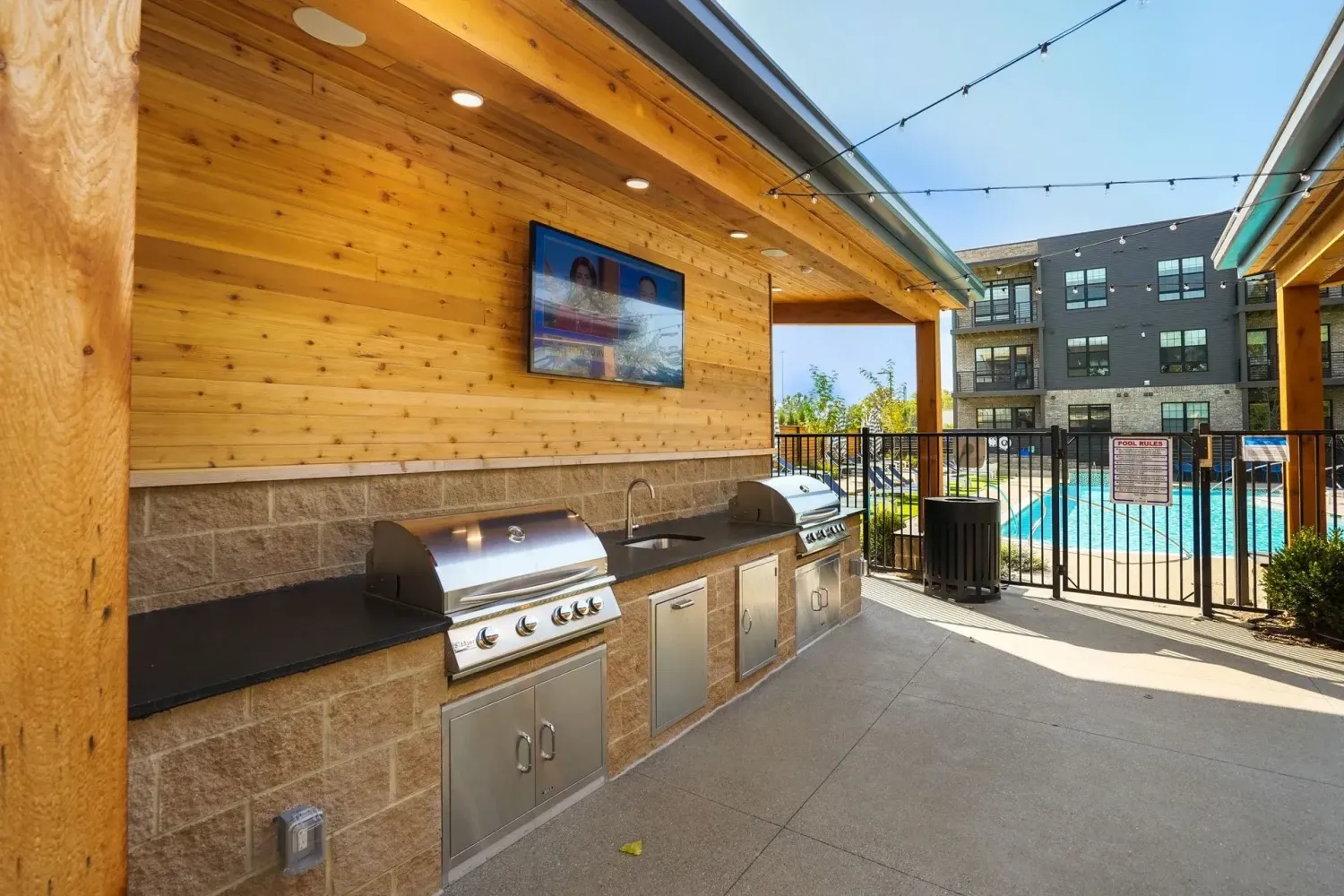
If you are about to commission an outdoor kitchen in Cumming, GA, and you want a base that will still look right when the house sells in 2046, the specific answer for most of our clients is: hard-coat scratch-and-brown over CMU block with a 1-to-2-inch adhered manufactured stone veneer in a buff/gold mixed blend, black polished granite counter (Absolute Black or Uba Tuba), galvanized flashing at every penetration, and a cedar tongue-and-groove pavilion ceiling overhead if you can afford the roof. It is not cheap at the start. It is, by a factor of two, the cheapest kitchen base to own.
Outdoor kitchen design & build across 20+ cities within 30 miles of Winder, GA
From stone-veneer bases in Vickery and St. Marlo to steel-frame cabinets on second-story decks in Haw Creek, we engineer the substructure before we pick the finish — because in Cumming’s freeze-thaw climate on Piedmont clay, the base decides everything.