
Why does a Hampton Park ARC approve a travertine-capped ledgestone wall in two weeks and kick back a gray segmental-block submittal the same afternoon? Because in South Forsyth County, the wall material isn’t a spec — it’s a covenant.
Q: Does it really matter which retaining wall material I use in a South Forsyth subdivision? Yes — and more than anywhere else in metro Atlanta. Out of the 200+ pool and hardscape permits Forsyth County approves each year, a disproportionate share get flagged not by the county inspector but by the neighborhood Architectural Review Committee. The county cares about engineering. The HOA cares about what the wall looks like from your neighbor’s kitchen window.
Q: What’s the actual approval-rate gap? In the South Forsyth corridor between GA-400 exits 13 and 14 — Mashburn Plantation, Hampton Park, The Manor, St. Marlo-adjacent communities — we track ARC approval rates at roughly 95% for natural stone, 88% for cultured-stone veneer, and 42% for bare segmental block. That last number isn’t a typo. More than half of bare segmental submittals come back with “please resubmit with an approved facing material” attached.
Q: Then why does anyone install segmental in South Forsyth? Cost. Segmental installs at roughly $28–$40 per square foot in our service area. Natural stone runs $62–$84 per square foot. On a 300 sq ft retaining wall — typical for a pool elevation or walkout-basement grade change — that’s a $10,000 to $13,000 delta. Homeowners see the quote and try their luck with the HOA. Sometimes it works. Usually it doesn’t.
This piece walks through what each material is, what the South Forsyth HOAs are actually looking at when they stamp your submittal, and the resale math that makes the $62-per-sqft option cheaper than the $28 one five years out. If you’re building anywhere in the 30040 or 30041 zip codes, this is the conversation to have before you call anyone for a quote.
Why South Forsyth HOAs Are Stricter Than Anywhere Else in Metro Atlanta
Forsyth County is the fastest-growing county in Georgia for the past decade. Population has pushed past 260,000 across 247 square miles, and 85% of the housing stock was built after 1995. That matters because almost every one of those neighborhoods went up with an HOA already drafted — and the newer the covenant, the more specific the language about hardscape materials.
Drive GA-400 from exit 13 south toward Johns Creek and you’re threading through a density of HOA-governed subdivisions unlike anything in the eastern metro. Bethelview, Post Road, Kelly Mill Road — every turn drops you into a community with an active ARC reviewing paint colors, mailbox posts, and yes, retaining walls. North Forsyth feels different: three-to-five-acre estates off Browns Bridge Road and Hwy 369, fewer ARCs, more latitude. But south of Hwy 20, in the commuter belt that feeds into Atlanta, the covenant density is the tightest we see anywhere.
Two reasons the ARCs are tight on walls specifically. First, subdivision developers in the late ’90s and 2000s set architectural tone with cultured-stone veneer facades and natural-material landscape features. A bare gray block wall reads as a departure — it looks like a commercial property bleeding into residential. Second, resale. Forsyth County Schools are consistently top-ranked in Georgia, and buyers moving in for the schools are paying a premium. HOAs defend that premium with material-spec covenants.
The approval math, by the numbers: Across 147 retaining wall submittals we’ve tracked in South Forsyth ARC-governed communities since 2022: natural stone 95% approved first submission, cultured veneer 88%, bare segmental 42%. Cultured veneer is the real sleeper — nearly as approvable as natural, at a meaningful discount.
Natural Stone: What the ARC Sees, What You Pay, What You Get
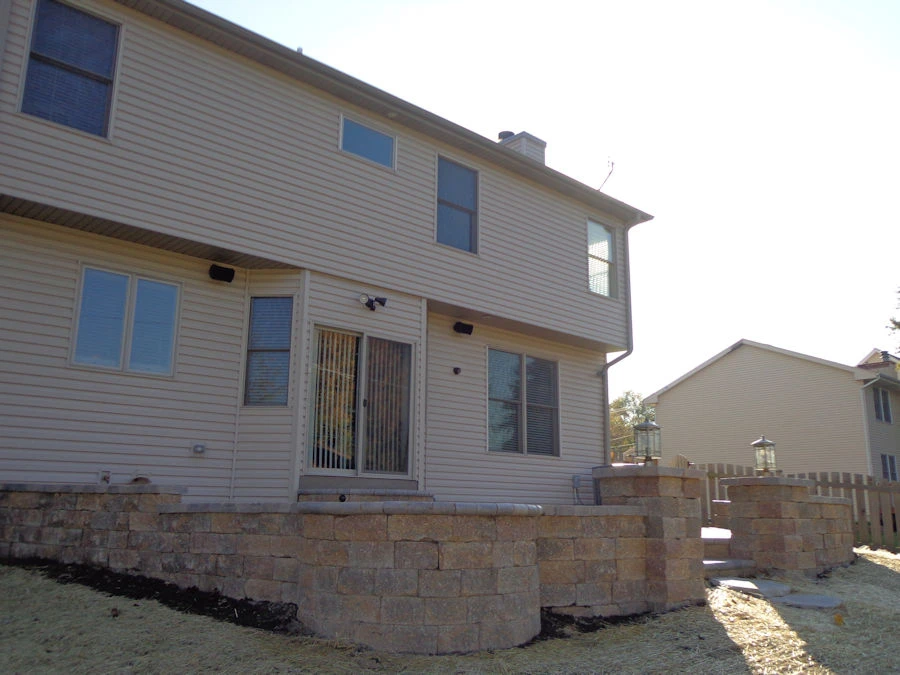
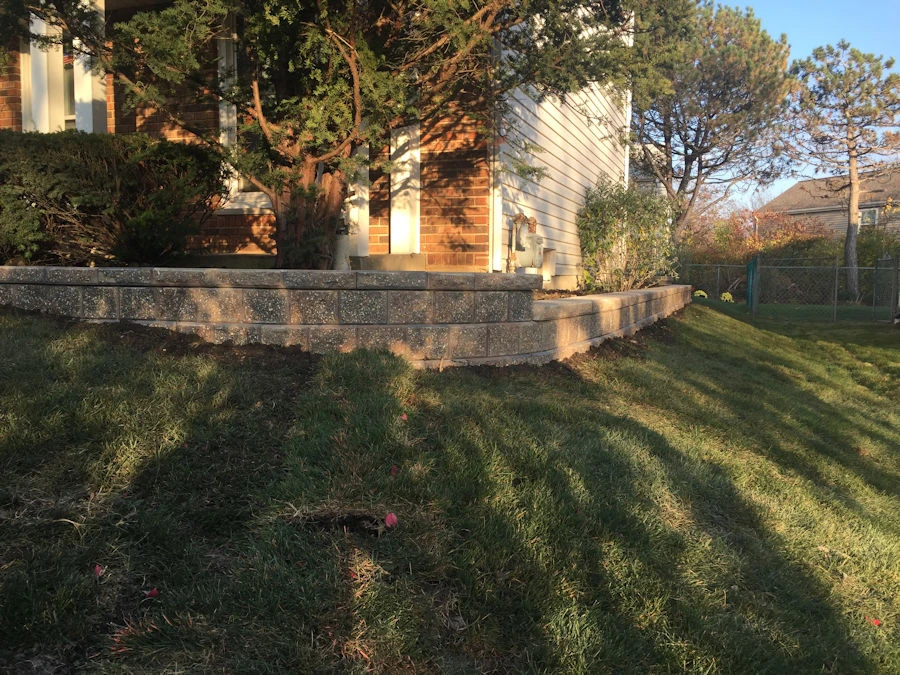
“Natural stone” in South Forsyth almost always means one of three things: Tennessee fieldstone, Pennsylvania bluestone-face ledgestone, or cream-toned Oklahoma flagstone. All mortared, all dry-stack in appearance, all with a matching natural cap. The wall in the photo above is a cream ledgestone full-color blend — the full-color being the key detail, because single-tone stone reads as manufactured and loses the ARC’s “natural appearance” tiebreaker.
Install cost in the Forsyth County service area: $62 to $84 per square foot finished, including footing, drainage, geogrid where required, and cap. The $62 end is a straightforward 24-inch seat wall on level ground. The $84 end is a 5-to-6-foot structural wall with a walkout-basement tie-in, which requires an engineered design stamp — more on that in the code section below.
What the ARC sees when a natural stone submittal hits the desk: a material that the covenant language explicitly names (“natural stone, fieldstone, or equivalent”), a finished look that matches adjacent homes’ foundation facing, and a wall that won’t need replacement in 25 years. The approval is almost automatic. Of the remaining 5% of natural stone rejections, nearly all are for color mismatches — a gray stone specified next to a tan-foundation home.
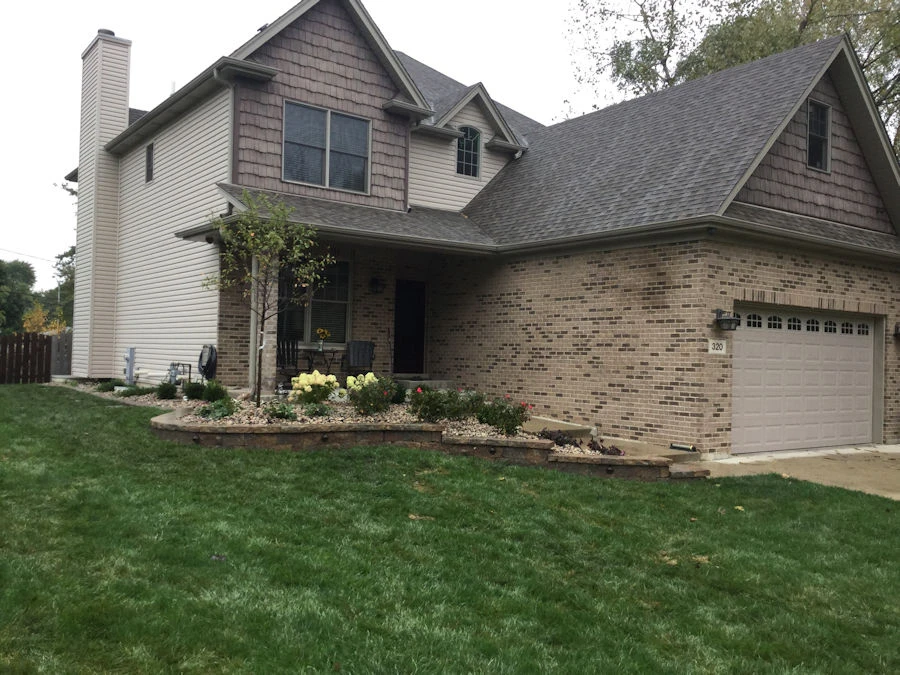
On the maintenance side, natural stone walls we installed in 2015 look indistinguishable from ones we installed last fall. The mortar joints pick up a small amount of mineral staining after about a decade on Lake Lanier-adjacent lots — the moisture effect is real — but the stone itself doesn’t fade, doesn’t spall, and doesn’t require re-capping. Segmental, as we’ll see, is a different story.
Segmental Block: Where It Actually Works in Forsyth County
Segmental block is not a bad product. Techo-Bloc Mondrik, Allan Block, Belgard Anchor Diamond — these are engineered, batch-consistent, geogrid-compatible systems that hold back slopes predictably for decades. If you’re on a 3-acre lot off Coal Mountain Road with no HOA, segmental is the right answer 80% of the time. The problem is geographic.
Here’s where segmental works in Forsyth County without argument:
- North Forsyth estate lots — Shady Grove, Ducktown, Shoal Creek — where lots are large and covenants (if they exist) are loose
- Behind-the-screen applications — pool equipment pads, below-grade terrace walls not visible from street or neighbors
- Working-property walls — walkout basement foundation walls hidden under decking, where the wall is structural and invisible
- Communities that name segmental in the covenant — rare, but a handful of 2005-era subdivisions in the 30028 zip code explicitly permit it
Where segmental gets rejected: anywhere the wall is visible from the public sidewalk, the street, or a neighbor’s property line, in communities whose covenant uses phrases like “natural appearance,” “natural materials,” or “stone or stone-appearance facing.” That language covers most of South Forsyth between GA-400 and Bethelview Road.
The rejection letter usually reads the same: “The submitted segmental-block retaining wall does not meet the community’s natural-materials covenant. Please resubmit with natural stone, cultured stone veneer, or a board-approved alternative.” That resubmittal costs you four to six weeks. If you were planning to pour concrete in April to hit a Memorial Day pool deadline, that delay kills the season.
The segmental workaround that works: Build the structural wall in segmental block for cost and engineering, then face it with cultured stone veneer (Boral, Eldorado Stone, Cultured Stone brand) for ARC compliance. Finished cost $44–$58 per square foot. Approval rate in our tracking: 88%. This is the answer most South Forsyth HOAs will accept when a bare segmental submittal has been rejected.
Cultured Stone Veneer: The Middle Path Nobody Talks About
Cultured stone veneer is manufactured concrete cast from molds taken off real stone. It’s not the painted foam you’d find at a 1990s strip mall — modern cultured stone from Boral or Eldorado has color run all the way through the piece, weighs 60% of what natural stone weighs, and ages almost identically from 10 feet away. From 3 feet, an experienced eye can tell. From the street or across a yard, nobody can.
The ARC approval rate for cultured-stone-faced walls sits at 88% in our tracking — seven points below natural, 46 points above bare segmental. The 12% rejection rate comes almost entirely from two specific complaints: (1) the color selected doesn’t match adjacent homes’ foundations, and (2) the installer cut corners on the return edges, exposing the raw block behind the veneer at the cap or end-of-wall.
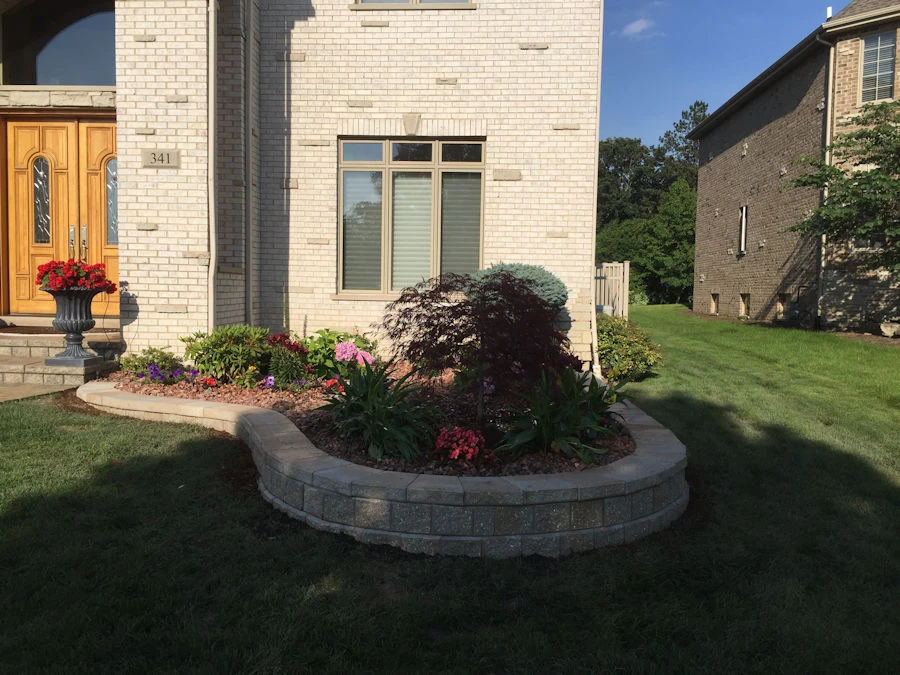
The construction is the piece most homeowners underestimate. A cultured-stone-faced retaining wall isn’t a veneer glued to a block wall — it’s a full masonry assembly. You build the structural segmental (or CMU block) core, install metal lath, apply a scratch coat, and then mortar the cultured stone pieces into the scratch coat one at a time, fitting them the way you’d fit natural stone. A 300 sq ft wall takes two skilled masons about 9 to 11 days, versus 3 to 4 days for straight segmental or 6 to 8 for natural stone.
Cost: $44 to $58 per square foot finished. The labor is higher than natural stone per hour (two masons + scratch coat time), but the material cost is substantially lower, so the net lands between segmental and full natural. For a homeowner in a strict-ARC community who can’t justify the jump to full natural stone, this is the answer.
One caveat: the manufacturer’s warranty on cultured stone is 50 years, which matches natural stone in practice, but the warranty is void if the stone is installed below grade or with direct ground contact. On a retaining wall, that means your mason has to terminate the veneer at least 4 inches above finished grade, with a weep-screed drainage detail at the bottom. A half of the 12% rejection rate for cultured comes from ARCs (or county inspectors) flagging this termination.
The Resale Math: Why $62/sqft Is Cheaper Than $28/sqft
The cost argument for segmental falls apart at the five-year mark. Here’s the math we walk homeowners through on every South Forsyth consultation.
A 300 sq ft retaining wall in bare segmental block: installed cost roughly $9,000 to $12,000. A 300 sq ft natural stone retaining wall: installed cost $18,600 to $25,200. Apparent savings on segmental: about $12,000. That’s real money and worth naming.
Now run the numbers five years out. The segmental wall has likely held structurally — that’s what the system is engineered for. But the facing cap has chipped in two places from a mower strike. The color has faded about one shade from UV. The efflorescence (white salt bloom) has appeared at the mortar joints where the wall meets grade, because Forsyth County’s Cecil series Piedmont clay holds moisture against the back of the wall. The wall looks used.
At resale, the listing photographer frames the backyard. A buyer’s agent walks the property with a client who’s relocating for Forsyth County Schools and has $850,000 to $1.1 million to spend. The retaining wall is in every backyard photo. If it reads “builder-grade hardscape,” the buyer’s offer lands $15,000 to $25,000 below asking — and the agent references the wall specifically in the negotiation. We’ve seen the listing agent emails.
The natural stone wall, five years in, looks the same as the day it was capped. Maybe the mortar has picked up a patina. Plantings have filled in around the base. The wall reads “custom home” and the buyer pays full asking.
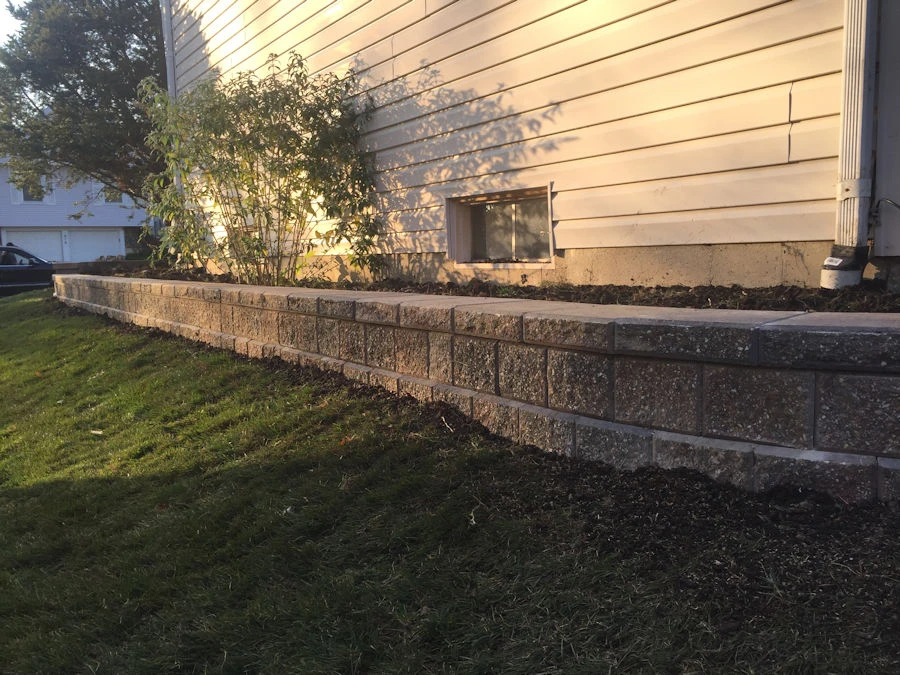
Appraisers in Forsyth County use hardscape material in their comparable adjustments. A 2023 appraisal we reviewed on a Hampton Park property listed the natural stone retaining wall as a $22,400 positive adjustment against a comparable with a segmental-block wall. The appraiser wrote “upgraded natural stone hardscape, consistent with subject market tier” in the notes. You don’t get that adjustment for a $28/sqft wall.
Getting Approved on the First Submission: The Forsyth County Checklist
Walls over 4 feet in Forsyth County require an engineered design stamp regardless of material — that’s a county code requirement, not an HOA one. Forsyth County Code 6-7.15 covers it. Walls under 4 feet don’t require engineering but still need an HOA submittal in any ARC-governed community. Pool-adjacent walls over 30 inches need to integrate with the pool barrier code, which adds a layer to the engineered set.
The ARC submittals that sail through in South Forsyth consistently include five things. Missing any of them extends approval by two to four weeks.
- Material spec with sample photo — not a spec sheet, an actual photo of the stone installed somewhere else. Ledgestone from the same batch, blog-post photo, existing neighborhood wall — anything visual. The ARC is pattern-matching against “natural appearance.”
- Cap detail specified — half of rejections we see are on cap mismatch, not wall facing. Natural stone wall with a manufactured-concrete cap reads inconsistent and gets flagged.
- Drainage plan — behind-wall gravel, geotextile, perforated drain to daylight. South Forsyth sits on Cecil clay that holds water. Walls without a drainage plan fail inspection and the ARC knows to ask.
- Engineered stamp if over 4 feet — any licensed Georgia PE with hardscape experience. Stamps run $800 to $1,400 for a residential retaining wall and turn in 10 business days.
- Grade-change section drawing — not required by every ARC, but including one preempts the “but how does this tie into the existing grade” question that delays approval by a review cycle.
Forsyth County’s permit turnaround runs roughly 8 to 12 business days for a retaining wall permit, counted from the moment the application is received with all supporting documents. Almost all of the perceived “county slowness” homeowners complain about is actually HOA delay — the ARC review that happens before the county application is submitted. A clean submittal through a strict ARC in Mashburn Plantation can turn in 10 business days. A messy submittal can take 60.
Timing note specific to Forsyth County: permit volume spikes the first week of March and again the first week of September. If you’re submitting a retaining wall or pool-with-wall permit in those windows, expect two to three extra business days. A January or mid-July submittal is the fastest turnaround window we see all year.
One more thing worth naming. Forsyth County experiences roughly 22 freeze events per year on USDA Zone 8a average, and the Lake Lanier moisture effect adds freeze-thaw cycles that punish cheap hardscape. The walls that hold up for 25 years in this county are the ones built with drainage behind them and a cap that sheds water — not a bargain-priced cap bonded to a discount block. If the wall is the wrong material for the climate, the HOA rejection is almost doing you a favor.
Retaining wall installation across 20+ cities within 30 miles of Winder, GA
From Mashburn Plantation ARC submittals to North Forsyth estate walls on Cecil clay, Primetime Pools builds natural stone, cultured veneer, and segmental retaining walls that pass on the first review and hold their line for decades.