
A River Club homeowner called us after the architectural review board sent their third revision request. The renderings were fine — the stone wasn’t. They wanted the fireplace to read as an extension of the native Georgia granite already veneering their home’s main elevation, and the mason the builder had subbed to didn’t understand how to source it. We took over the project, and what followed is the story of how a $47,000 stone fireplace with a 19-foot chimney actually gets built in Suwanee’s luxury corridor.
This is not a generic how-to. This is a specific angle on a specific kind of project: the oversized stone fireplaces that anchor courtyards and outdoor living rooms in Laurel Springs, The River Club at Suwanee, and Bear’s Best Atlanta. The kind that run 8 to 12 feet wide at the firebox and rise 16 to 22 feet on the chimney. The kind that look like they were carved out of the property. The kind that cost more than a decent new truck and take two and a half months from pour to first fire.
If you’re planning one of these — or you’ve been quoted one and want to understand what you’re actually paying for — read on. Every H2 below ties to a decision that will meaningfully change either the final price, the ARB approval odds, or the code-compliance package we submit to Gwinnett Dept. of Planning & Development at 446 W. Crogan St. in Lawrenceville.
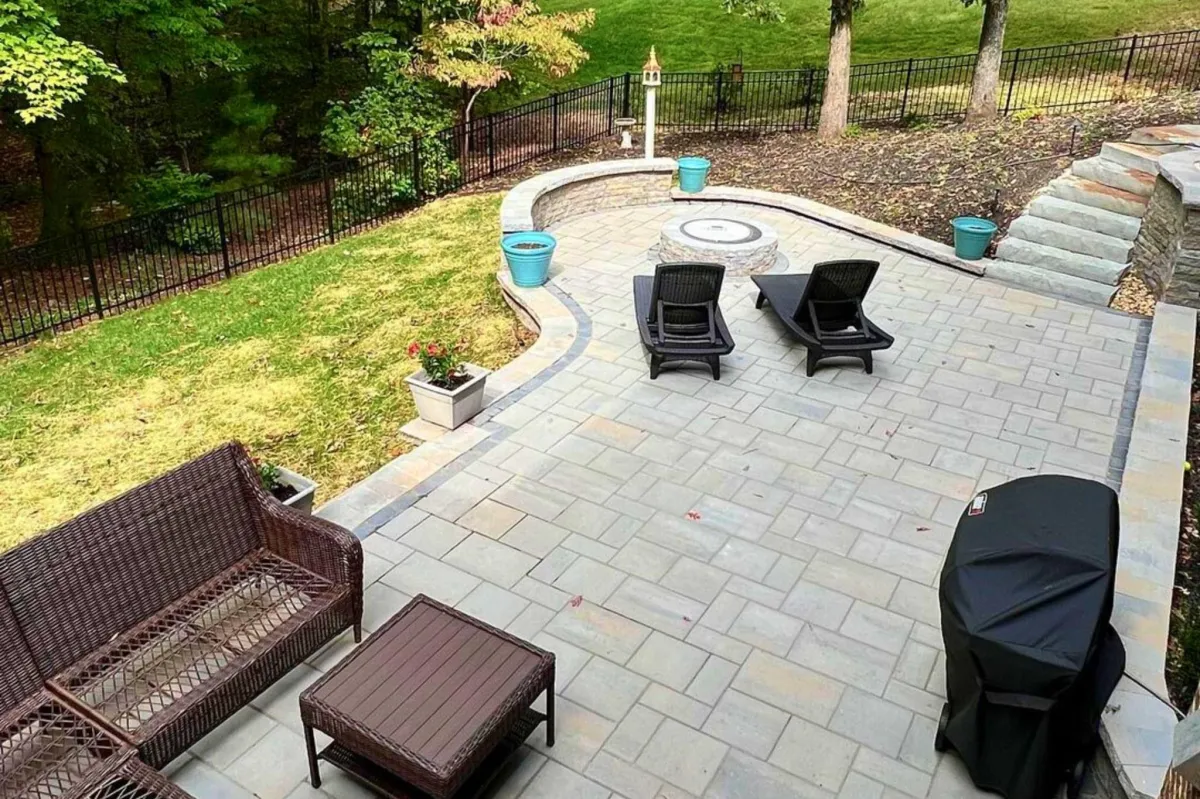
Why the Chimney Height Matters More Than the Firebox
Most homeowners focus on the firebox opening — 42 inches, 48 inches, a mantel shelf, a raised hearth. Fine. But in a Laurel Springs or River Club build, the chimney is what drives the budget, the engineering, and the permit conversation. The architectural review board will often care more about the chimney silhouette than the hearth detail, because from the neighboring lot, that’s what reads.
We design courtyard chimneys in three height bands, and every band triggers different structural and code requirements. Under 12 feet: straightforward. 12 to 18 feet: you’re stamping engineering and running a bigger footing. 18 to 22 feet: you’re in full commercial-masonry territory with a structural engineer’s seal, a deeper footing, stainless flue liner sized per NFPA 211, and wind loading calculated at the ridge. That top band is where nearly every River Club courtyard fireplace lands.
The height isn’t arbitrary. It has to clear the nearest roof ridge by the NFPA 211 “2-foot, 10-foot” rule — the outlet must be at least 2 feet taller than any structure within 10 feet horizontal. Add a big two-story home with a steeply pitched roof, place the courtyard on the lee side of the prevailing wind, and you’re quickly looking at 20+ feet to get a clean draw. Shortcut the height and you get a smoky courtyard every time the wind comes off the Chattahoochee.
Chimney height range for Suwanee courtyard builds: 16 to 22 feet measured from firebox throat to cap. Material cost for the upper 6 feet alone is typically $7,800 to $11,400 in native Georgia granite, or $12,200 to $17,000 in imported Pennsylvania bluestone. That single decision — stone sourcing — moves the whole project price more than any other choice.
The Native Georgia Granite Sourcing Problem
Here is the sourcing dilemma that ended up on our desk on that first River Club project. The home had been built in 2011 with a granite veneer quarried from a small Elberton-area yard. That quarry had been idle for six years. The homeowner wanted the courtyard fireplace to match — not resemble, match — the existing elevation stone. The original mason hadn’t kept overage. No bin, no pallet, no reference board.
This is the Suwanee luxury-market version of a problem we see constantly. The 2000-2015 build wave put a lot of custom granite and fieldstone on these homes, and 10 to 20 years later, when the homeowner wants the back of the house to finish the front’s design language, the original stone is often untraceable. Three options usually surface:
- Track down the original quarry. Takes 4 to 10 phone calls, rarely succeeds for small North Georgia yards, and when it does, the current output may no longer match the 2011 production. Granite weathers and the new cut reads brighter.
- Commission a custom blend. A stone yard like Stone Center of Georgia or Ferguson Stone can hand-pick 2,400 to 3,600 square feet of Elberton, Tate, or Blairsville granite and color-match against a photo set. Adds roughly 18% to 22% to material cost and 3 to 4 weeks to the schedule.
- Pivot to a sympathetic stone. Instead of matching, deliberately contrast with Pennsylvania bluestone, Tennessee crab orchard, or a thermalled travertine. We often recommend this when the home is more than 10 years old and an exact match is going to read as a bad wig.
On that River Club job, we went with option two — a hand-blended 2,900-square-foot pallet of Elberton and Tate granite, color-graded against the existing elevation in morning light, afternoon light, and overcast. The blend added $8,400 to the stone line. It was the single best money the homeowner spent.
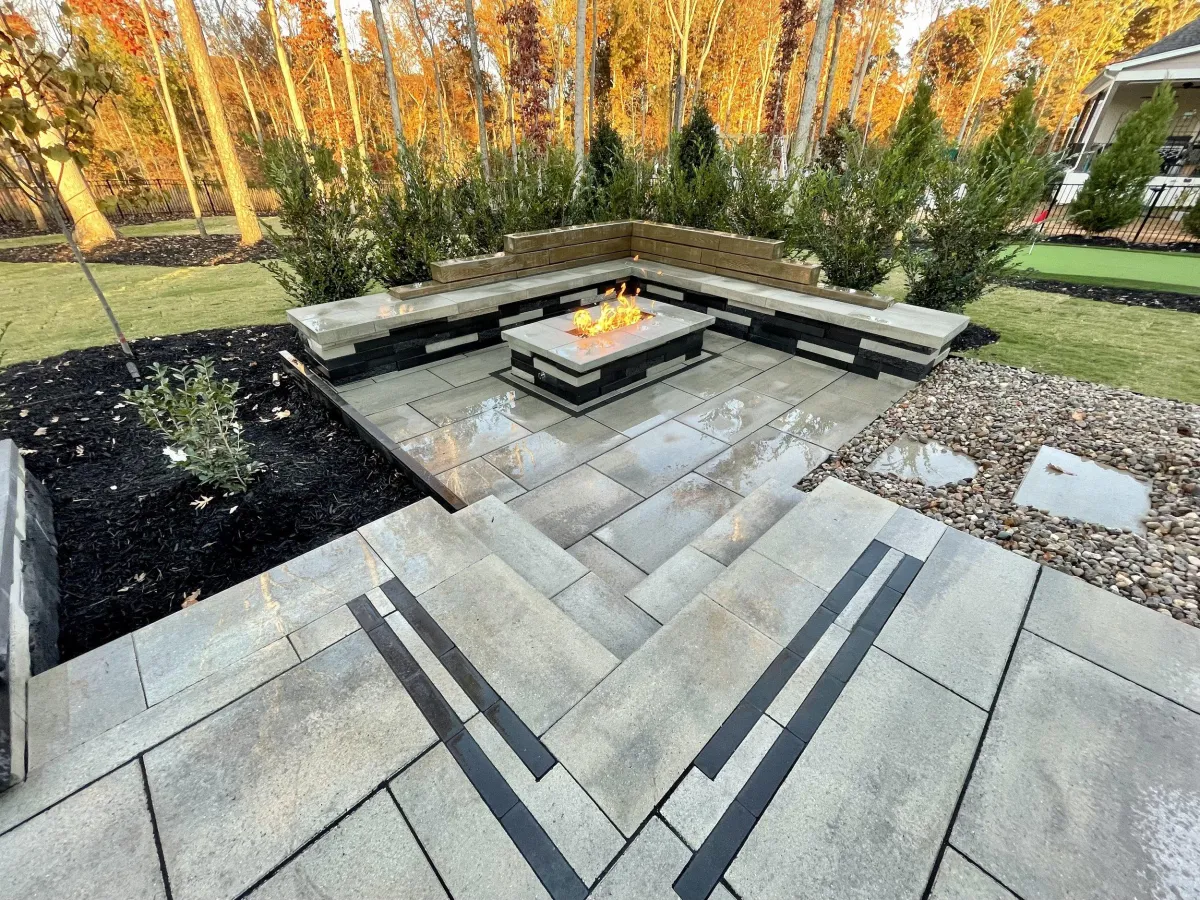
The Footing, the Footprint, and Why Gwinnett Clay Changes the Math
A 22-foot masonry chimney is not a decorative assembly. It’s a dead load on a footing, and in Suwanee you’re pouring that footing into Cecil-series Piedmont clay — the same expansive red clay we deal with across Dacula, Grayson, and Lawrenceville, with a mostly unimportant variation: properties close to the Chattahoochee River floodplain in Settles Bridge and parts of Village Grove have thin sandy loam deposits mixed into the upper horizon, which drain better but have lower bearing capacity in the top 12 inches.
What that means practically: for a 22-foot chimney with stone veneer (call it a 34,000-to-42,000-pound dead load), our standard specification is a 24-inch deep, 6-foot by 4-foot reinforced concrete footing with #5 rebar on 12-inch centers both ways, mat top and bottom. That footing pours at 3,500 psi minimum, cures 7 days before any masonry stands on it, and ties into the house footing if the fireplace is attached, or sits independent with a code-required expansion gap if it’s freestanding across the courtyard.
On a River Club property with heavy piedmont clay and no floodplain proximity, that’s the spec. On a Settles Bridge lot in the AE flood zone along the Chattahoochee, we sometimes step that up to a 30-inch footing with a perimeter French drain, because the upper sandy horizon can shift seasonally when the water table rises. The extra digging and concrete adds $1,900 to $2,600. Cheap insurance for something that’s going to stand for 60 years.
The ARB Package — What Laurel Springs Actually Wants to See
The Laurel Springs architectural review board is, by most Gwinnett County reckonings, the strictest HOA review process outside of Berkeley Lake. Their typical turnaround on a complete exterior modification application is 3 to 4 weeks, and they will kick a submission back for anything that reads as incomplete. The River Club ARB is slightly less exacting but still a serious gate. Both boards want the same core package, and submitting it right the first time is worth weeks.
Our standard ARB submission for a Suwanee luxury courtyard fireplace includes:
- A photorealistic 3D rendering of the fireplace in context, viewed from the three most common sightlines — backyard center, side elevation from the neighboring lot, and from the rear patio door. Flat elevation drawings alone will get rejected. We render in SketchUp with Enscape or V-Ray and include early-morning, afternoon, and dusk lighting passes.
- Stone sample board. Physical. 18-inch by 24-inch mounted panel with the actual quarry stock, grouted to spec, photographed and appended to the digital submission. Boards are kept on file by both Laurel Springs and River Club for future reference.
- Dimensional site plan showing setbacks from property lines, from any structure, from septic lines if applicable, and the chimney height checked against the NFPA 211 clearance calculation.
- Structural stamp. For any chimney over 18 feet, Gwinnett will require a Georgia-licensed PE’s stamp on the footing and masonry detail. The ARB wants to see it attached to the application even when the county hasn’t asked for it yet.
- A construction staging plan. Where the dumpster goes, where the pallets stage, how trucks access via Peachtree Industrial Blvd and whichever gated entrance applies, and what the site looks like from the street on day 18 of the build.
The staging plan item surprises most homeowners. Both boards review it as carefully as the fireplace design, because a 10-week build with poor staging becomes everyone’s problem in a gated community with 24-hour guarded entry. We’ve had one ARB pre-approve a design concept but hold final sign-off until we submitted a revised staging plan moving the stone pallet drop off a shared driveway.
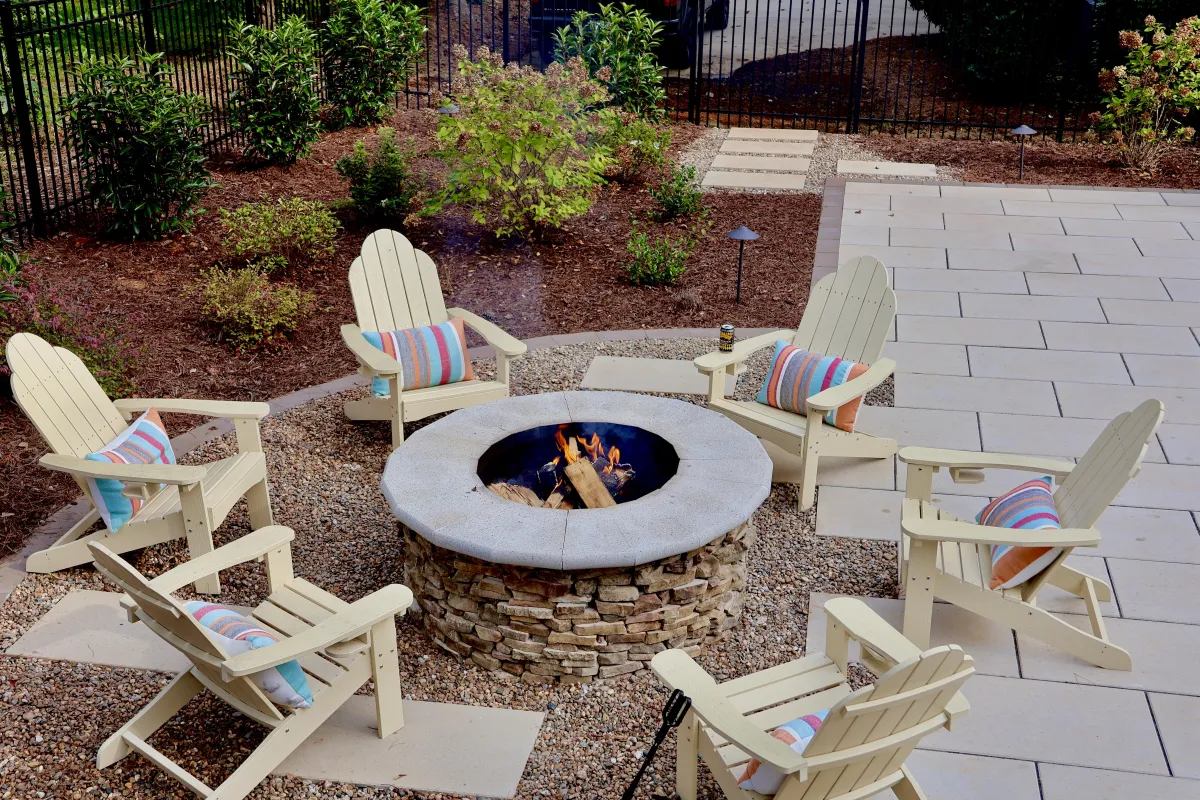
The Real Price Range — and What Drives the Swing
The honest range for a Suwanee luxury courtyard fireplace of the scale we’re describing — 8 to 12 feet wide, 16 to 22 feet tall, stone-veneered masonry — is $32,000 to $58,000. That’s a nearly 2x swing, and homeowners deserve to know what pushes a project from the low end to the high end. It’s not markup. It’s six specific decisions.
1. Stone choice and sourcing. Standard palletized fieldstone from a Gwinnett yard runs $18 to $26 per square foot installed. Hand-selected native Georgia granite color-blended to match existing elevation runs $38 to $54. Imported Pennsylvania bluestone with ledger cuts runs $46 to $62. On a 380-square-foot veneer job, that delta is $10,600 to $13,700 in stone alone.
2. Chimney height. Every additional 2 feet above 16 adds roughly $2,800 to $4,100 depending on stone. You’re not just paying for stone — you’re paying for scaffold rental time, engineering revision if you cross the 18-foot threshold, and hand-labor at height.
3. Firebox hardware. A basic steel-lined firebox with a standard damper runs $1,200 to $1,900. A heat-circulating precast firebox with a Lyemance top damper, outside combustion air, and stainless flue liner runs $4,600 to $6,400. The second option is what we spec for homeowners who actually plan to use the fireplace more than 10 nights a year.
4. Mantel and hearth detail. A tossed-on reclaimed timber mantel is $400 and looks like it. A cast limestone mantel with carved corbels from a yard like Ferguson is $2,900 to $4,800. A raised bluestone hearth with a bullnose return and integrated seating adds another $1,800 to $3,200.
5. Gas line or wood-burning. Full wood-burning with proper throat damper, smoke shelf, and flue sizing is the default. Adding a concealed gas log starter (the “match-light” assist) adds $650 to $1,100 and requires Jackson EMC coordination only if the gas service itself is new. Converting to pure vent-free gas logs in a wood-rated masonry firebox is a separate code conversation we generally steer against on these scale builds — if you’re going to spend $47,000, burn real wood.
6. Electrical integration. LED down-lights on the firebox exterior, landscape lighting in the surrounding hardscape, and a concealed outlet for the audio system bring $1,400 to $2,800. Run conduit before the footing pour or you’ll tear up the courtyard floor later.
Utility note specific to Suwanee: most of the Laurel Springs and River Club properties are served by Jackson EMC, not Georgia Power. If the courtyard electrical tie-in requires a service upgrade or new 240V drop, you’re dealing with Jackson EMC’s planning office in Jefferson, GA, not the Atlanta-area Georgia Power process. Plan 2 to 3 extra weeks for any coordinated electrical work.
The 10-Week Build Calendar — What Actually Happens and When
From signed contract to first fire, a full Suwanee luxury courtyard fireplace takes 9 to 11 weeks of active work, plus roughly 4 weeks of pre-construction permitting and ARB review. Here’s the real calendar we publish to homeowners on kickoff day so nothing surprises them.
Weeks -4 to 0 (pre-construction): Final design drawings, 3D rendering, ARB submission, stone sourcing and sample board, PE stamp on the structural detail, Gwinnett County permit intake, Jackson EMC coordination if electrical applies. This is where most of the real work happens before a shovel hits the ground.
Week 1: Site prep, excavator mobilization, footing excavation down to 24 inches below grade and 36 inches on the perimeter to clear any courtyard slab edge. Georgia 811 locate call completed before any digging.
Week 2: Form the footing, set rebar mat, pour 3,500 psi concrete, 7-day cure with wet-down protocol if summer temps exceed 92°F — which is 30+ days of the Suwanee calendar from mid-June through late August.
Weeks 3–4: Cinder block chase construction up through the firebox floor height. Smoke shelf and throat forming. First pressure test on the gas line if applicable.
Weeks 5–7: Stone veneer from grade up, lift by lift. Mortar joint style locked in the first lift and carried consistently. Scaffold re-rigs once at roughly 12 feet up.
Weeks 8–9: Upper chimney and cap. Stainless flue liner installation, smoke test, bluestone or cast concrete cap install, drip edge detail.
Week 10: Mantel and hearth placement, electrical finish, bronze screen install, final clean, ARB walkthrough, first fire inspection.
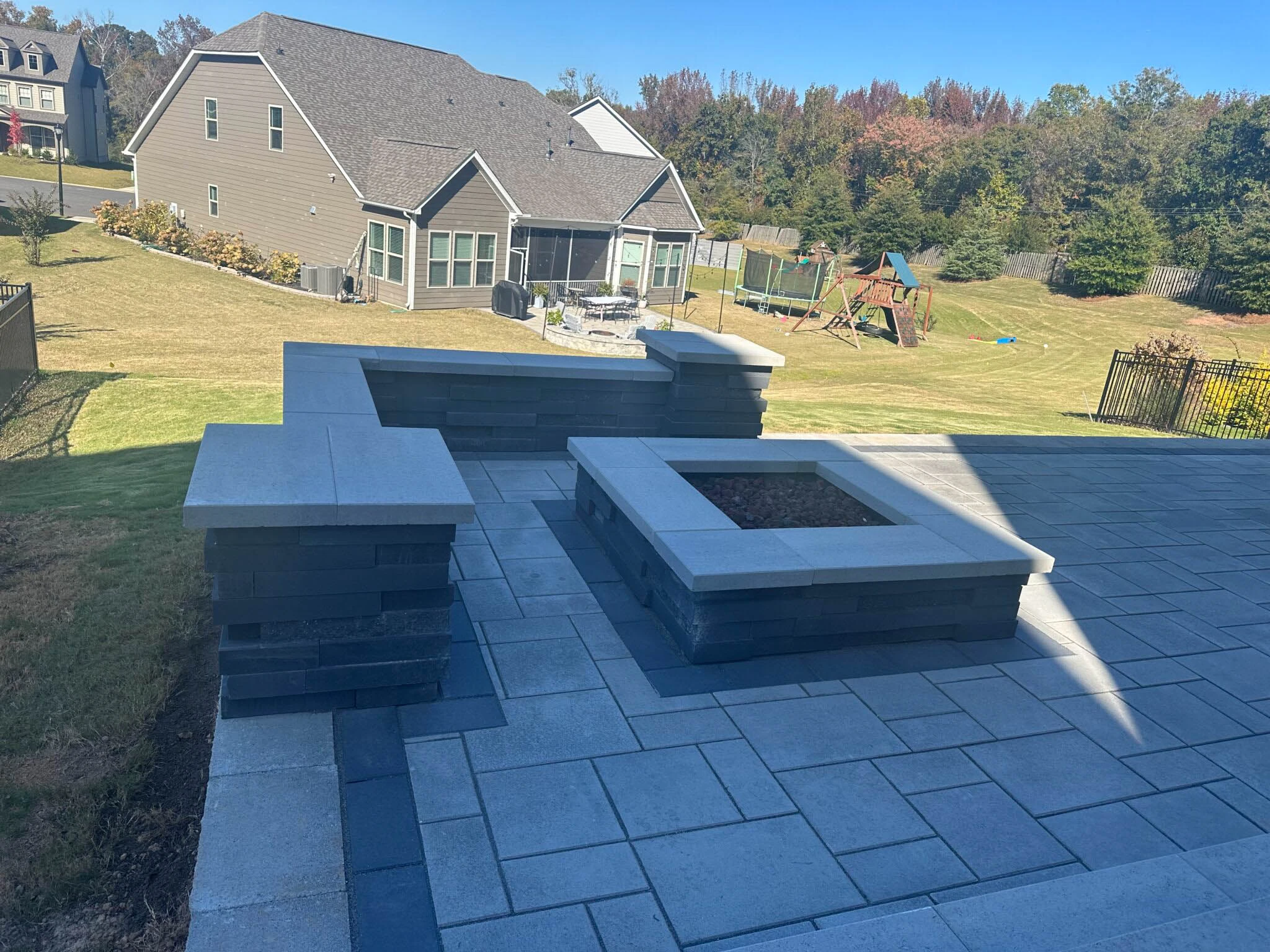
Integrating the Fireplace With the Home’s Exterior Stonework
The last decision, and often the hardest, is the relationship between the new courtyard fireplace and the home’s existing exterior stone. This is where most generic fireplace installs fall apart visually. The fireplace reads as a separate, pasted-on object. On a $2.4 million River Club home, that shows.
Three integration moves that reliably work:
Mortar joint match. If the house is drystack-style with recessed raked joints, the fireplace must be the same. A flush mortar fireplace next to a drystack elevation is the single biggest giveaway that the fireplace was added later. We mock up a 4-foot by 4-foot joint panel on site before the first real lift goes up.
Coursing rhythm. If the house uses horizontal-coursed ledger stone in tight 3-to-5-inch bands, the fireplace should pick up the same rhythm at least on the primary face. Random-rubble fireplaces next to coursed elevations read as afterthoughts.
Cap and accent continuity. If the home has bluestone caps on its stone retaining walls and chimney, the fireplace cap should match that bluestone. If the front door surround uses a cast limestone detail, the fireplace mantel should echo it. These small carryovers are what make a new fireplace feel like it was always part of the house.
On a Bear’s Best Atlanta project we finished last season, the homeowner had us pull color samples from the existing chimney cap, the front retaining wall, and the garage elevation. We color-matched the courtyard fireplace against all three, weighted toward the chimney cap because that’s the element most visible at eye level from the courtyard. The resulting fireplace reads as original — which is exactly the target.
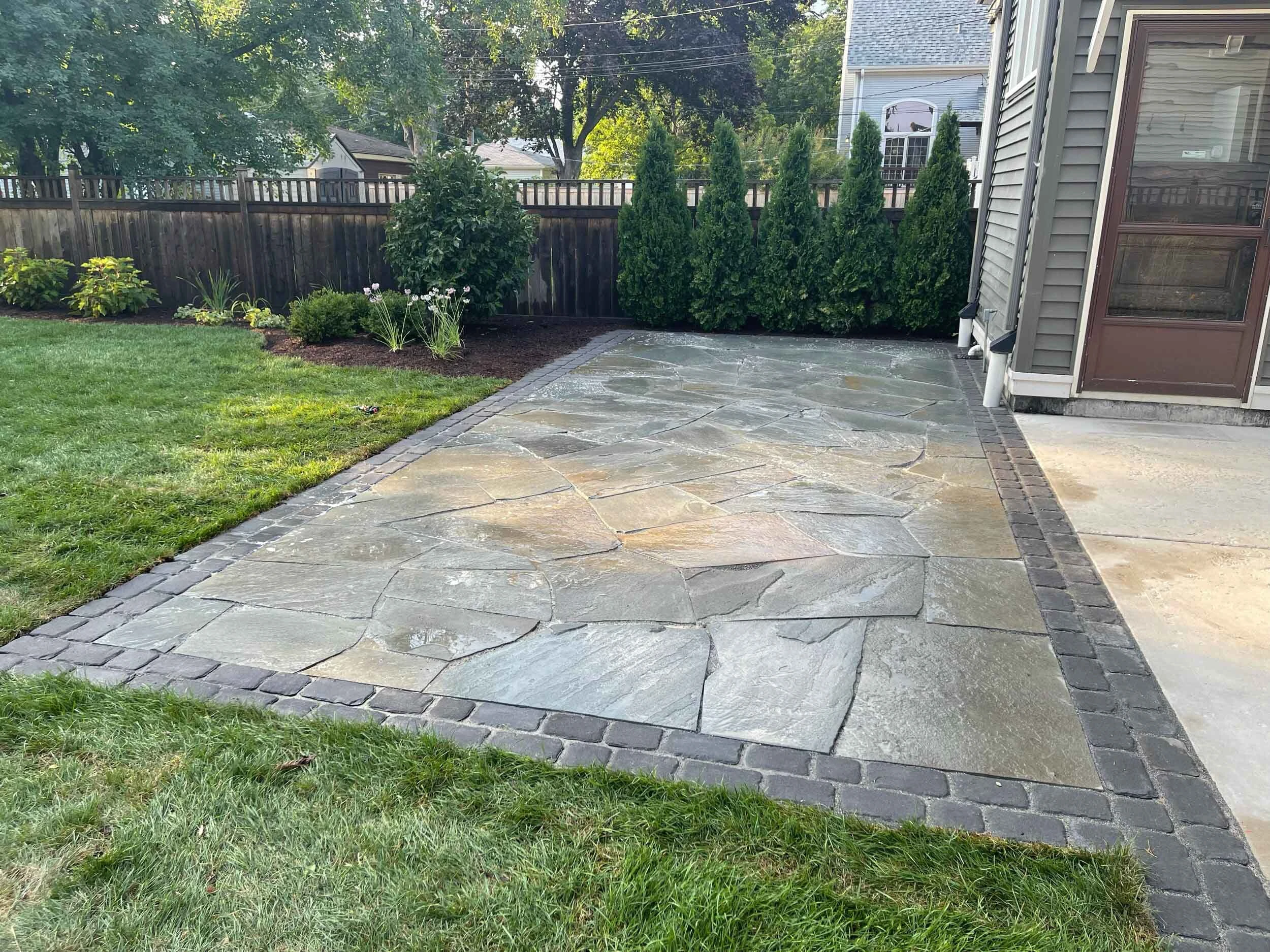
Stone fireplace and hardscape construction across 20+ cities within 30 miles of Winder, GA
From 22-foot chimneys in Laurel Springs to streamlined fire features on smaller Suwanee proper lots — every build stamped, permitted, and sourced to the property’s specific design language.