
The call came from a homeowner in Cogburn Estates. Their architect had specified Tennessee fieldstone on the home’s chimney columns, and the pool builder they’d already hired wanted to wrap the kitchen base in stucco. “That’s going to look wrong,” she said. “I can feel it, but I can’t explain it.” She was right — and this post is the long explanation for why.
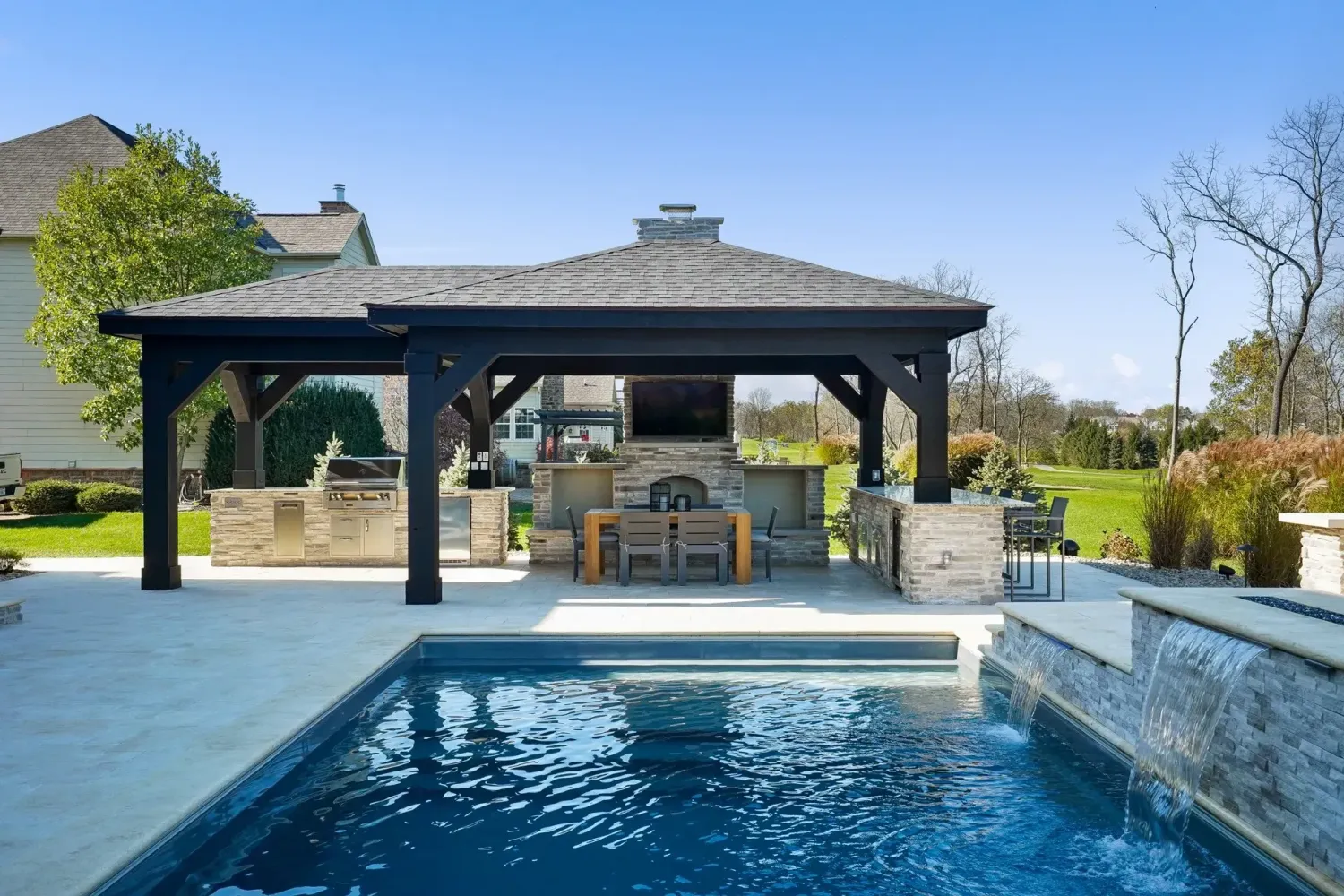
What followed was an 11-week build on a 2.4-acre estate lot off Freemanville Road: a 16-LF outdoor kitchen with a stacked-stone base clad in the same Tennessee fieldstone that ran up the home’s front-elevation chimney, tied into a pool deck that stepped down 8 feet to a salt pool with a pavilion at the low end. The total kitchen line item was $47,000, of which $14,800 was stone-scope. Every dollar of that stone premium was visible from the back-porch French doors. That’s the angle of this post.
Milton’s 2015-and-later homes — the ones filling The Manor, Cogburn Estates, Greystone, and the custom pockets off Hopewell Road — read overwhelmingly as modern farmhouse. Board-and-batten siding, standing-seam metal accents, cedar soffits, and architectural stone on chimney stacks or base piers. When we bring a pool and outdoor kitchen to these houses, the kitchen base is the single most visible architectural element from every seated angle on the pool deck. Getting it wrong dates the entire project on day one. Getting it right makes the kitchen feel like it was drawn on the original elevations.
Why Farmhouse Architecture Demands Stone at the Base
Modern farmhouse is a layered vocabulary. White or charcoal siding handles the upper elevations. Dark-metal roof seams pull the eye up. Cedar soffits warm the underside of every overhang. And stone — almost always — grounds the building at the foundation plane. Chimneys, porch piers, a knee-wall at the garage, the base of a water-table detail. Stone is the weight that makes the rest of the composition feel honest.
An outdoor kitchen sitting on a pool deck is, in architectural terms, a detached volume with its own foundation plane. When you clad it in stucco, board-form concrete, or tile, it reads as a separate building from a different decade. Nothing about the material vocabulary connects back to the house. When you clad it in stacked stone that matches the primary elevation, the kitchen reads as a satellite of the main building — the same family of materials, the same stone coursing, the same grout profile. The eye relaxes. The project looks intentional.
This is the rule every architectural review committee in Milton applies, written or unwritten. At The Manor, the review process typically runs 4–5 weeks through the structural review committee, and the single most common revision request on outdoor kitchen packages is material continuity with the primary residence. If the chimney is a specific fieldstone blend, the kitchen base needs to be within a ten-percent visual distance of that blend. No exceptions that we’ve seen in five years of work inside that gate.
The Manor review cadence: Submit complete architectural package (plans, elevations, material boards with physical stone samples) to the structural review committee. Allow 4–5 weeks for first-pass response. Revisions typically request material refinements, not layout changes. Build permits from City of Milton Community Development at 2006 Heritage Walk follow the HOA approval and run 10–14 business days.
The Two Stone Systems That Actually Work in Milton
Across 40-plus Milton builds over the past six years, two stacked-stone systems have shown up on almost every kitchen base we approve. The choice between them isn’t aesthetic preference — it’s driven by what’s already on the house and how far you’re willing to push the budget.
System 1: Natural Tennessee Fieldstone (dry-stack or mortared)
Tennessee fieldstone is the default specification at The Manor, Atlanta National, and most of Cogburn Estates. The stone comes out of quarries along the Cumberland Plateau and arrives in Milton as irregular, face-tumbled pieces in a palette that runs from warm tan through weathered gray to moss-green-tinged brown. Installed over a CMU block core with Type-S mortar pressed back from the face, it reads as authentic masonry — because it is.
Installed cost at Milton rates: $46–$58/sqft of veneer surface. On a typical 16 LF kitchen with a 42-inch-tall base, you’re looking at 140–180 sqft of veneer once you wrap the three visible faces plus returns, which puts the stone-scope line item between $6,500 and $10,400. Add another $2,000–$3,500 if you’re carrying the stone up onto a bar-height seating counter, pilasters, or a chimney-backed fireplace on the same deck.
System 2: Eldorado Stacked Stone Veneer (manufactured)
When budget is tight, or when the architect has already specified Eldorado on the house itself — which happens in about a third of new Milton builds — we match veneer to veneer. Eldorado’s “RoughCut” and “Mountain Ledge” profiles mimic dry-stack Tennessee fieldstone closely enough that the transition from house to kitchen reads as identical material.
Installed cost: $38–$46/sqft. Same 16 LF kitchen example lands at $5,300–$8,300 for stone scope. The trade-off: manufactured veneer is thinner (roughly 1.25 inches vs. 3–5 inches for natural), so you lose some shadow depth at the joint lines. At arm’s length it’s obvious; at pool-deck seating distance it disappears.
How the Kitchen Base Actually Gets Built
A stacked-stone kitchen on a farmhouse-spec project is a four-layer sandwich, and the layers matter because cutting any one of them dates the failure to year three. Here’s the full stack from the slab up:
- Concrete footing: 16 inches wide, 12 inches deep, reinforced with #4 rebar on 12-inch centers. Milton’s Cecil clay soils expand and contract hard between the wet winter cycle and the August dry-down, so the footing carries the kitchen through that movement without transferring it up into the veneer.
- CMU block core: 8-inch concrete masonry units laid up to 42-inch finished counter height, with openings framed for the grill, refrigerator, and whatever cabinet package the homeowner specified. This is the structural skeleton the veneer bonds to.
- Scratch coat + metal lath: Galvanized 2.5 lb diamond lath mechanically fastened to the CMU, then a Type-S mortar scratch coat troweled on and left with a tooth. This is where most DIY and low-end contractor jobs fail — they skip the lath, the mortar fails at the bond plane, and the stone falls off the base in year three when the first freeze cycle gets behind the veneer.
- Veneer stone with pressed joints: Fieldstone or manufactured veneer set in mortar over the scratch coat, with the joints pressed back from the face by roughly 3/4 of an inch to create the shadow line that makes the coursing look like dry-stack masonry.
The final element is a stone cap or countertop overhang that throws water away from the veneer face. On Tennessee fieldstone builds we typically specify a 2-inch leathered granite top in Steel Gray or Black Pearl, with a 1.5-inch overhang on all exposed edges. That detail alone extends the useful life of the stone base by about a decade because water never gets to sit on the top course.
Matching Stone to the Primary Elevation — the Architectural Continuity Requirement
This is the detail that separates an outdoor kitchen that looks right from one that looks airlifted in. Every Milton farmhouse we’ve worked on has a specific stone specification on the primary residence, and the kitchen base has to live inside that vocabulary.
The process on a real build: the architect or builder provides the original stone submittal — either a physical board from Eldorado Stone, Tennessee Stone and Marble, or one of the regional quarries, or a photograph of the installed chimney. We take that onto the stone yard and hand-pick pallets that sit inside the same color range and piece-size distribution. On one recent Greystone build, the original chimney was Eldorado RoughCut in “Silverton” — we specified the same SKU on the kitchen veneer, and the transition between the two structures was invisible at twenty feet.
When the original spec is unavailable or the house predates the current veneer catalog, we photograph the chimney in overcast light (shadows lie under direct sun), bring the photo to Stone Center of Georgia or General Shale, and have the yard manager pull three candidate blends for a physical mockup on-site. The homeowner approves the mockup in daylight before any stone goes on the base. Skipping that mockup has cost contractors in Milton full kitchen rebuilds — the stone looked right in the yard and wrong against the house.
Creek-buffer note: Many north Milton estate parcels sit within 25–75 ft setbacks from Cooper Sandy Creek, Chicken Creek, Lake Creek, or unnamed Etowah tributaries. Outdoor kitchen footings inside a creek buffer require a separate variance through Milton Community Development. Plan for an additional 3–5 weeks on the permit timeline if your pool deck approaches a named tributary.
The Cedar, Metal, and Appliance Language That Completes the Kitchen
Stacked stone alone doesn’t finish the farmhouse vocabulary. Three other material moves lock the kitchen into the architecture, and skipping any of them leaves the finished project looking half-dressed.
Cedar or tongue-and-groove pavilion soffit
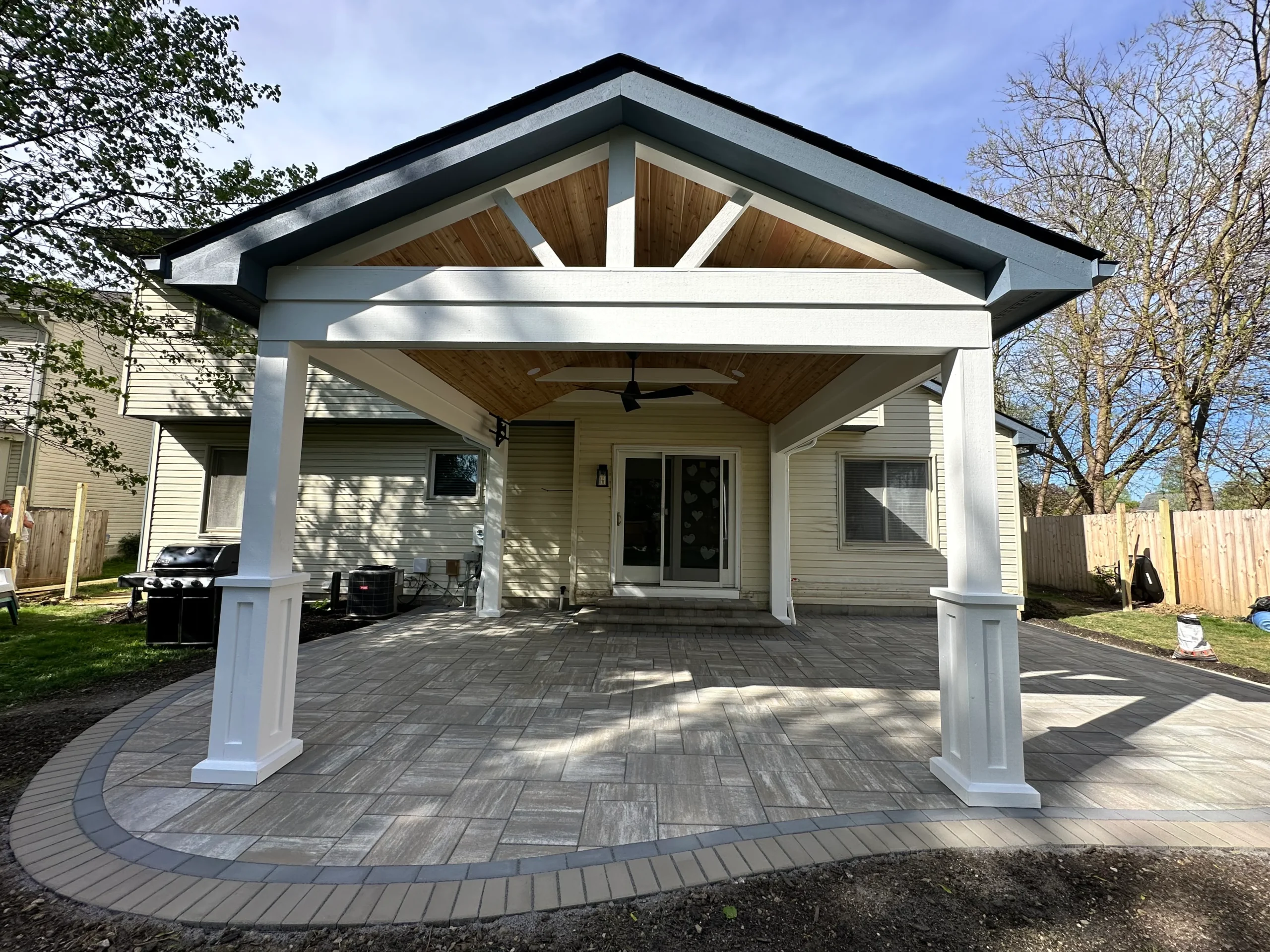
If the kitchen sits under a pavilion or attached cover, the underside of that structure needs to match the cedar soffits on the main house. Tongue-and-groove western red cedar, typically 1×6 or 1×8, installed with stainless brad nails, finished with a UV-resistant clear sealer like Penofin Pro-Tech or left to silver out naturally. This single detail — warm wood directly above stone — is the defining material pairing on Milton farmhouse pool decks. Without it, the kitchen reads as commercial.
Dark-bronze or matte-black metal accents
The hood vent, any visible structural steel, the grill itself, and the cabinet hardware all should land in the same dark metal family as the home’s roof seams and window frames. Specifying a stainless-steel grill on a farmhouse with a bronze standing-seam roof is the kind of detail that costs the project visual cohesion. Hestan, Lynx Sedona, and the Twin Eagles Collection all offer dark-finish packages that sit correctly inside farmhouse elevations.
Grounded countertop with visual weight
Thin quartz looks wrong on a stacked-stone base. The stone wants a counter that matches its density — leathered granite at 2-inch thickness, a honed soapstone slab, or a thick bluestone cap. The counter’s job is to finish the stone visually, not to compete with it. On the Cogburn Estates project we opened with, we used a 2-inch leathered Black Pearl granite with a 1.5-inch overhang and an eased edge. The granite reads almost as a single continuous cap even though it’s three slab sections mitered at the corners.
Grade, Drainage, and the Milton-Specific Engineering You Can’t See
Milton estate lots are harder than Alpharetta lots. The rolling topography produces 6-to-14-foot grade drops across a typical rear yard, and Cecil clay doesn’t drain the way sandier coastal-plain soils do. Every stacked-stone kitchen we build carries three engineering details that don’t show up in the finished photos but determine whether the project survives ten freeze cycles.
Saprolite shelf avoidance: On ridgeline lots in The Manor and the Crabapple escarpment, the topsoil layer thins to 18–24 inches before you hit weathered granite (saprolite). Kitchen footings that bear partly on saprolite and partly on topsoil will crack along the transition line. We over-excavate to a uniform bearing stratum — either all-saprolite at full footing depth, or bring in compacted #57 stone on 12-inch lifts to establish a uniform engineered base across the entire footing footprint.
Water management behind the veneer: The back side of the CMU core, above grade, gets a full coat of liquid-applied waterproofing (we use Laticrete Hydro Ban) before the cedar soffit or countertop caps the top course. This keeps wind-driven rain from getting behind the stone and freezing during Milton’s ~22 annual freeze events. Without that layer, a 10-year-old veneer job will show spalling along the top course.
Slab-to-kitchen expansion joint: The kitchen footing is structurally separate from the pool deck slab, with a 1/2-inch expansion joint at the interface filled with closed-cell backer rod and a self-leveling polyurethane sealant. This detail prevents pool-deck heave (and Milton clay heaves) from transferring lateral load into the kitchen base and cracking the veneer at the corners.
Budget Reality — What a Complete Milton Farmhouse Kitchen Actually Costs
Homeowners walking into an outdoor kitchen conversation in Milton typically arrive with a budget figure pulled from a national-average article. The gap between national numbers and Milton numbers is wide enough to derail the project if we don’t set expectations in the first meeting. Here’s what a complete, code-legal, architecturally-continuous farmhouse kitchen actually costs on a Milton estate lot today.
A 14–18 LF kitchen with stacked-stone base, granite counter, premium grill package, side burner, refrigerator, storage cabinetry, and a single pavilion structure above:
- Stone scope (veneer + footing + CMU + labor): $12,000–$18,000
- Appliance package (grill, burner, fridge, hood): $9,000–$18,000 depending on brand tier
- Counter (2″ leathered granite or soapstone): $3,800–$6,200
- Cabinetry and door fronts (stainless-core w/ veneer doors): $6,500–$11,000
- Gas line, electrical, and water rough-ins: $2,800–$4,500
- Pavilion structure (if applicable, cedar + shingle/metal roof): $18,000–$34,000
Total project range: $34,000 to $72,000 for the kitchen alone, or $52,000 to $106,000 including an integrated pavilion. On the Cogburn Estates project we opened with, the full kitchen plus a shingle-roof pavilion landed at $71,400, of which the stone scope was $14,800 and the pavilion was $28,200.
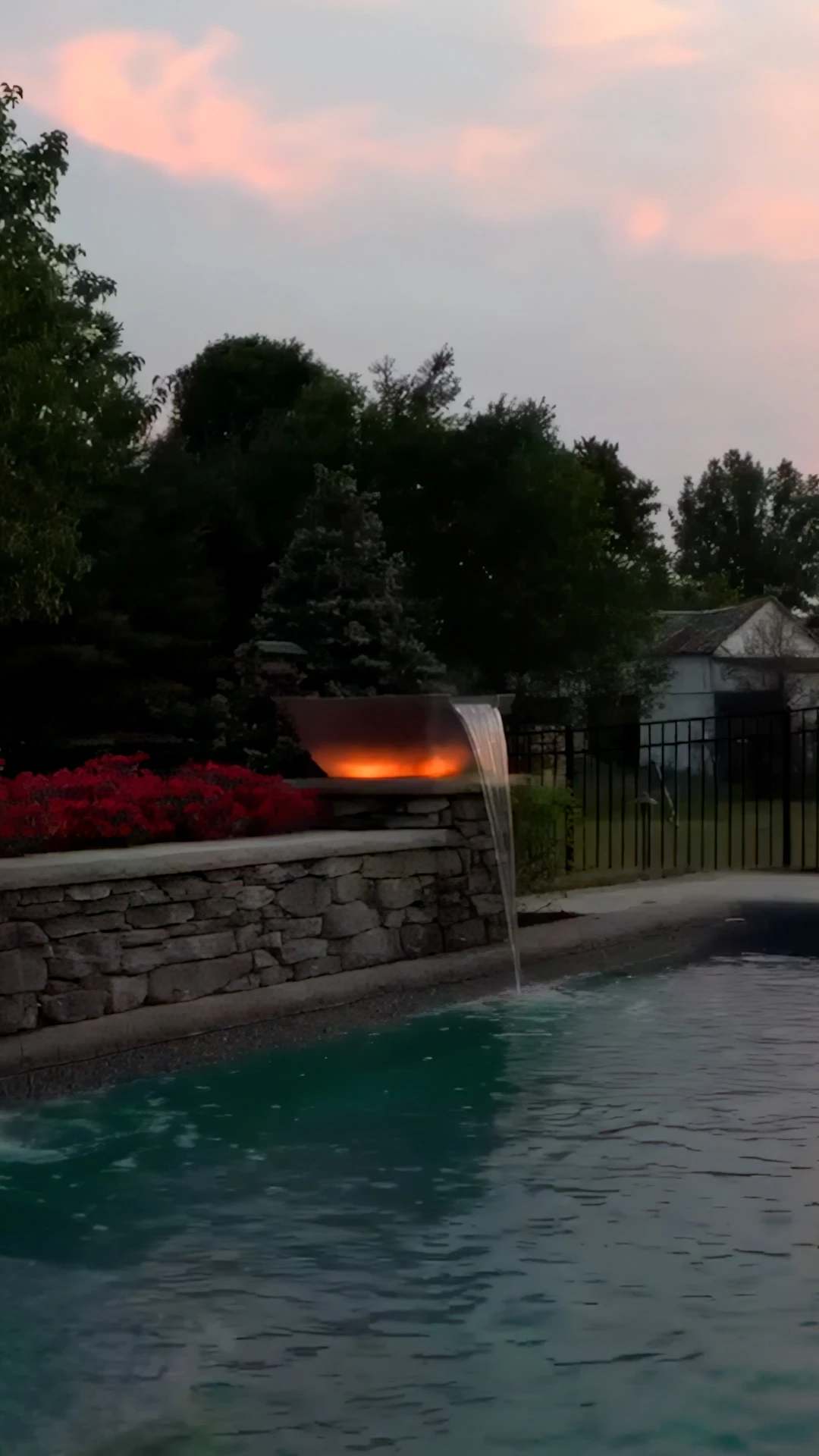
A note on sequencing: on sloped Milton lots where the pool deck steps down from the house, we almost always build the kitchen on the upper terrace adjacent to the back door and position the pool at the lower elevation. This puts the kitchen inside the conditioned walking path from the house (no one wants to carry a platter 40 feet downhill), uses the grade to create visual separation between the cooking zone and the swimming zone, and lets the pavilion at the lower end anchor the far edge of the composition. That sequencing decision — kitchen high, pool low, pavilion at the terminus — is worth sketching before any stone gets specified.
Permit and inspection path: Outdoor kitchen + pool projects in Milton require separate trade permits (building, mechanical, electrical, plumbing) submitted as a combined package to Milton Community Development. Expect three inspection visits minimum — footing, rough-in, and final — with gas-line pressure tests at rough-in. Since Milton incorporated as a separate city in 2006, the permit path is faster than surrounding Fulton County, but stricter on preservation review.
The Short Version — If You Remember Three Things
If you take nothing else from 3,000 words of kitchen construction detail, take these three. They’re the decisions that separate a Milton farmhouse outdoor kitchen that looks commissioned from one that looks purchased.
One: the stone on the kitchen base must be the same family as the stone on the house. Not similar. Not close-enough. The same family, ideally the same SKU or the same quarry-run. Every review committee in Milton enforces this, and the houses themselves enforce it visually whether a committee weighs in or not.
Two: build the full sandwich — footing, CMU, lath, scratch coat, veneer, cap. Each layer does specific work against Milton’s freeze cycles and clay soils. Skipping any layer to save money produces a kitchen that looks right in year one and fails visibly by year four.
Three: match the appliance and counter language to the stone. Dark-bronze metals, thick grounded counters, cedar soffits above. A stainless-steel grill package on a stone base with a thin quartz top reads as showroom. A bronze-finished Hestan with a 2-inch leathered granite cap on Tennessee fieldstone reads as architecture. Milton homeowners can feel the difference even when they can’t name it.
A stacked-stone kitchen base, built right on a Milton farmhouse estate, is the single highest-leverage material decision on the entire outdoor-living project. It’s not the most expensive line item and it’s not the most complicated, but it’s the element everyone sees first and the element that carries the architecture of the home out into the yard. On a $71,400 kitchen build, the $14,800 in stone scope is the part that makes the other $56,600 look like it belongs.
Outdoor kitchens across 20+ cities within 30 miles of Winder, GA
From Milton farmhouse estates to Dacula family builds, we engineer the stone base, the appliance package, and the architectural continuity as one integrated project — not an afterthought to the pool.