
We were staking a deck in Indian Hills last spring when the homeowner asked the question we hear on almost every East Cobb job: “The yard slopes — is that going to be a problem?” The honest answer is that a 3 to 6 percent grade is the Goldilocks zone of East Cobb lots. Trickier than flat. Nowhere near as ugly as a Kennesaw Mountain side-lot. Get the subdrain right and it disappears into the finished deck.
If you live anywhere east of I-75 between Lower Roswell Road and the Chattahoochee, there’s a very good chance your backyard falls somewhere between three and six feet from the back of the house to the rear property line. Not enough grade to force a retaining wall. Too much grade to ignore. That in-between slope is the most common condition we build on in the 30062, 30066, 30067, and 30068 zip codes, and it’s the exact range where pool deck grading stops being cosmetic and starts being the difference between a deck that drains and a deck that puddles for a decade.
Pool decks in Marietta aren’t flat. They’re never supposed to be flat. A pool deck is a sloped plane with a pool cut out of the middle of it, and on East Cobb’s rolling Piedmont terrain, that plane has to do two jobs simultaneously — shed water away from the coping at a walkable pitch, and shed water away from the foundation of the house. When the lot already slopes toward the back of the home, or sideways toward a neighbor, those two jobs can start to fight each other. That’s the entire problem this article is about.
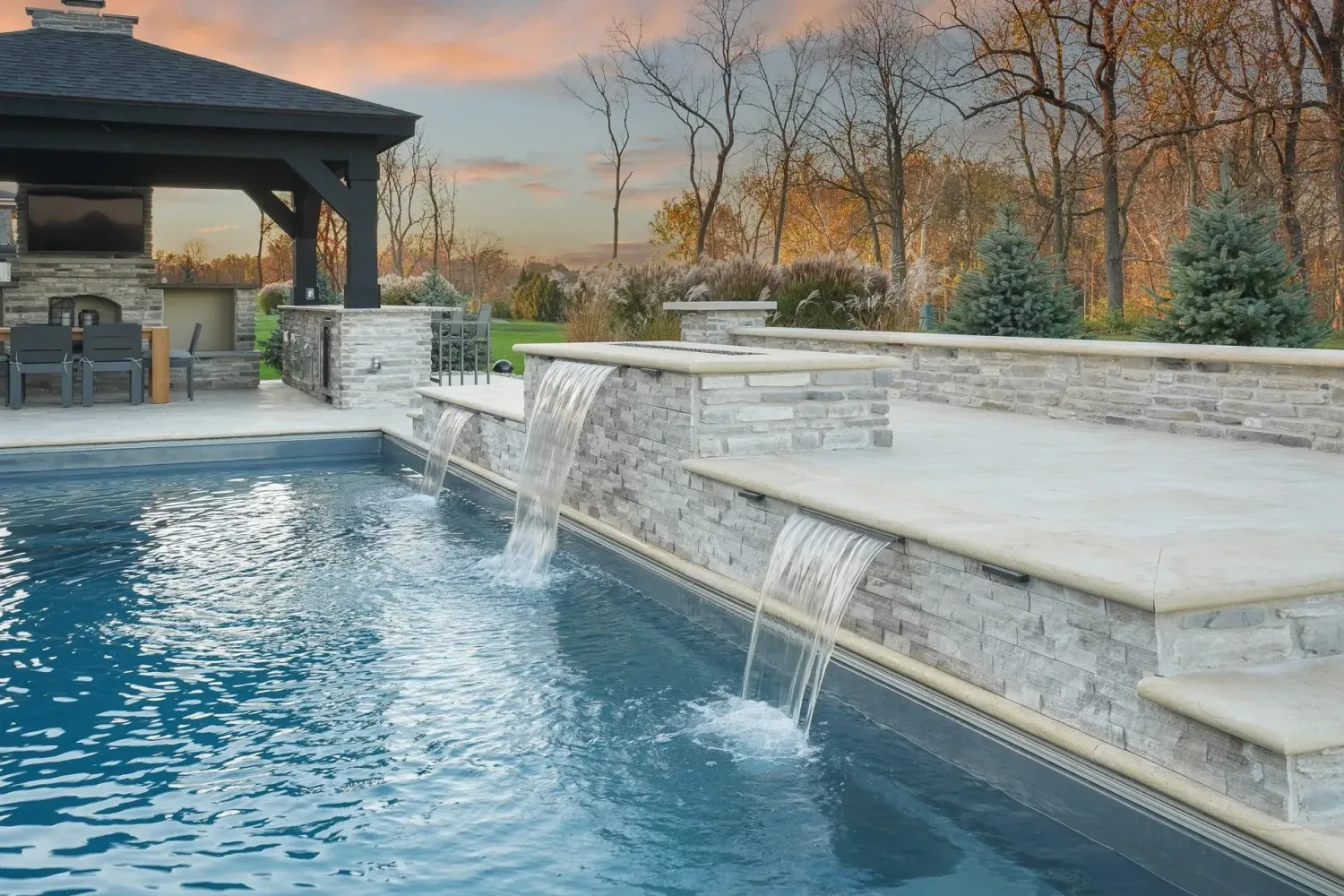
Why East Cobb’s 3–6% Slope Changes the Math
In the industry we talk about three lot conditions. Flat, which is basically anything under a 2% natural grade. Sloped, which covers that 3 to 6 percent band running across most of Indian Hills, Atlanta Country Club, Walton Woods, and Seven Oaks. And steep, which is what you get when a builder carved a pad out of a hillside in Burnt Hickory or along Willeo Creek and left a six to ten foot grade change in twenty feet.
A flat lot is forgiving. You pitch the deck 2% away from the coping in all four directions, dump the water into the yard, and move on. A steep lot is brutally expensive — you’re almost certainly into engineered retaining walls, segmental block systems, tiered decks, and structural fill. Cobb County will want a PE stamp on anything over a certain threshold, and budgets climb fast.
The sloped lot is the in-between case, and it’s the one that gets built wrong most often because it looks like a flat lot to a contractor who isn’t paying attention. A 4% backyard grade means that over a standard 8-foot-wide deck, the back edge of the deck naturally wants to be about four inches lower than the pool coping. That’s fine — as long as you planned for it. If you didn’t plan for it, you end up with a deck that drains toward the house, a low spot at the back corner that holds standing water after every thunderstorm, or a side edge that discharges directly onto the neighbor’s property line. All three are avoidable. All three are also extremely common on East Cobb rebuilds where a previous contractor poured a pad without a grading plan.
Cobb County permit office: Drainage plans for pool decks are reviewed by Cobb County Community Development at 1150 Powder Springs St. Any slope above 5% typically triggers an engineered drainage plan requirement. Budget $800 to $1,400 for the civil-engineer fee if your lot crosses that line.
The 2% pitch rule — and why it only works with a plan
Every builder will quote you the 2% pitch rule — roughly a quarter-inch of fall per foot, away from the pool. That’s the starting point, not the finish line. On a flat lot, 2% in every direction is enough. On a 4% natural grade, 2% pitch in the downhill direction means the deck is actually falling at 6% combined, which is now steeper than ADA allows if you ever want a pool lift, and borderline slippery in bare feet. Pitch in the uphill direction means you’re trying to push water back up a 4% slope, which water will not cooperate with.
The fix is the perimeter subdrain. A four-inch PVC pipe, pea-gravel bedded, wrapped in non-woven geotextile, set at the low edge of the deck. The deck still pitches 2% away from the coping on every side, but instead of counting on natural grade to carry the water, the subdrain catches it and pipes it to daylight. Once that subdrain is in, the surface pitch is free to follow the most comfortable, walkable line regardless of what the native soil is doing underneath.
The Cobb County Discharge-to-Neighbor Problem
This is the part of the job that surprises homeowners more than any other. You cannot legally discharge concentrated stormwater onto your neighbor’s property. Cobb County’s stormwater rules — which largely mirror the Georgia Stormwater Management Manual — require that any pool deck drainage system demonstrate a drainage pathway that exits on the owner’s parcel or into a recognized drainage easement. That rule applies whether the lot is in unincorporated Cobb, inside the Marietta city limits, or in the pocket of addresses served by Cobb EMC up near Sope Creek.
In practice this means the drainage plan we submit to permit has to show where every gallon of deck runoff is going. Not “to the yard.” Specifically, on a site plan — which side of the property it exits from, what the downstream grade is, whether it sheet-flows or concentrates, and whether it reaches daylight on the homeowner’s side of the line. On an Atlanta Country Club lot with two-foot setbacks and a three-way neighbor corner, that analysis can take a civil engineer half a day.
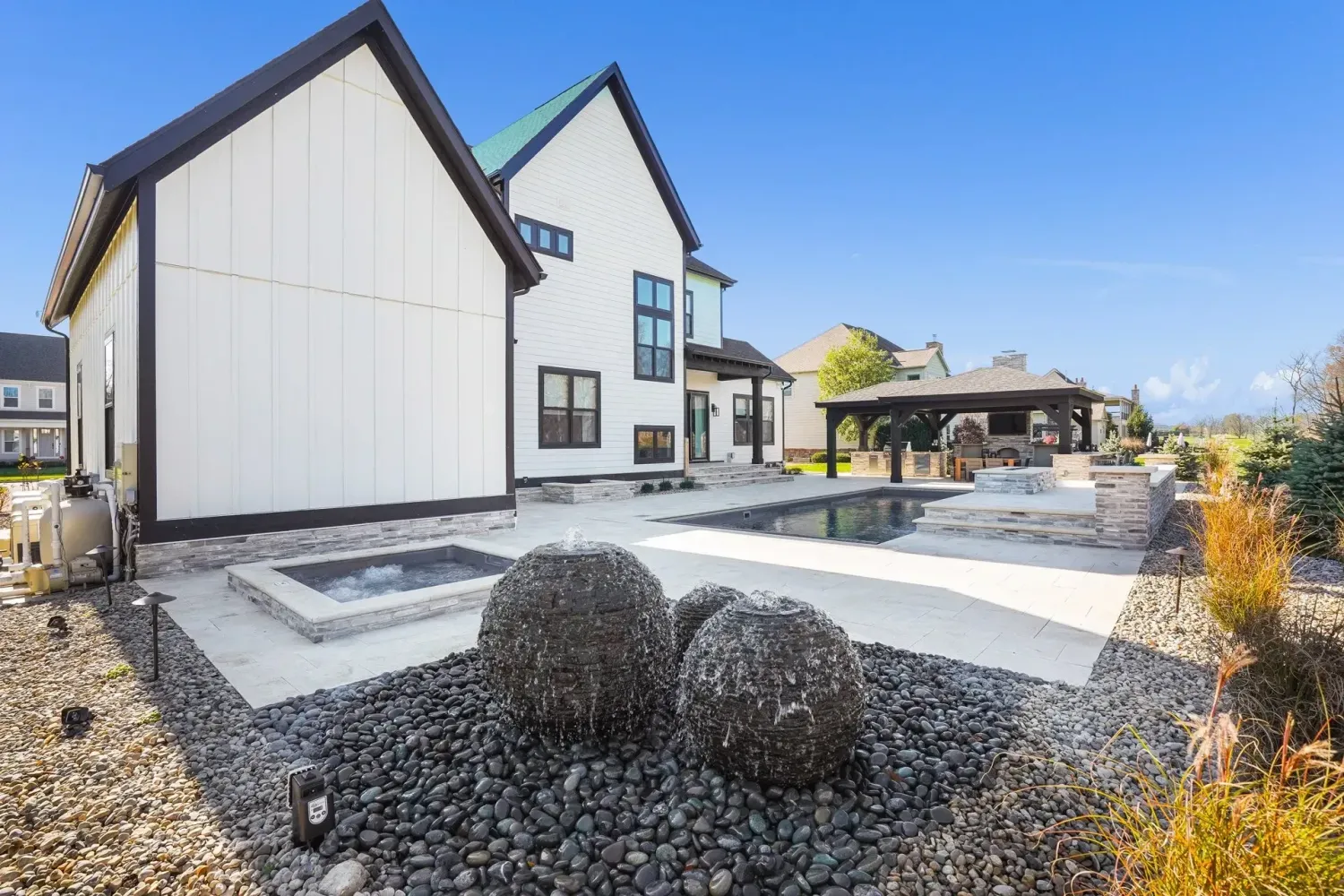
Three patterns account for about 90% of what we actually install:
- Daylight to the rear yard. The easy case. Your lot falls toward the back, there’s 40+ feet of rear setback, and the subdrain terminates in a pop-up emitter or a simple river-rock dispersion pad well inside your property. Plenty of East Cobb ranches on 30066 lots qualify.
- Daylight to a side swale. The mid-case. A side yard carries a natural swale — we run the subdrain into that swale with energy dissipation at the outlet so the discharge matches pre-construction velocity. Common in Brookstone and Chestnut Hill where lots are wider than they are deep.
- Tie into a dry well or infiltration pit. The engineered case. Used when the lot has no workable daylight — usually a side-hill build with the neighbor uphill on two sides. A 6-foot by 8-foot dry well filled with #57 stone and wrapped in geotextile holds a surprising volume of runoff and lets it infiltrate over 24–48 hours.
The wrong answer — and the one that still happens more often than it should on rushed jobs — is running the deck subdrain into the neighbor’s rear yard because it’s the closest low spot. If the neighbor files a nuisance complaint with Cobb County, the homeowner foots the bill for the remediation, not the contractor who left three years ago.
What the Cobb certification actually requires
For permits that require a drainage certification — anything over that 5% threshold, or anything within a regulated buffer near Sope Creek, Willeo Creek, or the Chattahoochee — the engineer’s letter has to show three things: pre-construction drainage pattern, post-construction drainage pattern, and a statement that post-construction flow velocities do not exceed pre-construction velocities at the property line. That last clause is the one that knocks back the most submissions on first review. It’s also the reason the $800 to $1,400 engineering fee isn’t optional on steeper lots — Cobb’s plan reviewers will not accept a contractor-drawn arrow on a site plan in place of a stamped letter.
Deck Width, Pitch, and the “6 to 10 Foot” Sweet Spot
On East Cobb builds we typically run 6 to 10 feet of deck width around the pool — wider than a minimum utility deck, narrower than the vast expanses you see on new-construction North Forsyth pads. There’s a drainage reason for that sweet spot as much as an aesthetic one.
A deck that’s too narrow doesn’t give the pitch enough run to actually shed water without feeling like you’re walking downhill. At 2% pitch, a 4-foot deck only drops an inch over its entire width. That’s fine for drainage but it leaves almost no room for the transition to the surrounding yard grade, which on a sloped lot is the whole engineering challenge.
A deck that’s too wide — say 14 feet or more — runs into the opposite problem. At 2% over 14 feet, you’re dropping almost three and a half inches, which starts to feel meaningfully sloped under bare feet and under pool furniture. You also get a bigger collection area feeding the subdrain, which now has to be sized up from a 4-inch to a 6-inch main just to handle the flow during a summer thunderstorm. Marietta averages 52 inches of rainfall per year, and most of that comes in high-intensity June–August bursts that will absolutely overrun an undersized drain.
The 6-to-10 foot range hits the middle. Enough room for two lounge chairs and a walk path. Enough fall to drain without feeling tilted. Collection area small enough that a standard 4-inch subdrain with three or four catch basins handles a 2-inch-per-hour rain event without backing up.
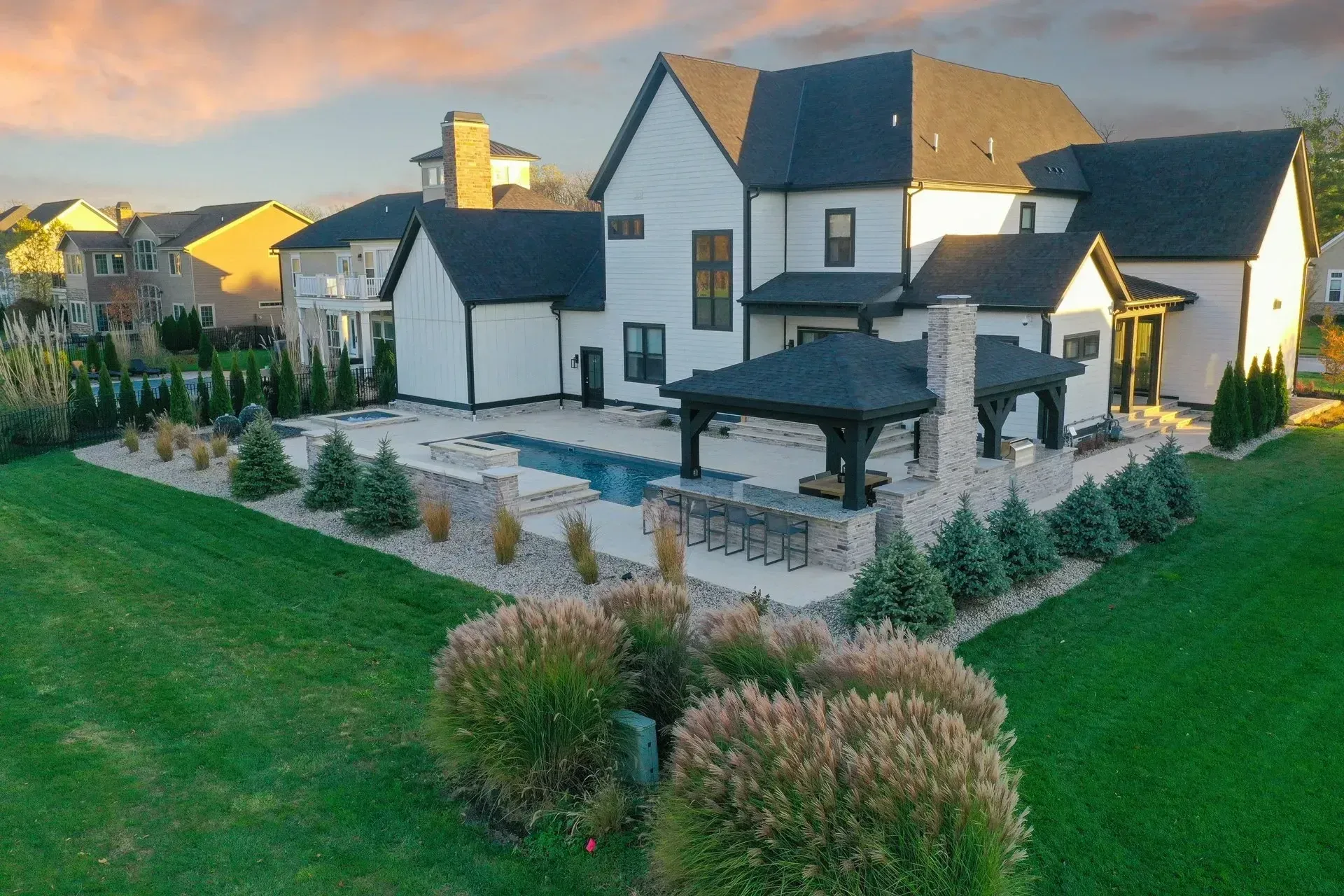
Where strip drains earn their keep
On a sloped lot where the deck runs parallel to the natural fall line, we’ll often add a linear strip drain along the downhill edge of the deck. A NDS Dura Slope or a stainless channel drain bedded in the slab at the uphill side of the coping does two things — it intercepts any runoff coming off the yard above the pool before it reaches the deck, and it gives the deck surface a defined low line that can carry stormwater to the subdrain without needing a dramatic pitch.
The specification isn’t complicated. 5-inch channel width for residential applications. Cast iron or composite grate depending on the deck finish. ADA-compliant slot spacing at the heel-catch. Set flush with finished deck grade with a 1/8″ negative reveal so the deck pitches into the drain, not across it. The cost adds between $22 and $34 per linear foot installed, which is a rounding error against the cost of re-grading an entire deck three years later because the original grading plan was wishful thinking.
Soil, Base, and the Piedmont Clay Reality
Every pool deck in Marietta sits on some variation of Cecil-series Piedmont clay. East Cobb has pockets of sandy-loam topsoil over that clay, particularly in the lower-lying parts of Indian Hills and along the Chattahoochee bench, but the subgrade for the deck is almost always compacted clay once the topsoil is stripped. That clay does one thing extraordinarily well — it holds water. It does one thing poorly — it moves. Shrink-swell from wet to dry seasons can flex a clay subgrade by a quarter-inch or more through the year, and a deck that isn’t built on a proper base will follow that flex and crack.
Our base build on every Marietta sloped-lot deck is the same regardless of finish. We over-excavate six inches below finish slab elevation. We install a separation layer of 6-ounce non-woven geotextile between the Piedmont subsoil and the base — this stops clay migration up into the base over time. Then a 6-inch compacted base of GAB (graded aggregate base), installed in two 3-inch lifts, each lift compacted with a vibratory plate or roller to at least 95% standard Proctor density. On steeper grades we’ll spec 8 inches with a geogrid interlayer for additional shear resistance.
For poured-concrete decks, a 4-inch slab with #4 rebar on 18-inch centers goes on top of that base, with a fibermesh additive in the mix for surface crack control. For travertine or paver decks, it’s a different assembly — the same base, then a bedding layer of 1-inch washed concrete sand, then the pavers set and joint-sand swept in. Neither assembly will perform well on a sloped lot if the base fails, and the base will fail if the subdrain isn’t there to keep hydrostatic pressure off of it.
Why the geotextile matters: Without a separation fabric, rainwater moving through the aggregate base pulls fine clay particles upward from the subsoil. Over 3 to 5 years, enough clay migrates into the bottom inch of aggregate that the base loses its drainage properties and starts holding water. That’s the single most common cause of “mystery” paver deck settling on Piedmont clay lots — nothing obvious broke, the base just turned into mud.
Coping elevation and the skimmer line
Pool coping on a sloped-lot deck has one more job than it does on a flat lot — it’s the fixed elevation that every other deck grade references. We set the top of coping at the pool skimmer’s designed water line, normally 1 inch below the top of coping for the Pentair or Hayward skimmers we typically install. The deck then pitches away from that fixed elevation at 2%. Every coping stone gets checked with a laser level before it’s set — not just eyeballed with a 4-foot bubble level — because a quarter-inch error at one corner translates into an inch of off-pitch deck by the time you’re twenty feet away.
On long runs, we’ll break the deck into two pitch zones with a saw-cut control joint that also functions as a drainage divide. One zone pitches toward the rear subdrain, the other pitches toward a side strip drain. That way no single run of deck is longer than about 18 feet before the water finds an outlet, and the visible deck slope never exceeds the 2% comfort threshold even on a 5% natural grade.
The East Cobb tree canopy factor
One last piece of the grading puzzle that’s specific to Marietta — the mature oak and poplar canopy across older East Cobb neighborhoods dumps an above-average leaf load into pool skimmers and, more relevant here, into deck drainage systems. An uncovered catch basin in Indian Hills or along Johnson Ferry Road will pack with leaves by late October and stay packed until someone clears it. We spec cast-iron atrium grates on every deck catch basin now, sized with roughly twice the inlet area of a flat grate, specifically because a flat grate under an oak will be useless by Thanksgiving. It adds about $45 per basin and prevents the single most common post-install service call on East Cobb decks.
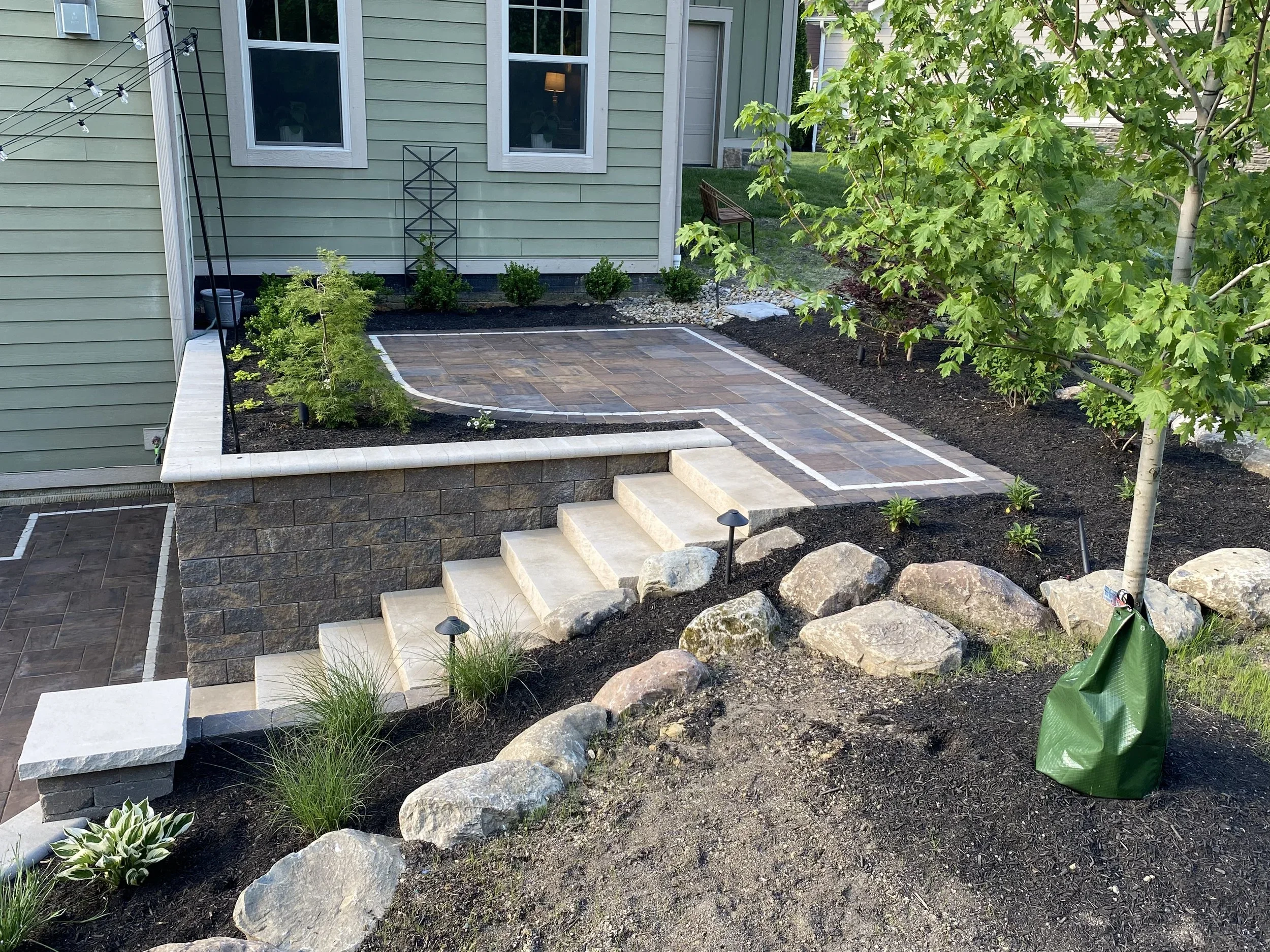
The grading plan, the subdrain layout, the base spec, the coping elevation, the strip drain placement, the catch basin selection — these aren’t separate decisions. On a sloped lot they’re one integrated system, and the failure mode when any one piece is skipped is the same. Water finds the lowest point. If that lowest point is your back foundation, your neighbor’s fence line, or a low corner of the deck that nobody planned for, you’ll know within the first heavy August thunderstorm. And the fix, three years in, costs more than doing it right cost to begin with.
That’s why the grading conversation on an East Cobb deck happens at the site visit, before the pool design is even finalized. Lot slope direction, existing drainage patterns, neighbor elevations, tree canopy, soil pockets — all of it goes on the notepad before we price anything. And when the final plan goes in to Cobb County Community Development for permit, the drainage narrative is already baked in, not tacked on.
Pool deck engineering across 20+ cities within 30 miles of Winder, GA
Every deck we build in Marietta gets a site-specific grading plan before a single form board goes down — because on a sloped lot, the drainage is the deck.