
Q: My pool is from 1997 and I just noticed a crack in the shell — do I have a $2,000 problem or a $48,000 problem? A: That depends entirely on three measurements you can take this weekend with a feeler gauge, a sharpie, and 30 days of patience.
Forsyth County has one of the densest concentrations of aging gunite pools in Georgia. From Bethelview to Coal Mountain, Shiloh to Shady Grove, the subdivisions that exploded between 1993 and 2005 are now crossing the year-25 to year-30 mark — the exact window where concrete pool shells begin telegraphing decades of freeze-thaw cycles, soil movement, and slab fatigue. If you bought your home in the last five years, odds are high you inherited a shell that is further along the fatigue curve than the previous owner admitted.
The question is never whether an older pool will eventually crack. It will. The question is which category of crack you’re looking at — cosmetic, monitor, or structural — and what that category forces you to decide. Pump a structural crack full of plaster patch and you will watch it reopen the next summer. Spend $40K rebuilding a shell that had nothing more than a surface map-crack and you’ve burned money that should have stayed in your kitchen remodel. Diagnostic precision is the entire game.
This piece walks you through the exact field method we use when we show up to a 1998 pool off Post Road or a 2003 build near Fowler Park. Feeler gauge technique. The 30-day widening protocol. Crack location geometry. And the hard-number decision framework between a $1,800 epoxy injection and a full shell rebuild. By the end you will know — before you ever call us — whether you’re looking at a morning of repair or a month of reconstruction.
Why Forsyth County’s 1993–2005 Pool Stock Is Hitting the Wall Right Now
Forsyth County is the fastest-growing county in Georgia for the last decade, but the growth curve before that told a different story. Between 1993 and 2005, neighborhoods like Polo Fields, St. Marlo, Windermere, and the dozens of tighter subdivisions off Bethelview Road and Kelly Mill Road went from cow pasture to rooftop density in less than 15 years. Most of those homes came with either a builder-allowance pool voucher or a post-close pool install in the first three years. The median install year of the older county pool stock lands squarely between 1997 and 2002.
That gives us a population of pools that are now between 20 and 30 years old. Gunite shells engineered to 1990s standards were designed assuming 25 to 40 years of service life before requiring structural intervention — and we are now sitting on the early side of that window for the oldest subset, and the late side of the window where cosmetic issues become structural ones.
Forsyth County sits in USDA Zone 8a. We average roughly 22 freeze events per year, concentrated in December through February. Every one of those events is a micro-expansion cycle at every existing hairline in your shell. Water wicks into the capillary structure of the concrete, freezes, expands 9%, and walks the crack fractionally wider every single year. A crack that was 1/64″ when your previous owner noticed it in 2015 can be a verified 3/32″ today — and that’s without a single structural cause behind it. Just time, water, and temperature.
Layer on the soil story. Forsyth sits on the Cecil series Piedmont clay belt — the same shrink-swell clay that tortures foundations across metro Atlanta. Cecil clay loses 10–14% of its volume when it dries in August, then regains it in October rains. A gunite pool is a rigid boat floating in a soup of expanding and contracting dirt. The shell has to absorb that movement somewhere, and for older pools it absorbs it at the weakest points of the pour: cold-joint transitions, the bond beam around the skimmer throat, and the floor-to-wall cove.
Field data we track by zip code: Shell-crack calls in the past 18 months cluster at 30041 (south Forsyth, age 22–28) and 30040 (Cumming core, age 20–32). The 30028 zip (north/Coal Mountain) comes in third — its pools skew newer but the rockier soil creates a different failure pattern (more point-load stress cracks, fewer fatigue cracks).
The signature Forsyth failure pattern, across all three zip codes: a hairline starting at a skimmer corner, walking vertically down the wall toward the cove, then stopping. Second most common: a diagonal crack across a shallow-end floor, typically running from a main-drain corner out to the wall intersection. Third: spider-web cracking around a light niche where the conduit penetration was never re-sealed after a 2010s bulb swap.
The Three-Tier Crack Classification That Controls Every Dollar You’ll Spend
Every shell crack in a Forsyth County gunite pool falls into one of three categories. The category controls the repair. You cannot upgrade a structural crack into a cosmetic one with plaster, and you cannot downgrade a cosmetic crack into a rebuild by panicking. Classify first, spend second.
Cosmetic cracks: under 1/16″
Width: less than 1/16″ (0.0625″), or roughly the thickness of a credit card. Pattern: typically surface-only map cracking in the plaster, not through the gunite shell. Usually caused by plaster cure shrinkage, calcium scaling at the waterline, or freeze-thaw spalling in the top 1/8″ of the finish.
Diagnostic tell: when you run a fingernail across it, your nail doesn’t catch on a clear edge — it feels like a scratch, not a groove. Water loss test shows zero measurable loss over 48 hours beyond normal Forsyth evaporation (roughly 1/8″ per day in July).
Repair category: cosmetic. Options range from localized plaster patch ($600–$1,200) up to a full replaster if cosmetic cracks are widespread across the shell ($7,500–$14,000 for a typical 16×32 residential pool). These cracks do not threaten structural integrity and are not emergencies.
Monitor cracks: 1/16″ to 1/8″
Width: between 1/16″ and 1/8″. These cracks penetrate the plaster and enter the top layer of the gunite shell, but have not yet gone through the full shell thickness. A garden-variety monitor crack is 3–6 feet long, lives in a single wall or a single floor panel, and does not cross a cold-joint boundary.
Diagnostic tell: the fingernail test now catches — you feel a distinct edge, and you can trace the crack in a continuous line. Dye-test result (a drop of food coloring from a syringe, released at the crack face with the pump off): the dye is pulled into the crack slowly, over 30–90 seconds, indicating active but slow seepage.
Repair category: watch-and-injection. The key move is the 30-day widening check (protocol in the next section). If width is stable over 30 days, a hydrophilic polyurethane or two-part epoxy injection plus plaster overlay is the repair. Budget: $1,800 to $3,400 per injection site including plaster blend-back. If width has grown measurably in 30 days, the crack is not a monitor — it is structural, and you skip to tier three.
Structural cracks: over 1/8″
Width: greater than 1/8″, or crossing a cold-joint boundary at any width, or accompanied by visible shell displacement (one side of the crack raised above the other by even 1/32″). Cracks of this grade go fully through the shell. Soil and groundwater move through the crack in both directions.
Diagnostic tell: the fingernail doesn’t catch — your finger goes in. Dye test: the dye vanishes into the crack instantly, indicating active through-shell seepage. Water loss over 48 hours exceeds 2″ with the pump off. You may see surrounding plaster popcorn-textured from rebar corrosion pushing outward through the concrete (we call this “rust staining bleed-through” and it’s a non-negotiable structural indicator).
Repair category: structural intervention, up to and including full shell rebuild ($34,000 to $58,000) for a standard 16×32 residential pool in Forsyth County. Staple-and-stitch repairs with carbon-fiber reinforcement ($12,000–$22,000) are an intermediate option for single-location structural cracks that have not propagated through more than one wall panel.
The Feeler Gauge Method — Ten-Point Width Sampling in 45 Minutes
A feeler gauge costs $8 at any auto-parts store in Cumming. It’s a folding set of flat steel blades in graduated thicknesses from 0.0015″ up to 0.025″ or higher. It is the single most useful tool a Forsyth homeowner can own when staring at a shell crack, because it removes all the subjective guesswork from “is that 1/16″ or 1/8″?”
The method:
- Drain the pool to 6″ below the lowest point of the crack, or lower the water enough to expose the crack fully. If the crack runs to a floor drain, drain to empty and weight the shell with water in a bucket at the deep end — this is important to keep hydrostatic pressure from lifting an already-compromised shell.
- Clean the crack face with a stiff nylon brush and muriatic-diluted rinse (1:10) to remove plaster dust, scale, and algae that will falsely pad your measurement.
- Mark the crack at 10 evenly spaced points along its length. A 6-foot crack gets a point every 7 inches; a 12-footer gets one every 14. Use a permanent sharpie, not tape — tape will fall off the 30-day remeasurement.
- At each mark, slide the thinnest blade you can into the crack. Step up in thickness until the blade binds. The thickest blade that freely slides is your measurement at that point.
- Record all ten readings. Average them, then also note the maximum single reading. The average tells you the crack’s overall category; the max tells you where the stress concentration is.
What the data tells you: if the average is under 0.062″ (1/16″), and no single point exceeds 0.093″ (3/32″), you are in the cosmetic-to-monitor band and you have time. If the average is above 0.125″ (1/8″) or any single point exceeds 0.187″ (3/16″), you are in structural territory and you should not refill the pool until an engineer or repair contractor inspects the shell.
Forsyth-specific note: Pools in the 30028 zip (north Forsyth, Coal Mountain, Ducktown) tend to show higher max-point readings with lower averages — a signature of rocky soil creating point-load stress. Pools in 30040 and 30041 show more uniform readings because they sit on more homogeneous Cecil clay.
The 30-Day Widening Protocol — The Single Test That Separates Monitor From Structural
Here’s the move almost every Forsyth homeowner skips, and it’s the difference between a smart $2,600 repair and a panicked $48,000 rebuild: if your initial feeler-gauge reading puts the crack in the monitor band (1/16″ to 1/8″), do not repair it yet. Remeasure in 30 days at the exact same ten points. The number tells you what category you’re really in.
Protocol:
- Day 0: Complete the ten-point feeler-gauge sweep. Photograph each sharpie mark with a ruler in frame.
- Day 7, 14, 21, 30: Repeat at the same ten points. Use the same gauge. Photograph again. Track on a simple spreadsheet — point number in column A, day reading in columns B through F.
- Environmental log: Record any freeze events, heavy rain days (over 1.5″), or empty-pool periods in a sixth column. We have seen Cecil clay in Shiloh and Brookwood move cracks visibly after a single 3″ rainfall following a drought.
Interpretation:
- Zero growth across 30 days (all ten points within ±0.001″): this is a stable monitor crack. Epoxy injection plus plaster blend-back is the correct repair. Budget $1,800–$3,400. The crack will not grow further once the injection is set, provided the shell doesn’t see new soil movement.
- Growth under 0.010″ across 30 days: borderline. Re-run the 30-day test in six months. If growth repeats, treat as structural. If growth stops, treat as stable monitor.
- Growth over 0.010″ in 30 days: structural. The crack is actively moving under current loads (soil, hydrostatic, thermal). Injection alone will fail within 18 months. You are looking at carbon-fiber staple reinforcement minimum, and possibly a shell rebuild.
We learned this protocol the hard way on a 2001 pool off Browns Bridge Road (Hwy 369). Initial reading: 0.078″ average, no point over 0.110″. Looked like a textbook monitor crack. Homeowner was in a rush and wanted it injected immediately. We ran the 30-day protocol anyway (at our insistence). By day 30, the average had grown to 0.094″ and max point was 0.142″. The injection would have failed by the following spring. Instead we installed carbon-fiber staples across the crack in six locations and saved the shell. Repair ran $17,400 — still 70% less than a rebuild, but triple what an injection would have cost. If we had skipped the 30-day check, we would have done the wrong repair, and the customer would have paid twice.
The Repair-vs-Rebuild Decision Framework — Hard Numbers for Forsyth Pools
Once the crack is classified and the 30-day data is in, you can make the economic decision cleanly. This is the framework we walk every Forsyth homeowner through at the kitchen table:
Single cosmetic crack, under 12 feet total length
Repair: spot plaster patch, $600–$1,200. Or wait 2–4 years and do it as part of a scheduled replaster. No rush, no structural concern.
Multiple cosmetic cracks / widespread map-cracking
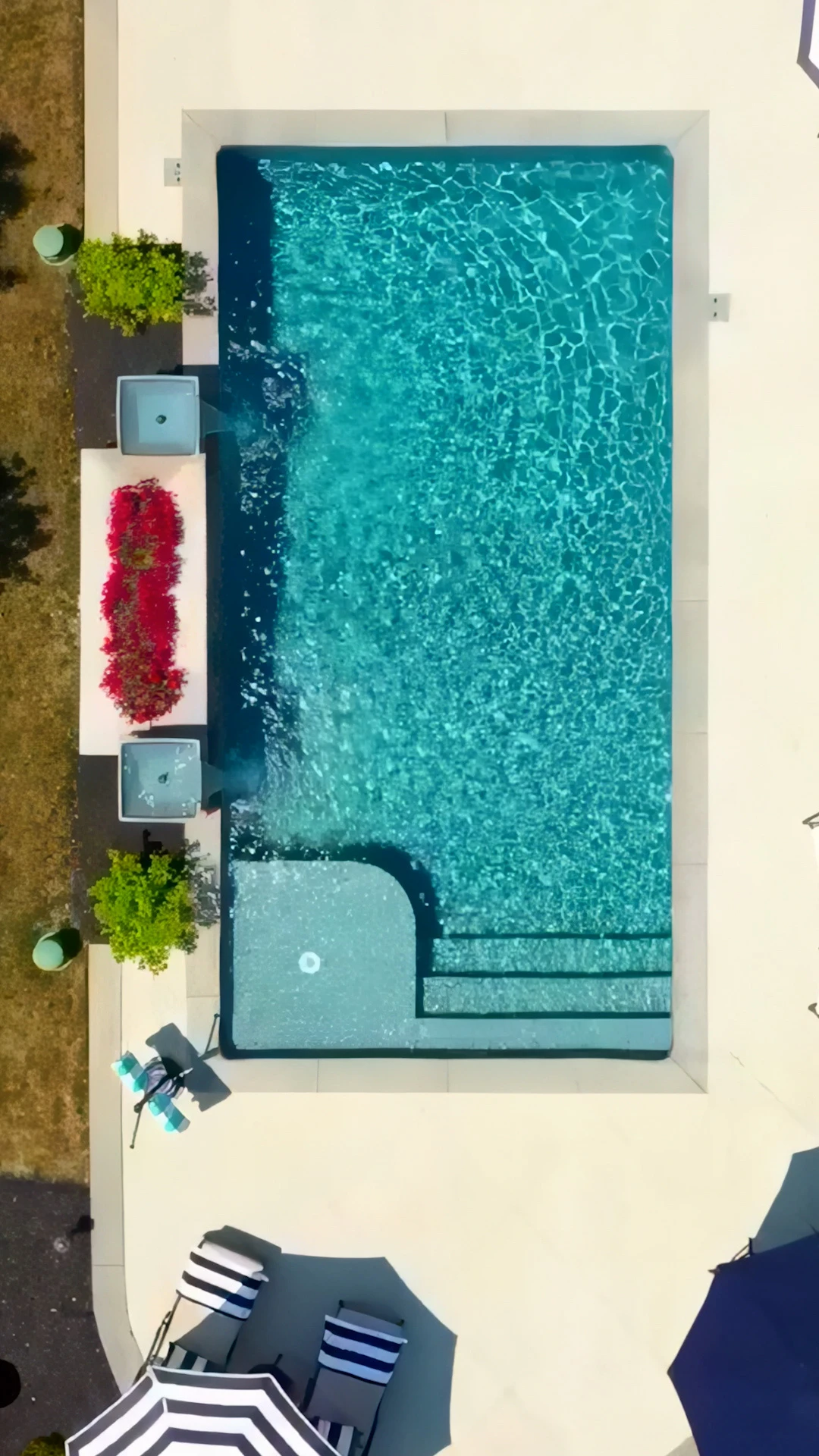
Repair: full replaster, $7,500–$14,000. Adds 12–15 years to shell service life. Best paired with waterline tile update if tile is also past its design life. Photo #2 above shows the tile-chase step we run during these jobs.
Single stable monitor crack
Repair: epoxy or polyurethane injection, plaster blend-back. $1,800–$3,400. Carries 10-year performance expectation if the 30-day test showed no movement. This is the most common Forsyth repair for pools age 22–28.
Two to four stable monitor cracks
Repair: staged injection (one visit per crack) plus full replaster, $12,000–$18,000 total. Replastering is near-mandatory at this count because the localized patch-work will otherwise be aesthetically obvious.
Single structural crack, one wall or one floor panel
Repair: carbon-fiber staple stitching plus injection plus replaster. $12,000–$22,000. Carries 15–20 year performance expectation. Valid alternative to rebuild when only one shell panel is compromised.
Multiple structural cracks / crack crossing cold-joint / visible displacement
Repair: full shell rebuild, $34,000–$58,000 for a standard 16×32 residential gunite pool in Forsyth County. Includes demo, new rebar cage, new gunite pour, new plaster, new waterline tile, new coping if needed. Typical timeline: 6–9 weeks. We permit through the Forsyth County Department of Planning and Community Development — they process roughly 200+ pool permits per year and their turnaround runs 10–14 business days for a shell-rebuild permit provided the engineered drawings are complete.
Where the line actually sits
The single most common mistake we see Forsyth homeowners make is over-repairing a cosmetic crack or under-repairing a structural one. The most expensive mistake is the under-repair: we have been called to three separate shells in the last two years where a neighbor’s uncle’s friend “fixed” a 0.180″ crack with pool putty, and 14–22 months later the shell failed catastrophically, typically after a January freeze. Each of those pools cost the owner a full rebuild they could have avoided by spending $17,000 on carbon-fiber staples at the outset.
Do the classification work. Do the 30-day test. Use the framework. The price of the right repair is always lower than the price of the wrong one, even when the right repair is expensive.
When to Call a Pro — and What to Send When You Do
You can do the entire crack diagnostic yourself. What you cannot do yourself: confirm whether a structural crack has compromised the rebar cage, pull the County permit for a staple or rebuild, or warrant the repair after it’s complete. That’s where we come in.
When you reach out, send us the following — not later, in the first message:
- A photograph of the full crack with a ruler in frame for scale
- Close-ups of the two widest points
- The year the pool was built (or your best estimate — we’ll verify via permit history)
- Your ten-point feeler-gauge readings (average + max)
- Your 30-day remeasurement spreadsheet if you’ve completed it
- The approximate location (zip is fine — 30028, 30040, or 30041 tells us a lot about the likely failure mode)
- Your address so we know whether you’re on Sawnee EMC power or not (affects scheduling of equipment-pad work if the repair involves plumbing)
With that data we can usually tell you — before we even come out — which of the three categories you’re in and which of the six repair tiers applies. It saves us a truck roll and saves you 45 minutes explaining what you already photographed. We’ll schedule an on-site inspection after that for anything in the monitor or structural bands.
Forsyth County’s sheer scale — 260,000 residents across 247 square miles, from Big Creek in the south to Coal Mountain in the north — means we structure our route days around zip-code clusters. Getting multiple Forsyth estimates on the same day is usually possible if you’re near GA-400 exits 13–17, or near Highway 9. Call out where you are and we’ll try to bundle.
One Last Thought on 30-Year Shells
There’s a quiet reality in Forsyth County that doesn’t get discussed enough: a well-rebuilt shell from 2026 has a design life of 40 to 50 years — substantially longer than what was poured in 1998. Modern rebar spec, modern gunite mix, modern waterproofing membranes, and modern cold-joint detailing have moved the state of the art forward. If you’re facing a rebuild decision, you’re not replacing your shell like-for-like. You’re upgrading to a shell your grandchildren may still be swimming in.
And if you’re in the cosmetic-to-monitor band, the repair we install today will hold hands with a replaster cycle in the 2030s and get you another 20 years out of a shell that’s already given you 25. Either way, the diagnostic precision at the front of the project is the single highest-ROI thing you can do.
Pool shell diagnostics and repairs across 20+ cities within 30 miles of Winder, GA
From epoxy injection on a single monitor crack to a full gunite shell rebuild on a 30-year-old Forsyth pool — we bring the feeler gauge, the permit file, and the carbon-fiber staples to every estimate.