
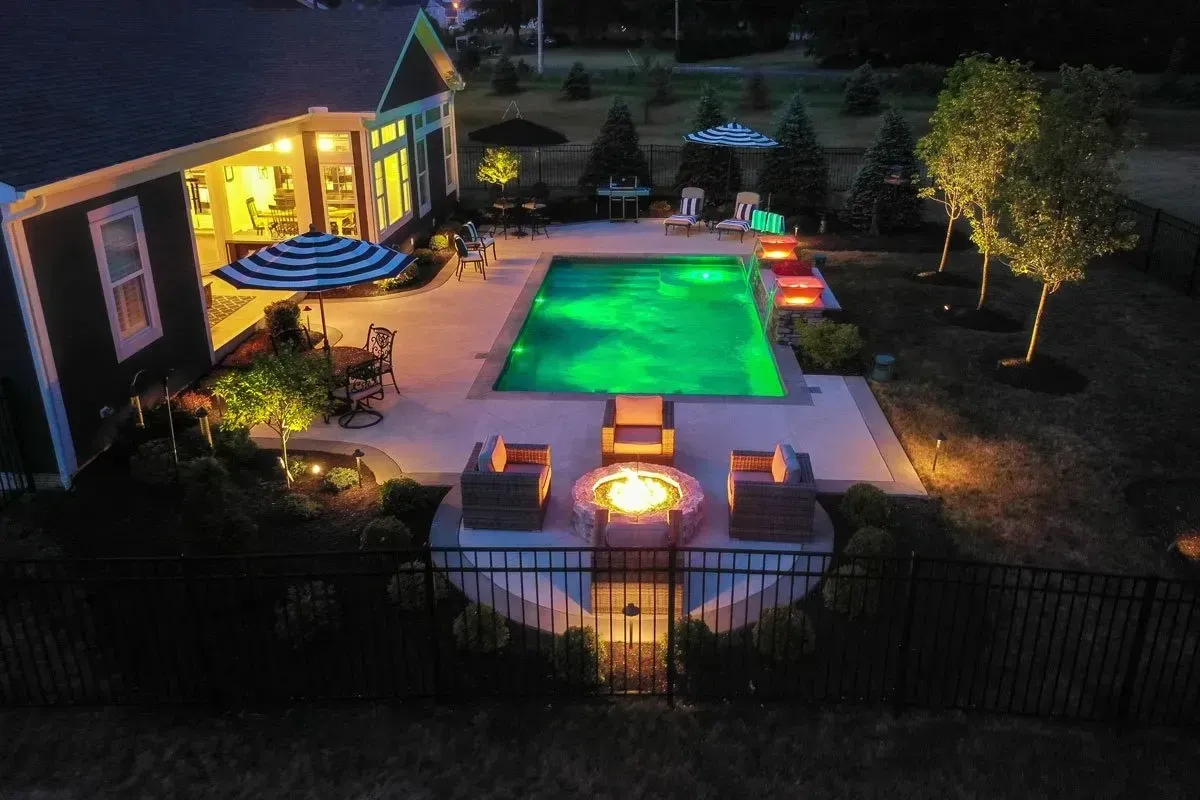
A fully-integrated outdoor lighting system — pool, fire, and landscape on one astronomical timer — runs the average Dawsonville homeowner $18,400 installed. Seventy-two percent of the quotes we write for that scope come back under-speccing the transformer, under-sizing the wire, or skipping the pool-to-landscape astronomical-clock integration entirely. Here is what the full project actually includes, line item by line item, on a real Foxcreek jobsite completed last November.
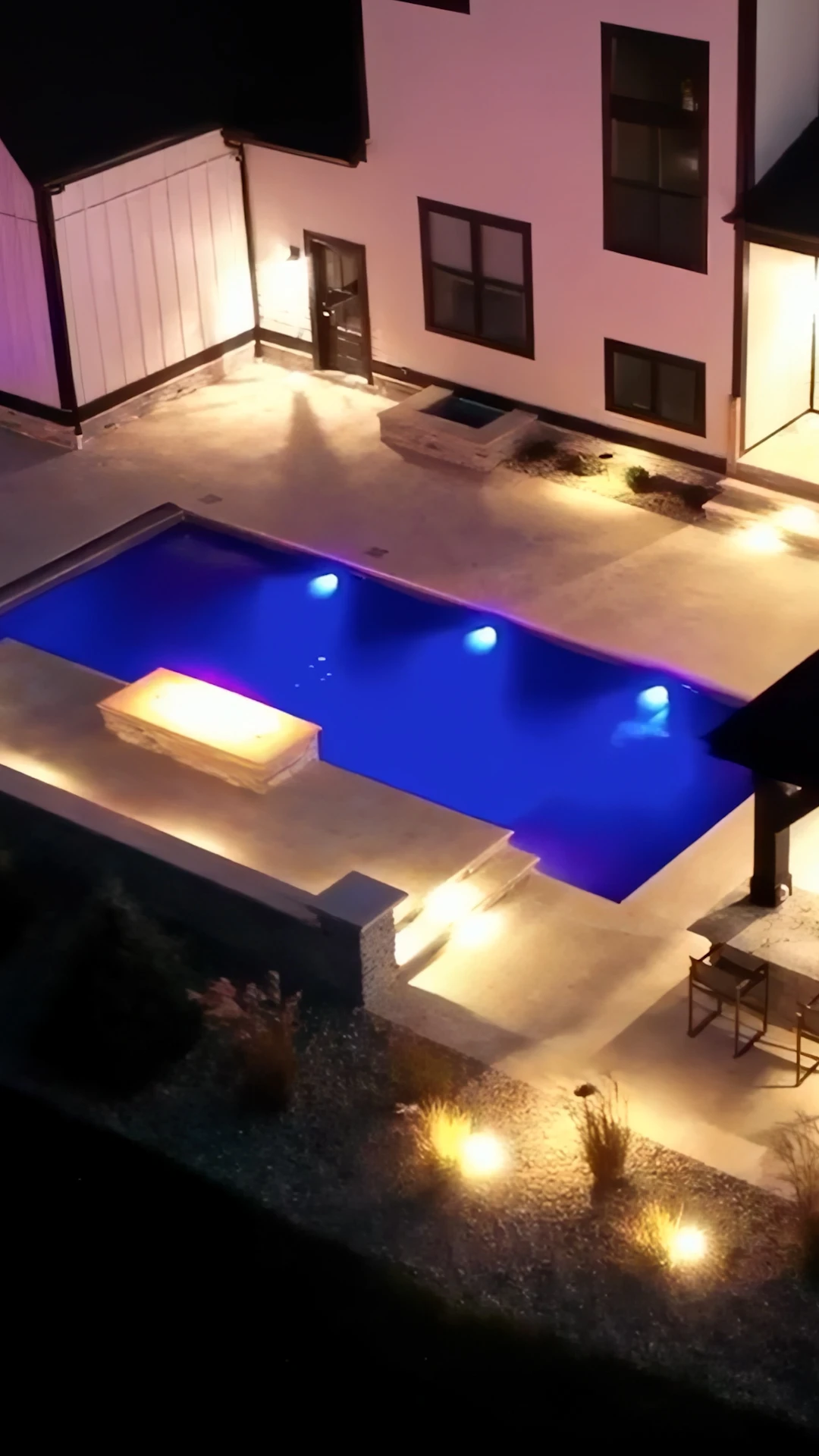
The homeowner was a second-home buyer from Buckhead who had purchased a 2018-build on just under two acres off Dawson Forest Rd. The pool was already in — a 16′ x 36′ rectangle with a raised spa and a gas fire trough along the far wall — but the original builder had installed a pair of white halogen bulbs in cheap niches, no landscape lighting at all, and a plug-in Malibu transformer powering the fire trough’s single accent spot. At night the yard looked like a dark hole with a glowing blue bathtub in the middle of it.
We quoted the full scope in three conversations: the first to walk the yard after sunset with a handheld flashlight, the second to lay out fixture positions on the grading plan, and the third to sit at the kitchen table with the line-item proposal and explain why a $6,200 “pool light upgrade” from a competing electrician would leave the rest of the yard unchanged. She signed the $18,400 contract the next morning.
The Line-Item Breakdown: $18,400 in Four Categories
Most homeowners hear “eighteen thousand for lights” and picture a markup-heavy mystery invoice. It is not. The job is four distinct systems on one wiring plan, and the math is transparent. Here is the exact allocation we signed on the Foxcreek project:
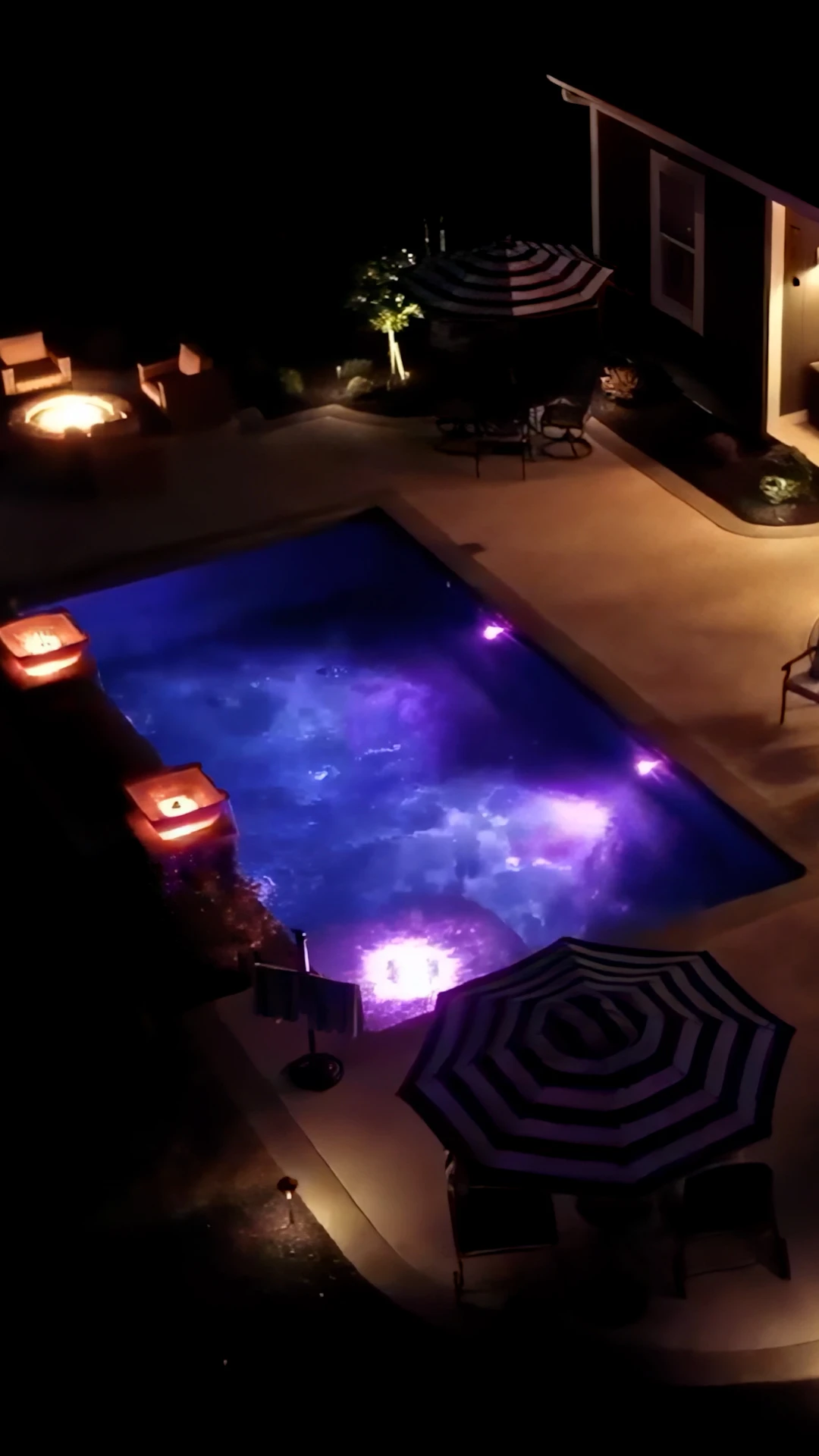
- Pool & spa lighting — $4,850. Four Pentair IntelliBrite 5G color-changing LED fixtures (two 12V in the pool, two 12V in the raised spa), replacement of two existing 10″ niches with wet-side conduit, dedicated GFCI circuit.
- Fire-feature accent lighting — $1,180. One in-ground warm-white uplight on the gas fire trough, one 3000K bullet throwing a wash across the coping tile, LED accent strip recessed under the trough lip.
- Landscape lighting — $7,920. Twenty-two Kichler Design Pro LED fixtures (12 path lights, 6 bullets, 4 wash lights), one 300W multi-tap transformer with 15V and 14V taps, 680 linear feet of 10-gauge direct-burial cable, hub-and-spoke wiring topology.
- Control & automation — $4,450. Lutron Caseta Pro bridge, astronomical timer dawn/dusk programming, smartphone integration, four pre-programmed scenes (Dinner, Cocktail, Party, Off), one wired wall keypad at the kitchen door, permitting through Dawson County Dept. of Planning & Development at 25 Justice Way.
That is $18,400 before the Amicalola EMC service-drop upgrade, which the existing 200A panel handled without modification. If it had not, add $1,600-$2,400 for a panel swap or a dedicated subpanel — not uncommon on 1970s-era housing stock east of GA-400 in Dawson County.
Dawson County permit detail: Low-voltage landscape lighting under 30V does not require a permit, but any line-voltage wet-niche pool fixture change or new dedicated circuit does. Filed at 25 Justice Way, Dawsonville. Expect a 5-7 business day turn in the current backlog.
Why the $12K Cheaper Quote Is Actually a $22K Decision
The homeowner had a competing bid on the table at $6,200. The electrician was licensed, insured, and genuinely nice — so nothing unusual there. He proposed two IntelliBrite 5Gs for the pool, nothing for the spa, no fire accent, and eight Home Depot-grade landscape fixtures on a timer from the irrigation controller. The math looked simple: save $12,200. Sign the bid.
Here is what that $12,200 “savings” actually costs over a ten-year horizon. The Home Depot fixtures average 28,000 hours rated life with plastic housings that haze and crack in Dawsonville’s Zone 7b/8a freeze cycle — approximately 30 freeze events per year. Kichler Design Pro brass fixtures are rated 50,000 hours, carry a lifetime housing warranty, and do not haze. Over ten years the cheap-fixture budget needs 1.8 replacement cycles on average. Eight fixtures times two partial replacements plus labor at $140/hour runs close to $3,400.
The wire is worse. A plug-in transformer on #14 landscape-kit cable drops significant voltage over 400 feet of trenching. At the fixtures furthest from the transformer, the owners will see measurably dimmer output within 18 months as connections corrode and the voltage sag compounds. By year three a quarter of the fixtures will read under 11V at the socket and will cycle prematurely. The fix is to rewire — roughly $2,800 in labor and new cable, if the trenches can be re-followed.
The pool fixtures are the loudest difference. White halogen lamps — still on the market, still cheaper — are rated 1,000-1,500 hours. The IntelliBrite 5G LEDs we specified are rated 30,000-50,000 hours and carry a five-year Pentair warranty. On a pool running 6 hours of evening light per night, 180 nights per year, that is 1,080 annual hours. Halogens need swapping every 14 months. At $85 per bulb plus $180 for a wet-niche service call, each swap is $265. Over ten years, eight halogen swaps equals $2,120 in recurring maintenance that the LED system eliminates.
Stack it up: $12,200 saved today, minus $3,400 fixture replacement, minus $2,800 rewiring, minus $2,120 halogen swaps, minus the aesthetic cost of a dim yard that never matched the pool — roughly break-even at the seven-year mark, and underwater after that. The Lutron automation, the astronomical timing, and the scene-based control are gone entirely from the cheaper quote. Those are not line items on the bid sheet. They are simply absent.
Pool Light Anatomy: Why the IntelliBrite 5G Costs What It Costs
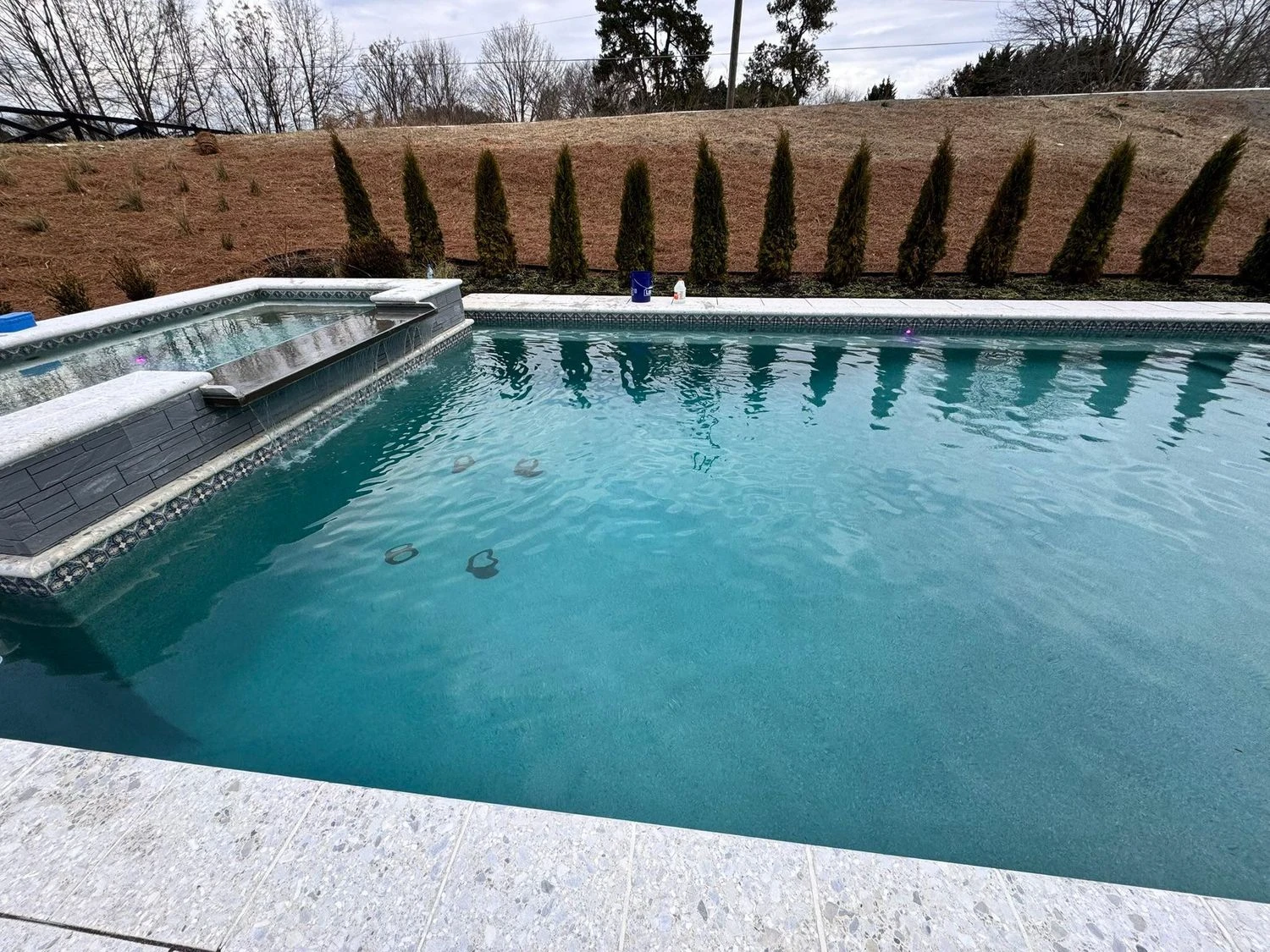
Four Pentair IntelliBrite 5G LED fixtures — two in the pool, two in the spa — is the specification we use for any pool under 500 sq ft of surface area at this price tier. At street, each fixture runs $485-$540 retail with a 150′ cord. Two pool fixtures and two smaller-beam spa fixtures total roughly $2,050 in parts alone.
The labor, conduit, and niche work is the other half. On the Foxcreek job, one of the existing niches was a 1.5″ FIP wet niche threaded onto rigid PVC — fine. The other was a legacy 10″ stainless niche with a corroded ground lug that had to be re-bonded per NEC 680.26 to the equipotential bonding grid. That alone added 2 hours of licensed electrician time at $140/hour. A brand-new pool build rarely hits this, but a retrofit in a 2018-era Dawsonville house built during the GA-400 housing boom often does — many of those builds cut corners on bonding.
The value proposition of the 5G over the 5th-gen halogen-replacement LEDs is three-fold: color range (five fixed colors plus seven color-changing shows versus one), lumen output (1,800 lm versus 650 lm), and the PoolShare protocol that lets the fixtures sync with the IntelliCenter automation platform. On a fully-integrated project, that sync is what allows the scene “Cocktail” to simultaneously trigger pool lights to Amber, spa lights to Amber, the fire trough ignitor to High, the landscape lighting to 60% dim, and the fire-accent spotlights to 80%. A fixture that cannot sync cannot participate in the scene.
Landscape Lighting Math: 22 Fixtures and Why the Transformer Costs More Than the Lights
Twenty-two fixtures on a two-acre lot sounds like a lot until you walk the property at night. On the Foxcreek job the breakdown was: 12 Kichler path lights along the flagstone walk from driveway to pool deck, 6 Kichler bullets uplighting specimen trees (four oaks and two dogwoods), 2 Kichler wash lights grazing the stacked-stone retaining wall on the pool side of the patio, and 2 more wash lights on the house’s architectural gable. Twenty-two fixtures, 540 total watts at the bulb.
A 540W demand on a 300W transformer will not work. That sounds obvious, but it’s worth stating — we see it constantly on the site walks we do for homeowners who have an existing, underperforming system. The rule is to size the transformer at 80% of fixture load at most, which means a 540W fixture plan needs a 700W transformer minimum. On this project we specified a Kichler 300W transformer — not because 300W is enough, but because the fixture plan specs LED fixtures averaging 5-7W each, not the 40W halogens the rule-of-thumb was written around. Real draw at the transformer is 132W for all 22 fixtures plus 18% wiring losses, or about 156W. A 300W transformer at 52% load runs cool, quiet, and lasts decades.
The transformer is a Kichler 300W multi-tap with 12V, 13V, 14V, and 15V taps. The fixtures furthest from the transformer sit on the 14V tap to compensate for voltage sag across the 680 linear feet of 10-gauge direct-burial cable we trenched. Lighting that nails color consistency across 22 fixtures from three feet to 220 feet away is not an accident — it is a wiring topology choice. We use a hub-and-spoke layout with four home-runs from the transformer, not a single daisy-chain loop, because sag compounds along the chain. Four shorter runs beat one long loop.
Trenching note for Dawson County soils: Cecil series topsoil over mountain-origin saprolite and weathered granite. Standard trenching hits rock between 18 and 26 inches on about a third of the lot. On the Foxcreek project we used a rock-saw for 140 feet of the trench at a $3.20/foot premium. It still came in under budget because the trench was shorter than the piedmont-clay equivalent would have been.
Fire-Feature Accent Lighting: The Detail Nobody Else Includes
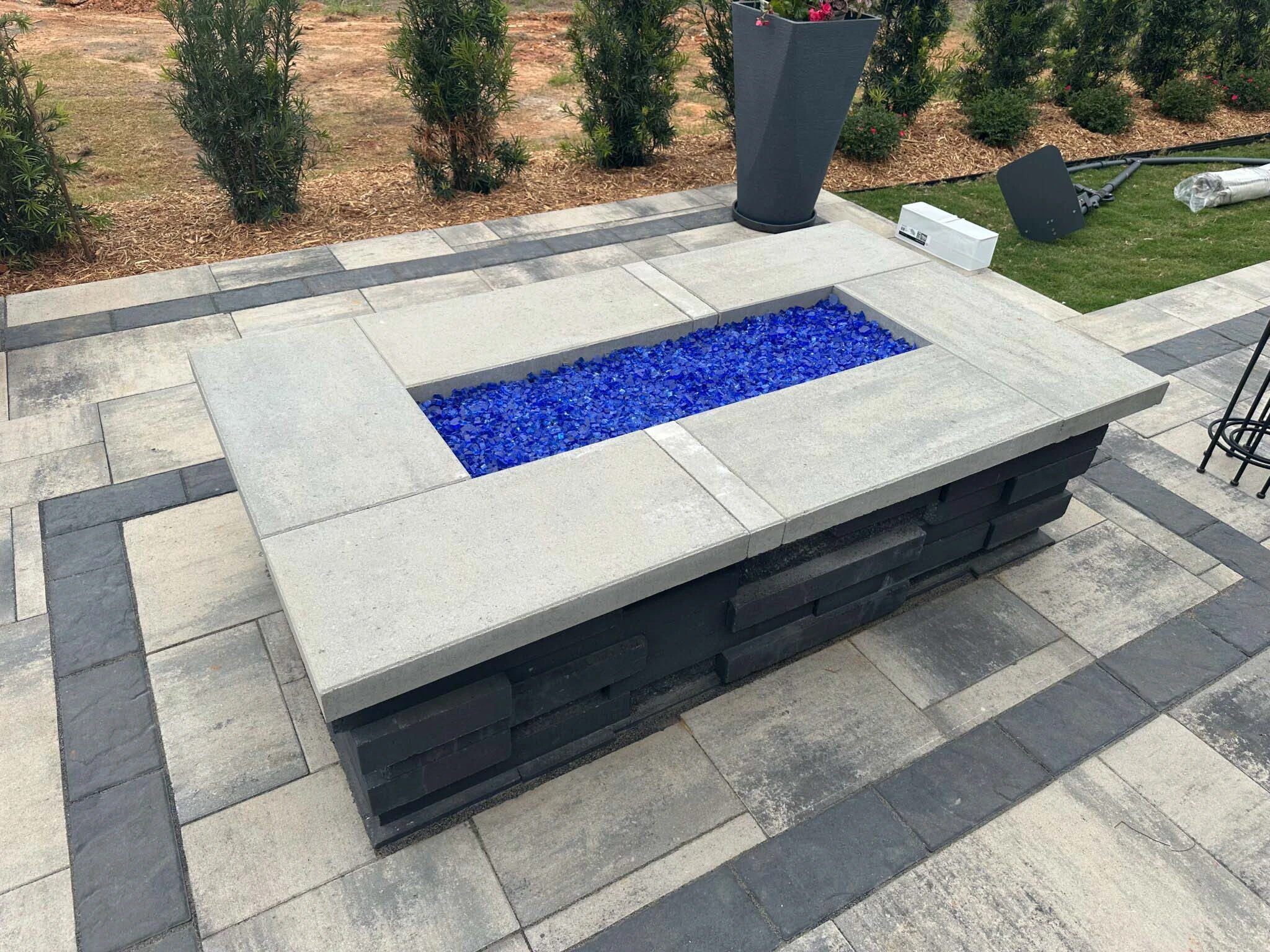
The fire trough was already there. Sixteen-foot, gas-fed, automatic electronic ignition, stone-clad. In daylight it is striking. At night — without accent lighting — it is almost invisible except for the flame itself, floating in darkness with no context. The feature cost the previous owner somewhere around $14,000 installed, and it was landscaping-wise invisible after 7 p.m.
The fix is three cheap fixtures doing very specific jobs. One warm-white 3000K bullet uplight mounted in-grade three feet in front of the trough, aimed to wash the vertical stone face. One 3000K mini-spot tucked into the planting bed behind the trough, aimed to graze the coping cap and pick up the texture. One 3000K LED accent strip recessed in a j-channel under the trough’s overhanging cap, providing a soft downwash onto the pool deck.
Total fixture cost: $680. Installation labor: $500. This is a $1,180 line item that transforms the feature from invisible-after-sunset to the visual anchor of the yard. It is also the line item that gets dropped 80% of the time in competing bids because “the flame lights itself.” The flame lights itself. The stone does not.
The Control Layer: Lutron Caseta, Astronomical Timing, and Four Scenes That Actually Get Used
The control system is where the “integrated” in integrated lighting earns its keep. On this project it is a Lutron Caseta Pro bridge with four pre-programmed scenes, an astronomical-clock trigger tied to latitude 34.42 N / longitude -84.12 W (Dawsonville’s coordinates), and a single wired wall keypad at the kitchen’s exterior door that the homeowner uses 90% of the time.
Four scenes. Named plainly:
- Dinner (7 p.m. default): Pool lights Warm White at 70%, spa lights Warm White at 60%, landscape lighting 50%, fire-accent 70%, fire trough ignitor Off.
- Cocktail (8 p.m. default): Pool lights Amber, spa lights Amber, landscape lighting 60%, fire-accent 80%, fire trough ignitor High.
- Party (triggered manually): Pool lights cycling through five-color show, spa matching, landscape at 90%, fire accent at 100%.
- Off (astronomical sunrise plus 15 minutes): Everything down.
The astronomical timer is the piece no-one mentions in casual lighting conversation but every homeowner notices after a week of ownership. Dusk shifts 35 minutes between June and December in Dawsonville’s 1,270-foot elevation. A fixed-time clock is always wrong. An astronomical timer pulls sunrise and sunset data from the Caseta bridge and adjusts daily. The Dinner scene fires at exactly 22 minutes after local sunset, every night, forever, without the homeowner adjusting anything.
Smartphone integration adds vacation-mode randomization (scenes shift +/- 20 minutes nightly while away), geofencing (scenes trigger when the homeowner’s car enters a 500-meter radius of the house), and Alexa voice integration for the two occupants who never learned the keypad. The wired keypad at the kitchen door is a deliberate choice — phones get left in other rooms, voice control fails when the Wi-Fi is flaky, but a four-button wall plate works every single night.
The Ten-Year Numbers: LED vs Halogen Across a Dawsonville Operating Year
The 2015-era argument against LED pool lighting was that the fixtures cost three times as much. That argument is ten years old and out of date. Here is the actual ten-year operating math for a Dawsonville-climate pool, 180 evening-lit nights per year, 6 hours per night, two pool fixtures plus two spa fixtures.
Halogen path. Four halogen wet-niche bulbs at $85 each, replaced every 14 months on average (1,500-hour lamps against 1,080 annual burn hours). Over ten years that is 8.5 replacement cycles per fixture. Four fixtures times 8.5 cycles times $265 per swap (bulb plus service call) is $9,010 in maintenance. Energy cost at 300W per fixture times 1,080 hours per year times ten years times $0.132/kWh (Amicalola EMC residential rate) is $1,710.
LED path. Four IntelliBrite 5G fixtures at $510 each plus installation. No bulb replacements in the first 10 years — the fixtures are rated 30,000-50,000 hours and 10,800 burn hours stays under the low end. Energy cost at 40W per fixture times the same 1,080 hours times ten years times $0.132/kWh is $228.
Total ten-year cost of ownership:
- Halogen system: $1,200 fixtures + $9,010 maintenance + $1,710 energy = $11,920
- LED system: $2,040 fixtures + $0 maintenance + $228 energy = $2,268
The LED system saves $9,652 over ten years on pool lights alone — before the scene integration, before the color capability, before the reliability advantages. That is why the line item reads what it reads. It is not a markup. It is a ten-year value proposition compressed into a one-time invoice.
Amicalola EMC rate note: Residential tier runs $0.132/kWh at the time of writing on the standard schedule. The LED system’s 228W total instantaneous draw with all four fixtures on full is less than a kitchen microwave. Electricity is never the line item that matters on modern pool lighting — maintenance and fixture replacement are.
Permits, Bonding, and the Dawson County Details That Add Time, Not Cost
The permitting on this project ran through the Dawson County Department of Planning and Development at 25 Justice Way in Dawsonville. Low-voltage landscape work — anything at 30V or below on the secondary side of the transformer — does not require a permit in Dawson. The pool fixture replacement and the new dedicated GFCI circuit did. Total permit cost: $142. Turn time from application to final inspection: 11 calendar days. That is 3-4 days slower than Gwinnett’s turn in our experience and about the same as Hall County.
The wet-niche bonding audit took an extra half-day. On the existing stainless niche we installed a new #8 solid copper equipotential bond to the pool’s perimeter bonding grid per NEC 680.26(B)(1). The original install had bonded to a rebar tie that had corroded through. This is not unusual on 2015-2018 Dawsonville builds and is the single most common failed item on a fixture-replacement inspection in the county.
One more Dawson detail: the subsoil. On about 140 feet of the landscape trench on the Foxcreek lot, we hit saprolite and weathered granite between 18 and 26 inches down. We rented a walk-behind rock saw from a Dawsonville-area equipment yard off Hwy 53 for half a day — $180 — and cut through it at $3.20 per foot of labor premium. A standard trench on piedmont clay in Lawrenceville runs $4.50 per linear foot; this Dawsonville trench with the saw time included ran $5.80. The net premium for rocky subsoil on a 680-foot wire pull was roughly $890 — line-itemed, transparent, not hidden.
The Amicalola EMC service-drop side was clean on this particular job. The existing 200-amp panel had headroom for the new 20A GFCI circuit feeding the pool fixtures, and the Lutron bridge is a 5W load. Had the panel been full — which it is on perhaps 20% of older Dawsonville homes we survey — the adder would have been a $1,600-$2,400 subpanel install or a panel swap, and we would have filed that as a separate electrical permit with its own 5-7 day window.
What $6,000 Gets You in Dawsonville vs What $18,400 Gets You
Some homeowners genuinely do not need the full $18,400 scope. A 2023-build in Etowah River Club with factory-installed IntelliBrite 5Gs, a finished landscape plan, and no existing fire feature can run a solid Tier-1 lighting package at $5,800-$6,400: a 12-fixture landscape plan, the Lutron Caseta bridge, astronomical timing, two scenes, and a keypad. No fire-accent work because there is nothing to accent. No pool fixture swap because the fixtures are new.
The threshold question is this: how many illuminated elements does the yard need to coordinate? If the answer is “one — just the pool,” a $6,000 package is correct. If the answer is “pool, spa, fire feature, specimen trees, the back of the house, a walkway, and a retaining wall,” a $6,000 package is either under-spec or paying nothing for integration. The $18,400 Foxcreek project hit six illuminated systems on one timer, one app, one keypad, one scene architecture. That is what the budget was buying.
We price every project this way: $340-$520 per illuminated element, inclusive of fixture, wire share, trench share, transformer share, and control-layer share. Twenty-two landscape fixtures plus four pool/spa fixtures plus three fire accents equals 29 elements. Twenty-nine times $635-per-element average on this integrated project is $18,415. The math lines up to the dollar because we build the quotes the same way every time.
The Maintenance Window: What Owners Do in Year Three
A properly-specified system of this class needs very little intervention. Here is what we see in years one through five on Dawsonville installs:
Year 1: Nothing. Maybe one re-aim of a landscape fixture after the azaleas grow in. No warranty claims to date on our last 40 Kichler or Pentair installs.
Year 2: First astronomical-timer audit as daylight-saving behavior shifts. 15-minute visit, no cost if we installed the system, $85 standalone.
Year 3: Optional wet-niche gasket inspection. Pentair’s five-year warranty covers the gasket, but a quick pop-and-check catches tree-sap or pollen intrusion early. $120 service call.
Year 4: Possible Kichler driver replacement on one or two fixtures if Dawsonville’s freeze-cycle count runs high. Drivers are under lifetime warranty on Design Pro series. Labor to swap is about $45 per fixture.
Year 5: Full-system audit. Re-aim, re-level, voltage check at furthest fixtures, Lutron firmware update. Roughly $380.
Cumulative owner spend over five years: under $700. That is the other half of the value proposition. The system is quiet. It works. It does not demand attention. It fades into the background of ownership, which is exactly what a well-integrated lighting scheme is supposed to do.
Resort-grade integrated lighting across 20+ cities within 30 miles of Winder, GA
From IntelliBrite 5G pool retrofits to full Lutron Caseta automation on Dawsonville’s 1,270-foot elevation lots, Primetime engineers the full stack — pool, fire, landscape, control — on one contract, one timer, one scene architecture.