
It’s a Tuesday in early March. You’re standing on the travertine deck behind your Laurel Springs home in Suwanee, coffee in hand, staring at the rectangular pool your builder finished in 2011. It still swims fine. But the back wall is flat — no sound, no movement — and your neighbor two cul-de-sacs over just added a raised spa with three cast-stone scuppers that spill from an 18-inch elevated bond beam and sound like a small river. You want that. The question is what it takes on a property governed by one of the strictest ARBs in Gwinnett County.
This post is for homeowners in Laurel Springs, The River Club at Suwanee, Bear’s Best Atlanta, and the other high-review-standard neighborhoods along Peachtree Industrial Boulevard. Adding a raised spa with multi-scupper spillover is not one decision. It’s a stack — spa geometry, spillway count, scupper material, veneer stone, waterline tile, coping, heater sizing, and the approval packet your HOA’s architectural review board needs before any of it starts.
We’re going to walk every layer material by material, name what each choice costs, name what it looks like after three winters of freeze-thaw, and say which combinations we’ll put our name on and which we won’t.
The ARB Reality: Why Laurel Springs and River Club Require 3D Renderings
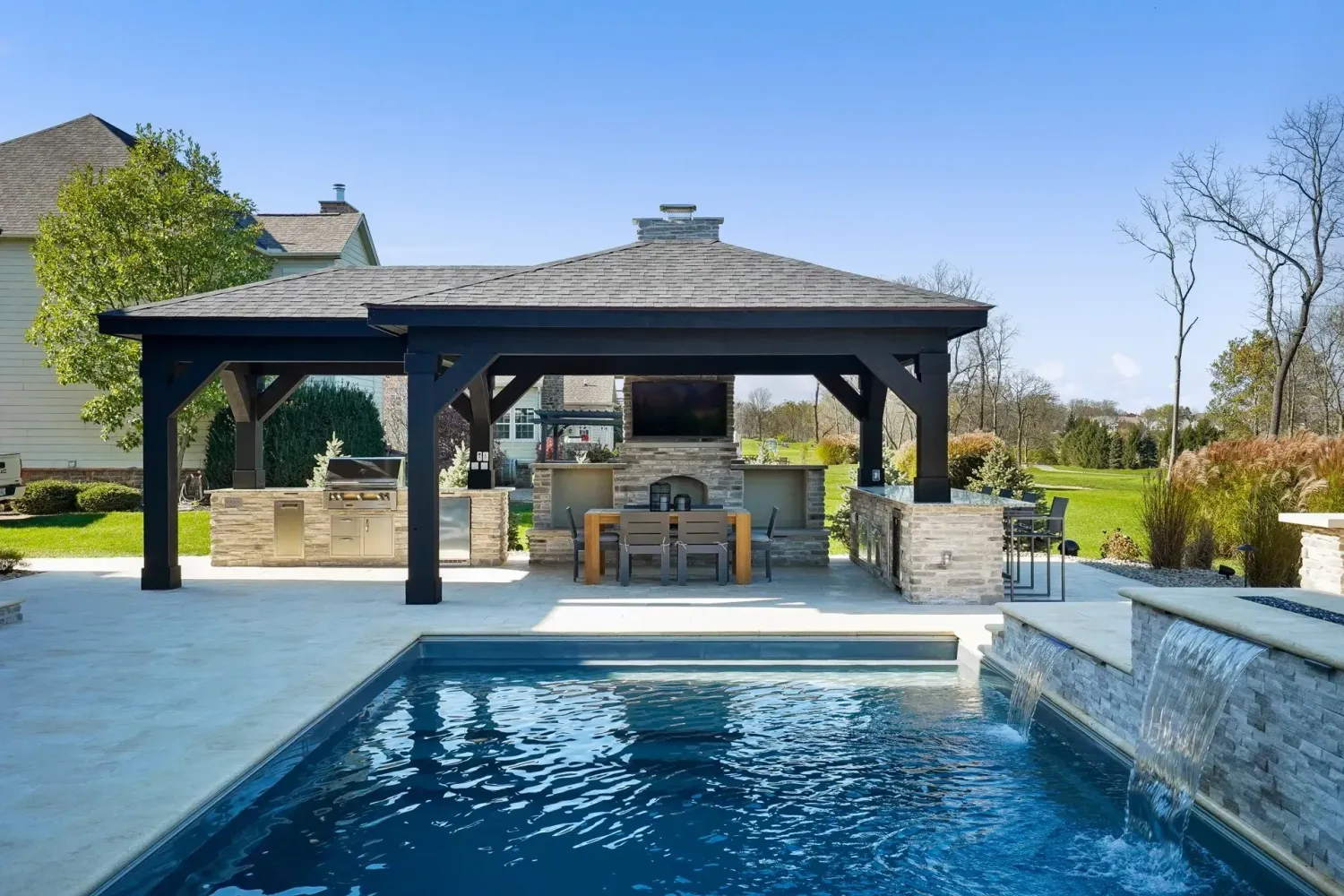
Before a single material, we have to talk approvals. The Laurel Springs Architectural Review Board and the River Club at Suwanee ARB both explicitly require rendered drawings for any water-feature modification — not hand sketches, not photos of a neighbor’s pool, not cut sheets from a supplier’s website. Rendered drawings. We typically deliver a 3D photoreal rendering plus an elevation view showing coping height, veneer coursing, and scupper placement.
Turnaround from ARB submission to approval in Laurel Springs runs 3 to 4 weeks with a complete packet. Incomplete packets — missing elevations, missing material samples, renderings that don’t match the existing pool’s coping color — add another meeting cycle, which means another four weeks waiting for the next ARB review. We’ve watched Suwanee remodels go from “signed in January” to “first truck in mid-May” purely because an outside contractor submitted a flat line-drawing instead of a rendering and got bounced twice.
The River Club runs similar in process but slightly slower in practice. Bear’s Best Atlanta has a smaller board and moves faster — 2 to 3 weeks — but requires a $250 review fee and a signed contractor indemnification form before scheduling. None of this is optional. Gwinnett County’s permitting office at 446 W. Crogan St., Lawrenceville will not issue a building permit for a raised bond beam in a covenant-controlled neighborhood without proof of ARB approval in the packet.
Budget line you won’t see on a cheaper bid: A proper 3D rendering for ARB submission runs $800 to $1,400 as a line item. If your contractor’s estimate doesn’t break this out, either they’re eating it and cutting corners somewhere else, or they don’t plan on doing it. Ask.
Scupper Spouts: Cast-Stone vs. Bronze vs. Copper
The spout is the piece the water actually pours out of. It’s what everyone looks at. Three materials cover nearly every Suwanee project, and they age differently under Piedmont rain and Jackson EMC-powered spa heaters cycling them every weekend.
Cast-stone spouts
Cast stone is the workhorse. Concrete cast in a mold with integral color — we most often source from Bobé Water & Fire or a Georgia-based caster that matches travertine tones. Budget $650 to $1,200 per spout installed. Color locks in, doesn’t patina, doesn’t need sealing, matches cream travertine and fieldstone veneers without a designer’s eye. The one caution: sharp edges can spall slightly after 8 to 12 years of freeze cycles if the caster used a weaker mix. This is what we recommend for most Laurel Springs homeowners — it ages quietly and stays on-palette.
Bronze spouts
Bronze is the upgrade. Cast silicon bronze in a 12-inch to 24-inch spout will develop a slow green-brown patina over roughly 5 to 7 years in Suwanee’s humidity. That patina is the point — homeowners who want bronze want the patina. Budget $1,400 to $2,800 per spout. Critical detail: bronze spouts for salt-chlorinated pools must be specified as marine-grade silicon bronze or manganese bronze. Regular yellow brass or cheap bronze alloys from internet-only suppliers corrode visibly in salt systems within 3 years, and you’ll be pulling and replacing spouts under a brand-new waterfall.
Copper spouts
Copper is the photography-grade choice. Fresh copper reads pink-orange for the first 6 months, shifts to brown by year 2, and picks up verdigris around year 4 or 5. Budget $1,800 to $3,600 per spout. Copper’s problem in Suwanee specifically: Chattahoochee river-corridor humidity plus chlorinated spa water creates an uneven patina pattern some homeowners love and others hate. We pull sample discs from the fabricator, soak them in pool water for 30 days, and show clients what year 1 actually looks like before they sign.
Stacked-Stone Veneer on Cecil Clay: Moss Rock, Fieldstone, Cultured
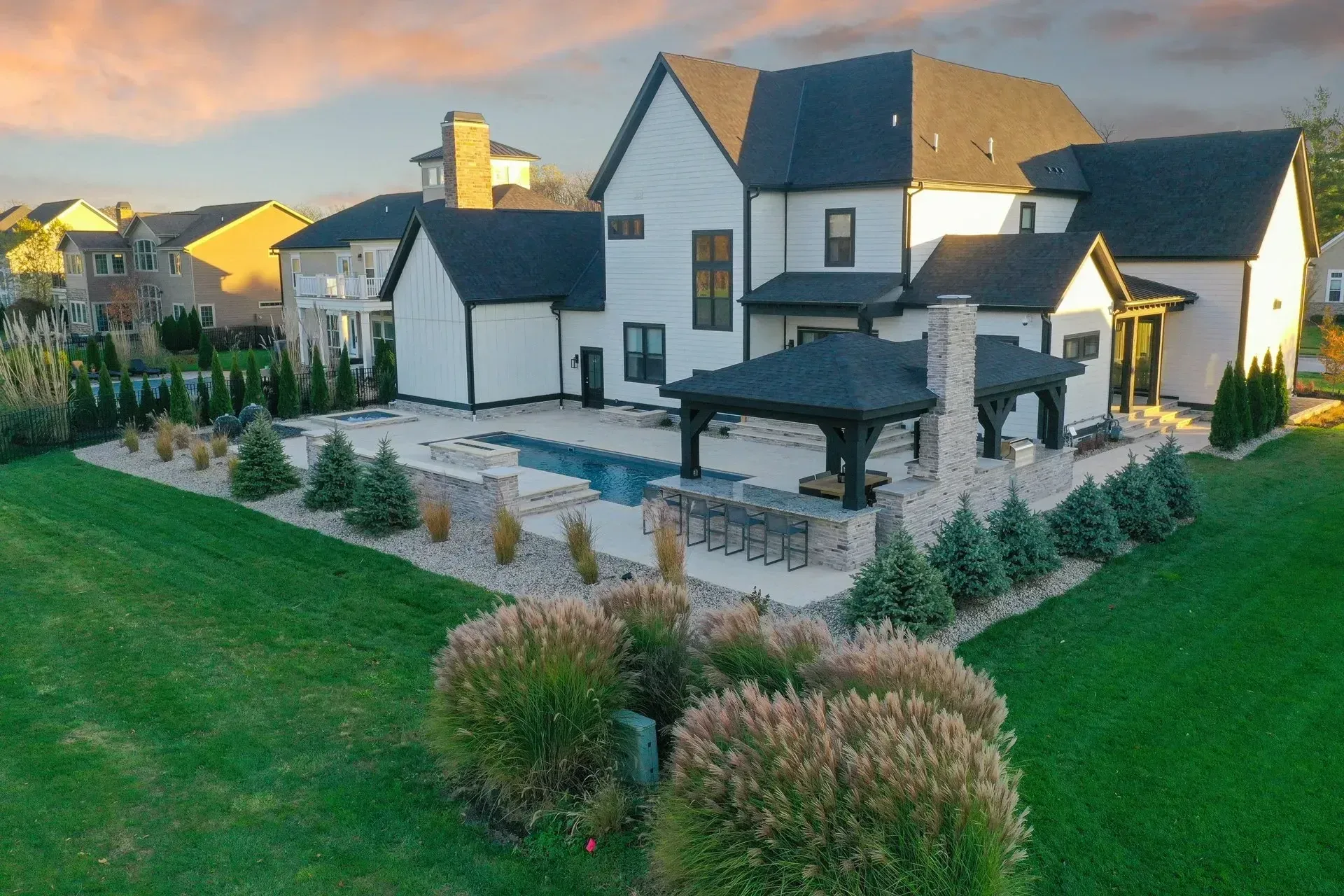
The raised spa wall has two jobs. It holds back 400 to 600 gallons of heated water on an elevated bond beam, and it tells the story of what the whole backyard is supposed to feel like. Three veneer types cover about 95% of what gets specified here, and they perform differently on Cecil series Piedmont clay — the same expansive clay that runs through Dacula and north through the Chattahoochee watershed.
Moss rock
Harvested from North Georgia and East Tennessee quarries, moss rock is weathered, lichen-dappled field stone with irregular faces in thicknesses from 3 to 8 inches. Budget $32 to $48 per square foot installed on a mortar-bed veneer system. Every face is unique, and it looks like it’s been there since the Chattahoochee carved the property line. Disadvantage on spa walls: irregular thickness makes your mason work harder to hold the face plumb, and cheap installers will “face set” (just gluing the front face on) instead of mechanically tying back. On a 30-inch raised spa wall in constant splash-back contact, face-set stone fails within 4 winters. Insist on mechanically anchored installation with stainless ties every 16 inches on center per NCMA guidelines.
Fieldstone
Sawn fieldstone (also called “thin veneer fieldstone”) is moss rock’s cleaner cousin — cut to a consistent 1-1/4″ to 1-1/2″ thickness so it installs faster and truer. Budget $24 to $38 per square foot installed. Lighter, bonds better, passes ARB review faster because the renderings render cleaner. Nearly every Laurel Springs spa wall built over the past 5 years has used sawn fieldstone in a light gray-cream palette that reads well against travertine decks. This is our default recommendation when a homeowner doesn’t already have a material they’re emotionally attached to.
Cultured stone (manufactured veneer)
Brands like Eldorado Stone and Boral Versetta make concrete-based cultured veneers at $14 to $22 per square foot installed. They photograph well and hold up fine for the first 3 years. The problem on a raised spa specifically: manufactured veneer is porous concrete with painted-on color, and around active scupper splash zones the color layer degrades and the underlying gray concrete shows through. We’ll install cultured stone on a fireplace or a non-water wall all day. We won’t put it on a spillover spa wall — and in fairness, neither Eldorado nor Boral warrants it for that application.
Waterline Tile: 1×1 Glass Mosaic, 2×2 Fused-Glass Matte, Porcelain
The waterline tile is the 6-inch band that wraps the spa at the water line and usually continues around the main pool. It’s the single most visible tile surface in the backyard and takes the worst abuse — constant wet-dry cycling, sunscreen oils, chlorine stabilizer, and, in freeze events (Suwanee averages about 20 freeze nights per year), water intrusion into grout joints. Three categories matter.
1×1 glass mosaic
Brands: Lightstreams, Oceanside Glasstile, National Pool Tile. Price range $42 to $78 per square foot material, plus roughly $18 per square foot installation. These are the iridescent, color-shifting waterline tiles you’ve seen on magazine-grade pools. The 1×1 format gives you enough grout line density to tile a curved spa wall without cuts showing, and glass doesn’t absorb water. Caution: bargain 1×1 imports that don’t specify fully fused glass will delaminate at grout joints after 3 winters. If the datasheet doesn’t say “fully fused” and “pool-rated,” walk away.
2×2 fused-glass matte
The quieter luxury choice. 2×2 matte-finish glass (Lightstreams Glass Lagoon is the reference product) reads as a single continuous color band from a few feet away, and the matte surface hides waterline scale that builds up in our hard-water region. Budget $58 to $92 per square foot material. 2×2 is faster to install than 1×1 mosaic but slower than 3×3 porcelain — roughly $14 per square foot installation. For a raised spa with active scupper splash, we lean matte. Iridescent 1×1 catches spray-pattern mineral deposits; matte doesn’t.
Porcelain tile (3×3 or 2×6 plank)
The budget-friendly and entirely acceptable option. Porcelain waterline tile in a 3×3 format runs $18 to $32 per square foot installed, hides scale well, and survives freeze cycles as long as it’s rated freeze-thaw Class 3 or higher. Aesthetic tradeoff: porcelain reads as tile. Glass reads as jewel. On a million-dollar Laurel Springs backyard, the ARB will approve porcelain but won’t be impressed, and a few neighborhoods explicitly require glass waterline tile on any approved spa addition — which you’ll only find out if you read the design guidelines cover to cover.
Raised Bond Beam and Spillway Count: One, Two, or Three Scuppers
Spillway count moves the budget most in dollar terms. Every additional scupper adds roughly $2,400 to $5,800 — the spout, the penetration through the bond beam, the weir cut, the basin waterproofing, the flow-balancing valve on the feed side, and the additional waterline tile wrapping the spillway lip.
Single scupper
One centered spout, 12 to 18 inches of flow, quiet and focused. Single-scupper installs add $2,400 to $4,200 to the raised spa total. Right for smaller pools or back walls under 10 feet wide.
Dual scupper
Two symmetrical spouts, typically 30 to 48 inches apart on center. Dual is the default on rectangular pools 14 to 18 feet wide. Adds $5,800 to $9,400. The acoustic effect is substantially louder than single — you hear water from the breakfast nook 40 feet away through closed glass.
Triple scupper
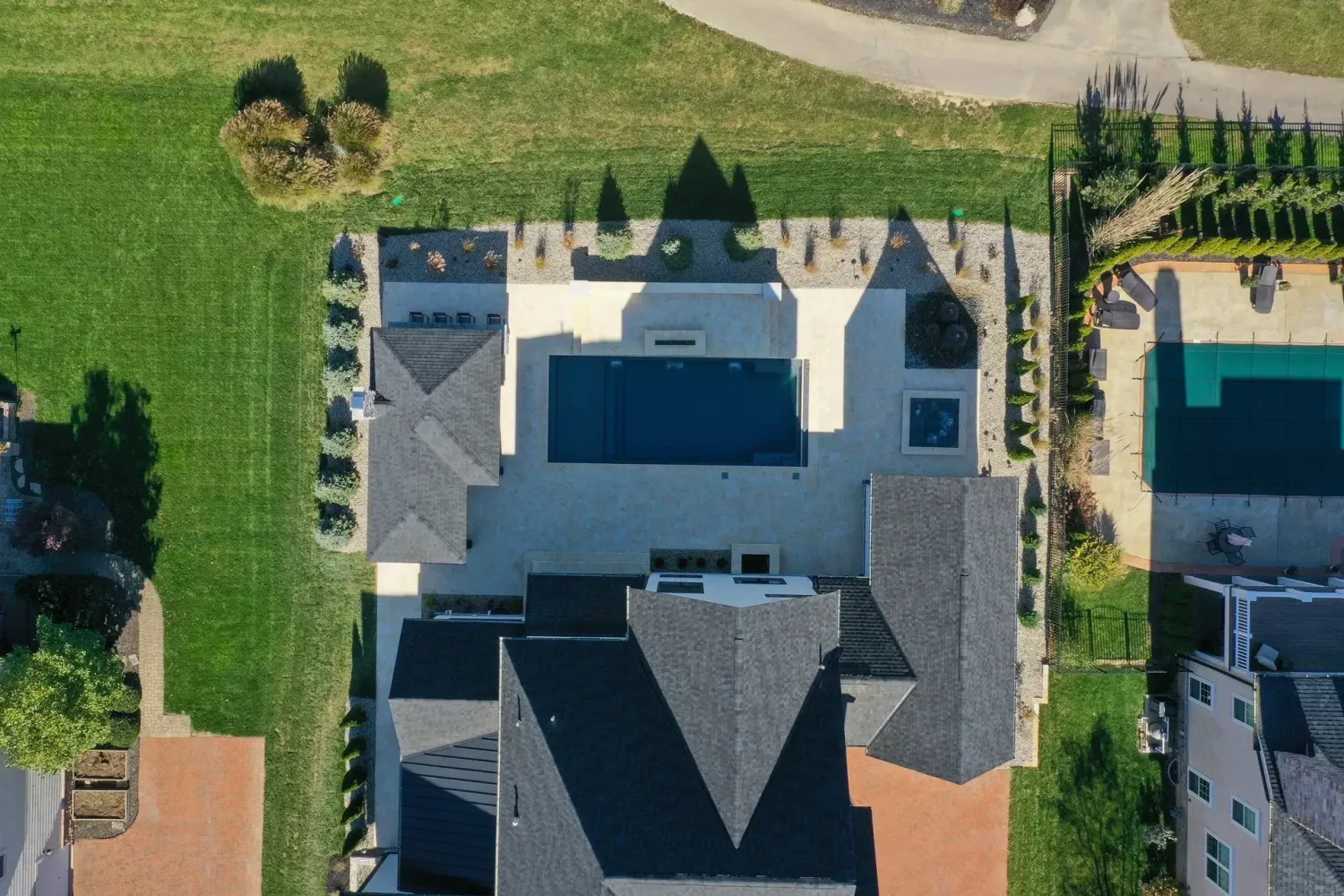
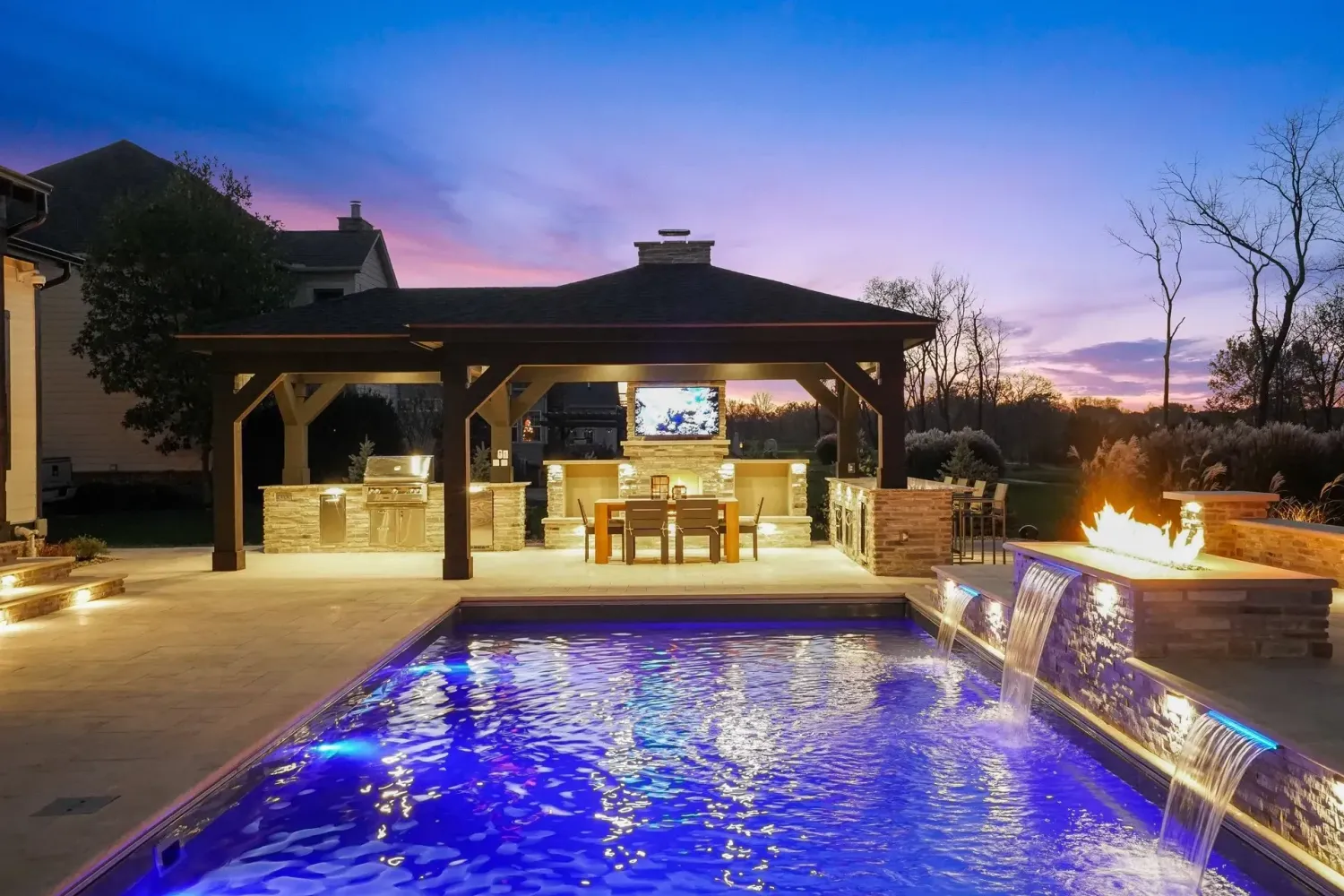
Three spouts across a wider back wall, usually on pools 18 feet or wider or raised walls that extend beyond the spa itself. This is the configuration in several hero-grade Laurel Springs projects finished in the last two years. Budget $9,200 to $14,600 on top of the base raised spa. Triple also requires a larger equipment pad — more water over a longer weir means a larger spillover pump on the main pool side and a heater with enough BTU headroom to hold spa temperature while feeding the waterfall.
Total budgets for raised-spa-with-multi-scupper-spillover builds we’ve delivered in Suwanee over the last 36 months land in a $28,000 to $52,000 band for the add-on — the raised spa, the multi-scupper spillover wall, the veneer, the waterline tile, and the additional equipment. That does not include deck modifications, pool resurfacing on a larger remodel, or electrical upgrades, which are almost always required.
Scope-creep trap: Suwanee pools built before 2015 typically have a 150,000 BTU spa heater sized for a standalone spa — not for a spa also feeding a spillover. Adding three scuppers doubles the thermal load. You’ll either upsize to a 250,000 to 400,000 BTU unit (Raypak P-R406A or Jandy JXi 400) or accept a spa that takes 90 minutes to reach 102°F. Budget $3,400 to $5,800 for heater upgrade plus gas line re-run if needed.
Jackson EMC 240V service — the electrical detail outside contractors miss
Suwanee’s electric utility is Jackson EMC, not Georgia Power. This matters more than it sounds. Jackson EMC’s new-service-drop process for a dedicated 240V/60A circuit serving a spa heater plus spillover pump runs on a different scheduling calendar than Georgia Power, and contractors who do most of their work in Gwinnett’s Georgia Power territory (roughly everything south of McGinnis Ferry into Sugarloaf and Dacula proper) sometimes forget the service-request form entirely.
For a new raised spa with spillover you typically need:
- A dedicated 240V/60A breaker on a separate GFCI-protected circuit per NEC §680.43, which governs spa bonding and disconnect requirements
- An additional 20A circuit for the dedicated spillover pump if it runs on a separate timer from the main pool pump (strongly recommended)
- Bonding grid upgrades if the existing equipment pad was installed before 2008 — NEC bonding standards tightened substantially that year
- A Jackson EMC service-capacity review if your meter is already near its ceiling, common in Settles Bridge and older Suwanee subdivisions built in the 1990s on 150A or 200A service
Budget $1,800 to $3,600 for electrical. If a Jackson EMC service upgrade is required (meter to 320A, or pulling a subpanel to the equipment pad), add another $2,400 to $5,200 and 2 to 3 weeks while Jackson EMC schedules the cut-in. It’s paperwork and truck-roll timing with a specific utility whose appointment windows run narrower than Georgia Power’s.
Putting It Together: Specifying in the Right Order
“Adding a raised spa with multi-scupper spillover” is really a sequence of seven independent material decisions, each cascading into the next. Here’s the order we work through them with Suwanee clients:
- Scupper count first. Sets back-wall length, which sets spa geometry, which sets equipment sizing. You can’t pick tile before you know how wide the wall is.
- Spout material second. Cast-stone, bronze, or copper anchors the entire palette, and almost nothing else gets selected until it’s locked.
- Veneer stone third. Fieldstone, moss rock, or cultured — must coordinate with the spout and the existing coping and deck material.
- Waterline tile fourth. Glass mosaic, fused-glass matte, or porcelain — often a direct reaction to spout choice (bronze pairs with warm glass, copper with darker glass, cast-stone with almost anything).
- Coping and deck integration fifth. Does the new raised wall cap match the existing pool coping or is this the moment to re-cap the whole perimeter? Half of Suwanee remodels end up re-capping because 12-year-old concrete coping looks wrong next to new travertine.
- Equipment sizing sixth. Pumps, heater, plumbing runs — dictated by scupper count and the vertical lift from main pool surface to weir lip.
- Electrical and permits seventh. Jackson EMC service verification, Gwinnett County building permit, HOA ARB packet assembly. This is usually where the biggest delays hide.
We quote all seven as separate line items on Suwanee proposals so homeowners can see exactly where the money goes and make informed trades. A $38,000 raised spa with bronze spouts and fused-glass matte tile becomes a $29,000 project by swapping to cast-stone spouts and porcelain tile — and in many Laurel Springs neighborhoods the ARB approves either combination. That’s the trade conversation a good contractor will walk you through. A contractor who quotes a round number for “add raised spa with spillover” is hiding information you need to make the call.
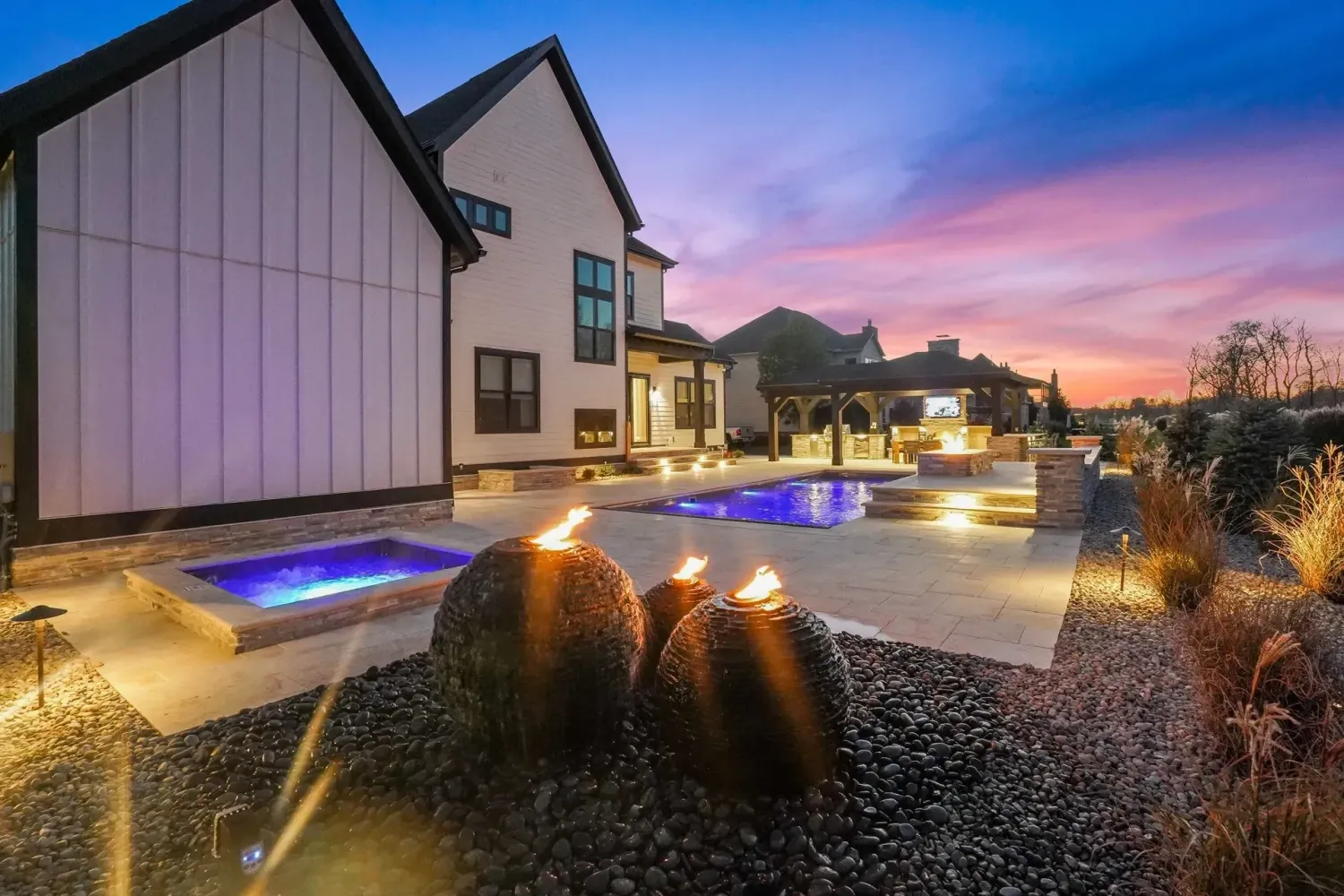
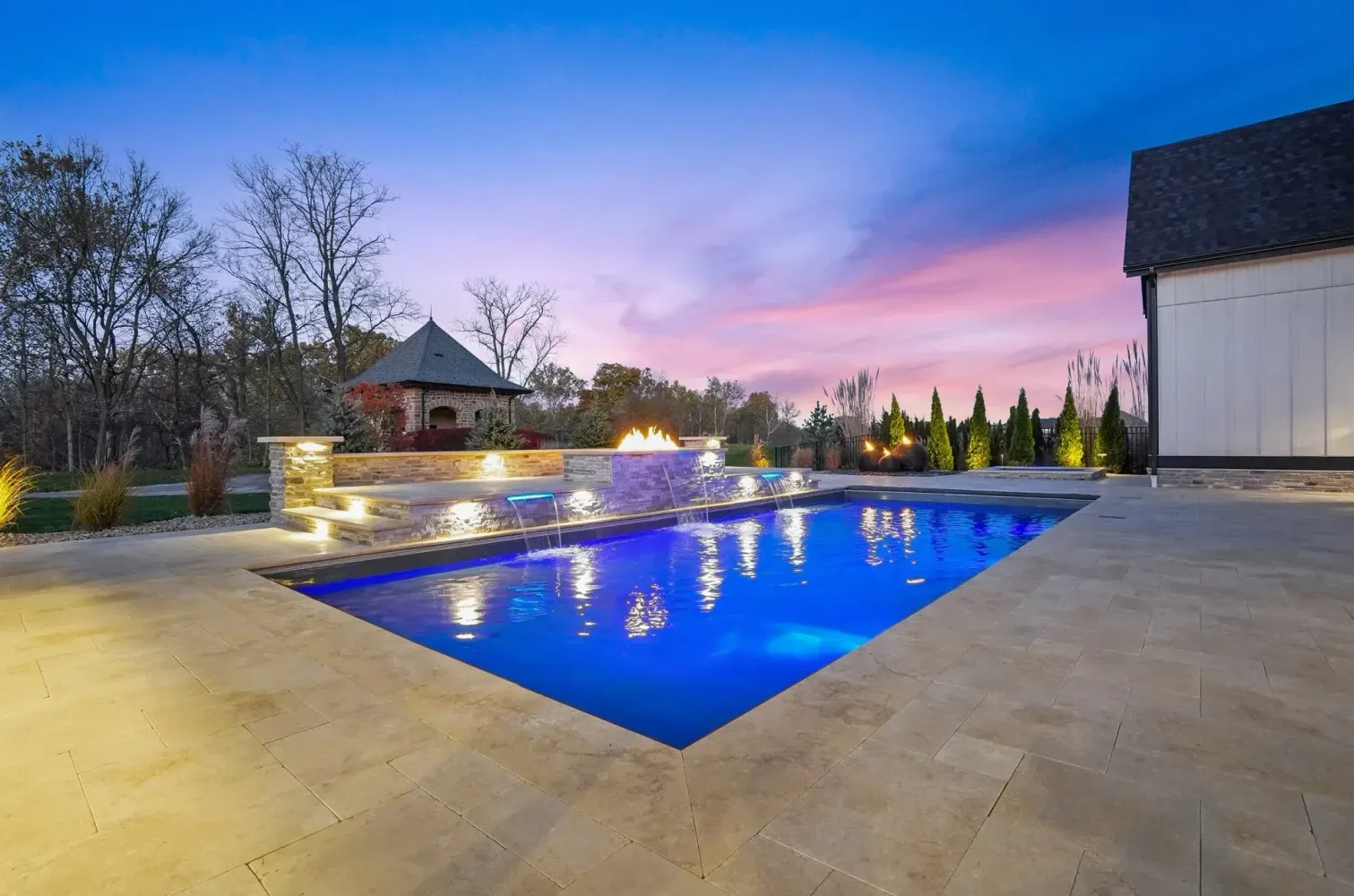
One last Suwanee-specific note. A handful of properties in Settles Bridge and along the southwest border sit in Zone AE flood designation because of proximity to the Chattahoochee. If your lot is in Zone AE, raised-bond-beam-wall construction requires a Gwinnett County floodplain elevation certificate in the permit packet — add $600 to $900 and 7 to 10 business days to the permit cycle. About 95% of Laurel Springs lots are well outside the floodplain and it’s a non-factor. For the River Club and the handful of estate homes with direct Chattahoochee frontage, it’s real, and nearly every contractor outside Suwanee misses it.
Pool remodeling and raised-spa spillover design across 20+ cities within 30 miles of Winder, GA
Specifying a raised spa with multi-scupper spillover on a covenant-controlled Suwanee property takes a full material spec, a 3D rendering, and a contractor who knows the ARB review process. That’s the work we do.