
A homeowner in Windward stands in their backyard with a tape measure, walks heel-to-toe from the rear of the house to the property pin, turns 90 degrees, and counts the steps to the side fence. Fourteen feet. Minus the 10-foot side setback. That leaves four feet of play — and a decision most builders make wrong.
The lot is a quarter-acre. The house is 4,200 square feet. The backyard — what’s actually left after the footprint, the rear deck, and the HVAC pad — is a rectangle roughly 38 feet deep by 42 feet wide. Not 42 feet of pool width. Forty-two feet from fence to fence, with a side setback on both sides eating into it.
This is the Alpharetta quarter-acre problem. It shows up in Windward, Brookhollow, Martins Landing, and a good slice of the 1990s-built HOA subdivisions along the GA-400 corridor. The lots are legal, the homes are big, and the buildable pool envelope is tiny. The zero-side-setback design exists because of these lots — and it’s the only approach we’ve seen consistently produce a swimmable, code-compliant, resale-sensible pool on them.
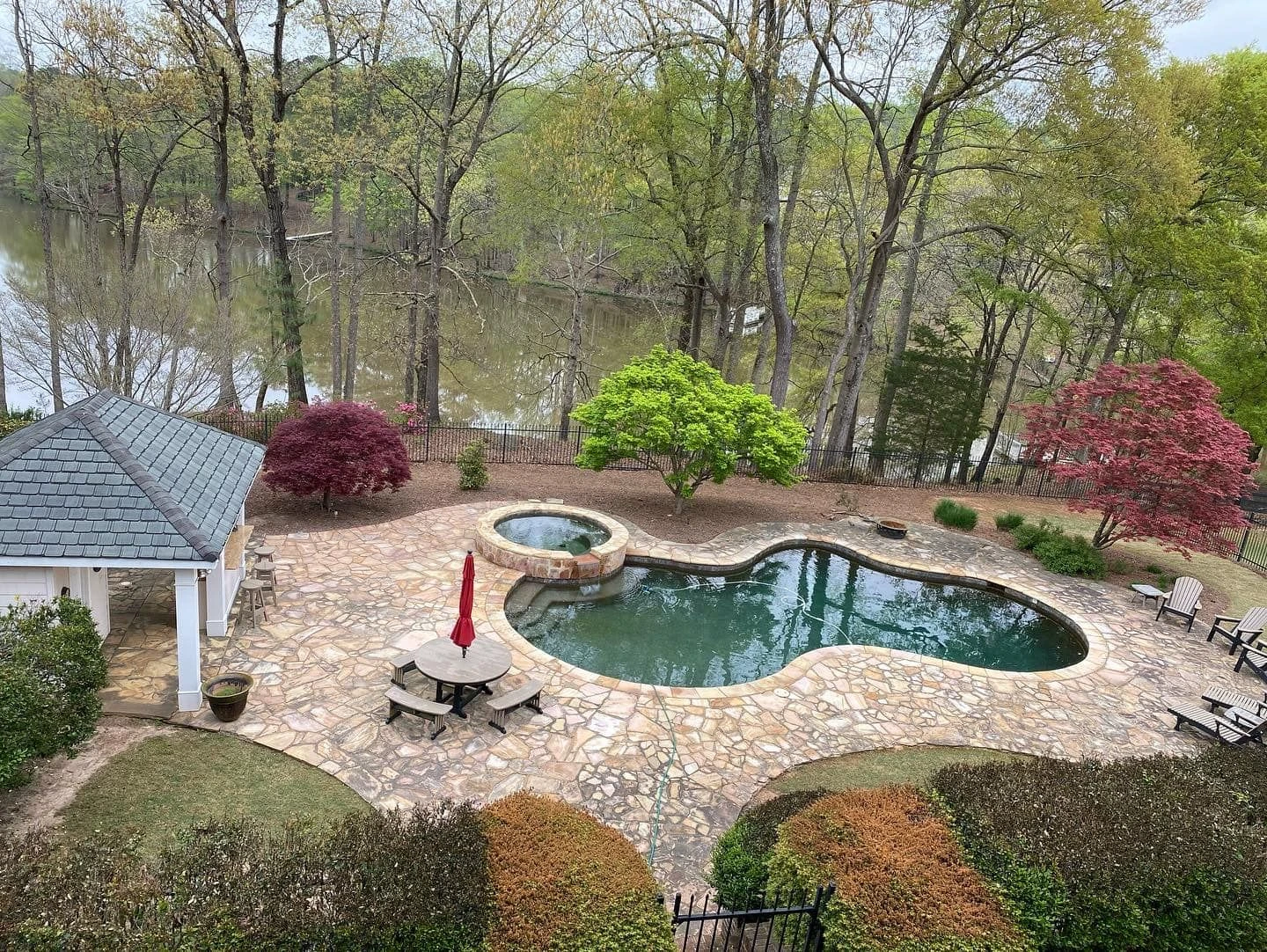
Why the Quarter-Acre Lot Breaks a Standard Pool Design
A “standard” custom pool in Georgia starts around 16×32. Add the coping, a 4-foot deck return on every side, and a pad for equipment somewhere accessible, and you need roughly 26×42 of clear, unobstructed, graded ground. That’s the number to carry around in your head.
Now take a typical Brookhollow quarter-acre lot. The house is pulled as far forward as the 30-foot front setback allows, because in the mid-’90s builders maximized curb presence. The backyard has maybe 40 feet of depth from the rear of the house to the back property line. Subtract the 10-foot rear setback. Subtract a 6-foot cantilevered deck or covered porch. You’ve got 24 feet of pool depth to play with before you hit the rear setback line.
Width is worse. A lot platted at 75 feet wide with the house sitting 55 feet wide (including bumps and chimneys) leaves 10 feet on one side and 10 on the other. The side setback on most of these plats is 10 feet. The math writes itself: zero inches of side yard between the setback and the house wall.
A generic 16×32 simply won’t fit. Builders who try it end up pushing the pool into a setback, begging for a variance, and losing 8-12 weeks while the variance goes through the Alpharetta Board of Zoning Appeals. Most variances on pools in established Alpharetta HOAs get denied — the neighbors show up.
The Zero-Side-Setback Rectangle — What It Actually Is
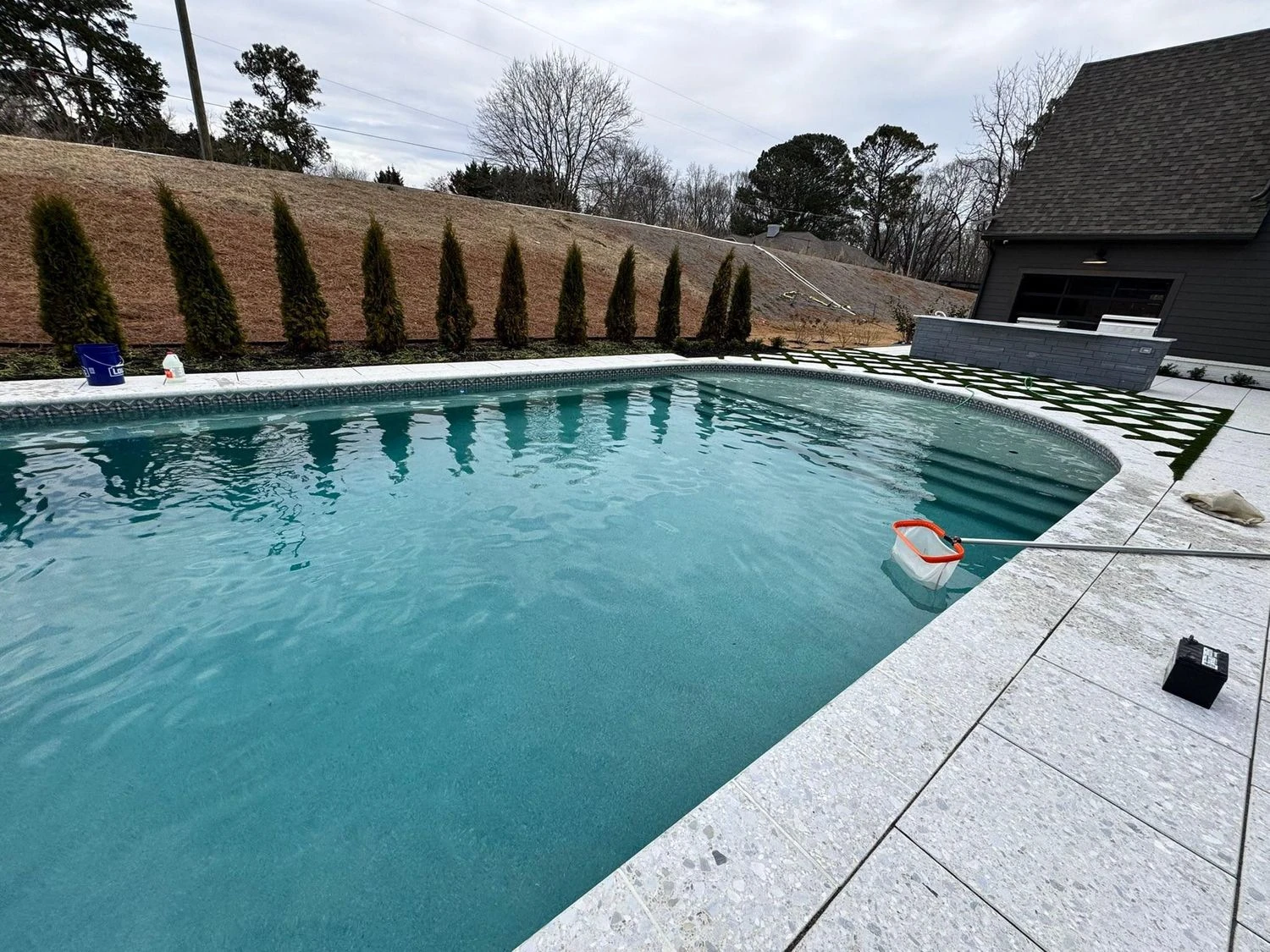
The design is boring on paper and elegant in execution. A 14×28 rectangle, pulled tight against the 10-foot side setback line on the long axis, with a 3-foot concrete walk on the house side and a 5-foot tanning ledge or lounging deck on the fence side. That’s the whole pool.
Why those numbers:
- 14 feet wide. Two swim lanes plus a skim margin. Below 12 feet a pool stops feeling like a pool; at 14 feet two adults can pass each other without brushing.
- 28 feet long. Long enough for a real swim stroke. A 30-foot pool requires a longer equipment run and triggers the next tier on most variable-speed pump specs. Twenty-eight is the sweet spot.
- Rectangular. Freeform curves cost 6-9 inches of swimmable area on every radius. On a tight lot you cannot afford to give that up, and the rectangle reads as architectural rather than residual.
- Pulled to the setback line. The pool shell sits with its outside coping edge at or within inches of the 10-foot property line offset. This is legal. It’s the decks and equipment that trigger most setback denials — not the water.
Alpharetta code reference: City of Alpharetta Zoning Ordinance Section 3.3.4 treats the pool water body, coping, and any deck as separate items. The pool water and coping typically must sit behind the primary setback line; the deck can encroach under certain conditions but equipment cannot. Confirm your specific zoning district (R-1, R-2, AG) with Alpharetta Community Development at 2 Park Plaza before finalizing placement.
The design philosophy is simple: every square foot of the lot is accounted for, nothing is wasted, and the pool reads as if the backyard was always going to have it. Done right, it looks intentional. Done wrong, it looks like someone dropped a lap pool into a dog run.
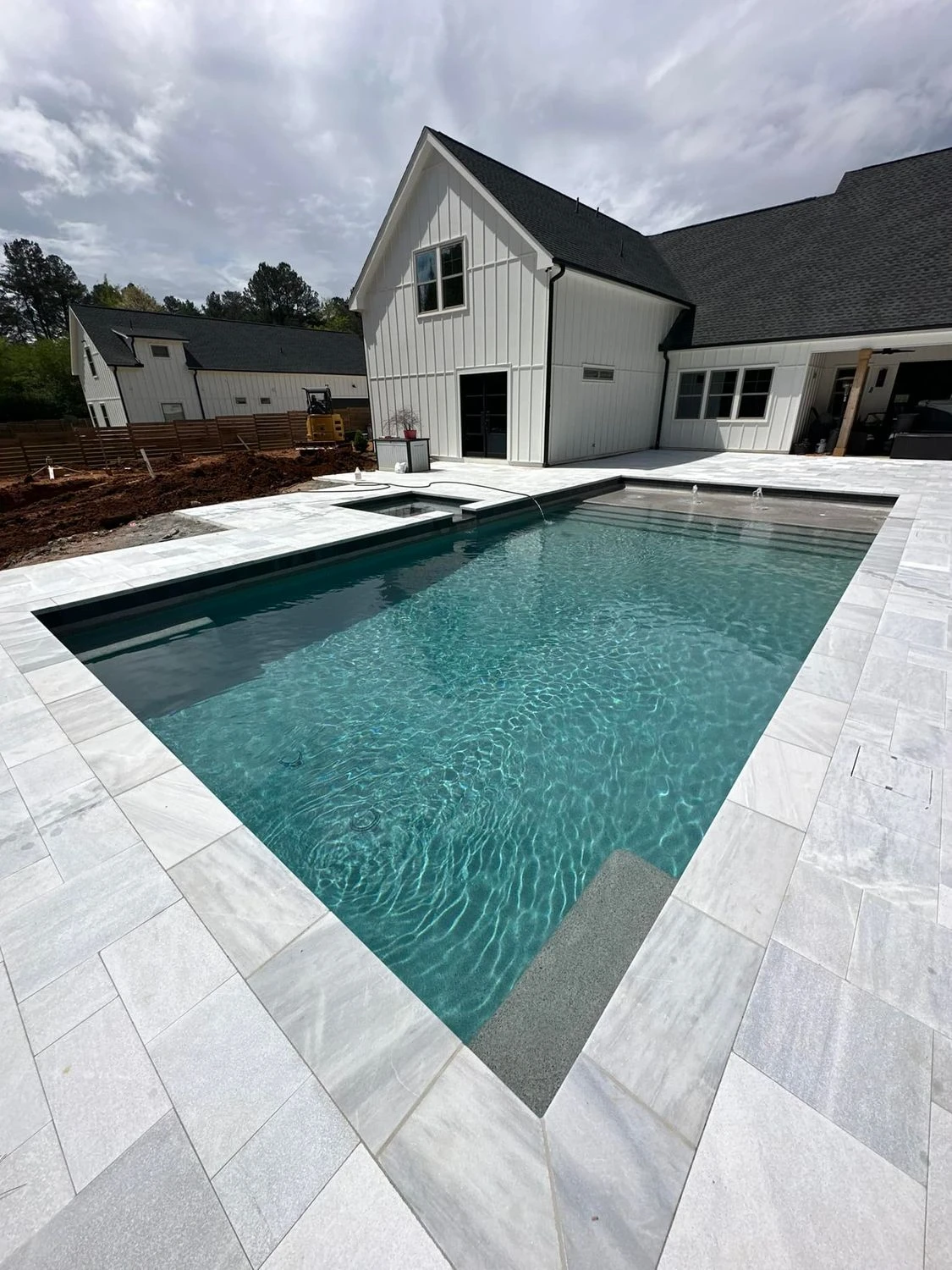
Routing Equipment When the Side Yard Is 10 Feet Wide
The equipment pad is where the zero-side-setback design lives or dies. A variable-speed pump, a cartridge filter, a heater, an automation panel, and a chlorinator need roughly a 4×8 pad with service clearance. On a quarter-acre lot with a 10-foot side yard, you don’t have a corner of the backyard hidden behind a shed. You have a sliver of grass between a privacy fence and your neighbor’s privacy fence.
We route plumbing down that sliver and land the pad at the rear corner of the house, not the side. Two reasons. First, rear-corner placement keeps the service run from the pool under 40 feet — the point at which 2-inch PVC becomes 2.5-inch and the job gets noticeably more expensive. Second, equipment at the rear corner disappears behind a cedar screen or a fence return that nobody sees from the pool deck or the kitchen window.
This is not a trivial detail. We’ve walked onto jobs where a previous builder put the pad in the only obvious open spot — right next to the rear patio — and the homeowner now listens to a Pentair IntelliFlo3 VSF pump hum whenever they’re trying to have dinner outside. Thirty-two decibels on low speed is quiet until it’s five feet from your ear.
The Plumbing Trench Nobody Sees
Running 80-100 feet of 2-inch PVC through a 10-foot side yard means trenching along the fence line, down 18-24 inches, well away from the house foundation and well away from the fence-post footings. In Alpharetta’s Cecil-series clay, that trench holds water for three or four days after a rain. The crew has to sequence it: trench, plumb, pressure-test, backfill — all on the same day if the forecast is right.
The reward is a pool where the only thing the homeowner sees from the back door is water. No equipment. No plumbing manifold. No automation panel bolted to the house. Everything important is at the far corner, behind a louvered screen or a simple fence return.
Permits Through Alpharetta — Not Fulton County
This is the detail that every agent and relocation buyer misses. Alpharetta is an incorporated city. If your lot is inside the Alpharetta city limits — and the Windward, Country Club of the South, Brookhollow, Martins Landing, Avalon, and most of the downtown subdivisions are — you permit through City of Alpharetta Community Development, not Fulton County.
The difference is material. Fulton County unincorporated pool permits have been running 4-6 weeks in 2025-2026 due to backlog. Alpharetta in-city permits we’ve pulled this year have been averaging 10-14 business days from submittal to issue, assuming the engineering is clean and the plat is accurate.
Submittal packet for Alpharetta pool permit: signed survey plat showing setbacks, engineered pool plan with cross-section, electrical plan stamped by a Georgia-licensed PE, Georgia Power service coordination letter, erosion & sediment control plan, HOA architectural review approval letter (where applicable).
Address: 2 Park Plaza, Alpharetta, GA 30009. Plan review coordinated via the city’s online portal.
The HOA approval letter is the rate-limiting step in half the Alpharetta subdivisions we build in. Windward’s ARC reviews monthly, and the approval cycle can eat 3-4 weeks on its own. Country Club of the South’s ARC is stricter still — specific coping materials, specific screen-wall heights, and submittal drawings that read more like an architect’s set than a pool plan. Start the HOA package the week you sign the design agreement. Do not wait for the final construction drawings.
Soil, Grade, and the 3-6 Foot Drop Across the Backyard
Alpharetta sits on the southern shoulder of the Piedmont, at roughly 1,100 feet elevation. Most residential backyards in the city pitch 3-6 feet from the rear of the house to the back property line, sometimes more in the older Martins Landing and Haynes Manor sections that were cut into natural ridge-and-valley topography.
A 4-foot grade drop across a 30-foot pool zone means your pool bond-beam is sitting 3 feet above finished grade on the downhill side. That’s not a pool — that’s a retaining wall with water in it. The right answer is a terraced approach: the pool sits level, the uphill side ties in at grade, and the downhill side is supported by a segmental retaining wall 36-48 inches tall, typically in a split-face concrete block or a veneer-finished shotcrete wall.
The Piedmont red clay that dominates Alpharetta — Cecil and Pacolet series — behaves predictably. Moderate shrink-swell, decent bearing capacity at 36 inches of depth, and a tendency to shed water laterally rather than absorb it. That last point matters: a pool built into a hillside in Alpharetta clay will, over years, channel groundwater around its shell and into the side yard. Every pool we build on grade gets a perimeter gravel drain, a sock-wrapped French drain, and a daylight-to-storm outlet.
Cost, Timeline, and What $118K-$148K Actually Buys
A 14×28 rectangle on a quarter-acre Alpharetta lot, built to the zero-side-setback design with equipment routed through the side yard, a plaster interior, paver coping, and a 200-square-foot Techo-Bloc deck, runs $118,000 to $148,000 as of Q1 2026. The range is driven by three variables:
- Retaining wall exposure. Every linear foot of wall above 18 inches adds cost. A flat lot sits at the low end; a lot with a 4-foot drop sits at the high end.
- Finish. Standard marcite or quartz plaster is at the low end. A NPT Stonescapes mini-pebble is mid-range. A Pebble Sheen or exposed-aggregate custom-tint blend is at the high end — and yes, it’s worth it on a small pool where every finish detail is visible from every angle.
- Automation. A basic Pentair Intellicenter Lite with remote app control is $3,200 installed. A full-feature system with color-changing LED, variable-speed pump tuning, and heater integration is $6,800-$8,400. On a small pool in a tight lot, automation earns its cost back fast — nobody wants to walk down a 40-foot side yard at 9 PM to flip a breaker.
Timeline from signed contract to swim is 14-18 weeks for a well-planned Alpharetta build, broken down roughly: 3-4 weeks of design and HOA, 2-3 weeks of permitting, 6-8 weeks of construction (dig, steel, plumb, gunite cure, tile, coping, deck, plaster, fill), and 1-2 weeks of startup and water chemistry stabilization.
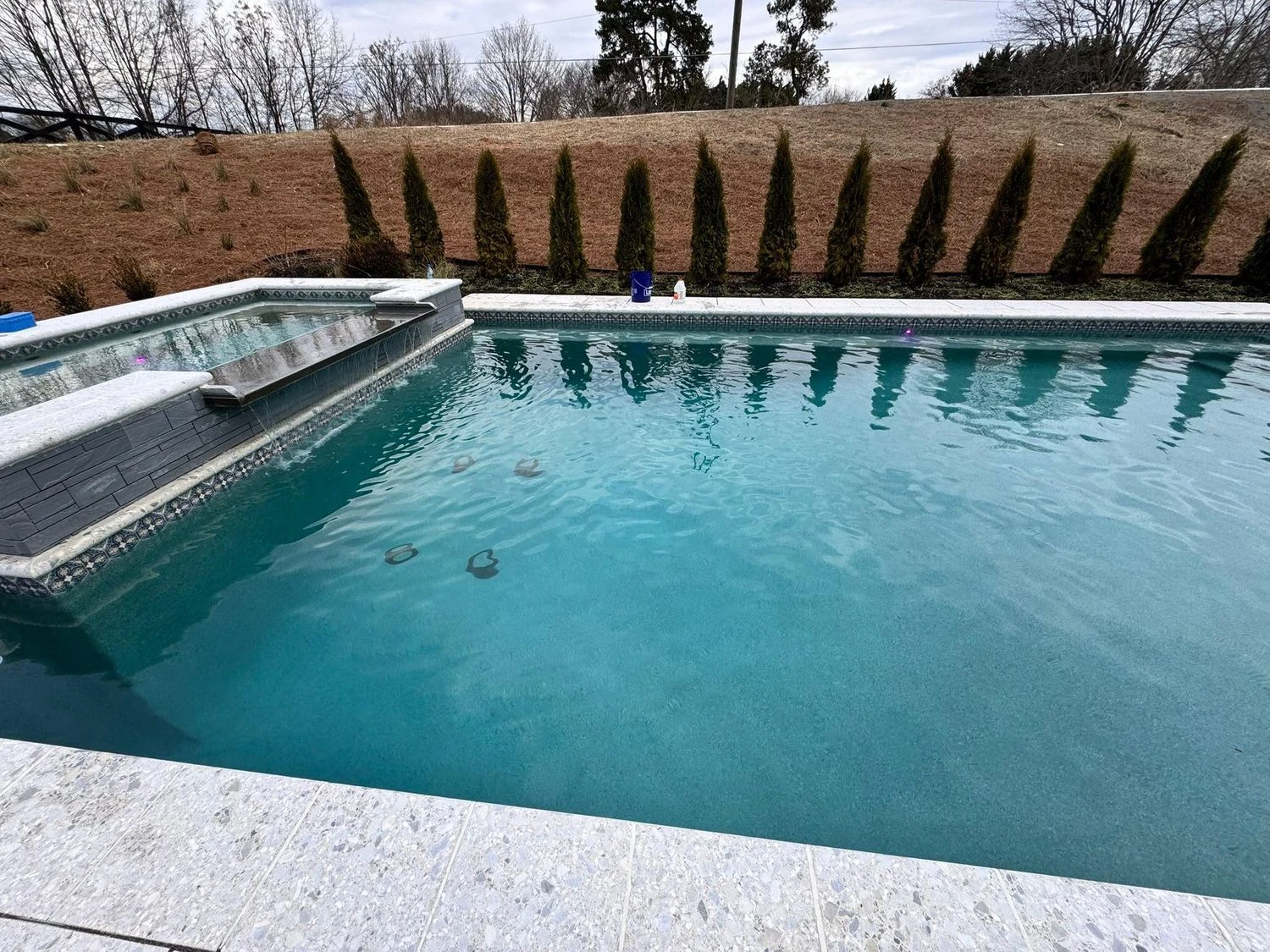
Why the Tanning Ledge Does Heavy Lifting Here
A 14×28 pool is swimmable but not expansive. The tanning ledge — a 5-foot-wide shelf at 9-12 inches of water depth running along the fence side — transforms the pool from “a rectangle of water” into a layered outdoor space. Two chaise-style in-pool loungers fit the ledge comfortably. From the kitchen window, the ledge reads as usable backyard square footage even when no one’s in the water.
On a quarter-acre lot, every visual layer you can add matters. The ledge adds one. Architectural coping — bullnose travertine or a linear-format Techo-Bloc — adds another. A single water feature, typically a spillover bowl from the adjacent retaining wall, adds movement and sound without adding hardscape footprint.
Utility Coordination and the Georgia Power / Sawnee EMC Line
Most of Alpharetta’s residential electric service is Georgia Power. The northern edge of the city — up toward the Milton line, along Hembree Road and Rucker Road — transitions to Sawnee EMC service territory. The difference matters for a pool build because the two utilities have different inspection calendars, different service-upgrade lead times, and different rules about how a pool subpanel ties into the main service.
A pool requires a dedicated 60-amp subpanel minimum, typically 100 amps if you’re adding a heater and automation. On a Georgia Power meter, the service upgrade — if needed — schedules within 2-3 weeks. On Sawnee EMC, it’s been running 4-6 weeks through early 2026. Relocation buyers moving into Alpharetta from out of state don’t always know which utility their specific address is on. The short answer: check the breaker panel label in the garage before you sign a contract.
Electrical spec, Alpharetta pool build, 2026: 100-amp subpanel fed from main service, 20-amp pump circuit on GFCI, 240V/40A heater circuit, 20-amp lighting circuit, 20-amp automation/controller, bonding grid to all reinforcing steel and any metal within 5 ft of water per NEC 680.26.
The underground run from the house meter to the equipment pad — typically 60-90 feet on a quarter-acre Alpharetta lot — uses PVC conduit at 24-inch burial depth. We bond the conduit run and the pool shell rebar before the concrete is placed. Missing the bonding grid is the single most common failed-inspection item on Alpharetta pool permits. The fix is expensive, because the inspector won’t sign off on plaster fill until the grid reads continuous.
The Alpharetta Buyer — Who’s Actually Building These Pools
The zero-side-setback design isn’t a budget pool. It’s a thoughtfully-engineered pool built on an expensive lot. The typical buyer in 2025-2026 is a relocated tech-corridor professional — Microsoft’s Alpharetta campus, CDW, the cluster of corporate-HQ buildings along Windward Parkway — who paid $850K-$1.4M for a four-bedroom in Windward or Hutchinson Farm and is adding a pool in year two or three of ownership.
They know what they’re doing with numbers. They’ve gotten three bids. They’ve read a dozen pool-forum threads. And they’ve been told by at least one builder that “there’s not enough room for a real pool on this lot” — which is usually a polite way of saying that builder doesn’t want to solve the equipment-routing problem, doesn’t want to do the retaining wall, and doesn’t want to deal with the HOA.
The answer, almost always, is that there is enough room. The lot just demands a specific design. The 14×28 rectangle with equipment routed through the side yard, a 5-foot tanning ledge on the fence side, and a segmental retaining wall on the downhill side is that design. It’s been proven across dozens of builds in the Windward, Brookhollow, and Martins Landing footprints, and it reads as intentional architecture rather than a compromise.
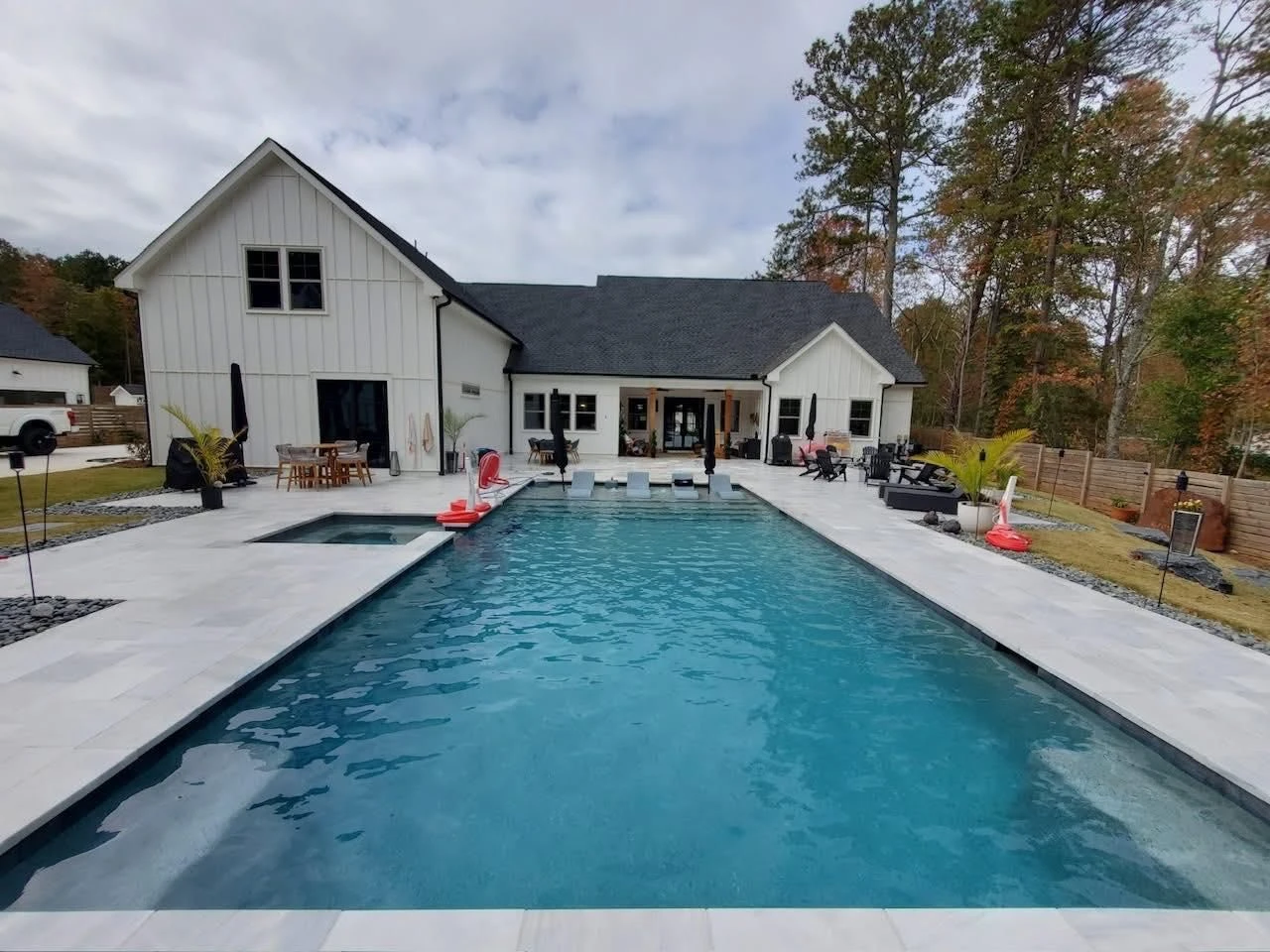
Resale Math on a Quarter-Acre Alpharetta Pool
A pool in the Alpharetta market generally returns 60-75% of its cost at sale within the first 7 years. On a $130,000 build in a Windward home currently valued at $1.1M, that’s $78,000-$97,500 of realized value — and the pool keeps the home competitive against the 2015+ luxury infill near Avalon, which almost universally comes with a pool or a pool-ready backyard.
The return math is tighter on a freeform pool built to a generic template. It’s stronger on a rectangular, architectural, well-integrated design because Alpharetta buyers in the $1M+ range are buying a specific aesthetic — and a 14×28 rectangle with linear coping and a tanning ledge fits that aesthetic. Curved pools with mounded rock features tend to age poorly in the North Fulton market.
Custom Pool Construction across 20+ cities within 30 miles of Winder, GA
Tight lot, strict HOA, tricky grade — we solve the engineering before a shovel hits the ground. Alpharetta, Milton, Johns Creek, and the wider North Fulton / Northeast Atlanta corridor.