
Every Laurel Springs homeowner hearing “$9 to $14 per square foot” from a driveway quote should stop reading and get a second opinion. That number is not wrong — it just isn’t what goes down in a gated golf community where the HOA review board spends three weeks evaluating your capstone color. A real Laurel Springs-spec paver driveway lands between $18 and $26 per square foot installed, and there are six concrete reasons the gap is that wide.
The contrarian truth is that the cheapest paver driveway in Suwanee will cost more than concrete over a 12-year timeline, and the most expensive one will outlive the roof of the house it leads to. The spread between those two outcomes has almost nothing to do with the pavers themselves. It has everything to do with what sits eight inches below them, how the soldier course was locked, and whether the installer bothered to call Jackson EMC before the skid steer rolled off the trailer.
This post is built around one install spec — the one we deliver for Laurel Springs, The River Club, and Bear’s Best Atlanta homeowners — and the exact breakdown of why the number looks the way it does. If you live in Settles Bridge or Village Grove and are pricing a 600-square-foot motor court right now, this is the piece of paper you want in front of you when the second estimate arrives.
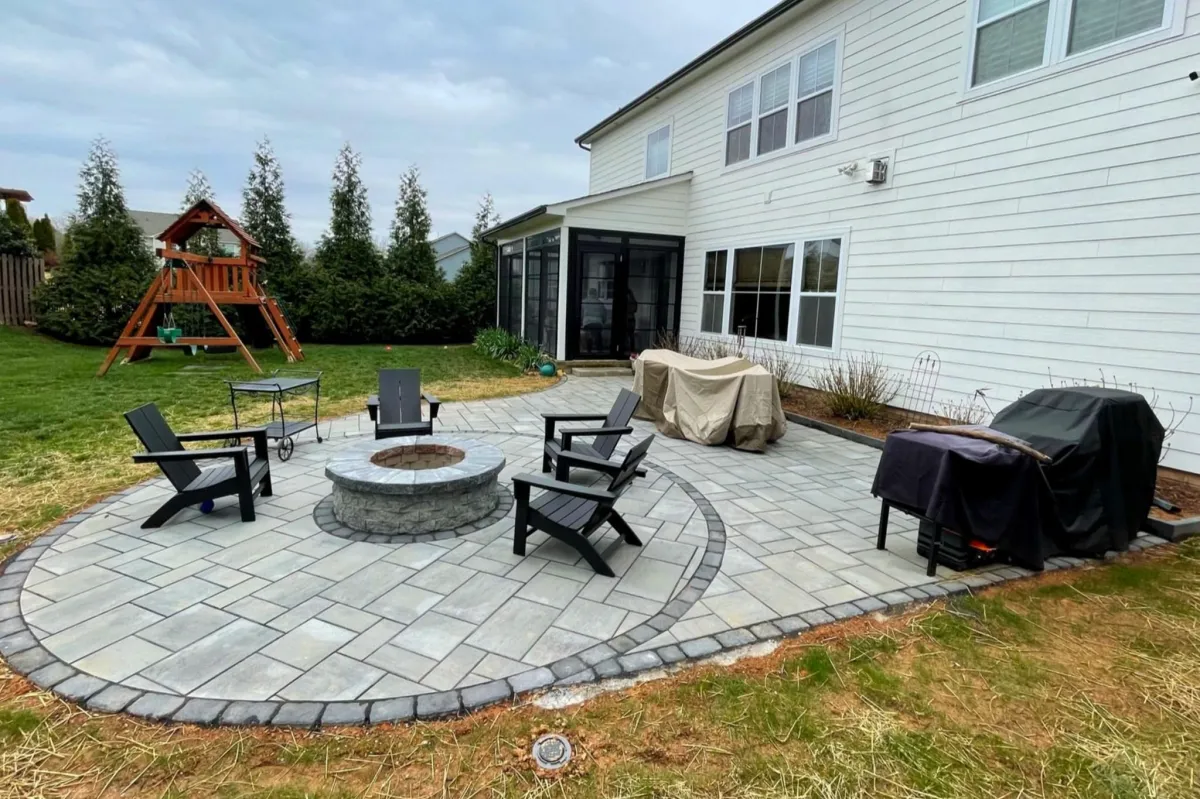
Why a Laurel Springs driveway costs twice what the rest of Gwinnett pays
A standard Gwinnett County paver driveway — the kind going in off Buford Highway or on a 1989 ranch in old Suwanee proper — gets installed on 4 inches of GAB-2 aggregate base, no geotextile, a plastic edge restraint spiked with 10-inch nails, and 3-1/8-inch-thick pavers. That’s a legitimate build for a 3,500-pound sedan on flat Cecil clay. It will hold up for seven to ten years before the soldier course starts walking, the field develops wheel-track dips over the subgrade, and you start sweeping polymeric sand back in every spring.
A Laurel Springs driveway does not get to be a seven-year driveway. Three things force the spec up: the grades, the loads, and the HOA. The golf community sits on rolling Piedmont at roughly 1,063 feet of elevation, which in practical terms means almost every drive has a 4 to 9 percent working slope. Dual-axle stone delivery trucks for the adjacent properties run 60,000 pounds at the axle. And the Laurel Springs architectural review committee — one of the strictest boards in Gwinnett County, with a typical three-to-four-week submission turnaround — rejects anything that reads as a production-home finish.
That last point is the one most homeowners underestimate. We’ve had submissions kicked back because the soldier course color was Greyed Nickel instead of the specified Onyx, because the cast-in-place curb lacked a tooled chamfer, and because the proposed paver was 60mm (standard residential) instead of the 80mm the board reads as “driveway-grade.” Each kickback costs three weeks of permit time.
The six cost drivers for a premium paver driveway in Laurel Springs:
1. 80mm paver (not 60mm) — Techo-Bloc Blu 60 Driveway or Belgard Dublin Cobble HD.
2. 10-inch compacted aggregate base (not 4-inch) — GAB-2 in 3-inch lifts, each lift proctor-compacted.
3. Woven geotextile separator between subgrade and base — Mirafi 500X or equivalent.
4. Mortar-set soldier course locked into a cast-in-place concrete curb edge, not plastic restraint.
5. Polymeric sand rated for vehicular traffic — SureBond SB-150, not residential joint sand.
6. HOA-compliant documentation: stamped drainage plan, capstone sample, lighting plan if applicable.
Run those six upgrades across a 600-square-foot driveway and the material delta alone is roughly $4,200 over a standard residential install. The labor delta is larger: the mortar-set soldier adds a day, the cast-in-place curb adds a day-and-a-half, and the deeper base excavation adds a full day of machine time plus haul-off for the extra 15 cubic yards of spoil.
The 10-inch base — what Cecil clay does to driveways without it
Suwanee sits on the same Cecil series Piedmont clay as Dacula and Lawrenceville, though properties close to the Chattahoochee floodplain pick up some sandy loam that drains a little faster. Cecil clay is a C-soil under the USDA Hydrologic Soil Group classification, which in contractor terms means it holds water, swells, and telegraphs every freeze-thaw cycle up through whatever sits on top of it.
Suwanee gets about 20 freeze events per year and 52 inches of annual rainfall. Every one of those freeze events is a micro-heave cycle in saturated clay. A 4-inch aggregate base doesn’t have enough mass to bridge those movements — it telegraphs them. A 10-inch base spreads the load wide enough that the surface sees maybe 15% of the subgrade movement, not 80%.
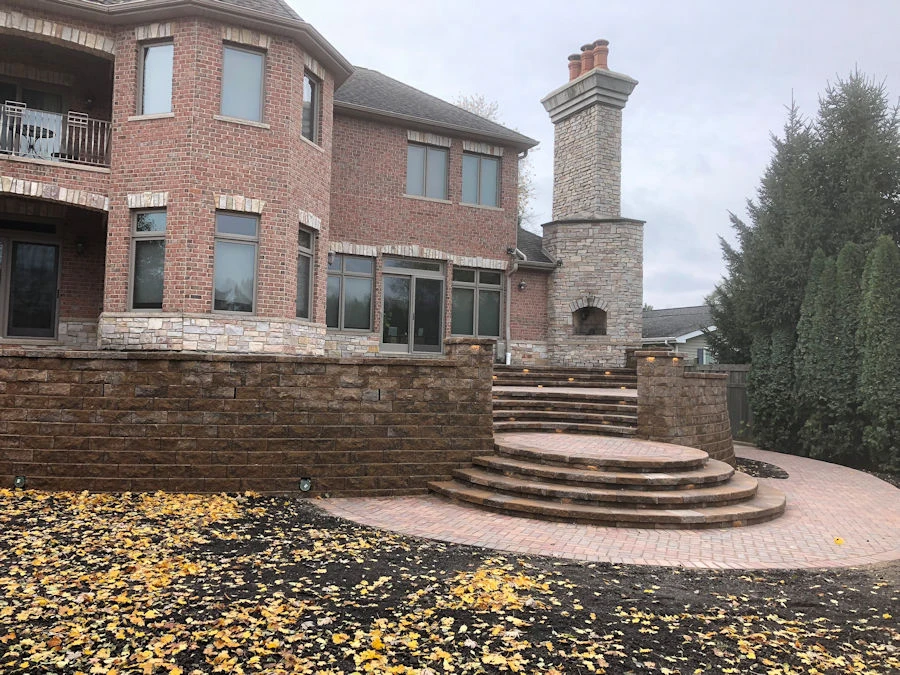
The geotextile is the piece most Suwanee homeowners have never heard of. A woven polypropylene separator — we spec Mirafi 500X — gets rolled out across the compacted subgrade before the first lift of stone goes down. It does one job: it keeps the clay fines from migrating up into the aggregate base over the next 15 years. Without it, the base layer slowly turns into mud-contaminated stone by year 8, loses its compaction, and the pavers start to roll.
We run the base in three lifts: 4 inches, 3 inches, 3 inches. Each lift is compacted with a 3,000-pound vibratory roller to 95% Modified Proctor density. This is not a detail the crew eyeballs. We pull a density test with a nuclear gauge on every driveway over $12,000 and document it for the homeowner. On sloped driveways — which includes nearly every Laurel Springs install — we also step-cut the subgrade into 6-inch terraces so the base doesn’t creep downhill over time.
One Settles Bridge homeowner called us in 2023 to rebuild a 9-year-old driveway another contractor had installed on a 4-inch base without geotextile. The field was sinking in two-inch-deep wheel tracks where the grocery SUV parked. We pulled up the pavers — most were salvageable — and found the base layer had turned into a cement-like slurry of Cecil clay and DGA fines. The only fix was full removal, re-excavation to 10 inches, geotextile, fresh GAB-2, re-lay. Cost to rebuild: $14,800 on a driveway that had originally been a $7,200 “budget” install. Do the math on that.
Techo-Bloc Blu 60 in Driftwood Gray — why this paver for this community
The specific paver we’ve been running for Laurel Springs and The River Club driveways for the last four years is Techo-Bloc Blu 60 Driveway in Driftwood Gray. This is an 80mm-thick (3-1/8″), smooth-face, modular three-piece pattern with a shot-blasted surface texture and a color blend that reads as warm gray with subtle charcoal veining. It is not the cheapest paver. It is not the showiest. It is the one that passes the HOA review on the first submission 90% of the time.
There are three reasons it lives on our Laurel Springs spec sheet. First, the 80mm thickness is non-negotiable for driveways rated for full-size SUV and light-truck loads. A 60mm paver will chip at the corners under a loaded F-250 backing out — not catastrophically, but enough to look worn at year 5. Second, the smooth-face finish cleans up with a pressure washer. Tumbled-edge pavers in this community look amazing on day one and start collecting pine straw and organic staining by month 18. Third, Driftwood Gray holds color. It doesn’t fade to chalk the way some of the warmer red-blend pavers do under direct afternoon sun.
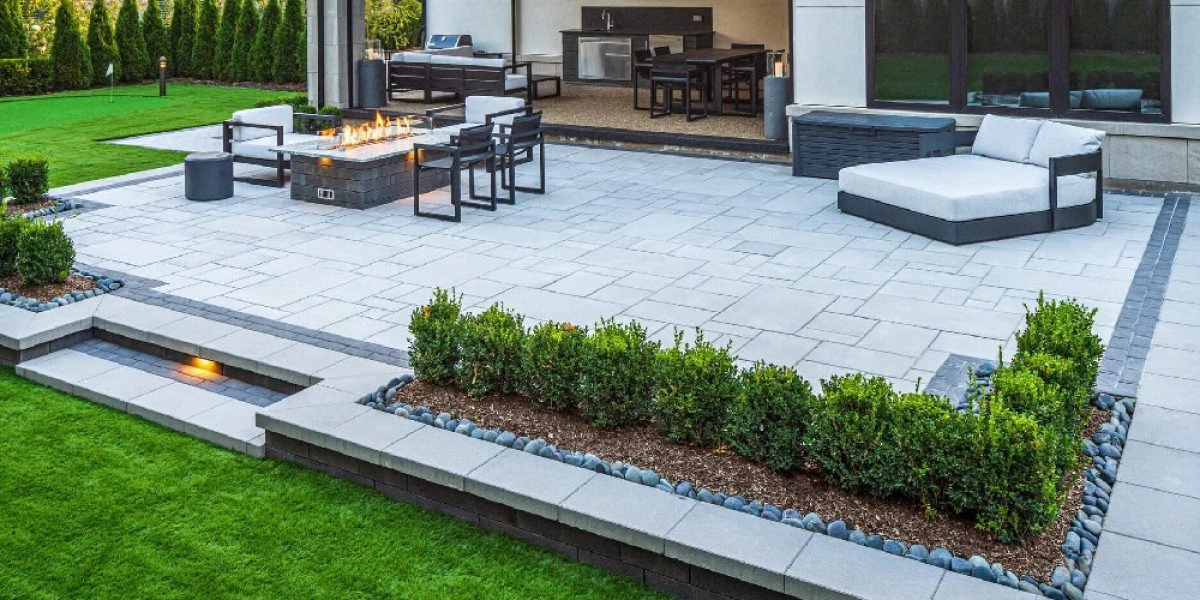
We pair it with an Onyx soldier course — 80mm-thick, dark-charcoal, single-size, laid perpendicular to the field. The soldier is set in a mortar bed on top of the compacted base and locked against a cast-in-place concrete curb edge poured 6 inches below the paver surface and 4 inches wide. This is the detail that separates a driveway that holds its edge for 25 years from one that walks two inches outward in every direction by year 7.
Polymeric sand matters here too. For driveway applications we use SureBond SB-150, which is rated for vehicular traffic and cures to a harder matrix than the SB-90 product used on patios. It resists ant excavation, doesn’t wash out in a heavy Chattahoochee-corridor thunderstorm, and needs reapplication only every 8 to 10 years rather than annually.
The 600-square-foot motor court math — $10,800 to $15,600 built right
Most Laurel Springs and River Club driveways we install are not full-length runs. They are motor courts — the 500 to 800-square-foot paved area at the top of a longer asphalt or concrete approach, where guests park, the delivery trucks turn around, and the Sotheby’s listing photo gets taken. A 600-square-foot motor court is the median job.
Here is the actual line-item breakdown for that size at the Laurel Springs spec, built to pass first-time HOA review:
- Excavation, haul-off, subgrade prep: $1,850 (15 cubic yards of spoil, step-cut on slope)
- Mirafi 500X geotextile + 10″ GAB-2 base, three lifts, compacted: $2,900
- Techo-Bloc Blu 60 Driveway, Driftwood Gray field (600 sqft): $3,120 material
- Onyx soldier course, 80mm, mortar-set: $680 material + $720 labor
- Cast-in-place concrete curb edge (perimeter, tooled chamfer): $1,450
- SureBond SB-150 polymeric sand, install + activation: $420
- HOA submission package (stamped drainage plan, samples, turnaround): $480
- Gwinnett permit fees + drainage stamping: $320 to $580
- Labor balance, site protection, punch-list: $2,100 to $3,500
That totals $14,040 to $15,600 for a 600-square-foot motor court. Divide by the 600 square feet and you’re at $23.40 to $26.00 per square foot installed. On larger jobs — a 1,200-square-foot full driveway — the per-square-foot number comes down to the $18 to $22 range because the fixed costs (permits, curb forms, mobilization) spread wider.
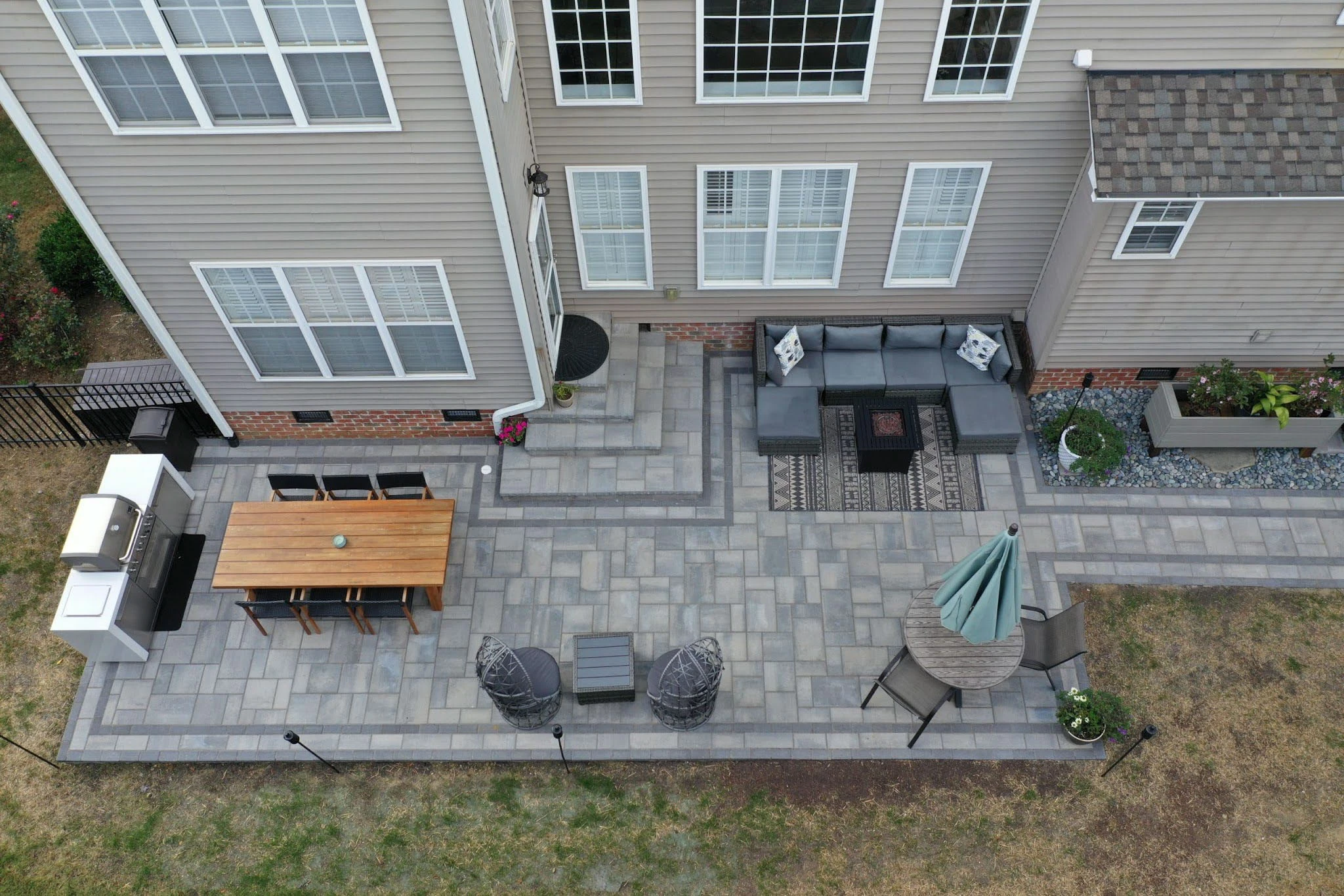
Compare that to the alternatives. Standard broom-finished concrete for the same 600-square-foot motor court runs $3,600 to $4,800 — roughly a quarter of the paver cost. Stamped and colored concrete runs $6,000 to $8,400. Asphalt runs $2,400 to $3,600 but resurfaces every 5 to 7 years. The paver install is the most expensive upfront and the only one that still looks new after two decades of Suwanee humidity, pine sap, oil drips, and 240 freeze cycles.
Resale premium — what the driveway returns: Zillow and RE/MAX comp data across Laurel Springs, River Club, and Bear’s Best between 2022 and 2025 shows premium paver driveways adding $28,000 to $44,000 in appraised home value versus standard concrete on comparable homes. On a typical $1.4M to $2.8M Laurel Springs sale, that’s a 2.5x to 3x return on the install cost — before you count the 25-year service life.
Jackson EMC, Chattahoochee flood zones, and the other Suwanee-specific details
Two Suwanee-specific items catch out-of-market contractors every time. The first is that this part of Gwinnett is served by Jackson EMC, not Georgia Power. For driveway work that’s mostly relevant on the lighting side — if you’re running low-voltage landscape lights along the paver edge or integrated soldier-course LEDs, the 240V service transformer and meter layout differs from what a contractor used to the Atlanta Georgia Power grid expects. We coordinate lighting loads through Jackson EMC’s standard residential service parameters and pull the electrical permit from Gwinnett County Department of Planning & Development at 446 W. Crogan Street in Lawrenceville.
The second item is flood zones. Properties along Settles Bridge Road and some of the lower sections near the Chattahoochee River sit in FEMA Flood Zone AE, which changes the drainage math for any paved surface. Driveways in AE have to route surface runoff to a non-floodplain discharge point, and the paver drainage plan we submit to Gwinnett has to reflect that. This adds roughly $600 to $1,200 to the permit and engineering portion of the job. Not every Laurel Springs or River Club property is in AE — most are well above the floodplain — but the properties closest to the river absolutely are, and that detail has to be verified on the FEMA flood map before we price the job.
Equipment delivery is the third quiet variable. Peachtree Industrial Boulevard (Highway 141) is the north-south spine that every paver delivery, skid-steer trailer, and concrete truck travels to reach Laurel Springs, Village Grove, Highgrove, and The Manor. Early-morning deliveries (before 9 AM) avoid both the Town Center Park event traffic and the I-85 exit 111 to 113 backups. We schedule paver drops between 6:30 and 8:00 AM whenever a property sits inside a gated community with guard-approved delivery windows. Miss the window at Laurel Springs and you’re paying a reset delivery fee of $220 to $380 to the distributor.
Then there’s the fog. The Chattahoochee River creates consistent morning fog along the southwest border of Suwanee through most of October and November. Practical effect: polymeric sand activation (the water-wash step that cures the joint) cannot happen in fog or under dew. We plan the final activation for mid-afternoon on fall installs, which occasionally slides the project end-date by a day.
One final note on timing. From signed contract to completed install, a Laurel Springs driveway runs 9 to 14 weeks. Roughly 3 to 4 weeks is HOA review. 2 to 3 weeks is Gwinnett permit. 1 week is material procurement (Techo-Bloc color runs on a lead time). The install itself is 8 to 11 working days. Any quote that promises a 3-week turnaround on this spec is either skipping the HOA submission or skipping the 10-inch base. Neither shortcut survives the first winter.
If you’re comparing estimates right now for a Laurel Springs, Settles Bridge, or River Club driveway, print the six-item spec from the callout box above and hand it to every contractor bidding the job. Ask each one which paver thickness, which base depth, which geotextile, which soldier restraint, which polymeric sand, and which HOA documentation process they’re using. The answers will tell you — in about 90 seconds — which bid is real and which one is a 7-year driveway priced like a 25-year driveway.
Premium paver driveways and hardscape across 20+ cities within 30 miles of Winder, GA
From Laurel Springs motor courts to River Club driveways, we build to a spec that passes HOA review on the first submission and holds its edge for a quarter-century.