
The homeowner had already built the pavilion. Cedar posts, stained warm brown, dining set underneath, pool planned for the following spring. Six months later, when the pool layout hit the survey, the pavilion column on the southwest corner sat three feet and two inches inside the sight line we needed for the water feature. The choices were: move the pool, move the column, or accept a broken axis for the life of the project. That is the wrong order to build in.
This post is built around a project we took on in Laurel Springs last year — a full pavilion-and-pool integration where the two structures were conceived together, engineered together, and permitted in a single package. The homeowner, a transitional-farmhouse build on 1.4 acres inside the gated community, had seen two other pools in the neighborhood where the pavilion roof pitch fought the house architecture and the column grid clipped the pool coping at an awkward angle. He wanted the opposite: pavilion roof pitch matched to the primary house at 8/12, column spacing coordinated with pool corners for clean axial sight lines, and a travertine-to-paver deck transition that didn’t telegraph as a seam.
What follows is the actual integration math — the pitch logic, the column grid, the deck transition, the permit sequence through Gwinnett County, and the trench coordination that saved this project roughly $8,400 in duplicated site work. If you’re planning a pool-and-pavilion project in Laurel Springs, The River Club at Suwanee, or Bear’s Best Atlanta, every section below is load-bearing.
Why Laurel Springs Forces the Integration Conversation Earlier
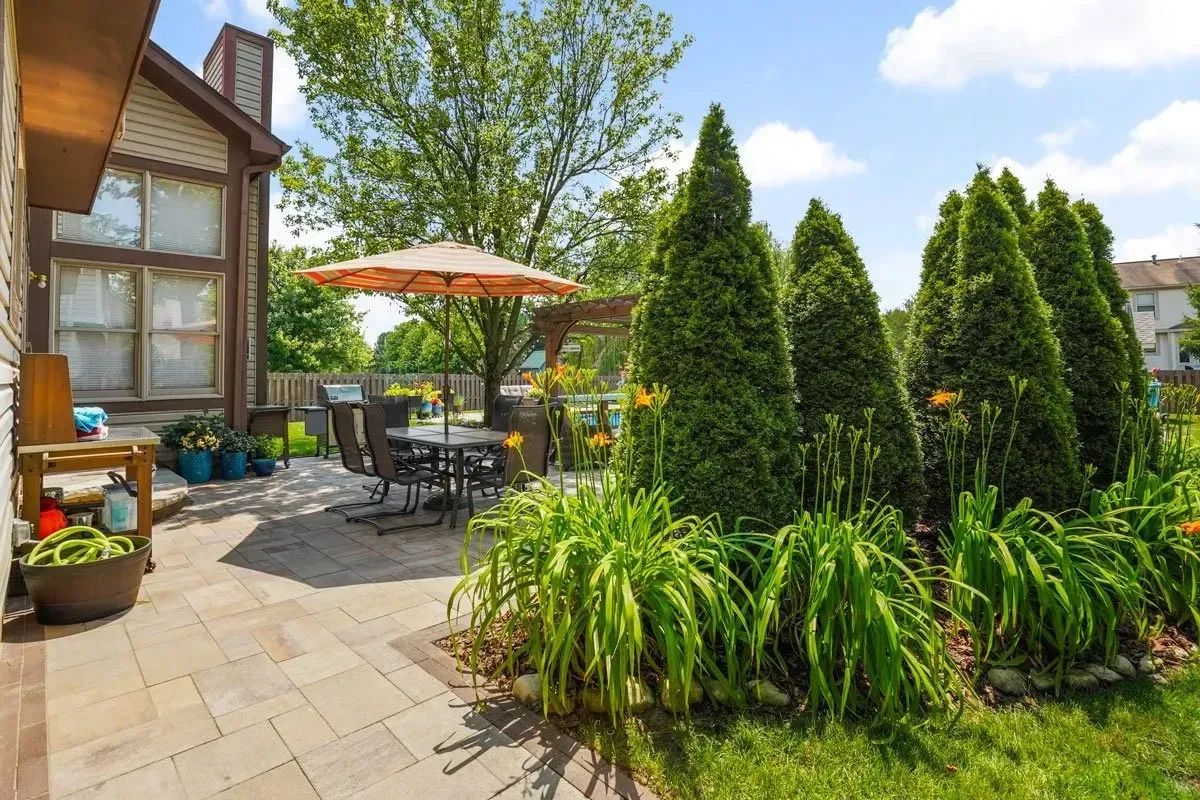
Laurel Springs is Gwinnett County’s most design-disciplined golf community. The HOA operates an Architectural Review Board that is widely considered the strictest review process in the county — submittal packages require a site plan, elevations of any detached structure over 200 square feet, material specs, roof pitch confirmation, and a grading and drainage plan that shows where water moves after construction. Typical turnaround is three to four weeks if the package is complete. Incomplete packages bounce back and restart the clock.
That sounds onerous until you realize what it actually protects. The neighborhood’s aesthetic coherence — 2000 to 2015 luxury builds, transitional and modern-farmhouse architecture, tall pines mixed with hardwoods — is what holds the property values. A pool-adjacent pavilion that doesn’t match the primary house roof pitch reads as an add-on from the street the moment leaves drop. The ARB exists to prevent that. The structural engineer stamp requirement on any pavilion over 200 square feet is not the ARB’s invention, though — that is Gwinnett County Department of Planning and Development policy, handled at 446 W. Crogan Street in Lawrenceville.
The integration conversation starts earlier in Laurel Springs because the ARB will reject a pool permit that shows the pavilion “TBD” or “by others.” They want to see the full outdoor living plan on day one — pool, pavilion, hardscape, drainage, lighting, plantings. If the pavilion comes later, it triggers a second submittal, a second review cycle, and often a second engineer stamp if the scope changed. We have watched homeowners in other Gwinnett communities build a pool, then spend nine months trying to bolt on a pavilion that would have been cheaper and better if it had been drawn on the original set.
The River Club at Suwanee operates a similar ARB with comparable turnaround. Bear’s Best Atlanta — private club with estate-scale lots — has a lighter review process but the lots are large enough that site conditions (slope, tree protection, septic setbacks on some older parcels) become the constraint instead of HOA aesthetics. Settles Bridge properties can sit in FEMA Flood Zone AE along the Chattahoochee floodplain, which adds a base flood elevation constraint that pavilion foundations have to clear. In every case, the pavilion and the pool are one permit package if you plan it right.
Roof Pitch: Why 8/12 Matches the House and 6/12 Reads as an Add-On
The rule we follow on every integrated pavilion in Laurel Springs and River Club: match the pavilion’s primary gable pitch to the house within one-half pitch unit. If the house reads at 8/12 — which is the most common transitional-farmhouse pitch in these neighborhoods — the pavilion gets 8/12 or 7.5/12. Not 6/12. Not 10/12. The eye calibrates to the house roof as the reference, and any detached roof in the same sight line that deviates more than a half unit reads as foreign.
The subject project used 8/12 on a 16×24 pavilion — 384 square feet, which trips the Gwinnett structural engineer stamp threshold. The gable ran perpendicular to the pool’s long axis so the ridge line pointed away from the water. This matters for two reasons. First, the ridge-to-eave shadow falls across the pool deck rather than across the pool itself, keeping the water open to sun during the core pool-use hours from roughly 11 a.m. to 5 p.m. Second, the pavilion gable end becomes a clean architectural element when viewed from the house — a framed silhouette against the tree line, not a lateral roof plane.
Laurel Springs ARB pitch rule of thumb: If your primary house is transitional farmhouse or traditional (most likely 7/12 to 9/12), your pavilion should be within a half pitch unit. Modern builds with flatter 4/12 roofs can justify a 4/12 pavilion but only if the pavilion cladding and column treatment also pull forward the modern language. A 4/12 pavilion beside an 8/12 farmhouse gets rejected, and it should.
Column treatment reinforces the pitch decision. On 8/12 transitional pavilions we specify 6×6 cedar posts stained to match the house exterior trim or, where the house has stone accents, stacked-stone pier bases rising 30 to 36 inches with cedar posts continuing up from the pier cap. The stacked-stone pier detail — ledgestone veneer in gray or buff — pulls the pavilion into the house palette and adds enough visual weight at the base to keep the structure from floating when viewed from the pool’s far end. We used 30-inch ledgestone piers on the subject project because the house had a stone water table at the same elevation. Alignment matters.
Column Spacing: The Pool Corner Axis Trick
Here is the geometry rule that separates an integrated pool-and-pavilion project from two projects that share a backyard. The pavilion column grid must land on lines that extend cleanly to pool corners, water feature centers, or the spa spillover — not in between. When the sight line from inside the pavilion looks out across the pool, your eye wants to follow the column edge to a hard landing point on the pool shape. If the column splits the pool visually — say, lands mid-coping on one side — the composition reads broken.
A 16×24 pavilion with four corner posts and two mid-span posts on the long side gives you a four-post sight line axis on the short side and a six-post axis on the long side. We set the pavilion so the two long-side mid-posts aligned to the pool’s first and second corner on that elevation. From the dining set inside the pavilion, you see straight lines: post-to-corner, post-to-spa, post-to-water-feature. Every view closes properly.
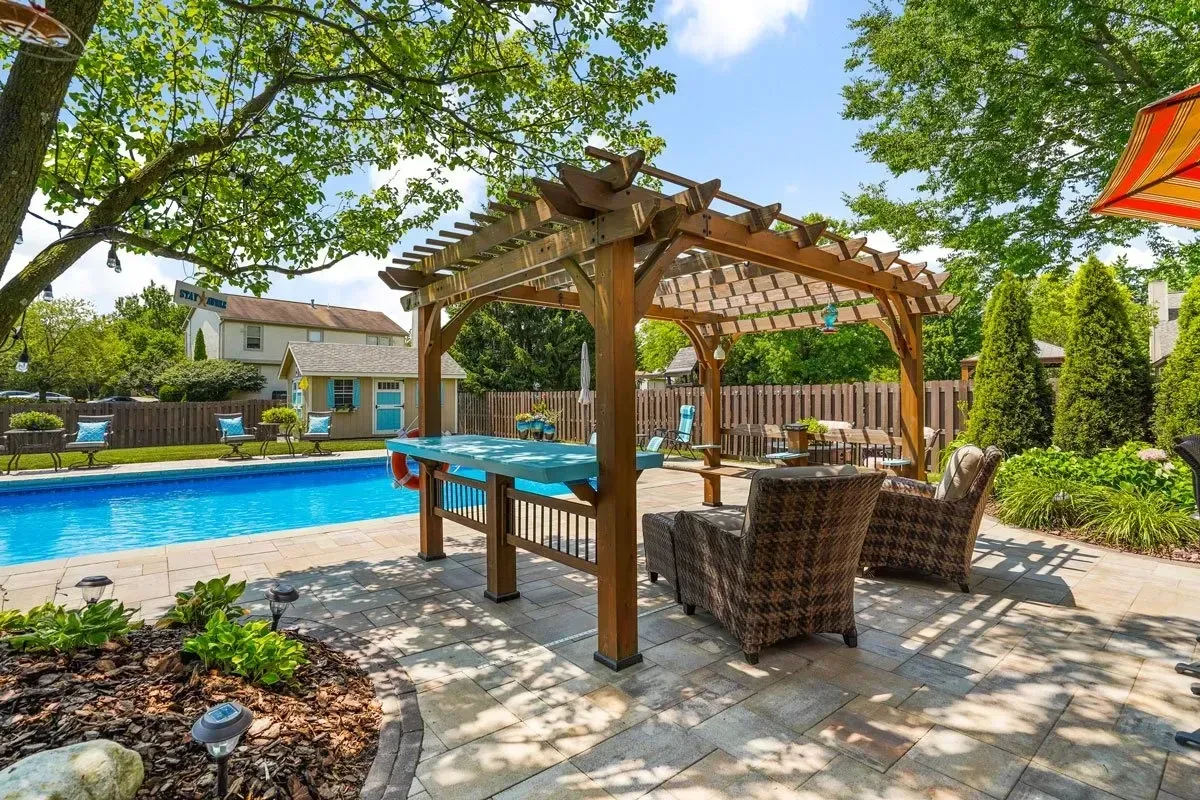
The easy way to break this: design the pavilion first, then squeeze the pool into whatever footprint is left. The hard way — the right way — is to draw the pool and the pavilion together on the same CAD sheet at 1/8 scale, then move them in pairs until every column lands on a pool or landscape feature. On the Laurel Springs project, this took three revisions before we hit a grid where the four corner posts aligned to (1) the spa spillover trough, (2) the pool’s tanning-ledge edge, (3) the centerline of a raised planter on the back wall, and (4) the travertine-to-paver deck transition joint. Every column does double duty as a sight-line anchor.
On a 14×20 pavilion — the other common size we build in these neighborhoods at 280 square feet — the grid is tighter. Four corner posts, no mid-span, 14-foot clear span on the short side and 20-foot clear span on the long side. At 20 feet you want a real beam — either a glulam or a pair of dimensional lumber beams scabbed together — and at 14 feet you can often run a single 2×10 header. The smaller footprint aligns more easily to a compact rectangle pool in the 14×28 range because the pavilion’s long-side grid lands naturally near the pool’s mid-line and far corner.
Deck Transition: Travertine to Paver at the Expansion Joint
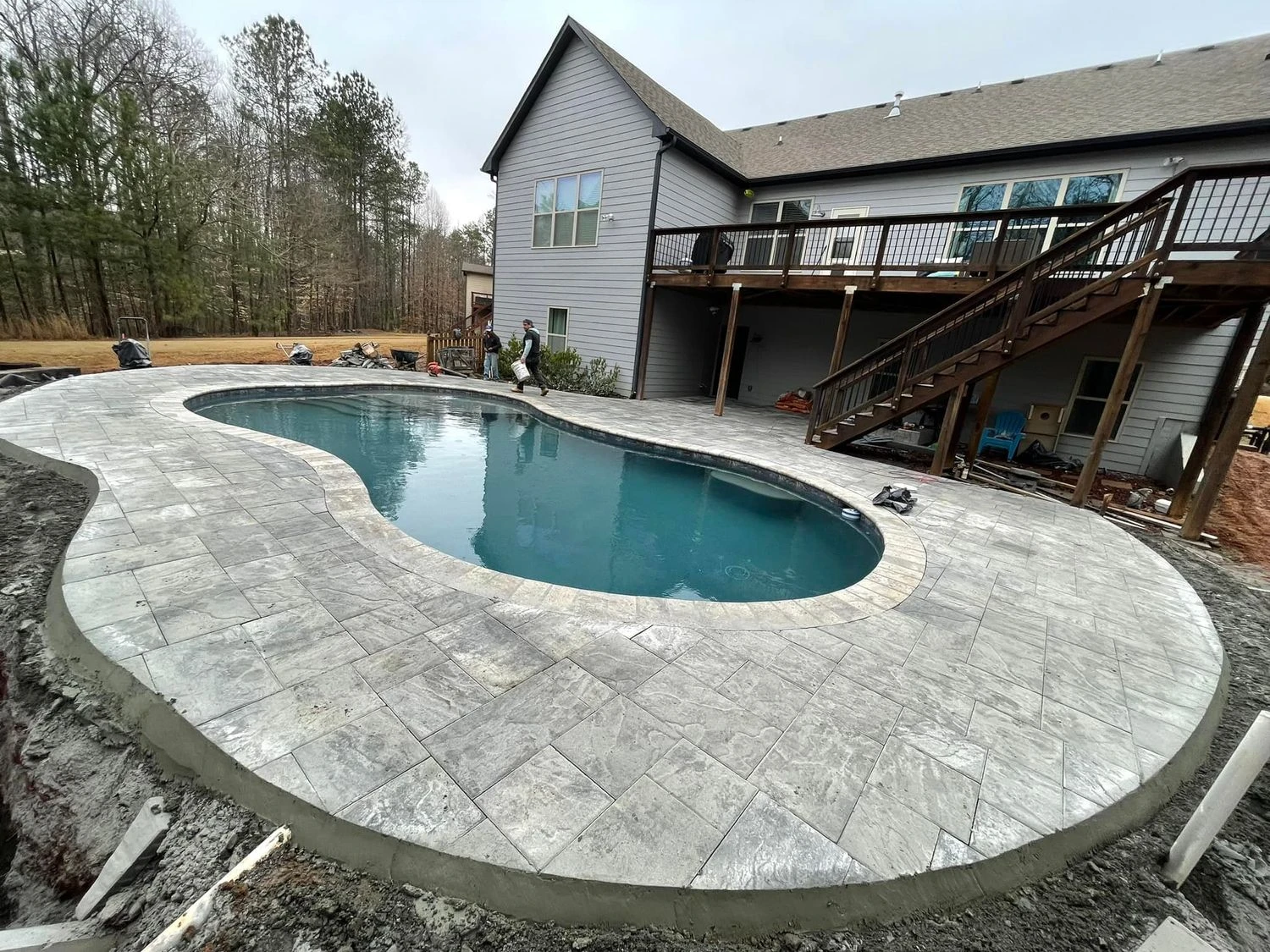
A detail that looks small in a CAD drawing and looms large in the finished project: where the pool deck material changes at the pavilion threshold. Most Laurel Springs pools we build use silver or ivory French-pattern travertine at the pool coping and immediate deck, transitioning to a larger-format paver — driftwood gray running-bond Belgard Mega-Lafitt, Techo-Bloc Industria, or similar — under the pavilion footprint for the dining area. The two materials share a warm gray palette but read at different scales.
The mistake is butting travertine against paver. Even with a precision cut, you get a seam that telegraphs differential movement over a few winters of Zone 8a freeze-thaw cycles — Suwanee averages about twenty freeze events per year and the differential expansion rates of travertine and concrete paver will crack a tight butted joint. The fix is to land the transition on a planned expansion joint: a one-half inch gap between the two materials, filled with a flexible polymeric sand or a cut-to-width neoprene strip tinted to match the travertine color.
The transition joint on the subject Laurel Springs project ran the full width of the pavilion’s pool-facing edge — 16 feet — aligned with the inside face of the pool-facing columns. The travertine finished flush to the joint with a clean saw-cut edge. The paver started on the other side of the joint with a soldier course running perpendicular to the pool, drawing the eye across the threshold. From inside the pavilion looking out, the joint disappears. From the pool looking back, it reads as an architectural intention, not a construction seam.
Rain Chains, Gutters, and Routing Water Away from the Skimmer
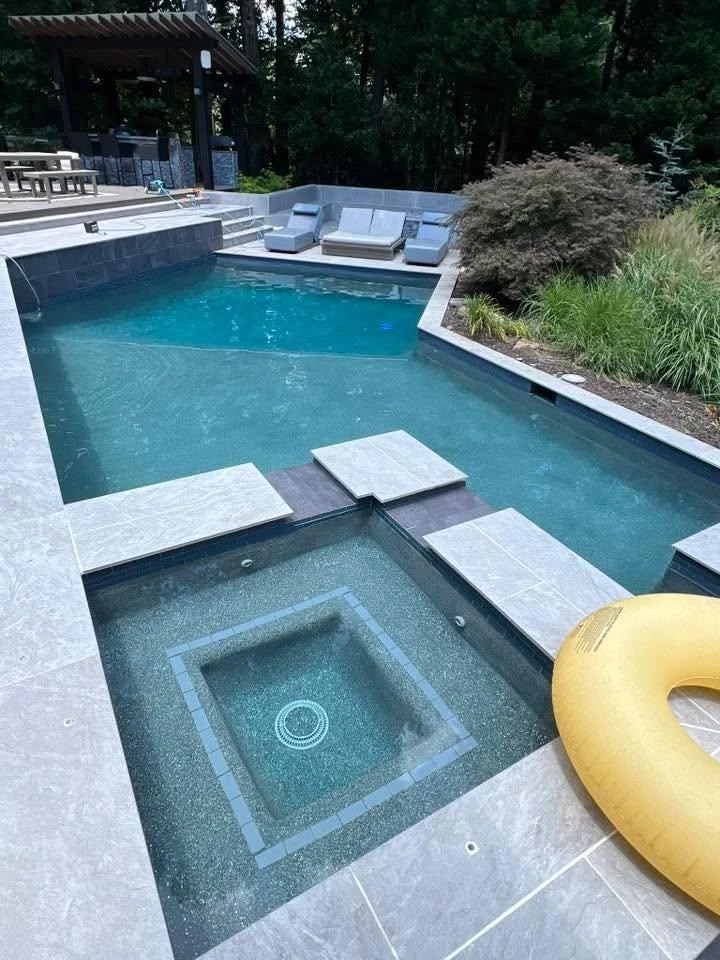
A pavilion roof shedding water near the pool creates two problems nobody discusses until the first heavy summer storm. First, roof runoff hitting the pool deck dumps debris — shingle granules, pine needles, oak pollen in April — within a few feet of the skimmer inlet, which doubles skimmer basket frequency and accelerates cartridge filter replacement cycles. Second, uncontrolled roof shed against Cecil-series Piedmont clay around the pool shell creates saturated soil against the bond beam, and saturated clay heaves under freeze. We have inspected pool coping failures in Gwinnett backyards where the only real culprit was an unmanaged pavilion gutter.
The two good options: gutters with downspouts that route to a dry well or daylight outlet away from the pool shell, or rain chains terminating in decorative catch basins that tie into a pop-up emitter at least 15 feet from the pool. We prefer gutters on integrated pavilions because the water volume from a 384-square-foot roof at 2.5 inches per hour (a realistic Gwinnett summer thunderstorm rate) is about 60 gallons per minute — more water than a rain chain handles cleanly. The gutter downspouts on the Laurel Springs project ran along the pavilion’s back elevation (away from the pool), tied into a 4-inch PVC French drain system, and daylighted at the lawn edge 22 feet from the pool shell. No water ever reaches the bond beam backfill.
The Chattahoochee River corridor adds one more wrinkle. Suwanee sits at roughly 1,063 feet elevation on rolling Piedmont terrain, and properties close to the river — Settles Bridge in particular — get chronic fall morning fog that keeps deck surfaces damp longer than the rest of the county. That moisture amplifies any drainage mistake. If the pavilion gutters aren’t routing water decisively away, the deck stays wetter longer, and travertine stays slicker longer. Drainage is never just “nice to have” in these neighborhoods.
The Single-Trench Utility Play: Gas, Electric, and Water
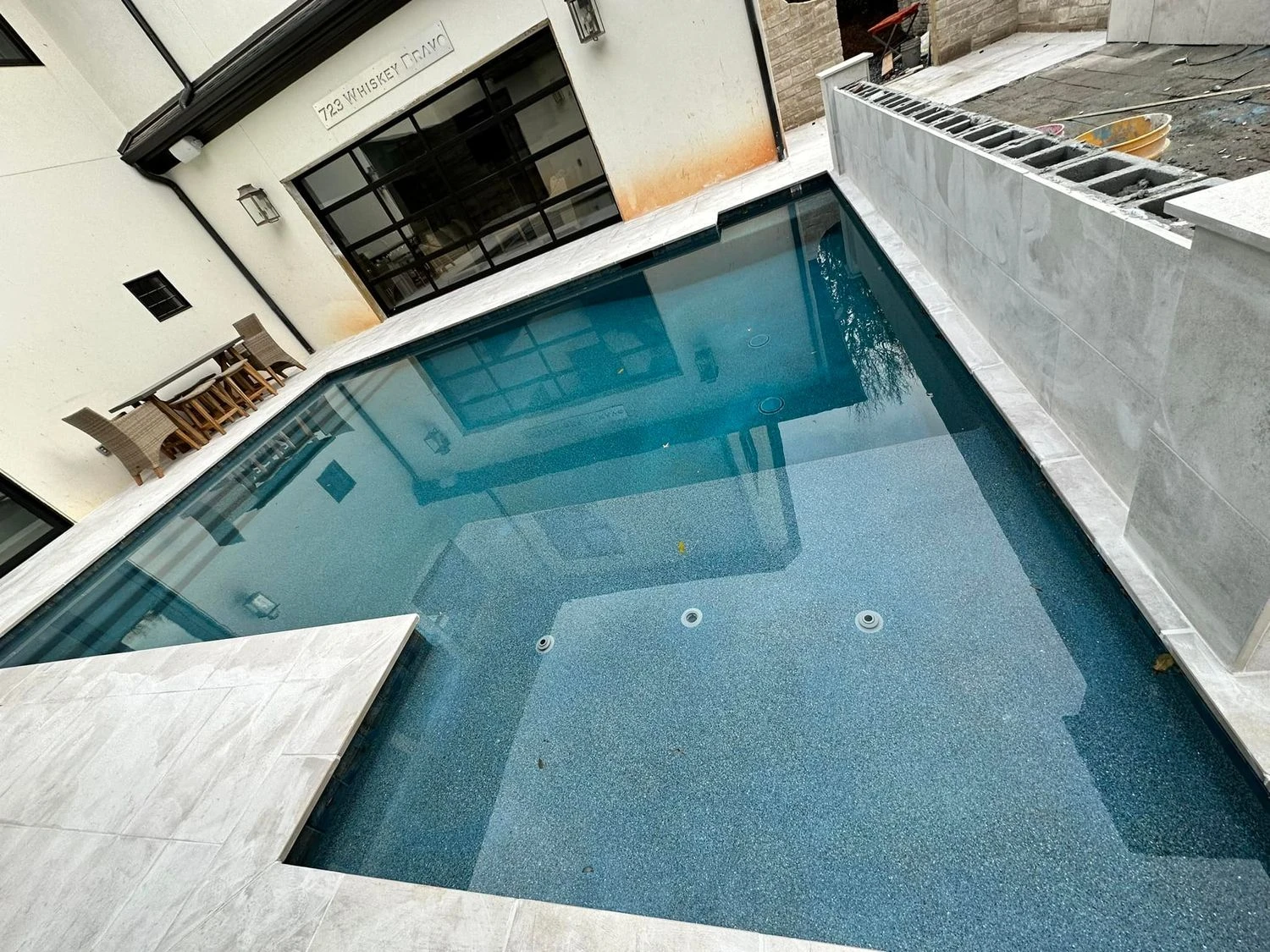
This is where an integrated pool-and-pavilion project saves real money, and it is the section most homeowners never hear about until the excavation is closing up. Pools need 240V electric service to the equipment pad, bonding wire around the pool shell, a gas line to the heater, and a water feed to the autofill. Pavilions with outdoor kitchens need a separate gas line to the grill and side burner, a water line to the prep sink, and 120V/240V electric for lighting, fans, and appliances.
If the pool and pavilion are built sequentially by separate trades, each one gets its own trench from the house to the site. Two trenches means two open-cut runs across the yard, two rounds of backfill, two rounds of lawn restoration. On the Laurel Springs project — where the equipment pad sat 88 feet from the gas meter and the pavilion kitchen sat another 34 feet beyond — we coordinated a single trench at the utility rough-in phase carrying the pool’s gas line (3/4-inch), the pavilion’s gas line (3/4-inch teed off near the pavilion), the pool’s electrical conduit (dedicated 60A subpanel feed), the pavilion’s electrical conduit (40A subpanel), and the water line for both the pool autofill and the pavilion sink. One trench, one permit inspection for utility cover depth, one backfill cycle, one sod restoration.
Single-trench savings: On projects where the utility runs total 120+ linear feet from the gas meter to the pool pad, a coordinated single trench vs. two separate trenches runs $6,500 to $10,000 less on combined excavation, backfill, conduit, and restoration. The subject Laurel Springs project saved roughly $8,400. Those numbers scale with trench length, not project size.
This only works if the pool builder and pavilion builder are coordinated from day one, or — ideally — the pool builder is also building the pavilion as a single contract.
The Jackson EMC distinction is a Suwanee-specific note worth calling out. Jackson EMC serves most of Suwanee including Laurel Springs and River Club, not Georgia Power. The inspection process, service upgrade fee structure, and turnaround on a 200A-to-400A service upgrade (sometimes needed when a pool heater, pool pump, pavilion appliances, and a future EV charger are all added in the same year) are Jackson EMC’s, not Georgia Power’s. If you are comparing notes with a friend in Alpharetta who upgraded through Georgia Power, the process is not the same. Build the Jackson EMC service upgrade into the project timeline from the start.
Budget, Permit Sequence, and Timeline
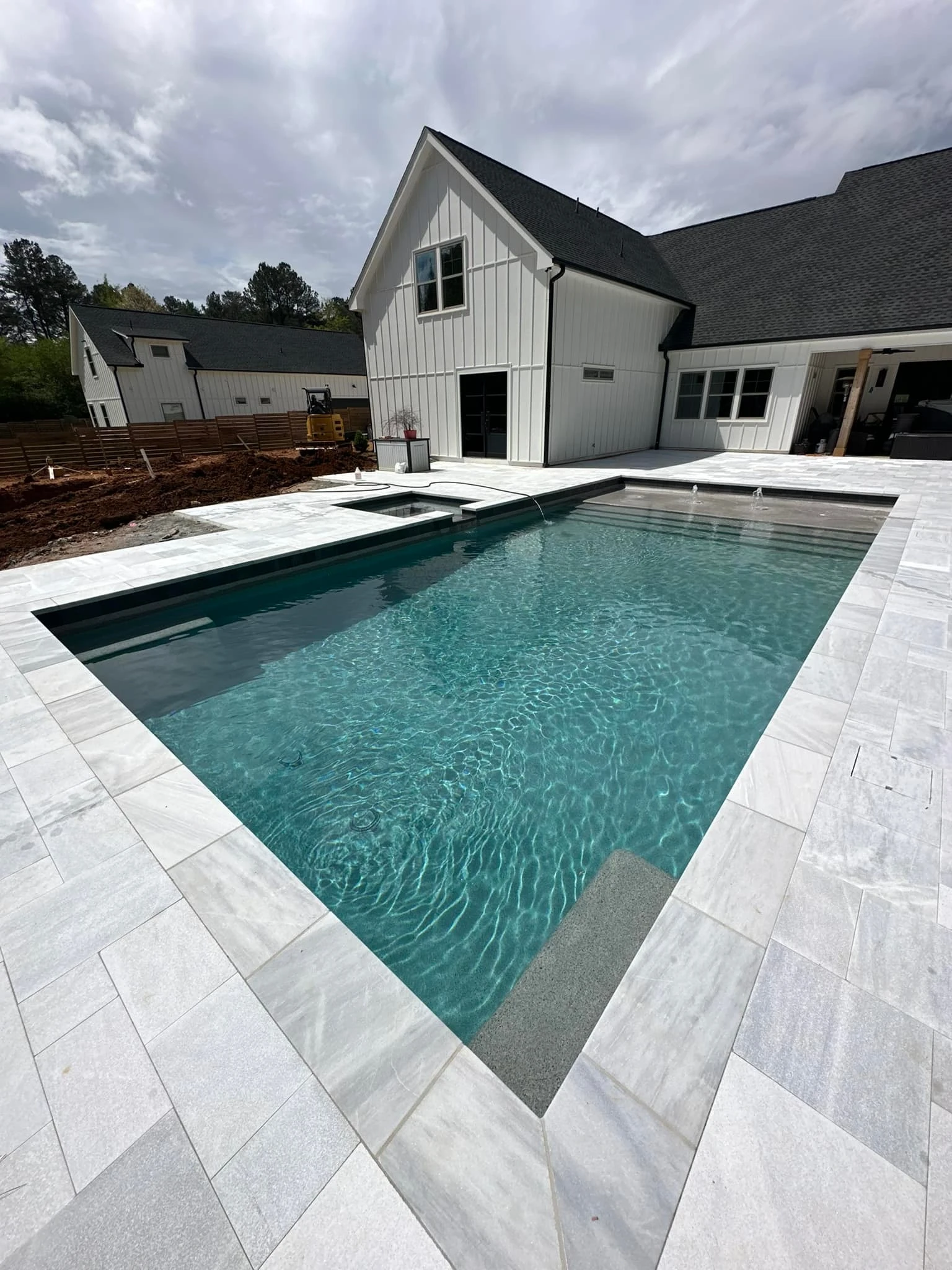
A full integrated pavilion-plus-pool package in Laurel Springs or River Club runs $255,000 to $325,000 depending on pool size, spa configuration, pavilion size (14×20 vs. 16×24), pavilion finish level (basic roof deck vs. tongue-and-groove cedar ceiling with stacked-stone piers), and outdoor kitchen scope. The subject project — 16×36 rectangle pool with flush spa and linear spillover trough, 16×24 pavilion with 8/12 roof, outdoor kitchen with built-in grill and side burner, French-pattern silver travertine pool coping, Belgard Mega-Lafitt pavilion deck — came in at $298,000 before landscape plantings and lighting.
Permit sequence matters. Through Gwinnett County Planning and Development, the pool permit, pavilion permit, and electrical/gas/plumbing permits are separate line items but can be submitted as a single package with a coordinated site plan. The structural engineer stamp on the pavilion (required because it exceeds 200 square feet) runs $800 to $1,400 depending on design complexity. The Laurel Springs ARB submittal is a separate track that runs in parallel with the county submittal. Typical timeline from signed contract to first shovel:
- Week 0 to 3: design development, material selections, CAD drawings, structural engineering on pavilion.
- Week 3 to 6: ARB submittal and county permit submittal simultaneously.
- Week 6 to 10: ARB review response (often requires one round of clarifications), county permit issuance.
- Week 10: excavation start.
- Week 10 to 22: construction — pool shell, pavilion framing, roof, deck, outdoor kitchen, finish work.
- Week 22 to 26: plaster, water fill, startup, punch list, landscape planting.
Total window: six to seven months from contract to pool up. Homeowners who sign in January are typically swimming by mid-July. Those who sign in April end up swimming in October. Suwanee’s build season is real — Peachtree Industrial Boulevard (Highway 141) is the primary corridor for equipment delivery into these neighborhoods, and it stays workable year-round, but concrete and plaster crews book out heavily April through June.
Five Integration Mistakes to Avoid on Your Suwanee Project
After a decade of building in Laurel Springs, River Club, Settles Bridge, Village Grove, Highgrove, and the surrounding 30024 zip code, the same five mistakes show up on half of the projects we get called in to rescue or redesign:
1. Treating the pavilion as an afterthought
Pool first, pavilion “next year” — this is the single biggest trap. It doubles permit cycles, often doubles trenching, and almost always creates a geometry conflict. Draw both on day one even if you phase construction.
2. Matching the pavilion roof pitch to the garage instead of the house
Detached garages on farmhouse builds often carry a flatter pitch than the main house. The pavilion should reference the primary gable of the house, not the garage.
3. Skipping the structural engineer on a 201-square-foot pavilion
Homeowners sometimes try to size the pavilion at 199 square feet to dodge the engineer-stamp requirement. Gwinnett building officials know this game. A stamped drawing for a 384-square-foot pavilion costs under $1,500 and saves you from a red-tagged project.
4. Letting the pavilion gutter daylight toward the pool
This is the number one cause of premature coping and bond beam issues on pool-adjacent pavilions. Always route roof water decisively away from the pool shell.
5. Butting travertine and paver at the pavilion threshold
Differential movement over multiple freeze-thaw seasons will crack this seam every time. Use a designed expansion joint.
Every one of these mistakes is avoidable with a single integrated design sheet and a builder who is running the pool and the pavilion as one project instead of two. In Laurel Springs and River Club specifically, the ARB review process has the side effect of forcing this integration earlier — which is ultimately why those neighborhoods look the way they do, why the property values hold, and why the pools built inside those gates tend to read as part of the house instead of an appliance bolted to the back yard.
Integrated pool-and-pavilion construction across 20+ cities within 30 miles of Winder, GA
Pavilion roof pitch matched to the primary house, column grid aligned to pool corners, deck transitions designed at real expansion joints, utilities coordinated in a single trench. Serving Laurel Springs, The River Club at Suwanee, Bear’s Best Atlanta, and every luxury neighborhood inside the 30024 zip code.