
We pulled into a Burnt Hickory driveway last October on a third-year warranty callback. The patio was eighteen hundred square feet of Techo-Bloc, installed by another outfit, sitting under a sixty-foot water oak that shaded the whole rear yard. Every joint between every paver was hollow, black, and growing moss. The homeowner wanted to know what went wrong.
What went wrong was the sand. Specifically, it was the assumption the installer made when they swept polymeric sand into the joints, misted it twice, and called the job finished. That protocol works fine on an open-exposure patio in Loganville where the sun bakes the joints dry in ninety minutes. It does not work in East Cobb under a mature hardwood canopy, where the joints stay damp for twenty hours after a morning dew and leaf tannins drip into the sand every time it rains.
We have installed pavers across Cobb County for a long time — Atlanta Country Club, Indian Hills, Marietta Country Club, Walton Woods, Seven Oaks, Sope Creek — and the single variable that destroys more paver jobs in this city than anything else is the oak canopy. Not the red clay under the base. Not the freeze-thaw cycle. The canopy. And the single change that fixes the canopy problem is a third polymeric sand application at the seven-day mark, paired with a pre-application cleaning protocol that most local installers skip because it costs them two extra hours on the truck.
This post is the long version of a conversation we have with Marietta homeowners every spring: why your polymeric sand failed, why two applications wasn’t enough, and what the three-application protocol looks like when it is done right.
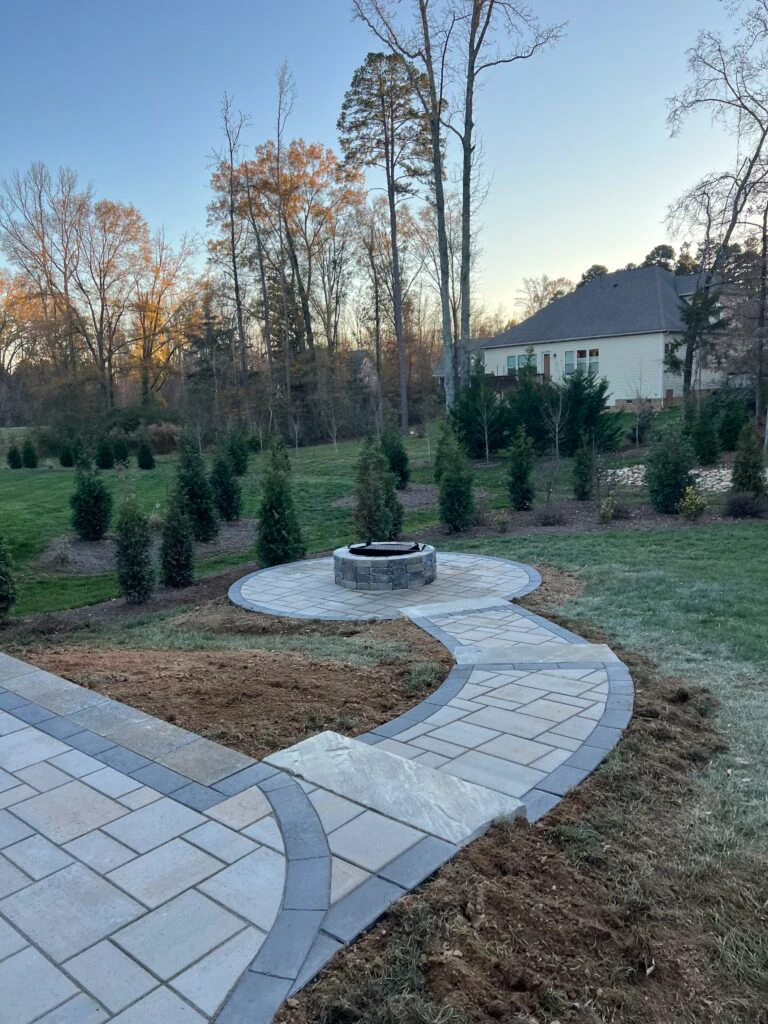
Why Oak Canopy Breaks the Standard Two-Application Protocol
Polymeric sand is a mixture of graded silica sand and dry polymer binder — usually a proprietary blend of synthetic latex and proprietary activators. When you mist it with water, the polymer activates, wicks into the sand column, and then cures into a semi-flexible matrix that locks the joint. The cure happens over 24 to 48 hours in typical exposure. That is the standard playbook, and every bag of Alliance Gator Maxx G2 and SRW P2 ships with instructions that assume it.
The instructions assume a joint that gets direct sun. Oak canopy violates every assumption in that spec sheet. Here is what actually happens when a paver patio sits under a mature water oak, willow oak, or southern red oak in East Cobb:
The joints stay moist. Morning dew that would burn off by 9:30 on an open lot lingers until mid-afternoon under a forty-foot canopy. The sand column is wet, then drying, then wet again — a freeze-thaw equivalent on the cure chemistry. The polymer never fully crystallizes. A joint that looks cured at 48 hours is still chemically soft at the deeper stratum.
The leaf load is constant. A single mature water oak drops roughly 240 to 330 pounds of leaf litter per year — not all at once, but in continuous pulses from September through March. Tannins from decaying oak leaves are acidic (pH roughly 3.8 to 4.5 in concentrated leachate) and they leach into damp polymeric sand joints, weakening the polymer bond before it fully sets.
Pollen season makes it worse. From mid-March to early May, Cobb County pollen counts routinely exceed 6,000 particles per cubic meter. That yellow film is not cosmetic — it is organic matter that settles into open sand joints during the exact window most installers are doing spring paver work.
Two applications — the standard “initial sweep plus three-day touch-up” — leaves the installer off the property before any of these forces have had time to compromise the joint. The failure does not show up until month eight or month fourteen. Which is why so many Marietta homeowners think their patio is fine until one humid July afternoon they look down and the joints are hollow.
Field benchmark: On side-by-side test sections we ran in a Chestnut Hill backyard (one-third canopied, two-thirds open), the canopied section needed 2.1x more sand volume at the 12-month inspection than the open section. Same paver, same base, same install crew, same week.
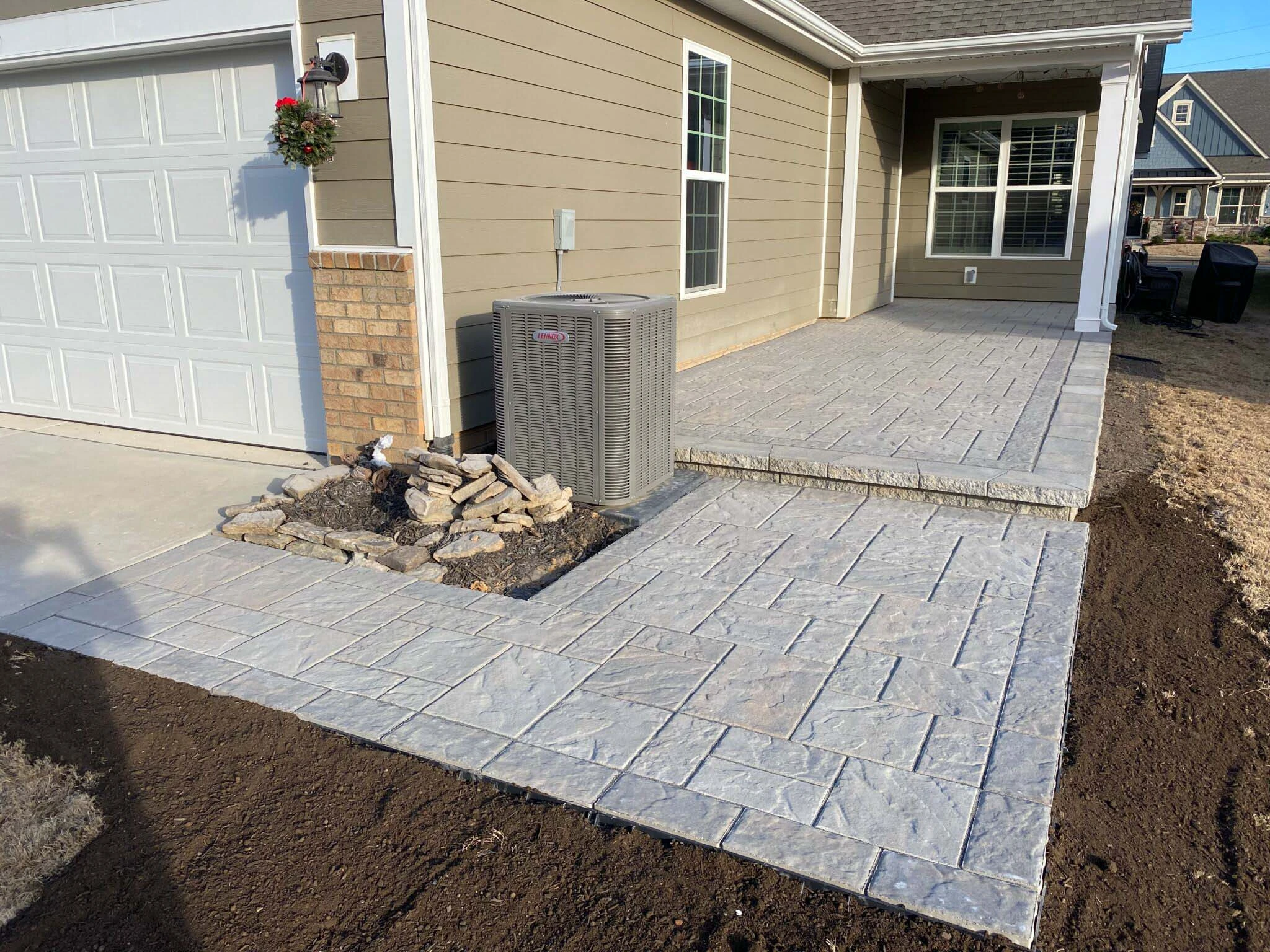
The Three-Application Protocol We Use on East Cobb Canopy Lots
Our canopy protocol adds a third application at day seven and — equally important — a dedicated pre-application cleaning step before each of the three applications. Below is the exact sequence as our crews run it on a Gator Maxx G2 install in the Atlanta Country Club corridor or the Indian Hills subdivision.
Application 1: Day Zero (Install Day)
The patio is swept clean with a push broom and then blown with a backpack leaf blower at the lowest setting to clear dust without displacing anything in the joints. Sand is broadcast across the surface and swept diagonally with a squeegee-style soft broom, then cross-swept to consolidate the column. The joints are topped, vibrated with a plate compactor and neoprene mat, and topped again.
Before water: we blow the surface one more time, at full power, from three feet away, held perpendicular. This is the step that most installers skip. Any residual sand on the paver face will blush when misted and leave a permanent haze on darker pavers — a haze the homeowner reads as “poor workmanship” even though the joint itself is fine.
Mist at shower setting, not stream. Apply water in short bursts and watch for the sand to darken uniformly across the joint. Stop the moment you see water pooling on the paver face. Under canopy we keep this mist volume on the low end of the manufacturer’s spec because the joint will stay wet longer than the bag instructions assume.
Application 3-Day Inspection And Touch-Up (Day Three)
On day three we return to the job site with a blower, a broom, a fresh bag of sand, and a fine-mist wand. This is where most installers stop — and where our second real application begins.
The patio gets blown clean of any debris. Every joint is inspected at eye level. On an open-exposure install the joint is usually flush or slightly below flush — a 1/16″ top-off is typical. On a canopy install in East Cobb, we often see joints sitting 3/32″ to 1/8″ below flush after three days, because the polymer has settled into the sand matrix during cure and the column has compressed more than on an open lot.
We top off every low joint, compact with a rubber mallet on individual pavers as needed, sweep clean, blow the face, and mist again. Under canopy, this second application is the one that actually locks the joint — the first application is really a base coat.
Application 3: Day Seven
This is the step that separates canopy work from open-exposure work. Seven days after install, the joint has seen a full weather cycle: at least one dew cycle, usually one light rain in Cobb County’s ~52 inches/year rainfall pattern, a full week of leaf drop in the fall, and temperature swings that cause the polymer matrix to flex and settle.
On arrival we pressure-wash the paver surface at 1,200 to 1,500 PSI with a 40-degree fan tip held 14 to 18 inches off the surface — firm enough to lift organic debris from the joint face, gentle enough not to excavate the cured sand column. (Anything above 2,000 PSI will strip cured polymeric sand — that is also why homeowners who hire pressure-wash crews for spring cleanup destroy their own joints.)
After the pressure wash, we let the surface dry for a minimum of four hours — longer under canopy, until every joint is visibly dry to the depth of the paver. Then we sweep sand, compact, top off, blow, and mist one final time. This third mist is the coat that gives the joint its ten-year life under a canopy.
Pricing note: The third application adds roughly $0.45 to $0.75 per square foot to the install total — on an 800 sq ft patio, that is $360 to $600. Every homeowner in Marietta Country Club or Atlanta Country Club who has watched a neighbor redo joints at year three understands why it is the best $600 line item on the quote.
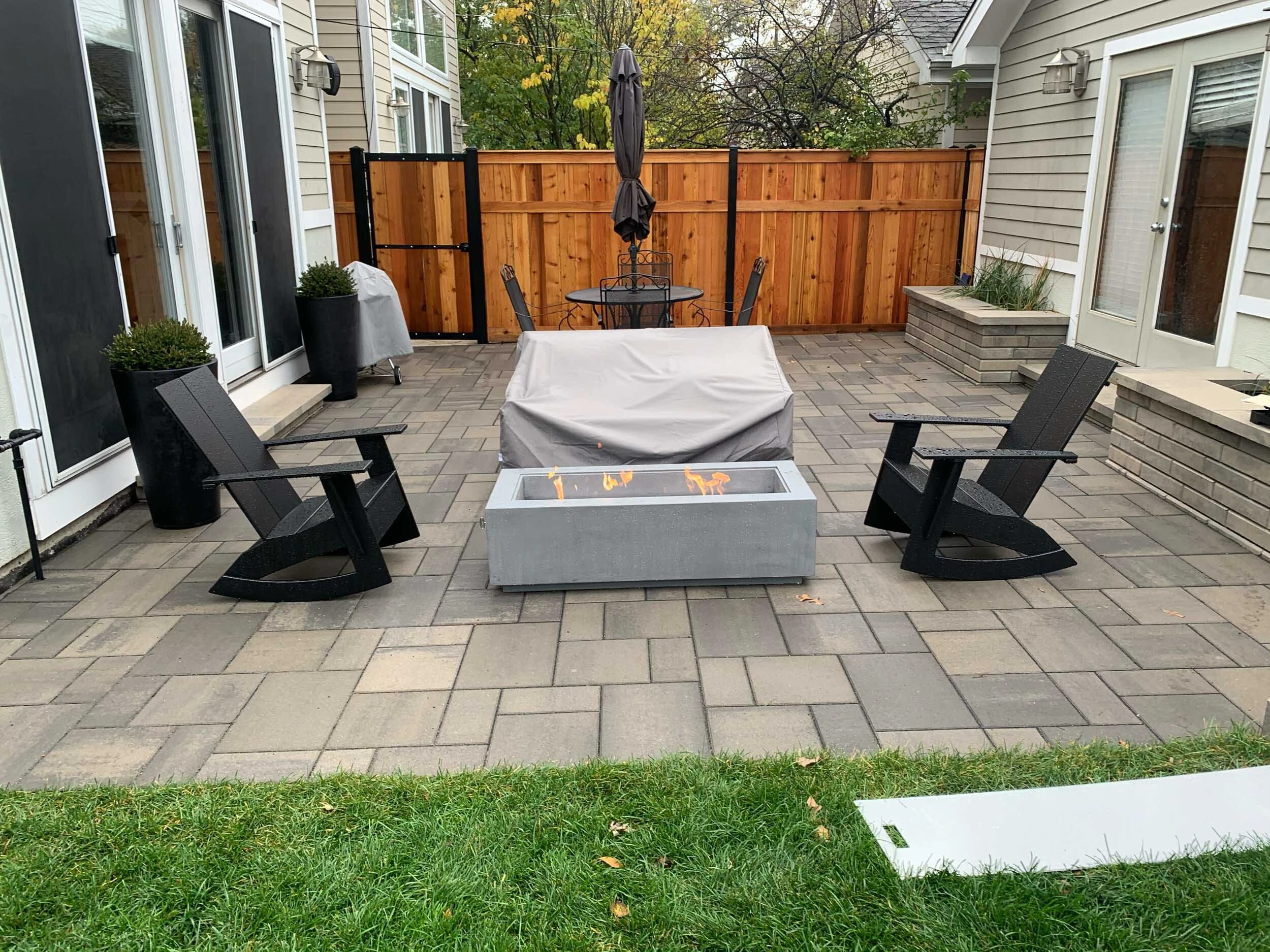
Gator Maxx G2 vs Alliance G2 — Product Selection Under Canopy
The two polymeric sands we have run against each other on canopy lots across Cobb County are Alliance Gator Maxx G2 (Alliance Designer Products, Quebec) and SEK-Surebond’s G2 — both marketed as second-generation products with haze-resistant formulations. In open-exposure installs, the difference is negligible. Under canopy, we have a strong preference.
Gator Maxx G2 (the Alliance formulation) cures to a slightly firmer joint and resists the tannin leach from oak leaves noticeably better in our field testing. The polymer blend includes a stabilizer that tolerates variable moisture during cure — which is the exact condition you get on a shaded Marietta lot. On a five-year callback in Indian Hills, a Gator Maxx G2 joint showed roughly 15 to 20 percent less sand loss than a Surebond G2 joint installed the same week by the same crew two streets over.
Where Surebond G2 holds an edge is on lighter-colored pavers where haze resistance matters most — a cream-and-stone blend like Belgard Mega-Lafitt in Sandlewood will show haze faster than a gray-and-charcoal like Techo-Bloc Blu 60. On a canopy lot, though, we still choose Gator Maxx G2 for durability and compensate on haze risk with the pre-mist blower step described above.
A note on “wide joint” sands: if your install is a flagstone-format or irregular large-format paver with joints wider than 1/2″, you need a wide-joint-rated product — Gator Maxx G2 is rated to 4″ joint width, Techniseal HP NextGel caps around 2″. We specify by joint width first and haze resistance second.
One product to avoid entirely under Marietta canopy: any first-generation polymeric sand that is not rated for damp conditions during cure. Gator Dust Bond, SEK Paver Set original formulation, and unbranded “contractor grade” products sold by the pallet at general-purpose building supply will all fail inside 18 months on a shaded East Cobb lot. If your installer cannot name the product on the bag when you ask, that is the conversation.
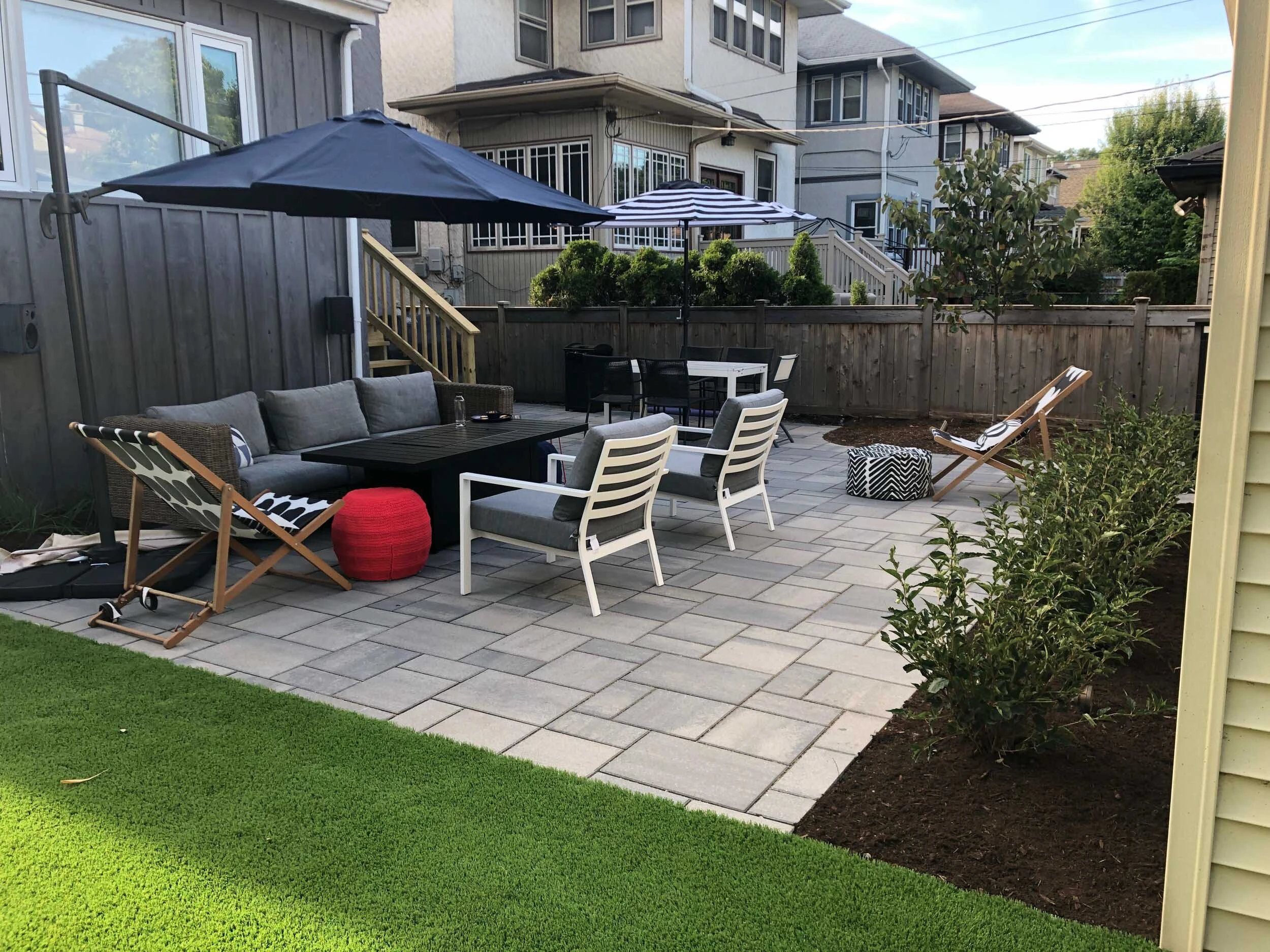
Maintenance Schedule for East Cobb Canopy Patios
Here is the annual schedule we give every customer whose patio sits under significant canopy — anything more than 40 percent shade coverage between 10 AM and 4 PM. It is calibrated for the Cobb County climate (USDA Zone 7b/8a border, roughly 22 freeze events per year, 52 inches annual rainfall) and for hardwood drop patterns specific to East Cobb oak-poplar mix.
Late February to early March — Pre-pollen cleaning. Blow the patio clean. Inspect joints for winter settle. Top off any low joints with the same polymeric sand used at install. This is ahead of the mid-March pollen bloom, which is why the timing matters. A 30-minute pass in late February prevents eight weekends of yellow pollen staining.
Mid-May — Post-pollen rinse. Light rinse at 800 to 1,000 PSI — essentially garden-hose-plus — to clear pollen from the paver face and any shallow sand intrusion. Do not pressure wash; the pollen month has softened the surface of the joint temporarily and anything above 1,500 PSI will strip fresh sand.
Late July — Summer inspection. Eyes-only pass. Look for ant activity (a sign of joint compromise), weed germination at paver edges, and any tilt or settle. Early catch is a 15-minute fix; a late catch is a crew day.
Late November — Post-drop pressure wash. After the oaks drop and before the first hard freeze — usually the first weekend of December in Marietta — pressure-wash the patio at 1,200 to 1,500 PSI to remove the tannin-stained leaf residue. This is the single most important maintenance event of the year on a canopy lot. Letting tannin sit on cured polymeric sand through a wet winter is what turns an eight-year joint into a five-year joint.
Every three years — Joint top-off and seal review. On a canopy lot, we budget a full joint top-off at year three, year six, and year nine. This is not a failure — it is a normal wear pattern under heavy organic load. Priced at retail this is roughly $0.90 to $1.40 per square foot for sand, labor, and a light penetrating sealer if the paver style accepts one.
Cobb County Permits and HOA Considerations
Most paver work in Marietta does not require a Cobb County building permit — patios and walkways under 200 square feet and not attached to a drainage structure are generally exempt. Cobb County Community Development at 1150 Powder Springs St. is the right stop if your project includes a retaining wall over 30 inches, any drainage swale modification, or a detached structure footing. Call before, not after — Cobb inspection slots run about 7 to 10 business days out in peak season.
HOA approval is the more common gate. Atlanta Country Club, Indian Hills, and Marietta Country Club all have active ARB committees that review hardscape submissions. We have submitted for clients in all three and the recurring requests are: a plan drawing to scale, product specs (manufacturer, color, paver series), and a drainage statement showing the patio does not direct runoff onto a neighbor’s lot. Build 3 to 4 weeks of review time into your schedule.
A note on utilities: Marietta Power services incorporated city residents; Cobb EMC services most of the unincorporated East Cobb area and is distinct from Georgia Power. If you are planning a lighted patio with low-voltage transformer service, verify which utility owns your service — the permit path and meter rules differ.
Pavers and hardscape across 20+ cities within 30 miles of Winder, GA
If your Marietta patio sits under an oak canopy, the sand protocol is the job. We install with the three-application sequence on every shaded lot and we document each step for the homeowner’s records.