
Every paver failure we get called out to assess in Windward, Hutchinson Farm, and Country Club of the South shares the same root cause — and it isn’t the pavers. It’s a polymeric sand joint installed in the wrong month, in the wrong humidity, on a deck the homeowner wanted finished before the Fourth of July. The contractor poured, watered, and left. Eighteen months later the joints are washing out in the first real thunderstorm, and the homeowner is told they need a “refresh.” They don’t. They need the late-September-through-early-November window the first crew ignored.
This is a technical post, not a sales pitch. If you own a paver deck around a pool in Alpharetta — whether it’s a Techo-Bloc Blu 60 installation off Windward Parkway or a travertine French pattern behind a 2018 build in Cambridge Parks — the joint sand is the most fragile component of the entire assembly. It is also the component contractors cut corners on most often, because the failure mode is invisible for roughly two years. By the time it shows up, the crew that installed it is out of warranty, out of town, or out of business.
Alpharetta’s climate is the variable nobody wants to discuss on the estimate. Average relative humidity sits between 60 and 75 percent from May through August, which is the exact period when most paver work gets scheduled. That humidity is not a minor inconvenience. It is the deciding factor between a joint system that lasts 8 to 12 years and one that starts eroding in the second spring. This piece walks through why, what to demand, and when to schedule the work.
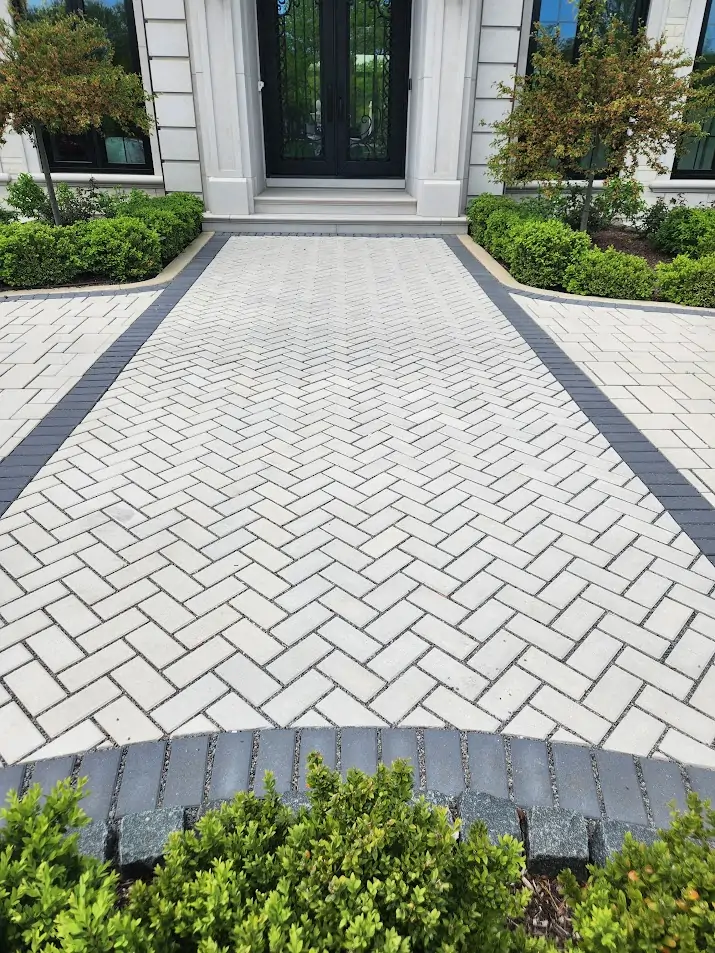
Why Polymeric Sand Fails in North Fulton Summer Humidity
Polymeric sand is not sand. It is silica sand mixed with a thermoplastic or thermoset polymer binder — a dry powder adhesive that activates when water touches it. The activation is a two-step process: water penetrates the joint, the polymer hydrates and migrates into contact points between grains, then the joint cures as excess moisture evaporates upward through the surface. Both steps matter. Both steps are humidity-dependent.
In Alpharetta between Memorial Day and Labor Day, daytime dew points routinely sit in the low-to-mid 70s. The Cecil-series Piedmont clay under your base holds moisture. The pool a few feet away evaporates into the surrounding air column. Ambient relative humidity on a pool deck in Windward at 4 p.m. in July is often 80 percent or higher, even when the weather app says 65. The joint has no way to dry.
When polymeric sand cannot complete the cure, three things happen. The polymer stays partially hydrated and gummy rather than locking into a rigid bond. Vertical evaporation stalls, which means moisture stays trapped in the joint and keeps flexing the polymer with every afternoon thunderstorm cycle. And the surface of the joint — the top 1/8 inch the contractor watered in — forms a skin that looks finished while the interior 3/8 inch underneath is still uncured sand. That skin fractures the first time a pool chair drags across it.
Contractors know this. The good ones schedule around it. The ones who don’t will tell you polymeric sand “cures fine in summer” because by the time it fails they’ve cashed the check and moved on to the next Haynes Manor backyard.
The numerical reality: Gator Labs and SEK-Surebond both publish install-window data. Both manufacturers specify an ambient relative humidity ceiling of 60 percent during cure and an ambient temperature floor of 35°F. Alpharetta exceeds the 60 percent RH ceiling roughly 70 to 85 days between May 15 and September 15. Installing inside that window is installing outside the manufacturer’s spec — which voids the product warranty regardless of what your contractor tells you.
The September 20 to November 5 Window — Why Fall Is the Only Right Answer
Here is what changes in late September along the GA-400 corridor. The dew point drops roughly 15 degrees over two weeks as the first cold front pushes through. Average relative humidity falls from 68 percent to 52 percent. Daytime highs settle into the 55 to 75°F range — comfortably above the 35°F floor and well below the 90°F ceiling that causes surface flash-drying. Evening temperatures stay in the high 40s to low 60s, giving the joint a slow, even cure rather than the whiplash cycle of hot-day-to-cool-night that summer installs endure.
Pollen drops to near zero after the first hard frost (historically October 28 to November 8 at Alpharetta’s 1,100-foot elevation). Pollen matters because it contaminates wet polymer during cure, creating discoloration and interfering with the binder’s surface tension. Anyone who has tried to install polymeric sand in April during the Georgia pine pollen dump knows what we mean.
Rainfall matters in the opposite direction. Alpharetta averages 51 inches per year, but October and early November are among the driest weeks on the calendar — usually 2.5 inches across the full six-week fall window versus 4.8 inches in a typical July. That matters because polymeric sand needs one controlled watering for activation and then dry weather for the following 48 hours. Summer afternoon thunderstorms rarely grant that 48-hour window. Fall almost always does.
The September 20 to November 5 range is the install window we hold on the calendar every year for Alpharetta paver work. Outside of emergency remediation, we do not install polymeric sand in this market between May 15 and September 15. Customers who need a deck done in June get travertine-and-sand or a dry swept stabilizer sand as a temporary joint, with a polymeric top-up scheduled for October. That’s the professional answer. It’s also the answer that makes our phones ring less two years later.

Product Choice — Gator Maxx G2 vs SEK-Surebond SB-7000 on a Pool Deck
Not all polymeric sand is the same product. There are three performance tiers on the market, and the tier determines both the price and the lifespan. The tier-one budget sands sold at big-box stores — Gator Maxx Basic, DryWay, some private-label Home Depot variants — use cheaper polymer chemistries that break down under UV and chloride exposure within 4 to 6 years on a pool deck. That is not a failure. That is the product performing to spec. The spec is just too short for a pool environment.
Tier two and three are the two products we specify on every Alpharetta pool deck installation: Gator Maxx G2 from Alliance Designer Products and SEK-Surebond SB-7000. Both use polyurethane-based binder systems that tolerate chlorinated splash-out and Georgia UV loading. Both are warranted for 15 years by the manufacturer — contingent on install inside the published humidity and temperature windows. Both cost significantly more than the budget products.
The per-linear-foot premium is the conversation homeowners skip at the estimate stage. Gator Maxx G2 on a 600-square-foot pool deck with typical joint spacing runs roughly $1.80 to $2.40 per linear foot of joint installed, which translates to somewhere between $540 and $720 in joint material plus activation labor for a standard deck. SEK-SB-7000 runs slightly higher at $2.60 to $3.40 per linear foot on the same deck — a $780 to $1,020 spend. Compared to the $4 per bag grocery-store sand from a box store, yes, it is expensive. Compared to a $9,000 re-jointing three years from now, it is not.
Which product, which deck: Gator Maxx G2 is our default for paver-on-paver pool decks with uniform joint width under 3/8 inch. SEK-SB-7000 is our specification for travertine French pattern and flagstone deck installations where joint widths vary from 1/4 to 5/8 inch — the SEK chemistry handles the wider joints without shrinkage cracking. Both ship in 50-pound bags. Coverage is approximately 70 linear feet per bag at 3/8 inch joint depth.
The Install Protocol — What a Correct Alpharetta Fall Application Actually Looks Like
A proper polymeric install in Alpharetta in October is a two-day job on a standard deck, not a same-day drop-and-go. Day one is prep. The deck is pressure-washed at minimum 72 hours before install to strip organic matter from existing joints, then allowed to dry fully. A wet deck at install time will cause premature polymer activation inside the bag as you pour — the sand clumps, the joints don’t fill evenly, and the homeowner ends up with visible voids that trap debris.
Day two is the install. Ambient temperature must be between 50°F and 85°F at the start — our crews check it with a digital humidity-and-temp meter, not the weather app. Joints are swept full, power-compacted with a plate compactor running a rubber mat underneath, swept again, compacted a second time. Any joint not fully packed at this stage will settle and trap water during cure. This sweep-compact cycle is usually two to three rounds per section.
Activation water is applied with a garden-hose fan nozzle in multiple light passes, never a direct stream. The goal is penetration without washing binder out of the joint. A single heavy watering pushes the polymer to the surface and leaves the bottom of the joint uncured — a failure we’ve diagnosed dozens of times on remediation calls in Windward. Total water volume is roughly 1 gallon per 30 square feet, spread across three or four applications with 30-second pauses between.
The deck then cures untouched for a minimum of 24 hours, ideally 48. No foot traffic. No pool use. No hose-down. Dogs off the deck. Pool chairs off the deck. The first heavy rain or pool overflow inside that 24-hour window will erode the still-soft polymer and leave the surface pocked. We schedule Alpharetta installs around the Windward ARB review calendar and the National Weather Service 5-day forecast together — if there’s rain inside 48 hours, we push.
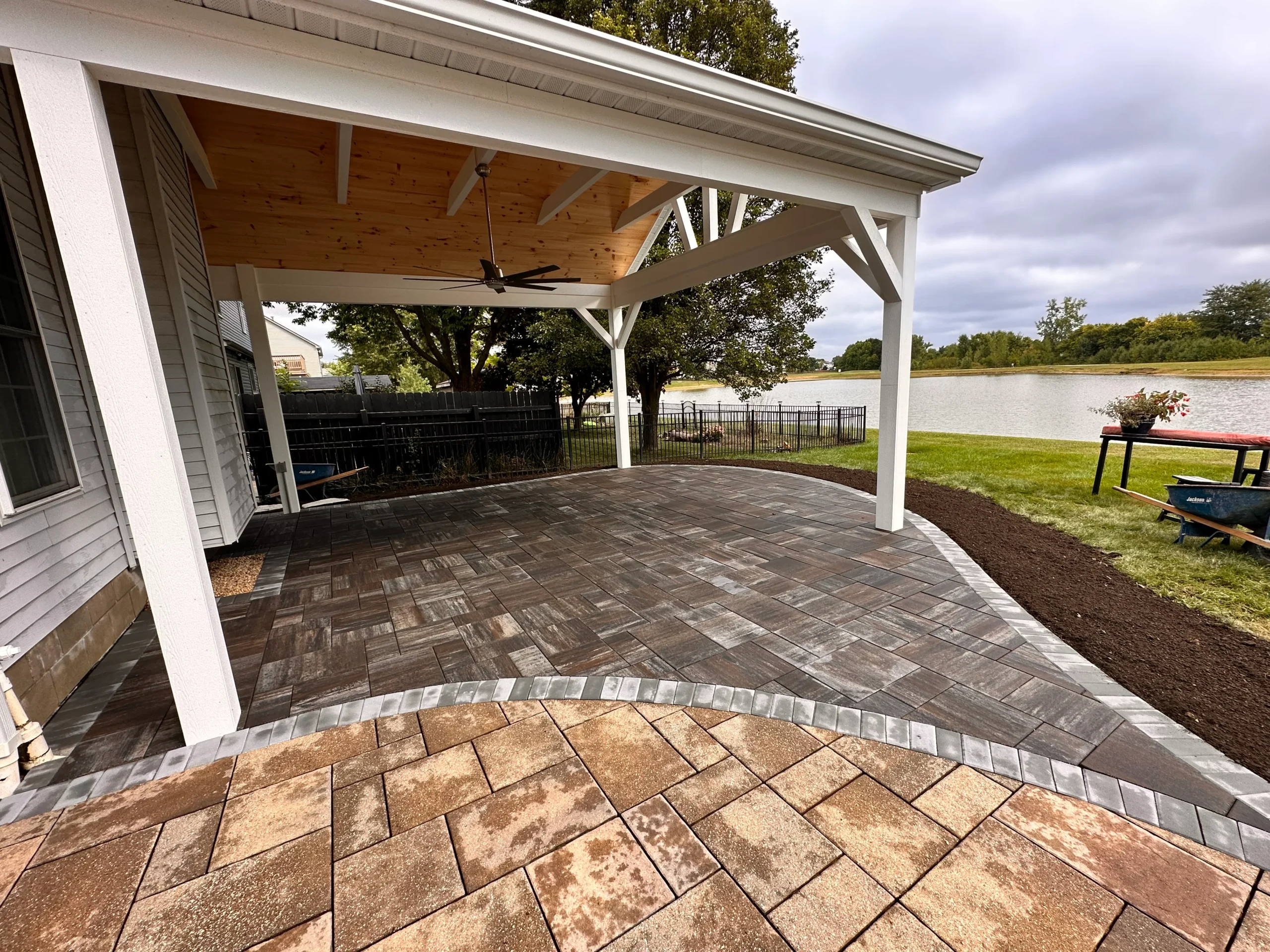
Diagnosing a Bad Install — What 18-Month Joint Failure Looks Like
The tells are consistent across every wrong-window install we’ve opened up. Hairline surface cracks running parallel to the paver edge, typically 1/16 inch wide, appearing in the second spring after install. Joint erosion in traffic zones — around the pool ladder, at the kitchen pass-through, along the gate path — where foot traffic flexes an undercured polymer bond. A gray-white chalky film on the paver edges where uncured binder migrated to the surface and oxidized. Ant colonies. Weed growth in joints that should be sealed tight. Efflorescence blooming after pool splash-out.
Any one of these in isolation is noise. Two or more together, inside the first 24 months, is almost always a humidity-window install failure. We’ve diagnosed this exact pattern in a Country Club of the South backyard where a June 2023 paver patio and pool deck was failing by April 2025. The pavers were perfect — Techo-Bloc Blu Grande, 80mm thickness, properly bedded on 8-inch compacted base. The joint sand was bargain-tier polymer installed at 78°F ambient with a 4 p.m. thunderstorm on the cure day. That wasn’t a pavers problem. It was a calendar problem.
Remediation is more expensive than correct install, not less. The failed sand must be removed with a combination of pressure-washing and hand-scraping without damaging the paver edges — a slow, delicate process. The joints are re-swept with fresh product. The whole deck is re-activated, re-cured. A 600-square-foot remediation in a Hutchinson Farm backyard runs roughly $2,800 to $4,400 versus the original $800 to $1,100 joint install cost. And the homeowner has lived with visible failure for two years before signing the remediation contract.
Scheduling Around Alpharetta’s Permit and ARB Timelines
The logistical reality of hitting the fall window in Alpharetta is that the decision chain starts in June. Here’s why. A new pool deck in Windward or Country Club of the South requires architectural review board approval, which typically runs 3 to 4 weeks from submittal. Alpharetta in-city permits processed through the Community Development office at 2 Park Plaza add another 2 to 3 weeks — faster than Fulton County unincorporated permits, but not instant. Demolition of existing hardscape, base prep, and paver set typically runs 7 to 14 days of crew time.
Back that chain out from a target October 10 polymeric install. Paver set complete by October 7 to allow a 3-day pre-install cure on the pavers themselves. Base and pavers started mid-September. Permit issued by early September. Permit submitted mid-August. ARB approval by early August. ARB submittal by mid-July. That means if you want your 2026 pool deck jointed inside the right fall window, the decision to move forward needs to happen by the first week of July. Miss that, and the deck slides to spring — which in Alpharetta means late March or early April, and then you’re fighting pine pollen instead of humidity.
For homeowners in unincorporated Milton-adjacent areas served by Sawnee EMC, the service-drop coordination for pool equipment adds another variable. Sawnee’s inspection calendar runs a different cadence than Georgia Power — roughly 10 business days versus 5 — which compresses your remaining paver-and-joint window. We plan Sawnee-footprint jobs with that delta built in.
The tech-corridor relocation buyers — the Microsoft, CDW, and Deloitte transplants buying into Avalon-adjacent infill or Hutchinson Farm — typically want pool construction to wrap before their relocation year closes out in December. That timeline works if the contractor starts scoping in May. It fails if the conversation starts in August, because by then the fall window has closed to new starts.
What to Ask the Contractor Before You Sign
Four questions separate contractors who understand the joint sand problem from contractors who’ll tell you what you want to hear to close the estimate. Ask them in this order.
One: What polymeric sand brand and product line do you install, and why? A contractor who answers “whatever’s in stock at SiteOne” is telling you they price-shop the most important material on the deck. You want a specification — Gator Maxx G2 or SEK-SB-7000 by name, with a reason.
Two: What ambient temperature and humidity range do you install within? The right answer names manufacturer spec: roughly 50 to 85°F, 60 percent relative humidity ceiling. Anything fuzzier than that means they don’t check on install day. Or they check and ignore the reading.
Three: What is your cure protocol and what’s the warranty if it fails inside year one? A contractor who doesn’t offer a one-year joint warranty separate from the paver warranty is telling you he doesn’t stand behind the joint install. Paver manufacturer warranties cover the paver, not the joint. Those are separate.
Four: If we’re signing in August, what are your options to avoid a summer install? The correct answer involves dry-swept stabilizer sand as a temporary measure and a scheduled October polymeric top-up, included in the original contract price. An incorrect answer is “oh, summer polymeric is fine, we do it all the time.” That answer costs you a remediation bill in 2028.
The eight-to-twelve-year standard: A correctly installed tier-2 or tier-3 polymeric sand joint on an Alpharetta pool deck should deliver 8 to 12 years before a refresh is needed. Refreshes are a top-dress, not a full remove-and-replace — the deeper polymer bond stays intact and the surface 1/4 inch is refreshed. Refresh pricing on a 600-sq-ft deck runs $600 to $900. Budget for one refresh in year 9 or 10, another around year 18 to 20, and the deck should deliver 25+ years of clean joints with no paver resets.
Closing — The Calendar Is the Contract
Everything above compresses to one sentence: on an Alpharetta pool deck, the polymeric sand calendar is more important than the polymeric sand brand. The best product installed in July will fail before the worst product installed in October. That’s not an opinion; it’s manufacturer spec and 60-to-75 percent humidity data pulled off the National Weather Service Atlanta feed for the last 20 years.
Homeowners in Windward, Country Club of the South, Hutchinson Farm, Haynes Manor, Brookhollow, and the newer luxury infill around Avalon have spent six and seven figures on pools, pavers, pool houses, and outdoor kitchens. The joint sand is a five-hundred-dollar line item on a hundred-thousand-dollar deck. Skimping on it or installing it in the wrong window isn’t thrift. It’s a slow bleed that shows up in the second spring and stays visible until the deck gets re-jointed. Get the calendar right and the deck reads clean for a decade. Get it wrong and you’ll be standing in your backyard in April 2027 wondering why the joints look like they’ve been through a pressure washer.
Plan for October. Specify Gator Maxx G2 or SEK-SB-7000 by name. Demand a humidity reading at install time. Hold the warranty in writing. That’s the full protocol for polymeric sand in Alpharetta humidity, and it is the difference between a deck that ages gracefully and a deck that needs a contractor back every three years.
Paver design, build, and joint-system specification across 20+ cities within 30 miles of Winder, GA
We schedule Alpharetta paver and polymeric sand work inside the September-to-November window on purpose — because the calendar is the difference between a joint that lasts a decade and one that fails in two years.