
It is the second week of October in Foxcreek. The thermometer on the back porch reads 48 degrees at 6:47 p.m., and the 16×32 sitting twenty yards from the house has been closed for three weeks. The homeowner, a retired pilot, is looking at a spa he has used eleven times this season, a pool he stopped using in early September, and a power bill from Amicalola EMC that still arrived. He is asking the question almost every hill-country client eventually asks: was the big pool ever the right shape for this elevation?
Dawsonville sits at 1,270 feet — the highest-elevation city in our service area and roughly 220 feet above Snellville. That elevation, combined with mountain-pattern thunderstorms and a thirty-night freeze calendar, compresses the swim season in a way most pool builders ignore. A traditional 16×32 rectangle here gets a real usable window of about 100 days. A properly engineered plunge-plus-spa configuration stretches that window to roughly 220 days without doubling the budget. This post is about why that trade-off works at this elevation, what the build costs actually look like, and how we detail the electrical, structural, and deck transitions to make the two bodies of water read as a single composed space.
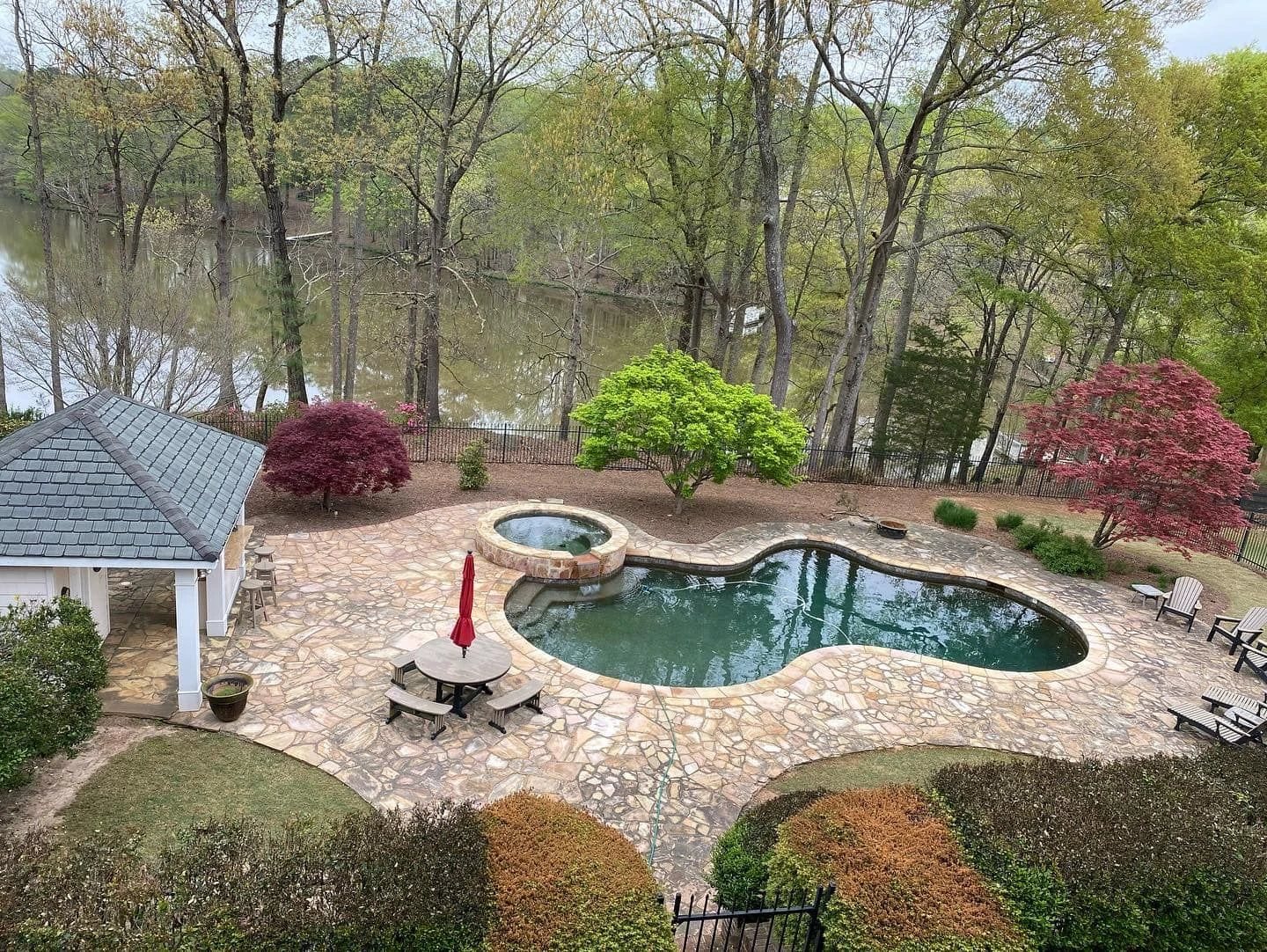
The 100-Day Problem at 1,270 Feet
Snellville and Grayson homeowners run their pools comfortably from early May through the last week of September. Dawsonville does not get that calendar. Our construction managers track overnight lows from the Dawson County airport weather station, and the honest usable window here for an unheated 16×32 rectangle runs from roughly May 18 through the end of August — about 100 days. Add a cover and modest heat and you can push it to 110. That is the ceiling for the dominant pool format sold in Georgia.
The reason is not water temperature in isolation. It is the drop-off between afternoon highs and sundown. Dawsonville averages 30 freeze events per year versus about 20 in Dacula, and the shoulder months stack evenings that fall from 84 degrees at 5 p.m. to 52 degrees by 9 p.m. No vinyl cover, no 400k-BTU heater, and no amount of optimism fixes a 32-foot body of water losing 18,000 gallons of warmth to a valley breeze rolling down from Amicalola. Homeowners in Foxcreek, Kensington Ridge, and Applewood eventually stop going in. The rectangle becomes scenery.
The answer is not a smaller rectangle. It is a fundamentally different format: a small deep pool designed for immersion, not laps, paired with a raised spa that can run in January when the pool is closed. The spa is the season-extender. The plunge pool is the summer centerpiece. Together they use the lot better than any single-body layout we can draw.
The Dawsonville Format: 8×16 Plunge Plus 7×7 Raised Spa
A plunge pool is not a wading pool and it is not a dip tank. The format we build for Dawsonville hill lots measures 8 feet wide by 16 feet long with a flat 5-foot-6-inch bottom across the full footprint. That depth supports neutral-buoyancy floating, standing-deep cooldowns after a sauna, and a single-lap cross-body swim. It does not support diving and it does not pretend to. The rectangle is set with the long axis parallel to the dominant view, which in Dawsonville usually means oriented toward the north-Georgia ridgeline or the Etowah River bend that shows up on so many lots in Riverbend and Etowah River Club.
The spa is a raised 7×7 square, 38 inches interior depth from bench to water line, set 14 inches above deck grade with a wall-mounted spillover that sheets into the plunge pool. Seven feet per side yields comfortable seating for six adults without the cramped knee-clash of 6×6 hot tubs. Two full-length hydrotherapy benches run the two long walls, and the third wall holds a single captain’s seat with deeper contouring. The spillover is a single 24-inch sheet weir — not a trickle, not a three-point bubbler.
Material-side, we detail the spa surround in the same honed-granite veneer we specify for most Dawsonville builds, because the stone is quarried within sixty miles of the job site and it reads correctly next to mountain-laurel plantings. The plunge shell itself is gunite with a PebbleTec Midnight Blue aggregate interior. Dark aggregate in a small pool at this elevation is intentional — it reads deeper than it is, holds solar gain longer into the evening, and disappears under the shade canopy that most hill lots carry.
Build cost, plunge-plus-spa combo: $72,000 to $98,000 installed in 2026 dollars, including rock-condition allowance, 100A subpanel, perimeter deck, and standard landscape restoration. The same lot built with a 16×32 rectangle and attached spa runs $145,000 to $175,000.
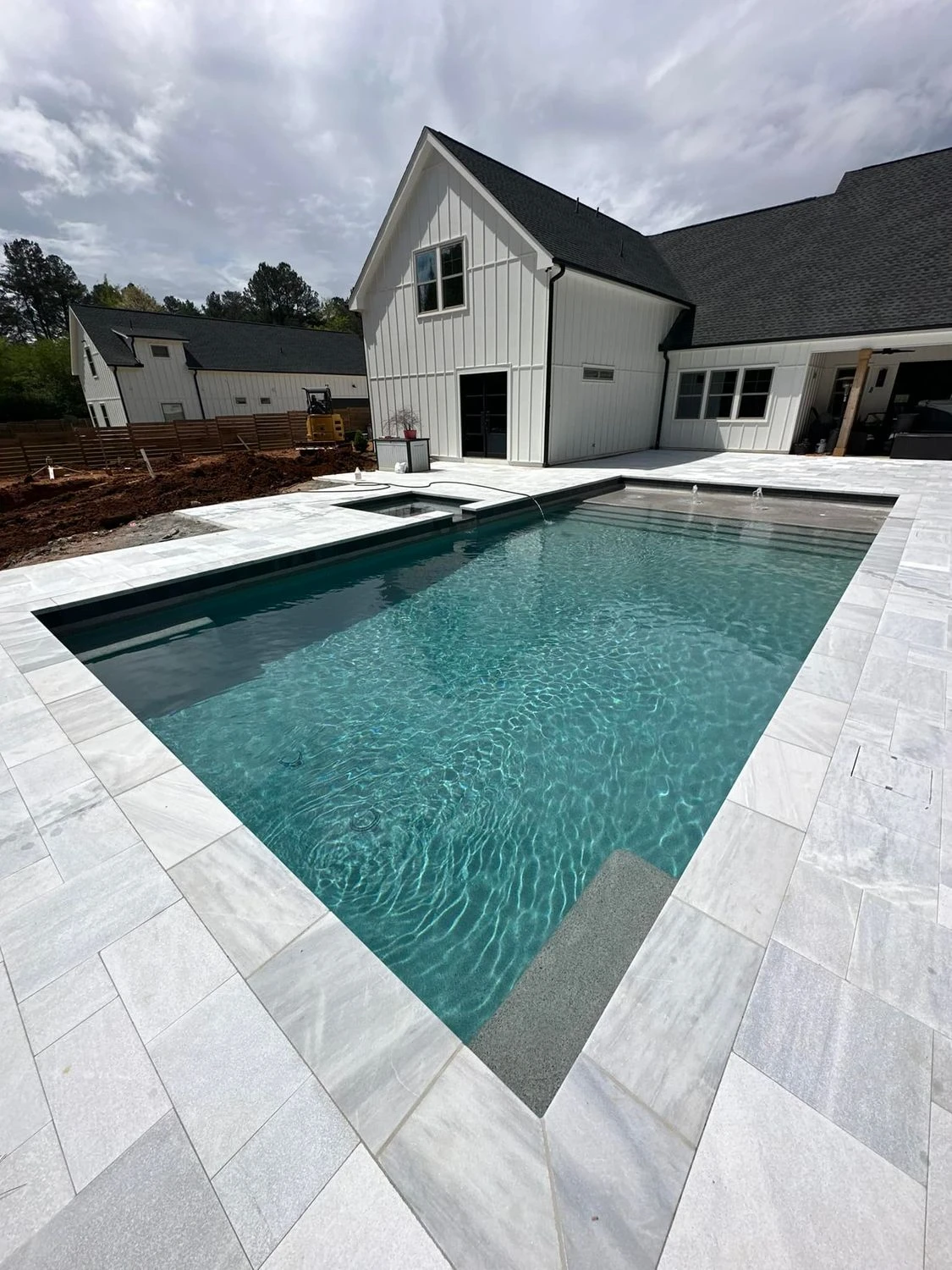
Why Mountain Residuum Changes the Excavation Number
This is the part of the budget most Atlanta-metro pool buyers have never heard explained. Dawsonville sits on a soil profile called stony residuum — weathered granite and saprolite, parent rock from the mountain weathering regime. Drainage is excellent compared to Dacula’s Piedmont clay, which is a real advantage. But at the 2-to-6-foot depth where a pool shell lives, we hit intact rock on a meaningful percentage of jobs.
Every pool contract we write in Dawson County carries a rock-condition rider. When the track hoe stops moving dirt and starts grinding, we either switch to a hydraulic breaker or, for the deeper monolithic shelves, bring in a licensed blaster with a Class A explosive permit through the county. The math is straightforward: standard excavation runs about $14 to $18 per cubic yard. When the bucket finds rock and we escalate, the number climbs to $22 to $32 per cubic yard, and for charge work we add a flat day rate plus a per-cubic-yard premium of $8 to $14.
This is another argument for the plunge format. An 8×16 plunge displaces roughly 45 cubic yards of spoil. A 16×32 rectangle displaces about 185. If the bottom third of your excavation is rock, the differential in rock-condition cost alone can run $7,000 to $14,000 — enough to buy the entire honed-granite spa surround we just described. The smaller footprint is not just a square-footage play; it is a rock-exposure play.
Lots in Kensington Ridge that back up to the old Chestatee drainage routinely hit the most rock. Lots in Applewood and Mountain Laurel, which sit on deeper saprolite pads, hit the least. We test-dig a 4-foot probe hole with a mini-excavator before issuing a firm number, and we price the contract off the actual probe, not a square-foot multiplier.
The Amicalola EMC Subpanel and the Dual-Heater Load
Running a plunge pool and a raised spa as two independently heated bodies of water is the mechanical reason this format extends the season. It is also the reason the electrical scope matters more than on a standard build. The spa carries its own 400,000-BTU Raypak gas heater dedicated to the 1,400-gallon spa body. The plunge carries a Pentair MasterTemp 400 on natural gas or LP depending on what the subdivision allows. Both are tied to a 100-amp subpanel we set on a dedicated stub near the equipment pad, fed from the main panel at the house.
Amicalola EMC is the utility serving most of Dawsonville and 30534 specifically. Their new-service process for pool subpanels is cleaner than Georgia Power’s if the house is under 25 years old, but older split-level stock from the 1970s and 1980s frequently tops out at a 150-amp main and cannot carry the pool subpanel without a service upgrade. We do the load calc on every job before signing the contract. On about one in four Dawsonville builds, the service upgrade adds $2,800 to $4,200 to the scope. We price it in up front rather than sending a change order.
The second reason the subpanel matters: variable-speed pumps on both bodies. A Pentair IntelliFlo3 VSF on the plunge and a second smaller variable on the spa cut combined run-cost roughly in half versus single-speed. At NEC §680 bonding requirements, all of this goes on a single ground grid with the perimeter bonding loop tied to the shell steel — standard practice but worth specifying, because the inspector in Dawson County will check it.
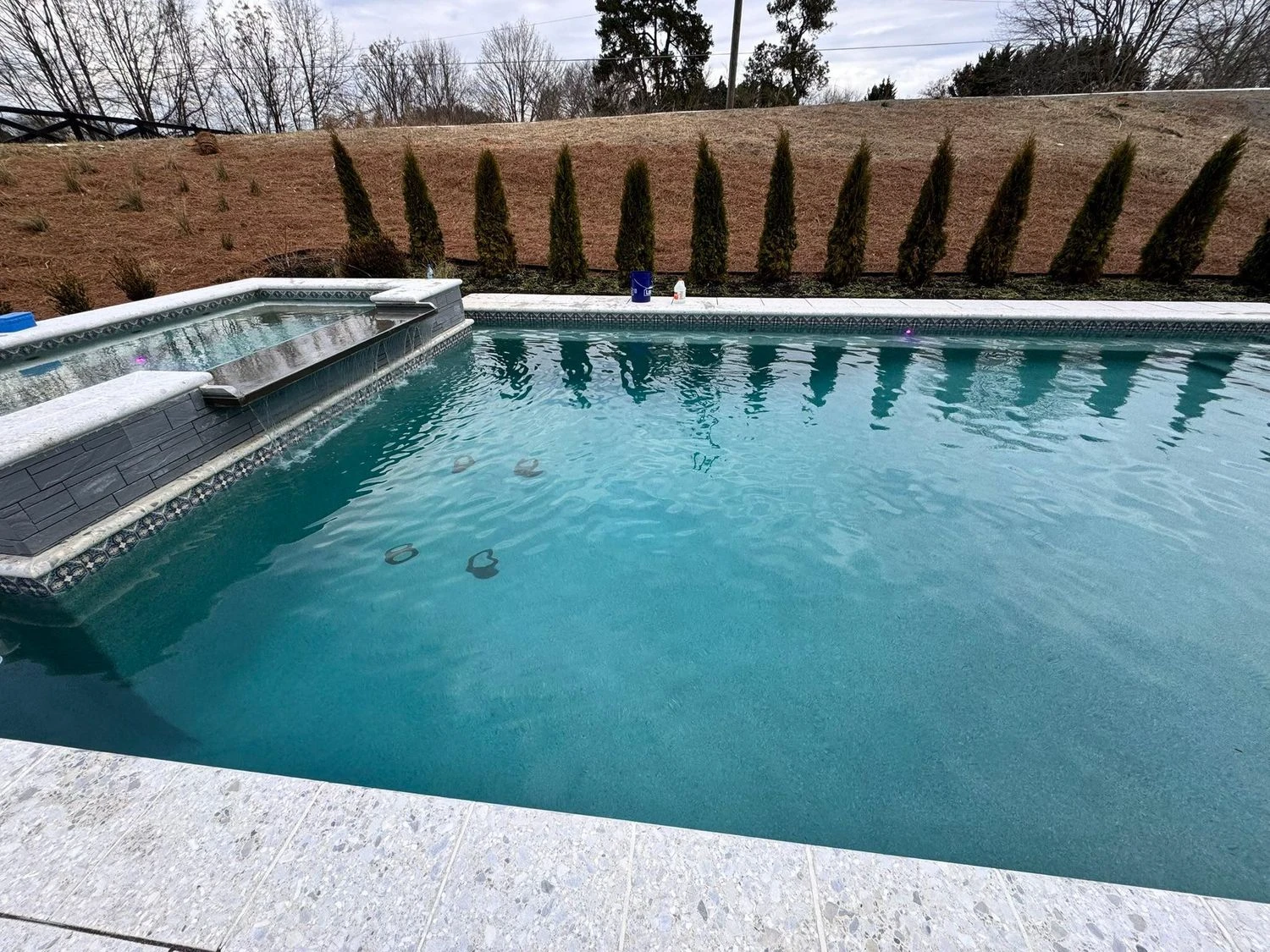
Fire Bowls, Evening Use, and the 45-Degree Rule
The reason a plunge-plus-spa installation earns back its cost has less to do with summer and more to do with the shoulder evenings. From late October through late March — roughly 150 nights — the spa is the only body of water anyone touches. Below 45 degrees ambient, we find homeowner use drops sharply unless we add a directed radiant heat source in the seating area.
Our standard detail is a pair of bronze 24-inch fire bowls mounted on stone pedestals flanking the spa’s long-axis view. Each bowl carries a 65,000-BTU burner tied into the same natural-gas or LP feed as the spa heater, plumbed with a dedicated manual key valve at deck grade and a secondary electronic ignition we can run from the spa controller. The total adder runs $9,400 including gas trenching, pedestals cut from the same local granite as the spa veneer, and the bronze bowls themselves.
This is a Foxcreek and Kensington Ridge upgrade specifically — both subdivisions trend toward the mid-fifties and sixties demographically, and the fire bowl line item shows up on maybe 70 percent of the contracts we sign there. Etowah River Club clients, who are often younger and more use-intensive, choose the bowls less often and redirect the budget toward a larger plunge or better auto-cover.
The practical comfort math: two 65,000-BTU directed sources within eight feet of the spa seat raise felt-temperature in that pocket by roughly 12 to 15 degrees in still air. A 45-degree evening becomes a 58-degree pocket. That is the difference between sitting in the spa for forty minutes and calling it early at fifteen.
Permits, GA-400 Logistics, and the Dawson County Planning Office
Permits for Dawson County pool builds go through the Dawson County Dept. of Planning & Development at 25 Justice Way. The office runs cleaner and faster than Gwinnett’s — we typically receive approval inside 12 working days on a complete submittal versus 18 to 24 in Gwinnett. The plans package must include a shell engineering stamp from a Georgia-licensed PE, the gas line schematic with BTU loads aggregated, electrical load calc, and a grading plan showing cut-and-fill and any retaining walls over 30 inches.
The grading plan matters more here than in flatter parts of the service area. Dawsonville lots in Riverbend and along Hwy 53 commonly carry 8-to-14 percent slope across the proposed pool envelope. Any retaining condition that holds back more than 36 inches of soil within ten feet of the shell requires its own PE-stamped wall design. We draw these walls as monolithic cast-in-place with #5 rebar on 12-inch centers, not as segmental block, because mountain lot drainage over time will defeat a segmental wall that was not perfectly backfilled on day one.
Trucking into Dawsonville is its own consideration. GA-400 makes equipment delivery easier than most people assume — we run concrete pumpers, gunite trucks, and low-boys up from Cumming and Alpharetta on 400 and peel off at Exit 17 or Exit 22 depending on the address. What does complicate the schedule is final-mile access on driveways off Hwy 53 and Hwy 136, where a 14 percent grade combined with soft shoulder can mean we stage equipment at the road and walk materials in by mini-track machine. That adds a day on the labor side but it is a known cost, not a surprise.
Permit cost line item: Dawson County plan review and construction permit for a pool with raised spa and electrical sub runs $875 to $1,150 depending on scope. Add $240 for the gas permit if a separate contractor pulls it.
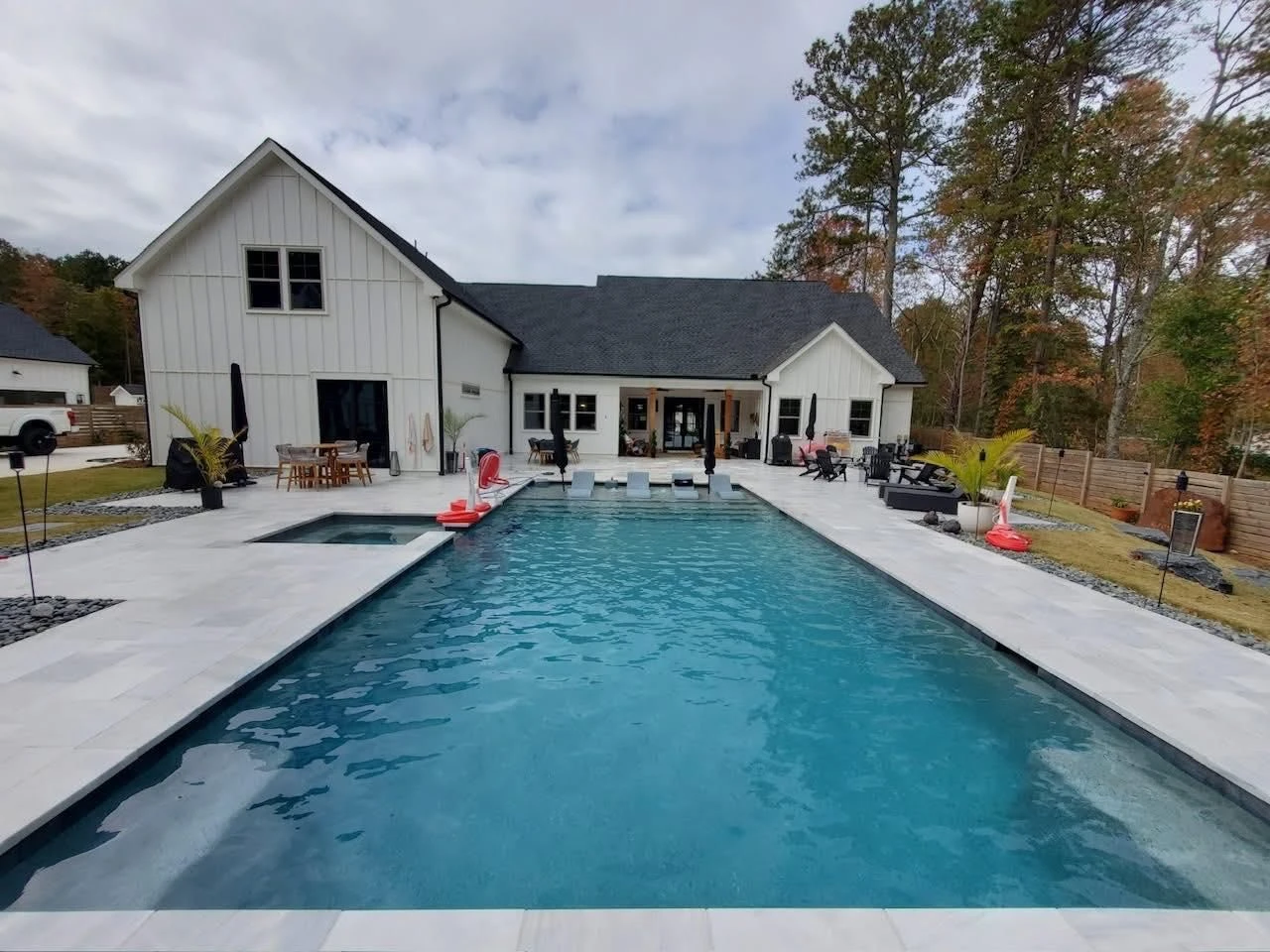
A Real Project: Foxcreek, 1.4 Acres, Retired Couple
The case that made us commit to the plunge-plus-spa format as our default Dawsonville recommendation was a 2024 build in Foxcreek for a retired pilot and his wife. The lot carried a north-facing 11 percent slope behind the house, mature oak-hickory canopy, and a house built in 1998 on a 200-amp main — enough panel capacity, no service upgrade needed. They had originally called us asking for a 16×36 rectangle with attached spa.
We walked the lot at 4 p.m. in February. The sun had already dropped behind the ridgeline. The homeowner mentioned that his previous pool, at a house in Cumming, had been used twelve times the year before he sold it. His wife mentioned that the hot tub at their gym was the thing she actually looked forward to. We redrew the project as an 8×16 plunge and 7×7 spa, oriented the long axis toward the ridge view, set the spa on the house-side of the pair so it was a 12-step walk from the kitchen door, and added the twin bronze fire bowls.
Contract total: $87,400 including a 4,200-square-foot travertine deck, retaining wall, subpanel run, fire bowls, and a manual-lock safety cover on the plunge. Build time: 9 weeks including 3 days of controlled rock blasting on the spa footprint. They closed the plunge on September 30 that year and opened it again April 24. The spa ran 188 days in the six-month window between. The fire bowls ran roughly 70 evenings. The couple now hosts their adult children and grandchildren on Thanksgiving Friday and Christmas Eve, outside, around the spa.
The 16×36 rectangle we had originally been asked to quote would have cost about $162,000 on that lot. It would have been used May through August and closed the rest of the year. The plunge-plus-spa we built instead cost roughly half as much and delivered four times the usable evenings. That is the equation at 1,270 feet. It is not the equation in Dacula, and it is not the equation in Suwanee, but it is the equation here.
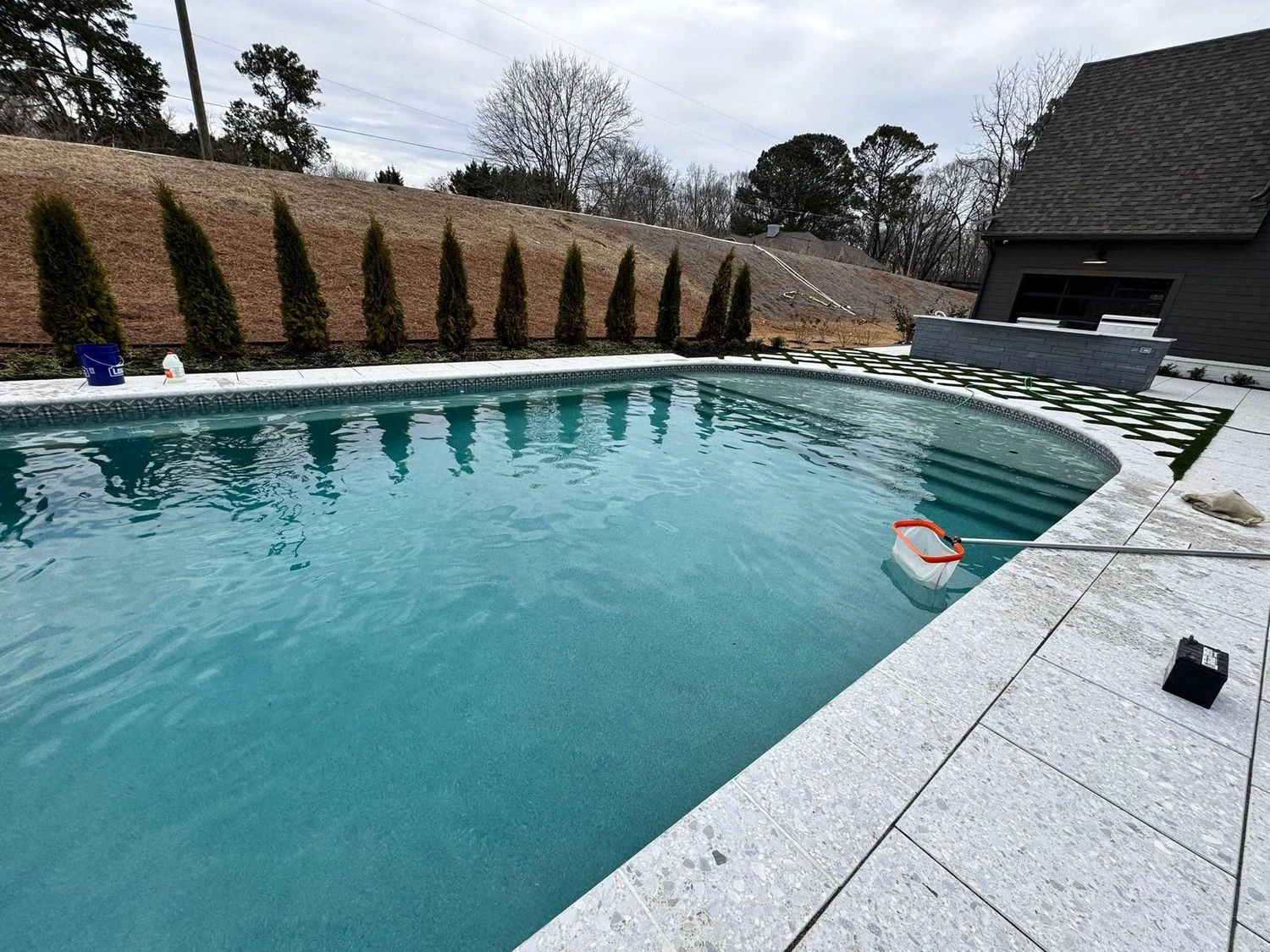
Custom pool construction across 20+ cities within 30 miles of Winder, GA
Dawsonville’s elevation and freeze calendar reward a pool format designed for the lot, not a template pulled from a catalog. We engineer every plunge-plus-spa build around the specific rock profile, utility service, and slope of the property.