
The owners wanted one thing: a backyard that read as a single estate composition, not three disconnected projects. A 115-foot walk separated the primary residence from the horse barn, and every foot of that walk had to earn its keep.
This case study covers a $548,000 integrated build on 4.2 equestrian-zoned acres in Milton, GA — pool, pavilion, and outdoor kitchen designed as one connected zone between a 1990s renovated farmhouse and a six-stall cedar horse barn. The homeowners, a thoracic surgeon and a dressage-level rider, came to us with a marked-up plot plan, a binder of Atlanta Polo Club reference images, and a rule: nothing in the finished yard could spook a horse, spark a fire within 40 feet of the barn, or require a second trench across the paddock.
What follows is how we built it — scope, elevation work, code path through City of Milton Community Development, equestrian-specific utility routing, and the dollar figures attached to each phase. Names of subdivisions and a handful of project numbers are preserved; specific client identifiers are not.
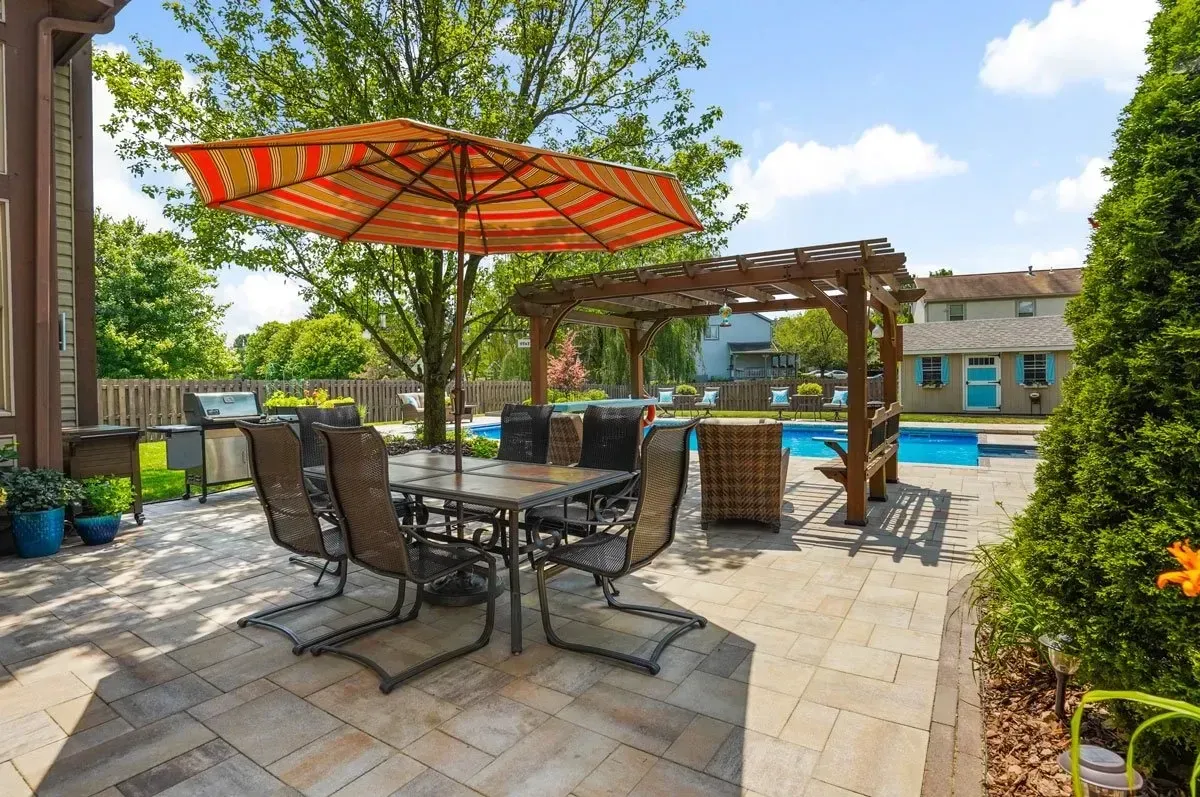
The site: a 4.2-acre parcel off Freemanville Road with a 9-foot grade drop
The property sat on the quieter stretch of Freemanville Road, roughly two miles south of Birmingham Crossroads, inside the 30004 zip and inside Milton’s AG-1 equestrian-preservation zoning. Lot configuration was classic north Milton estate: long frontage, deep rear, a pair of heritage white oaks mid-property, and a seasonal drainage swale feeding a tributary of Cooper Sandy Creek along the back third of the parcel.
The house sat on the high side. The barn, built by a previous owner in 2011, sat on the low side, 115 linear feet away with a 9-foot elevation drop measured across a laser level from back porch slab to barn pad. That drop is common in Milton — more dramatic than anything you see in Alpharetta subdivisions a few miles south — and it defined every structural decision on the project. A pool pad on the high side would have floated as an island. A pool pad on the low side would have felt divorced from the house. The only defensible location was the middle: a terraced shelf cut into the hillside, with the pavilion and kitchen positioned to catch the transition.
Soil was standard Cecil clay over weathered granite on the upper terrace, with thicker topsoil and a ribbon of saprolite exposed along the swale. Our excavator hit a saprolite shelf at 7.5 feet below grade in the deep-end pool dig, which cost three extra days and a 6-yard rock hammer rental. That is baked into the pricing below.
The connector concept: why the kitchen sits between the house and the barn
Most estate pools in Milton get dropped within 40 feet of the back porch. It is the path of least resistance — short plumbing runs, easy sightlines from the kitchen window, code separation from the septic field handled by the original builder. For a horse property, that placement is a miss. It forces the owners to walk past the pool to get to the barn at 6 a.m. feed, which means wet decks, chlorine drift onto tack, and children playing inside a zone where a loose horse will inevitably pass through.
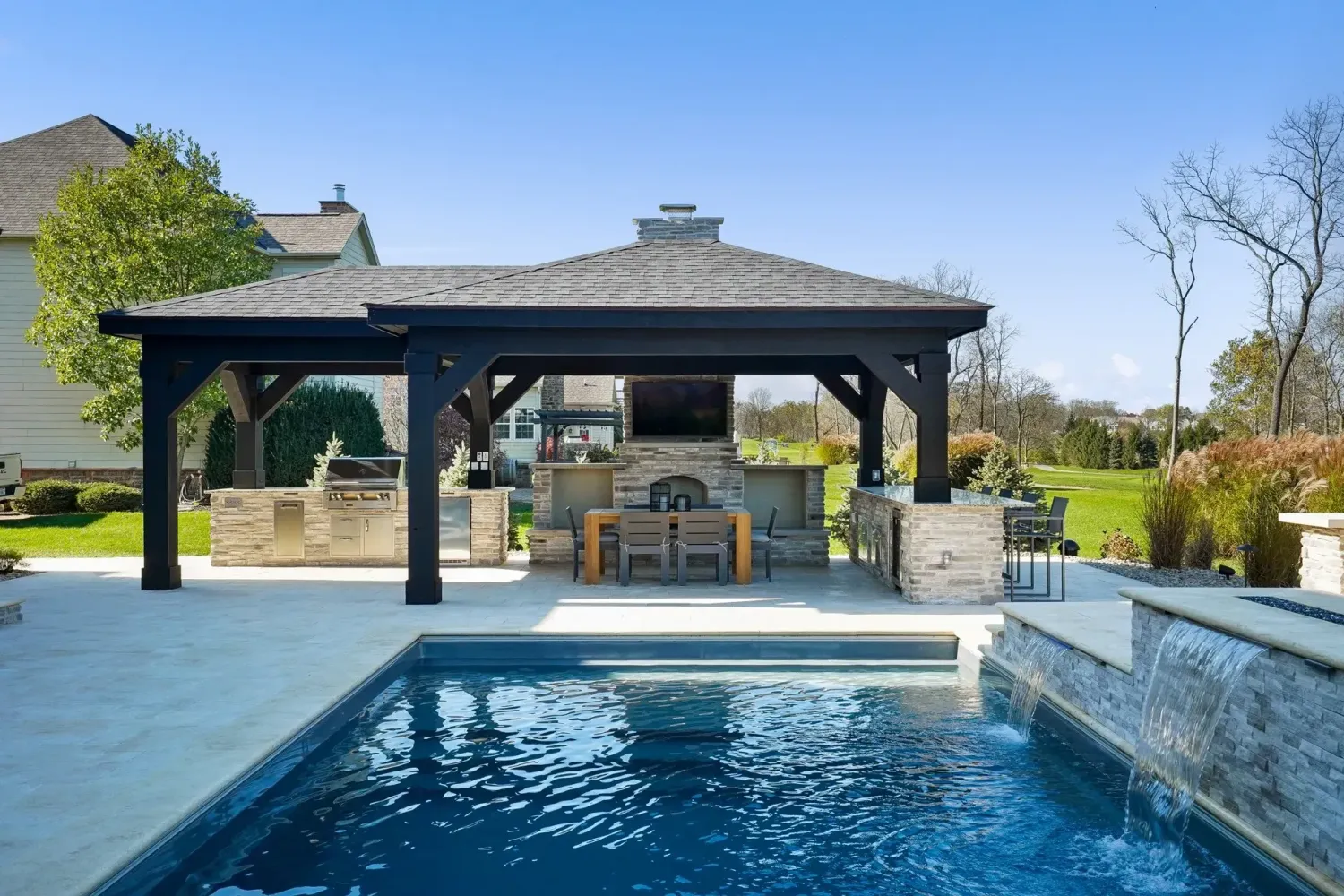
Instead, we centered the design on a simple question: what is the single point on this property where an owner can stand, see the barn door, see the back porch, and see the pool without turning their head more than 30 degrees? That point — exactly 58 feet from the back porch, 57 feet from the barn’s paddock-side gate — became the pavilion location. The kitchen slid under the pavilion roof. The pool took the west side, angled to catch the longest late-afternoon sun angle on the property. The travertine deck knit the three pieces together into what the homeowners started calling, by the second week of framing, the connector.
The pavilion: 18 by 28 feet, cedar ceiling, pitched to match the barn gable
Pavilion footprint landed at 18 feet by 28 feet, 504 square feet under roof, with the long axis running north-south to match the barn. Four 8×8 rough-cut cedar posts carried the load, set on poured concrete piers to 36 inches below grade — deeper than Milton minimum but matched to the footings on the existing barn so the two structures would settle together over time rather than drift.
Roof pitch came in at 8/12. The barn sat at 7.5/12; the close-but-not-identical pitch was deliberate, because matching the pitch exactly reads as a theme-park copy rather than an architectural conversation. Standing-seam metal roof in a matte charcoal, custom-fabricated by a metal shop in Ball Ground, picked up the charcoal trim on the barn without echoing its color panel-for-panel.
The ceiling is where the project either succeeds or collapses visually. We used tongue-and-groove western red cedar at a 6-inch nominal width, sealed with a UV-stabilized penetrating oil. Inside the barn, the stall ceilings are the same cedar, same width, same finish. Walking from the pavilion toward the paddock with the sun at the right angle, you get a single continuous cedar plane overhead, interrupted only by the 20 feet of open sky between the two roofs. That optical continuity was the most-requested detail from the client and the hardest one to execute — it required holding the pavilion ceiling height to an inch of the barn ceiling height so the horizon line read as one plane.
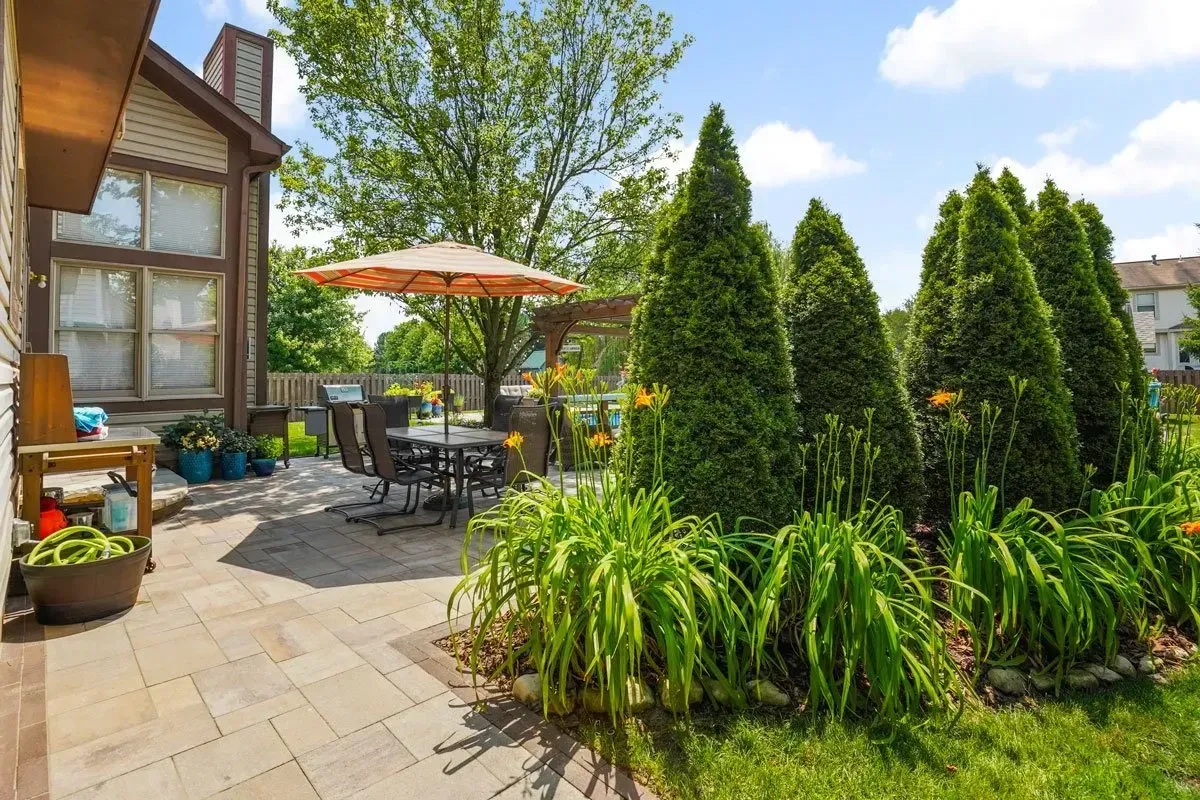
The kitchen: Big Green Egg, 42-inch grill, and an equestrian-proximity fire plan
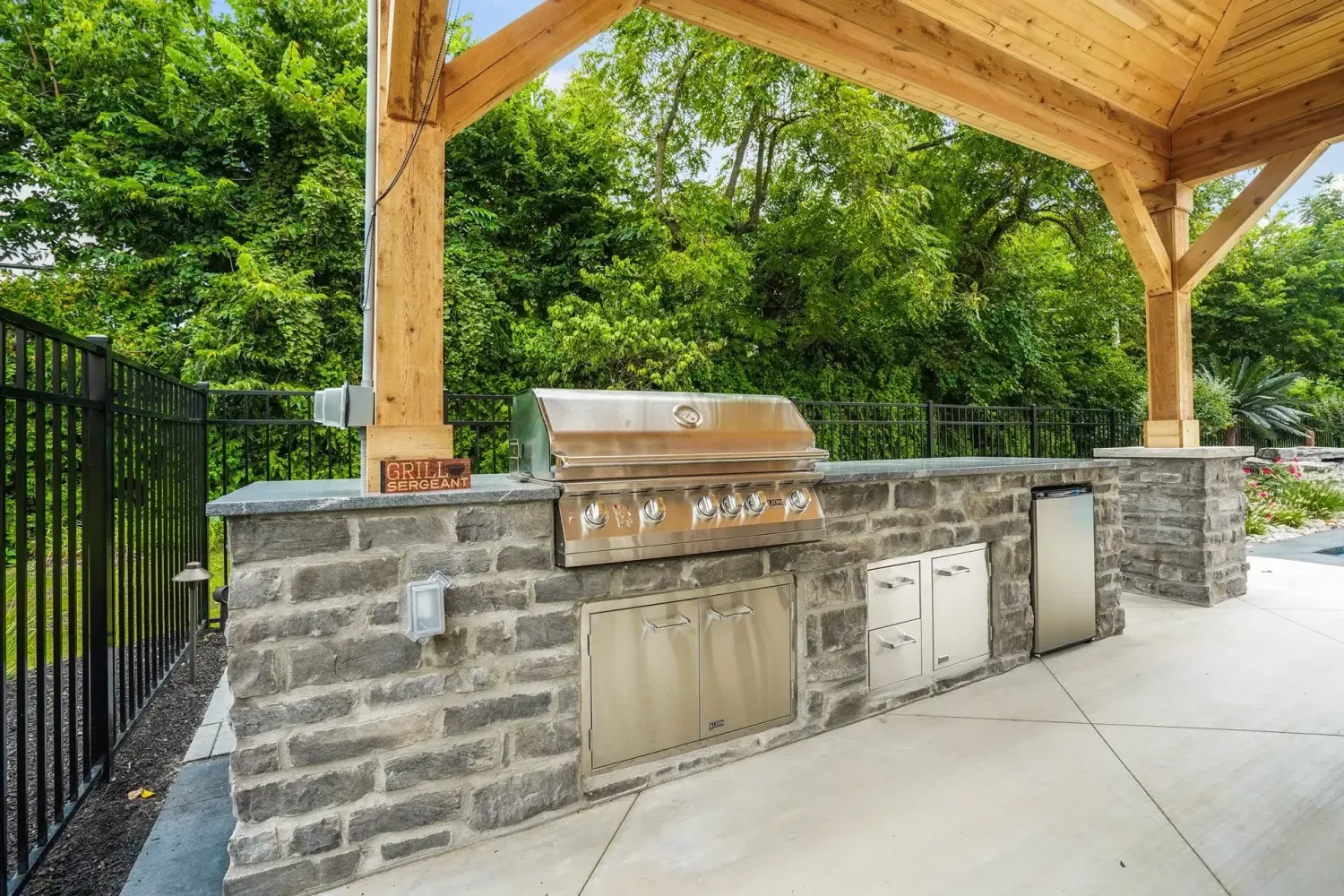
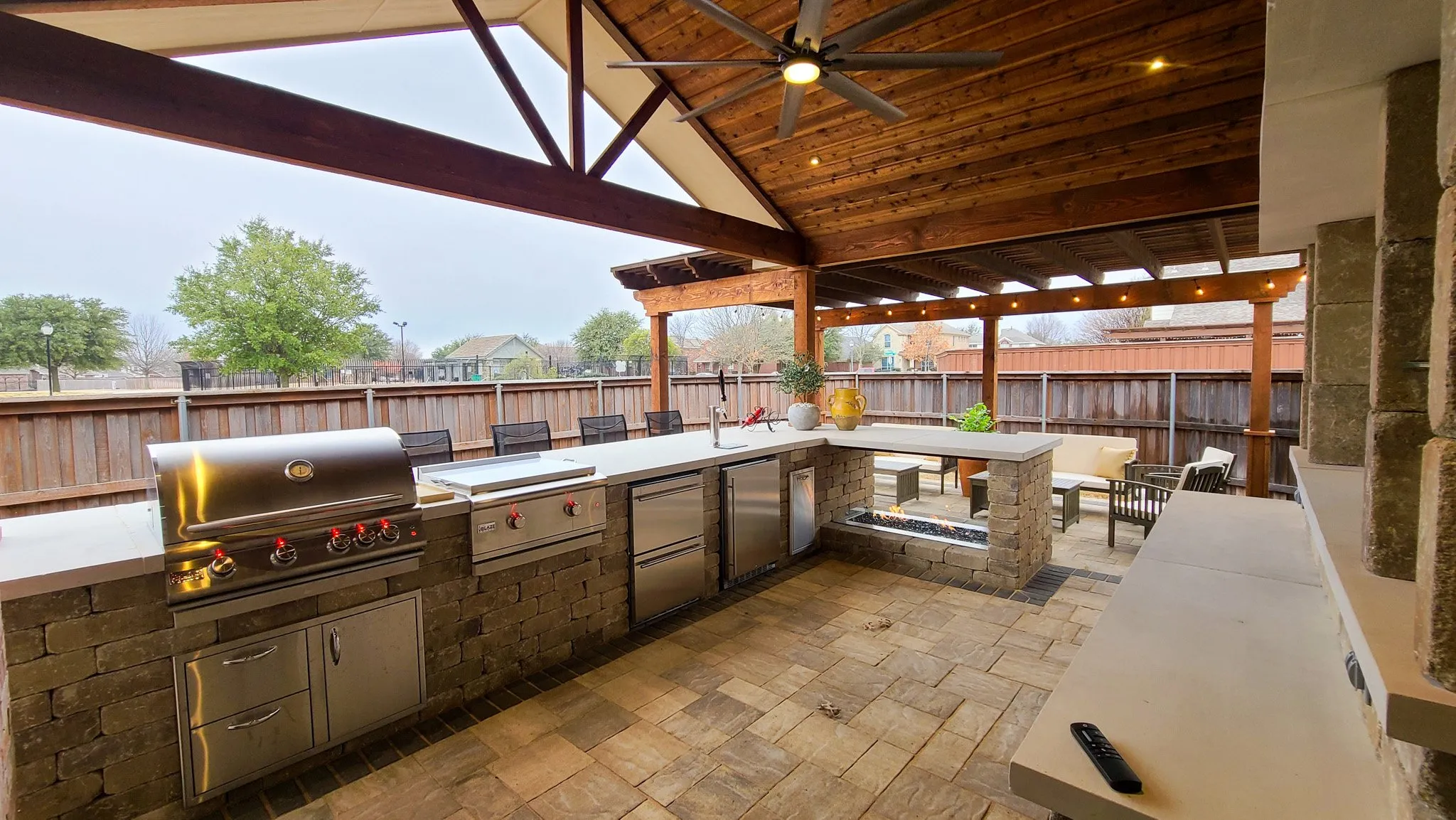
The outdoor kitchen lived under the east third of the pavilion, tucked against a custom dry-stacked fieldstone veneer wall that doubled as a wind break from the north-facing paddock. Three appliances anchored the run: a large Big Green Egg in a custom stone nest, a 42-inch built-in grill (the client chose a Hestan GMBR42 after a side-by-side with the Lynx equivalent), and a 27-inch outdoor-rated refrigerator under the counter on the south side. A 24-inch insulated ice drawer and a 16-inch bar sink completed the run.
Fire code in Milton for a horse-property outdoor kitchen is not in the IRC — it is a combination of City of Milton Community Development conditions plus insurance-driven best practice. We held the grill cookline 42 feet from the nearest barn wall, built a 4-foot by 6-foot non-combustible stone landing behind the cookline for ember fallout, and specified a recessed 10-pound Class K fire extinguisher inside a powder-coated stainless wall cabinet within arm’s reach. Smoke drift was the other concern for the dressage arena, which sits 140 feet west — we modeled prevailing summer wind off the Cooper Sandy Creek corridor and oriented the grill hood to vent south-southwest, away from both the arena and the barn.
Milton horse-property setback rule of thumb: hold any outdoor cookline 40 feet or more from the nearest combustible barn wall, include a non-combustible landing behind the cook zone, and submit the plan to Milton Community Development at 2006 Heritage Walk for review. Permit turnaround ran 11 business days on this project.
Counter surface was a 3-centimeter honed leathered granite from a Forsyth County stone yard, chosen for grip when wet (the client did not want polished surfaces anywhere near horses or children). Cabinet boxes were 304 stainless steel with a warm-gray powder coat, and toe kicks were set 1 inch higher than standard to keep paddock dust and rain splash out of the cabinet interiors.
The utility trench: one cut through the paddock subgrade, never two
This is the single detail that separates a thoughtful horse-property build from a generic estate build. Gas, water, and electrical all had to reach the pavilion from a mechanical closet on the house side. The dumb option is three separate runs. The cheap option is one run along the fence line and hope the horses do not dig at it. The defensible option — and the one we used — is a single, deep, consolidated trench that routes through the paddock subgrade below any hoof-impact depth, with a warning tape layer above.
The trench ran 42 inches deep, 18 inches wide, in a straight line from the house mechanical closet to the pavilion slab. Inside the trench, bottom to top: 3 inches of clean sand bed, 1.5-inch medium-pressure polyethylene gas line (sleeved), 1-inch Type K copper cold water with insulation jacket, and a 3-inch PVC sweep carrying two 1-inch PVC electrical conduits (one for 200-amp subpanel feed, one for low-voltage lighting and control wiring). Above the utilities came 6 inches of compacted fines, a bright yellow metallic detectable warning tape, then compacted backfill to grade.
Horses were relocated to a neighboring pasture the three days the trench was open — not a code requirement, a liability one. We coordinated with the client’s equine vet to confirm the relocation pasture’s fence height and gate latches before horses moved. When backfill finished and the paddock reopened, there was no surface evidence of the utility line. Two years in, there still is not.
Why the single trench matters: if you ever need to re-run a line — gas leak, water line rupture, electrical fault — you dig once. Three trenches become three future excavations. On a horse property, one excavation is a weekend of relocated horses; three is a month.
The pool: 18 by 38 freeform with a 9-foot drop-handled at the bond beam
The pool landed at 18 feet by 38 feet, a soft-edged rectangle the client called “freeform but not kidney-shaped.” Shell was shotcrete at 10 inches on the walls and 6 inches on the floor, with a #4 rebar grid at 12-inch centers double-tied at every intersection — a spec tighter than Milton requires, pulled from our standard for any pool built on a hillside cut with backfill on the downhill side.
The 9-foot grade drop across the property was resolved at the pool bond beam. On the uphill side, the bond beam sat flush with the travertine deck and the pavilion slab — a clean walk-out from the kitchen to the pool coping. On the downhill side, the bond beam stood 28 inches above the surrounding deck, becoming a sitting wall faced in the same dry-stacked fieldstone as the kitchen back wall. Seven landscape-grade LED strip lights recessed under the overhang of that sitting wall wash the paddock-side deck after dark at 2700K, warm enough that horses do not react to the light when they walk past on the far side of the fence.
Coping was travertine in a 12 by 24 pattern, chiseled edge, bullnose on the water side only. The deck surface was the same travertine in a French pattern running 1,600 square feet from the pavilion slab edge out to the sitting wall and along the paddock-fence run. All travertine was pre-sealed with a penetrating siloxane before install — a step we take on every Milton project because the saprolite-heavy substrate contains iron compounds that will stain a porous deck stone inside two seasons if left raw.
Code path: City of Milton Community Development, The Manor-adjacent review, and creek buffers
Milton’s 2006 incorporation means permits do not route through Fulton County — they go through City of Milton Community Development at 2006 Heritage Walk, and turnaround is faster than county review but the preservation lens is stricter. For a project like this, three reviews ran in parallel.
First, a standard residential accessory structure permit for the pavilion (reviewed as a covered outdoor structure with electrical subpanel). Second, a pool permit with associated barrier and alarm requirements. Third, a site-disturbance review because the project disturbed more than 5,000 square feet within 75 feet of a named tributary — in this case the Cooper Sandy Creek feeder swale at the back of the property. The creek-buffer review required a certified silt-fence plan, a construction entrance pad, and weekly inspection photos uploaded to the Milton portal for the first eight weeks of the build.
Because the property sat inside an equestrian-preservation overlay and near (not inside) The Manor Golf Club boundary, we also handled a voluntary courtesy review with the neighborhood HOA even though the property itself was not under Manor covenants. That review added nothing technical — it was relationship work, and on an estate build in Milton, relationship work is the difference between an easy four months and a painful eight.
Total permit window, from first submittal to final CO on the pavilion: 11 business days for the base permits, an additional 14 days for the site-disturbance approval. For reference: on a similar-scale project we built in Alpharetta last year that had to route through Fulton County, the same review set took 29 business days.
Cost breakdown and the Milton integrated-package range
Final project cost landed at $548,000, which sits inside the $425K-$625K range we see across Milton’s integrated pool-pavilion-kitchen estate builds. That range is wider than Alpharetta or Johns Creek because Milton’s equestrian properties vary more in scope — some clients want a Big Green Egg under a pergola and a lap pool, others want a full catering-grade kitchen under a timber-frame pavilion with an infinity edge pool and a spa.
Rough allocation on this specific build, rounded:
- Pool shell, equipment, and plumbing: $152,000
- Pavilion structure and cedar ceiling: $98,500
- Outdoor kitchen (appliances, cabinets, stone, hood): $86,000
- Travertine deck, coping, and sitting wall: $74,000
- Consolidated utility trench and paddock restoration: $38,000
- Electrical, lighting, and low-voltage control: $42,000
- Permits, creek-buffer compliance, site work: $28,500
- Landscape screening along paddock fence line: $29,000
Appliance selection was the single line item where homeowners overspent most often on projects like this. Our standing recommendation is to let the grill and the Big Green Egg be the showpieces, keep the refrigerator and ice drawer mid-tier commercial brands, and put the saved budget into the cedar ceiling and the travertine. Nobody notices a $7,000 outdoor refrigerator versus a $2,800 one after move-in. Everyone notices whether the pavilion ceiling reads continuous with the barn.
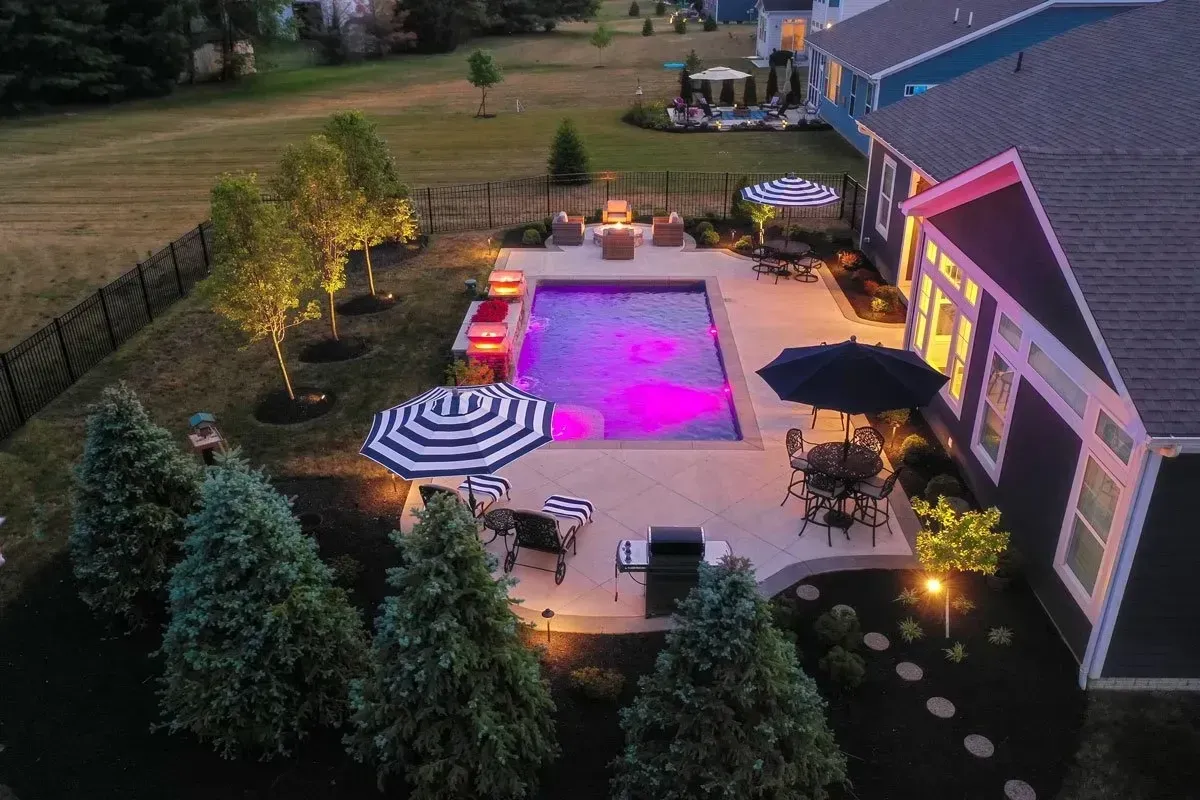
For homeowners in Crooked Creek, Atlanta National, White Columns, Bethany Creek, The Manor, Cogburn Estates, King Estates, Milton Forest, Greystone, or Hopewell Plantation — the common thread across Milton’s estate subdivisions is large lots, preserved rural character, and a growing appetite for integrated outdoor zones that honor both the equestrian heritage and the architectural realities of modern custom homes. The connector approach is not a Milton invention. It is, however, a Milton necessity. Every project where the horse barn is treated as a design constraint rather than a design partner ends up feeling like a suburban pool installed on a rural lot. That is a miss worth avoiding.
Hardscape Design and Construction across 20+ cities within 30 miles of Winder, GA
From Milton equestrian estates to Gwinnett subdivision lots, we build integrated pool, pavilion, and outdoor kitchen zones tuned to the specific topography, soil, and review path of each municipality.