
A homeowner in Atlanta Country Club called us on a Tuesday in May. She had a signed quote for an aluminum louvered pavilion over a new outdoor kitchen — modern, remote-controlled, beautiful in renderings. Two weeks later her ARC submission came back with a single line: solid pitched roof required, matching primary residence. The entire design had to start over.
That call is not unusual in Marietta. It happens often enough that we now ask one question before we draw a single line: what neighborhood are you in, and what does your covenant say about accessory structures. The answer shapes everything that comes next — the roof, the budget, the footings, the electrical run from the Cobb EMC meter, even where the grill vent can terminate.
This post is about the specific head-to-head that keeps coming up on Marietta jobs: a solid-roof timber pavilion versus an aluminum louvered pergola over an outdoor kitchen. Both can look extraordinary. Only one will pass in the neighborhood you actually live in. Here is the real test.
The Marietta HOA Map Nobody Publishes
Covenants are not published on a public map. You have to read the one recorded against your parcel — every neighborhood is different. After running permit and ARC paperwork through Cobb County Community Development at 1150 Powder Springs St. for years, the pattern across Marietta’s subdivisions is consistent enough to summarize.
East Cobb, generally, is the stricter half. Older money, mature lots, a protective view of architectural continuity. Atlanta Country Club is the tightest ARC in the city — solid pitched roofs required on all accessory structures, shingle or standing-seam metal to match the primary residence, no flat, no louvered. Indian Hills is more flexible; either solid pavilion or louvered aluminum gets approved, provided it integrates architecturally. Walton Woods allows louvered with ARC approval and a drawing set showing color, dimension, and screening.
West Cobb moves differently. Burnt Hickory and newer Brookstone sections approve aluminum louvered routinely. The newer the neighborhood and the further from the country-club corridor, the more the ARC treats louvered as a legitimate modern amenity rather than a departure from the aesthetic.
None of this is a substitute for reading your own covenant. But it is a real distribution, and it means the first decision on a Marietta outdoor kitchen is not grill versus griddle or granite versus quartzite. It is: what does the ARC in my specific subdivision let me build over it.
Before you sign anything: Pull your recorded covenant (title company can send it) and locate the section on accessory structures. Look for “roof material shall match primary residence,” “pitched roof required,” or “no flat roofs.” If any of those three phrases exist, aluminum louvered is almost certainly non-starter.
What Actually Happens Under Each Roof
The roof decision drives the kitchen design beneath it more than most clients expect. A solid pavilion is a fully weather-enclosed outdoor room — 100% rain coverage, full shade, drywall-adjacent ambient temperatures in summer. An aluminum louvered pergola offers roughly 90% coverage when closed (louvers seal but not perfectly at the seams) and transforms into an open-air pergola when opened.
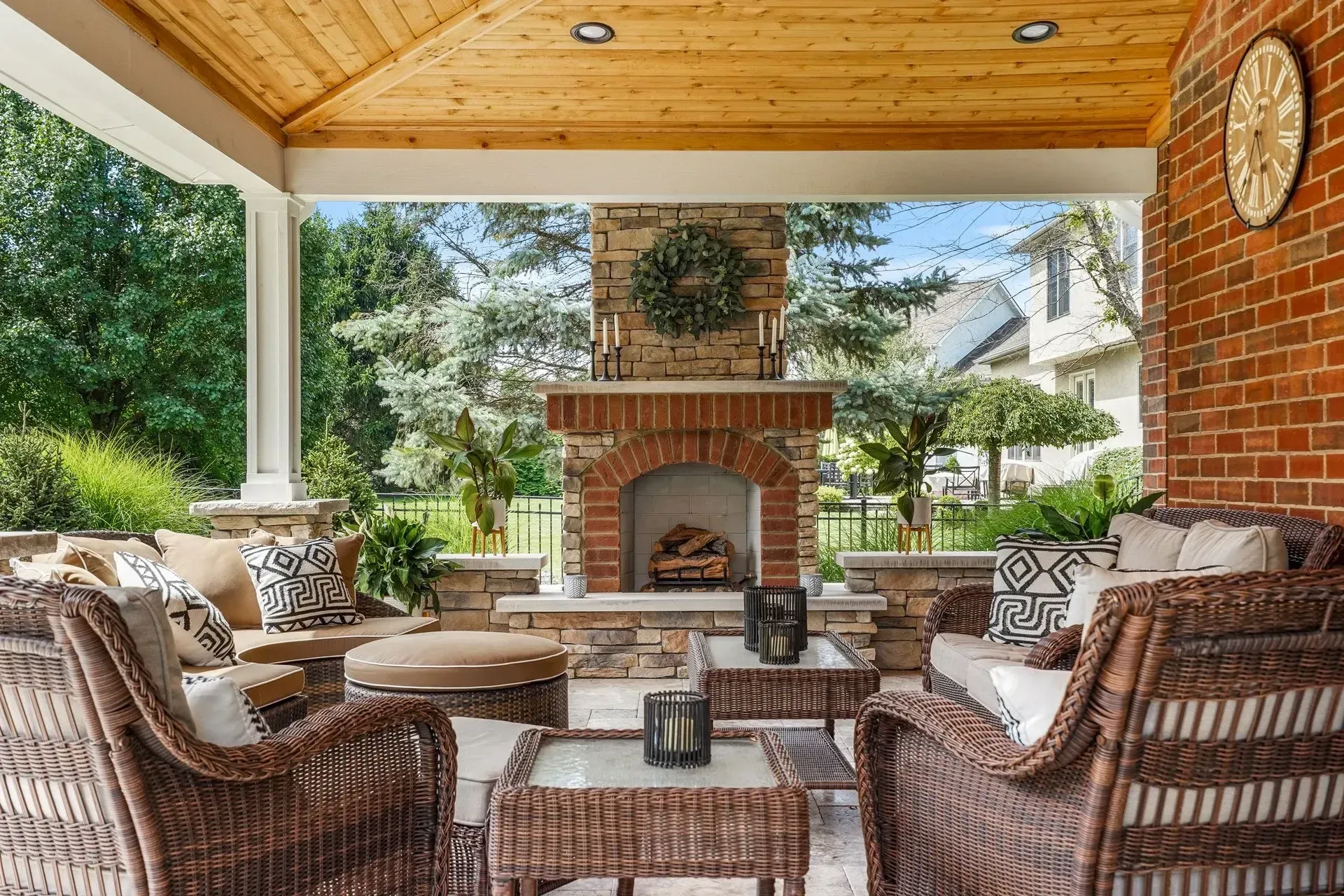
Under a solid pavilion, the kitchen becomes usable in almost any weather. Light rain, hard rain, pollen season, midsummer 94°F afternoons — you cook through it. The ceiling traps heat from the grill, which means we spec commercial-grade ventilation and keep the grill away from TV-wall areas. The cedar tongue-and-groove underside stays drier than any exterior surface in the yard, which extends its finish life by years.
Under an aluminum louvered roof, the kitchen behaves like two different rooms on the same footprint. Louvers open: it’s a breezy pergola, full sun-and-wind access, grill heat ventilates straight up. Louvers closed: it’s a covered porch with rain protection and climate control. The trade is that first minute of hard rain — louvers take 12 to 20 seconds to rotate closed, and if the homeowner isn’t there to hit the remote, the counter gets wet.
The Real Numbers — What Each Build Costs in Marietta
Marietta pricing, based on Primetime Pools’ 2025-2026 build log for 14×16 to 16×20 footprints with a built-in grill island and basic electrical (no roof, just the structure):
Note what those numbers mean in practice. On a 16×18 footprint, a mid-tier solid pavilion with stained cedar columns, Marvin standing-seam roof, and exposed rafter tails lands around $38,000 to $44,000. A comparable Struxure louvered system with the same footprint and integrated LED lighting lands around $34,000 to $42,000. The cost gap is narrower than most clients expect — the real decision is not price. It is approval and use pattern.
Why East Cobb Leans Pavilion, West Cobb Leans Louvered — And the Engineering That Goes With It
There is an actual reason this split exists, and it is not just architectural politics. East Cobb neighborhoods — Atlanta Country Club, Indian Hills, Walton Woods, Marietta Country Club — were platted between the 1960s and the early 2000s under a design philosophy that treated the primary residence as the defining visual element. Accessory structures were required to subordinate to it. A matching shingle roof is the cleanest expression of that philosophy.
West Cobb and the Kennesaw Mountain-adjacent neighborhoods were developed later, under a looser aesthetic framework, and often with more deliberately modern homes in the newer sections. Aluminum louvered roofs — clean black frames, horizontal proportions — fit that context naturally. On an Indian Hills brick Georgian, the same roof looks wrong.
Another factor is canopy. East Cobb’s mature oak and poplar canopy (one of the signature visual features of the older neighborhoods) already filters sunlight across much of the backyard. A louvered roof that can open for sky views returns less value when the actual sky is hidden behind 80-foot trees. A solid pavilion contributes its own architectural presence without needing to compete with the canopy. In the more open West Cobb and Brookstone lots, the open-sky view is a genuine amenity — louvers earn their keep.
Footings, Frost, and the Engineering That Follows
Both structures need 24-inch footings below grade per Cobb County building code, and both require engineered drawings over 200 square feet. That is where the similarity ends.
Solid pavilions on Piedmont red clay need wider pier pads than most builders spec. Cecil-series clay swells in winter wet and contracts in summer drought — a 12-inch diameter pier is marginal; we pour 18 to 24-inch diameter piers with #4 rebar cages and bell-bottom footings at frost depth. Undersized footings on a roofed pavilion show up as post heave after the second or third winter freeze cycle. Marietta averages 22 freeze events per year, and the cumulative freeze-thaw on undersized footings will rack the frame visibly.
Louvered aluminum systems are lighter — the structural demand on footings is less — but the electrical integration is more involved. The louver motor, LED perimeter lighting, and often heaters and fans pull a dedicated 240V circuit from the service panel. Marietta is split between two utilities: Cobb EMC serves the unincorporated county and some outskirts, and Marietta Power serves residents inside incorporated city limits. They have different service-drop specifications and different standards for sub-panel placement. Running a louvered pergola without that circuit mapped up front is how a $38,000 project becomes a $41,500 project mid-build.
Wind loading is the other engineering split. Lots on the slopes below Kennesaw Mountain (the 1,808-foot peak forms the north boundary of Marietta) experience above-average wind gusts funneled down the grade. A solid pavilion with a fully sheathed roof acts as a sail in those gusts — column anchors need more beef, and the leeward columns take tension loads the calcs have to account for. A louvered roof with louvers open passes wind through; with louvers closed it also acts as a sail but the structure is lighter. On mountainside lots in Burnt Hickory and the Kennesaw-adjacent streets, we spec 50 psf wind pressure instead of the default 40 — not always required, always worth it.
The Decision Framework — Six Questions That End the Debate
We walk every Marietta client through this sequence before we draw anything:
- What does the covenant say about accessory structure roofs? If it restricts to pitched/solid/matching, the decision is made. Skip to pavilion design.
- What architectural style is the primary residence? Traditional brick Georgian, craftsman, or transitional colonial reads awkward under a black aluminum louvered roof. Modern farmhouse, contemporary, or transitional reads natural under either.
- How open is the lot canopy? Heavy mature oaks overhead? Pavilion. Open sky over the patio zone? Louvered earns its cost.
- Do you entertain year-round or seasonally? Year-round cook-through-weather use favors solid pavilion. Three-season with warm-evening spring/fall bias favors louvered.
- Is a TV or sound system going under it? Pavilions protect electronics better. Louvered systems with tight seam work can too, but seam leaks in driving rain are the failure mode to plan for.
- What is the realistic budget ceiling — not the “stretch” — with 10% contingency included? If the answer is under $30,000 for structure-only on a 14×16 footprint, we’re looking at lower-tier louvered or a simpler pavilion. Above $40,000 opens real design conversation on both sides.
Those six questions resolve most Marietta kitchen projects in a single consultation. When they don’t — when the covenant is silent and the canopy is mixed and the architecture is transitional — we build a mockup in the yard with 2×4 posts and tarp before committing to a design direction. It takes a day and it has saved clients tens of thousands of dollars in reconsidered direction.
What We Actually Build Most Often in Marietta
Out of the last 30 outdoor kitchens Primetime Pools has built inside Marietta’s zip codes — 30060, 30062, 30064, 30066, 30067, 30068 — the distribution is roughly two-thirds solid pavilion, one-third aluminum louvered. That ratio is not a preference of ours. It is the ARC distribution of the neighborhoods where we work.
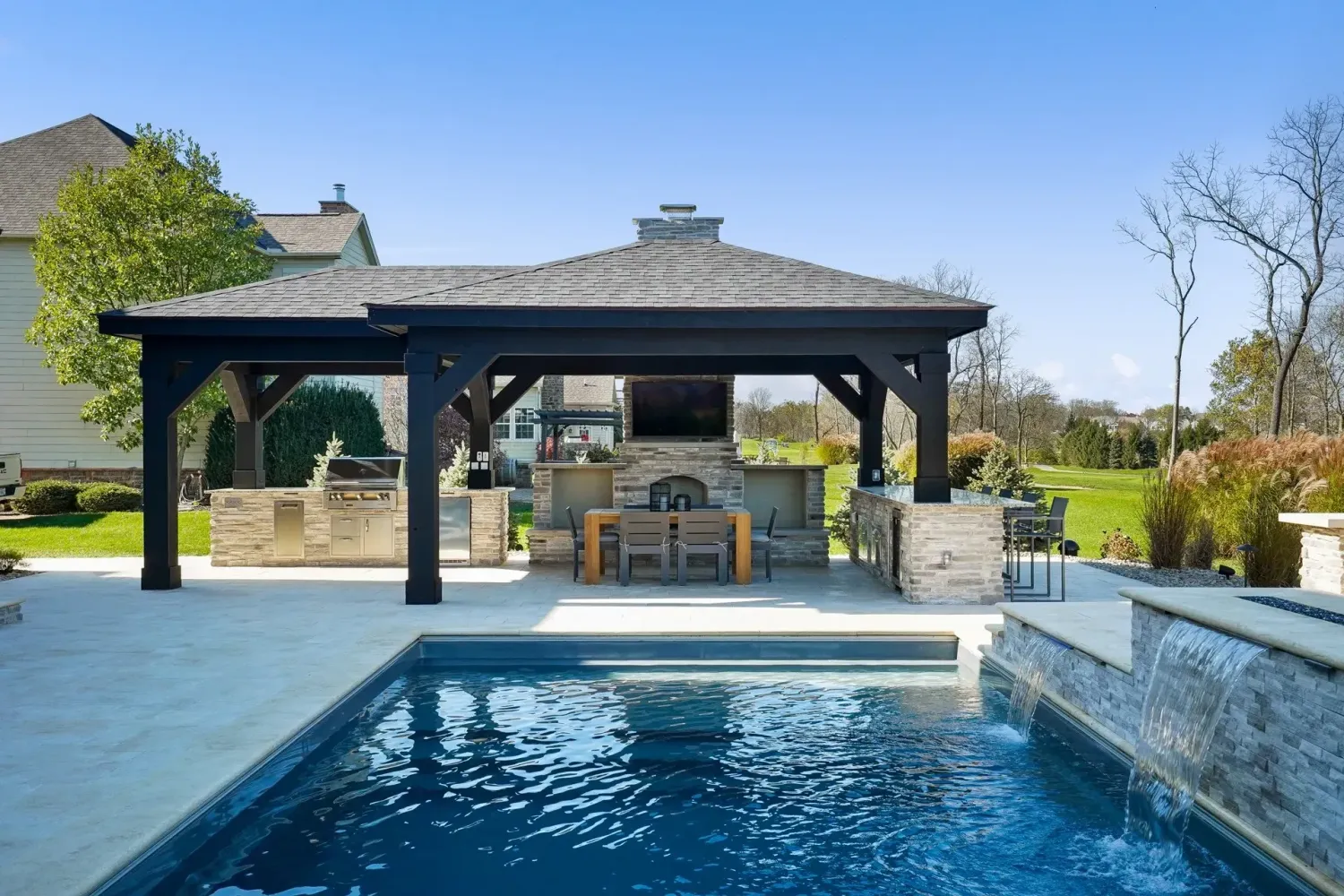
The pavilion clients, almost always, are in East Cobb. Cedar timber-frame with stained finish, standing-seam metal or architectural shingle roof, T&G cedar underside, ledgestone-wrapped pilasters that tie to the kitchen base. Between $32,000 and $48,000 for the structure alone, before the kitchen island, appliances, and deck finish are added. Total project including a built-in stainless grill, refrigerator, sink, and granite counter usually lands $62,000 to $95,000.
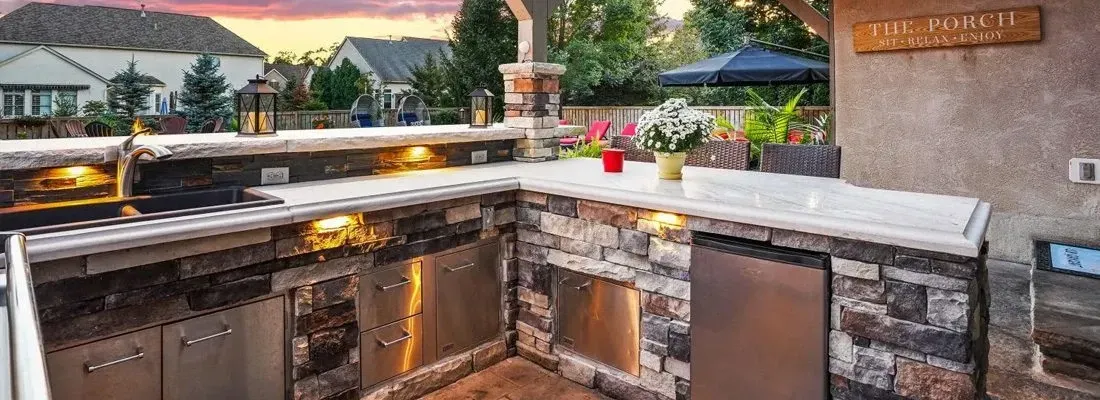
The louvered clients are predominantly in West Cobb and the newer Brookstone sections, occasionally Walton Woods or newer infill in East Cobb where the ARC has modernized. Struxure or Apollo frame in black powder-coat, integrated LED perimeter and under-beam lighting, remote-controlled louvers, often with integrated infrared heaters for shoulder-season use. Structure cost $32,000 to $42,000, total project $65,000 to $88,000.
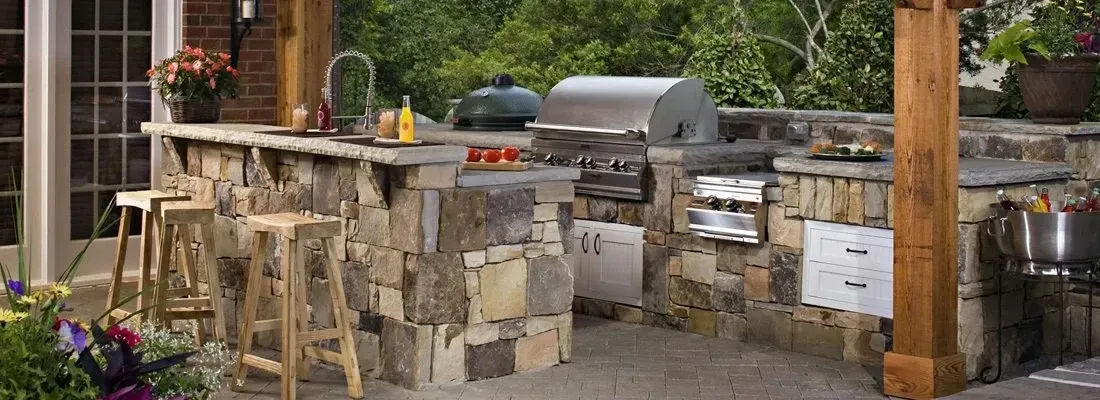
One pattern worth calling out: mature East Cobb canopy drops a serious leaf load into outdoor kitchens. Whatever roof you build, plan for clean-out. Oak and poplar canopy in Indian Hills and Walton Woods creates an above-average skimmer load on adjacent pools — and the same leaves settle on pavilion roofs, in louver troughs, and on any flat surface of the kitchen. Louvered systems have internal drainage channels that clog if not cleared annually. Solid pavilions with gutters need them pitched and cleaned the same way a house roof does. It is not a deal-breaker, but it is a recurring maintenance reality we make sure the client understands before the roof is specified.
Maintenance rhythm on a Marietta mature-canopy lot: Louvered pergola drainage channel — clear twice annually (spring after pollen, fall after leaf drop). Solid pavilion gutters — clean in late November and early April. Under-counter LED strips — inspect every spring, seal any water intrusion around junction boxes.
Four Scenarios That Show How the Decision Actually Plays
Scenario 1 — Atlanta Country Club colonial, 1998 build. Brick facade, shingle roof, 0.6 acre lot, mature oak canopy. Client wants a cooking and TV-watching kitchen. Covenant requires matching pitched roof. Decision: solid cedar pavilion, architectural shingle to match house, $44,000 structure. Louvered was never on the table.
Scenario 2 — Indian Hills transitional, 2008 build. Stucco-and-stone facade, hip-roof architecture, 0.8 acre, mixed canopy with open sky over the patio zone. Covenant allows either. Client splits time between Atlanta and a lake house, uses the kitchen mostly in April-October. Decision: Struxure louvered in bronze powder-coat, $36,000 structure. Open-sky evenings earn the extra complexity.
Scenario 3 — Walton Woods craftsman, 2015 build. Cedar shake accents, front-gable roof, 0.4 acre, partial canopy. ARC allows louvered with drawing set. Client wants a full outdoor room — TV, sound system, heaters, year-round use. Decision: hybrid — solid cedar pavilion roof over the TV/lounge zone, open slat pergola over the grill-and-prep zone for ventilation. $52,000 combined structure, approved on second submission with revised drawings.
Scenario 4 — Brookstone new-build transitional, 2022. Modern farmhouse, standing-seam metal primary roof, open .7 acre lot, minimal mature canopy. Client wants contemporary aesthetics and summer-evening sky access. Decision: Apollo louvered in matte black, integrated heat and LED, $40,000 structure. Would have read wrong on an older East Cobb home. Reads exactly right here.
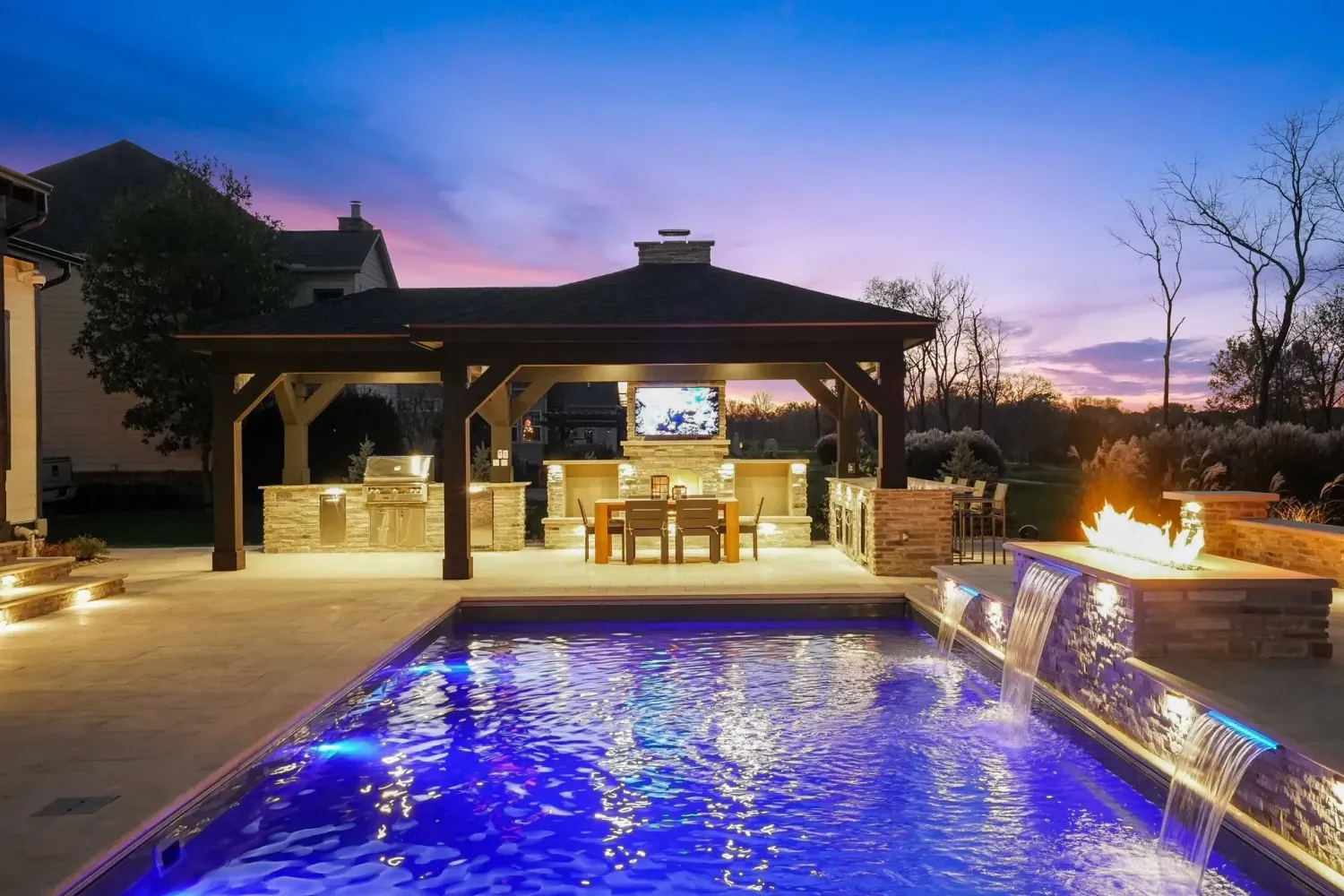
There is no one right answer. There is a right answer for your lot, your covenant, your architecture, and your usage pattern. We build both systems well. We have opinions about which one fits where, and we will tell you directly in the first site walk which direction the ARC in your subdivision will accept on the first submission versus make you re-draw.
The Marietta test is not about which roof is better. It is about which roof fits the specific parcel you own. Get that one decision right and every other choice downstream — the grill, the counter, the stone veneer, the lighting, the paver floor, the sink plumbing from the house’s supply line — becomes an easy series of coordinated calls. Get it wrong and you are paying twice to build once.
Outdoor kitchens and pavilion builds across 20+ cities within 30 miles of Winder, GA
We draw pavilion or louvered directions based on your actual covenant, lot canopy, and architectural style — not a template. Site walks in Marietta typically resolve the roof question in under an hour.