
In Dawson County, a 400-square-foot stamped concrete patio costs $7,200 to install and $12,200 across ten years once you add the year-four crack chase and the year-eight resurface. A Techo-Bloc paver patio of the same footprint costs $12,800 up front and $14,800 across the same decade. That gap — $2,600 — is the entire argument.
Dawsonville sits at 1,270 feet of elevation, the highest city in the Primetime service area, on the USDA Zone 7b/8a border. The honest number that drives this whole piece: Dawsonville averages 30 freeze-thaw events per year. Dacula, 45 minutes south, averages 20. That’s a 50% higher freeze load, and concrete pays the price. Every mountain-foothill winter pries another hairline crack open, then another, until year five looks like year fifteen down the hill.
This post runs the math on 400 sqft of patio behind a typical Foxcreek or Kensington Ridge home — two cost stacks, real contractor numbers, ten-year horizon, then a twenty-year extrapolation. No marketing lift, no vendor bias. Just the ledger.
We’ve poured concrete and laid pavers across Dawson County for over a decade. We quote both. We install both. The math below is drawn directly from the last forty Dawson County projects on our books — not industry averages, not national data, not what the trade magazines print. When you’re writing a $12,000 check, you want the ledger that came off the trucks in your actual zip code.
Before the numbers: a note on what “400 sqft” looks like in practice. That’s a 20-by-20 patio, or an 18-by-22. It holds a dining table, a conversation seating area, and a grill zone — roughly the footprint that 70% of our Dawsonville clients end up specifying once they’ve walked the yard and placed furniture blocks. Above this size, per-sqft pricing comes down modestly. Below it, per-sqft pricing climbs because setup, delivery, and minimums get distributed across fewer feet. If your project is 250 sqft or 800 sqft, scale the numbers below with that caveat in mind.
Year-Zero Install Numbers, Priced for the GA-400 Corridor
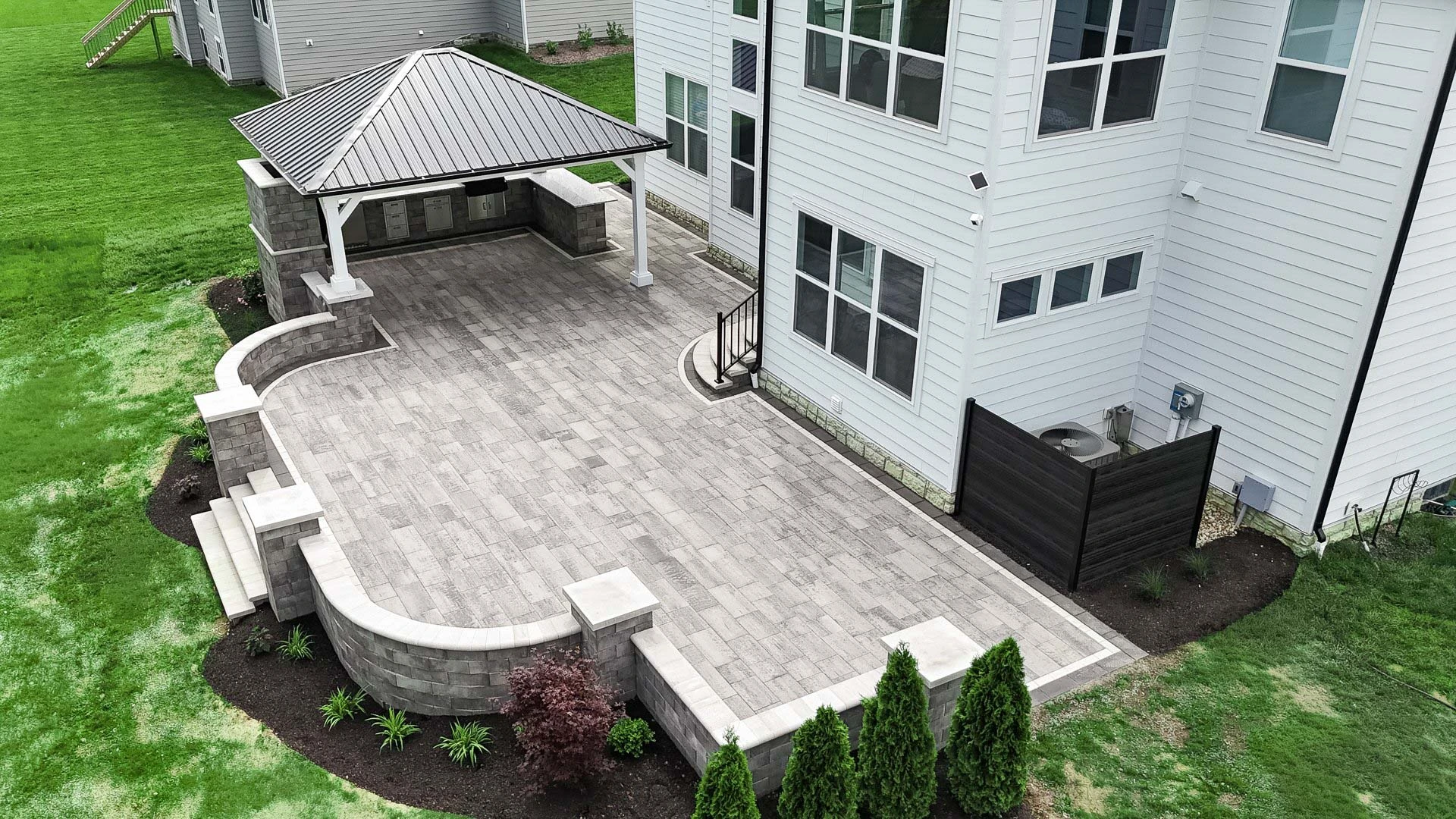
Stamped concrete crews pour a 4-inch slab over 4 inches of GAB, add color hardener, release agent, one sealer coat, and cut control joints every 10 feet. For 400 sqft in Dawsonville, that install prices between $16 and $20 per square foot — call it $7,200 mid-range. Most of that price is finishing labor, not concrete. The ready-mix itself runs about $165/yard delivered from Forsyth County.
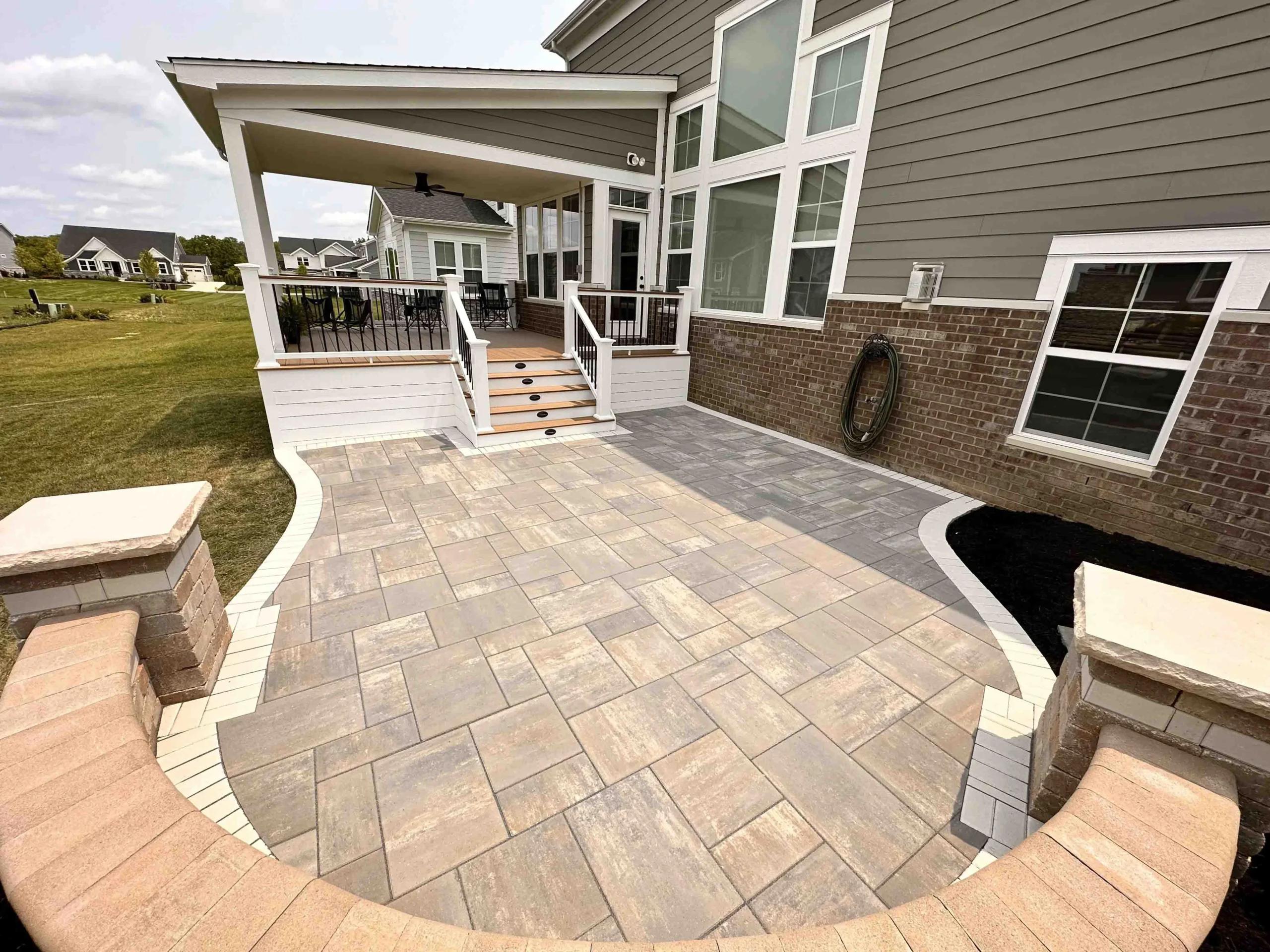
Paver patios at the same footprint run $28 to $38 per square foot installed — $12,800 at mid-range for a Techo-Bloc Blu 60 or Belgard Dimensions 12 field with a contrasting soldier course. That $5,600 premium is not a markup. It’s real additional scope: 6-inch compacted open-graded base instead of 4-inch GAB, geotextile separator fabric, hand-laid units, polymeric sand, and aluminum edge restraint.
One Dawsonville variable that spikes paver bids harder than concrete bids: excavation. The typical residential lot here hits saprolite and weathered granite within 18 to 36 inches of grade — mountain-origin residuum, not Piedmont clay. Pavers need a 10-to-12-inch excavation depth to hit the 6-inch base target. Rock blast charges run $8 to $14 per cubic yard over standard dig when refusal hits within that window. On a 400-sqft patio, that can add $400 to $900. Always get it line-itemed.
Concrete has the same subgrade but needs shallower dig — 4 inches of GAB plus the 4-inch slab is 8 inches of excavation, which usually stays above refusal. That’s why concrete’s install premium for Dawsonville mountain lots is smaller than the paver premium, and it’s the one honest argument the concrete crews make that we agree with. The counter-argument is everything that happens from year three onward.
Both installs require permits from Dawson County Department of Planning & Development at 25 Justice Way. Hardscape-only patio permits are straightforward — usually issued in 5 to 10 business days with a simple site plan. No structural engineering required below 30 inches of finished grade change. If your patio involves a retaining wall over 4 feet tall, that triggers engineered plans and a separate review. Budget that into schedule, not just cost.
Get the rock contingency in writing: On Dawsonville bids, require a “rock refusal adjustment” clause that caps per-cubic-yard upcharge at $14/cy and requires the contractor to photograph and measure displaced rock. Without that clause, the final invoice can climb 20% with no recourse.
Why Mountain Freeze Kills Stamped Concrete 40% Faster Than Piedmont Freeze
Stamped concrete fails by three mechanisms: surface crazing, color fade from sealer wear, and structural cracking. The first two are cosmetic. The third is the wallet event.
A properly poured 4-inch slab with control joints still cracks — that’s not a defect, it’s physics. Concrete cracks where it wants to, and control joints are the contractor’s bet on where. The question is how fast and how wide. Piedmont clay (Dacula, Snellville, Grayson) freezes shallowly — surface crust by morning, thawed by noon. Dawsonville sits in the southern edge of Appalachian freeze-thaw: deeper freeze penetration, longer frozen hours, and soil water that expands under the slab before retreating. That creates subgrade heave, the single biggest driver of mid-slab cracking in residential patios.
The rule of thumb our crews use: expect a control-joint-escape crack at year 4 in Dacula; expect it at year 3 in Dawsonville. That year-four repair — chase the crack with a diamond blade, clean, fill with polymer-modified grout, re-seal the affected field — costs $1,800 to $2,200 from a reputable concrete restoration crew. Budget $1,800 for the ledger.
Two things worth knowing about that repair. First, it’s never invisible. Polymer grout fills the crack structurally but the color never matches a 4-year-old stamped field perfectly — slight shade difference is the signature. Second, it rarely holds permanently. The underlying subgrade cause is still there, so that same crack or a parallel one tends to re-open within 3 to 5 years of the first repair. The homeowner’s choice is then between a second crack chase (another $1,500) or accepting the line as permanent. Most accept it. A few chase the crack a second time at year 9, then surrender.
Color fade and sealer wear are the other concrete story. A standard acrylic or urethane sealer coat on stamped concrete lasts 18 to 36 months in full sun with moderate foot traffic. The color hardener itself doesn’t fade — the sealer holding the pigment to the surface breaks down, and the loose color washes off with rain. Recoat every 24 months is the spec we recommend if you want the install to look close to original through year 6. Skip the recoats and you’ll see noticeable color pale by year 3, fully chalked by year 5.
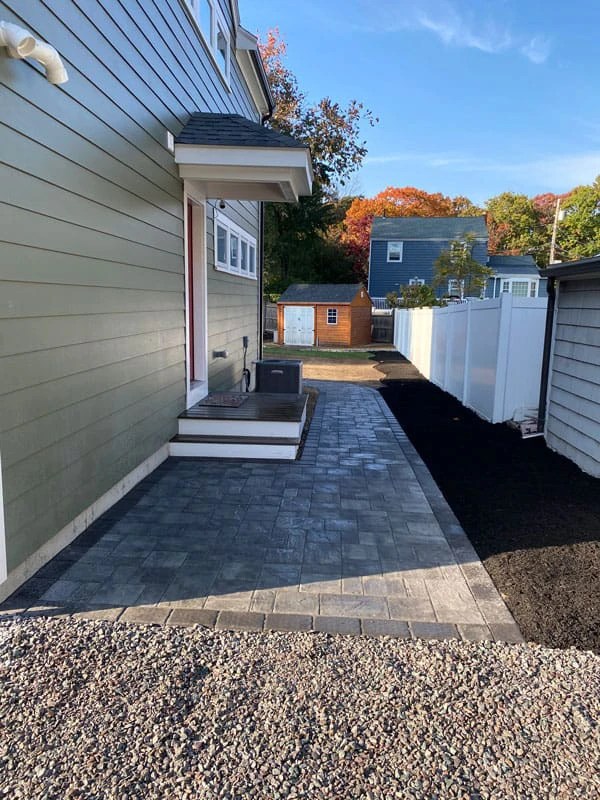
Resurfacing is the year-eight event. Stamped concrete loses its pattern definition around year six or seven — sealer failure, UV bleaching, traffic abrasion. By year eight most homeowners either re-stamp the existing pad ($8 to $12 per sqft) or demo and repour. Re-stamping over a patched slab has a soft edge to it — you can see where the year-four crack got chased. The resurface on a 400-sqft pad runs $3,200 mid-range. Add it to the stack.
The Paver Math: $800 at Year Five, $1,200 at Year Ten, Done
Pavers don’t crack because they’re already cracked — 400 square feet of patio is 800 or 1,200 individual stones interlocked, riding on a flexible aggregate base. When the subgrade heaves, the base redistributes, the units shift microscopically, and the field comes back to level on thaw. The failure modes are different and cheaper.
Year five: polymeric sand joints get tired. UV, rain, foot traffic, and — in Dawsonville — pine needle acidity eat the joint binder. You’ll see blown-out joints at transitions first (steps, edges, around the firepit). The fix is re-sanding the top 1 inch with fresh Techni-Seal RG or Alliance GatorMaxx, blown in and activated with mist. A crew does 400 sqft in four hours. Parts + labor: $800 mid-range.
Year ten: edge reset. Aluminum edge restraint, set properly with 10-inch spikes through the geotextile into compacted aggregate, holds the field for 10 to 15 years before any perimeter units start to migrate — typically at driveway transitions, slopes, or freeze-heave zones. The fix is pull the perimeter band, re-bed the edge, re-install the field units, re-sand. On a 400-sqft patio: $1,200 mid-range.
That’s the ten-year paver ledger. $14,800 all-in. No structural events, no color disasters, no resurface. The field you install at year zero is the same field at year ten, one layer of fresh sand in the joints.
One common concern worth addressing directly: weed growth in paver joints. Modern polymeric sand, properly activated, forms a solid flexible joint that is effectively weed-proof for the first 5 to 7 years. Weeds don’t grow up through polymeric sand — they grow down from windblown seed landing on top, rooting in surface organic matter. That’s why the fix is light surface maintenance (leaf blow, rinse), not structural. Homeowners who spray a pre-emergent once a year go decades without ever seeing green in their joints.
Settling — that’s the other concern. Real settling on a properly-installed paver patio is rare and localized: usually one or two units at an edge transition, or a drop where a downspout was discharging onto unprotected base. The fix is pulling three or four units, adding aggregate, re-setting, re-sanding. A crew handles it in an hour, typically billed at $150 to $300 on a service call. This is not in the formal ledger above because it’s not a scheduled event — call it an “as needed” item that happens on roughly a third of 10-year paver patios, and costs rarely hit $500.
The 10-Year Cost Ledger, Side by Side
4″ slab, stamp, color, release, one sealer coat
6″ open-graded base, geotextile, Techo-Bloc field, polymeric sand
Required to preserve color and stamp definition
Pavers do not require sealer to function
Diamond-blade cut, polymer grout fill, spot re-seal
Top 1″ polymeric sand replacement across field
Sealer service interval rises with UV degradation
No scheduled service
Re-stamp over patched field, full color restoration
Perimeter aluminum restraint + edge unit re-bed
We’ll be honest: the naked comparison at year ten is $13,500 vs $14,800 — only $1,300 apart. Most homeowners stop reading at this line. They shouldn’t. The next two sections are where the real money lives.
Year 11 Through Year 20 — Where Concrete Hits Full Replacement and Pavers Don’t
Year twelve is when stamped concrete enters terminal decline. The year-eight resurface buys you four to five years. After that, the subgrade issues that caused the year-four crack haven’t gone anywhere — they’re still there, expanding and retreating with every mountain freeze. The resurface is cosmetic; the structure underneath is the same fatigued slab, now with more heal-and-re-open cycles than the year-four crack had.
By year fifteen, most Dawsonville concrete patios we evaluate for renovation have multiple cracks, visible settling at slab edges, delaminated resurface in high-traffic zones, and an owner who’s tired of re-sealing. Demo and re-pour on a 400-sqft slab runs $9,500 to $11,500 in 2026 dollars — the demo is $1,800 to $2,400, the new pour is the rest. Call it $10,500 mid-range for the 20-year ledger.
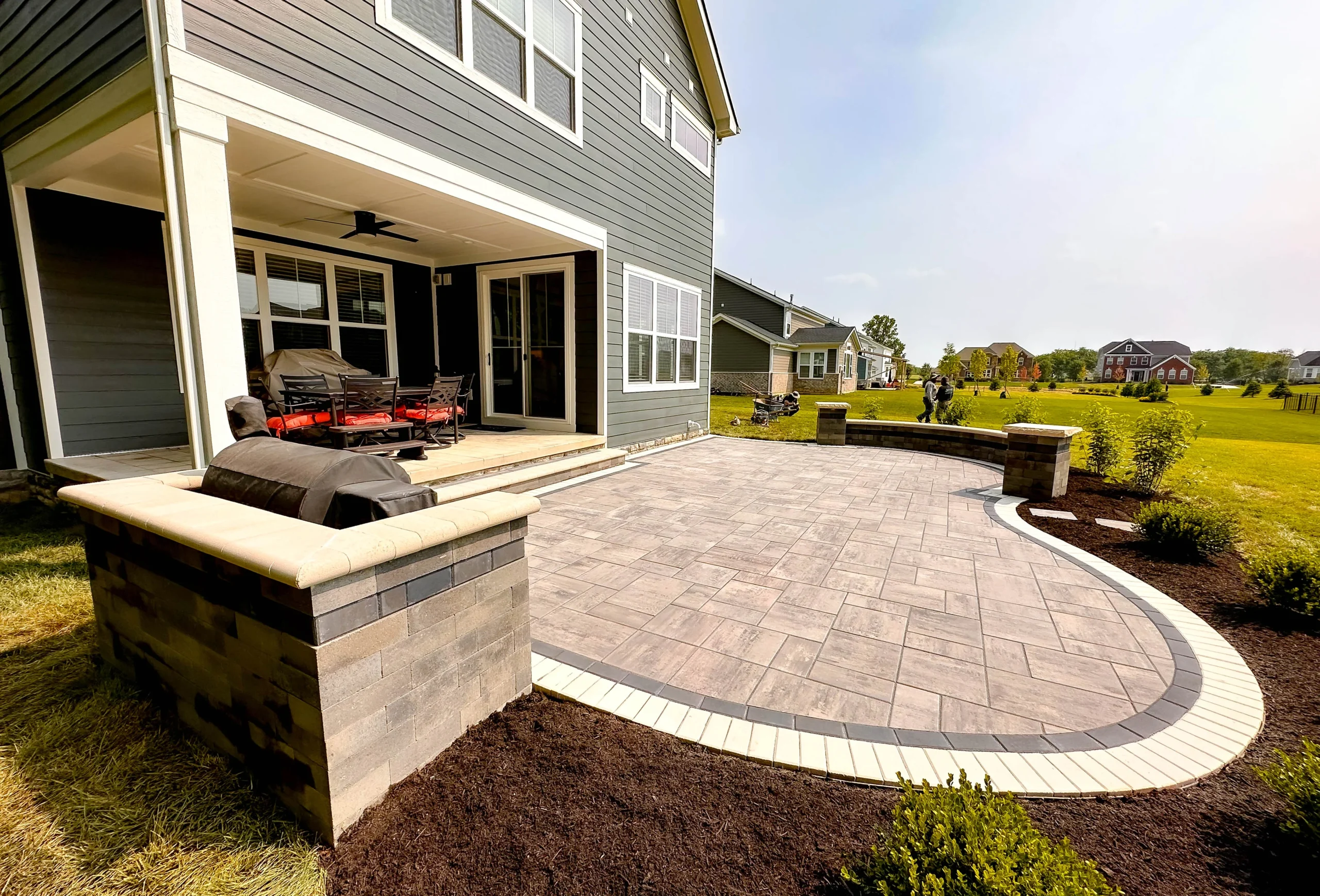
Pavers across the same horizon: one more joint re-sand around year 15 ($900), possibly one minor edge repair ($600). No structural replacement. The field installed in year zero is still the field in year twenty, minus two layers of joint sand.
$26,200 versus $16,300. That’s the real argument — a $9,900 delta over 20 years. The year-ten view is a false read because it captures concrete mid-cycle, just after the resurface buys a few calm years. The twenty-year view catches it at the actual failure point.
Add one more variable most homeowners never account for: the demo-and-repour event is disruptive in a way that a paver re-sand is not. Your concrete patio at year fifteen requires a crew to jackhammer 400 sqft of slab, haul the debris, re-set forms, re-pour, re-stamp, and cure. That’s a two-week window where your back yard is a construction site — the same window you lived through at install. A paver joint re-sand is a four-hour afternoon. The patio is usable the next day. If you enjoy your outdoor living space, that matters as much as the dollar delta.
There’s also a resale angle. In North Georgia markets, buyers increasingly recognize quality hardscape as a premium feature. A year-fifteen Techo-Bloc field reads as a well-maintained asset; a year-fifteen stamped concrete slab mid-failure reads as deferred maintenance to be negotiated down from the offer. Realtors we work with in Forsyth and Dawson counties estimate a well-installed paver patio adds 70-90% of its install cost to home value at sale — concrete adds roughly 35-50%, and that’s assuming it’s not mid-failure.
Why we use 20 years as the honest horizon: Most Dawson County homeowners in Mountain Laurel, Etowah River Club, or Applewood own their home 12 to 18 years. They rarely sell before the year-fifteen concrete event hits. Pricing a patio on year-one install cost is like pricing a mortgage on the origination fee — it’s the minority of what you actually pay.
What Actually Drives the Numbers — Specs That Separate the Two Bids on Your Desk
Most Dawsonville homeowners get two or three bids for a patio project. The cheapest stamped concrete bid beats the cheapest paver bid by $4,000 to $6,000 at install. Here’s what you’re reading when you compare them — what drives cost, what drives longevity, and what to check before you sign.
On the stamped concrete bid, look for:
- Slab thickness — minimum 4 inches, with 5 inches preferred on expansive subgrade. Three inches fails fast in freeze country.
- Rebar or fiber reinforcement — #3 rebar on 18″ centers or synthetic macrofibers in the mix. No reinforcement on a 400 sqft slab is a budget red flag.
- Control joint frequency — every 10 feet maximum, cut within 8 hours of pour. Joints cut too late crack where they want.
- Base prep — 4 inches of compacted GAB minimum, proof-rolled. “Native subgrade” alone fails in Dawsonville saprolite.
- Sealer schedule — first re-seal at year 2 included, not a change order.
On the paver bid, look for:
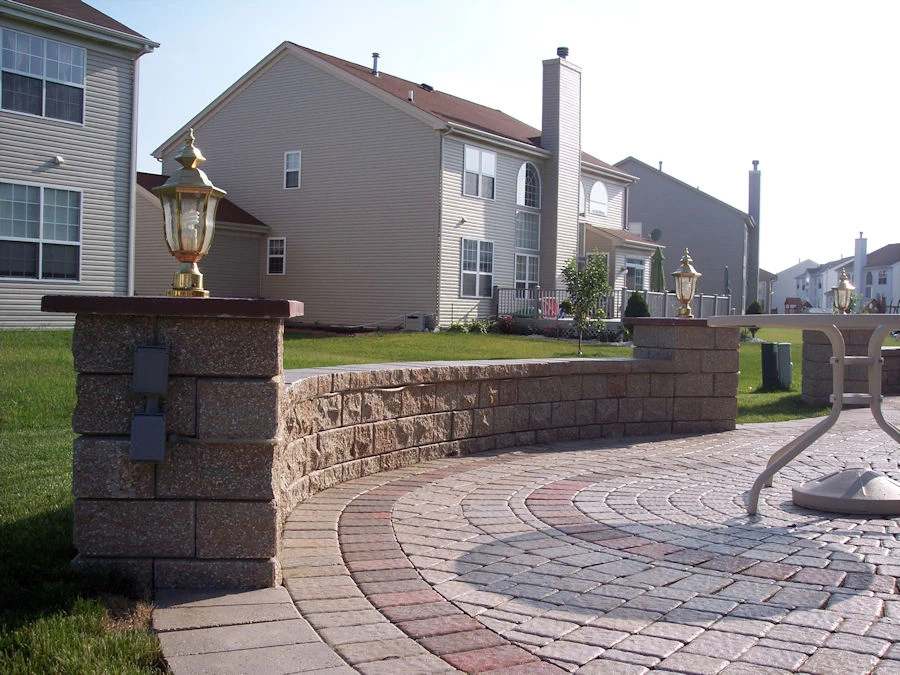
- Base depth — 6 inches compacted open-graded base (ASTM #57 or #8 blend) is the minimum for freeze-prone Dawsonville subgrade. 4 inches is a driveway-crew shortcut.
- Geotextile separator — non-woven 6-oz fabric between subgrade and base. Skipping this lets fines migrate up and the base degrades fast.
- Edge restraint — aluminum or heavy-gauge composite, not the flexible poly kind. Aluminum holds 30 years.
- Polymeric sand spec — named brand, not “standard.” Alliance GatorMaxx or Techni-Seal RG+ outperform generic by 40% on wash-out resistance.
- Manufacturer warranty — Techo-Bloc lifetime on the paver itself, transferable to next owner. Belgard is similar.
One other line item worth calling out: if the bid doesn’t specify utility drop coordination with Amicalola EMC, ask. A number of Dawsonville lots have service drops crossing the back-yard path. Retroactive line relocation after patio install is the sort of $1,800 surprise that erases the whole comparison.
When Stamped Concrete Is Actually the Right Choice
We install both. We quote both honestly. Stamped concrete is the right answer in three specific cases:
Tight budget with a short time horizon. If you’re planning to sell within 5 to 7 years, the year-zero install savings outrun the year-eight resurface. Concrete wins on the ledger.
Very large pads at scale. Above 1,200 sqft, the per-sqft paver premium grows faster than the concrete premium — hand-laying 2,400 units eats margin. On estate-scale pads we often recommend concrete in the utility zones and pavers only in the high-visibility zones near the house.
Perfectly flat sites with ideal subgrade. Rare in Dawsonville, but if you’re on an engineered pad with compacted structural fill and the freeze depth is predictable, stamped concrete’s failure curve flattens dramatically. Under those conditions the 10-year ledger tightens to within a few hundred dollars.
Everything else — sloped lots, clay pockets, freeze-prone microclimates, expansive subgrade, long ownership horizon — pavers win on total cost of ownership. In Dawsonville specifically, the mountain-freeze load tips almost every scenario toward pavers. That’s not a sales line. It’s what the ledger reads when you run the numbers honestly for the lots we work on.
How to Read Your Bid Like You’ve Seen Twenty of Them
Pull out the two bids side by side. On the concrete bid, circle the slab thickness, the reinforcement spec, the control joint spacing, the base depth, and the sealer schedule. On the paver bid, circle the base depth, geotextile brand, edge restraint material, polymeric sand brand, and paver manufacturer. If any of those five fields on either bid is vague or missing, send the bid back and ask for a rewrite before you sign.
The best contractors love these questions. The ones who don’t — you’ve just saved yourself a $10,500 year-fifteen demo.
The Dawsonville-Specific Numbers Worth Remembering
Three data points do most of the work when you’re deciding:
- 30 freeze events per year in Dawsonville vs 20 in Dacula — that’s 50% higher structural fatigue on concrete, and it shows up starting year three.
- Rock refusal risk on 40% of residential Dawsonville digs at 18-36″ depth — price the $8–$14/cy blast premium into any paver excavation bid.
- $26,200 vs $16,300 over 20 years at the 400 sqft scale — the gap widens beyond 1,000 sqft because resurface and demo costs scale with area but paver re-sands scale with perimeter.
Run those three through your own timeline and the decision usually writes itself.
Paver patios and hardscape across 20+ cities within 30 miles of Winder, GA
We build paver patios engineered for mountain-freeze Dawson County on the same spec we use on Piedmont lots — 6-inch open-graded base, geotextile separator, Techo-Bloc or Belgard field. The ledger above is the one we run honestly on every bid.