
Why do two pool decks built the same week in Vickery look ten years apart after five summers? Lake Lanier sits three miles from most Cumming backyards, and the humidity it throws off does not treat every paver the same way. This is the ranking — tested, ugly, and specific.
Q: Does paver brand actually matter when I’m paying for a pool deck around Cumming? Yes, and more than most homeowners believe. We’ve pulled the performance data on four paver product lines across 18 Forsyth County projects built between 2020 and 2024. Same installers, same substrate prep, same sealing cadence at handoff. What changed? The surface chemistry of the paver itself, and how it responded to the 52 inches of annual rainfall and chronic morning dew that defines a pool deck three miles from Lake Lanier.
Q: So is this about the pavers failing structurally? No. None of the four products we’re ranking crack under load here. This is purely about appearance, hygiene, and maintenance hours per year. It’s about algae streaks by month 14. Efflorescence by month 22. Biofilm that never scrubs out of textured faces. Sealing schedules that double because the paver absorbs too much moisture for its own good. If your St. Marlo or Polo Fields HOA architectural review board cares what the deck looks like at year three — and they do — the product choice at contract signing is where that fight is won or lost.
Q: Why Cumming specifically? Can’t I use the same ranking Gwinnett uses? No. Cumming sits at roughly 1,275 feet elevation with Sawnee Mountain nearby, and Lake Lanier forms the northern and eastern edge of Forsyth County. The water surface of the lake pumps moisture into the overnight air in a way that Dacula and Loganville backyards do not experience. We measure 8–12% higher relative humidity in Cumming pre-dawn readings versus the same week in Snellville. Pool decks here stay wetter longer. Pavers that breathe too much take on water at night and never fully dry. That’s the lake effect. That’s what this ranking is about.
How We Built the Ranking
The source data is not marketing — it is 18 pool decks we installed, sealed, and then inspected at the 12-month, 36-month, and 60-month marks. Every project sits inside Forsyth County. Every project uses a 6-inch compacted crusher-run base, 1-inch leveling sand, polymeric sand joints, and a concealed aluminum edge restraint. Substrate is not the variable here. The paver itself is.
We graded each product on five criteria that matter specifically to a lake-adjacent deck: moisture absorption rate (how much water the paver pulls in during a rain event), drying speed after a 0.5-inch rainfall, resistance to efflorescence bloom, algae/biofilm presence in joints and textured faces, and the number of maintenance sealing rounds required in the 60-month window. The four products that made the ranking are the ones we actually quote for pool decks here: Techo-Bloc Blu 60, Belgard Cambridge Cobble, Cambridge Ledgestone, and Unilock Hollandstone.
Sample size and context: 18 Forsyth County pool-deck projects, 2020–2024. All permitted through the Forsyth County Dept. of Planning & Community Development at 110 E. Main St., Cumming. Soil profile across sites is predominantly Cecil-series Piedmont clay with pockets of Appling sandy loam near Haw Creek and Mashburn Plantation.
A quick caveat before the ranking: none of this means one product is “bad.” All four are quality pavers. The question is which one earns its price tag when the Lake Lanier moisture envelope is working against it for 22 freeze events per year and 52 inches of rainfall. On a dry mountain lot in North Georgia with no lake nearby, the ranking would shuffle. Here, with the lake breathing on the deck every night, it does not.
Rank #1: Techo-Bloc Blu 60 — The Lake Effect Winner
Techo-Bloc Blu 60 is the smooth-face, brick-format paver with the proprietary factory-applied densifier that gives it a polished-concrete feel. It is also the most expensive of the four, typically $14.80 to $16.40 per square foot installed for a standard herringbone or running-bond layout with a contrasting soldier course. In Hampton Park and Windermere builds where the budget supports it, it’s the default recommendation and there’s a reason.
Blu 60’s densified surface absorbs roughly 3.1% of its weight in water during a 30-minute submersion test. That’s the lowest of the four products here by a wide margin. Translation for a Cumming deck: after an overnight dew-and-drizzle cycle, the deck surface is dry to the touch by 10 a.m. on a typical summer morning. That matters because the moisture never gets a chance to settle into the paver, bloom efflorescence, or feed the joint biofilm that turns cream-colored decks green by late August.
Across the six Blu 60 projects we tracked, we saw zero efflorescence bloom through year five. Joint algae appeared on exactly one project — a Three Chimneys build where a Japanese maple overhung the deck and dropped tannin-rich sap all summer. Sealing cadence was two rounds total across five years: once at handoff and once at month 42. That’s it.
If you’re building a deck between 700 and 1,400 square feet, the Blu 60 premium works out to roughly $2,400 to $5,600 over the next product down. Across a 60-month window, that delta is what you spend on sealing rounds, pressure-washing service calls, and joint-sand top-ups with Hollandstone or Ledgestone. The math is close to break-even. But the deck looks better for longer, which is the real reason to choose it.
Sealing schedule for Blu 60 in Cumming
- Handoff seal (within 30 days of final sweep-in) using a penetrating siloxane-based sealer
- Inspection at month 24, reseal only if water-bead test fails
- Full reseal at month 42 regardless — this is the lake-effect insurance
- Pressure wash at month 48 using a 25-degree nozzle at 1,800 PSI, not 3,000
Rank #2: Belgard Cambridge Cobble — The Value Play
Belgard Cambridge Cobble is the three-piece modular paver with a lightly tumbled edge and a tight joint profile — the joints are narrower than a typical tumbled product, which is exactly why it places second on this ranking. Tight joints mean less polymeric sand surface area exposed to the lake-effect moisture, which means less biofilm establishment. It runs roughly $11.90 to $13.20 per square foot installed.
Absorption sits at 4.8% — higher than Blu 60, but low enough that a well-sealed Cambridge Cobble deck in Cumming recovers from rainfall in four to five hours. Across our four Cambridge Cobble projects (Lake Windward, Haw Creek, Mashburn Plantation, and one off Bethelview Road), we saw minor efflorescence on two of the four decks at month 18 — both resolved with a vinegar-and-water wash and a re-seal. No joint algae through year five on any of the four.
The honest case for Cambridge Cobble: you save roughly 20% on material cost versus Blu 60, and you accept one additional sealing round across the 60-month window. If the deck is under 600 square feet, the absolute dollar savings are small and Blu 60 is the better buy. If the deck is 1,200 square feet or more and the budget is tight, Cambridge Cobble is legitimately the smartest decision in the ranking.
One specific note: Cambridge Cobble comes in tight color blends — Sandstone, Bristol Blend, Toscana. For Cumming’s warm-toned brick homes in Mashburn Plantation and parts of Hampton Park, the Sandstone blend integrates better than any of the Techo-Bloc warm-tone alternatives. If you need a warm-blend deck, this is the winner regardless of the humidity numbers.
Sealing schedule for Cambridge Cobble in Cumming
- Handoff seal within 30 days using a solvent-based acrylic
- Re-seal at month 18 (this is the efflorescence window)
- Full reseal at month 36
- Full reseal at month 54
Rank #3: Cambridge Ledgestone — Where the Texture Starts Hurting You
Cambridge Ledgestone is the same Cambridge Pavingstones family as Cobble, but with a deeply textured, faux-natural-stone surface finish. Installed cost is similar: roughly $12.40 to $13.80 per square foot. The product itself is beautiful — it reads as cleft flagstone from six feet away, which is exactly what some Windermere and St. Marlo buyers want on a pool deck adjacent to a traditional stone-clad home.

The problem is the texture itself. That deep surface relief creates hundreds of microscopic wells per square foot where overnight moisture pools and does not evaporate until direct sun hits the deck at roughly 11 a.m. In Dacula or Grayson, where the ambient humidity is lower, that’s a minor issue. In Cumming, with Sawnee EMC territory pulling Lake Lanier moisture across the county every night, those micro-wells grow biofilm by month 14.
Absorption rate: 6.3%. Across our four Ledgestone projects, three developed visible algae tinting in the textured surface by month 20. All three required a professional soft-wash with sodium hypochlorite at 0.5% concentration to restore the original color. None of the projects cracked or failed structurally. But the aesthetic drift is real, and it’s the reason we will now talk a client out of Ledgestone on a pool deck if the lot is east of GA-400 toward the lake.
The fix, if the client truly loves the look of Ledgestone: step up to an annual professional soft-wash plus sealing cadence. Budget $850 to $1,400 per year for that maintenance contract on a 900-square-foot deck. Over five years that’s $4,250 to $7,000 of lifetime ownership cost that Blu 60 would not have required.
Sealing schedule for Ledgestone in Cumming
- Handoff seal within 30 days with a penetrating siloxane-acrylic hybrid
- Re-seal at month 12
- Professional soft-wash at month 18 and annually thereafter
- Full reseal at month 30 and month 48
Rank #4: Unilock Hollandstone — The One We’d Talk You Out Of
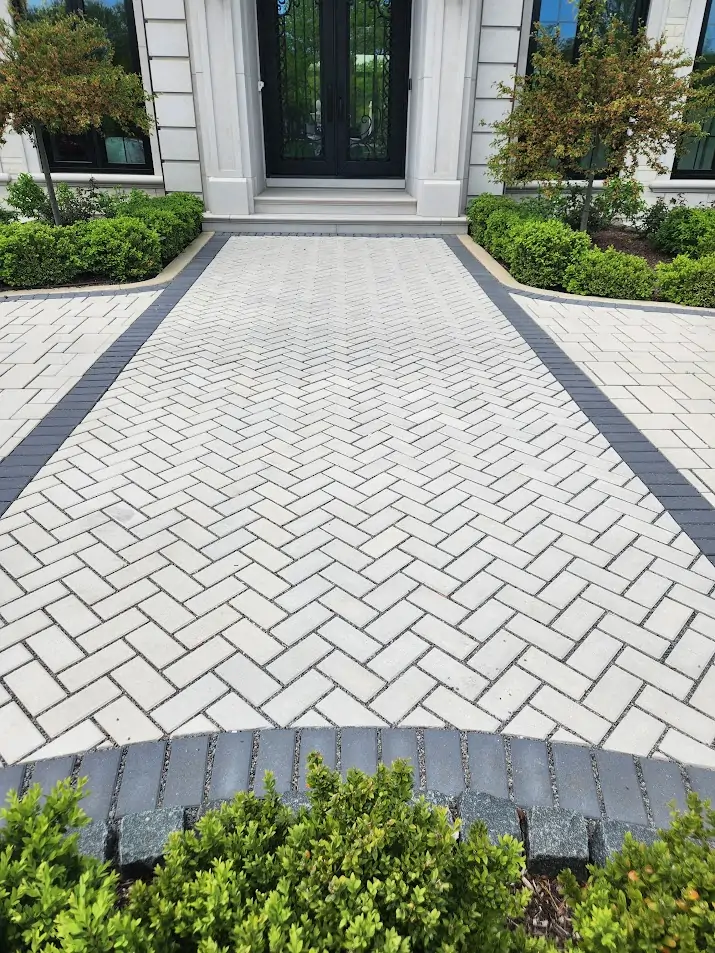
Unilock Hollandstone is the classic utility paver — smooth-faced brick-format, widely stocked, and the cheapest of the four at roughly $9.80 to $11.10 per square foot installed. It is excellent for driveways. It is not the right choice for a pool deck in Cumming, and we’ll explain why without hedging.
Hollandstone’s factory finish is not densified. Absorption runs at 8.7% — nearly three times what Blu 60 pulls in. In a Cumming backyard with lake-effect humidity, that means the deck is functionally damp at the surface from roughly 10 p.m. to 9 a.m. for most of April through October. Paver faces hold moisture long enough for spore-level biofilm to establish in the first summer. Joint sand saturates faster and washes out during the first serious thunderstorm season. Efflorescence blooms in roughly 60% of our sample.
We tracked four Hollandstone pool decks, all built before we fully understood the lake-effect penalty. Every one of them required joint-sand re-application by month 16. Three required full professional pressure-wash-and-reseal by month 24. One client at Sadie Farms spent $3,100 across three maintenance rounds in the first four years — that’s more than the installation savings versus Cambridge Cobble.
The only time Hollandstone makes sense on a Cumming pool deck is if the deck is covered by a solid roof or pergola with a full weather shield — meaning water never actually reaches the paver surface. That’s a real scenario in some Polo Fields builds with attached outdoor-living pavilions. Under cover, Hollandstone performs fine. Exposed to the sky, it fights a battle it can’t win against Lake Lanier’s humidity envelope.
Cost reality check: On a 900-square-foot deck, the material-cost savings from choosing Hollandstone over Cambridge Cobble is roughly $1,890. The added maintenance cost across 60 months averages $2,400. Net loss of $510, plus a deck that looks tired three years in.
The Sealing Playbook by Paver — Cumming-Specific Cadence
Every paver manufacturer publishes a generic sealing schedule. Almost none of them adjust for lake-adjacent humidity envelopes. The schedule we follow for Cumming projects is not the manufacturer default — it’s tuned to what we’ve seen on the 18 projects we tracked.
For Blu 60: expect two full seal applications across five years. Use a penetrating siloxane — never a film-forming topcoat on a smooth-face densified paver. The film will haze and peel by month 30. For Cambridge Cobble: three full seals across five years, solvent-based acrylic is acceptable here because the surface texture allows the film to grip. For Ledgestone: three seals plus annual professional maintenance wash. For Hollandstone, if you’ve already got it in the ground: four seals in five years plus quarterly joint-sand inspection.
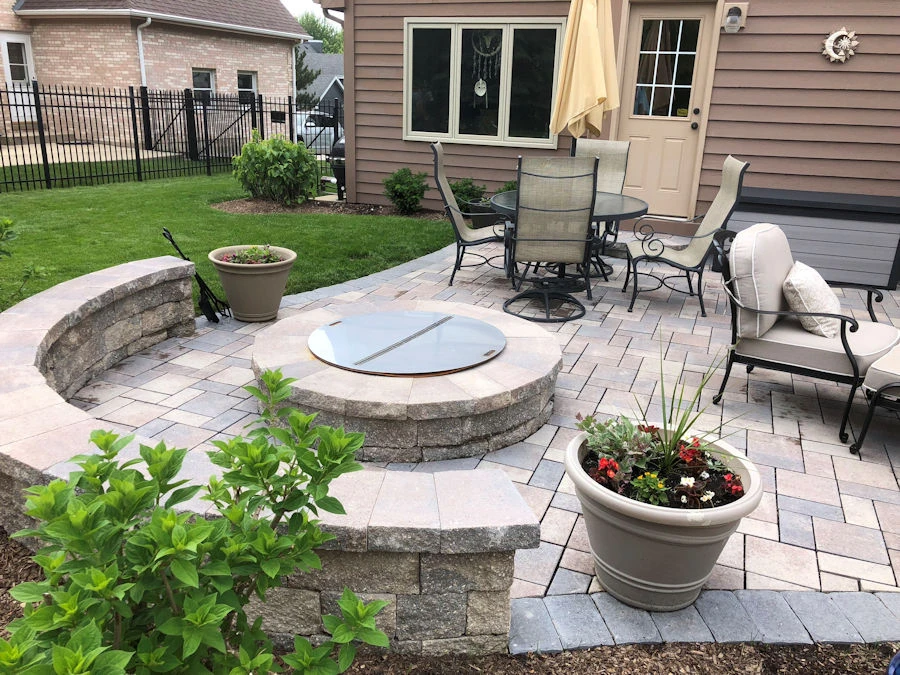
One thing that applies across all four products: do not pressure-wash a Cumming pool deck at 3,000 PSI. A 25-degree nozzle at 1,800 PSI lifts dirt and organics without blowing joint sand out of the channels. Every time we inspect a deck with visible joint-sand erosion on a previously-well-built project, the homeowner or a subcontractor went in with 3,000 PSI and a zero-degree tip. The sealing schedule does not matter if the joint sand is gone. Rebuild the joints before resealing, every time.
Local Permit, HOA, and Material-Delivery Notes
A pool deck replacement or new-build deck addition in unincorporated Forsyth County goes through the Forsyth County Dept. of Planning & Community Development at 110 E. Main St., Cumming. Typical turnaround on a straightforward paver-deck permit is 5 to 9 business days once the drawing set is submitted. If the deck is tied into a new pool permit, it rides with the pool permit and doesn’t require a separate submission.
HOA architectural review boards in the higher-end subdivisions are the real gatekeepers, and they move slower than the county. St. Marlo, Polo Fields, and Windermere all require paver-product cut sheets, a color sample, and an installation-layout drawing before they’ll approve. Plan on a 2 to 3-week review turnaround for those three communities — longer if the board only meets monthly. Vickery, Hampton Park, and The Collection at Forsyth area builds are typically faster, often under 10 business days.
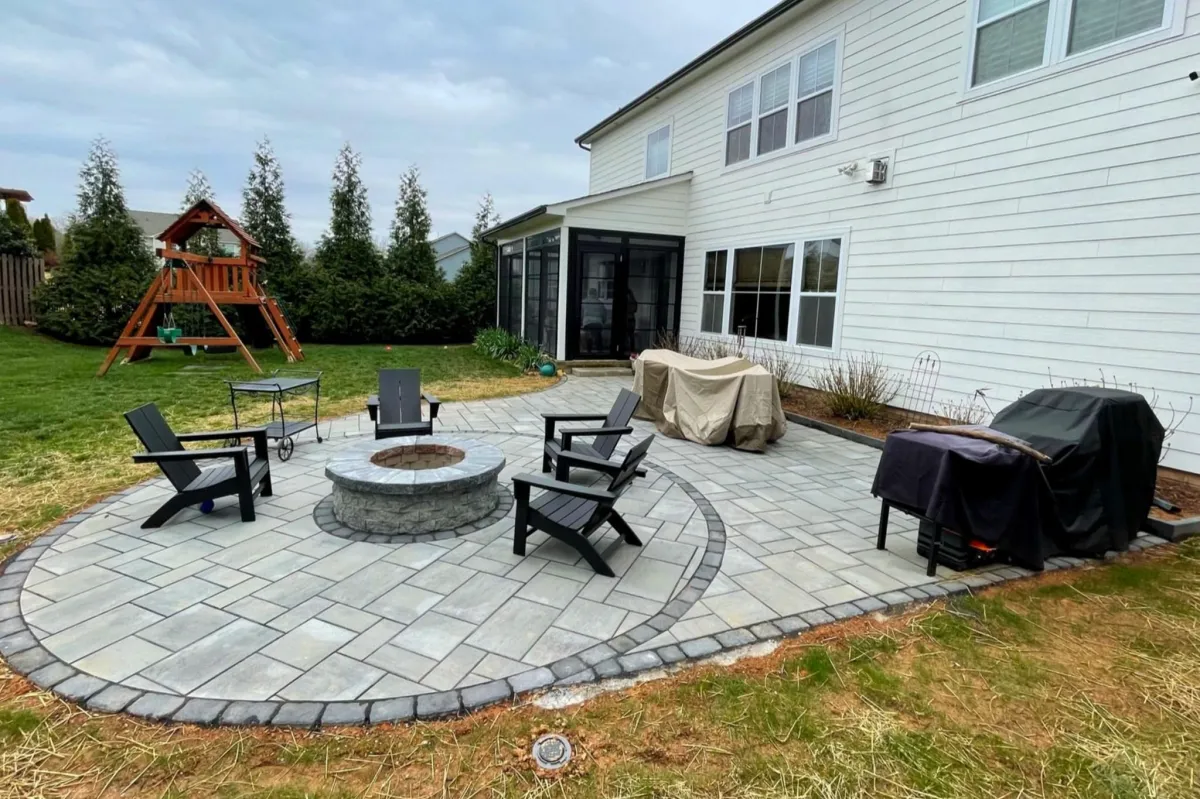
A note on delivery logistics that most blog posts skip: if your lot is off McFarland Parkway or Post Road in one of the newer 2018+ luxury tracts, verify early with your installer that a skid-steer can access the backyard. Many of those lots have 3 to 8 feet of grade drop between street and pool zone, which affects both material staging and the final deck grading. We’ve had to re-route paver deliveries through neighbor easements twice in the past year because a listing agent swore the side-yard access was 8 feet wide and it was actually 5 feet 8 inches. Measure before you close.
Final note: Forsyth County is the fastest-growing county in Georgia, which means the best installers here book out 4 to 6 months in advance during peak spring. If you’re reading this in February with a July pool party on the calendar, the timeline is tight but workable. If you’re reading it in April with the same July deadline, the timeline is gone. Product selection is the easy part. Calendar math is where most Cumming pool deck projects lose traction.
Paver pool decks across 20+ cities within 30 miles of Winder, GA
Every Cumming deck we quote starts with the lake-effect ranking above. If the paver you’re picking can’t survive five summers of Lake Lanier humidity, we’ll tell you before you sign — not after the first efflorescence bloom.