
Every paver driveway contractor quoting a job inside Indian Hills, Atlanta Country Club, or Sope Creek should be quoting two numbers — the one the homeowner wants to hear, and the one that keeps the driveway flat at year 10. In East Cobb, under the oak and poplar canopy that defines these streets, the cheaper number is a trap.
Here is the contrarian position, stated plainly: a paver driveway installed to the industry-standard 6-inch crushed-stone base under a mature East Cobb canopy will heave inside three to five years. Not maybe — predictably. The quotes homeowners are comparing on Johnson Ferry Road and Lower Roswell Road aren’t apples to apples, because most of them pretend the trees overhead don’t exist. The trees exist. Their roots are already under the driveway you’re about to rip out.
This post is specifically about installing a paver driveway on a Marietta lot with mature hardwoods — the kind of property that makes Indian Hills and Burnt Hickory beautiful and makes paver installation a different engineering problem than it is twenty minutes south in Smyrna. If you’re on a cleared infill lot with no canopy, the numbers in this post don’t apply to you. If you’re under 60-year-old oaks, they do.
The city of Marietta covers the six zip codes that anchor the heart of Cobb County — 30060 through 30068 — sitting at roughly 1,118 feet of elevation on the rolling Piedmont where Kennesaw Mountain rises sharply to 1,808 feet on the north boundary. That topography matters because it governs how water moves across every driveway we build. Paver driveways under canopy in Walton Woods drain differently than paver driveways on open lots near Marietta Square, and pretending the site doesn’t dictate the spec is the most expensive mistake a homeowner can sign off on.
What follows is the engineering we run on every canopied East Cobb job — the base sandwich, the root barrier, the Cobb County tree-permit math, the drainage plan, the paver selection, and the questions that separate a real bid from a cheap one. It is longer than most blog posts on this subject because the short version leaves out the parts that matter.
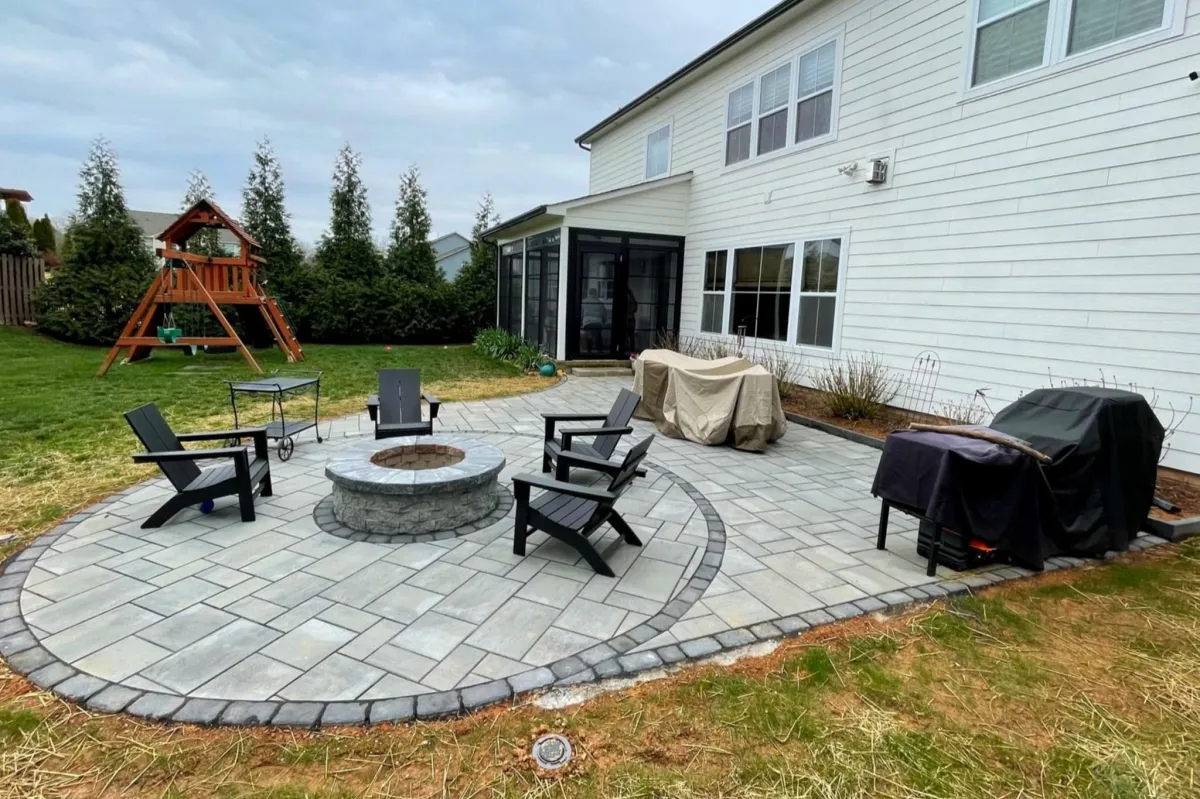
Why a Standard 6-Inch Base Fails in East Cobb by Year 5
The ICPI (Interlocking Concrete Pavement Institute) minimum for residential driveway base is 6 inches of compacted crushed aggregate over geotextile over subgrade. That spec assumes three things East Cobb lots routinely violate: stable subgrade without active root intrusion, consistent compaction at 95% modified Proctor, and surface drainage that moves water off the pavement in under 48 hours.
Under a mature oak canopy in Indian Hills or Walton Woods, all three assumptions break. Oak feeder roots actively seek the moisture gradient directly beneath a non-permeable surface — the paver field becomes a root magnet because water collects at the base-soil interface. Those feeder roots start at 1-2 mm diameter and thicken over three to five growing seasons. When a 10 mm root grows under a paver at 4-6 inches of depth, you get a surface differential. Differential becomes trip hazard. Trip hazard becomes lawsuit in HOA territory like Atlanta Country Club.
Piedmont clay makes it worse. The Cecil series soil mapped across most of Cobb County holds moisture at the clay-aggregate boundary, which is exactly where oak and poplar feeder roots want to live. We have pulled up five-year-old driveways in East Cobb and measured roots the diameter of a human thumb sitting directly on top of the original geotextile. The geotextile didn’t stop them. Nothing at 6 inches does.
The second failure mode is compaction. ICPI spec calls for aggregate compacted in 2-inch to 4-inch lifts, each tested to 95% of modified Proctor density before the next lift goes down. In practice, most residential crews compact the full 6 inches in one pass with a walk-behind plate. That gets you maybe 88-91% effective compaction on the bottom third of the base, which is exactly the zone where a growing root tip exerts the most pressure. Under-compacted base means the root doesn’t even have to lift the surface — it just pushes aggregate aside until the bedding sand migrates into the void. Then the surface drops instead of heaves, which is a different failure signature but the same root cause.
The third failure mode — and the one that kills driveways in Sope Creek and Chestnut Hill specifically — is hydrostatic pressure behind the root barrier. If a contractor installs a root barrier without a drainage plane, water trapped on the uphill side of the barrier freezes in winter, expands, and walks the barrier panels sideways over two or three freeze cycles. The panels stop functioning. Roots route around the displaced edge and the homeowner paid $4,000 for a feature that failed silently in year three. This is why we never quote a root barrier without quoting the drainage that makes it work.
Failure timeline observed on standard-spec East Cobb paver driveways: Year 1-2, no visible movement. Year 3, first surface irregularities near drip lines of trees within 15 ft of pavement edge. Year 4-5, measurable heave of 3/8″ to 3/4″ on individual pavers. Year 6-8, full replacement conversation.
The Full-Spec Root-Mitigation Build — Specs and Cost
The spec we install on canopied Marietta properties is materially different from the metro-standard driveway. Three additions drive the cost up and drive the service life past 25 years: a vertical root barrier, a geogrid layer, and a deeper base.
Here’s what “full-spec” actually means on a 1,000 sqft driveway in Burnt Hickory or Marietta Country Club:
- Vertical root barrier to 48 inches depth along any pavement edge within 25 ft of a protected-class tree trunk — we use Deep Root UB 48-2 high-density polypropylene panels, trenched and staked continuously along the barrier run.
- 10-inch compacted base of GAB (Georgia Aggregate Base, graded #57 over #67) instead of the 6-inch ICPI minimum, placed in two lifts and compacted to 95% modified Proctor with plate and walk-behind roller.
- Biaxial geogrid — Tensar TriAx TX160 or equivalent — placed between the two base lifts. The geogrid locks aggregate laterally so that root pressure from below translates into distributed load rather than a single-paver pop.
- Woven geotextile (Mirafi 500X class, minimum) under the full base — not the lightweight non-woven landscape fabric most contractors use.
- 1-inch bedding sand — washed concrete sand, not stone dust, screeded to grade.
- Polymeric joint sand — Techo-Bloc HP NextGel or Gator Maxx G2, activated with light misting per manufacturer spec.
That build runs $18 to $26 per square foot in Marietta, depending on site access, demolition scope, and drainage work. A metro-standard 6-inch-base install runs $9 to $14 per square foot. The spread is real. The service life spread is also real — standard fails at year 5, full-spec holds through year 25.
Amortize the numbers over twenty years. A 1,000 sqft cheap install at $12 per foot costs $12,000 and needs full replacement at year 6 — call the replacement $14,000 in year-6 dollars, then another partial rehabilitation around year 12. Twenty-year spend: somewhere north of $30,000. A 1,000 sqft full-spec install at $22 per foot costs $22,000 and holds without significant intervention. Twenty-year spend: $22,000 plus two or three sealer cycles. The “expensive” quote is in fact the cheaper quote once you price the second driveway the standard spec guarantees.
Homeowners who push back on this math usually do so because they’re comparing the first invoice rather than the twenty-year cost of ownership. That’s fair — most contractors don’t explain the twenty-year cost, because doing so benchmarks their standard quote against a better-engineered quote. We explain it because the homes we build driveways for in Atlanta Country Club and Marietta Country Club are held long-term. A driveway that fails in year five is not a feature of a long-term property.
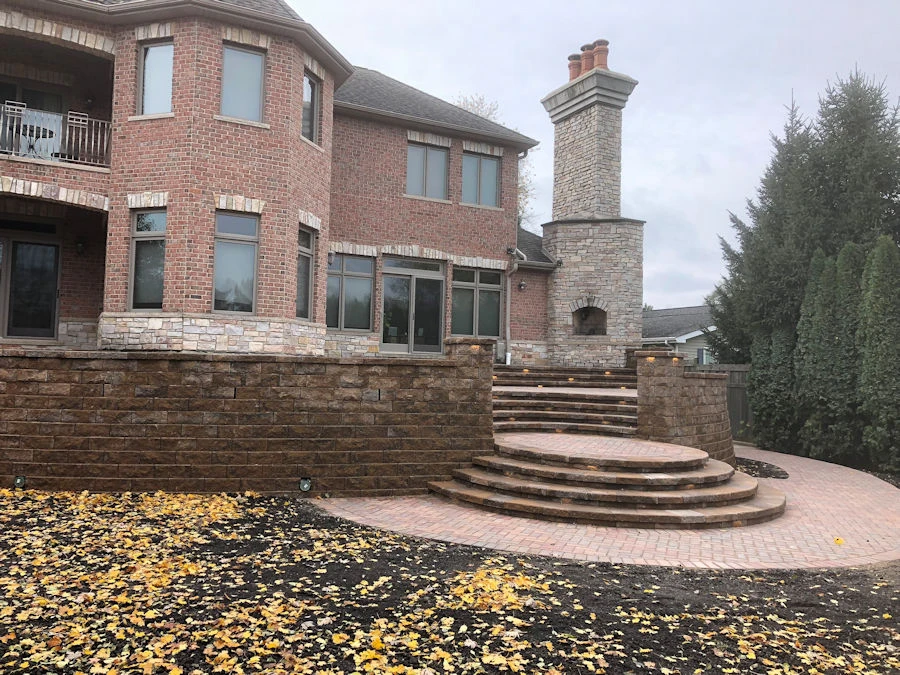
Cobb County Specimen Tree Protection — The Permit Problem Most Homeowners Miss
Cobb County’s tree protection ordinance is one of the stricter codes in Metro Atlanta. Any tree with a DBH (diameter at breast height) of 24 inches or greater is classified as a specimen tree. Removing or critically damaging one requires a permit pulled through Cobb County Community Development at 1150 Powder Springs Street. Damaging 50 percent or more of the critical root zone — defined as a radius in feet equal to 1.5× the DBH in inches — counts as critical damage even if the tree stays standing.
For a 30-inch DBH white oak, that’s a 45-foot-radius protected root zone. On a typical East Cobb lot, that circle frequently overlaps the existing driveway footprint. Which means the excavation you need to install a 10-inch base with a 48-inch root barrier cannot be done as a bulldozer dig along the full pavement edge without triggering a tree-damage review.
We handle this with staged hand-excavation and root-pruning. Along the tree-side edge of the pavement, the trench for the root barrier is dug by hand or with a pneumatic air spade — not a trencher — so that roots over 2 inches in diameter can be identified, cleanly severed, and sealed rather than ripped out. This adds labor, but it keeps the project on the right side of the ordinance and — more importantly — keeps the tree alive.
Cobb’s enforcement is not theoretical. We have been on jobs where a neighbor in Atlanta Country Club called in a specimen-tree complaint on a different contractor who ran a mini-excavator through a 38-inch-DBH white oak’s critical root zone without a permit. The stop-work order came same day. The fine was five figures. The tree was lost the following summer when drought and root damage compounded. The homeowner ended up with a driveway they couldn’t finish, a permit violation on the property record, and a dead specimen oak that had been standing since before the house was built.
The permit process itself is not onerous when the project is designed correctly. A tree protection plan drawn to scale, a tree survey identifying every specimen within 75 feet of the work zone, and a certified arborist letter signing off on the proposed root-pruning are usually sufficient. The Cobb County Community Development office at 1150 Powder Springs Street turns these around in one to three weeks depending on season. We include the permit scope in our estimates for any East Cobb driveway project with specimen trees adjacent to the work — it is not an upcharge surprise.
Cobb specimen-tree math: Critical root zone radius (ft) = 1.5 × DBH (in). A 32″ DBH oak has a 48-ft protected radius. Damaging ≥50% of that zone without a permit is an ordinance violation enforceable by Cobb County Community Development.
Drainage Engineering on the East Cobb Grade
Rolling Piedmont terrain gives most Marietta lots a 3-6 ft grade change from street to house. Combined with the roughly 52 inches of annual rainfall Cobb County receives and the 22 freeze events per year that come with USDA Zone 7b/8a, a paver driveway has to manage water aggressively or the freeze-thaw cycle will wreck the joint-sand and lift individual units.
We engineer three separate drainage functions into every canopied Marietta driveway:
- Surface flow — minimum 2% cross-slope, never more than 8% longitudinal slope. Anything flatter ponds on clay subgrade; anything steeper allows sand-joint scour during storm flow.
- Subsurface drainage — a 4-inch perforated HDPE pipe (ADS N-12 or equivalent) wrapped in filter sock and bedded in #57 stone along the uphill pavement edge, daylighting at the lowest property corner or connected to an approved infiltration basin.
- Freeze-protection detail — polymeric sand is specified rather than silica sand because Marietta gets enough freeze events to destabilize non-bonded joints. We don’t use polymeric sand for aesthetics; we use it because the alternative fails.
The detail most contractors miss is tying the subsurface drain into the root-barrier trench. Done right, the same 48-inch-deep excavation serves two functions — it stops roots laterally, and it creates a drained plane along the pavement edge that keeps moisture gradient from migrating under the base. Done wrong, the root barrier becomes an underground dam that pools water against the base and accelerates freeze damage.
Marietta’s freeze pattern is different from what you’d see a hundred miles south of here. The 22 freeze events per year cluster in five or six multi-night stretches between early December and mid-February, with occasional outliers in November and early March. Most of those freezes are shallow — surface air to 28-32°F overnight, rebounding above freezing by midday. But the soil under a paver driveway holds moisture from the preceding rain, and that moisture freezes at the base-aggregate interface rather than at the surface. Every freeze-thaw cycle that moisture runs shifts aggregate a fraction of a millimeter. Over a decade, a badly drained driveway can lose a full inch of grade consistency in the worst zones.
Kennesaw Mountain influences wind patterns on the north side of the city. Properties on mountainside lots in the Brookstone area catch colder air funneled down the Kennesaw slope on winter mornings, which means they see more frost events than the Cobb County average. We account for this on elevation-sensitive jobs — an extra course of GAB and tighter polymeric joint spec are cheap insurance against a microclimate you can’t feel from inside the house.
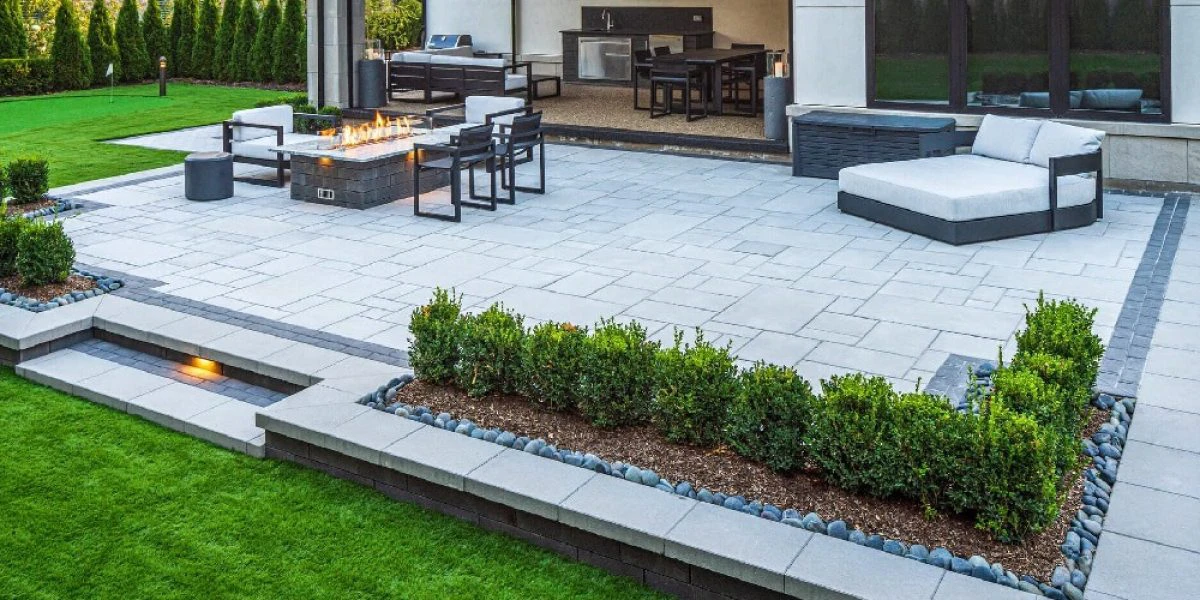
Paver Selection for Canopied Lots — Why Product Matters Here
Under heavy oak and poplar canopy, two product factors matter more than they do on an open lot: surface texture (because leaf tannin staining is constant) and unit format (because larger units span more aggressive root differentials without cracking).
On canopied Marietta driveways, we specify rectangular large-format units in the 60 mm to 80 mm thickness range. Thinner pavers crack under point-load when a root lifts the base unevenly. We use three product lines consistently in this market:
- Techo-Bloc Blu 80 Slate — 80 mm driveway-rated, chamfered edge, textured top, forgiving with debris staining. Our default for modern-transitional homes in Atlanta Country Club and Indian Hills.
- Belgard Cambridge Cobble — 80 mm three-stone pattern, better for traditional brick-and-stone architecture common in Walton Woods and Chestnut Hill.
- Pavestone Plaza Stone XL — budget-conscious option at the mid-range of the spec, but still 60 mm and driveway-rated. Works when the homeowner wants the engineering upgrade but not the premium paver.
Surface finish matters more in East Cobb than in newer subdivisions with young landscapes. Oak leaves release tannins; poplar leaves release acidic decomposition byproducts; both stain light-colored pavers aggressively unless the surface is sealed. We specify a penetrating silane-siloxane sealer — typically SEK-Surebond SB-5700 or equivalent — applied 6-8 weeks after install once efflorescence has cleared. Sealer gets reapplied every 3-4 years; skipping a cycle doesn’t destroy the driveway, but it does let staining accumulate to the point that a full acid wash becomes the only way back.
Color choice on a canopied lot is a quieter decision than homeowners expect. Light cream and ivory-toned pavers photograph beautifully in the showroom and then spend the next eight months of the year under leaf cover, holding tannin stains in a way that mid-tone gray and charcoal pavers simply don’t. We steer clients with heavy oak canopy toward mid-gray ranges with variation in the blend — slate, steel, charcoal with buff accents. The variation masks the inevitable staining between sealer cycles. Solid-color light pavers on a canopied lot are a high-maintenance aesthetic, not a low-maintenance one.
Pattern selection also matters on root-prone lots. Herringbone (both 45° and 90°) distributes point loads better than running bond or stack bond because the interlocking geometry lets adjacent pavers share a lift rather than rotating independently. For driveways — which carry both rolling wheel loads and occasional static point loads from parked vehicles — we default to 90° herringbone unless the architecture demands something specific. Running bond is fine on a walkway; on a driveway in Indian Hills, it’s a compromise most homeowners don’t realize they’re making.
What to Ask Any Contractor Quoting a Paver Driveway Under East Cobb Canopy
If you are evaluating three bids on a driveway replacement in Indian Hills, Sope Creek, Seven Oaks, or Marietta Country Club, the spread between the cheapest and the most expensive quote is almost always an engineering spread, not a greed spread. The cheap bid is the 6-inch base without root barrier or geogrid. The expensive bid is the full-spec build this post describes.
Six questions separate a real quote from a wishful one:
- What base depth are you quoting, and why that depth? If the answer is “6 inches, that’s standard,” the quote is optimistic for a canopied lot.
- Are you including a vertical root barrier along tree-side edges? At what depth? Anything less than 36 inches is decorative; 48 inches is the working spec for mature oak.
- Are you using geogrid between base lifts? If there’s no geogrid, there’s no lateral load distribution.
- How are you pulling the Cobb County tree-protection permit if required? A contractor who hasn’t thought about this is about to create a code problem you inherit.
- What polymeric sand product are you using, and what’s the warranty? NextGel, Gator Maxx G2, or Alliance G2 are the three we consider defensible. Cheap silica sand is a year-2 failure.
- How are you handling drainage along the uphill pavement edge? If there’s no perforated line in the plan, there’s no drainage plan.
The homeowner who asks these questions and gets real answers ends up with a driveway that looks identical to the cheap install on day one and materially different at year seven. That is the whole argument.
One more variable worth naming: the utility overhead. Cobb EMC services most of unincorporated East Cobb on 240V residential distribution, while incorporated Marietta addresses inside the city limits are on Marietta Power. Neither utility routinely runs its lines underground in the older East Cobb neighborhoods, which means overhead line clearance affects how contractors move equipment onto a job site. On a tight Indian Hills lot with 50-year-old trees and overhead utilities, the crew can’t simply swing a mini-excavator across the front yard — there’s a coordination cost. Contractors who haven’t worked in these specific neighborhoods underbid the mobilization and labor allocation. The bid gets “cheaper,” the timeline stretches, and the homeowner ends up with a seven-week project instead of a three-week one.
Another quiet variable: HOA culture. Atlanta Country Club, Indian Hills, and Marietta Country Club all have active architectural review processes. Paver color, pattern, and even edge detailing have to be submitted and approved before any demolition begins. We build that review into our timeline as a two- to four-week window. Contractors who ignore HOA review submit the plan after work has started, which is a documented pattern that ends in stop-work letters and owner-paid restoration. If the bid you’re reading doesn’t mention HOA submission, the bid is incomplete.
The driveway itself is sometimes the smallest line item on the scope of a well-executed East Cobb project. The root barrier, the drainage, the Cobb permit, the HOA submission, the traffic control during concrete demolition, and the disposal of the existing driveway all add up. When a bid looks suspiciously low relative to two others, one or more of those line items is missing from the scope. Ask which one.
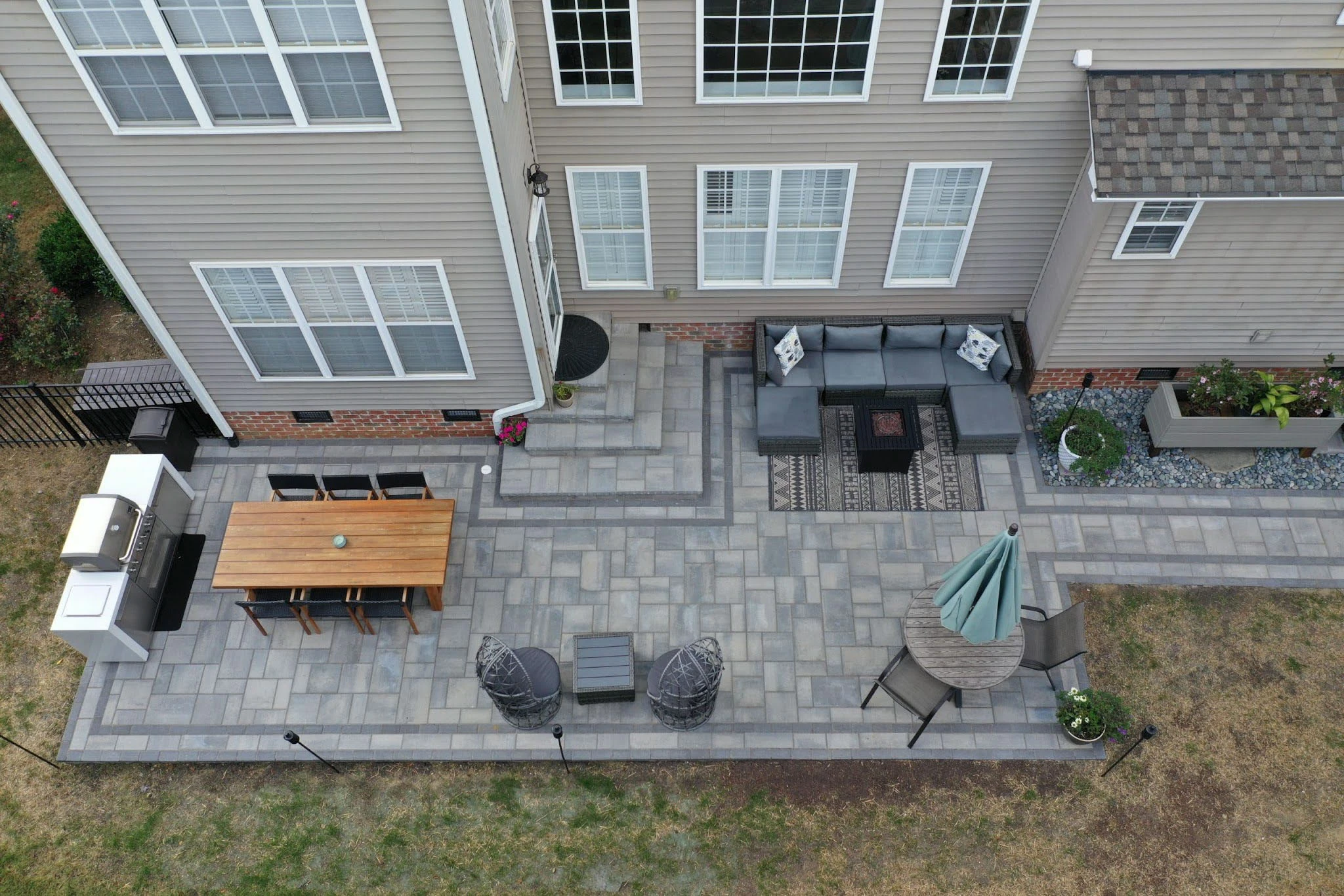
Paver driveways engineered for canopied lots across 20+ cities within 30 miles of Winder, GA
Root mitigation, deep-base builds, and Cobb specimen-tree permit navigation — the engineering under the surface is the reason our driveways hold flat past year 20.