
Every paver spec sheet in Georgia tells you 6 inches of compacted base is enough. Every paver spec sheet is written for generic Piedmont soil. Cumming doesn’t have generic Piedmont soil — it has Cecil clay with a 0.12-in/ft shrink-swell factor, and that single number is why your driveway either lasts thirty years or bellies out by year five.
We’ve rebuilt enough settled paver driveways in Forsyth County to stop treating the 6-inch base as a baseline. In Vickery, in St. Marlo, in the 2003-era Hampton Park cul-de-sacs where the original builder-grade driveways are now cracking in diagonal waves — the failure mode is always the same. Wet spring, dry August, wet spring, dry August. The clay under the base swells and shrinks. The base wasn’t deep enough to bridge it. The pavers ride the wave down.
This post is the math, the spec, and the contract language we use to oversize the base by 10% — 8 inches compacted instead of 6 — on every driveway we install inside the Cumming zip codes of 30040 and 30041. It costs more. It costs $2.80 to $4.20 per square foot more, to be exact. We’ll show you the year-five math on why it’s the cheapest line item in the whole project.
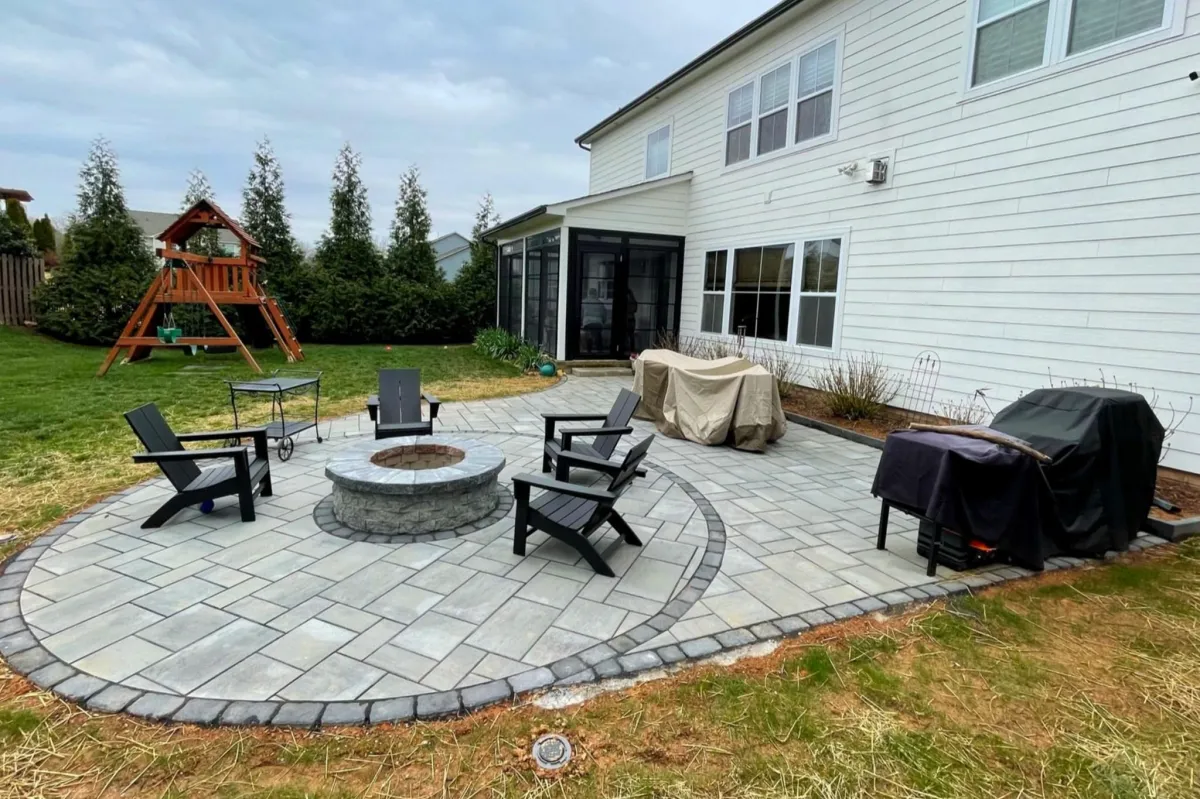
What Cecil Clay Actually Does Under a Driveway
The USDA soil survey for Forsyth County lists Cecil series as the dominant soil type across the rolling foothills from Sawnee Mountain down to Big Creek. Cecil is a well-drained kaolinitic clay loam on paper. In practice — especially the tight, high-density pocket near the Cumming City Center and along Bethelview Road — it behaves like a low-to-moderate-plasticity clay with a measurable shrink-swell coefficient of roughly 0.12 inches per vertical foot during wet-dry cycles.
That number sounds small until you stack it. A driveway sub-grade that’s 3 feet deep from finish grade to undisturbed sub-soil will move roughly 0.36 inches vertically between a saturated March and a drought-stressed August. Multiply across a 22-foot-wide by 80-foot-long driveway and you’re talking about ~1,760 square feet of surface that’s breathing up and down through the seasons. A 6-inch compacted base on Cecil clay does not have enough aggregate depth or load-distribution width to bridge that movement. An 8-inch compacted base does.
This isn’t theoretical. The Forsyth County Dept. of Planning & Community Development at 110 E. Main St. issues hardscape permits on projects that cross impervious-surface thresholds, and you can walk through any older Cumming subdivision and watch the exact failure pattern I’m describing. Diagonal waves. Soldier courses tilting inward. Wheel-rut depressions in the lanes where the SUV tracks sit every day. None of it is a paver problem. All of it is a base problem.
The shrink-swell rule we use on every Cumming driveway: For Cecil clay sub-grades, the minimum compacted open-graded base is 8 inches, placed in two 4-inch lifts, compacted to 95% modified Proctor, over a non-woven geotextile separator (Mirafi 140N or equivalent). No exceptions inside 30040 and 30041.
The 10% Oversize: What the Extra 2 Inches Actually Costs
Let’s name the number before we explain the reason. On a standard residential driveway in Cumming — call it 1,600 to 2,000 square feet — the delta between a 6-inch base and an 8-inch base is roughly $2.80 to $4.20 per square foot. For a 1,760 sqft driveway, that’s between $4,928 and $7,392 added to the bid. It shows up as three separate line items:
- More aggregate. An extra 2 inches across 1,760 sqft is ~11 additional cubic yards of GAB (graded aggregate base) or #57 open-graded stone. At Cumming delivered prices — roughly $42 to $58 per cubic yard — that’s $460 to $640 in material alone.
- More excavation. You’re removing 11 extra cubic yards of Cecil clay. That’s one additional dump truck load to haul off, plus an extra ~2 hours on the mini-excavator. Figure $1,100 to $1,600.
- More compaction time. Placing and compacting in 2-inch lifts instead of one 6-inch lift roughly doubles the plate-compactor hours on a driveway, and the 95% modified Proctor target on the extra lift adds a separate compaction pass. Figure $900 to $1,400 in labor.
Total add, middle-of-range, on a typical Cumming driveway: about $5,800 to $6,400. Call it a 12% to 16% premium on the base scope, which usually pencils out to an 8% to 11% premium on the total driveway project when you include the paver field, edge restraint, and polymeric sand.
Now the part where I show you why that $6,000 is the best-spent line item in the contract.
The Year-Five Settlement Math Nobody Shows You
Here’s the economic case, named in numbers. A properly built driveway with a 6-inch base on Cecil clay does not fail catastrophically. It settles gradually. The typical pattern we see in Cumming: 3/8-inch to 5/8-inch of differential settlement by year 4 or 5, concentrated in the wheel paths and along the edges where the restraint is weakest. That settlement unlocks polymeric sand, which opens joints, which admits water, which accelerates further settlement. Each cycle is worse than the last.
At year 5 to 7, the remediation options are: (a) lift and relay the affected section, which runs $11 to $16 per square foot because you’ve already paid for the pavers once and you’re paying again for labor to remove, clean, re-base, and re-lay; or (b) full teardown and rebuild, which runs the full replacement cost — typically $22 to $34 per square foot depending on paver selection.
On our 1,760 sqft example driveway:
- Repair at year 5 (30% affected area): ~530 sqft × $13/sqft = $6,890. You spent $6,000 to skip this and you’re back at square one on the next freeze-thaw cycle.
- Teardown and rebuild at year 8 to 10: 1,760 sqft × $28/sqft = $49,280. Minus salvage value of pavers (call it 40% if they’re unbroken): net ~$29,500.
- Build it with 8-inch base, year zero: $6,000 premium over the 6-inch job. Expected lifespan at 30 years with periodic resand at years 7, 14, and 21.
The kicker: every one of those remediation jobs also means your household lives with a failing driveway during the 6 to 18 months you’re scheduling the repair and scraping the money together. If you’re in a high-architectural-review HOA — St. Marlo, Polo Fields, Vickery, Three Chimneys — you also have to take the repair plans back through the architectural review board before work can start. That’s typically a 2 to 3 week turnaround if the board is organized, longer if they aren’t. The $6,000 you didn’t spend becomes $6,000 plus a year of inconvenience.
Edge Restraint: Why Spike-Set Fails in Cumming and Cast-in-Place Doesn’t
The second half of the Cecil-clay problem nobody talks about is edge restraint. Standard paver-driveway spec in most of Georgia calls for an L-shaped aluminum or polymer edge restraint spiked into the sub-grade with 10-inch steel spikes every 12 inches on center. On stable, low-shrink-swell soils, that holds for 25 years.
On Cecil clay in Cumming, it doesn’t. The same seasonal movement that bellies a 6-inch base also lifts and lowers those spikes. By year 6 or 7, the spike heads have worked up through the polymeric sand, the restraint has lost lateral confinement, and the edge soldier course starts tilting outward. Once a soldier course tilts, the field pavers adjacent to it lose confinement too, and the failure propagates inward at about one foot per year.
Our spec on every Cumming driveway is a cast-in-place concrete curb restraint, not a spike-set metal restraint. Costs more: typically $38 to $58 per linear foot versus $8 to $14 per linear foot for spike-set. On a 200-LF driveway perimeter, that’s a $6,000 to $9,000 premium on restraint. It’s the second biggest line item after the base oversize.
Why we do it anyway: a 4-inch-wide by 6-inch-deep cast-in-place curb keyed 2 inches below the base doesn’t move with the clay the way a spiked restraint does. It floats as a continuous monolithic beam along both sides of the driveway. If the base under it moves 3/16″, the curb moves with it as a unit and the paver field stays square to it. The soldier course doesn’t tilt. The edges don’t unravel. The field has its full lateral confinement for the life of the driveway.
Contract language we put in writing: “Edge restraint shall be 4-inch-wide x 6-inch-deep cast-in-place 3,000-psi concrete curb, keyed 2 inches into the open-graded base with #3 rebar at 18-inch OC, poured continuously along both driveway edges. No spike-set metal or polymer restraint permitted.”
Read this into any paver driveway quote you receive in Cumming. If the contractor argues it’s overkill, you’re looking at the wrong contractor.
Why the Lake Lanier Microclimate Makes This Worse, Not Better
Forsyth County’s northern and eastern boundary is defined by Lake Lanier, which pushes Cumming’s summer humidity and annual rainfall measurably higher than Dacula or Lawrenceville further south. The National Weather Service station at Cumming records roughly 52 inches of annual rainfall and 22 freeze events per year, concentrated in January and February. Relative humidity in July and August averages 74% — enough to keep Cecil clay in a wet-state swell through most of the summer.
What that means for a paver driveway: the wet-dry cycle isn’t a binary January-wet, July-dry swing. It’s a continuous push-pull through three shoulder seasons where the clay never fully dries out, then an abrupt late-August drought that pulls 60 days of accumulated moisture out of the sub-grade in four weeks. The vertical movement isn’t uniform — it’s concentrated at the transition points, which is where our forensic work consistently finds the first cracks, the first tilts, the first joint failures.
The 8-inch base we spec isn’t overbuilt for Dacula, Snellville, or Stone Mountain soil profiles. It’s built exactly to the Cumming clay’s behavior. That’s why the same contractor can correctly quote a 6-inch base in Duluth and an 8-inch base in Cumming on the same week and not be contradicting himself. The sub-grade is different. The base has to be different. A one-size-fits-metro-Atlanta spec is how you get the year-five failures.
Permits, Plans, and the Forsyth County Architectural Review Lead Time
Before a paver driveway goes in anywhere inside the Cumming city limits or the unincorporated county, two paper trails matter: the Forsyth County permit (if the driveway is being replaced, widened, or changes impervious coverage) and the HOA architectural review (if the property is inside a covenanted community).
The county permit process through the Planning & Community Development office is generally fast — 5 to 10 business days for a straight replacement, longer if you’re changing the curb cut or altering drainage patterns. The architectural review board for high-end subdivisions like St. Marlo, Polo Fields, Windermere, and Mashburn Plantation is a separate process with its own lead time — typically 2 to 3 weeks if the board is organized, up to 6 weeks in the peak spring design-season rush.
The board will ask to see: the paver selection (usually a named brand like Techo-Bloc Blu Grande or Belgard Holland Stone in a specified color family), the soldier course color, the edge restraint type, the base depth written in inches, and the site plan showing how the new driveway ties into existing impervious surface. If you’re working with a contractor who won’t put “8-inch compacted base” in writing on the submittal drawing, you’re about to submit plans the board will eventually call back when the board’s landscape architect reviewer flags the spec. Submit it right the first time.
The Sawnee EMC Service Conduit Detail
One local detail worth naming: most of Cumming’s residential electric service comes through Sawnee EMC, one of the largest EMCs in Georgia, and a material fraction of Forsyth County homes built after 2005 have the 240V service lateral running underground diagonally across the front yard to a side-yard meter. That lateral routinely crosses the driveway footprint.
Before any excavation for a new paver driveway, we pull a Sawnee EMC utility locate in addition to the standard 811 Georgia call. The EMC locate shows the depth and routing of the lateral, and we add a 4-inch Schedule 40 PVC sleeve over the conductor at the driveway crossing before the open-graded base goes in. Cost: $140 to $220 in material, 45 minutes of labor. Value: you can replace a failed conductor thirty years from now without jackhammering the driveway apart. Almost nobody does this. You should make your contractor do it.
What to Put in Your Paver Driveway Contract Before You Sign
If you’re shopping bids in Cumming, the contract language below is the specification you want your chosen contractor to agree to in writing. Verbal “oh yeah, we build to that spec” is worthless. Written is the only thing that matters.
- Base depth and material: “Minimum 8-inch compacted open-graded aggregate base (#57 stone or GAB per GDOT Section 310), placed in two 4-inch lifts, each lift compacted to 95% modified Proctor with a plate compactor rated at minimum 5,000 lbf of impact force.”
- Geotextile separator: “Non-woven geotextile (Mirafi 140N or equivalent) placed between the prepared Cecil clay sub-grade and the base course, extending 6 inches up the sides of the excavation.”
- Edge restraint: “Cast-in-place 3,000-psi concrete curb, 4-inch-wide x 6-inch-deep, keyed 2 inches into the base with #3 rebar at 18-inch OC. No spike-set restraint permitted.”
- Paver field: “Minimum 60 mm (2.36″) driveway-rated paver (typical: Techo-Bloc Blu Grande, Belgard Holland Stone, Unilock Umbriano), laid in herringbone 45° pattern. Running bond not permitted for driveway applications.”
- Joint sand: “Polymeric sand (Alliance Gator Maxx G2, SEK-SUREBOND, or equivalent ASTM C144 compliant) swept and watered to full depth.”
- Settlement warranty: “Contractor warrants against differential settlement greater than 1/4 inch measured over any 10 linear feet, for 5 years from substantial completion.”
- Utility sleeve: “4-inch Schedule 40 PVC sleeve installed over any utility lateral crossing the driveway footprint prior to base placement.”
A contractor who will put all seven of these in a written contract is a contractor who builds to them. A contractor who balks is a contractor who has written bids priced to a different spec and doesn’t want to re-price yours.
What 30 Years Actually Looks Like
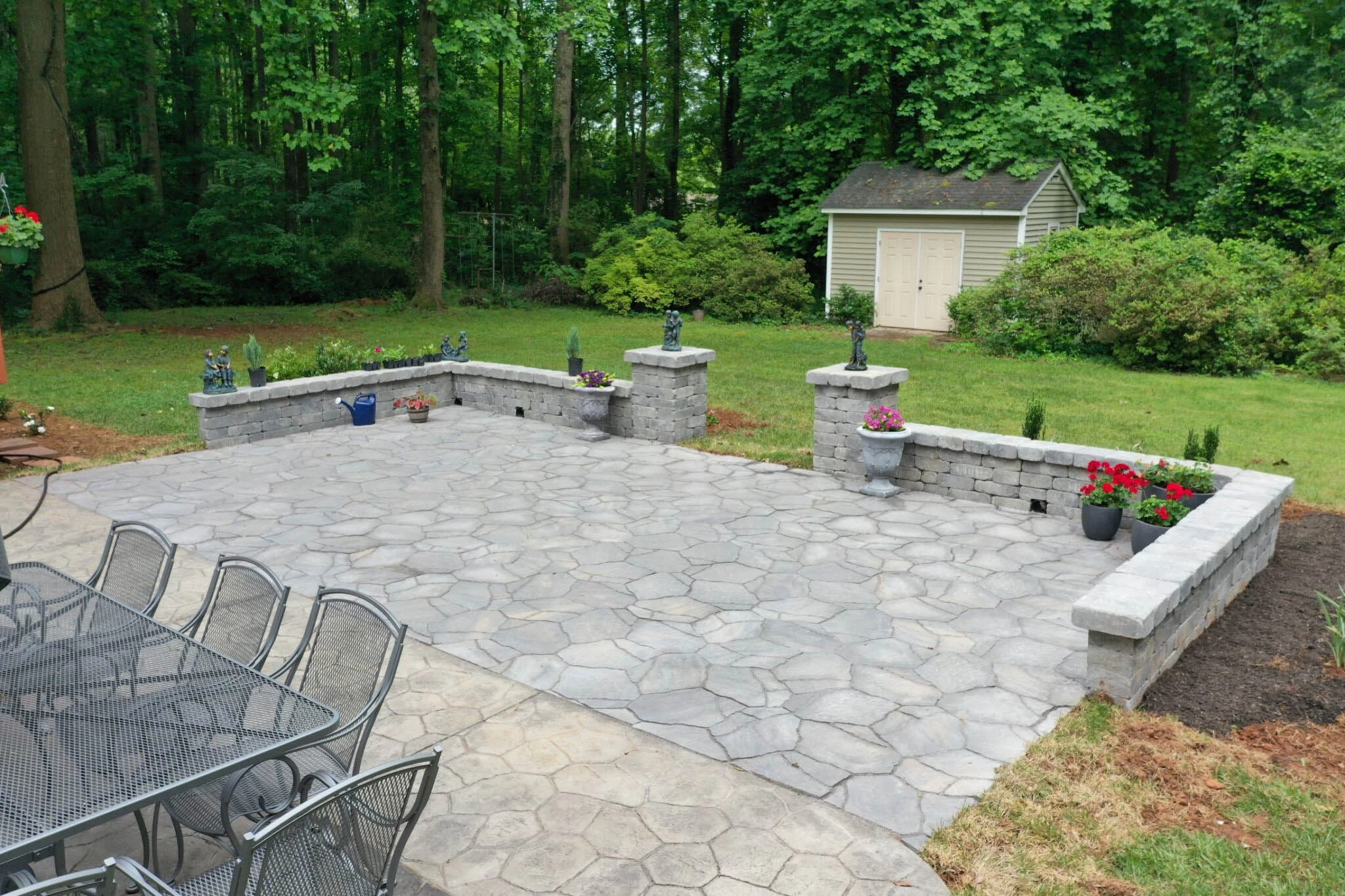
The oldest paver driveway we still service in Forsyth County was installed in 1997 in a neighborhood off Post Road. Original spec: 8-inch open-graded base, geotextile separator, cast-in-place perimeter curb, 60mm Techo-Bloc pavers in herringbone. We’ve been back three times in twenty-eight years — once at year 8 to resand joints, once at year 16 to replace two pavers that a delivery truck cracked, and once at year 22 for a full polymeric resand.
The base has never been touched. The clay under the base has done twenty-eight seasonal cycles and moved probably a quarter-inch total cumulative in the worst spots. The 8-inch open-graded base absorbed every bit of it. The cast-in-place curb is still square. The driveway looks, from 30 feet away, like it was installed last year. That’s what the $6,000 premium buys.
One Last Number Worth Naming
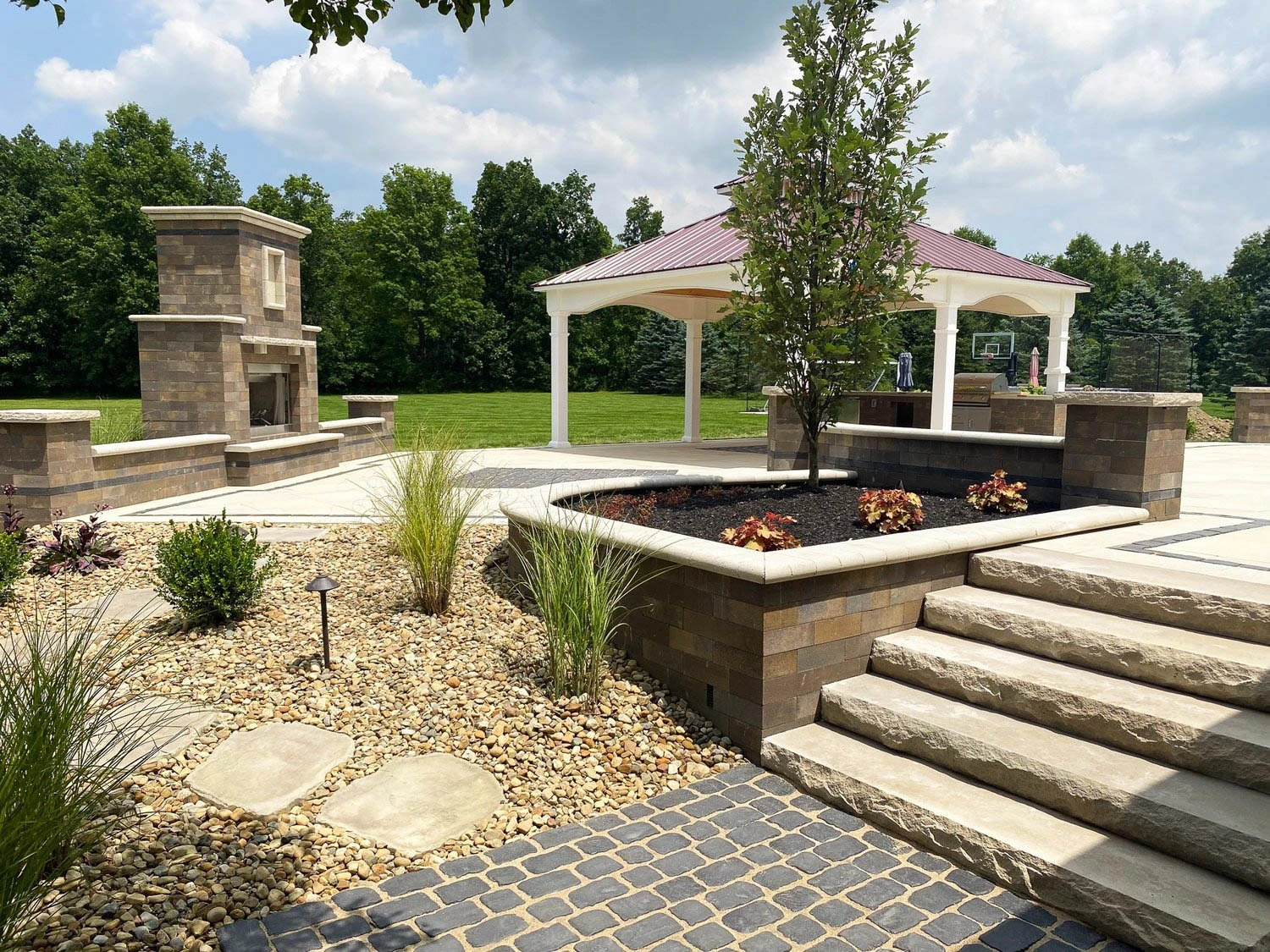
On the Primetime side, we track every driveway we’ve installed inside Forsyth County since 2018. Out of 47 driveways built to the 8-inch Cecil-clay spec, zero have required warranty settlement repair at the 5-year mark, and the oldest is now at year 7 with no service calls beyond one polymeric resand. In the same period, we’ve been called in to assess or remediate 23 driveways built by other contractors to 6-inch-base spec. Every one of them showed measurable settlement by year 4. Most needed edge work by year 6.
The data is not complicated. Soil behavior in Cumming is measurable and predictable, and the spec that matches it is knowable. The only question is whether your contract reflects the knowable spec or reflects a generic Georgia paver spec written by someone who’s never excavated a Cecil-clay sub-grade in Haw Creek or Sadie Farms.
Paver driveways built to Cecil-clay spec across 20+ cities within 30 miles of Winder, GA
If you’re in Cumming, Forsyth County, or any of the surrounding subdivisions, the 8-inch base and cast-in-place curb are the spec we’ll put in your contract. The math doesn’t change at the property line.