
You are about to spend $55,000 on a pool remodel in Coal Mountain. Eighteen months from now you will spend another $42,000 on an outdoor kitchen bolted onto the same slab. The second crew will saw-cut the deck you just replaced, re-trench the yard you just regraded, pull a second Sawnee EMC service upgrade, and re-submit to Forsyth County permitting as if the first job never happened. That second bill is mostly friction, not value.
Two-thirds of the Forsyth County homeowners who call us about a pool remodel quietly want an outdoor kitchen too. They almost always ask about it as a phase two project — something for “next year” or “after we see what’s left in the budget.” The math does not reward that sequencing. When trenching, permitting, and electrical runs share a single pull, the combined cost of a pool remodel plus kitchen drops 30 to 40 percent compared to doing them eighteen months apart. That gap widens further in Forsyth, where Sawnee EMC service upgrades, county permit review backlogs, and HOA architectural review boards all charge — in time or in money — per project, not per scope.
This post is the sequencing, electrical, gas, and sight-line decision tree for doing both at once on a Forsyth County property — where the 247-square-mile county approves more than 200 pool permits per year and the housing stock runs from 3-acre estates on Hwy 369 down to tight Post Road subdivisions with HOAs that care about paver color.
Why Phase-Two Sequencing Costs You 30-40% More in Forsyth County
A pool remodel — resurface, new tile, coping replacement, deck rebuild — touches four mechanical systems: plumbing, electrical, gas (if you have a heater), and drainage. An outdoor kitchen touches three of the same four. When you do them sequentially, every shared trench gets opened, backfilled, and then re-opened. Every conduit that could have been oversized once has to be replaced. Every permit fee gets paid twice.
Here is what doubles when you sequence them:
- Deck demolition and replacement. If your remodel includes new travertine or paver decking, that deck will almost certainly need to be cut again to run gas and water to a future kitchen. Saw-cutting a finished paver field and patching it is never invisible — the replacement stones age differently, grout lines shift, efflorescence appears on new stones before old.
- Electrical service. Most Forsyth County pool remodels trigger a load calculation from Sawnee EMC. If you add a heater, a variable-speed pump, and pool LEDs, you are already at or past the capacity of the original 60-amp pool subpanel. Adding a kitchen with a fridge, beverage center, ceiling fan, and dedicated outlet circuits means you need a 50-amp subpanel minimum — often 60 to 80 amps once you add ice makers or infrared grill burners. Doing the load calc once for both is one trip. Doing it twice is two service calls, two Sawnee EMC coordination windows, and potentially two separate main service upgrades.
- Permits. Forsyth County issues separate permits for pool work and for hardscape structures that include gas, electric, and plumbing. Combined permitting on a single application shortens the cumulative inspection schedule by four to six weeks. Split into two applications, you wait through two separate plan-review queues.
- HOA architectural review. Nearly every Forsyth subdivision — from Bethelview Road to Shoal Creek — has an ARC. They meet once a month. A combined submission goes through one cycle. Sequential projects mean two cycles, sometimes three if the second submission triggers follow-up questions about finish matching.
The compounding effect is the real number. On a project where the pool remodel alone would run $52,000 and a standalone kitchen eighteen months later would run $38,000, the combined number is rarely $90,000. It is typically $63,000 to $68,000. That is the 30-to-40-percent savings in plain numbers — and it applies across nearly every Forsyth zip code where we build, including 30028, 30040, and 30041.
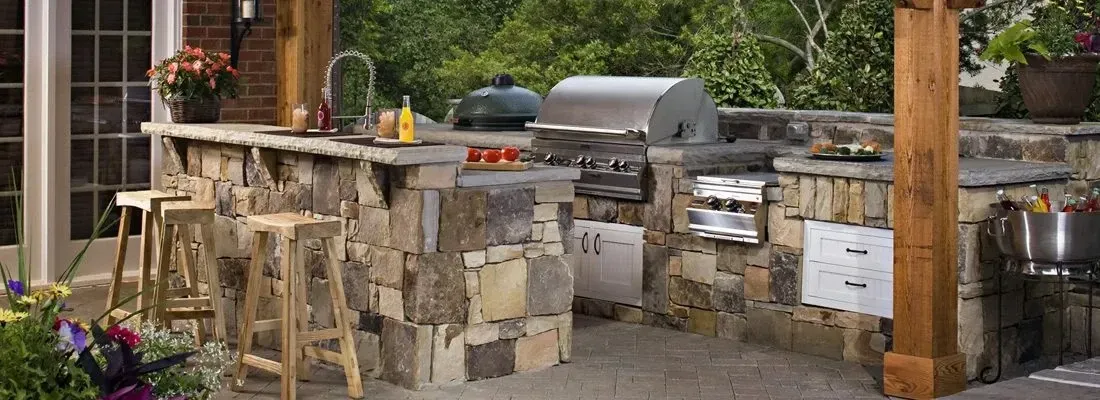
Typical kitchen adder during an active remodel: $18,000 for a compact single-bay grill island on an existing slab extension, scaling to $48,000 for a U-shape pavilion kitchen with plumbed sink, fridge drawers, side burner, and 60-amp subpanel.
The Sawnee EMC Load Calculation — and Why It Governs Your Kitchen Design
Every Forsyth County pool project runs through Sawnee EMC, the electric membership cooperative that serves the entire county plus chunks of Dawson and Hall. Sawnee’s load calculation is the gate. If you want a built-in grill with a rotisserie motor, a side burner, a beverage refrigerator, a chest-style ice bin, a ceiling fan above the cook station, and in-counter LED accent lighting — plus the pool’s existing variable-speed pump, heater, and color-LED lights — you are not going to squeeze it through a 60-amp pool subpanel. You need a dedicated 50-amp kitchen subpanel, minimum, fed from the main service.
This matters during a remodel because the trench from the house to the pool equipment pad is already open. If you run the kitchen feeder in that same trench — a separate 6-3 Romex or 6 AWG THHN conduit, pulled parallel to the pool feeder — the marginal cost is the wire and conduit, not the dig. If you wait, the conduit path runs through new decking and a second trench.
What drives the 50-amp number is not the grill (most built-in gas grills only need 120V for the rotisserie and lights) but the cumulative draw of the ancillary appliances. An outdoor refrigerator runs 2 to 4 amps continuously, a kegerator the same, an ice maker spikes to 8 amps during production cycles. GFCI-protected outlet circuits for blenders and phones add 15 to 20, a wet-rated ceiling fan 2 to 3, and under-counter LED transformers add more. Cumulative calculated load crosses 40 amps on a busy Saturday before a burner is lit.
Subpanel Placement — Where to Drop It, Where to Hide It
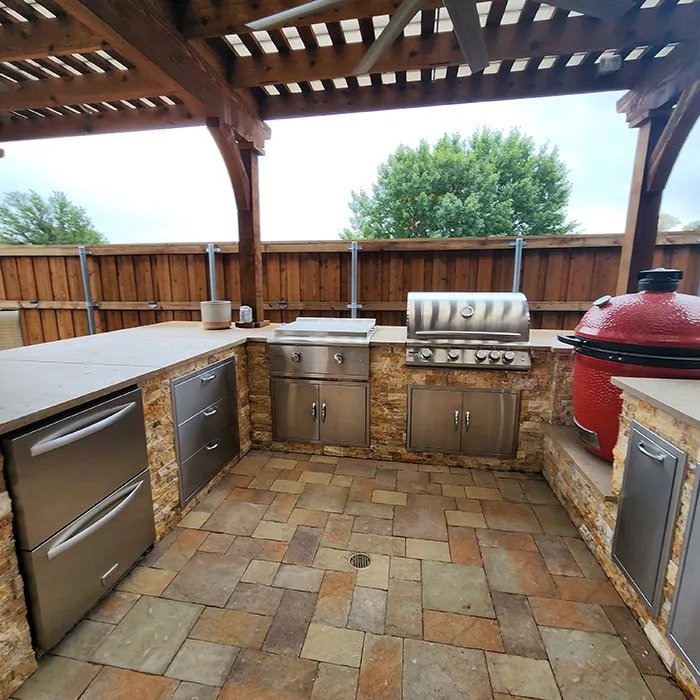
Subpanel location decides half the aesthetic success of the kitchen. Three placement patterns work on Forsyth County lots: behind a solid kitchen back wall inside a NEMA 3R enclosure (cleanest); adjacent to the pool subpanel on a shared equipment pad (common on larger Big Creek and Shady Grove lots); or on the garage exterior when the kitchen sits within 40 feet of the house (most South Forsyth subdivisions).
Gas Line Sizing, CSST, and the Hwy 9 vs. Hwy 369 Gas Reality
Forsyth County is split across two gas supply realities. South of Hwy 20, most properties have natural gas service — Atlanta Gas Light runs under the road right-of-way along Bethelview, Post, Hwy 9, and Kelly Mill. North of Hwy 20, especially toward Coal Mountain and the Hwy 369 corridor, roughly 60 percent of homes are propane, fed from a 250 or 500-gallon buried tank.
The sizing math is different for each. A typical built-in grill demands 60,000 to 90,000 BTU/hr. A side burner adds 15,000. A power burner for a wok or sear station adds 25,000 to 30,000. A pool heater runs 300,000 to 400,000 BTU/hr. Add those together and you are pulling up to 540,000 BTU/hr on a busy Saturday with the pool heater running and three burners lit.
On natural gas at typical residential delivery pressure (7 inches of water column), a single 3/4″ CSST line can carry the grill, side burner, and power burner over the distance most kitchens sit from the house — up to about 60 feet. If your pool heater shares the same line, you are in 1″ CSST territory. The right call is almost always to run two independent CSST runs from the meter: one dedicated to the pool heater, one dedicated to the kitchen. During a remodel the trench is already open, so pulling two lines costs the incremental tubing, not a second dig.
On propane, the capacity math is similar but the pressure regulator step-down matters more. A typical two-stage residential propane system delivers 11 inches water column at the appliance. Running 500,000+ BTU/hr through a single undersized line will starve the grill when the pool heater cycles on. This is the most common complaint we hear from North Forsyth homeowners: “the grill loses flame when the pool heater kicks in.” The fix is either upsizing the branch feeder to 1-1/4″ CSST or splitting the runs. Cheaper to do during a remodel. Much cheaper.
Forsyth County code reference: All CSST installations require continuous bonding to the grounding electrode system per IFGC 310 and NFPA 54. Inspection flagged on the final. Check that your installer uses a 6 AWG copper bonding conductor clamped to the manifold — not a lug on a hanger.
Sight Lines: Design the Kitchen So the Cook Faces the Pool
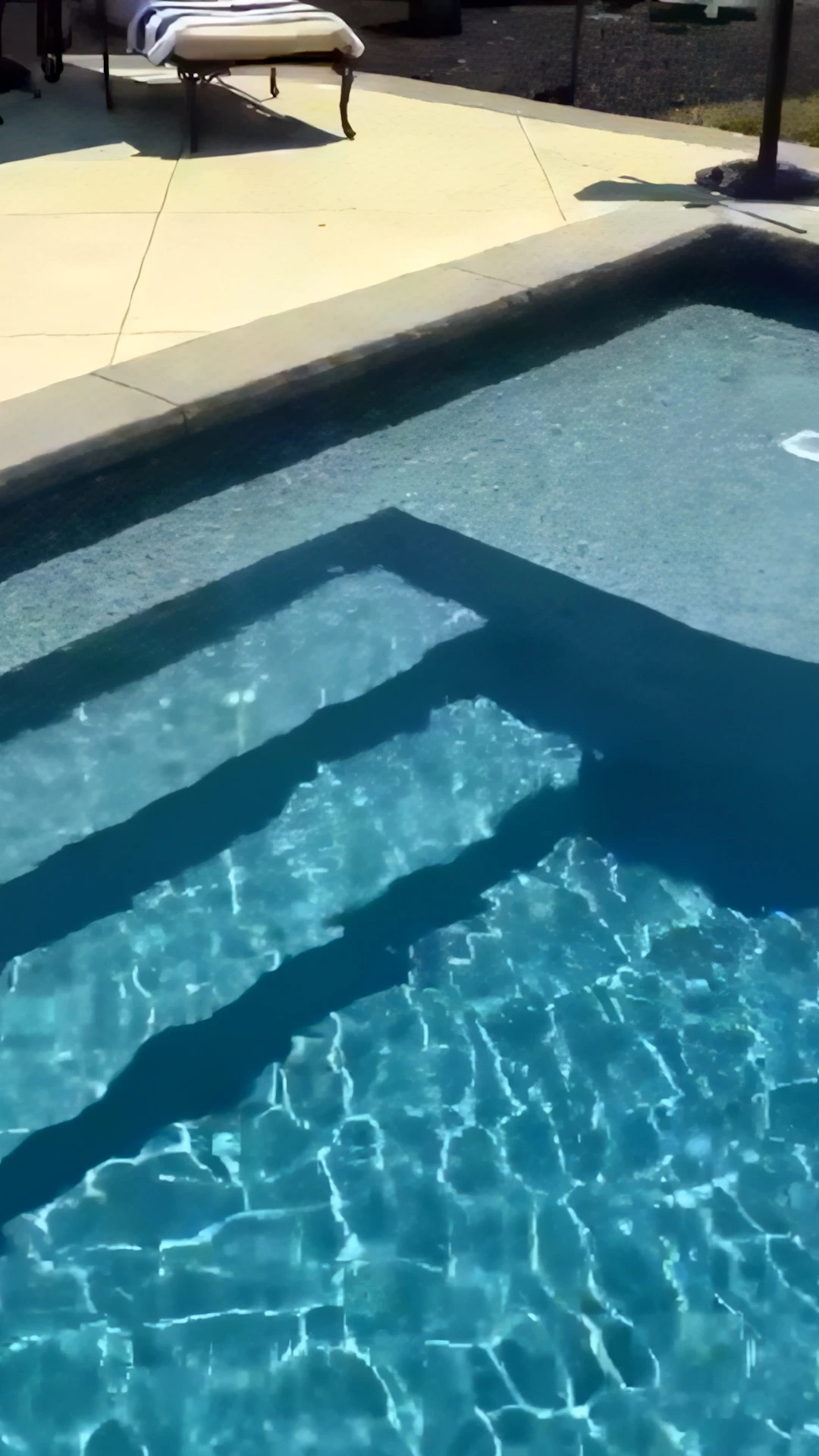
This is the single rule most Forsyth County kitchens get wrong. The cook should face the pool, not the house. Every kitchen we build starts with a sight-line plan drawn on site, because every yard rewards a different orientation.
On a typical South Forsyth lot — a half-acre with the pool 20 to 30 feet off the back of the house — the kitchen wants to sit on the house-side of the pool, with the cook station oriented toward the water. That puts the grill back to the house and the cook facing the splash pad, the spa, the kids. Social gravity flips: instead of guests crowding around the back door, they stay at the pool.
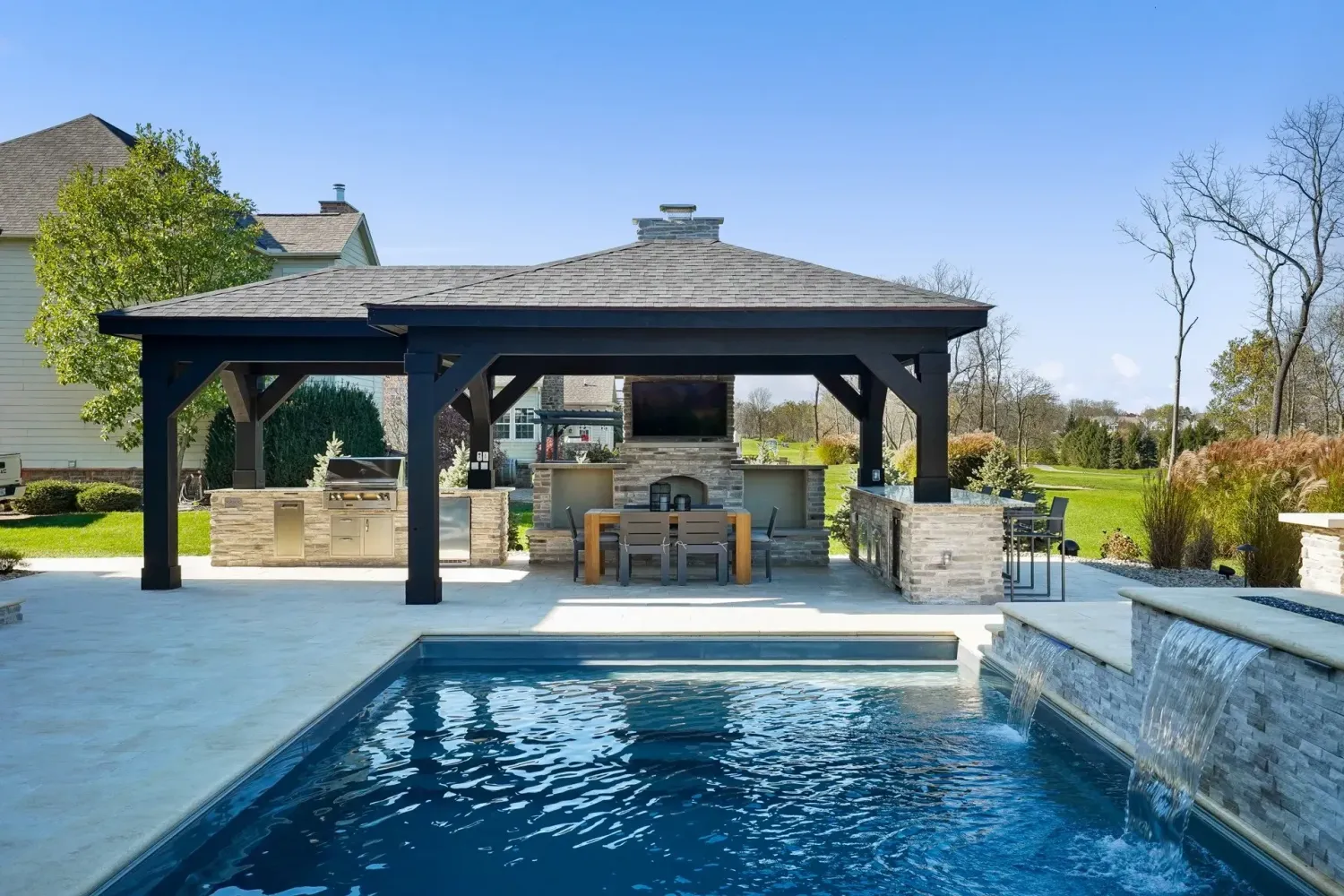
On a larger North Forsyth lot — 2 to 5 acres in areas like Shoal Creek or the Lake Lanier south-shore subdivisions — the kitchen often wants to sit on the far side of the pool, anchored to a pavilion or pool house. In that configuration, the cook faces back across the pool toward the house, and the pool becomes the foreground of the view. This is the pattern in our hero-grade pavilion-pool-kitchen combinations where a hip-roof pavilion anchors the far edge of the pool and the cook works with the dark-liner water and spa spillover in full view.
The 18-to-30-Inch Overhang Rule
If your kitchen has bar seating — and most Forsyth kitchens that include a fridge and sink do — the counter overhang determines whether the seating actually works. Under 12 inches is useless. Twelve to 15 inches is tolerable for drinks only. For actual bar dining with plates, you need 18 to 24 inches of overhang. For pool-facing bar seating where kids sit to eat hot dogs while watching siblings in the water, 24 inches is the minimum. The overhang needs steel support brackets embedded in the stone base every 30 to 36 inches — not wood, which rots, and not decorative corbels alone, which fail.
Wind, Smoke, and the Prevailing Southwest
Forsyth County’s prevailing wind is southwest, especially in summer. A grill station that sits with its open side facing northeast will send smoke directly across the pool deck toward the house. The fix is either rotating the kitchen 90 degrees so smoke drifts across landscape rather than seating, or installing a vent hood in the pavilion ceiling that ducts through the roof. Hoods over outdoor kitchens require a dedicated 20-amp circuit, makeup air calculations, and — if you are running a commercial-grade hood — a separate mechanical permit from the county. Plan this at the remodel stage or forfeit the option entirely.
Choosing Kitchen Scale to Match Pool Scale — and Your Forsyth Lot
Before scale, one permit note. A combined pool-plus-kitchen remodel in Forsyth County typically pulls a building permit (primary), an electrical permit, a plumbing permit if the kitchen has a sink, a gas permit for CSST work, and a mechanical permit only if the kitchen has a powered vent hood. Plan-review turnaround for a combined submission runs 12 to 18 business days; split into two sequential applications, you wait two review cycles. On estates with septic — common on Coal Mountain, Shiloh, and parts of Shady Grove — the Environmental Health Department adds another 7 to 14 days for kitchen sink drain clearance.
The most common reason a Forsyth kitchen plan gets kicked back is GFCI placement error. Every 120V outlet within 6 feet of the pool must be on a dedicated GFCI circuit. Get this right in the first submission and your combined permit closes four to six weeks faster than sequenced applications. And for North Forsyth HOAs off Bethelview, Post, or Kelly Mill Road: submit to the ARC 30 days before the county. Monthly ARC meetings mean a late kickback costs you a full cycle.
The last decision — and the one that most directly drives the $18,000 vs $48,000 range — is scale. Four kitchen tiers cover nearly every Forsyth County project we build:
Tier 1: Compact Single-Bay Grill Island ($18,000-$24,000)
A single 6-to-8-foot stone-veneer island with a built-in 4-burner gas grill, stainless doors below, a 3/4″ CSST gas feed, and a single 20-amp 120V GFCI circuit for rotisserie and grill lights. No sink, no fridge. Decorative cedar pergola overhead is optional. Fits on nearly any existing pool deck and works well for South Forsyth townhome and small-lot projects on 30041 zip-code streets.
Tier 2: L-Shape with Bar Seating ($26,000-$34,000)
An L-shape island with a built-in grill, side burner, stainless fridge drawers, bar seating with 18-inch overhang, and optional Big Green Egg or Kamado Joe bay. Requires a dedicated 30-amp kitchen subpanel, a gas line sized for grill + side burner, and 2 to 4 GFCI circuits. This is the most common build for mid-size Forsyth lots in Bethelview, Brookwood, and Big Creek.
Tier 3: U-Shape Under Pavilion ($36,000-$44,000)
Full U-shape with grill, side burner, fridge drawers, plumbed sink, and a ceiling fan — all under a solid-roof pavilion with heavy timber framing and T&G ceiling. Requires a 50-amp subpanel, full plumbing and gas permits, and typically an ARC submission. Best on larger 1-to-3-acre lots in Shady Grove, Coal Mountain, and the Lake Lanier south-shore corridor.
Tier 4: Full Pool-Pavilion-Kitchen Master Plan ($44,000-$48,000+)
The hero-grade combination: pavilion at poolside, built-in grill plus Kamado, side burner, griddle/plancha, fridge drawers, plumbed sink with hot water, ceiling fan, in-pavilion TV, and accent lighting. Requires a 60-to-80-amp subpanel, 1″ CSST gas main with branch runs, full mechanical permits if a vent hood is included, and an engineered pavilion structure. This is the combination that defines the top end of North Forsyth estate pool projects.
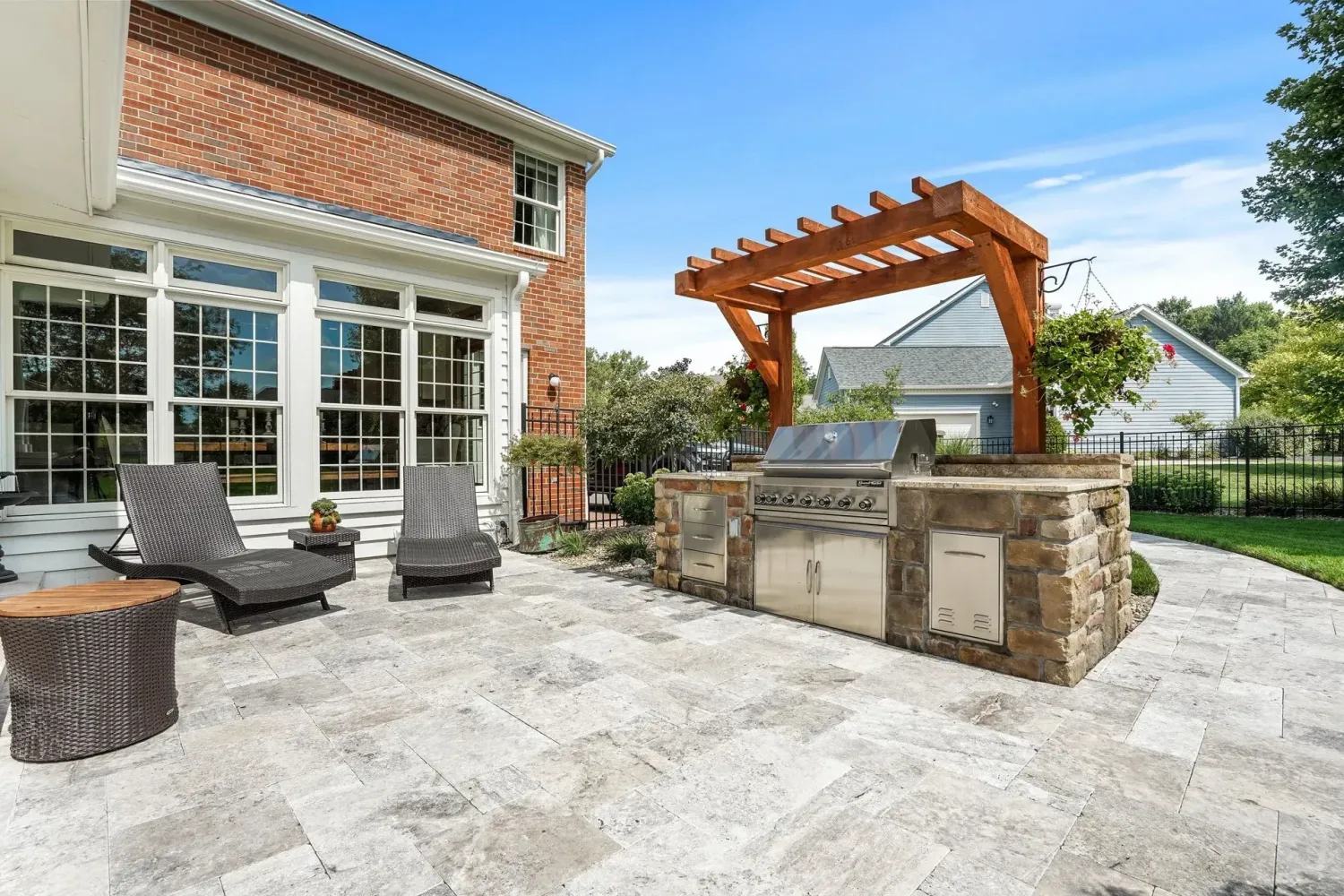
Matching Kitchen Finish to Pool Finish
This is the part most homeowners leave to chance and regret. If your pool interior is going to be a pebble aggregate finish in a warm tan speckle, the kitchen counter in a cool gray granite will fight it visually. If the pool waterline tile is dark navy, the kitchen backsplash wants to echo it — not match, echo. The Forsyth County pool remodels that age best pick one of three combined palettes:
- Warm-neutral — tan pebble interior, cream/tan granite counters, buff travertine deck, light cedar pavilion
- Cool-modern — gray pebble or glass-bead interior, flamed bluestone or concrete counters, gray paver deck, charcoal steel pergola
- High-contrast estate — dark-liner or dark-pebble interior, cream granite counter, mixed ledgestone veneer base, black-painted timber pavilion
Pick the palette at the remodel stage, not later. The finish samples for pool interior, coping, deck pavers, kitchen veneer, counter slab, and pavilion stain all want to be laid out on the same table in the same light before a single bag of cement leaves the yard.
The Forsyth Construction Window
Forsyth County’s USDA Zone 8a climate gives you a working window of roughly late February through early December — about 22 freeze events per year cluster between late December and mid-February. Combined pool-and-kitchen projects take 10 to 16 weeks depending on pavilion complexity. Starting in March puts you in the pool by June. Starting in June puts you in the pool by October, which is fine if your goal is the spa-spillover season more than the swim season — and Forsyth’s Lake Lanier moisture effect does extend comfortable outdoor evenings through October most years. Starting in September pushes your pavilion roof dry-in past the freeze window, which is a risk we avoid on every project where we can.
Pool remodels with outdoor kitchen integration across 20+ cities within 30 miles of Winder, GA
We build the combined pool-and-kitchen projects that make the 30-to-40-percent math work — one trench, one permit stack, one Sawnee EMC load calculation, one finish palette. From Cumming estates to South Forsyth subdivisions and across the 247 square miles of Forsyth County, our combined-project workflow saves the friction you cannot see on a line-item quote.