
Every outdoor kitchen brochure shows a six-burner professional grill flanked by a pizza oven, a kegerator, and a 48-inch power burner stacked next to a teppanyaki flat-top. Most of those kitchens get used twice a summer — usually for a graduation and a Fourth of July cookout — and then the owner goes back to grilling burgers on a Weber cart rolled out from the garage. The problem isn’t ambition. It’s that the design was built around what looked impressive in a showroom, not around how the family actually cooks on a Tuesday night in August.
We’ve been designing and building outdoor kitchens across Dacula and the rest of Gwinnett County long enough to have a pattern-matched view of what sticks and what gets covered in a tarp by year three. This post is a plain-English FAQ built from the questions Hamilton Mill, Sycamore Ridge, and Providence Club homeowners ask us during design meetings — and the answers we give them when the only agenda is building something they’ll genuinely use.
The goal here isn’t to talk anyone out of luxury. Real outdoor kitchens are worth the investment. The goal is to spend that investment on the pieces that pay it back with weekly, year-round use, and to skip the pieces that photograph beautifully and then collect pollen.
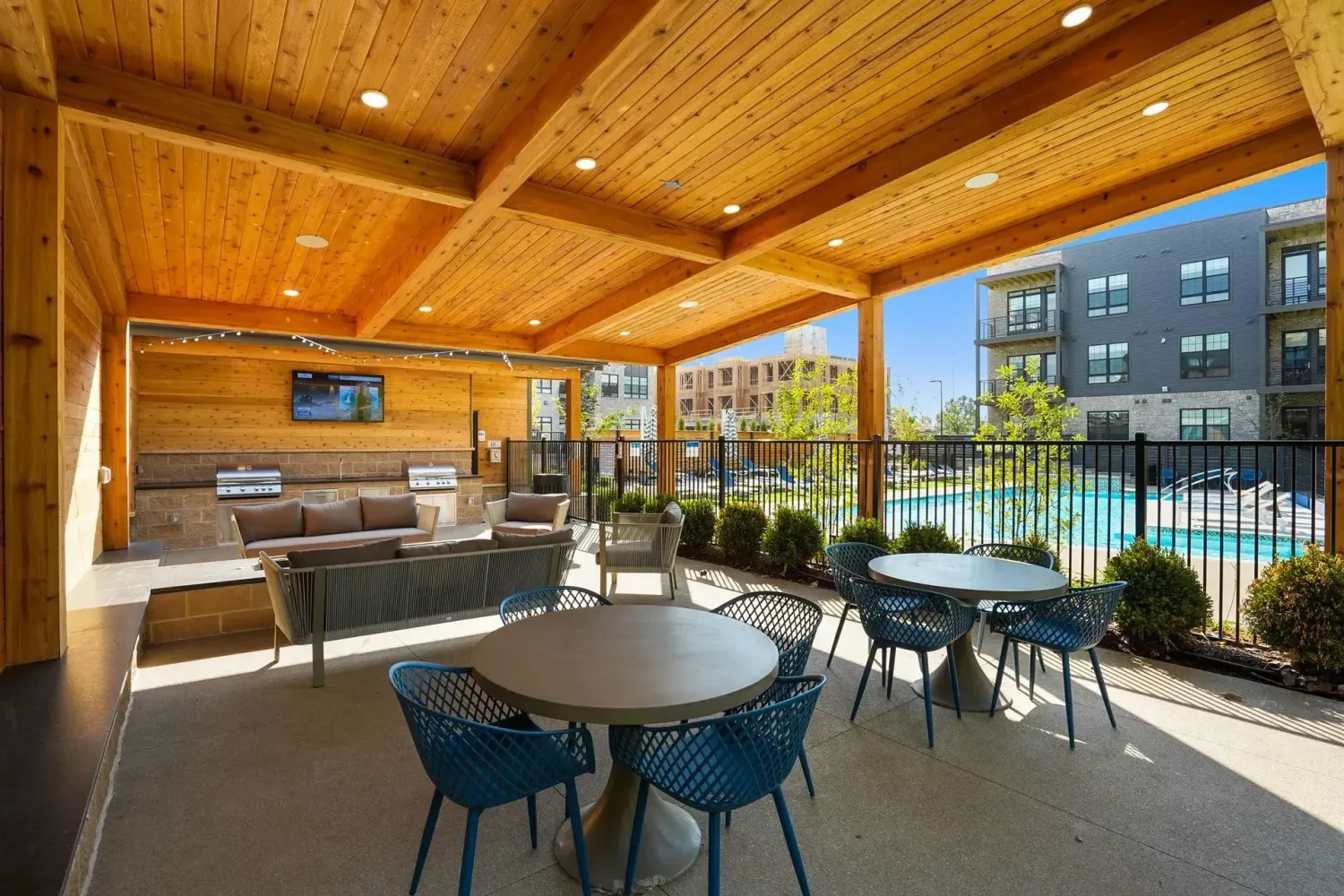
How Deep Do My Outdoor Kitchen Counters Actually Need to Be?
This is the first question we ask, and the first one most showroom designs get wrong. An indoor kitchen counter is 25 to 26 inches deep (24 inches of cabinet plus 1 to 2 inches of overhang). Outdoor kitchens routinely get built at 20 to 22 inches because it looks cleaner in a rendering and it saves a row of veneer stone on the base. It also makes the counter useless.
Our standard in Dacula is 24 inches of usable depth as a minimum, and 36 inches when the homeowner wants a fridge drawer or a storage cabinet installed below the counter. Here’s why that second number matters: a 24-inch beverage fridge drawer is 23 1/2 inches deep by itself. Drop it into a 24-inch base and the front face sits flush with the counter edge — great — but the countertop above it has zero landing zone. You can’t rest a cutting board, a tray of marinating chicken, or a casserole dish there without it overhanging. 36 inches gives you a 24-inch appliance cavity plus a 12-inch prep landing that actually holds a platter.
Usable counter depth standard: 24″ minimum for real prep work. Step up to 36″ any run of cabinet that hides a beverage fridge, storage drawer, or warming drawer underneath — the appliance alone eats most of the first 24″.
If your lot backs up to one of the Mulberry River tributaries west of Hamilton Mill Parkway and yard depth is tight, you can still pull this off — we just pivot the kitchen from a straight run to an L-shape so the 36-inch leg runs perpendicular to the house rather than eating into the patio depth.
Where Should the Grill Actually Sit — and How Much Space Does It Need Around It?
The single most common mistake we inherit on renovation jobs is a grill that was buried between two cabinets with 4 inches of counter on either side. It looks tight and architectural in the design, and then the first time someone tries to use it with a full rack of ribs, a marinade bowl, and a set of tongs, there is nowhere to set anything down. Worse, the cabinet edges get heat-checked and discolored because the hot zone wraps around the firebox.
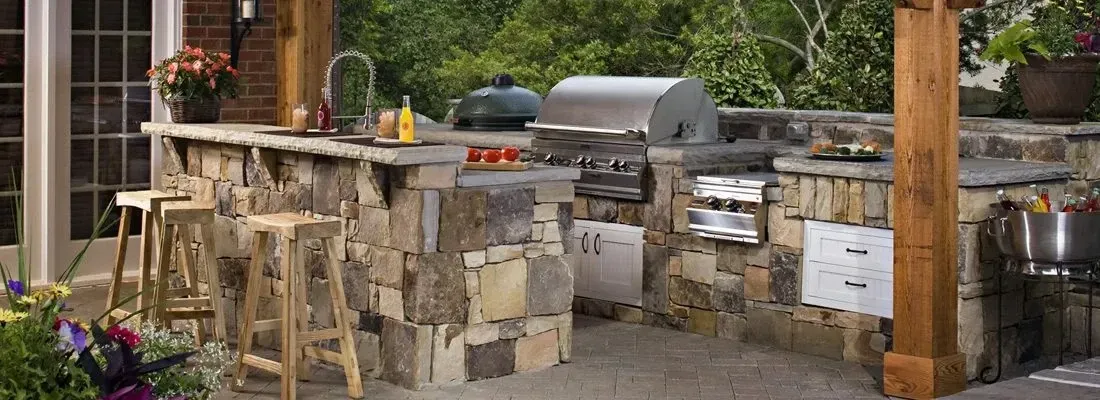
Our rule is 18 inches of clearance on each side of any built-in gas grill — that’s 18 inches of counter, not 18 inches of wall or cabinet fronts. That gives you a spot on the right to land a platter of raw food and a spot on the left to rest a finished tray, or vice versa for left-handed cooks. It also pulls the heat signature far enough from neighboring cabinets that the finishes hold up.
The second rule is to give the grill breathing room vertically. A 36-inch built-in grill head sits on roughly a 34-inch tall firebox cavity — don’t put a wood pergola beam at 7 feet directly over it. We keep 9 feet of clearance above any gas grill and use a stainless vent hood whenever the kitchen is under a covered roof. For uncovered grills (our default in Dacula — more on that below), just make sure nothing flammable is inside a 3-foot radius above.
Grill hot-zone spacing: 18″ of counter clearance on each side of any built-in gas grill. Don’t bury the grill between cabinets.
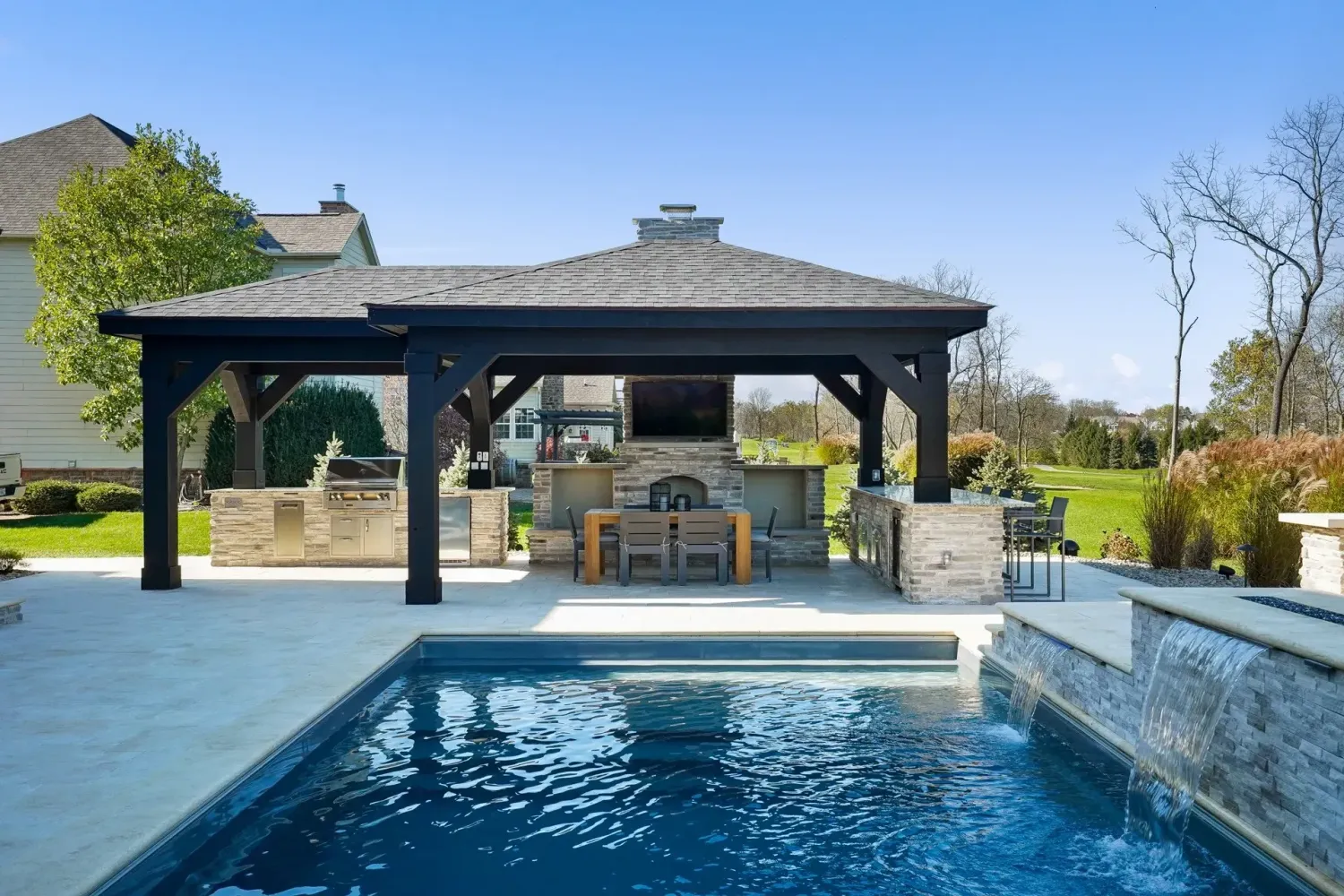
Do I Need a Big Green Egg AND a Gas Grill, or Can I Pick One?
We get this question at nearly every design meeting in Dacula, usually because the homeowner has seen a neighbor’s setup with both and wonders whether they’re duplicating themselves. The honest answer is that a Big Green Egg and a built-in gas grill are two different tools, and most homes genuinely benefit from having one of each — but only if the owner actually cooks. If one cook in the household is a weeknight-burgers-and-chicken person and that’s it, the Egg will sit covered for eleven months of the year.
Here’s the real tradeoff:
- Gas grill (primary): Fast ignition, predictable temperature, good for weeknight chicken, steaks, vegetables, and anything you want to eat in under 45 minutes. Used 2 to 3 times per week in a committed household.
- Big Green Egg or Kamado (secondary): Charcoal fuel, genuinely different flavor profile, and the ability to low-and-slow at 225°F for 10 hours for brisket, pork shoulder, and ribs. Used once every two weeks by an enthusiast, once a month by a normal household.
- Traeger or pellet smoker (alternative secondary): Easier than an Egg, runs on wood pellets with a thermostat, excellent for set-and-forget smoking. Gives up some of the charcoal flavor in exchange for zero fuss.
Our most common Dacula build is a 36-inch built-in gas grill as the primary plus a dedicated stone nook for a Big Green Egg (Large or XL) or a Traeger. We don’t normally recommend building in two gas grills, and we don’t recommend skipping gas entirely in favor of charcoal only — the gas grill is the one that earns its keep on Tuesday nights.
What Size Built-In Refrigerator Do I Really Need Outside?
Outdoor fridge sizing is where a lot of Dacula homeowners over-spec and then regret it. The default upgrade at most big-box design centers is a 24-inch outdoor-rated refrigerator with a capacity of roughly 5 cubic feet. That’s the right size if you regularly host twelve people. It’s way too much appliance if you’re a family of four running a normal weekend.
We think of outdoor fridges in two sizes:
- 15-inch beverage center (~3 cu ft): Holds about 90 cans, or 45 cans plus a six-pack of bottles, plus room on the top shelf for a few condiment jars and a carton of juice. This is the right size for a 4-person family using the kitchen for weeknight dinners, weekend casual use, and a few summer parties per year. It runs on a standard 120V outlet, stays inside a 15-inch cabinet cavity, and costs roughly half what a 24-inch unit does.
- 24-inch full outdoor fridge (~5 cu ft): The right size if you entertain regularly — 8-plus guests every other weekend. Dedicated shelves for trays, platters, and full party spreads. Also the right size if you want to stage an entire dinner outside (proteins + sides + drinks) without running back to the indoor kitchen.
The mistake we see is homeowners installing a 24-inch outdoor fridge because it sounded like the “real” choice, and then three years later they’re cleaning up a mostly-empty box that cycles on every 10 minutes because the compressor is oversized for the load. Start with the 15-inch. You can always add a second beverage drawer later.
Fridge sizing rule of thumb: 15-inch beverage center for a 4-person family. 24-inch full fridge only if you entertain 8+ guests every other weekend.
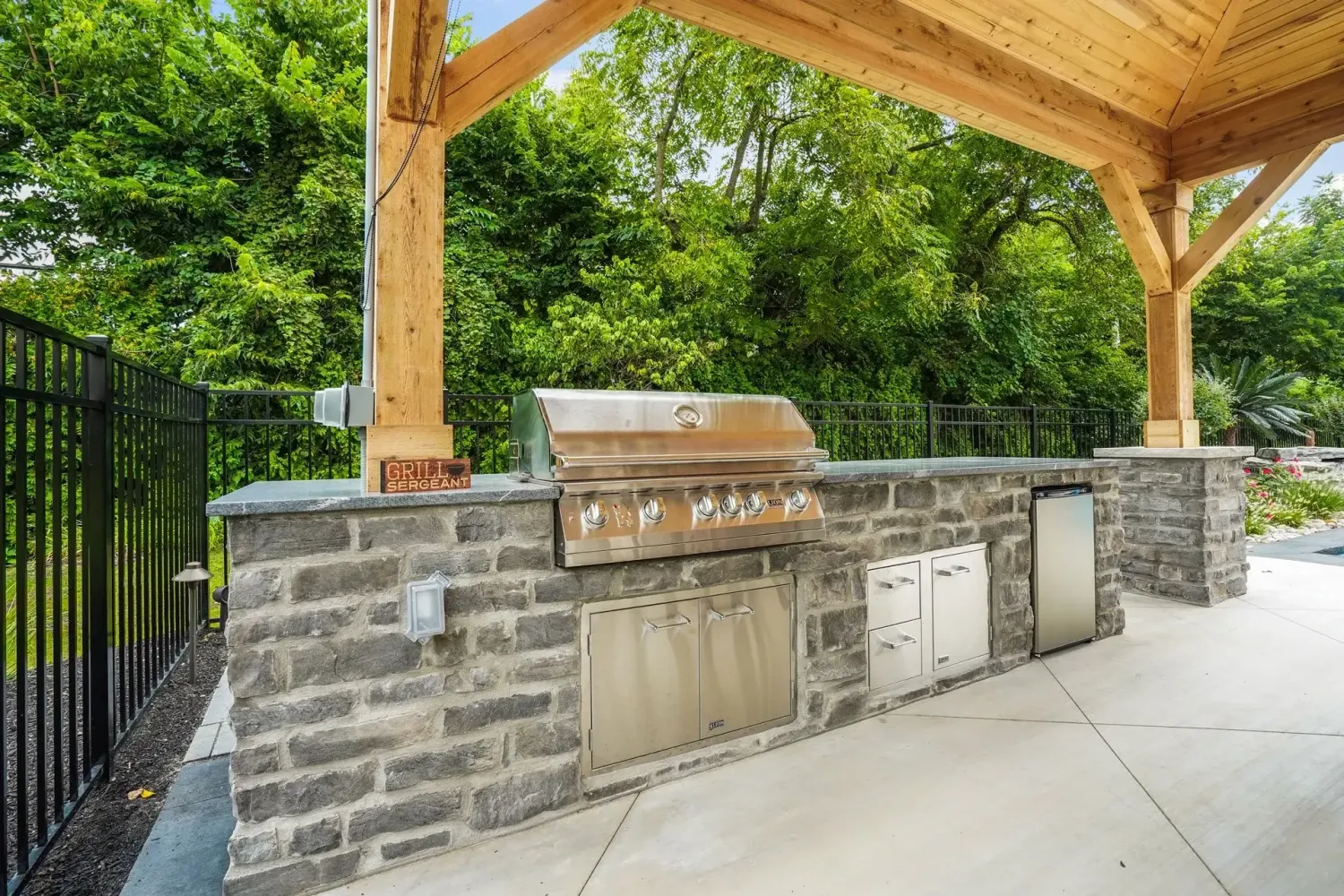
What’s the Right Bar Seating Setup — Counter Height, Overhang, and Stool Size?
Bar seating is the feature that turns an outdoor kitchen from a grill station into a hangout. It’s also the feature most likely to be built to the wrong dimensions because the contractor split the difference between a dining table and a bar height without checking which one the seating actually supports.
Here are the numbers that make bar seating work in Dacula:
- Counter height: 42 inches. This is bar height, not counter height. The cooking prep side of your kitchen will be at 36 inches. The seating side (the other face of a peninsula, or an extended counter behind the grill) steps up to 42 inches. That height change also gives you a visual shield between the prep zone and the people hanging out — no one at the bar is staring directly at the raw chicken.
- Overhang: 24 inches. Measured from the face of the base cabinet to the edge of the countertop. 24 inches gives knee clearance for a full-sized adult seated on a bar stool. Most DIY designs come in at 12 to 15 inches, which is enough for leaning an elbow on the bar but not enough to actually sit down and eat. If your counter is a 1 1/4-inch granite or quartz slab, a 24-inch cantilever needs steel brackets embedded in the base; for a poured concrete countertop, rebar reinforcement in the slab itself handles the load.
- Stool height: 30 inches seat-to-floor. This is “bar stool” height, not “counter stool” (which is 24 inches). A 30-inch stool under a 42-inch bar gives 12 inches of clearance — the standard ratio that lets you cross your legs without banging your knees on the underside of the counter.
Four bar stools is the sweet spot for a typical Dacula kitchen. Two stools feels stingy; six stools usually means you’re carving into the cook’s prep space. If you need to seat more than four, put the extras at a separate dining table on the patio rather than trying to stretch the bar.
Do I Need a Three-Bin Sink, or Is a Single Basin Enough?
The three-bin sink (one basin to prep, one to rinse, one to drain) is a restaurant-kitchen pattern that migrated into residential outdoor designs because it looks impressive and professional. In practice, almost no residential outdoor kitchen needs three basins. Here’s why: you’re not running food service. You’re washing the occasional tong, rinsing a bunch of cilantro, or filling a pot of water for corn. A single 17-inch stainless bar sink handles all of that with room to spare.
Where a three-bin setup actually makes sense is in large covered outdoor kitchens built for catering-style entertaining — 20-plus guests on a weekly basis, where the hostess genuinely wants to keep all the washing-up outside. That’s maybe one in fifty Dacula builds. For the other forty-nine, the money saved by going single-basin goes toward either the beverage fridge we talked about above or a proper storage drawer setup.
A few sink specs that do matter regardless of size:
- Stainless 304-grade, not 430. The cheaper 430 stainless will pit and stain within two Dacula summers. 304 holds up indefinitely.
- Hot and cold lines, not just cold. Cold-only bar sinks exist, but if you’re hand-washing a tray of grease-coated grill grates, you want hot water. It’s a one-time plumbing cost and it changes what the sink is actually usable for.
- Drain to the sanitary sewer or dry well, not just to grade. Gwinnett County Development permits typically require any fixed sink drain to tie into an approved disposal system; we always run a dedicated drain line at the same time we run the gas stub.
Sink spec: A single 17-inch 304-stainless bar sink with hot and cold lines handles 98% of residential outdoor kitchen needs. Skip the three-bin setup unless you’re catering.
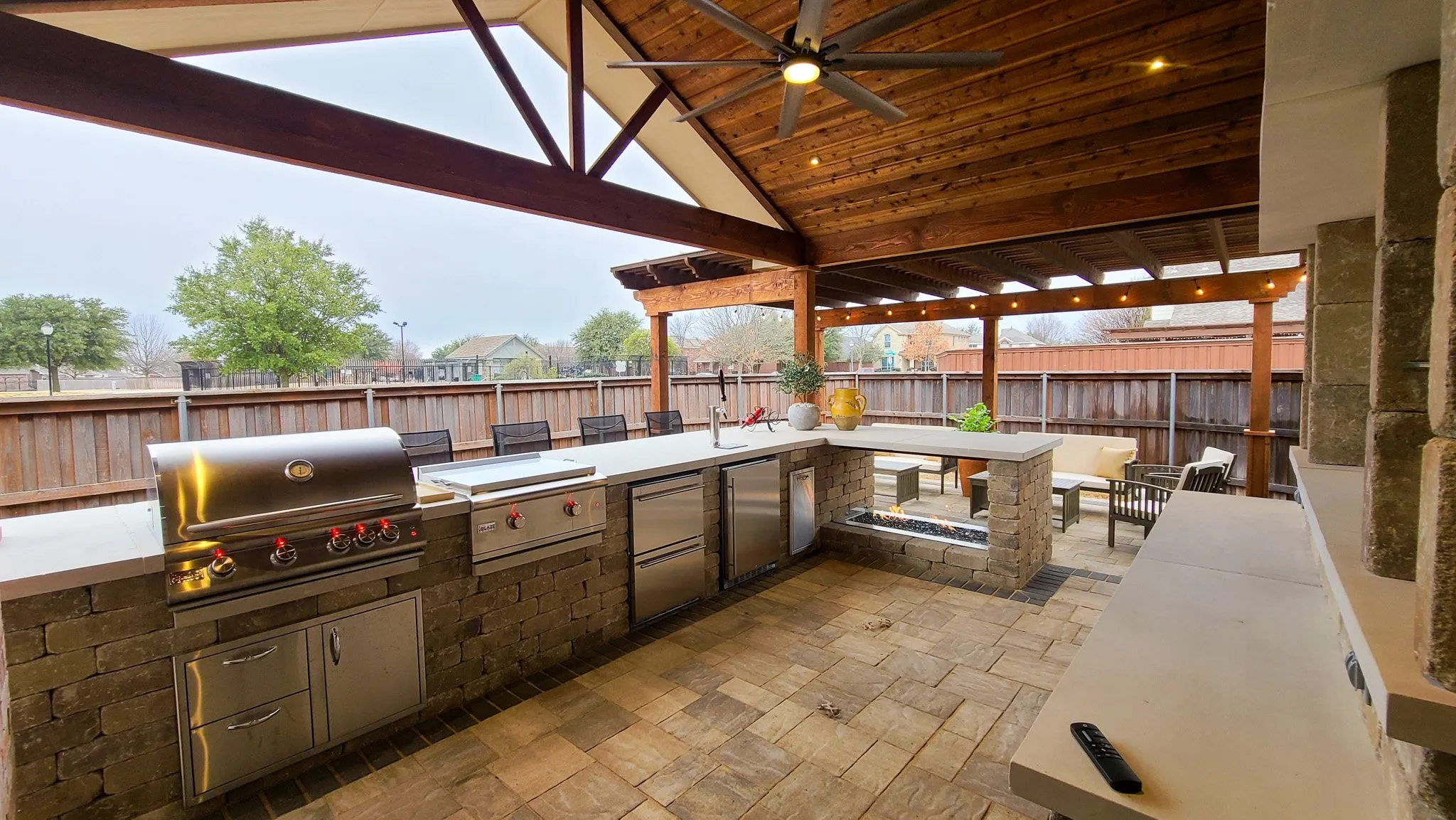
Propane or Natural Gas — Which One Makes Sense in Dacula?
This is the question with the clearest answer: if you’re in a Dacula subdivision — Hamilton Mill, Providence Club, Chandler Ridge, Ivey Chase, Auburn Park, and most of the 1995-2010 builds — you already have natural gas service at the meter. Use it. Run a dedicated gas line from the meter out to the kitchen location and you will never carry a propane tank again.
The Hamilton Mill side of town has particularly robust natural gas infrastructure; we’ve run outdoor-kitchen gas stubs on that side with almost no issue finding the main. The older infill streets closer to downtown Dacula on Dacula Rd and Harbins Rd sometimes predate the gas build-out, and in those cases propane is the right call — typically a 100-pound cylinder or a buried tank, never the 20-pound exchange cylinders you’d use for a portable grill.
The reasons to prefer natural gas when it’s available:
- Never running out mid-cook. The meter is supplying a city gas main. You cannot run empty.
- Lower fuel cost over time. Natural gas in metro Atlanta runs about 40% cheaper per BTU than propane, which adds up over a 15-year appliance lifetime.
- Permanent installations look cleaner. No tank visible, no hose routed to a cylinder box — just a clean gas valve at the kitchen base.
The Gwinnett County permitting process for residential gas work is straightforward: we pull the gas permit through the Gwinnett Department of Planning & Development at 446 W. Crogan St. in Lawrenceville, run the line in approved CSST or black iron per code, schedule the pressure test with the county inspector, and tie in at the existing meter. It typically adds 2 to 3 weeks to the overall project timeline, not months. The piedmont red clay in most Dacula yards actually makes trenching relatively straightforward — it’s cohesive enough to hold a clean trench wall without shoring.
Fuel choice for Dacula builds: Natural gas from your meter if you’re in any Hamilton Mill-era subdivision (nearly all of Dacula’s 30019 housing stock). Permit through Gwinnett County. Propane only where no natural gas main exists.
What Should I Skip if I’m Trying to Stay Within Budget?
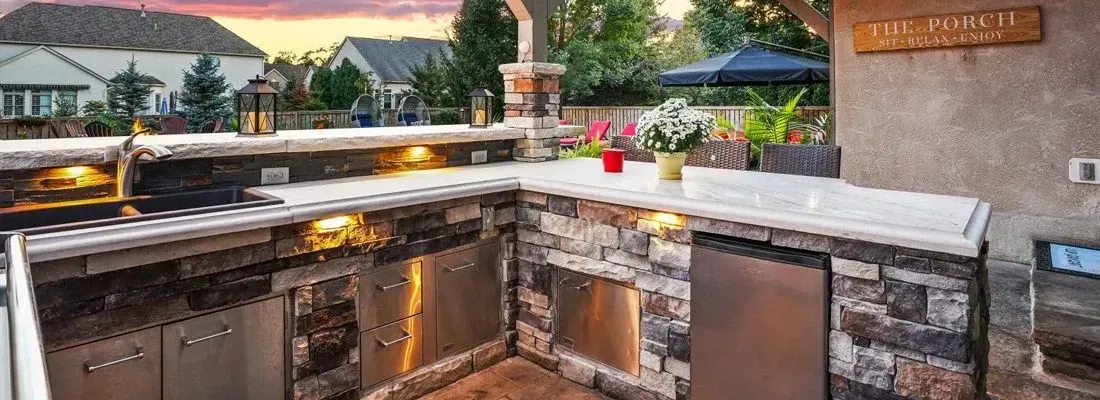
Every outdoor kitchen has features you’ll use three times a year and features you’ll use three times a week. If the budget is tight, here’s what we tell Dacula homeowners to skip without compromising the core function of the kitchen:
- Pizza oven. A good wood-fired pizza oven is a $4,500 to $9,000 add-on that most families use five to ten times a year. If you love pizza that much, put the oven on a cart so it can move. If you’re on the fence, skip it and use the budget on better storage.
- Side burner. The little 12,000 BTU single-burner tacked onto the side of most built-in grills rarely gets used. The inside stove is always closer when you need to boil water for corn or simmer a sauce.
- Power burner. Same story, but bigger and more expensive. Unless you’re genuinely doing seafood boils or wok cooking outside on a regular schedule, skip the 50,000-plus BTU power burner.
- Kegerator. $1,800 for a dedicated draft system that most households use at exactly two parties a year. A 15-inch beverage fridge full of cans serves the same need for one-third the cost and 30 fewer maintenance headaches.
- Ice maker. Outdoor ice makers are finicky in Dacula’s hard water — the calcium scale builds up fast and the units tend to fail within five to seven years. A countertop ice bucket filled from the indoor kitchen works just as well for parties.
- Second sink. One 17-inch bar sink is enough.
What we don’t tell anyone to skip:
- Real 24-inch (or 36-inch) counter depth.
- 18 inches of clearance on each side of the grill.
- A properly sized beverage fridge.
- Bar seating with 24 inches of overhang if you want people to actually sit there.
- Natural gas feed if your street has gas service.
- Proper drain connection if you’re installing a sink.
Those are the features that separate an outdoor kitchen from a patio with a grill on it. Everything else is optional.
The Real Measure of a Good Outdoor Kitchen
The families in Hamilton Mill, Sycamore Ridge, Chandler Ridge, and Providence Club who love their outdoor kitchens all have something in common: their kitchens get used more than once a week, year-round. Not just during the summer graduation-party season. Not just on perfect 75-degree October Saturdays. But on a Tuesday in February when the gas grill gets fired for chicken thighs because the inside kitchen is clean and nobody wants to dirty it.
That kind of use comes from design decisions made for cooking, not for photography. 24-inch counters. 18-inch hot-zone clearance. A 15-inch beverage fridge. Four bar stools at 30 inches. One primary gas grill and one smoker. Natural gas from the meter. Single-basin sink. Permit pulled through Gwinnett County. Concrete base on a crushed-stone pad that won’t heave in Dacula’s red-clay soil.
None of those decisions are exciting on their own. Together, they build a kitchen that earns its place in your backyard for the next twenty years.
Outdoor kitchen design and construction across 20+ cities within 30 miles of Winder, GA
Every outdoor kitchen we build in Dacula is designed around weekly use — real counter depth, proper grill spacing, and natural gas service from the meter — not showroom features that collect pollen.