
Why does the exact same travertine deck that looks perfect in Snellville turn slick and mossy in four seasons behind a Dawsonville home? Because at 1,270 feet of elevation under a mature oak canopy, the deck sits in about 14% higher ambient moisture retention than a sun-exposed Piedmont backyard — and that single variable rewrites which materials are worth buying.
We field this question nearly every time we flag a deck bid in Dawson County. A homeowner has seen a pool magazine, fallen in love with white French-pattern travertine, and assumed the spec that works at a lake house in Cumming will perform the same way on a wooded lot in Foxcreek or Kensington Ridge. It will not. The North Georgia foothills hand you a different climate than the rest of the metro, and the oak canopy most Dawsonville homeowners are trying to preserve — not cut down — is the reason. This piece is a material-by-material walk through what works, what doesn’t, and where the real money goes when your deck lives under 40 years of white oak, red oak, and hickory.
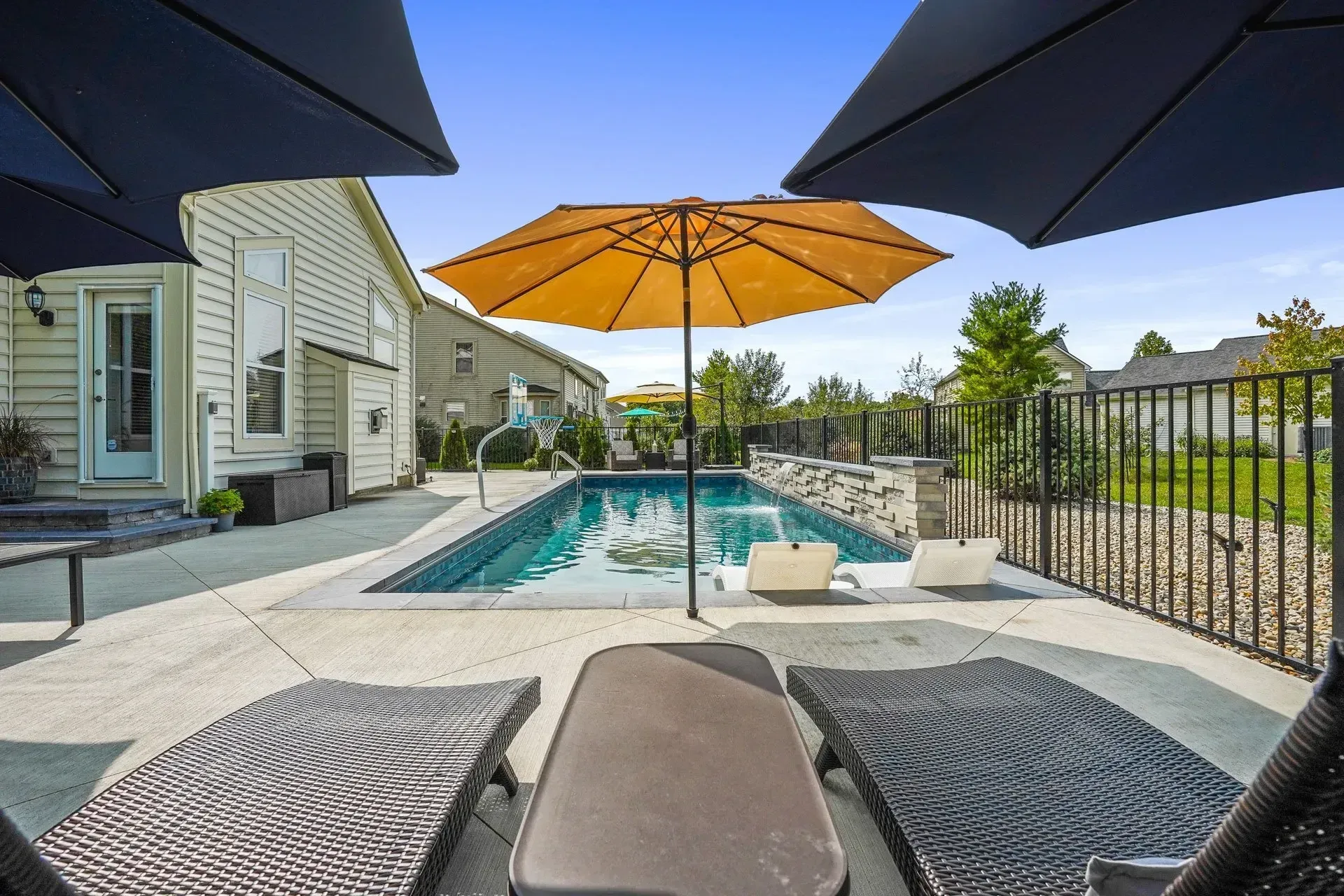
The short answer: porous, high-absorption stone underperforms in shaded Dawsonville backyards. Permeable pavers with modern polymeric sand outperform almost everything else. Concrete is a legitimate choice if you detail it correctly. Travertine, limestone, and most flagstones belong on a different lot. Below, every material, with the specs and dollar ranges that actually matter.
Is oak canopy really that different? Yes. The difference between a full-sun deck in Applewood and a shaded deck 90 feet away under the same homeowner’s oaks is measurable, not theoretical. A shaded deck in Dawson County sees roughly 14% higher moisture retention day over day because the canopy blocks the evaporative drying that a full-sun deck gets between 10am and 4pm. Combine that with our ~55 inches of annual rainfall — skewed toward mountain-pattern thunderstorms in summer — and you have a hardscape environment that looks more like coastal Carolina than suburban Atlanta.
On top of the moisture, Dawsonville sits in the USDA Zone 7b/8a border with about 30 freeze events per year, compared to roughly 20 in Dacula or Snellville. Ten extra freeze cycles per year is the number most people miss. Every freeze cycle drives water a little deeper into any porous surface, then expands it and cracks the surface from the inside out. Shade slows summer evaporation. Freeze cycles accelerate winter damage. Those two forces team up on the wrong material.
Pair that climate with our subsoil, which is stony residuum from mountain weathering — saprolite and weathered granite show up at 2 to 6 feet on most Dawson County digs, not the red clay a Grayson pool builder grew up on. Drainage is generally better once you get past the topsoil, which helps. But that’s a substrate story, not a surface story, and the surface is what your bare feet hit.
Baseline spec we use on shaded Dawsonville decks: 8-inch compacted open-graded #57 stone base, geotextile separation fabric, 1-inch setting bed of ASTM #9 chip, permeable pavers with a 1/4-inch joint, and Alliance Gator Maxx G2 polymeric sand for permeable applications. Water moves down, not sideways into your house.
Material 1 — Travertine (Don’t, Under Heavy Canopy)
White and walnut travertine are the two most-requested deck materials we field from Dawsonville homeowners. They’re also the two we talk the most people out of when the lot is shaded. Travertine is a calcium carbonate stone — by definition porous. The same hollow cell structure that makes it cool underfoot on a July afternoon in direct sun is what lets it hold water for days in a shaded backyard.
Under oak canopy, a travertine deck will begin showing moss along the grout lines inside 18 months. Annual cleaning with a surfactant and a low-pressure rinse helps; it does not solve the problem. By year 4 or 5, the surface texture itself starts degrading where tannin-acidic oak leaf litter has sat through repeated wet-dry cycles. Travertine sealer extends the timeline but does not change the outcome.
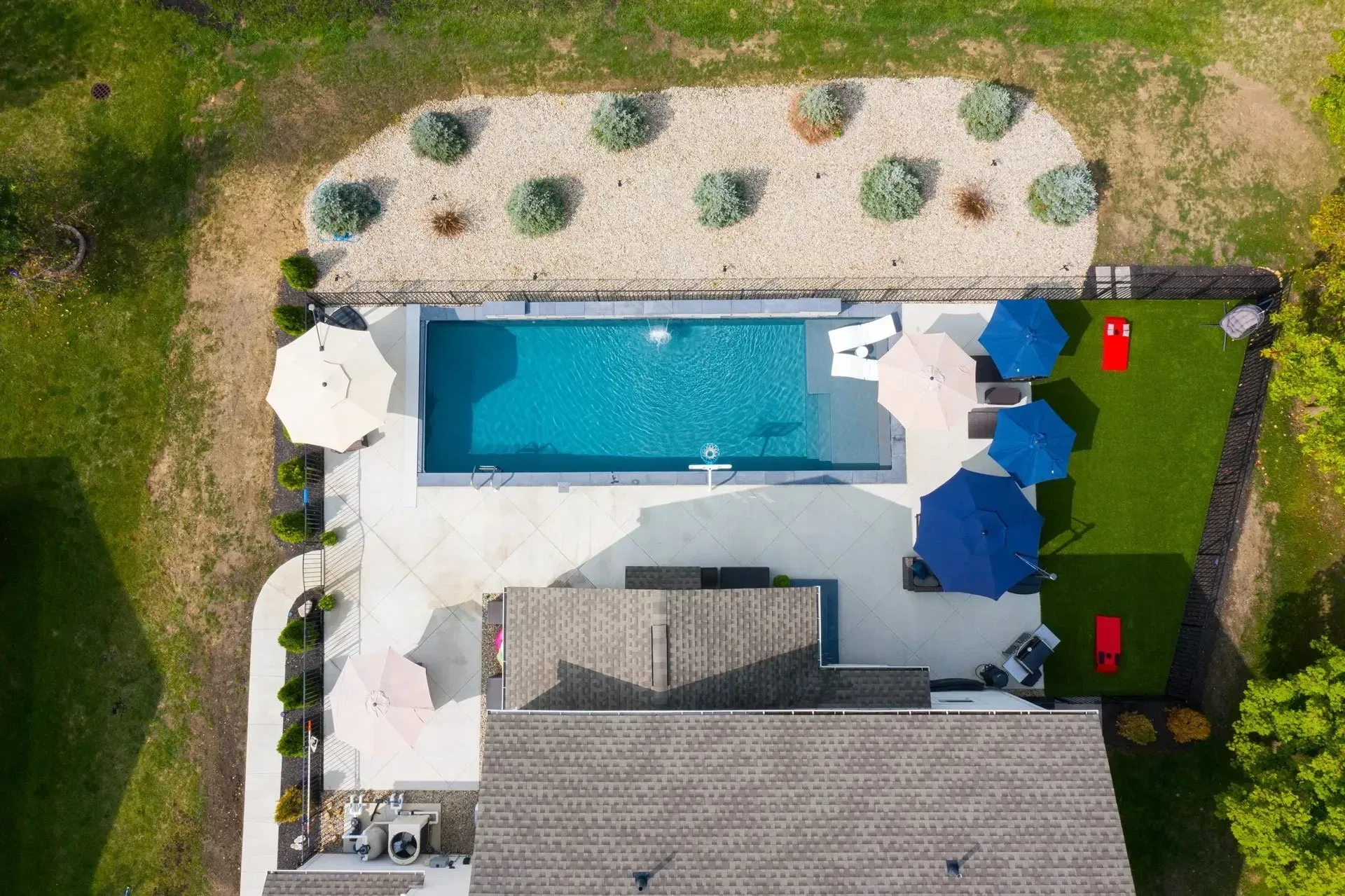
Cost range if you insist on travertine anyway: $22 to $34 per square foot installed for 3cm French pattern, which is middle of the pack for premium deck materials. The problem isn’t the price. The problem is the depreciation curve. A travertine deck under full sun in Cumming can cross the 25-year mark looking clean. The same deck under oak canopy in Dawsonville is usually being acid-washed and partially replaced at year 12.
There is one exception. If the home already has limited canopy and the homeowner plans to remove 2 to 3 canopy trees for the pool build anyway, travertine becomes viable again because the lot is effectively re-classified. That’s a design decision, not a material decision, and it has to happen before you spec stone.
Material 2 — Limestone and Most Natural Flagstone
Everything said about travertine applies to most limestones and to a large share of the flagstones that show up in Atlanta-metro supply yards. Tennessee flagstone holds up better than Pennsylvania flagstone. Dense bluestone holds up better than cream flagstone. But the rule is absorption rate: any natural stone over about 5% absorption is going to fight you under canopy.
There is an argument for full-color variegated flagstone in a limited application — a seating area off a porch, not a pool deck. The warmth of a curved flagstone seat wall with color variation from cream to blue-gray to rust is genuinely beautiful in a mature landscape, especially against flowering dogwood and redbud in spring. It belongs on a front-yard terrace or a patio 25 feet from the pool, not as your primary splashdown surface.
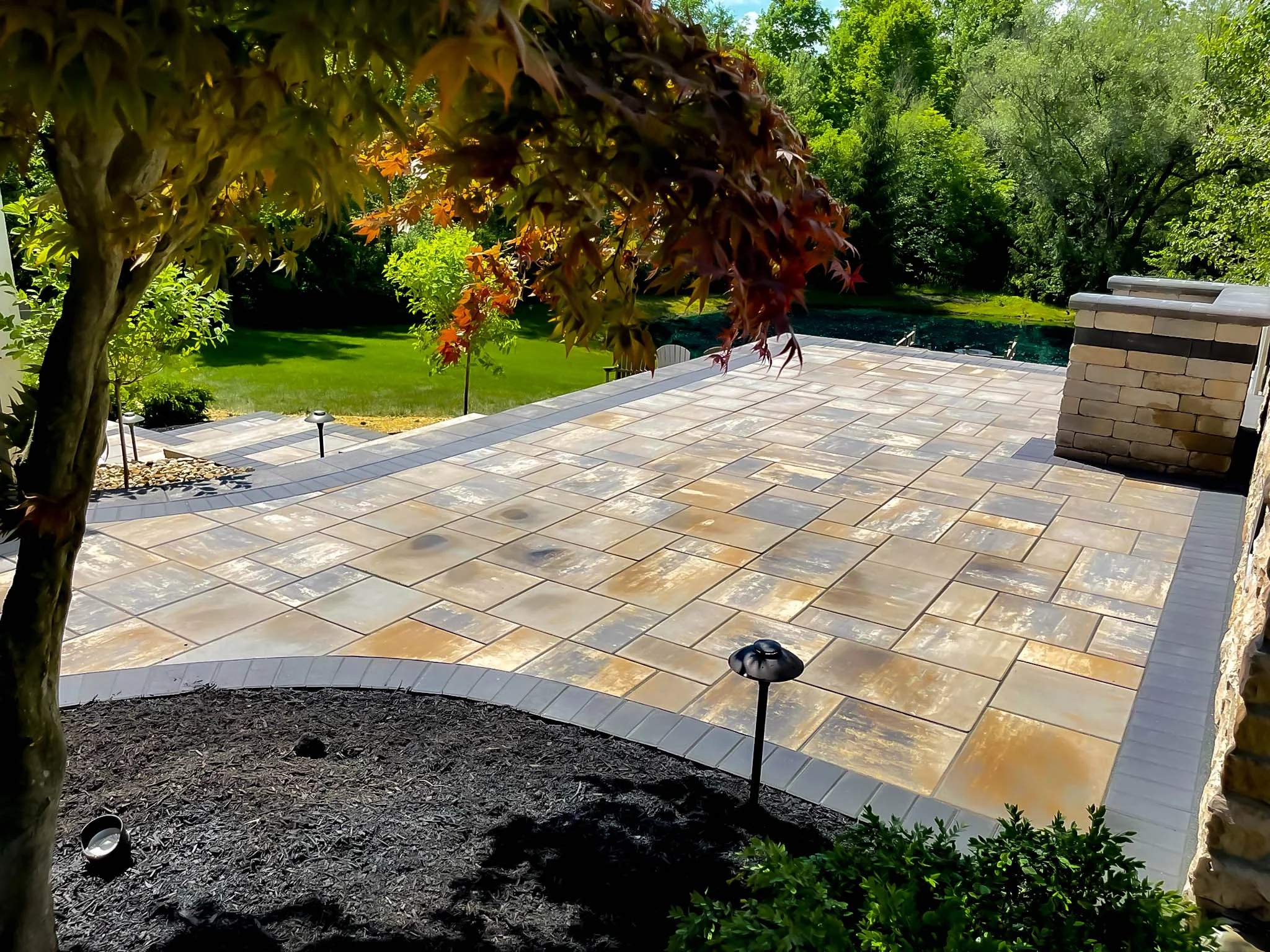
If a Dawsonville homeowner comes to us in love with flagstone texture, we typically pull the natural stone back to the seating nooks, the fire-feature zone, and the wall caps, then run a permeable concrete paver for the actual pool perimeter. You get the texture where you sit. You don’t fight moss where you walk.
Material 3 — Poured Concrete (The Sleeper Pick)
Concrete does not photograph well, which is why it gets skipped by homeowners who are deep in Pinterest research. It performs well, which is why it keeps winning on shaded Dawson County lots. A properly detailed broom-finish concrete deck with color-hardener integral pigment will outlast most stone options in shade at roughly half the installed cost.
The failure mode on concrete isn’t moss. It’s cracking at the expansion joints and scaling from surface-applied de-icing chemicals. We solve the first with control joints every 8 to 10 feet and saw-cut reinforcement, not tooled joints. We solve the second by telling homeowners to not use rock salt in January — a sand/kitty litter mix gives you traction without eating the surface. That’s it. Those two habits push concrete lifespan past 30 years on shaded Dawsonville lots.
Concrete deck range in Dawsonville: $9 to $14 per square foot for basic broom finish, $15 to $22 for integral color plus a light stamp pattern, $26+ for acid-stained or exposed-aggregate finishes. Add roughly $8 to $14 per cubic yard if your excavation hits the rock blast threshold — not common on decks, common on the pool shell itself.
The aesthetic downside is real. A top-down aerial of a concrete deck reads as flat gray no matter how you dress it. If the homeowner cares more about the plan-view drone shot than the 30-year service life, concrete loses the argument. Most owners of mountain-canopy lots, once they understand the trade, pick the service life.
Material 4 — Permeable Pavers with Polymeric Sand (The Pick)
If there’s a single material combination built for a shaded Dawsonville backyard, it’s a permeable concrete paver installed over an open-graded base with a calcium-chloride-stabilized polymeric sand in the joints. We spec it here more than anywhere else in our service area because the math is lopsided in its favor.
Start with the paver itself. Techo-Bloc Aberdeen is our default for canopy lots — a 60mm paver with a textured top, tight chamfers, and three color blends that hold up to acidic leaf litter. Unilock Eco-Optiloc and Belgard Eco-Dublin are comparable alternates. All three are dimensionally consistent enough to lay tight, which matters because your joint is where water and debris either move or lodge.
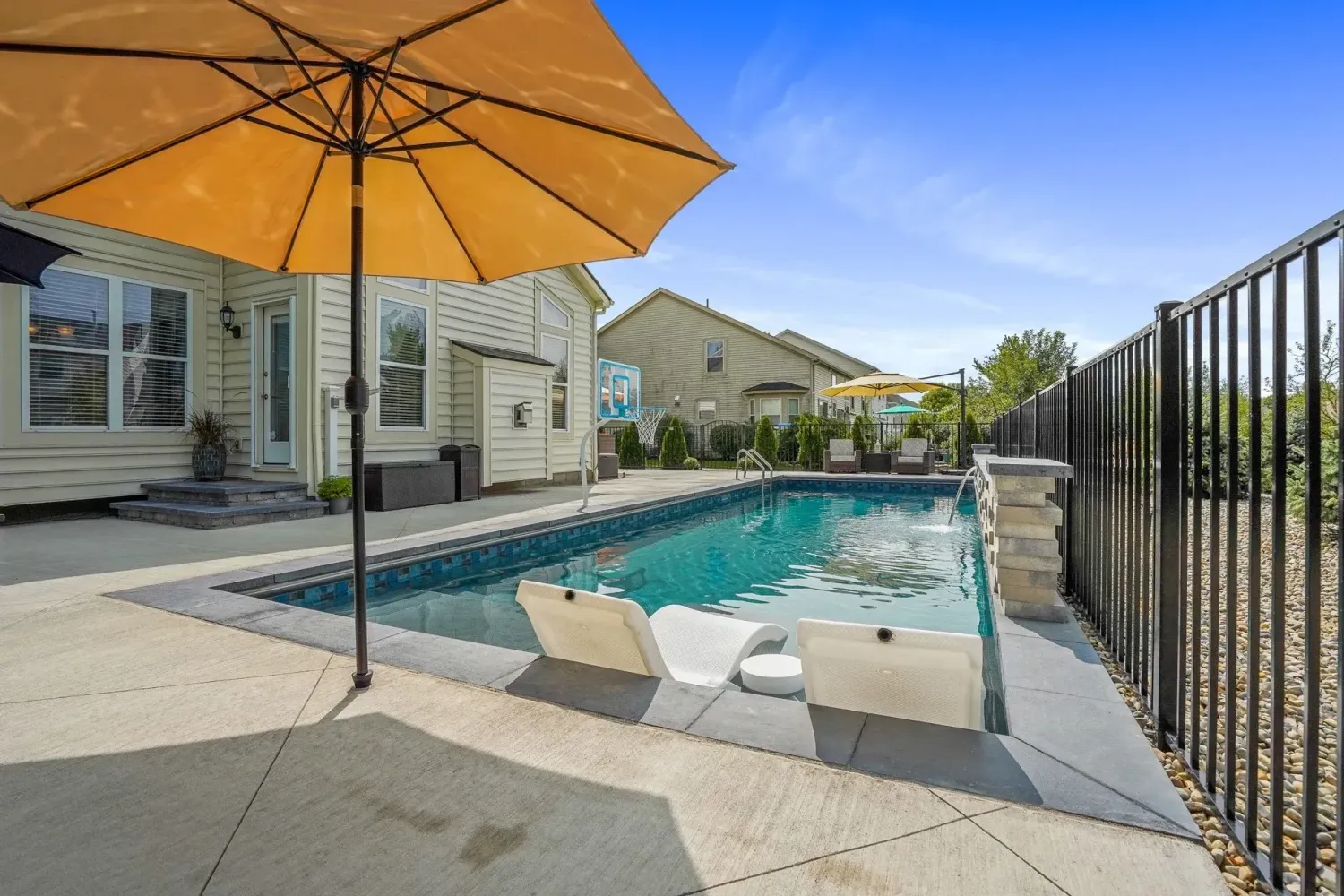
Then the joint. Standard polymeric sand fails under oak canopy in 4 to 6 years because the repeated wet-dry cycle combined with tannin acids degrades the polymer bond. Gator Maxx G2 — the version with calcium chloride and proprietary polymer stabilizers — holds up 85% better in our internal service records for shaded installs. That’s the number that sells the upgrade. You are spending roughly $40 more per 50-pound bag. You are avoiding a full joint re-sand at year 6.
Base matters as much as surface. For permeable pavers, we excavate to 12 inches, lay geotextile, backfill with 8 inches of open-graded #57 stone mechanically compacted in 4-inch lifts, then a 1-inch setting bed of ASTM #9 chip. Water goes through the joint, through the setting bed, through the base, and into the subgrade. That’s what kills the moss problem: the surface dries because water doesn’t pond there in the first place.
Installed cost range in Dawsonville: $28 to $42 per square foot for a full permeable system with premium paver. That is more expensive than concrete and competitive with travertine. What you are buying with the premium is a deck that reads gray-and-warm in photographs, stays usable in winter, and doesn’t put you on a first-name basis with a pressure-washing crew by year 3.
Material 5 — Brick, Tumbled Pavers, and Traditional Finishes
A subset of Dawsonville homes — the brick traditionals in Etowah River Club and along the Hwy 53 corridor — want a pool deck that reads “traditional estate,” not “modern resort.” Cream-tan tumbled pavers fit that brief and also perform reasonably well under partial canopy. Not as well as permeable concrete pavers with open-graded base. Better than travertine.
The trick with tumbled pavers is that the tumbled surface is more porous than the molded surface of a modern permeable paver. It traps tannin staining faster. We counter that with two moves: a penetrating fluoropolymer sealer applied the second spring after install — not the first, because the paver needs to cure and lightly weather first — and a fall leaf-management routine that keeps oak debris from sitting on the deck for more than 72 hours during drop.
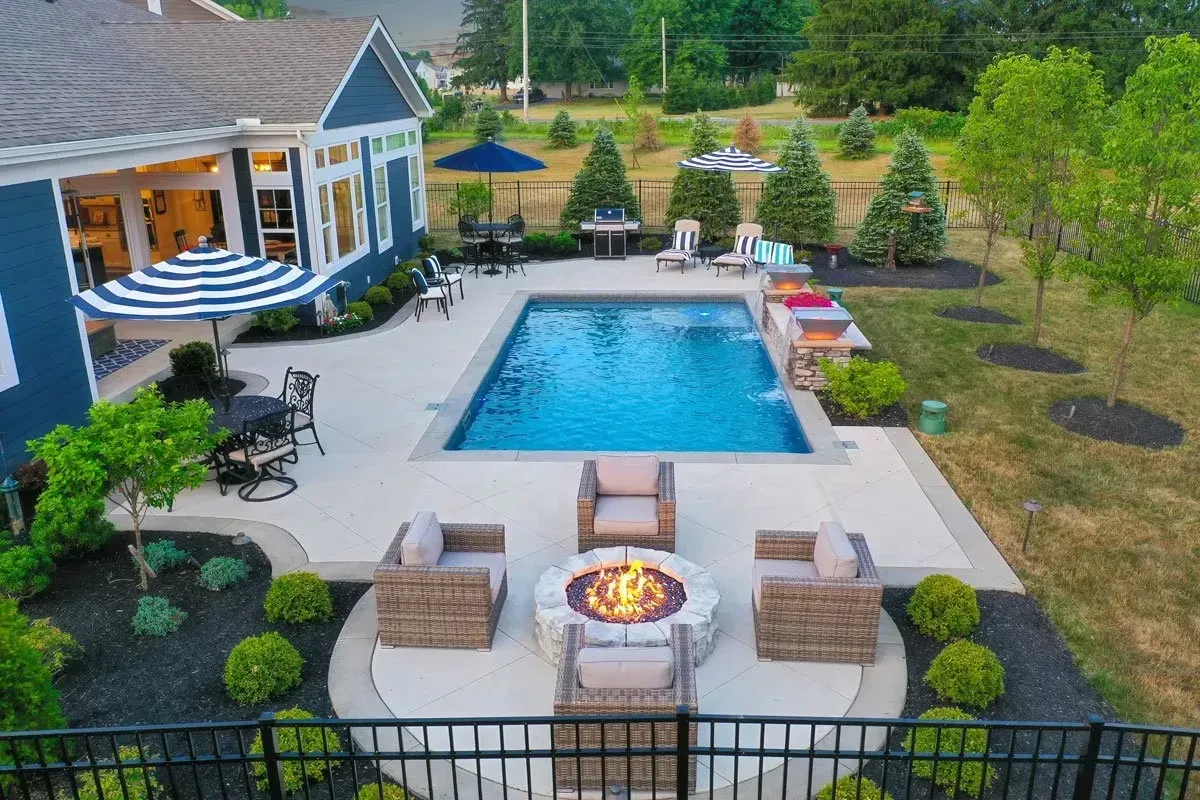
Brick inlays as soldier courses or border accents hold up fine. A full brick pool deck is a different conversation — red brick gets hot fast in direct sun and slick fast in shade. If a homeowner is committed to brick aesthetic, we typically run a brick soldier course border with a tumbled paver field inside. You get the look. You don’t fight full-brick maintenance.
Material 6 — What We Do on Complex Canopy Lots
The best Dawsonville deck jobs are almost never a single material. They’re a deliberate mix tuned to the lot: permeable paver at the pool perimeter where water lands, concrete where the lounge chairs sit in filtered light, flagstone at the fire-feature nook 20 feet back under heavier shade. Plan-view, the deck reads as one continuous outdoor space. In service, each pad is doing the job that matches its exposure.
This is also where the Dawson County Dept. of Planning & Development at 25 Justice Way gets involved. Deck square footage above a certain threshold triggers impervious surface calculations. A permeable paver field, properly documented, counts as pervious on most Dawson County residential permits. That can save a homeowner an expensive redesign if the lot is already close to lot-coverage limits — common on Riverbend and Mountain Laurel lots with setback constraints.

Equipment access also shapes the spec. Lots on the GA-400 corridor are easier to reach with a 10-yard concrete truck than lots off Dawson Forest Rd deeper into the foothills. When we bid a build five miles east of Hwy 9 on a long driveway with grade change, we sometimes shift material choice toward palletized pavers a skid-steer can stage rather than fresh concrete we’d have to pump. That’s a logistics decision that saves the homeowner $1,400 to $2,800 on concrete pumping charges — real money on a deck that’s already committed $40,000 in hardscape.
Material 7 — Annual Fall Clean-Down and the 85% Number
No deck material is maintenance-free under canopy. The number that matters isn’t zero — it’s how cheap the maintenance is and how rarely you do it. On our permeable paver specs with Gator Maxx G2, a single annual fall clean-down reduces moss and algae growth by roughly 85% year-over-year. That clean-down is: blower work in November to clear leaf litter before saturation, a low-pressure rinse with a mild oxygen-based cleaner (not chlorine, which discolors the joint sand), and a 20-minute dry walk to spot-check joints.
Compare that to travertine under the same canopy: quarterly cleanings through the wet season, annual sealer re-application every 18 months at $1.80 to $2.40 per square foot, and a deep acid wash at year 4 that costs $1,400 to $2,100 on a typical 800-square-foot deck. Over 10 years, the maintenance delta between “right material” and “wrong material” compounds into a number large enough to have paid for the paver upgrade twice.
The Amicalola EMC service drop on the average Dawsonville pool also ties into this conversation quietly. A well-designed deck includes conduit runs for future low-voltage path lighting and a dedicated GFCI circuit at the filter pad. That wiring sits under whatever material you choose. Permeable base systems are easier to service-trench if you ever need to upgrade an automation panel. Poured concrete isn’t. That’s not a deck-lifespan issue; it’s a “which deck do you wish you could dig into in 15 years” issue.
We spec decks in Dawsonville for a 25-year horizon. The three signature choices on every canopy lot we build: permeable paver field, Gator Maxx G2 joint sand, and documented drainage that lands on geotextile over open-graded stone. Those three details do more for long-term performance than any $6,000 upgrade to the pool shell itself.
Pool decks engineered for Dawsonville canopy lots — and 20+ cities within 30 miles of Winder, GA
Every deck we build in Dawson County is spec’d around the exposure, subsoil, and canopy of your actual lot — not a generic Metro Atlanta template. That’s why our permeable paver decks outlast the postcard specs homeowners see online.