
A homeowner in Sycamore Ridge called us last October about a three-year-old outdoor fireplace another contractor had built for him — hairline cracks running from the firebox corners out through the stone face, a smoke shelf that pulled air down instead of up, and a copper cap that had already worked loose at the flashing. The stone itself was beautiful. Everything behind the stone was wrong.
We tore it down to the slab over two weeks that November. What we found underneath explains why we’re writing this: the footing was 18 inches wide and 6 inches deep, sitting on disturbed backfill from his pool install four years earlier. The firebox had been laid in common brick with type N mortar. The flue was a single-wythe stainless pipe boxed inside the chimney with no liner separation. Every single one of those shortcuts is cheaper on build day. Every one of them is the reason we were standing in his backyard with a chipping hammer instead of the original crew.
This post is for Dacula homeowners planning a masonry fireplace for the first time — or for anyone who already has one and has started to notice the stair-step cracks widen after the first real freeze. We’re going to walk through the fireplace as a masonry system, layer by layer, the way a mason thinks about it when he’s looking at an empty footing trench and a pallet of fieldstone.
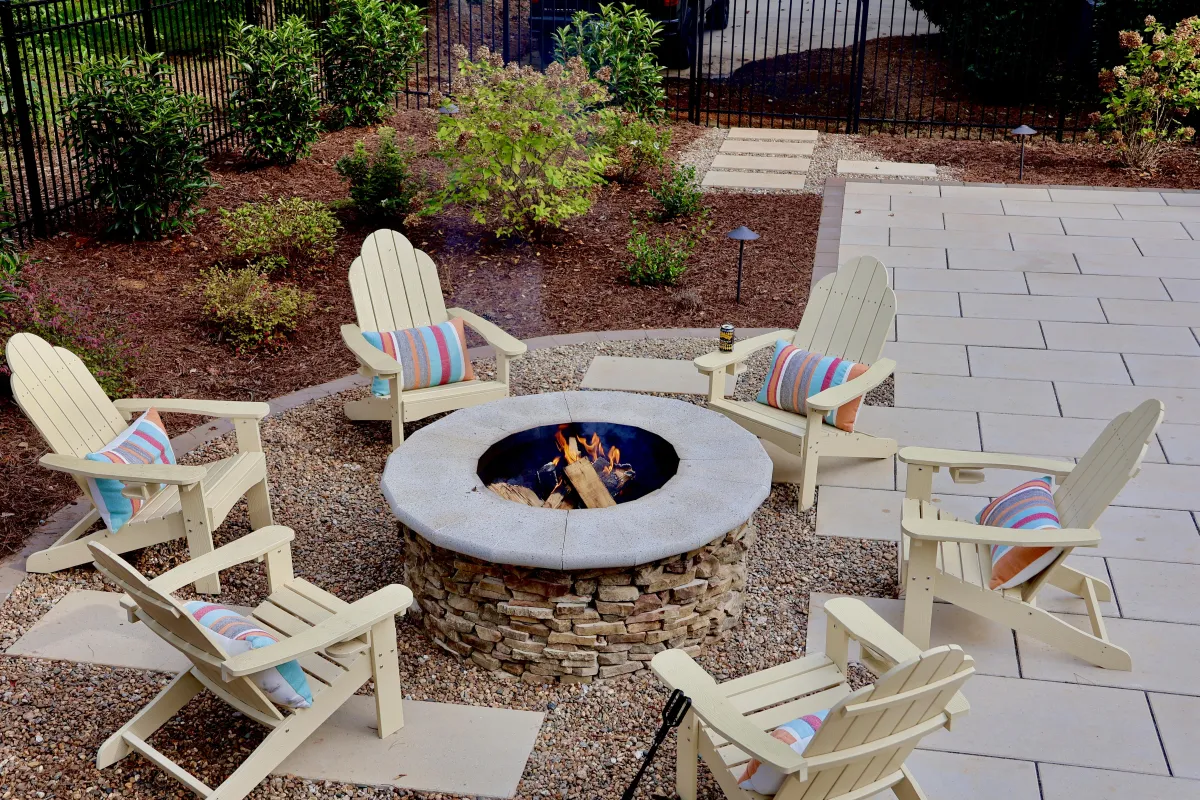
The Footing Is the Fireplace
A freestanding masonry fireplace in Dacula will weigh between 9,000 and 18,000 pounds depending on height and width. A Gwinnett County 42-inch-tall outdoor fireplace with a six-foot hearth, typical of what we build in Hamilton Mill and Providence Club backyards, lands around 14,000 pounds before the veneer stone is attached. All of that sits on a single pad of concrete. Get the pad wrong, and the cracks are already baked in before the first stone goes down.
Our footing spec for outdoor masonry fireplaces in Dacula is 42 inches wide by 12 inches deep, poured directly against undisturbed soil, with the bottom set below the frost line. Gwinnett County frost depth for structural footings in unheated exterior work runs to 12 inches, and we always pour to that depth — no shortcuts at 8 or 10 inches even when the homeowner’s existing slab is shallower. The width matters because the load path through a tall, narrow fireplace is not centered; it migrates toward the firebox side as the chimney rises, and a too-narrow footing lets one edge settle faster than the other. That differential settlement is what drives the diagonal cracks you see walking out of the firebox corners on any aged fireplace that was built on 18-inch footing.
Reinforcement goes in as a doubled mat of #4 rebar, 12 inches on center both ways, top and bottom, with 3 inches of cover to the soil and 2 inches of cover to the top face. We chair the rebar — we don’t set it on brick bats or scraps of 2×4. On most Dacula sites, the Piedmont clay subgrade is firm enough to carry the load directly, but we test it. If a #5 rebar pushed by hand goes in more than four inches without resistance, we over-excavate another six inches and fill with compacted #57 stone before placing forms.
Footing spec we pour every time: 42″ wide x 12″ deep, set below the 12-inch Dacula frost line, doubled #4 rebar mat at 12″ on center, poured on undisturbed soil or compacted #57 stone. 3,000 psi mix minimum; 4,000 psi when the chimney exceeds 10 feet above the hearth.
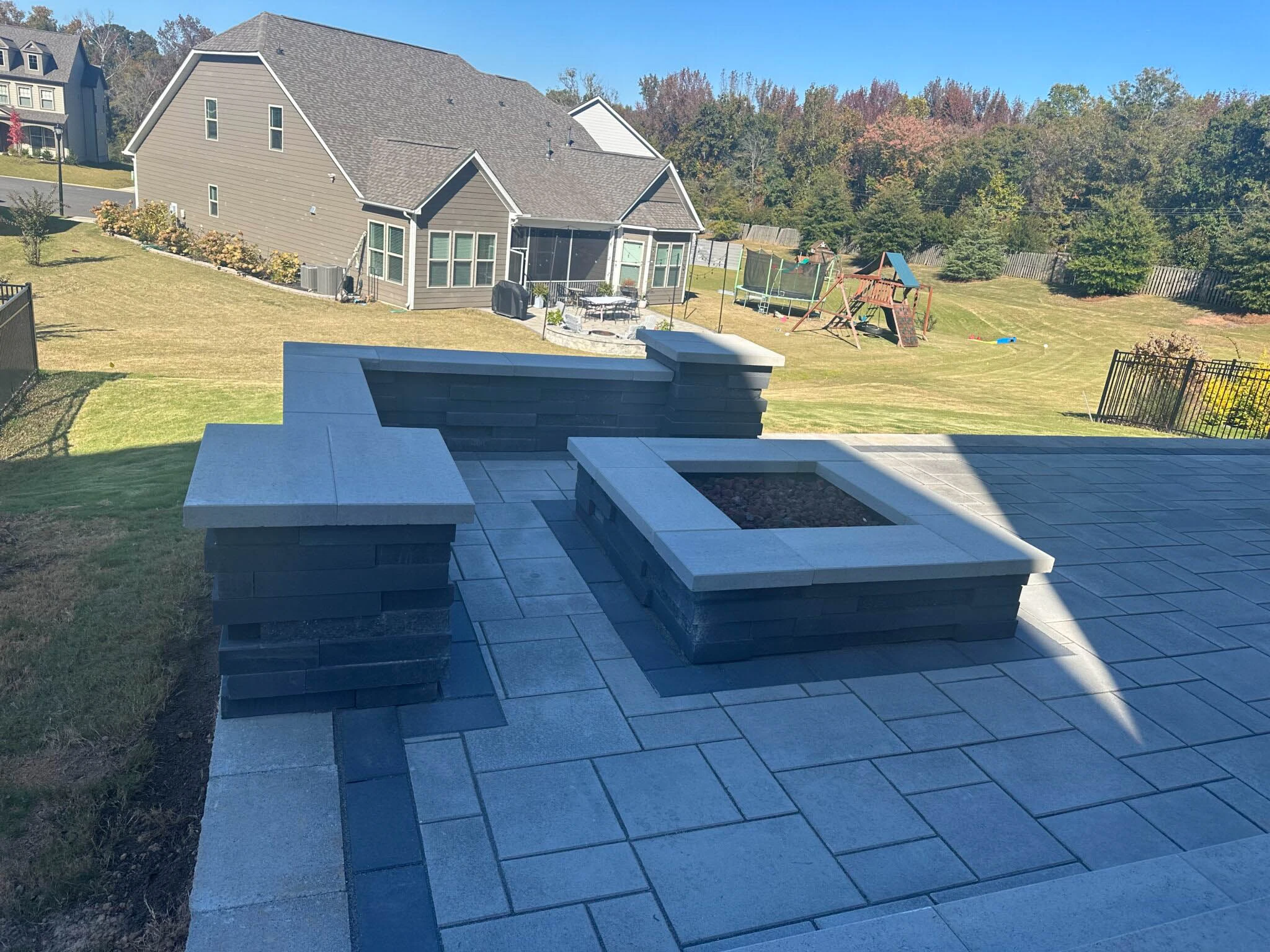
The Firebox — Where Three-Year Failures Begin
Here is where the contractor on the Sycamore Ridge job gave himself away. The firebox he built was standard red masonry brick — the kind you’d use on a garden border — laid in type N mortar. Type N is a 1:1:6 mix of portland, lime, and sand. It’s perfectly adequate for a garden wall. It is not a mortar that survives a wood fire.
The interior of a masonry firebox sees sustained temperatures between 900 and 1,400 degrees Fahrenheit during a typical evening burn. Portland-based mortars begin losing integrity above about 500 degrees and calcine — literally burn off their chemical bonds — above 800. After a single season of weekend fires, the mortar joints inside the firebox he built had turned chalky. After three seasons, they were opening to the point that thermal expansion was pushing the firebox wall outward into the surrounding common brick, and that lateral force was radiating out through the stone veneer. The cracks on his face stone were not a veneer problem. They were a firebox material problem telegraphing through.
The fix is non-negotiable: ASTM C27 Class 1 refractory firebrick, bedded in refractory mortar, not type N or type S. C27 Class 1 is the medium-duty refractory grade, rated for service temperatures above 2,900 degrees — overkill for a wood-burning fireplace but the right thermal-cycling margin. We use a pre-mixed air-setting refractory like Rutland or Heatstop, troweled to a tight 3/8-inch joint and struck flush on the interior so there’s no shadow line to collect soot.
Firebox walls go four inches thick minimum, with the back wall sloped inward at roughly 20 degrees above the halfway point. That slope pushes heat out onto the patio rather than letting it roll straight up the flue, and it begins the transition into the smoke chamber. Too shallow and the fireplace smokes; too steep and the fire runs cold because draft pulls combustion up before it completes.
Firebox interior dimensions we target for a 36-inch-wide opening: 24 inches deep at the hearth narrowing to 16 inches at the back, back wall 14 inches tall before the inward slope begins, and the slope carried up another 22 inches to the throat. These proportions trace back to the Rumford fireplace geometry and they work.
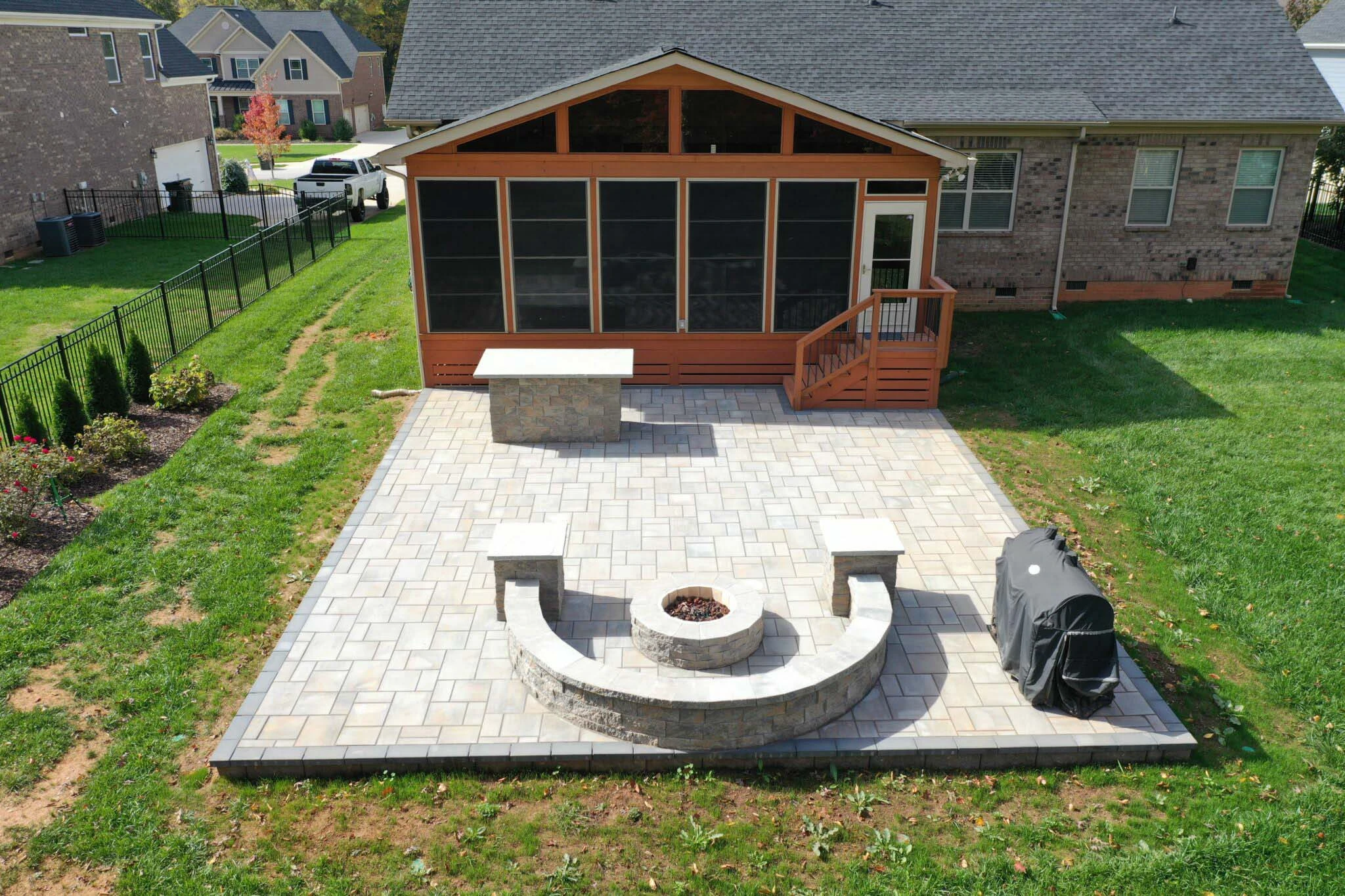
Smoke Chamber, Throat, and Flue — The Physics of Draft
Above the firebox is the smoke chamber, and above that is the throat that feeds into the flue. This is the section of the fireplace homeowners never see and too many builders treat as negotiable. It is where the single largest functional difference between a fireplace that draws and a fireplace that smokes is decided.
The smoke chamber is a transition zone. At the bottom it’s as wide as the firebox opening. At the top it has to neck down to match the inside diameter of the flue liner. That necking has to happen at a specific rate: no steeper than a 2:1 vertical-to-horizontal taper. If the taper is steeper, the combustion gases hit the narrowing walls at too sharp an angle and eddy back into the firebox — that’s smoke rolling out into your yard. The smoother the transition, the more efficient the draft.
We parge the inside of the smoke chamber with a smooth coat of refractory mortar after the masonry is up — no exposed brick edges, no step-joints, no mortar droppings. Every bump creates turbulence, and turbulence robs the stack of the upward pressure differential that pulls combustion out the top. At the throat, we size the transition so throat cross-section matches flue cross-section within 5 percent. Step-changes in cross-section create pressure discontinuities that register as smoke spill at the firebox opening every time someone opens a beer near the fire.
The flue liner itself is the spine of the chimney. Our standard is refractory clay tile flue liner set in refractory mortar, or an insulated double-wall stainless liner when the geometry requires an offset clay tiles can’t make. Either way, the liner cross-section has to be approximately 1/10 the cross-sectional area of the firebox opening — a rule of thumb masons have used for two centuries. A 36-inch-wide by 30-inch-tall firebox has a 1,080-square-inch opening, so we target roughly 108 square inches of interior flue. A 13×13 nominal clay tile (11×11 interior, 121 square inches) is where we land for most 36-inch firebox builds.
The clay tile liner is set with 3/8-inch joints in refractory mortar, one tile at a time, with a 1/4-inch air gap between the exterior of the tile and the surrounding masonry. That air gap is critical: it lets the liner expand thermally without transferring stress into the chimney walls, and without it, the first hard burn will crack both the liner and the chimney face. If you’ve seen old fireplaces in Dacula’s 1995-era subdivisions with stair-step cracking on the chimney exterior, nine times out of ten the liner was mudded tight to the block and the thermal expansion had nowhere to go.
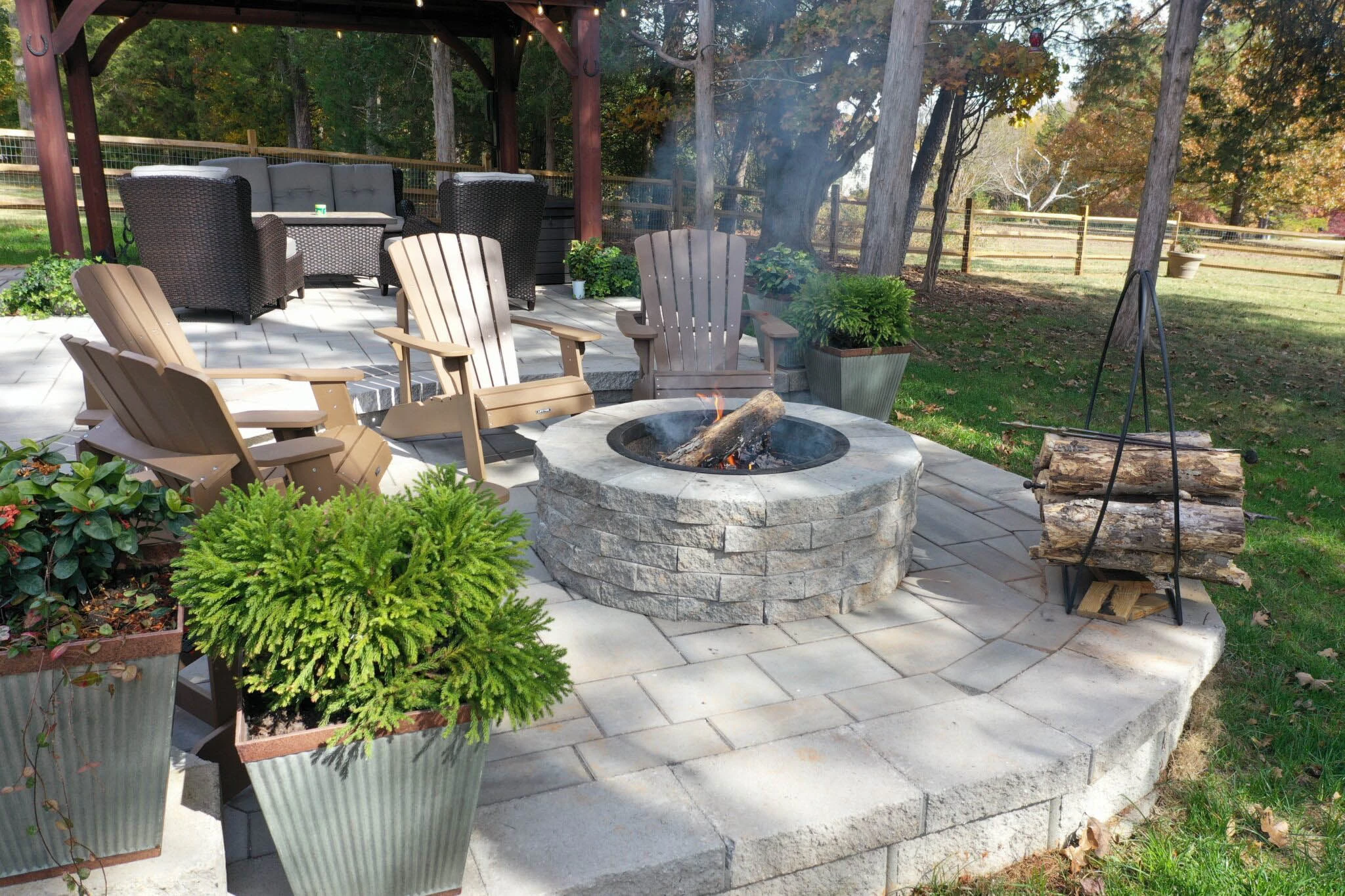
Chimney Height and the Weather Cap
The height rule catches Dacula homeowners with two-story homes in Hamilton Mill or Chandler Ridge every spring: per NFPA 211, the chimney must rise at least 24 inches above the highest point of the roof within 10 feet horizontally, and at least 3 feet above the roof penetration itself. On a fireplace sitting 15 feet from a two-story house with a steep gable, the chimney often has to climb nine or ten feet above the hearth just to satisfy this rule. Go shorter and the chimney enters a zone of positive pressure during wind events — the wind rolls over the roof, creates a downwash, and pushes smoke back into the stack. The homeowner ends up with a fireplace that smokes into their patio whenever the wind is out of the north.
At the top of the chimney we install a stainless-steel weather cap with an integral spark-arrestor screen — required under Chimney Safety Institute of America (CSIA) guidelines and enforced by the Gwinnett County fire marshal on any masonry fireplace permit. The mesh runs 3/8 to 5/8 inches, passing combustion gases while stopping ember escape. Every Dacula lot sits near piney or mixed hardwood canopy, and dry needle duff is dense enough that an unscreened chimney is a wildfire vector during a dry September. The cap is mechanically anchored — not adhered — with stainless screw-lags through the skirt, then flashed with high-temperature silicone. That flashing joint, wet through a freeze cycle, is the single largest point of chimney spall we get called back to assess on houses five to eight years out.
The Veneer — Stone Attachment, Expansion, and Weather
The visible fireplace — the fieldstone, ledgestone, or dimensional-cut stone that the homeowner actually picked out — is a veneer. It is non-structural. Its job is to look right, shed water, and stay anchored to the structural masonry behind it for the life of the installation. When the veneer lets go, it’s almost always because of one of three failures: the attachment method was wrong, the water management was wrong, or there was no allowance for thermal and moisture expansion.
Attachment first. On a masonry-backed fireplace — which is what every Primetime Pools build is — the veneer anchors with #9 corrosion-resistant wire ties embedded directly into the mortar joints of the structural block behind, spaced at a maximum 16 inches vertically. Each tie threads through a horizontal bed joint in the veneer as we set the stone, and gets tucked into the next joint going up. The tie pulls the stone face tight to the structural wall without rigid-linking them — there’s a small allowance for differential movement, but not so much that the veneer can separate and bulge outward over decades of thermal cycling.
What we never do: nail veneer to sheathing or drywall screw it to a framed chase. We have seen this on more than one demolition in Gwinnett County — outdoor fireplaces with framed chases, stone glued and nailed to plywood, chases filled with nothing structural. First severe freeze, moisture pulls out of the stone-to-chase mortar, ice expands, mortar fractures, and by year four the stones are working loose one row at a time. A natural-stone fireplace sits on masonry, not on framing.
Expansion management: on any long horizontal run of veneer — a hearth extension, a wrap-around bench, the sidewall of an integrated outdoor kitchen — an expansion joint has to be cut every 20 feet of linear run. A 3/8-inch vertical joint from footing to top course, filled with closed-cell backer rod and self-leveling polyurethane sealant color-matched to the mortar. Without it, Dacula’s thermal swing (35 degrees in January to 95 in July, stone face absorbing direct sun well past ambient) drives the veneer into compression against itself, and the first thing that lets go is always the corner of a stone, chipping off a piece that never grows back.
Water management: the top course of every stone wall has to be capped with a thrown-off coping or drip edge. Water running down the face is fine — natural stone sheds water. Water sitting on a flat top and soaking into the backer is the destroyer. We detail a 2-inch-minimum slate or bluestone cap with a 1-inch overhang on all sides and a drip kerf ground into the underside so water breaks free and falls clear.
What a Primetime Pools Dacula Fireplace Costs — and Why
We don’t hide pricing, because the gap between a fireplace that lasts 40 years and one that fails in three is, more than anything else, a budget decision made at the start. A natural stone outdoor fireplace built to the spec above — proper footing, firebrick interior, lined flue, wire-tied veneer, stainless cap — starts around $18,500 for a 42-inch opening, six-foot hearth, and nine-foot chimney. Add a flagstone hearth extension and it’s $21,000. Add an integrated woodbox or raised bench and we’re in the $24,000 to $28,000 range. A fireplace anchoring a full outdoor kitchen with ash cleanout and gas starter typically runs $32,000 to $38,000 installed.
The contractor who built the Sycamore Ridge fireplace bid it at $9,800. The homeowner saved $8,700 up front and spent $16,400 rebuilding it three years later — total cost $26,200, plus the full 2024 patio season lost to tear-down and rebuild. We price the way we price because every line item is pulled out of that failed bid and rebuilt at code. There is no shortcut that survives year three in Dacula’s climate — USDA Zone 8a, 20 freeze cycles a year, high summer humidity, and clay soil that drives water up through capillary action in spring and down through infiltration in fall.
If you’re in Dacula planning a masonry fireplace — or staring at a three-year-old one with cracks you can fit a dime into — we permit everything through the Gwinnett County Department of Planning & Development at 446 W. Crogan Street in Lawrenceville, including building permit, fire-code review, and final inspection. We’ve rebuilt enough of other contractors’ outdoor fireplaces in this zip code to know what fails and why, and we’ve built enough of our own to stand behind what we deliver.
Masonry fireplaces and outdoor fire features across 20+ cities within 30 miles of Winder, GA
From Hamilton Mill to Providence Club, we design and build natural stone fireplaces engineered for Dacula’s freeze-thaw, soil, and wind conditions — permitted through Gwinnett County and built to last decades, not seasons.