
Should your Milton outdoor kitchen run on natural gas or propane? The honest answer: it depends on where your driveway meets the road — and on Milton’s estate lots, the math tilts toward buried propane more often than homeowners expect.
We get the question on almost every consultation inside The Manor Golf Club, Cogburn Estates, and the Crabapple corridor: “Can we just tap into natural gas like the neighbors did?” Sometimes yes. Sometimes the Atlanta Gas Light (AGL) main stops 600 linear feet short of your house, and the quoted extension runs past $10,000 before you’ve lit a single burner. This piece walks through how we scope the fuel decision on Milton builds — when natural gas is the clean answer, when propane is the smarter one, and how we design the gas infrastructure so the pool, the grill, the fire bowls, and the pavilion heaters all run without nuisance pressure drops at peak demand.
This is a Milton-specific conversation. Alpharetta has dense AGL service almost everywhere. Milton — incorporated as its own city in 2006, with AG-1 zoning requiring 1–3+ acre minimum lots across most of its footprint — has long setbacks, equestrian parcels, and main roads where service stops and private drives begin. That geography drives the fuel choice more than any preference we bring to the table.
Where the AGL Main Actually Runs in Milton
Atlanta Gas Light’s distribution footprint in Milton follows the arteries, not the acreage. If your driveway meets the road along Birmingham Highway (GA-372), Freemanville Road, Hopewell Road, Crabapple Road, Mayfield Road, or Highway 9, there’s a strong chance the AGL main is at the right-of-way. The Crabapple historic crossroads district — around Mayfield, Crabapple Road, and Birmingham Highway — has the densest service coverage in the city, a legacy of that area being developed before Milton incorporated separately from Fulton County.
Step one lot deep off those arteries and the picture changes fast. Interior estate roads in Crooked Creek, Atlanta National, and The Manor Golf Club are a mix: some streets were stubbed with gas at build-out, others were not. Private drives on Potters Road, New Providence Road, Arnold Mill Road extensions, and the equestrian parcels off Hopewell Road frequently sit 300 to 900 linear feet from the nearest live main. On a 2.8-acre parcel in Cogburn Estates we recently scoped, the AGL service locate put the closest main 740 LF from the proposed outdoor kitchen — a reality check that reframed the entire fuel conversation.
The utility verification is non-negotiable on every Milton build. Before we price any outdoor kitchen quote, we pull a service availability letter from AGL and — on the service-territory borderline along the north and east edges of the city near Forsyth County — we confirm whether the parcel is served by AGL or by Sawnee EMC for electric (because heat-pump backup and appliance choice both change the fuel math). Georgia Power covers most of Milton’s footprint. Sawnee EMC service shows up on specific ridgelines along the county border.
AGL main extension cost (2026 Milton market): $1,200–$1,800 per 100 LF for standard trenched extension on private property. Add road-bore crossings ($4,500–$8,500 per crossing) if the main is on the opposite side of a county road. Paved driveway restoration ($45–$80 per SF) if the trench cuts asphalt.
Net: a 600 LF extension from an interior estate drive to Birmingham Highway frequently lands in the $9,000–$13,500 range all-in before the meter is even set.
When Propane Is the Correct Answer (Not the Compromise)
Homeowners often assume propane is a fallback — the “we couldn’t get gas so we settled” option. On Milton estate builds, that framing is backward. For lots sitting more than 400 LF off the nearest AGL main, buried propane is frequently the better engineering answer, the better economic answer, and the better aesthetic answer.
Here’s the math we walk clients through. A 500-gallon buried propane tank, installed with sacrificial anode, riser, and first-fill, runs $3,200–$4,400 in Milton. A 1,000-gallon buried tank — the size we spec for estates running pool heater + outdoor kitchen + pavilion appliances + fire features off one fuel system — runs $4,800–$5,800 installed. Both numbers include the City of Milton mechanical permit and the tank-set inspection. Contrast that with a $9,000–$13,500 main extension, and a 1,000-gallon buried tank is already the cheaper capital outlay — before you factor in the commodity cost.
On commodity, natural gas almost always wins per BTU. But on Milton estates with infrequent winter use of the outdoor kitchen and seasonal pool-heater use, the annual delta is smaller than spreadsheet math suggests. Typical estate use — pool heater shoulder-season, outdoor kitchen 40–60 uses a year, occasional fire-bowl runs — books at $1,800–$3,400 annually in propane deliveries. AmeriGas and Blossman Gas are the two dominant providers servicing Milton; both run keep-full contracts and will lock seasonal rates if you ask. Natural gas on the same usage profile runs $900–$1,600 annually. The delta — roughly $900–$1,800 a year — amortizes a main extension over 7 to 15 years, not 3.
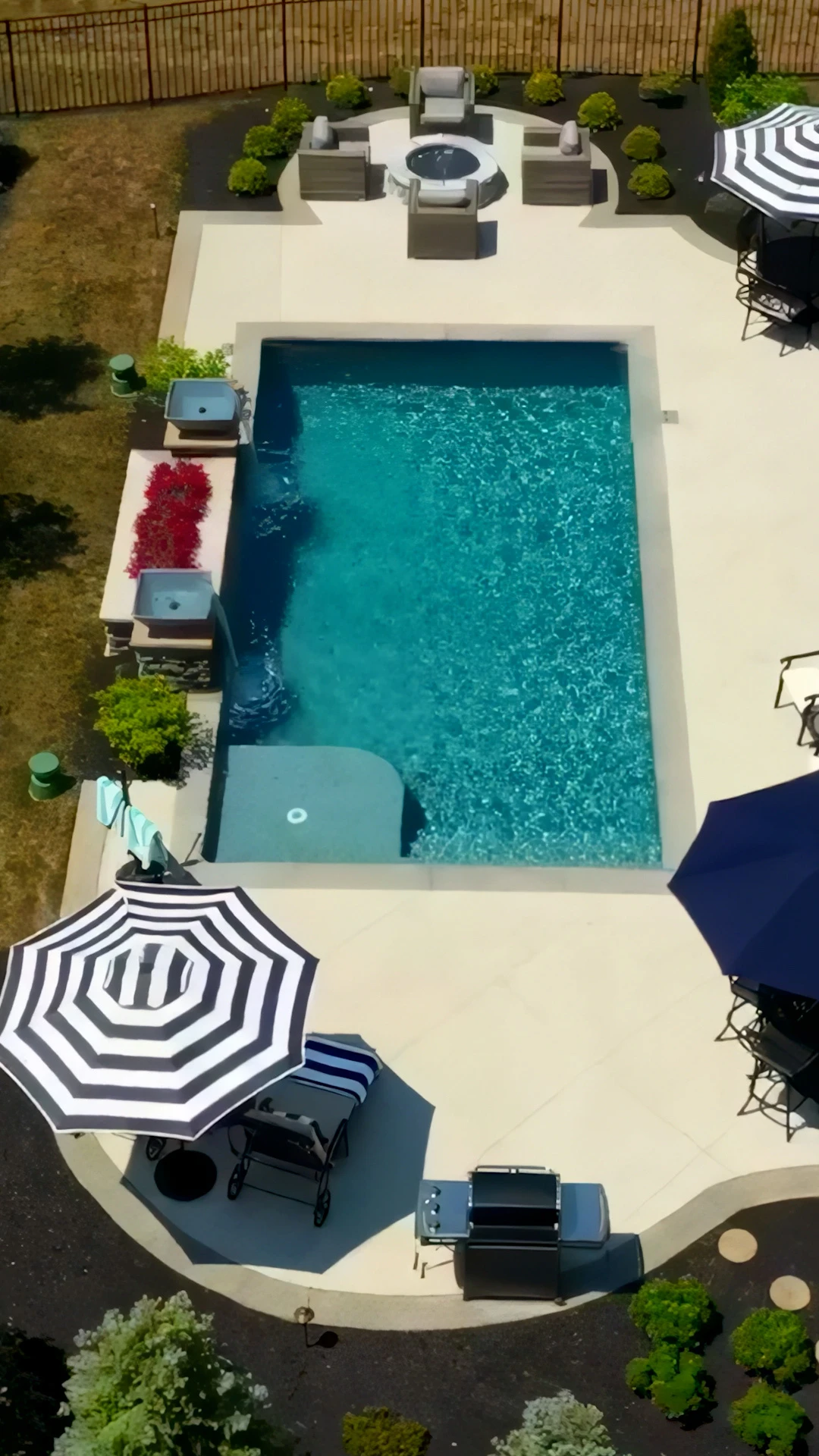
Propane also wins on two aesthetic concerns that come up almost every time at The Manor and Crooked Creek design reviews. First, buried tanks disappear. The dome lid sits flush in a planting bed; we typically screen it with boxwood or loropetalum. Second, propane appliances fire hotter per volume — the same searing performance from a ribbon burner on a fire bowl uses a smaller orifice on propane than on natural gas, which means tidier plumbing runs and fewer manifold fittings visible at the appliance.
Load Sizing: Why the BTU Math Has to Happen First
Whether the fuel is natural gas or propane, the design error we see most on Milton properties isn’t the fuel choice — it’s undersized supply lines. A homeowner adds a fire pit two summers after the pool was built, or the original builder sized the kitchen stub for a grill only, and suddenly the pool heater kicks on while the side burner is lit and both are starving for pressure.
We size gas infrastructure on the whole ecosystem, not the appliance in front of you. A typical Milton outdoor living buildout we spec carries:
- Pool heater: 400,000 BTU/hr (residential Raypak or equivalent)
- Grill + side burner: 80,000–120,000 BTU/hr combined
- Pizza oven or smoker: 40,000–65,000 BTU/hr
- Pavilion overhead heaters (2): 80,000 BTU/hr combined
- Fire bowls or fire table: 60,000–110,000 BTU/hr combined
That’s a connected load of roughly 660,000–775,000 BTU/hr. Diversified — because you don’t run every appliance simultaneously — we typically design to a peak simultaneous demand of 450,000–550,000 BTU/hr. That number drives pipe sizing from the meter or tank to the manifold, and from the manifold to each appliance.
For propane systems, that demand profile is why we push clients toward the 1,000-gallon tank over the 500. At peak winter draw with the pool heater running, a 500-gallon tank at 30% can hit vaporization limits on a 28°F morning and lose pressure at the regulator. A 1,000-gallon tank has roughly double the wetted surface area and won’t pressure-drop on the coldest Milton mornings. Given that Milton logs ~22 freeze events per year in USDA Zone 8a, that margin matters three or four mornings a winter.
Pipe sizing reality check: A ½” black iron supply line that was fine for a single 60,000 BTU grill will not carry a 400K pool heater + 90K grill run simultaneously. We size outdoor kitchen trunk lines at ¾” minimum and feed pool heaters on dedicated 1″ or 1-¼” runs depending on distance from meter/regulator.
Permits, Inspections, and the Milton Preservation Review
Milton’s incorporation in 2006 pulled permitting out of Fulton County and into City of Milton Community Development at 2006 Heritage Walk. That’s a net win on timeline — typical mechanical permits turn in 10–14 business days versus the 3–4 weeks Fulton County currently runs. But Milton has stricter preservation and setback review, and on any lot in the AG-1 equestrian overlay or within the 25–75 ft creek-buffer setbacks along Cooper Sandy Creek, Chicken Creek, and Lake Creek tributaries, tank placement triggers additional review.
For propane tank installs in Milton we pull two permits in parallel: the city mechanical permit for the gas line and the plumbing/tank-set permit. Tanks cannot sit within a mapped creek buffer, cannot sit under roof overhangs, and — critically on Milton estate lots — must maintain 10 ft from any combustible structure and 10 ft from property lines. On lots backing the Chicken Creek floodplain in north Milton, we also verify the tank pad is above the base flood elevation before scheduling the tank set.
Natural gas meter sets go through AGL directly and require a City of Milton mechanical permit on the house-side piping. Expect 4–6 weeks from AGL survey to meter set after the new service application is accepted. This is the timeline most homeowners underestimate — if you want the pool heater fired for a Memorial Day opening, the gas application needs to be in by mid-February at the latest.
Properties inside The Manor Golf Club layer an architectural review on top of the city permit. The Manor’s structural review committee typically runs 4–5 weeks and looks at tank placement, appliance venting locations, and any above-grade gas line in hardscape joints. We submit to The Manor ARC and the City of Milton in parallel — they don’t approve each other’s work, but running them concurrently keeps the project from adding 5 weeks of calendar sequentially.

How We Sequence Gas Work on a Milton Build
On a typical Crooked Creek or Bethany Creek estate buildout, gas infrastructure isn’t an afterthought layered in at the end — it’s trenched with the pool plumbing. Here’s the order we run on Milton jobs, propane or natural gas, because the sequencing doesn’t change much between them:
- Fuel scope + load calc (week 0): AGL service availability check, propane tank location study, connected-load BTU calc for every appliance planned now and within 3 years.
- Permit package (week 1–2): City of Milton mechanical permit, tank-set permit if propane, AGL service application if natural gas, ARC submission if inside The Manor or Atlanta National.
- Excavation coordination (week 3–5): Gas trenching happens the same week pool plumbing, conduit, and low-voltage runs are trenched. One trench, multiple sleeves. This is where most retrofits go sideways — running a gas line through an existing patio costs 3× a new trench.
- Rough-in + pressure test (week 5–6): Black iron or CSST trunk lines set, manifold located at pool equipment pad, appliance stubs brought to grade, system pressure-tested to code. City of Milton rough-in inspection.
- Tank set or meter set (week 8–10): Propane tank delivered and set by AmeriGas or Blossman; or AGL meter set. Regulator and first-stage pressure drop verified.
- Appliance hookup + final (week 10–12): Grill, side burner, pool heater, fire features tied to stubs. Final leak test, manometer reading at each appliance, final inspection.
On the Cogburn Estates job mentioned earlier — the one with the 740 LF AGL extension quote — we ran the propane path instead. A 1,000-gallon buried tank went in on the far side of the pool pad, screened by existing hardwoods. Total gas-system capital was $6,200 including tank, regulator, manifold, and all stub-outs to a 135,000 BTU grill island, 400K pool heater, and two 40K pavilion heaters. AGL extension would have run $12,800 for the main alone — before tap fees, meter set, or house-side piping.
Retrofit pricing premium: Adding gas to a finished Milton outdoor kitchen — cutting through existing hardscape, re-threading lines under pavers or around a built patio — typically costs 2.5× to 4× what the same run costs during original construction. This is the single strongest argument for over-sizing gas infrastructure on day one, whether you plan to use all the capacity right away or not.
The Decision Framework — In Plain English
After walking hundreds of Milton properties, here’s the field framework we actually use. Natural gas is the answer when: the AGL main is within 200 LF of the proposed meter location; the parcel sits on an artery (Birmingham Highway, Freemanville, Hopewell, Crabapple, Mayfield); no road-bore crossing is required; and the outdoor program runs heavy on appliance hours (full outdoor kitchen used weekly, pool heated shoulder-to-shoulder season). In that profile, the commodity savings justify the connection cost inside 5–7 years.
Propane is the answer when: the AGL main is more than 400 LF from the meter location; the parcel is interior to an estate subdivision or on a private drive; a road-bore crossing is required; the outdoor program is typical estate use (weekend and holiday heavy, shoulder-season pool); or the ARC in a gated community has cleaner tank-screening precedent than meter-box placement. This covers roughly 55–65% of the Milton estate builds we price.
The gray zone — AGL main between 200 and 400 LF away — depends on the commodity profile and whether a future addition (pool house, pizza oven, pergola fire pit) is in the 3-year plan. If yes to the additions, the main extension often wins on long-horizon math. If the program is fixed and the use is moderate, propane wins on capital.
The error nobody should make on a Milton estate build: letting the fuel decision get made after the trenches are closed. Have the fuel conversation at the design-development stage, run the AGL locate before the final site plan is drawn, and size the gas trunk for what you might add in year three — not only what you’re installing in month one. That single discipline prevents the 3×-retrofit premium and keeps the outdoor kitchen, the pool heater, and the fire features all running at spec during a 28°F January evening when the whole family’s home.
Outdoor Kitchens across 20+ cities within 30 miles of Winder, GA
From Milton estate lots on buried propane to in-town Decatur builds on AGL service — the gas infrastructure is sized to the whole program before the first trench opens.