
“Do I have natural gas at my house, or do I need propane?” It is the first question a serious Alpharetta outdoor-kitchen build has to answer — and the answer lives on the meter base on the side of your house, not on a utility map. The wrong answer costs you $2,400 to $3,800 before you’ve lit a single burner.
We get this call every spring. Someone signs a design agreement for a 30-inch Lynx built-in grill, a side burner, a Kamado Joe cutout, and a gas fire bowl pair, and three weeks later the gas contractor shows up, walks the side yard, and delivers news the homeowner didn’t know to ask about. No meter. No Atlanta Gas Light line at the street. The lot is on propane-only service because it sits on the wrong side of an invisible utility seam that runs through north Alpharetta.
That seam is the Georgia Power / Sawnee EMC boundary, and it does not always follow what your tax records or HOA documents suggest. Electric territory is assigned by the Public Service Commission; natural gas availability usually tracks the electric footprint, because Atlanta Gas Light historically built its distribution mains along the same corridors Georgia Power serves. Translation: the farther north you sit in Alpharetta — especially toward the Milton border above Windward Parkway — the more likely you are on Sawnee EMC, and the more likely there is no natural gas at your street.
This post is written for the homeowner who is two weeks from signing a build contract and wants to stop guessing. We will walk the meter base, the permit path through the City of Alpharetta Community Development office at 2 Park Plaza, the gas-line sizing for a real outdoor kitchen load, the dollar math on natural gas versus propane over 10 years, and the signature detail that trips up every second build: the 1-inch main with 3/4-inch laterals and why undersized supply makes your grill whistle and your fire bowl sputter.
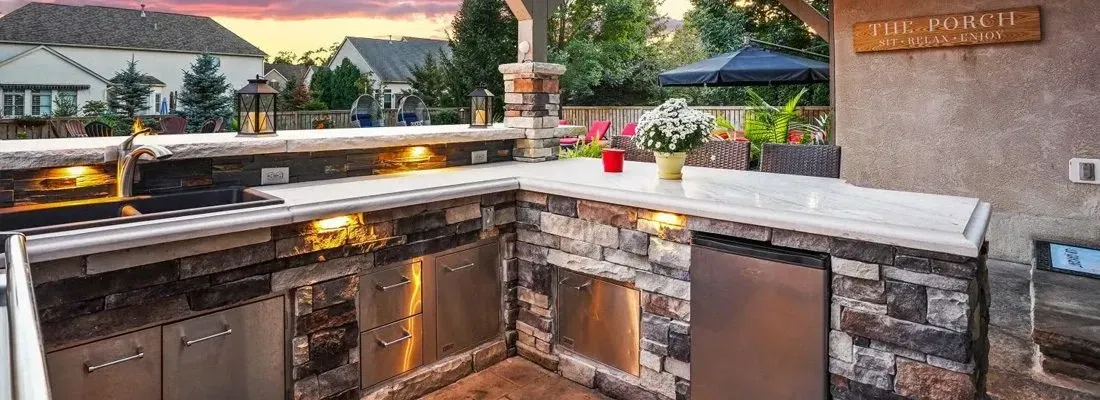
The First 90 Seconds: How to Read Your Meter Base and Know What You Have
Walk to the side of your house — usually the driveway side, occasionally the back corner on homes built into a grade. You are looking for two things: the gray rectangular electric meter with either a Georgia Power nameplate or a Sawnee EMC nameplate, and a separate smaller silver or dark-gray gas meter fed by a short steel pipe rising out of the ground.
On an Atlanta Gas Light service, the gas meter is distinctive. It wears a blue horizontal stripe across the front, stamped with “AGL” or “Atlanta Gas Light Company.” The meter is a diaphragm style with a small red triangle inside a clear glass dial window — the triangle spins when any gas appliance inside is running. If you see that blue stripe, you are on natural gas, and this project is straightforward.
If you walk the entire perimeter of the house and there is no gas meter at all, only an electric meter, there are three possibilities. First, the house was built all-electric — common in Country Club of the South homes from the early 1990s when Windward Parkway was still being widened. Second, the house is already on propane, in which case you will find a buried tank in the yard (look for a green or white 6-inch plastic dome cap flush with the grass, usually 10 to 30 feet from the house). Third — and this is the worst of the three — the street has no natural gas main at all, which means retrofitting natural gas is not a $400 connection fee; it is a $6,000 to $18,000 main extension that AGL quotes on a case-by-case basis.
The 90-second test: Blue AGL stripe on a meter next to your house = natural gas, proceed. No gas meter anywhere + green dome cap in the yard = propane, budget a tank upgrade. No gas meter + no dome cap = the street may not have a gas main. Call Atlanta Gas Light at (678) 507-4216 before signing anything and ask them to run a “service availability check” by address. They do this for free and usually answer within 24 hours.
Why the Georgia Power / Sawnee EMC Split Decides This For You
Alpharetta’s electric-utility map is not a single color. The city sits primarily in Georgia Power territory, but a meaningful slice along the northern edge — roughly north of Windward Parkway and trending toward the Cherokee County and Milton lines — belongs to Sawnee EMC, the member-owned electric cooperative headquartered in Cumming. The PSC drew these territory boundaries decades ago based on whoever got there first with a line. They do not change.
Why this matters for your outdoor kitchen: Atlanta Gas Light distribution mains were historically built alongside Georgia Power corridors in urbanized zones. Where Georgia Power runs dense, AGL usually has a 2-inch or 4-inch distribution main in the right-of-way. Where Sawnee EMC runs — typically lower-density, originally rural land that got developed later — the gas main may stop at a subdivision entrance or skip the neighborhood entirely. You end up on propane by default, not by choice.
Lots in Windward and Country Club of the South are almost universally on Georgia Power with natural gas available. Lots in White Columns, Hutchinson Farm, and parts of Cambridge Parks trending north are a mixed bag — we have built outdoor kitchens on both propane and natural gas inside the same zip code (30004). Lots near Avalon and the Alpharetta City Center — zip codes 30009 and 30022 — are almost always Georgia Power + AGL because the infrastructure was densified when those lifestyle-center corridors were redeveloped.
The rule of thumb we use in our pre-build site walk: if the power pole on your street says “Georgia Power” on the metal tag, check the meter base next. If the pole is unmarked or says “Sawnee EMC,” assume propane until proven otherwise and ask AGL for the availability check in writing before the design phase closes.
Propane as a Real Option — The Honest Cost Breakdown Over 10 Years
Propane is not a consolation prize. For a vacation-home feel, for remote rural lots, for a client who wants a self-contained system that does not depend on a utility, propane can be the right call. But the numbers need to sit on the table honestly before you sign.
The installed cost of a buried 500-gallon propane tank in Alpharetta soil runs $2,400 to $3,800 for the tank, excavation, anode bag, sacrificial cathodic protection, stone bedding, first fill, and regulator set. A 1,000-gallon tank runs $4,200 to $5,800 — we recommend the 1,000 for any outdoor kitchen that combines a grill + side burner + fire feature + pool heater, because the larger tank cuts your refill frequency from 3-4 times per year to 1-2 times per year and pulls the propane vendor out of your backyard.
Propane delivery contracts in north Fulton average $1,100 to $1,400 per year for a household that runs a full outdoor kitchen plus a pool heater in season. The per-gallon price floats with the wholesale market; Alpharetta spot price in early 2026 sits around $3.10 per gallon on auto-fill, $3.40 per gallon on will-call. Natural gas, by comparison, runs an Alpharetta household on AGL around $0.90 to $1.10 per therm all-in, and a fully loaded outdoor kitchen + fire bowl + pool heater adds maybe $35-$60 per month during use season — under $500 per year on the gas side of the utility bill.
10-year ownership math — propane vs natural gas, Alpharetta outdoor kitchen + fire bowls + pool heater:
Propane: $3,500 tank install + ($1,250/yr × 10 years) = $16,000 over 10 years.
Natural gas: $900 meter upsize / hookup + ($500/yr × 10 years) = $5,900 over 10 years.
The delta — roughly $10,000 — is the real cost of being on the wrong side of the AGL footprint. If you are close to the line and the main extension is $6,000-$8,000 installed, paying for the extension pays back inside 4 years.
There is one scenario where propane wins on lifecycle: a lot with no AGL main for a quarter mile, where the main extension would exceed $15,000, AND the owner plans to stay fewer than 8 years. For most Alpharetta buyers in the Microsoft / CDW tech-corridor relocation wave — buyers with a 10-15 year horizon in mind — the math runs the other direction every time.
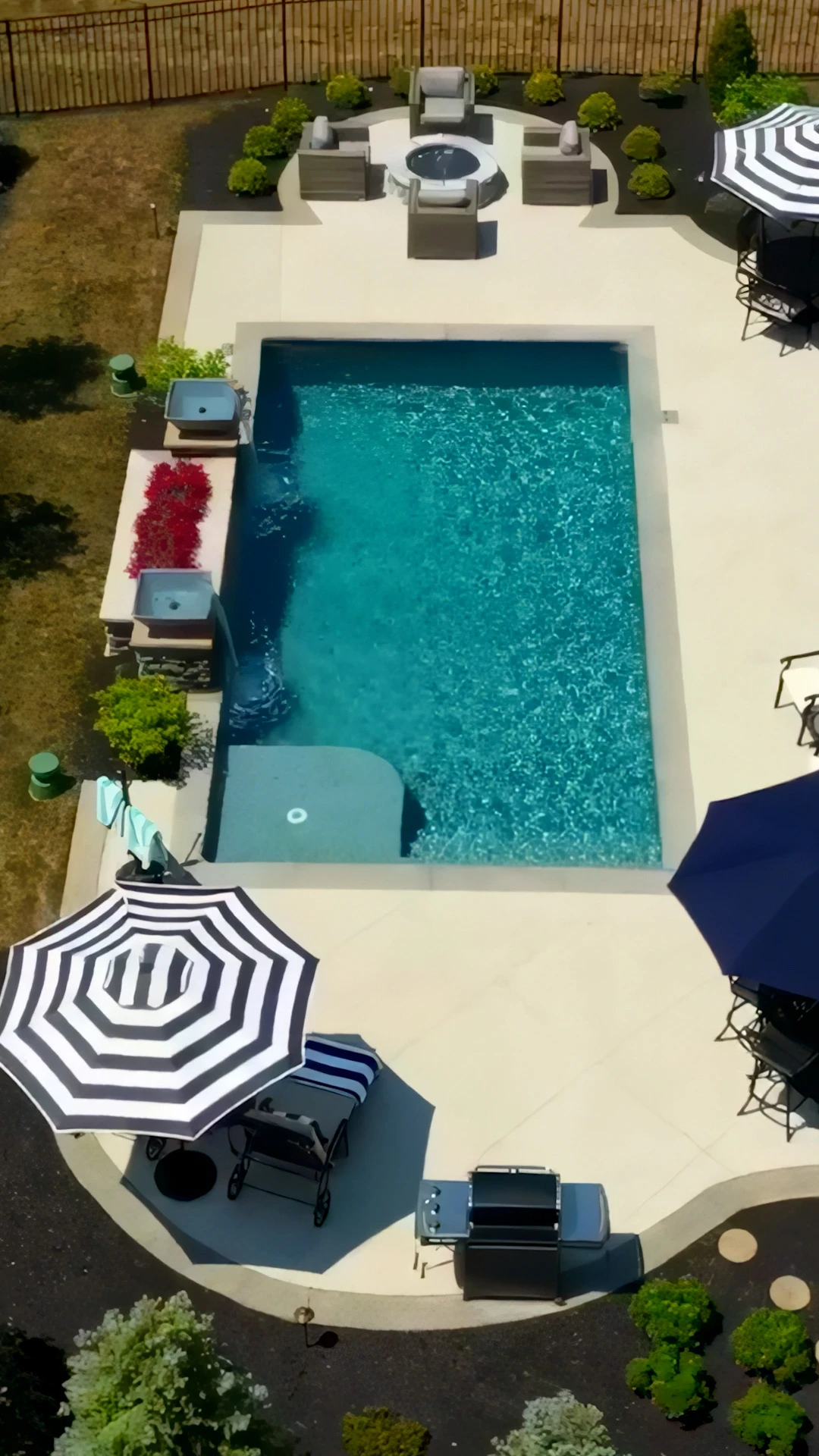
Gas Line Sizing for a Real Outdoor Kitchen Load — 1-Inch Main, 3/4-Inch Laterals
This is the section nobody writes honestly. A typical Alpharetta outdoor-kitchen build we quote pulls a combined BTU load around 180,000 to 260,000 BTU/hr when everything is running at once. That is a Lynx or DCS 36-inch grill at 75,000 BTU, a side burner at 25,000 BTU, an infrared sear zone at 25,000 BTU, a pair of 24-inch gas fire bowls at 65,000 BTU each, and — separate circuit on the pool-pad side — a 400,000 BTU pool heater that you never want fighting the kitchen for supply pressure.
The error we see on bad retrofits: the homeowner’s original builder ran 1/2-inch CSST (that yellow flexible corrugated stainless tubing) from the meter to the backyard for a basic gas grill quick-connect, and now the new outdoor kitchen is being spliced into that same 1/2-inch feed. At 1/2-inch, you can run about 60,000 BTU of appliances 25 feet before pressure drop starts killing flame consistency. Hook up a full outdoor kitchen to 1/2-inch and the grill whistles, the fire bowls sputter, and the pool heater locks out on low-pressure fault.
The correct spec for a full Alpharetta outdoor-kitchen build on natural gas: a 1-inch black iron or 1-inch CSST main leaving the meter, reducing to 3/4-inch laterals at each appliance junction. This gives you roughly 380,000 BTU of capacity at 100 feet of run — enough headroom for the kitchen and a future pool heater on the same main. Propane sizing runs tighter because propane delivers more BTU per cubic foot; on a propane system you can often use 3/4-inch main with 1/2-inch laterals — but you still want a dedicated line per appliance, not a daisy chain.
Spec to write into your contract: “Natural gas supply: 1-inch CSST or 1-inch black iron from meter set to outdoor kitchen manifold. 3/4-inch laterals to each appliance. Manual shutoff valve at each appliance within 6 feet, accessible. Pressure tested to 30 PSI for 15 minutes before wall closure.” If the gas subcontractor will not write that into the scope, they are not the gas subcontractor you want.
The other detail that separates a real build from a hack job: the meter upsize. Most residential AGL meters installed in Alpharetta homes pre-2010 are sized for a whole-house load around 250-300 CFH (cubic feet per hour). Drop a full outdoor kitchen + pool heater on top of a furnace + water heater + cooktop and you are at 550-650 CFH peak. AGL will replace the meter with a larger diaphragm for a service fee (currently around $275) once you submit the load calculation. That step gets skipped on 30% of the retrofits we walk into. The symptom is consistent: appliances work individually, fail together.
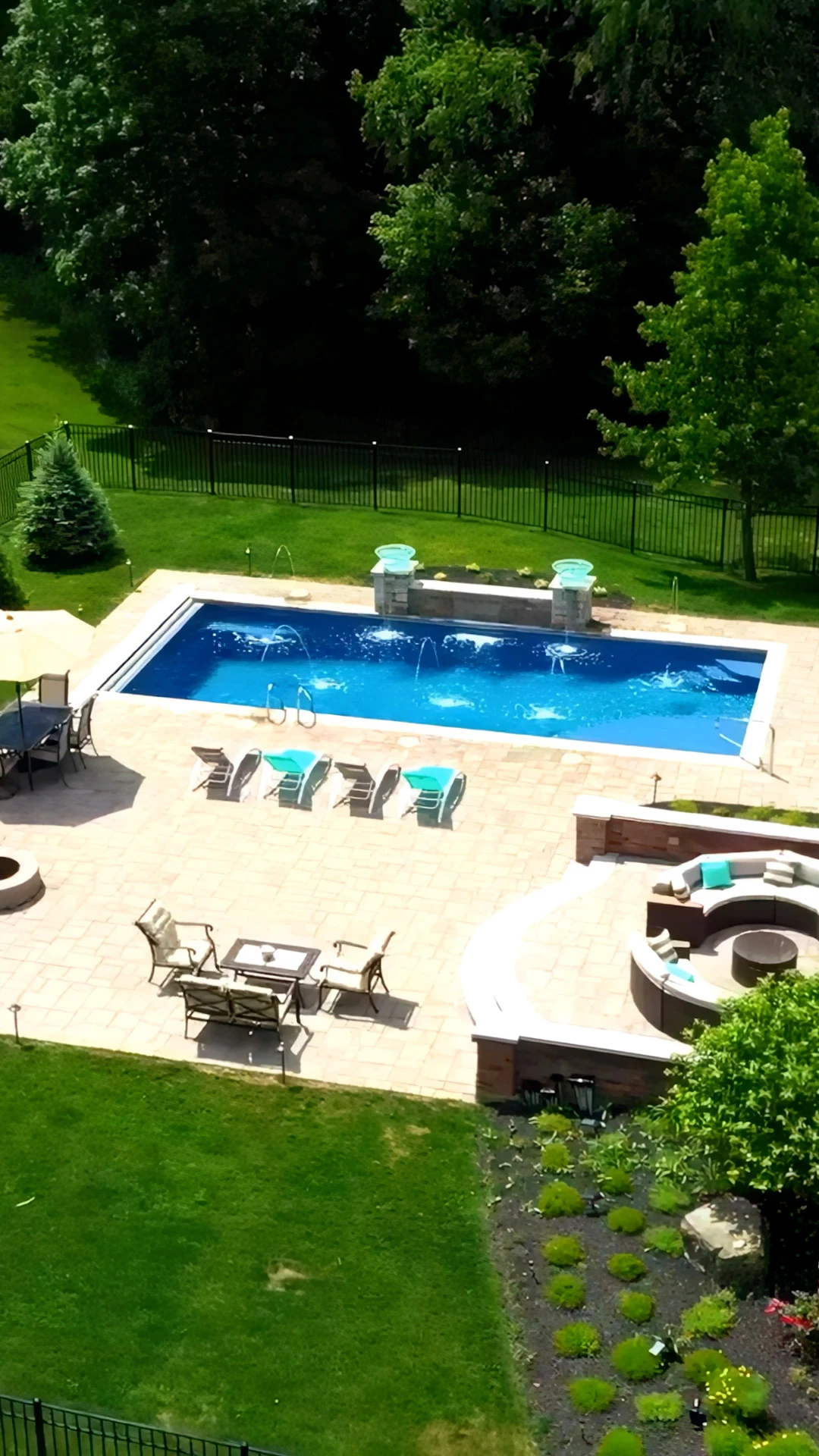
The Alpharetta Permit Path & Build Sequencing — 2 Park Plaza, ARB Coordination, and One Shared Trench
Alpharetta is one of the few North Fulton municipalities that operates its own Community Development office rather than routing permits through Fulton County. The office at 2 Park Plaza, Alpharetta issues gas-line permits, mechanical permits, and outdoor-kitchen structural permits directly. Turnaround on a clean application is typically 5 to 8 business days for gas + mechanical, versus 3 to 5 weeks for comparable scope in unincorporated north Fulton.
The permit package for a natural-gas outdoor kitchen build in Alpharetta includes: a site plan showing the kitchen footprint and gas run path, a load calculation in BTU/hr per appliance, a copy of the appliance data plates (the silver stickers on the back of each unit), a pipe schematic showing main size and lateral reductions, and a pressure-test protocol. The city inspector performs two inspections — one rough-in (before the trench is backfilled, pressure held at 30 PSI) and one final (after appliances are set, bubble-test at each joint).
Inside Windward and Country Club of the South, there is a second review layer: the neighborhood Architectural Review Board. Both ARBs run a strict 3-4 week review on any hardscape that alters the rear elevation visible from common areas, and both require submittal of the kitchen’s finished materials (stone veneer sample, countertop slab photo, grill hood spec) before the city permit is filed. We coordinate the ARB submittal in parallel with the city application — never sequentially — or you lose 3 weeks waiting for one office to bless what the other is already reviewing.
Propane installations in Alpharetta follow a different track. The buried tank falls under the State Fire Marshal’s office, not the city, and the installer (typically Heritage Propane or Ferrellgas) pulls the permit and handles the state inspection. The city still requires a gas-line permit for the run from the tank to the kitchen, but the tank itself is the propane vendor’s paperwork. This is usually invisible to the homeowner and rolls into the tank install quote.
Sequencing the Build — What Goes in the Ground First, and Why
On an integrated project where we are building a pool, a patio, and an outdoor kitchen in the same scope — which is the majority of our Alpharetta builds — the gas line goes in the ground in a specific sequence to avoid a second lot disturbance later. Here is how we stage it on a typical 4-6 week build:
Week 1 — Excavation and utility locates. We pull the Georgia 811 locate before any digging and walk the marked yard with the gas subcontractor. The trench path for the kitchen gas feed is dry-fitted on the surface before the pool dig starts, so we can coordinate depth and crossing points with pool plumbing, electric, and any low-voltage lighting runs.
Week 2 — Pool shell, gas rough-in, electric conduit. While the pool shell is going in, the gas subcontractor pulls the 1-inch main from the meter set to a capped stub inside the kitchen footprint. Depth is 18 inches below finished grade minimum, sand-bedded, with a yellow detection tape 12 inches above the pipe. The trench is shared with low-voltage landscape lighting and, where allowed by code separation, a dedicated 20-amp kitchen circuit in a separate conduit within the same trench.
Week 3 — Masonry. The kitchen base gets built up in block and stone veneer, with chase cutouts for the gas laterals and ventilation knock-outs per the grill manufacturer’s spec (Lynx wants a 10-square-inch vent per side on the front face). The 3/4-inch laterals are run up inside the block cavity to the appliance locations and capped.
Week 4 — Pressure test and rough inspection. The system is pressurized to 30 PSI for 15 minutes with the gauge sealed. Any drop of more than 1 PSI fails the test. The city inspector comes out, signs the rough card, and we are cleared to close walls.
Week 5 — Appliance set and commissioning. Grills, side burners, fire bowls, and any remote ignition controls get mounted and connected. Each joint is bubble-tested with soap solution at operating pressure. AGL is contacted to open the meter and verify flow. We run every appliance simultaneously for 10 minutes to confirm no pressure drop across the system.
Week 6 — Final inspection and ARB sign-off. City final, ARB final (inside Windward / Country Club), and the project closes. Gas is live.
On a propane build, substitute this step in week 2: the buried tank excavation runs parallel to the pool dig. The tank hole is 6 ft wide by 10 ft long by 4.5 ft deep for a 500-gallon tank, 7 x 12 x 5 ft for a 1,000-gallon. Stone bedding, anode bag, and cathodic protection go in before the tank is set. The tank then gets 2 ft of cover, and the service line runs on the same trench as above.
The signature-detail that differentiates a clean build from a retrofit headache later: we trench one deep, wide shared path from the meter (or tank) to the kitchen during the pool dig, and we never come back and disturb that ground again. A split trench — gas this month, electric next month, lighting the month after — triples the labor cost and guarantees a compacted-soil scar that the turf never fully recovers.
Outdoor kitchens across 20+ cities within 30 miles of Winder, GA
Every Alpharetta outdoor-kitchen quote we write starts with a meter-base walk and an AGL service availability check. Infrastructure first, grill brand second — that is how a kitchen built in 2026 still runs flawlessly in 2040.