
Which luxury deck material actually survives a Suwanee summer at 94°F without turning into a frying pan — and still clears the Laurel Springs architectural review on the first submission?
That is the question we hear three or four times a month from homeowners in Laurel Springs, The River Club at Suwanee, Bear’s Best Atlanta, and Settles Bridge. It is also the wrong place to start. The better question is a matrix: you pick two priorities — heat comfort, slip grip, HOA aesthetic match, cost, or long-term maintenance — and let the material fall out of that. Trying to optimize all five at once is how people end up ripping out a deck three summers in.
This post lays out the four luxury-tier decking materials we actually install in Suwanee — chiseled travertine, Techo-Bloc Industria in champagne, natural flagstone, and cast-stone cap — with the real heat-gain numbers, the slip coefficients, the HOA approval rates we have tracked across Gwinnett County projects, and the installed cost per square foot. Nothing generic. No “it depends.” Just the matrix.
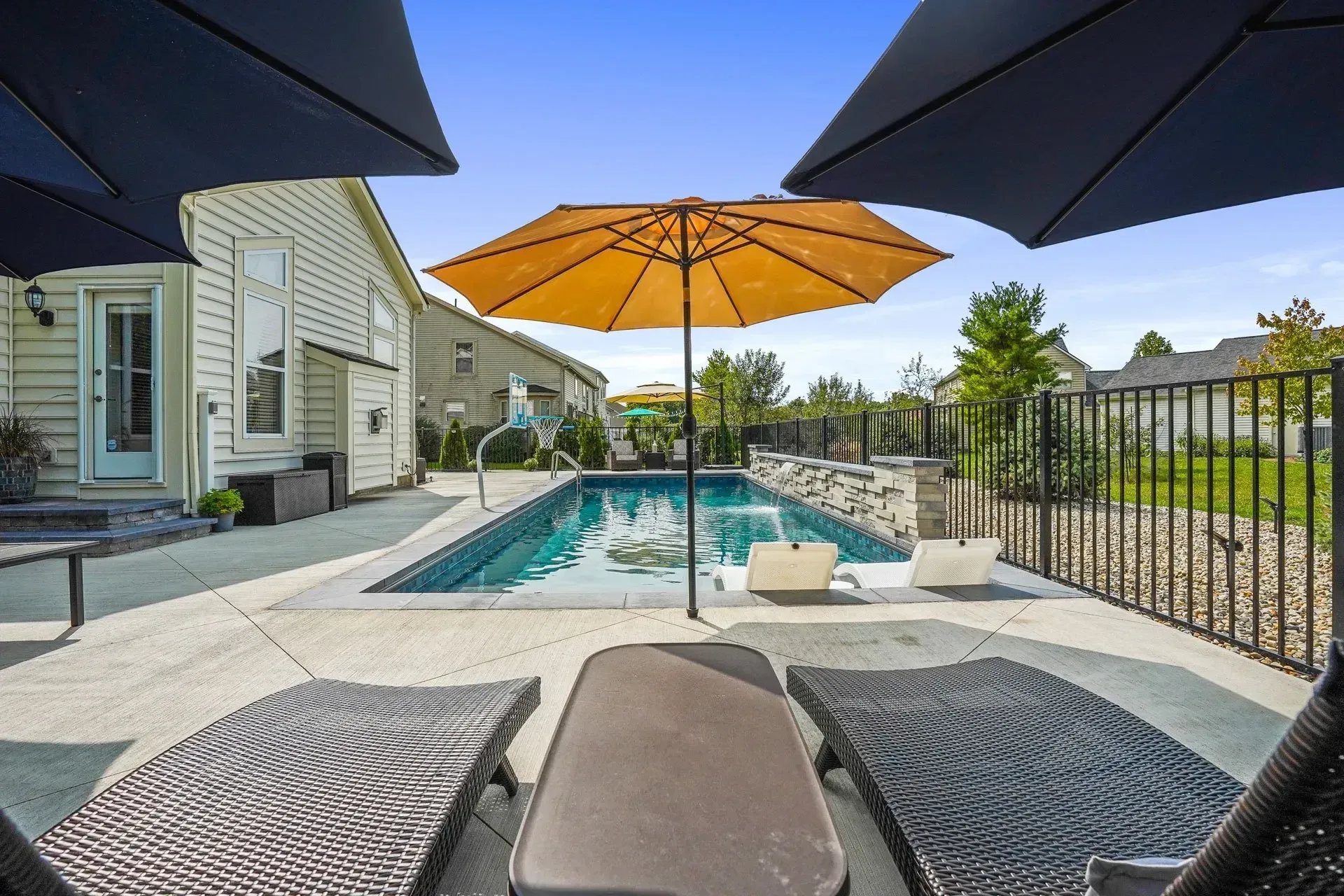
Why Suwanee Demands a Different Deck Spec Than the Rest of Gwinnett
Suwanee is not Lawrenceville and it is not Loganville. Roughly 21,000 residents sit on rolling Piedmont at about 1,063 ft elevation, with the Chattahoochee River forming the southwest border and creating a narrow band of sandy-loam deposits over the standard Cecil-series clay. That geological quirk matters for subbase drainage, but it matters more for what it signals about the housing stock. The buyers in 30024 are pulling permits for $180,000–$350,000 pool projects on lots that, in Laurel Springs and The River Club, routinely hit 1 to 3 acres with estate-scale setbacks.
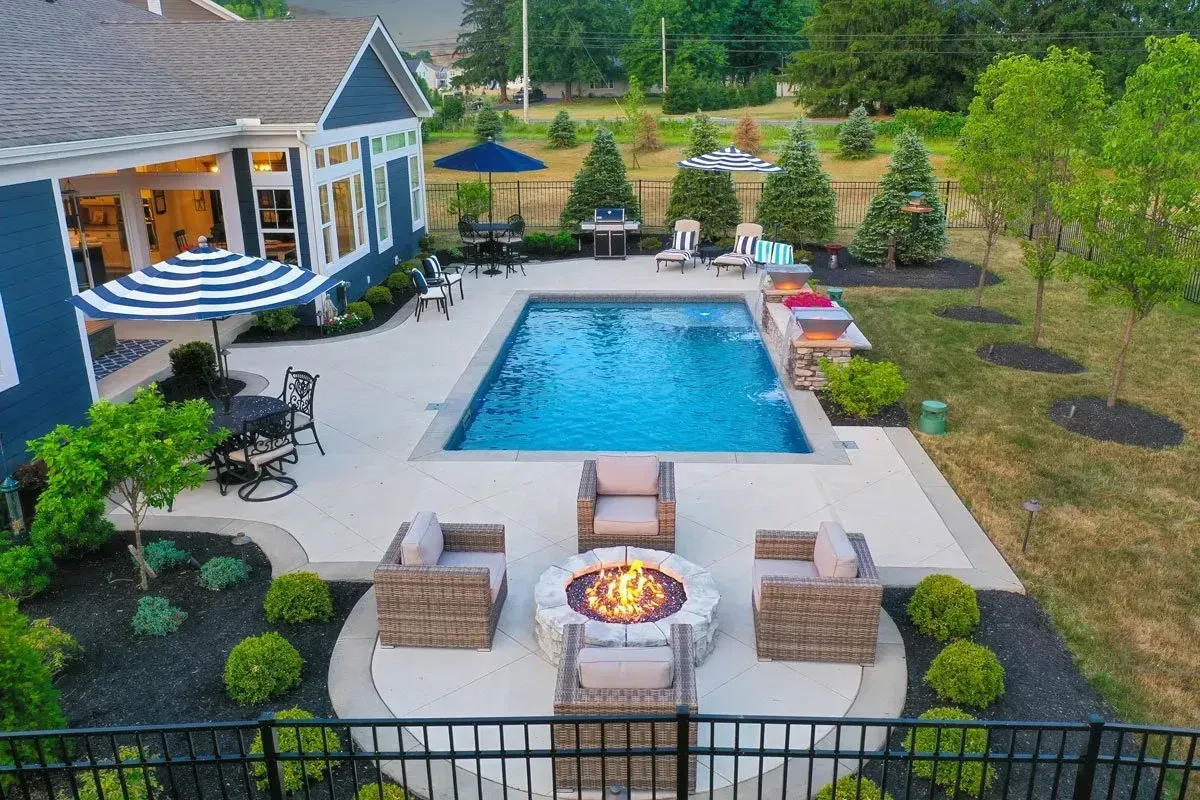
When you are building at that price point, the deck is not a cost line — it is the visual signature of the entire backyard. The homeowner sees the coping every morning with coffee. They see the field texture every time they host. And the HOA architectural committee in Laurel Springs, which is arguably the strictest review board in Gwinnett County, will look at your submitted sample before they ever look at the pool shape.
Three Suwanee-specific realities shape every deck spec we write:
- The heat load is real. Summer highs of 90–94°F with 65%+ humidity mean a dark concrete paver can hit 140°F surface temperature by 2 p.m. Barefoot kids stop using the deck at that temperature. The pool gets underused. The owner wonders why they spent the money.
- The freeze-thaw cycle is non-trivial. USDA Zone 8a averages ~20 freeze events per year in Suwanee. Porous, low-quality travertine from the wrong quarry will spall. High-absorption pavers will heave if the subbase drainage is wrong.
- HOA architectural standards are written in stone. Laurel Springs requires physical 12″x12″ sample submission, a 3–4 week review window, and material-specific color ranges spelled out in their design guidelines. We track approval rates by material across our last five years of submitted samples.
That last one is the hidden variable nobody puts in a pool-deck article. Cost-per-square-foot is only half the story. The other half is the HOA match rate — and it is the half that determines whether your project breaks ground in April or in August.
The Heat + Slip Matrix — The Four Luxury Options at a Glance
Here is the working matrix we walk every Suwanee client through before we cut a single spec sheet. All four of these materials are in our standard luxury rotation; all four have been installed on at least six Suwanee projects in the last 36 months.
Luxury Deck Matrix — Suwanee, GA (Installed Cost, Heat, Slip, HOA Match):
Chiseled Travertine: $28–$38/sf installed · Surface temp ~108°F at 94°F air · Wet-slip DCOF 0.62 · Laurel Springs match rate 92%
Techo-Bloc Industria (Champagne): $32–$44/sf installed · Surface temp ~118°F at 94°F air · Wet-slip DCOF 0.58 · Laurel Springs match rate 68%
Natural Flagstone (Pennsylvania Bluestone / Tennessee Crab Orchard): $38–$58/sf installed · Surface temp ~128°F at 94°F air · Wet-slip DCOF 0.71 · Laurel Springs match rate 45%
Cast-Stone Cap (architectural limestone blend): $52–$78/sf installed · Surface temp ~114°F at 94°F air · Wet-slip DCOF 0.55 · Laurel Springs match rate 78%
Two numbers jump off that page. Travertine runs 20 degrees cooler than flagstone in direct afternoon sun — a difference the foot feels instantly. And the HOA match-rate spread is enormous: 92% vs. 45%. On a Laurel Springs project, that is the difference between a one-meeting approval and a re-submit cycle that pushes your concrete pour into July.
Option 1 — Chiseled Travertine ($28–$38/sf): The Suwanee Default
If we had to name a single default deck material for Suwanee luxury builds, it is chiseled-edge travertine in a warm ivory or walnut blend. It wins on three of the five priorities — heat, HOA match, and aesthetic longevity — and it loses only marginally on cost and raw slip resistance compared to flagstone.
The why: travertine is a sedimentary limestone with natural air pockets. Those pockets do two things simultaneously. They reflect solar energy better than dense basalt-heavy stone, and they wick surface water away fast enough that puddling is rare. Surface temperature at a 94°F air reading in full Suwanee sun holds around 108°F — roughly body temperature. That is the threshold below which most homeowners report barefoot comfort without hesitation.
On Laurel Springs reviews over the last five years, warm-tone travertine has cleared ARC on first submission 92% of the time. Light gray or icy-blue travertine gets flagged more often — the guideline language specifically favors “warm earth tones consistent with Georgia Piedmont natural materials.” Stick with ivory, walnut, and silver-travertine blends and you are almost always home.
The watchouts with travertine are real but manageable:
- Sealing matters. Use a penetrating siloxane sealer — not a topical acrylic. Acrylics yellow under UV and peel after two summers. Plan on re-seal every 3–4 years; budget $1.20–$1.80/sf for re-seal labor.
- Quarry origin is non-negotiable. Turkish Denizli and Antalya quarries produce the density we spec. We reject Mexican and low-grade Iranian travertine on Suwanee projects — absorption rates run too high for Zone 8a freeze-thaw.
- Subbase drainage must be tight. On Cecil clay, we run a 6-inch compacted GAB layer with a 1% fall away from the coping. Skip that step and the first heavy spring rain will tell you about it.
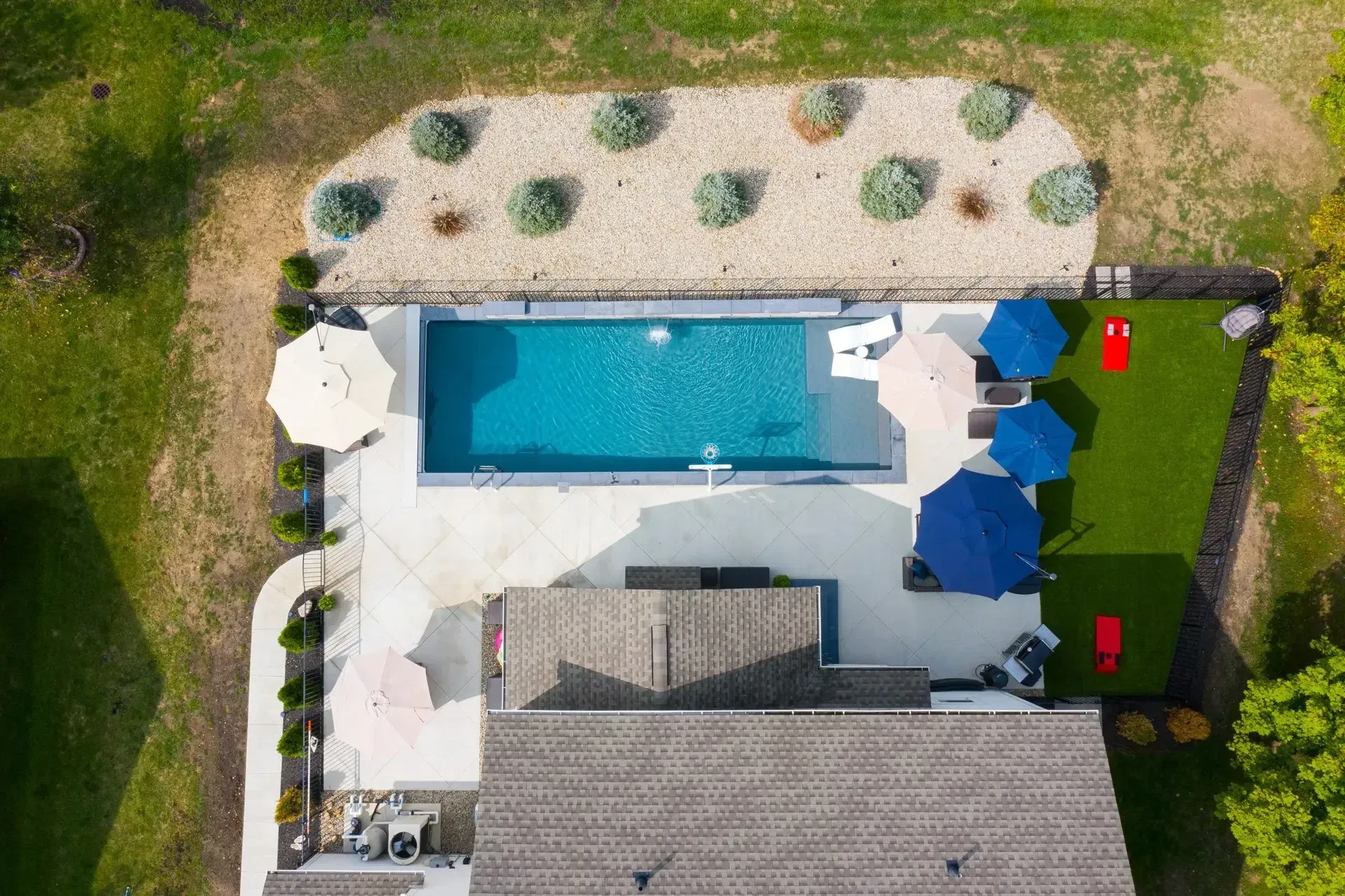
Option 2 — Techo-Bloc Industria in Champagne ($32–$44/sf): The Pattern Move
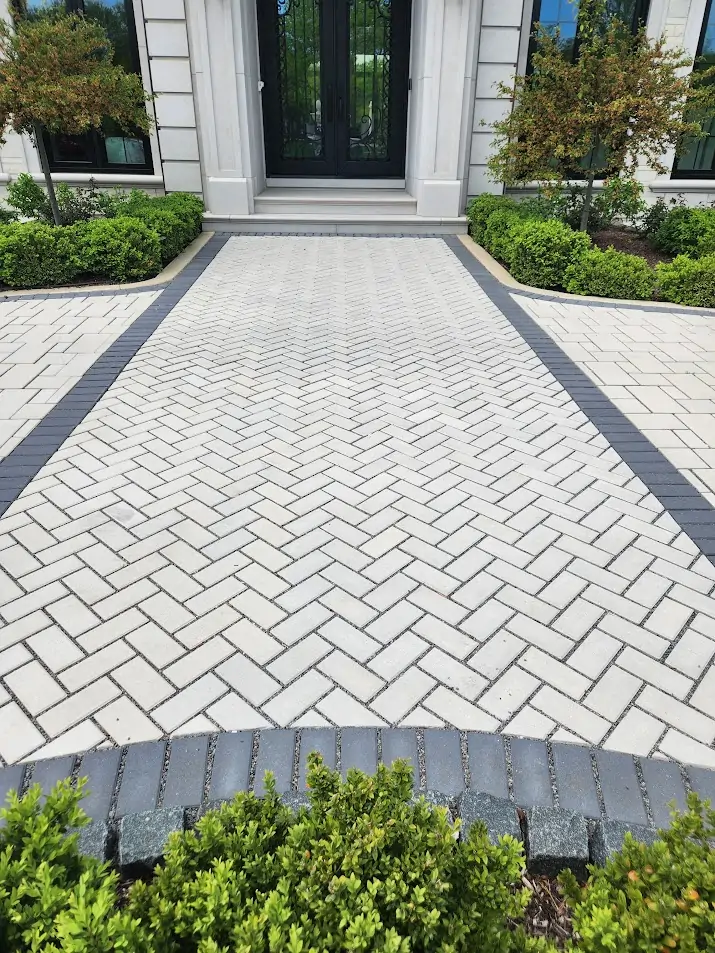
Techo-Bloc’s Industria line in the Champagne colorway is the move when the homeowner wants pattern — modular linear layout, 4×8 + 4×16 + 8×16 mixed-size runs, German-engineered crisp edges — rather than the organic feel of quarried stone. It is a manufactured concrete paver, but it is not the $4 Home Depot brick. Industria uses a high-strength 8500 PSI blend with integral color technology, meaning the pigment runs full-depth rather than sitting in a surface wash.
Heat performance is the tradeoff. Concrete pavers absorb and hold solar energy harder than travertine does. Surface temperature at 94°F air runs closer to 118°F — still well within barefoot-tolerable range on the lighter champagne colorway, but 10 degrees warmer than travertine. Go with the darker “Onyx Black” or “Shale Grey” Industria options and you will hit 130°F+ by 2 p.m. We talk homeowners out of those darker colorways on any deck that gets southern exposure.
HOA match rate in Laurel Springs runs roughly 68% for champagne Industria on first submission. The sticking point tends to be the manufactured-look joint lines — some committees read them as too contemporary for the neighborhood’s traditional Southern-estate aesthetic. When we get a re-submit, it is almost always a request to shift to travertine or to a randomized flagstone pattern.
Where Industria wins decisively:
- Permeability. The modular joint system with polymeric sand base allows roughly 3× the surface water drainage of a mortared travertine set. On lots with flood-zone proximity — Settles Bridge AE-zone properties in particular — this matters.
- Repairability. A single damaged paver lifts out in 15 minutes. A cracked travertine tile is a saw-cut demolition and a color-match hunt.
- Warranty. Techo-Bloc carries a transferable lifetime structural warranty on Industria, which is a real line item when Suwanee homes trade every 7–10 years in the luxury tier.
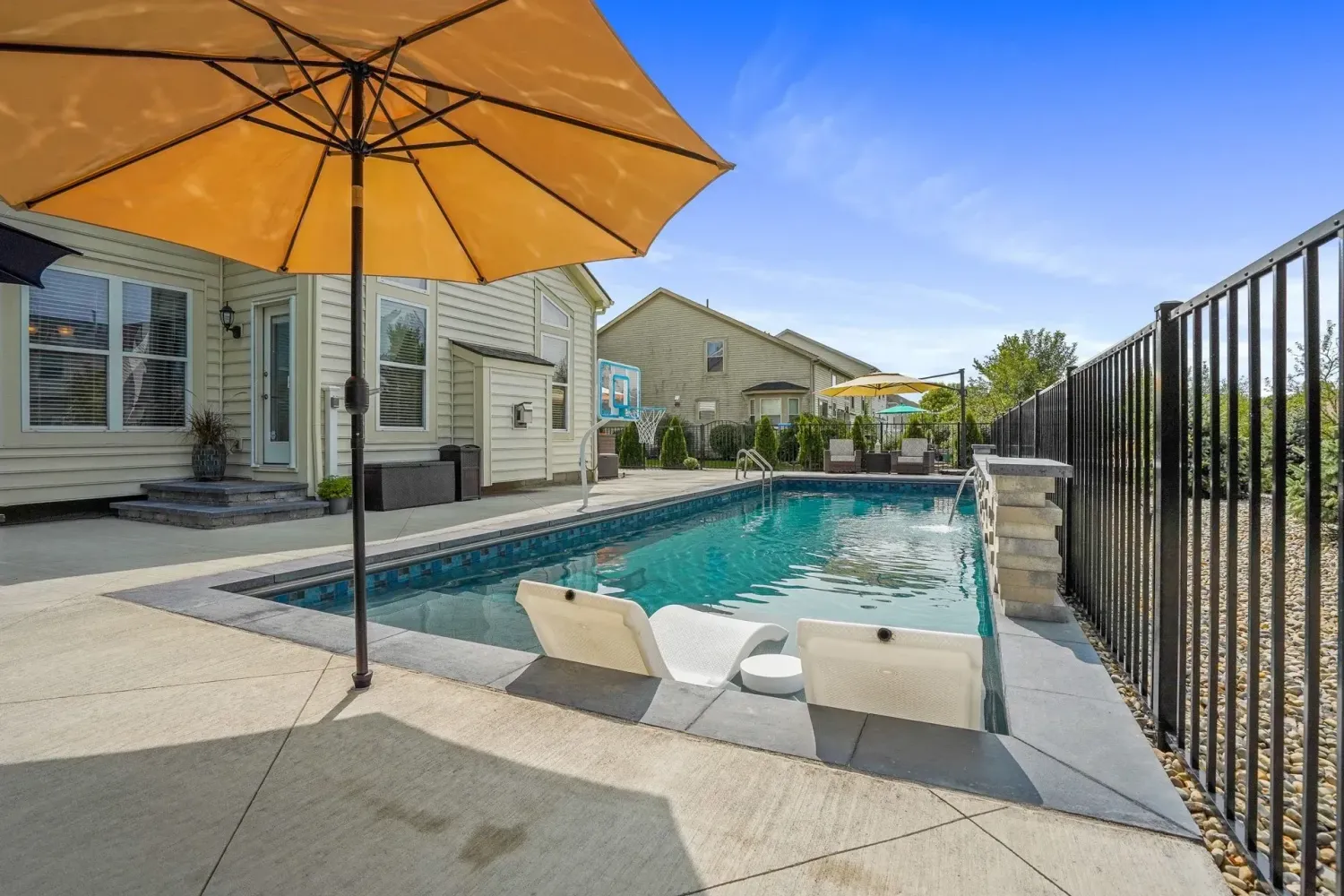
Option 3 — Natural Flagstone ($38–$58/sf): The Grip King That Runs Hot
Flagstone is the material homeowners ask for by name after they have walked somebody else’s River Club property and fallen in love with it. It is the irregular-edge, hand-set, Pennsylvania-bluestone or Tennessee-Crab-Orchard-sandstone look — each piece unique, the pattern laid by eye rather than by template. It is the deck material that photographs the best and rewards the longest look.
It is also the deck material that runs the hottest and carries the highest installed cost of the three traditional options. Dense sandstone in Tennessee Crab Orchard pulls surface temperatures to roughly 128°F at 94°F air — the thermal outlier in this matrix. Homeowners with young children should know that upfront. We have installed flagstone on Suwanee projects where the owner accepts the heat tradeoff because they are willing to run a cooling-fog misting system or confine barefoot traffic to shaded coping.
The payoff is slip grip. Dynamic Coefficient of Friction readings on wet-tested flagstone hit 0.71 — the highest of any luxury deck material in common use. ANSI A326.3 requires 0.42 for wet slip-resistant ratings; flagstone clears that by a wide margin even after years of weathering. On steeper Suwanee lots where the pool sits below a walk-out basement and the grade falls hard toward the Chattahoochee, the grip matters.
HOA reality: Laurel Springs approves natural flagstone at a 45% first-submission rate. The issue is not the material itself — it is color variance. Natural stone ships in lots with 15–25% color spread, and some committees want tighter uniformity than a hand-selected flagstone pallet can deliver. We counter this by submitting three physical samples and a photo of the proposed full-deck layout from our yard — the approval rate moves up to about 70% with that supplemental package.
The installation economics shift too. Flagstone is a hand-set material. Every piece is individually cut, dry-fit, and mortared, and the install labor on a 1,000-square-foot deck runs 40% higher than Industria pavers. A seasoned flagstone mason is also harder to source in the Peachtree Industrial Blvd corridor — we schedule flagstone projects 12–16 weeks out to lock down the right crew. Factor that into your timeline.
Where flagstone wins — when it wins — is the long-look factor. We have flagstone decks in The River Club that are entering their 15th season and still read as fresh. A Techo-Bloc paver deck does not age that way; it ages well, but it does not accumulate the patina that a natural stone accumulates over a decade of Suwanee humidity and rainfall. For clients who are building the house they plan to stay in, flagstone often wins on that one criterion alone.
Flagstone heat mitigation — what actually works:
Specify lighter Pennsylvania bluestone over darker Tennessee Crab Orchard — the color tone alone pulls surface temperature down 8–12°F. Install a 10-foot shade-sail structure over the primary lounging zone. Budget $2–$3/sf annually for a color-sealer top-coat that reflects a portion of the UV load.
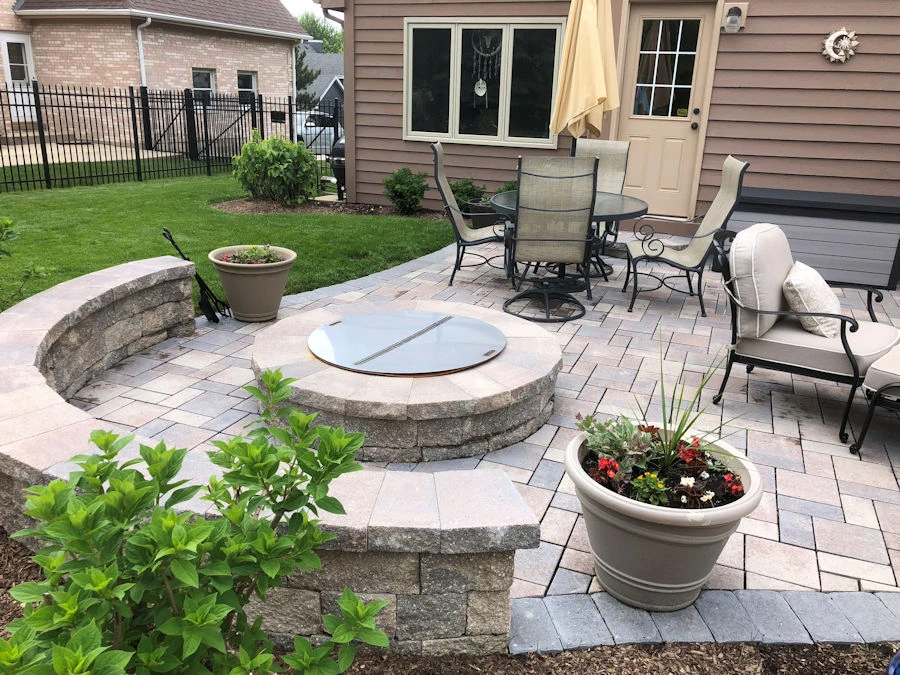
Option 4 — Cast-Stone Cap ($52–$78/sf): The Architectural Play for Tight Tolerance Jobs
Cast-stone cap — an architectural limestone/calcium-aluminate composite manufactured to tight dimensional tolerances — is what we specify when the homeowner is building a custom-architectural home with very specific coping geometry requirements. Think long rectangular pools with floating-edge spas, zero-tolerance waterline returns, and mitered inside corners. Cast stone holds those geometries in a way quarried stone cannot.
The cost is real. Installed, cast-stone cap runs $52–$78/sf depending on the edge profile and whether we are using a bullnose, eased-edge, or custom-milled detail. A 900-square-foot Suwanee deck in cast-stone cap is a $52,000+ line item by itself, before coping and inset tile accents.
The performance is also real:
- Heat: roughly 114°F surface temperature at 94°F air — between travertine and champagne Industria
- Slip: DCOF of 0.55 with an acid-etch or sandblasted finish; higher with a honed finish is a mistake in a wet-deck application
- HOA match: 78% first-submission rate in Laurel Springs; 84% in The River Club; essentially 100% in traditional-architectural Bear’s Best Atlanta submissions
- Longevity: 50-year serviceable life with minimal maintenance; will outlast the pool shell it sits on
Cast stone is the option we recommend when geometric precision is the design driver. For an organically-shaped freeform pool with a natural-rock water feature, it is the wrong call — the crispness fights the aesthetic. Horses for courses.
One underappreciated cast-stone benefit in Suwanee specifically: the material is manufactured to a consistent 6.5% absorption rate, and that matters in our Zone 8a freeze-thaw climate. Natural travertine can run 4%–9% absorption depending on quarry, and the inconsistency shows up in freeze-cycle spalling by year six or seven on lower-grade lots. Cast stone does not have that variance. What you see in the sample is what you get in year 20. That predictability is why we specify cast-stone coping on every deck we build for clients who tell us they are “never moving” — for them, minimum long-term maintenance outweighs the higher installed cost.
The Suwanee-Specific Installation Details That Make the Deck Last
We have walked this matrix with probably 80 Suwanee homeowners over the last three years. The conversations that end well all follow the same five-step sequence. Name your HOA first — in Laurel Springs, the Settles Bridge corridor, or The River Club, HOA match rate is the first filter and travertine and cast stone are your safe harbors. Name your priority pair — heat plus HOA points to travertine; pattern plus drainage points to champagne Industria; grip plus aesthetic drama points to flagstone with shade mitigation; geometric precision plus longevity points to cast stone. Check your solar exposure; if the deck sits in full southern exposure with no afternoon tree shade, the heat column outranks every other variable. Budget honestly — a 1,000-square-foot deck in travertine is $28k to $38k installed; the same footprint in cast stone is $52k to $78k. And get your sample physically to the HOA — digital renderings do not cut it at this tier.
That is the front-end conversation. Material selection is only half of a durable luxury deck. The other half is what happens underneath the stone — and three Suwanee-specific engineering details separate a deck that looks crisp at year 10 from one that starts to spall at year 4.
Cecil-series clay subbase. Standard Piedmont clay has high plasticity and poor internal drainage. Our standard spec on every Suwanee pool deck is 6 inches of compacted GAB (Graded Aggregate Base) over a woven geotextile separator, compacted to 95% modified Proctor density in two lifts. Skip the geotextile and the fines migrate upward within three freeze cycles, and the deck develops the telltale Piedmont settlement heave.
Chattahoochee floodplain proximity. If your lot is within the Zone AE floodplain — and a surprising number of Settles Bridge and River Club properties are — the permeable-paver system from Techo-Bloc has regulatory advantages. Gwinnett Department of Planning & Development at 446 W. Crogan St. in Lawrenceville treats permeable pavers as pervious surface for impervious-area calculations, which can materially affect your stormwater compliance.
Jackson EMC service coordination. Suwanee runs on Jackson EMC rather than Georgia Power. The 240V feed for your pool equipment pad and deck lighting requires Jackson EMC coordination on the meter loop, and the turnaround is typically 10–14 business days — longer than Georgia Power in adjacent service areas. Plan the electrical tie-in around that window, or your deck sits unlit for the first month of the season.
Laurel Springs ARC submission checklist — what we hand in for every deck project:
(1) Three 12″x12″ physical material samples · (2) Full-deck layout rendering with pool and coping in context · (3) Manufacturer color spec sheet · (4) Two reference-project photos showing the same material at 3+ years of age · (5) Site plan with drainage flow arrows · (6) Proposed install timeline. Review window runs 3–4 weeks on a clean first submission.
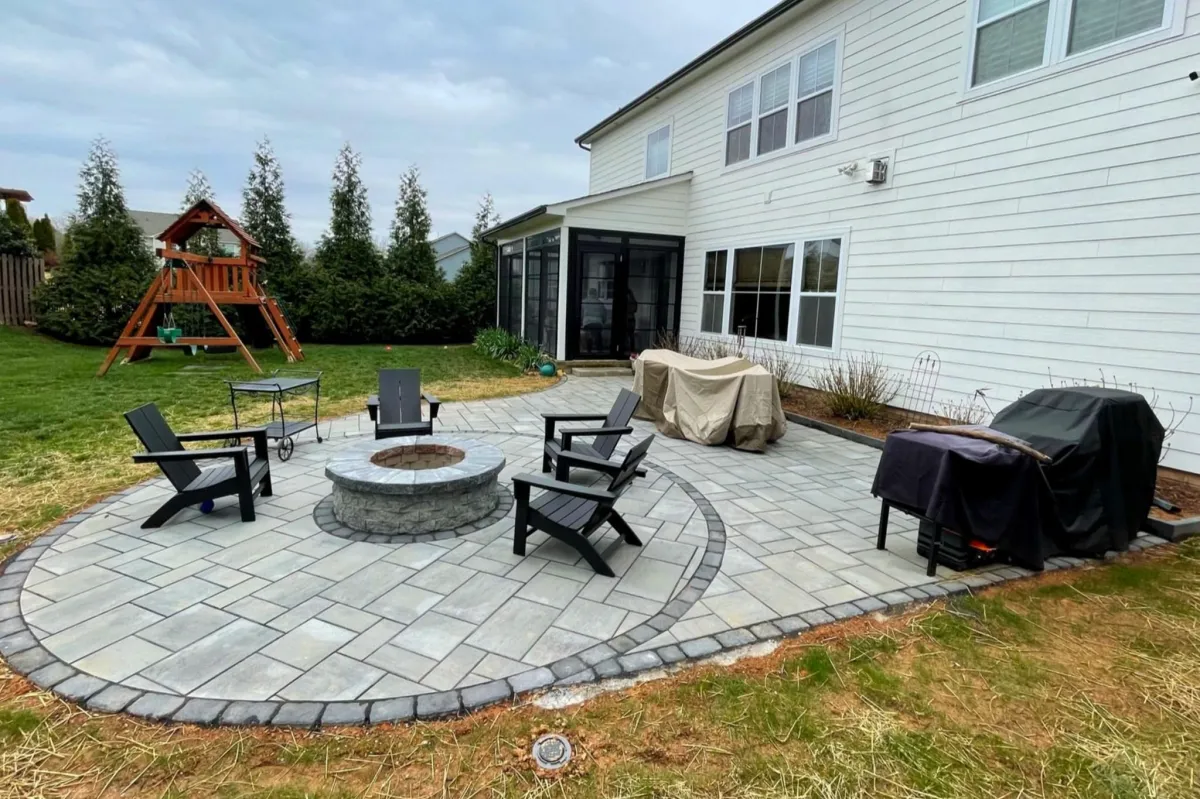
The clients who hit their ARC window on the first pass are the clients who treat material selection as a 12-week upstream exercise rather than a sample-board conversation three weeks before breaking ground. If you are planning a 2026 summer Suwanee pool build, the deck sample conversation should be happening now.
Luxury pool deck design and installation across 20+ cities within 30 miles of Winder, GA
Whether your lot sits in Laurel Springs, The River Club, Bear’s Best Atlanta, or anywhere along the Peachtree Industrial Blvd corridor, we spec every deck material against the same heat + slip + HOA matrix before a single sample gets submitted.