
Roughly 68% of Dawsonville lots we estimate for outdoor kitchens sit more than 120 feet from the nearest gas meter — and the lot elevation change averages 11 feet of vertical grade between the house and the patio pad.
That is not a minor detail. That single distance decides your pipe diameter, your pressure-drop math, your trench depth, your inspector’s workload, and — more than anything else — the number on the invoice you sign before the first burner ever lights. A typical 40-foot gas run to a grill tucked off the back patio is a $800–$1,400 line item. Stretch that same run to the far corner of a Foxcreek or Etowah River Club lot and you are looking at $2,800–$4,400, a Dawson County inspector standing in your trench, and a pressure test that has to hold for four uninterrupted hours.
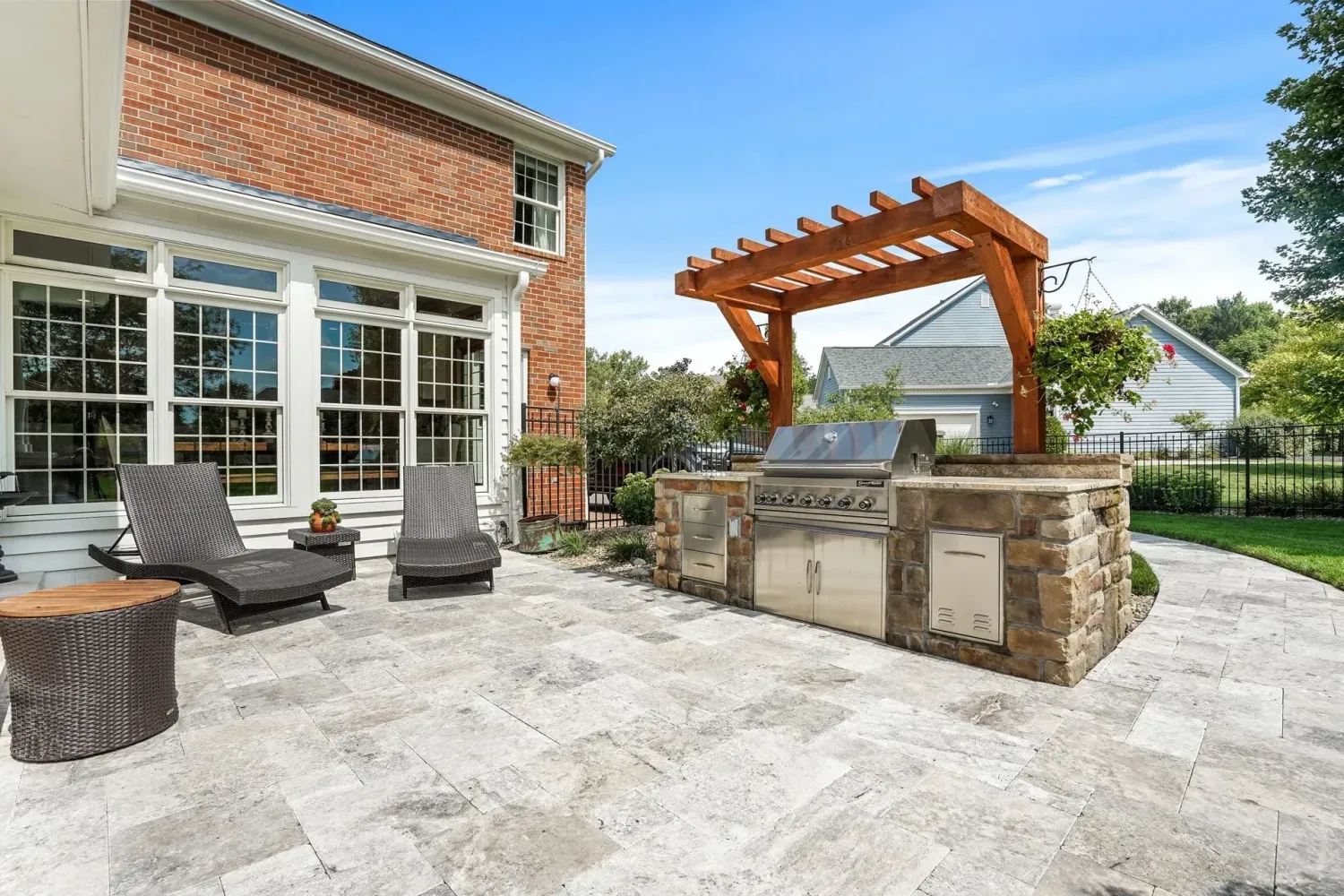
This post is about one specific Dawsonville install: a 180-foot black-iron natural-gas run from a meter on the side of a two-story brick home to a U-shape kamado-and-griddle kitchen under a heavy-timber pavilion at the back property line. Everything downstream of that 180 feet — grill brand, counter material, roof pitch — is irrelevant if the gas math is wrong. We will walk the numbers in order.
Step 01 — Measure the Actual Run, Not the As-the-Crow-Flies Distance
The first mistake every homeowner makes is Google-Earth measuring. They draw a straight line from the meter to the proposed kitchen footprint and write “120 feet” on a napkin. Then we walk the property, measuring the path the pipe will actually take, and the number is 180.
Why the difference? Because natural-gas black iron does not cross the middle of a lawn. It follows the foundation line, turns at the house corner, parallels the pool coping or patio edge, and finally arrives at the kitchen base. Add vertical drops for buried trench depth and sleeve penetrations and you have picked up another 15–25 feet of developed length. In the Foxcreek and Kensington Ridge subdivisions — where lots run half-acre to 1.5 acres with significant grade change — we routinely log developed lengths 40–60% longer than the straight-line distance.
For the pressure-drop calculation that determines your pipe size, developed length is the only number that matters. Use the wrong one and every burner downstream runs lean.
Field rule: On any Dawsonville lot with more than 8 feet of elevation change between meter and kitchen, add 15% to the straight-line measurement before sizing the pipe. On lots above 1,200 ft elevation with visible saprolite outcrop, add 20%.
Step 02 — Calculate the Total BTU Demand of the Kitchen
The pipe has to feed whatever you plug into the end of it, all running simultaneously, on the hottest cookout day of the year. This is where we add up the nameplate BTU ratings of every appliance the kitchen will ever host, not just the ones on the current drawing.
A typical Dawsonville long-run kitchen we spec looks like this:
- Built-in 6-burner gas grill with rear infrared rotisserie — 110,000 BTU/hr
- Stainless flat-top griddle / plancha — 60,000 BTU/hr
- Dedicated side burner (wok or sear station) — 30,000 BTU/hr
- Future smoker drop (Kamado gas-assist or pellet smoker with ignition) — 20,000 BTU/hr
- Pavilion-mounted patio heater tap (winter use, cold-weather Zone 7b) — 40,000 BTU/hr
That totals 260,000 BTU/hr. We size to 100% of nameplate, not diversified demand, because Dawson County inspectors do not accept diversity factors on residential outdoor kitchen runs — every burner must be able to fire full-open simultaneously without the inlet pressure sagging below 6 inches of water column at the grill manifold.
Most homeowners are shocked by this number. They look at their 6-burner grill alone (110,000 BTU/hr) and assume that is the design load. It is not. If you ever plan to add the griddle, the smoker, or the patio heater drop, the pipe has to be sized for all of it today — because retrofitting a larger main trunk later means digging the whole 180 feet again.
Step 03 — Size the Black Iron: 1-Inch Minimum, 1-1/4-Inch for Full Kitchens
Here is the math that sends most DIYers to a propane tank instead. At 180 feet of developed length and 260,000 BTU/hr of demand, with the standard residential inlet pressure of 7 inches water column and an allowable pressure drop of 0.5 inches water column, the sizing chart in NFPA 54 (2024) Table 6.2(a) gives a required pipe diameter of 1-1/4 inch Schedule 40 black iron.
Drop the demand to just the grill and side burner (140,000 BTU/hr) and you can get away with 1-inch. Drop the distance to 80 feet and 3/4-inch starts working again. But at 180 feet carrying a full-stack Dawsonville kitchen, 1-1/4 is the floor. No exceptions, no “we will upsize at the kitchen end” — the trunk itself has to be 1-1/4 from meter to manifold.
Why black iron and not CSST (the yellow flexible tubing)? On 180-foot runs with multiple 90-degree turns we prefer rigid threaded Schedule 40 because:
- CSST has a higher pressure drop per foot at equivalent diameters — losing you capacity on long runs
- Saprolite-heavy Dawsonville soil contains sharp angular rock fragments that can abrade CSST even inside a trench sleeve
- Lightning-bonding requirements for CSST in Dawson County require #6 AWG bonding at every appliance, adding electrician cost
- Black iron has a 60-plus-year service life; the additional $280–$420 in material is amortized across decades
Pipe sizing shortcut: For Dawsonville long runs, use 1-1/4-inch Schedule 40 black iron on any kitchen over 200,000 BTU total. Step down to 1-inch at the last branch tee inside the kitchen island itself. Never reduce below 3/4-inch at any individual appliance drop.
Step 04 — Trenching Through Saprolite: Where the Budget Really Cracks
Dawsonville sits on the edge of the North Georgia foothills at roughly 1,270 feet of elevation, and the subsoil reflects it. Unlike the deeper Piedmont clay that covers Dacula and Lawrenceville, Dawsonville lots present weathered granite, saprolite, and stony residuum starting as shallow as 18 inches below grade. On the Etowah River side of town the rock gets even closer to the surface.
Gas line code in Dawson County requires minimum burial depth of 18 inches for residential natural gas. In Dacula clay we hit that depth with a walk-behind trencher in two hours. On a 180-foot run through the Mountain Laurel neighborhood last spring, our crew hit decomposed granite at 14 inches and had to bring in a rock hammer attachment on a mini-excavator for the final 90 feet of the trench.
The cost delta is real and it stacks fast:
- Standard trenching through clay or loam: $6–$9 per linear foot
- Trenching through decomposed granite / saprolite: $10–$14 per linear foot
- Rock hammer attachment required for hard granite: add $4–$8 per linear foot
- Full blast charge required (rare, Big Canoe tier only): $8–$14 per cubic yard premium over standard dig
On our reference 180-foot Foxcreek install, the trench alone came in at $1,680 versus the $1,080 it would have cost through clean Gwinnett County clay. That $600 delta is entirely attributable to Dawsonville’s topography and subsoil.
Step 05 — The Pressure Test: 25 PSI for 4 Hours, Inspector Watching
Dawson County does not wave on long-run gas pressure tests the way some metro Atlanta counties quietly do. The county’s Department of Planning & Development at 25 Justice Way staffs mechanical inspectors who require direct observation on any natural-gas installation with a developed length of 100 feet or more. No video pressure tests, no homeowner gauge readings, no unattended overnight tests.
The spec we pressure-test to on every long-run Dawsonville install:
- Test pressure: 25 psi minimum (3x working pressure per NFPA 54)
- Hold time: 4 hours with inspector present (county standard for 100+ ft runs)
- Allowable drop: zero psi measurable — any gauge movement fails the test
- Test medium: dry compressed air or nitrogen, never water
- Gauge: calibrated to 0-60 psi range with ¼ psi increments
We schedule the pressure test the day before backfill. If it fails — and on new long runs, roughly 1 in 12 runs fails the first test, usually at a threaded elbow torqued dry instead of with the correct pipe dope — we pull that joint, re-dope, re-torque, and test again. The inspector can require a full second 4-hour hold, which means the homeowner’s project sits open for another day.
Permit reality: Dawson County inspection calendar runs 3–7 business days out during peak season (April through September). Schedule the pressure-test inspection the same day you permit, not the day you finish trenching, or you will have an open trench sitting through a weekend thunderstorm.
Step 06 — The Real Numbers: What a 180-Foot Dawsonville Run Costs
Here is the invoice, itemized, for the kind of 180-foot black-iron run we price into Dawsonville outdoor kitchens. These are 2026 numbers for a kitchen in the Etowah River Club or Applewood tier, permitted through Dawson County, with a 6-burner grill, griddle, side burner, and smoker drop terminated under a pavilion.
Materials
- 180 LF of 1-1/4-inch Schedule 40 black iron pipe: $540–$720
- Threaded fittings, tees, unions, elbows, caps (qty ~22): $180–$260
- Pipe dope, Teflon tape, anti-corrosion wrap for buried sections: $60–$95
- Yellow tracer tape + underground warning ribbon (county required): $28
- Shutoff valves (main at meter, branch at each appliance): $140–$220
- Appliance flex connectors (stainless CSA-certified): $110–$180
Labor & Equipment
- Trenching through saprolite (180 LF @ $10–$14/LF): $1,800–$2,520
- Rock hammer surcharge on ~90 LF of decomposed granite: $360–$720
- Pipe threading, assembly, and installation (2 plumbers × 1.5 days): $1,400–$1,800
- Pressure test setup + 4-hour inspector hold: $280–$420
- Backfill, compaction, tracer-tape placement, sod repair: $320–$480
Permits & Inspection
- Dawson County mechanical permit (gas): $95–$145
- Final inspection fee: $55–$85
- Plan review for runs over 150 ft (Dawsonville-specific): $75
Total delivered range: $2,800–$4,400 for a 180-foot, fully-permitted, pressure-tested natural-gas trunk sized for a 260,000 BTU Dawsonville kitchen. Contrast that against the $800–$1,400 a typical 40-foot run costs in a Duluth or Lawrenceville subdivision and you can see where the Dawsonville topography tax actually lives.
Why homeowners try to shortcut this (and why we will not let them)
Almost every Dawsonville homeowner we quote asks the same question after seeing the number: “Can we just run a propane tank and call it done?” The answer is technically yes — a 500-gallon buried propane tank in Applewood runs $2,200–$2,800 installed, and it eliminates the trench entirely. But there are three reasons natural gas wins on long-run Dawsonville kitchens:
- Running cost. Natural gas in the Amicalola EMC / Atlanta Gas Light service territory runs roughly 40% cheaper per BTU than residential propane delivered to a buried tank. Over 10 years of regular cookout use, a natural gas line pays for itself twice.
- Refills and outages. A propane tank running dry mid-cookout is an avoidable humiliation. Natural gas is there every time you hit the igniter.
- Resale. Dawsonville buyers in the $700K–$1.2M bracket read “natural gas outdoor kitchen” on a listing the same way they read “Viking range inside.” It is a hard-resale feature. A propane kitchen is a soft one.
The three joints that fail on long Dawsonville runs
After dozens of these installs, we know exactly where the leaks show up on the pressure test:
- The first elbow off the meter. Crews over-torque it trying to get the pipe alignment right for the trench. Use a backup wrench.
- The sleeve penetration under the patio slab. If the pipe is not perfectly centered in its sleeve, seasonal ground movement stresses the joint. Foam-pack every sleeve.
- The last tee before the kitchen manifold. This joint gets made last, usually by a tired plumber in the dirt. Re-dope it, always.
We pressure-test with both our own gauge and the inspector’s gauge on the same test — if either one moves, we fix it. Belt and suspenders, every time.
When 180 feet is not actually the right answer
Occasionally on a Riverbend or Chestatee lot we walk, the 180-foot run makes zero sense — because the meter could be moved. Amicalola EMC does not move natural-gas meters (Atlanta Gas Light handles that in the Dawsonville service area), but the relocation fee runs $400–$900 and can cut a 180-foot run down to 90. If the reduction in pipe and trench cost exceeds the relocation fee, we recommend the move. On 4 of the last 18 Dawsonville kitchens we installed, we moved the meter first and saved the client between $900 and $1,800 in total project cost.
The calculus is simple: ask Atlanta Gas Light for a meter-relocation quote before you commit to the pipe route. A single 15-minute phone call has saved more than one Dawsonville homeowner $1,500.
Cold-weather design: Dawsonville runs 30 freeze events per year
One piece of Dawsonville context that rarely makes it into metro-Atlanta outdoor-kitchen content: the city sits on the USDA Zone 7b / 8a border with roughly 30 overnight freeze events per year, compared with the 20 we see in Dacula and the 14 in Decatur. That matters for three reasons on a long gas run.
First, any above-grade pipe segment — the riser at the meter, the riser at the kitchen manifold, the short stub inside the pavilion base — has to tolerate sub-freezing ambient temperatures while the burner is firing. Cold pipe with warm gas flowing inside will condense moisture at the transition if the dew point lines up wrong. We always insulate the exterior risers on Dawsonville installs with closed-cell pipe sleeve rated for outdoor UV; that is a $35 material upgrade that pays off the first time you cook chili in January at 26 degrees.
Second, the winter patio-heater drop we mentioned back in Step 02 is not optional on a Dawsonville kitchen the way it is in Gwinnett. Clients actually use them. Build the BTU headroom in now.
Third, freeze-thaw cycling on saprolite subsoil heaves slightly with each deep freeze — usually a quarter inch or less, but over a decade of cycling it adds up to enough movement that a rigid un-sleeved pipe penetration through a slab can fatigue-crack at the threaded joint. Every slab penetration on every Dawsonville long run gets foam-packed inside a 2-inch PVC sleeve, which lets the pipe float with the ground instead of fighting it.
Why Big Canoe and the far end of Highway 136 get their own rules
If the kitchen project sits in the Big Canoe community or anywhere on the Amicalola Falls side of Highway 136, the playbook changes. Natural gas service drops stop at the property line of many of those lots; what looks like a kitchen-gas question becomes a propane-or-move-the-service-drop question before you ever pick up a pipe wrench. Atlanta Gas Light’s Dawsonville service area is tight to the GA-400 corridor and the downtown Dawsonville / Chestatee zone. The outliers get priced as propane projects, with a 250-gallon or 500-gallon buried tank replacing the meter. That changes the trench math (no county permit required for the gas line between tank and house, only between tank regulator and the first appliance) but the BTU sizing math stays identical.
We ask where the property sits on day one of the estimate. If you are north of Highway 53 west of GA-400, expect a propane conversation. Everything else is a natural-gas play.
What to ask your outdoor-kitchen contractor before signing
If you are interviewing contractors for a long-run Dawsonville kitchen, here are the four questions that separate the ones who know what they are doing from the ones guessing:
- “What pipe diameter are you running from the meter to the kitchen, and what is your developed length calculation?” The answer should include a number in feet and a specific NFPA 54 sizing reference.
- “Are you using black iron or CSST, and why?” On a 180-foot saprolite-soil run, the correct answer is black iron with a specific reason (pressure drop, abrasion, lightning bonding).
- “How long do you hold the pressure test, and will the Dawson County inspector be present?” The answer should be 4 hours and yes.
- “Have you quoted the trench surcharge for decomposed granite?” If the contractor has never dug in Dawsonville before and the bid is suspiciously cheap, they are about to discover the rock — on your dime or theirs.
A good answer to all four of those questions takes a Dawsonville contractor about 90 seconds to deliver. A bad contractor will stall, change the subject, or quote a flat $1,500 “gas line” line item without mentioning trench conditions, pressure-test scheduling, or permit fees. Walk away from the flat quote.
The finished kitchen: what 180 feet of gas actually powers
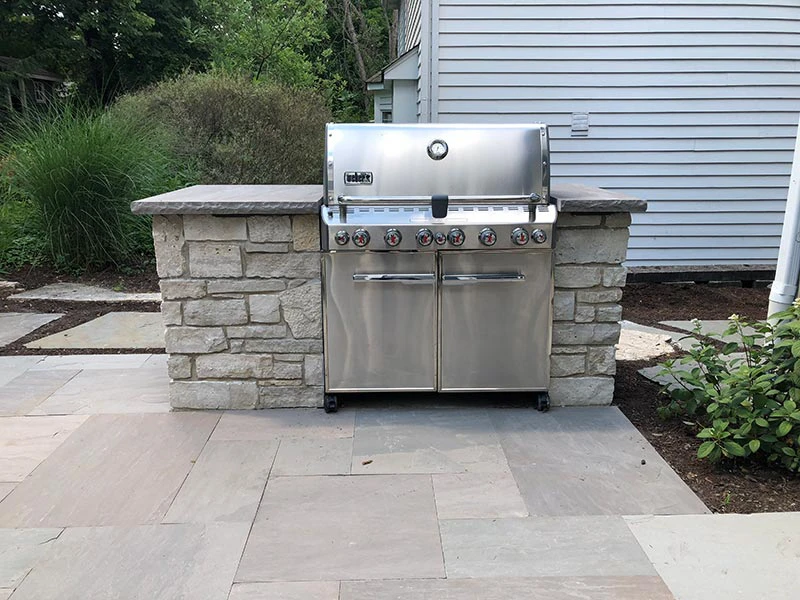
When the trench is backfilled, the sod is replaced, the permit sticker is signed, and the pressure test is logged, what you own is a kitchen that can run every appliance simultaneously on the hottest cookout Saturday of the year without a single burner going lean. That is the whole game. The guests never see the pipe. They see the grill throwing rotisserie heat, the griddle searing smash burgers, the side burner reducing a sauce, and the smoker holding 225 degrees for a brisket — all at once, all from a meter 180 feet away on the side of the house.
The money you spent on the extra pipe diameter, the rock-hammer trench surcharge, and the four-hour pressure test is the reason it works. The clients who chose a cheaper shortcut — undersized pipe, propane instead of natural gas, a pressure test shortened to an hour — always call us back within two years, usually after the first real cookout when the grill ran fine alone but lost a burner every time they fired up the smoker. At that point, re-doing it costs more than the original correct install would have, because you are paying to dig up the kitchen foundation to run a second gas trunk.
Outdoor kitchen design & construction across 20+ cities within 30 miles of Winder, GA
Long-run gas, rock-hammer trenching, and four-hour inspector holds — every Dawsonville install gets priced, permitted, and pressure-tested the same disciplined way.