
A 340-foot approach drive off Freemanville Road, six-foot grade drop from the pillar gate to the motor court, Cecil clay subgrade with a saprolite shelf surfacing at station 2+80. That was the project. This is what it took to build it — and why the specs that work on a Crabapple subdivision driveway will fail on a Milton estate lot before the first freeze.
The owners had already lived with a crumbling asphalt ribbon for eleven years. Every spring it sank at the same four dips. Every August the edges unraveled into the pasture fence line. After the third patch-and-seal cycle they called us asking about pavers — not because pavers were trendy, but because they were tired of pretending asphalt was going to survive another decade on a 1,150-foot elevation ridge with 22 freeze events per year and a rolling topographic grade that turns every rainstorm into a sheet-flow event.
The finished job was 3,600 square feet of Techo-Bloc Industria in Amber, laid on a ten-inch GAB base with a reinforced concrete turnaround apron at the motor court. Installed cost landed at $184,000 — right inside the $137K-$209K band Milton estate drives typically fall into. Below is the full build, decision by decision, because if you’re sitting on a Cogburn Estates or Manor Golf Club lot weighing the same question, the generic “paver driveway” pages on the internet will steer you wrong by about half a decade of service life.
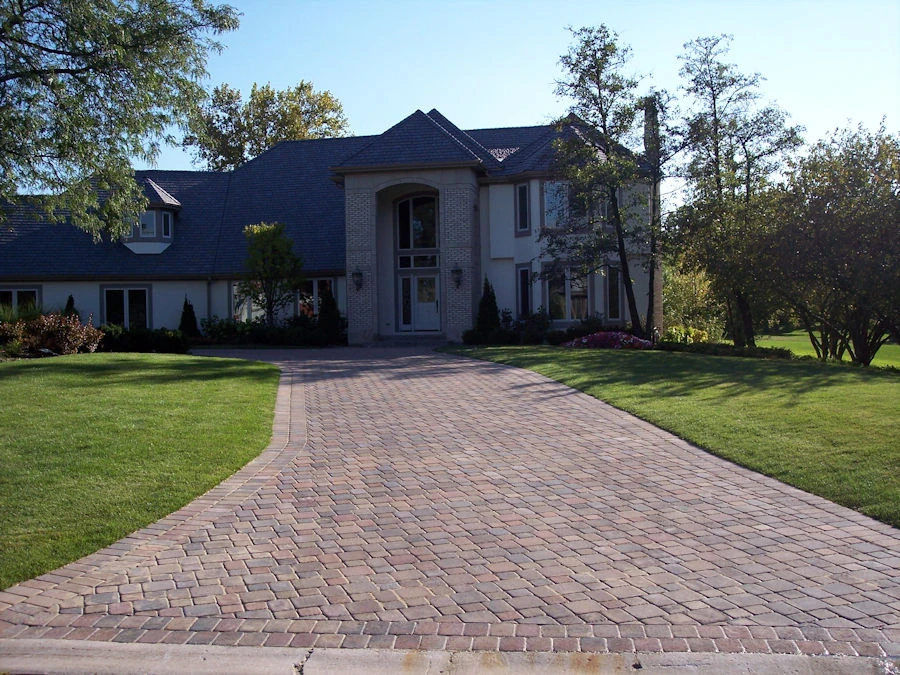
Why Milton Estate Drives Are Not Alpharetta Subdivision Drives
The mistake most homeowners make — and most contractors perpetuate — is pricing a Milton estate driveway the way you’d price a 60-foot subdivision apron in Windward. The math works out to about $22 per square foot for a short drive on flat ground in a 1970s-established subdivision. Apply that same rate to 3,600 square feet on a 6-foot grade drop and you get a number that wins the bid and destroys the driveway inside three winters.
Milton’s equestrian preservation ordinance puts most estate parcels in AG-1 zoning with 1-3+ acre minimums. That means long setbacks from the road. Long setbacks mean long drives. Long drives on a rolling topography mean multiple grade transitions, multiple drainage decisions, and multiple places where a cheap base will fail first.
Here’s the short version of the scope math that applies to almost every serious Milton driveway we quote: 300 linear feet × 12 feet wide = 3,600 square feet at $38-$58 per square foot installed = $137,000 to $209,000. The spread is not contractor markup — it’s the spec difference between a drive that lasts 30 years and a drive that starts failing at year seven.
The Milton base spec that matters: Subdivision paver drives use 8 inches of compacted GAB (graded aggregate base). Milton estate approach drives need 10 inches minimum, compacted in two 5-inch lifts at 95% Proctor density, with a geotextile fabric separator at the subgrade interface. The extra 2 inches of base is the single cheapest insurance policy on the entire project.
Reading the Ground Before You Draw the Line
Before we set a single string line, we walk the full run with a laser level and a hand auger. On the Freemanville job we hit something halfway up the approach that every Milton contractor has eventually seen — a saprolite shelf about 22 inches below grade, running roughly perpendicular to the drive line. Saprolite is weathered granite that hasn’t fully broken down to clay yet. It’s structurally sound when dry but it’s a hard stop for excavation and, more importantly, it’s an impermeable bench that perches groundwater and turns the area around it into a soup zone for three weeks after every significant rain.
You cannot treat a saprolite-shelf section the same as the Cecil clay sections on either side of it. The base prep has to be re-engineered for that stretch. On this project we specified a 4-inch layer of #57 open-graded stone over a perforated 4-inch HDPE underdrain daylighted down-grade to the pasture, then rebuilt the GAB base on top. That one design adjustment, maybe 35 feet of driveway, is the difference between a drive that sits flat and a drive that sinks a quarter inch every spring until year six becomes unrecoverable.
This is the kind of reading nobody does on a subdivision quote because nobody needs to. On a Milton estate lot, skip it and the driveway tells on you.
Grading for Drainage — The 2% Crown Rule
Long drives fail at the drainage joints. On a short 60-foot subdivision apron you can get away with a flat cross-section because water doesn’t have enough run to do damage. On a 340-foot approach, every inch of water that sits on the surface longer than 20 minutes is working on the polymeric sand joints, and every joint that loses sand accelerates the next one.
The spec we hold to on every Milton approach drive is a 2% crown — meaning the centerline sits 2 feet higher than the edges per 100 feet of width-measured cross-section. In practice, on a 12-foot-wide drive, that’s about a 1.4-inch crown from edge to centerline. Shed water left and right into the pasture grass or into the drainage swale, never let it run down the drive.
Where the drive crosses a natural drainage line, we build in a reinforced concrete cross-drain — a 4-inch-thick concrete slab running the width of the drive, with #4 rebar on 12-inch centers, then the pavers laid over it. Looks like pavers. Acts like concrete where it has to.
On the Freemanville job that concrete cross-drain sits exactly at station 2+15, where a natural swale crosses the drive line headed toward Cooper Sandy Creek. Without it, that section would wash out inside three seasons.
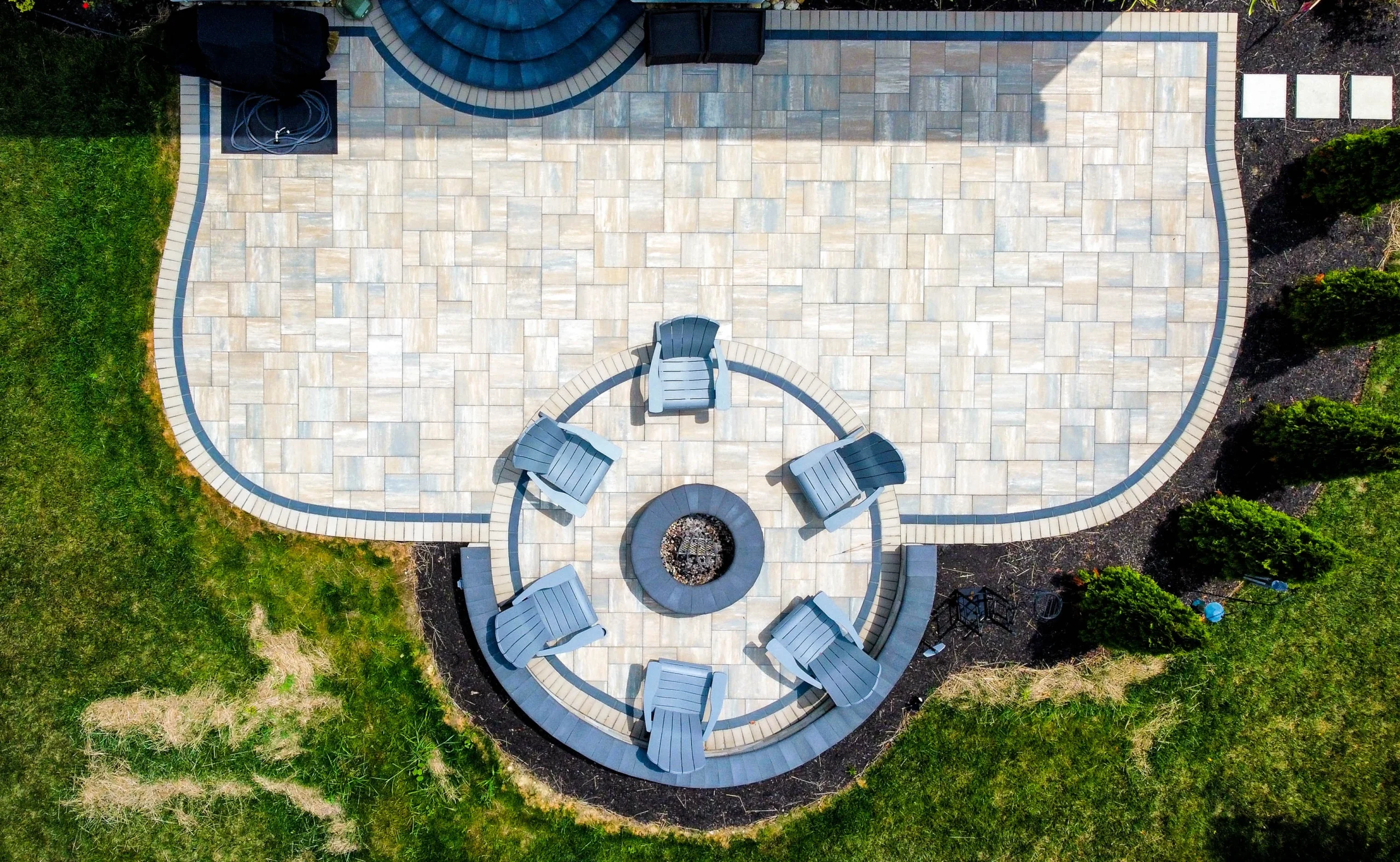
Paver Selection — Why Industria Amber Wins at Estate Scale
At subdivision driveway scale, the paver selection conversation is mostly aesthetic. At Milton estate scale, it’s structural. You need a paver thick enough to handle delivery trucks, landscape equipment, and the occasional moving van — we specify 60mm (2⅜ inch) minimum thickness for vehicular drives, and on longer approaches with heavier anticipated loads we go to 80mm. Below 60mm and you’re in patio territory, not driveway territory, and the individual pavers will crack under point loads before the base ever fails.
The two products that dominate serious Milton estate driveway specs are Techo-Bloc Industria Amber and Belgard Cambridge Cobble in Fieldstone. Both are 60mm+ tumbled-finish pavers with color ranges that read as natural stone from ten feet away. Industria has slightly tighter color modulation and a more consistent surface texture — it reads more architectural. Cambridge Cobble has more variation and reads more European-cottage. On the Manor Golf Club side of Milton, Industria wins most of the time because the architectural review committee prefers the tighter visual rhythm. On the Crabapple historic overlay side, Cambridge Cobble tends to slot in more comfortably with the farmhouse vernacular.
Where homeowners go wrong is picking a lighter color. On a 340-foot drive, light-colored pavers show every tire mark, every oil drip, every pine-tar smear from a landscape truck. Amber, Fieldstone, and the mid-tone gray blends hide use. A Sahara or Shale driveway in Milton looks incredible for six months and tired for the next twenty-nine years.
The thickness rule: For any drive longer than 150 feet or wider than 14 feet, specify 60mm minimum pavers. Below that, every joint failure becomes a paver failure, and individual replacement over a long drive becomes a permanent maintenance project.
Edge Restraint, Polymeric Sand, and the 5-Year Refresh Cycle
Every paver driveway eventually fails at the edges if the edge restraint isn’t engineered correctly. On a subdivision apron you can get by with plastic spike-down edge restraint at 8-foot intervals. On a Milton approach drive, the combination of length, grade, and freeze-thaw cycling will push a plastic edge out of line inside five years.
Our Milton spec is concrete edge restraint poured in place at 5-foot intervals, tied into the base with #3 rebar, then backfilled with compacted topsoil and sodded tight. That’s not cheap — call it another $3-$4 per linear foot over plastic — but on a 340-foot drive with two long edges that’s roughly $2,400 more on a $184,000 job, and it’s the difference between a clean edge line at year 20 and a drive that slowly widens into the grass over a decade.
The joint sand is the other end of the same conversation. We use Alliance Gator Maxx polymeric sand in either the Slate Gray or Desert Tan shade, depending on the paver color. It activates with water, sets up to a stiff flexible bond, and — critically — seals against weed seeds and ant colonies, both of which are relentless on rural Milton lots bordering pasture and woods.
Polymeric sand is not permanent. On an estate approach drive with the square footage we’re talking about, plan on a polymeric sand refresh every 5 years. The refresh is not a rebuild — it’s a pressure-wash, a dry-sweep of new polymeric sand into the joints, a light misting to activate, and a cure day. Call it $0.75-$1.25 per square foot. On a 3,600-square-foot drive, budget $2,700-$4,500 every five years and the driveway keeps reading new.
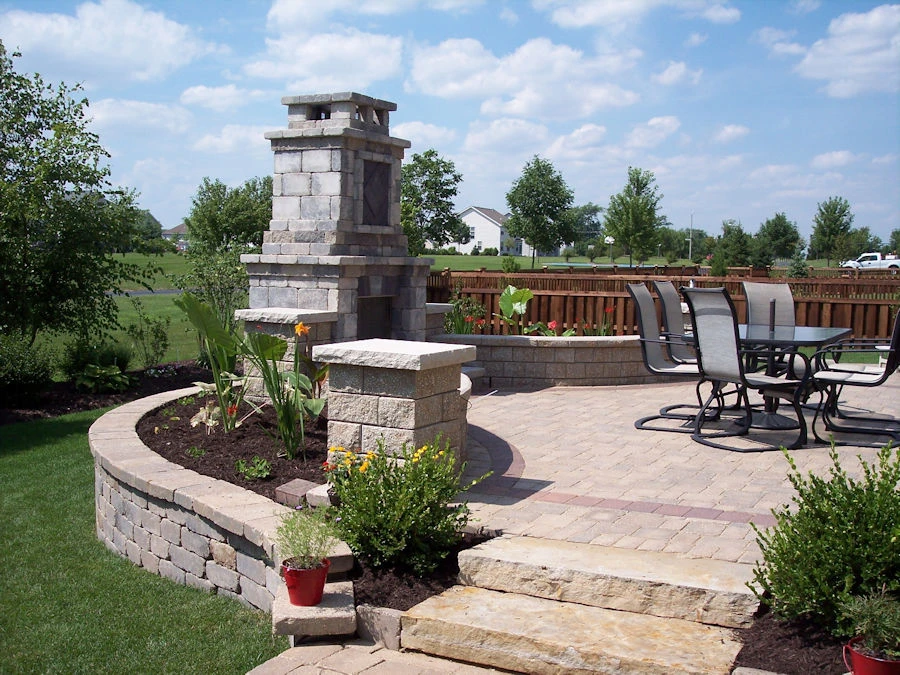
The Motor Court and the Turnaround Apron Problem
Milton estate drives almost always terminate in some version of a motor court — a widened circle or oval at the house where cars can turn around without reversing 340 feet back to the road. This is where the engineering gets interesting and where most contractors quietly under-spec.
The motor court is the point-load zone. Delivery trucks park on it. Landscape trucks pivot on it. Moving vans sit on it for six hours at a time with their stabilizers down. A drive-thickness base under a motor court will eventually show wheel ruts from static point loading, even with 60mm pavers on top.
Our standard Milton motor court spec is a 4-inch reinforced concrete slab beneath the entire paver field — #4 rebar on 12-inch centers in both directions, 3,500 psi mix, poured to the edge restraints and finished rough for paver adhesion. The pavers then lay on a 1-inch bedding sand layer over the concrete. Total profile: 10-inch GAB, 4-inch concrete, 1-inch bedding, 2⅜-inch paver. That’s roughly 17½ inches of engineered section.
On a 40-foot diameter circular motor court, you’re looking at about 1,250 square feet that gets this upgraded concrete-reinforced section. The upcharge is typically $11-$14 per square foot over the standard drive section. On a $184,000 job that lands another $14,000-$17,500 in the budget, and it’s the single best-spent money on the entire driveway because the motor court is where guests arrive and where the eye lives.
Permits, The Manor Review, and Milton’s 10-14 Day Turnaround
Since Milton incorporated as a separate city in 2006, driveway permits no longer route through Fulton County — they go through Milton Community Development at 2006 Heritage Walk. That’s good news and bad news.
The good news: turnaround is typically 10-14 business days for a residential driveway permit, faster than comparable Fulton County reviews. The bad news: Milton’s preservation overlay and AG-1 zoning pull more scrutiny on estate-scale work than a subdivision permit would. If your drive disturbs more than 5,000 square feet of ground, you trigger an erosion and sediment control review. If any portion of the disturbance is within the 25-to-75-foot creek buffer on a named tributary — Cooper Sandy Creek, Chicken Creek, Lake Creek, any Etowah feeder — you’re into stream buffer variance territory, and that adds 3-6 weeks.
Homes inside The Manor Golf Club carry an additional layer: a private architectural review committee with its own structural review cycle, typically 4-5 weeks in parallel with the city permit. The committee wants color samples, paver specs, grading plans, and — particularly on approach drives visible from the road — landscape screening commitments. Allow for it in the schedule. Don’t order materials until both approvals are in hand.
Creek buffer heads-up: North Milton parcels near Chicken Creek sit inside FEMA-mapped floodplain on some lots. If any portion of your proposed drive touches the mapped floodplain, you’ll need a floodplain development permit on top of the standard driveway permit. Pull the FEMA panel before the design hits paper.
Integrating the Drive with the Rest of the Estate
The final piece most homeowners miss — and the reason Milton drives outlive Alpharetta drives on identical budgets — is treating the approach as part of the whole estate rather than as a standalone item on the hardscape list.
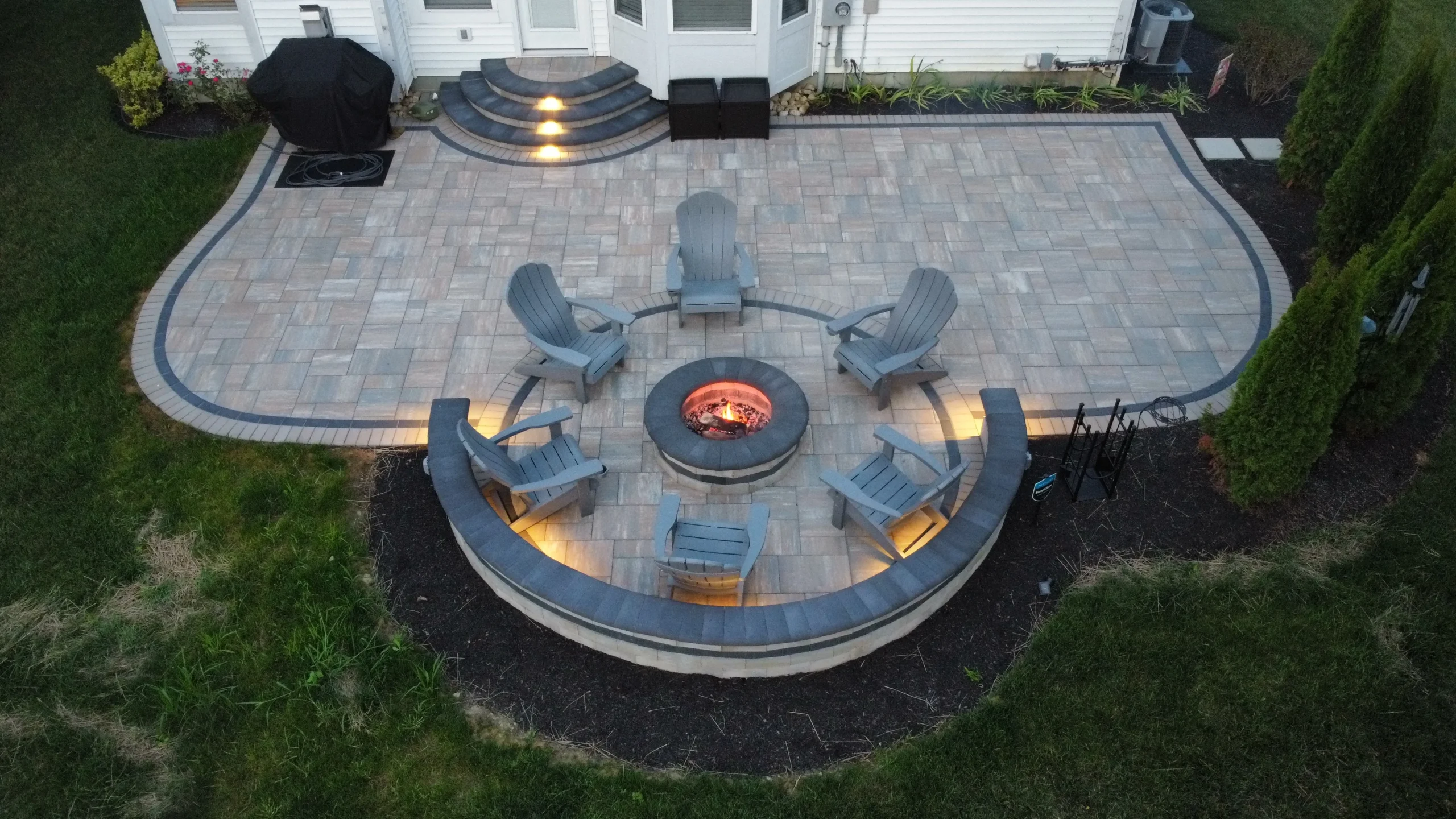
On the Freemanville project the same Industria Amber paver runs from the motor court through a connecting walkway to the pool coping, and the polymeric sand joint color ties the pool deck, the driveway, and a detached pavilion walkway into one continuous visual rhythm. That’s not cosmetic. That’s unit buying power — running a single paver family across driveway, pool deck, and walkway generally saves 6-9% on material cost over sourcing three different products, and it lets you schedule one polymeric sand refresh cycle across the whole property instead of three staggered ones.
On a 1.8-acre Cogburn Estates lot, a 2.4-acre Crooked Creek lot, or anything in White Columns or Bethany Creek, this integrated approach is the difference between a driveway project and an estate hardscape program. The finished result reads coordinated rather than assembled, and the maintenance calendar collapses from “which surface, which year” to one unified 5-year refresh cycle.
For homeowners weighing a serious driveway project on a 1-to-5-acre Milton parcel, the deciding question isn’t “pavers versus concrete versus asphalt.” The deciding question is whether the contractor quoting the job is engineering for the 340 feet of approach drive actually in front of you — the grade drop, the saprolite shelf, the creek buffer, the freeze cycle, the motor court point loads, the Manor review calendar — or whether they’re repricing a Windward subdivision apron with a Milton zip code attached.
Estate paver driveways across 20+ cities within 30 miles of Winder, GA
If you’re weighing a 200-600 foot approach drive on a 1-5 acre Milton lot — and want the base, grading, and edge engineering specified for the scope actually in front of you — we build the full program: drive, motor court, pool deck, and connecting walkways in one paver family.